Featured articles
Food & Drink
Food & Drink
Food & Drink
Featured articles
Things to Do
Features
Things to Do
Featured articles
Things to Do
Things to Do
Things to Do
Featured articles
podcast-ep
podcast-ep
podcast-ep
Featured articles
Features
Features
Food & Drink
Featured articles
Food & Drink
Food & Drink
Ready to know more about San Diego?
SubscribeReady to know more about San Diego?
A look inside this month's issue where we talk art conservation, Tijuana's art scene, and local hip-hop roots
Postcards make the world go round.
These intimate snippets of life, condensed into a finite word count, handwritten, and offered to the winds, they’re a true egalitarian art form. Anyone can write a postcard and likely find a happy audience for their efforts.
What magic.
If everyone sent one postcard per week, I’m convinced the world would be a more welcoming place for us all. Imagine: Someone writes you a little note from some far-flung local and maybe gifts you a little doodle, drops it in the mail—unsealed for the world to see—and, days or weeks later, you find yourself
holding this little one-of-a-kind work of art.
Suddenly, you’re back where that person was when they wrote to you: drinking tea in an Istanbul café or a beer in a foggy Bolivian village or instant coffee in a damp tent in Montana. The sender has moved on—left that café, packed that tent—but you’re still there each time you take that postcard off your fridge to read it again. Postcards are a time machine.
I can’t remember all the postcards I’ve sent, or all the many I’ve gotten, but I keep boxes full of them. They’re leaves on the tree of memory, each one carrying a story. You can even send them to yourself if you want to. There’s no law against it.
I once wrote a postcard to myself after traveling 10 hours out of my way to go to the Magritte Museum in Brussels, which I’d long dreamed of visiting. “Finally” was all I wrote. See, some people are sports stadium bucket-listers who long to see a game at every MLB field; some are live music freaks who, no matter the odds, will see Beyoncé or T. Swift before they die. For me, it’s art.
The Magritte Museum was only open for another hour when I got there. I would have liked to stay longer, but I saw an opportunity and I took it. Jet-lagged as I was, I didn’t want to miss what might be my only chance. Call me a fool, but art propels us toward a bigger, richer life. It fertilizes our souls.
In this issue we’re exploring art and virtuosity in SD. So much about our unique corner of the world inspires creativity, and we’re celebrating it.
We head south, north, and everywhere in between. We’re gassing up what’s to come with a huge 2024 local arts preview and then we check in on some of the incredible talents firing up Tijuana’s art scene. Staff writer Danielle Allaire takes us inside a collaboration between two local avant-garde indie theaters, and we venture out on a tour of some of LA’s weirdest museums. Neon, bunnies, and dinosaurs anyone?
We’re also exploring SD’s hip-hop roots and getting the lowdown on what $1 million does for a prolific local art conservation org. For our cover, we commissioned an oil painting from one of our favorite local artists, Encinitas’ Taylor Chapin, featuring a visual commentary on the contemporary tendency to offer our very selves up for consumption.
Our team has felt inspired while weaving this issue together. We hope it inspires you, too, to get out and experience what so many creative minds are up to around here—and to maybe create something of your own. To sing in the shower, to dance in your living room, maybe write a song. Who knows, maybe you’ll be on the cover of this magazine next year.
If you want to share your work, I accept emails, but postcards are preferred.
Mateo Hoke is a journalist and author. His books include Six by Ten: Stories from Solitary, and Palestine Speaks: Narratives of Life Under Occupation.
Eighteen seconds, one unforgettable mistake, and a Fourth of July story that somehow gets better with age
There’s a famous video.
“This is insane!” the guy filming it seems to proclaim. “It’s the best fireworks show ever!” a companion confirms, inspiring a debate lasting over a decade.
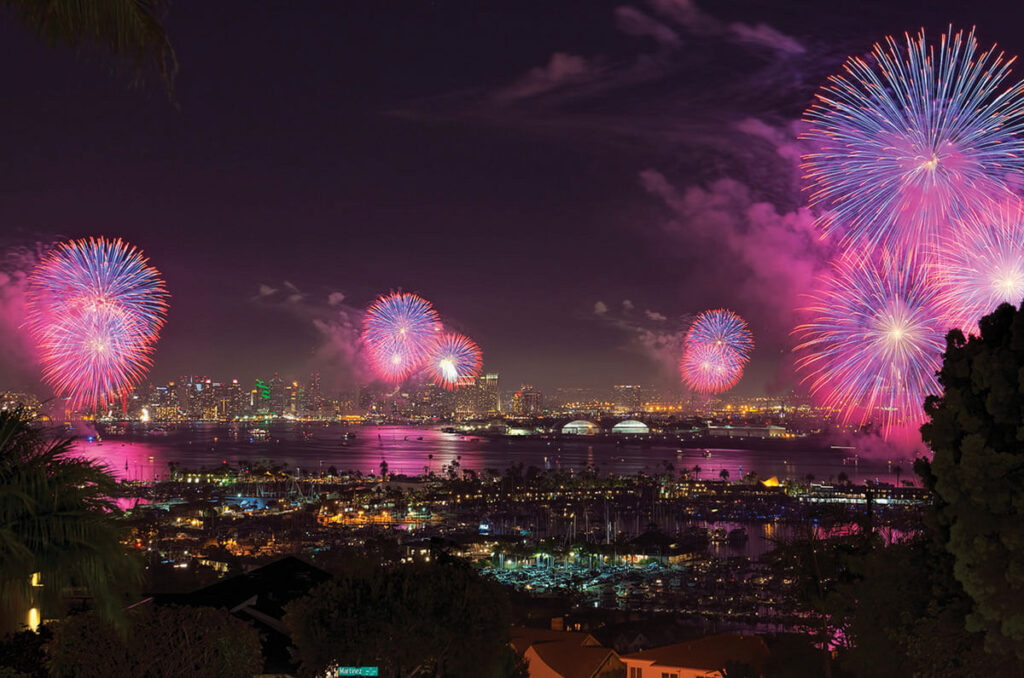
All told, 7,000 fireworks exploded in the span of 25 seconds over San Diego Bay on July 4, 2012. A Michael Bay amount of unison. $125,000 worth of shells, cakes, Roman candles, and skyrockets had been placed on a barge—enough for 17 minutes of decorative sky flares—and…
Boom.
The sky looked like someone had set a giant Rorschach test on fire. Or as if whatever we all see in our Rorschachs—butterflies, clowns, tongue kissing, dads—was being electrocuted and lifted heavenward, amen. It was shocking how bright it was, how much it sizzled the local cosmos. Could’ve been one of those sci-fi films where a hole is ripped open between warring universes. But angstier, more metal—the work of some methy creator in a sleeveless concert tee.
The sound?
Lou Reed once released an entire album that contained 64 minutes of mindflaying guitar screeches and machine noises. No regular songs, just a fascinating amount of ear distress. His record label reps no doubt heard the melodic outro of their careers, but everyone else was in pain and stumped. That album still sounded better than the bay did that night. The bay sounded like a god who struggled with emotional regulation had blown his speakers and was working through the anger stage of AV grief.
In the left frame of the video, a middle-aged woman is attempting to drag her husband off by the hand. In no way does he want to go, possibly because he had missed the time Roseanne Barr sung the national anthem at a Padres game, simultaneously disemboweling and amusing America through the power of song. He would not willingly abandon an equally worthy San Diego trainwreck.
Another woman in the video appears to have just filled her beer, rushing to sit down for the show. She pauses mid-sit and returns to the full and upright position to properly bear witness. What was supposed to be prolonged entertainment has been so radically shortened that she will have to find another reason to drink. Lucky for her, drinking will be the only way to adequately process.
Locals remember the conspiracy theories. People wondered if the fuses had been tripped by a saboteur who was sympathetic to dogs, fish, or the growing suspicion that late-stage capitalism is a gorgeously branded but impossible dream sustained by remarkably efficient top-tier wealth retention and the soft compliance of fireworks-watchers who can no longer afford a house, a beer, or the personal impacts of human reproduction.
Speaking of being terrified of babies, babies were terrified. The children who witnessed it probably still can’t go near a candle store. But those kids will be tougher, perfectly scarred kids. They’ll write better songs.
That night helped us absolutely dominate the national news cycle. For a hot minute, we became America’s water-skiing squirrel. Now, years later, when you Google “fireworks gone wrong,” San Diego is always a top contender, along with that poor Nebraska family who nearly wiped out a couple generations in their front yard, their minivan somehow turning into a howitzer of recreational TNT.
There is still debate as to whether Big Bay Boom 2012 is the worst or greatest fireworks show of all time. But the advanced parts of civilization arrived at the truth as quickly as the women in the video did. It was undeniably amazing.
First of all, the point of Fourth of July fireworks isn’t “the intricate choreography of sky fire over a guaranteed amount of show time.” It’s about creating a vivid memory shared with some people you like, love, or would like to love.
BBB2012 used large-scale chemical fire to create the ultimate memory.
Sure, some people who iron their jeans subjected their family to a sermon about how San Diego managed to botch America’s birthday like a Disney princess-for-hire who smelled of quite a few Sauvignons.
The rest of us saw how perfectly it nailed the actual feeling of being an American. Because only a miniscule percentage of us bake postcard apple pies where every inch of crust is perfectly laminated like the wood in an Irish bar. Very few of us can paint on par with Picasso. The rest of us—despite truly believing in our America-activated abilities to achieve greatness in almost any field of our choosing—burn pies. We try to paint only to realize it looks like our fine motor skills have entered active death.
That’s why BBB2012 was the most perfectly American fireworks show ever: A wildly ambitious idea galvanized thousands upon thousands of people to both work on it and come to hold a beer and gawk at it, only to have it fail in the most glorious TMZ-level spectacle.
America isn’t about immaculate, storyless wins. It’s about how the framework of a country is solid enough that we can accidentally detonate our entire lives—a few times—and still probably be OK.
No one has America’d quite like San Diego did on that day. It was performance art. Lou Reed’s heart slow-clapped. Any brief municipal embarrassment quickly became a pride of our people. I can only hope the same for the Nebraskan yard family whose Dodge Aerostar became a hyperactive Death Star.
P.S. Local writer Maya Kroth compiled a quite great oral history of that night for Thrillist. The bottom lines for me were—it took nine months to prepare, no one was hurt, and even though the pyrotechnics company tried to zero out the bill, Big Bay Boom founder H. P. “Sandy” Purdon refused and paid them in full. This year will mark the 25th Anniversary of the yearly Big Bay Boom.
Troy Johnson is the magazine’s award-winning food writer and humorist, and a long-standing expert on Food Network. His work has been featured on NatGeo, Travel Channel, NPR, and in Food Matters, a textbook of the best American food writing.
From surprise revivals to changing dining habits, these are the shifts redefining the local culinary landscape
If absence makes hearts (and stomachs) grow fonder, then shuttered restaurants quickly become the hottest tickets in town—something a number of iconic institutions found out after taking very public hiatuses after historically long runs. For instance, following a lengthy (and extremely flip-floppy) closing process after 92 years in business, Las Cuatro Milpas reopened two blocks away in Mercado del Barrio. Similarly, Carlsbad butcher shop Tip Top Meats reopened in the same location (albeit a smaller space) after the death of founder Joachim “Big John” Haedrich in 2023. Finally, after a whopping decade out of business, Sami Ladeki and chef Alfie Szeprethy brought back Roppongi to its original Prospect Street space, where it was the talk of the town in the late ’90s. All came back under the same proprietors, so they weren’t third-party nostalgia-licensing deals. The algorithm may have ravaged our attention spans away from all but the newest and shiniest, but this proves there’s still hope for our collective prefrontal cortex.
Other local eateries honored their pasts by bringing in new perspectives. The Lion’s Share in Embarcadero, Milton’s Deli in Del Mar, Dudley’s Bakery in Santa Ysabel, and J-K’s Greek Cafe in La Mesa handed over the keys to new owners willing to take on a big task: maintain the soul of icons through particularly rough economic circumstances for restaurants, navigate big feelings from longtime regulars (who often don’t take kindly to change), and make some necessary changes to keep going for another few decades. Taking over a project in process can be a lot harder than starting from scratch. But building that feel-good nostalgia doesn’t happen overnight, so it sure helps to have a well-established playbook of success passed down from those who came before.

It wasn’t just restaurant groups from Los Angeles that decided to put down roots en masse, although San Diego saw plenty of LA transplants recently (Sugarfish, Mr. Charlie’s, For the Win, Katsuya Ko, Bacari). Global brands like Chef Fei, Zuma, and Pepper Lunch have locations of their own on the way, and upscale Canadian eatery Joey joined to the inescapable gravitational pull of Westfield UTC’s culinary cosmos for its first spot in America’s Finest City. Good to see the rest of the world is catching up with what we’ve been seeing the last few years—San Diego is a dining destination already on the rise.
Between the never-ending news cycle of doom and perimenopause brain fog, I’m at the stage in life where I’m more than happy to let someone else make a decision for me, especially when it comes to what’s for dinner. And based on the way a lot of menus look right now, I’m not alone. It seems like half the places I visit offer some version of a prix fixe, omakase, or tasting menu. Restaurants are embracing the curated experience to solve the problem of affordability (a fixed menu reduces food and labor costs, guarantees an acceptable check average, etc.) and critical thinking in one fell swoop. Omakase (meaning “I leave it up to you”) is far from a new concept in high-end Japanese sushi culture, but now that it’s popping up everywhere from coffee experiences to grab-and-go sushi and sandwiches, it’s gone from somewhat niche to nearly omnipresent.

The world got an up-close look at San Diego’s coffee industry when we hosted the premier specialty coffee expo World of Coffee for the first time this April. San Diego’s long and rich coffee history stretches back to the late 19th century. Things percolated fairly quietly for around a century before really picking up steam. Today, there are nearly 200 specialty roasters and cafes across the county, with many earning national accolades like the Good Food Award (Steady State Roasting, 2020; Bird Rock Coffee Roasters, 2023, 2021, 2019, 2017, 2016), Roaster of the Year by Roast Magazine (Mostra Coffee, 2020; Bird Rock Coffee Roasters, 2012), and the Specialty Coffee Association Coffee Design Award for packaging (Rikka Fika, 2026). Now that we’ve moved past the comically insufferable coffee snob era of the early 2000s, even java newbies can feel comfortable walking into pretty much any coffee shop in San Diego, asking questions, trying a few things, and feeling confident they’re going to get great service and a great beverage.
Beth Demmon is an award-winning writer and podcaster whose work regularly appears in national outlets and San Diego Magazine. Her first book, The Beer Lover's Guide to Cider, is now available. Find out more on bethdemmon.com.
We ask the city's best food photographers to choose their favorite pics and share their secrets to capturing a drool-worthy pic
Food is a notorious diva to photograph. The wrong lighting can make José Andrés’ paella look like a jaundiced grain bowl. You could be staring at the best sandwich of your life, but shoot it from above and—hey, congrats on that abandoned piece of lettuce bread. A cottage meme industry has been built around the hilariously bad photos on review sites that make Michelin-star food look like Michelin tires.
Especially in a visual modern media world, food culture depends on great photographers capturing the painstaking work in equally deserving ways. We asked four of San Diego’s top food photographers for their favorite shot from another year of documenting what we eat.

Getting this kind of shot takes a bit of yoga. Asana yourself into the corner, hold your breath, pray that a chef on the move doesn’t back into your light stand.
“You’re stepping into someone’s workspace during their busiest moments, so it’s a balance of being present to get the shot and being invisible to not slow anything down,” Kimberly Motos says.
The subject here is the Birdman sandwich from Chick & Hawk—hot fried chicken thigh, tangy slaw, kimchi comeback sauce, sweet and spicy pickles, potato brioche bun—getting a hearty dousing of its difference-maker seasoning. Motos captures the parts of the process that diners don’t usually see: the chaos behind something that looks so simple.

“I love this image because it feels like a moment you want to step into,” says Lucianna McIntosh. A warm, sunny day at The Fishery in PB with oysters, caviar, and martinis. Yes, please.
The little details—the glass sweating a little, the direct afternoon light creating stark shadows, the oyster glistening on the tray—are the main characters. Instead of trying to overly control the setup, McIntosh “followed the light and lines that draw you in more,” she says. “This was one of those moments where everything lined up on its own for a second. I love it when the shadows end up being just as important as the food itself.”

La Jolla native Eric Wolfinger—who won a James Beard Award for Tartine Bread, one of the most stunning bread books of all time—says he doesn’t have a signature style. His style is a conduit.
“I see my job is to translate the chef’s point of view into something you can feel,” he says.
For this shot, Fleurette chef Travis Swikard had one directive: cuisine du soleil (“cuisine of the sun”). With a spread of leeks vinaigrette, herb-roasted golden chicken, and beets, Wolfinger wanted to create a scene that felt straight out of the French Riviera, relaying the light, bright style of Swikard’s new spot.
Some bonus additions here: Extra lights—to add lots of warmth—and a clipping from an olive tree.

Timing and light are everything in food photography. In Lucien—La Jolla’s tasting-menu-only restaurant with moody ambiance—a single strobe flash creates the ideal spotlight.
Dee Sandoval says she uses the “natural, just-plated energy” of the dish to “create a portrait of moment and craft.” That’s why this Mostra Ghost Bear espresso ice cream—with San José dark chocolate mousse, soy-miso caramel, and koji shoyu chocolate sauce—looks like it might dissolve halfway to your mouth.
Emma Veidt is an editor at San Diego Magazine. She earned her bachelor's and master's degrees from the Missouri School of Journalism. She loves running, hiking, and rock climbing, but really, she mostly loves encounters with the street cats around North Park.
KQ Aesthetic Society goes beyond cosmetic to provide comprehensive care and transformative results
Kelly H. Harfouche, founder of KQ Aesthetic Society, knows firsthand that cosmetic treatments like fillers, neurotoxins, and microneedling, can not only enhance a person’s appearance and restore confidence, they have the power to truly change a person’s life. An expert injector has the ability to tailor treatments to each individual patient’s anatomy and goals for personalized results. Harfouche, a board-certified nurse practitioner, has spent nearly a decade perfecting her craft as an aesthetic injector and integrating her multifaceted artistic skills with precision patient care. Her commitment to continual education and training, plus a passion for helping people look—and feel—their best, set KQ Aesthetic Society apart in a sea of local medspas.
For many people considering nonsurgical treatments, the intent is to look refreshed and refined. KQ Aesthetic Society’s philosophy eschews a cookie cutter approach that bases treatments around units, instead working to understand each person’s unique goals, then curating a treatment plan to fit that vision. Harfouche focuses on “inclusive luxury,” the belief that everyone deserves access to aesthetic treatments, respective of budget restrictions. She develops long-standing trusted relationships with her patients, and works with each one to achieve their aesthetic objectives and address the underlying causes of their concerns.
“For me, forming an honest and open relationship with every patient who walks through the door is essential. This means understanding them on a deeper level and meeting them where they are to define and achieve their individual goals,” she says.

Drawing on her artistic background, which inspired her transition into medical aesthetics, Harfouche sees each client as a “unique canvas.” Rather than relying on standardized procedures, the practitioner’s distinctive approach combines her profound understanding of the physiological and anatomical changes associated with aging with an unwavering commitment to ongoing education about the newest products and their mechanisms of action. Her goal is to make each patient feel beautiful in their own skin and to embrace their individuality.
She has also pioneered a way to combine her talent for aesthetic artistry with her philanthropic nature. Harfouche is one of only a handful of providers using dermal fillers to treat patients with lip asymmetry and scarring resulting from cleft lip surgery. Patients travel from around the country for this transformative treatment, noting increased confidence and a restored identity. She hopes to eventually launch a training program to help fill the void in this space.

“My passion has always been connecting with people and giving back in any capacity that I can,” she says. In the rapidly advancing landscape of aesthetic medicine, you can place your confidence in Harfouche and KQ Aesthetic Society to deliver exceptional care. To learn more or book a consultation, please visit kqaestheticsociety.com.
As NASCAR lands in San Diego this weekend, a recently burgled dad is irregularly excited
My 15-year-old daughter tried to steal our car this week, so I’m ready to become a NASCAR dad. It would be appropriate discipline. We just relocated to a nice suburb within walking distance of her high school. The suburbs are like living in a Tesla commercial. I am pretty far from the wealthiest dad in this neighborhood (I am the least wealthy dad in this neighborhood), more than a few engineering degrees short of being in the running.
I’m fairly certain watching NASCAR is a violation of our HOA and a violation of my daughter’s emotional HOA. But NASCAR hits San Diego this weekend and I have a fever I’ve never felt before. I want to watch 111 drivers do dangerous things in cars and trucks on an active military base in the ocean. Since my lifelong exposure to NASCAR is limited to Talladega Nights and every single iteration of the movie Cars, I can only base my plan of attack on oafish stereotypes.
So while other neighbor dads are sizing bubble jackets for their golf simulators, I’m gonna grow a Ricky Bobby, run the extension cord for the TV out into the carport we share with six other condos, fill a cooler with a proper 80-20 split of Hamm’s and Mountain Dew, treat a lawn chair like an ADU, and spend a few hours yelling ohsheeeit as if it’s a single, nine-syllable word.
The quality parents in our neighborhood seem highly attuned to the sound of any vehicle breaching the 6 MPH threshold, so I should gather a crowd pretty fast. They may come over with strongly worded emails in their hearts, but one glimpse of Shane van Gisbergen and hometown hero Jimmy Johnson guzzling the last remaining drops of gasoline on the planet in a dazzling display of carmanship—they’ll join my NASCAR pop-up party.
By the time my daughter brings her friends over, we’ll have a real welcoming committee.
Because, like I said, my daughter tried to steal my car.
She wasn’t going to Mexico. But while Claire and I were off doing businessy stuff to afford my teen’s skincare rituals, she and a friend decided to teach themselves stick shift. She’s never driven a stick before. I’m not saying she has, but if she has driven a vehicle at all—it would have been done in a remote, abandoned parking lot where the only possible thing she could destroy was the concept of driving itself.
But a couple TikTok videos later, she and her friend felt a certain level of mastery had been achieved, and they gave it a go. They backed our VW Bug out of the garage with a series of stalls and transmission seizures, and managed to get it into the carport, attempting to do “donuts.” That’s when I got a call from a resident, who had taken an active interest in this experiment.
Which got me wondering about the power and might of vehicles. Turns out, even at carport speeds there exists a bit of potential fireworks. A garage door could become not a garage door anymore. At 145 MPH on Naval Base Coronado this weekend (don’t worry, they slow down to 100 MPH for turns), NASCAR drivers are essentially doorbell ditching gods. I didn’t register the temperature after my daughter’s trial run, but the track at NASCAR races usually hits a cool 130-150 degrees, enough to lightly sear some Nikes (the tires themselves hover in the 200 degree range).
And that is at least part of our fascination with NASCAR (the other fascination is the legendary pit parties, which either set humanity back a few evolutionary links, or advance it by the same amount of links). These drivers do something all of us do every day in a very efficient, boring way—drive a car—and take it to its extreme impulse. Grace and precision at the thunderous edge of shit going terribly wrong. Most of us have looked at San Diego home prices and felt a burning desire to see how fast our Honda Pilot could make it to our new home in Vegas. So NASCAR drivers are acting on our own wildest impulse.
Troy Johnson is the magazine’s award-winning food writer and humorist, and a long-standing expert on Food Network. His work has been featured on NatGeo, Travel Channel, NPR, and in Food Matters, a textbook of the best American food writing.
In a sport obsessed with prestige, a San Diego–born golf brand is betting on something more fun and less fussy
Music drifts across the fairway. Someone’s in flip flops. The Pacific flashes in the distance. Sun peeks onto shoulders through the palm trees. It’s spring, technically, but the air reads suspiciously like summer. At the par-3 course at Liberty Station, the longest hole barely stretches past 120 yards, and no one looks particularly interested in becoming the next PGA legend.
This is where Sunday Golf was born.
“I got dragged to a par-3 course in 2019 —The Loma Club—and it was way more my jam,” says Ronan Galvin, CEO and co-founder of Sunday Golf, a company that makes lightweight golf bags for players who’d rather carry less and laugh more. “It was a lot different than the stereotypical ideas you have about golf where it’s kind of long, uptight, and exclusive.”
Galvin spent over a decade in the golf industry working in product development, sourcing and manufacturing. But he didn’t grow up swinging clubs. Basketball and football were more his speed. What clicked for him was a simpler, more relaxed kind of play: shorter rounds and weekend games built for fun rather than formality. The kind of golf that resonated for him felt accessible, effortless, and surprisingly his lifestyle.

He noticed something else, too.
On a course where five clubs do the job, players were still lugging 14. So Galvin built something smaller. Lighter. A bag designed specifically for par-3 rounds, the Loma Bag is sleek, functional, and refreshingly unfussy. It’s practical minimalism in a sport known for excess.
Sunday Golf was slated to launch in January 2020. Then, COVID hit. Shipments stalled; lost at sea. The future felt shaky. But the series of catastrophes for the young company turned out to be anything but: By the time inventory arrived that August, golf had become one of the few activities people could safely do.
“It introduced and brought so many people back to the game,” Galvin says. “It created a habit for a lot of people, which is a big reason golf is on its growth trajectory.”
It turns out Americans can’t get enough of golf. Forty-eight million of them swung clubs last year, a 41 percent jump since 2019, and the National Golf Foundation says the total could top 50 million by the end of 2026.
The brand rode this unlikely momentum. Since 2021, Sunday Golf has expanded into larger lightweight bags and continues evolving from there. A major reason for the company’s success is its approachability, a value so central that it’s literally written on the office walls in the form of the company’s guiding mission: “Get 500,000 golfers having more fun by 2027.” This goal is measured, fittingly, by golf bags sold.
Sunday Golf has already passed 300,000 bags sold.
But the numbers aren’t the point.

“To remind the world that life is meant to be enjoyed,” Galvin says of the brand’s why. In an era dominated by screens, golf offers something analog. “People are outside, touching grass with their friends. A golf bag is a golf bag, but our products are vehicles to help support that.”
Unlike legacy golf giants promising proximity to Rory McIlroy-level greatness, Sunday Golf leans into what Galvin jokingly calls “diet golf” or “golf light”—weekend rounds, driving range sessions, company scrambles. The bags are built for the casual golfer, and the fit feels obvious.
That philosophy resonates across Southern California, where year-round sunshine means golf courses never really hibernate for winter. As Galvin puts it, “the laid-back lifestyle of San Diego kind of seeps into everyone’s veins.”
Sometimes the validation arrives via email: a 76-year-old customer is able to walk the course again because their golf bag is lighter. Parents are able to take their children out with Sunday Golf’s kids line.
For Galvin, that’s the real win. Not perfection. Not prestige. Just more people outside, enjoying themselves. In San Diego, that might be the most natural mission of all.
Isabella Dallas is a freelance writer for San Diego Magazine and the Arts and Culture Editor at The Daily Aztec in her final year at San Diego State University. She previously worked as an editorial intern for SDM, but when she’s not writing, you can find her trying the best coffee spots in SD, devouring the latest rom-coms, and indulging in anything and everything pop culture.
A look at San Diego's top designers creating unique environments that combine creativity and function


AVRP Studios’ tradition for Design Excellence and Innovation began in 1976 with Doug Austin, FAIA, in Solana Beach, California. The firm has since grown to complete major projects throughout the United States and Canada. We think of ourselves as a family and we care deeply about people. We want to inspire, help make their lives richer and more complete through our efforts. We believe that architecture is one of the most important art forms because of the impact it can have on the lives of those it touches. We’re delighted to have been recognized with over 150 awards for design excellence.
703 16th Street, Suite 200, San Diego, California 92101 | 619-704-2700 | avrpstudios.com