Featured articles
Food & Drink
Food & Drink
Food & Drink
Featured articles
Features
Features
Everything SD
Featured articles

Things to Do

Everything SD
Everything SD
Featured articles
podcast-ep
podcast-ep
podcast-ep
Featured articles
Features
Features

Everything SD
Featured articles
Food & Drink
Features
Partner content
Ready to know more about San Diego?
SubscribeReady to know more about San Diego?
The Fish Shop's charitable efforts gives San Diegans another reason to dine on fresh fish tacos and great wine
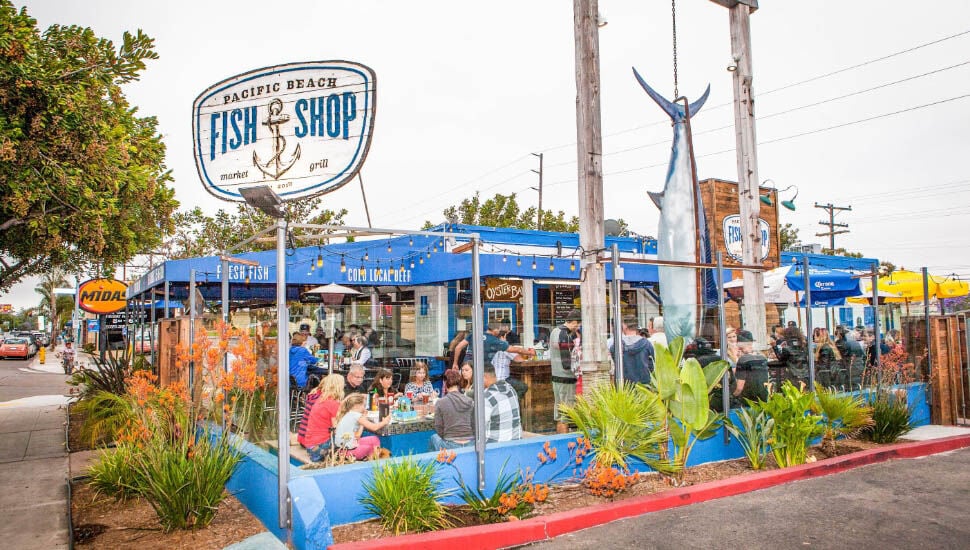
The Fish Shops
I rarely (if ever) say no to spending money on food—whether it’s because I want to support small businesses or just prefer not to deal with cooking and cleaning. And let’s be real, I just like to eat. So when given the option to eat a meal that also does some good in the world, I’ll be the first in line.
Enter The Fish Shop. With three locations throughout San Diego, it has only been around for 12 years, but are often regarded as longtime community staples. Owned by OMG Hospitality Group, you can find The Fish Shop in Pacific Beach, Point Loma, and Encinitas.
With their fast-casual approach to SoCal cuisine, dog-friendly atmospheres, no corkage fees, celebration of local beers and fishing vendors, it’s not hard to see why locals love it.
Its owners take special pride in their house-made sauces, salsas, and marinades, their craft cocktail program, and their fresh, sizable seafood offerings. But the real difference here is their commitment to their community. “Ever since we started, the three owners have always been big about giving back to the community with different programs,” says Larry Alva, operations director of The Fish Shop. “We always want to be ingrained in our community.”
When The Fish Shop opened their first location in Pacific Beach, they began partnering with local schools to host “Give Back” nights where 10 percent of sales went to parent-teacher associations for various school projects. During the holidays, The Fish Shop would offer free tacos to anyone who brought in a toy worth $5 or more for gift giving.
As the restaurant continued to grow, charitable efforts became a staple on their menu. “We decided to come up with a taco that, when purchased, provides one nutritious meal for a child in San Diego,” shared Alva.”
With this, the Elote Taco was born—all in the name of giving back. Filled with fresh, grilled Mahi Mahi and marinated with Fish Shop seasoning, it’s topped with cilantro white sauce, cabbage, elote pico, and cotija cheese. And since the introduction of the elote taco, the various locations have donated over 35,000 meals to It’s All About the Kids.
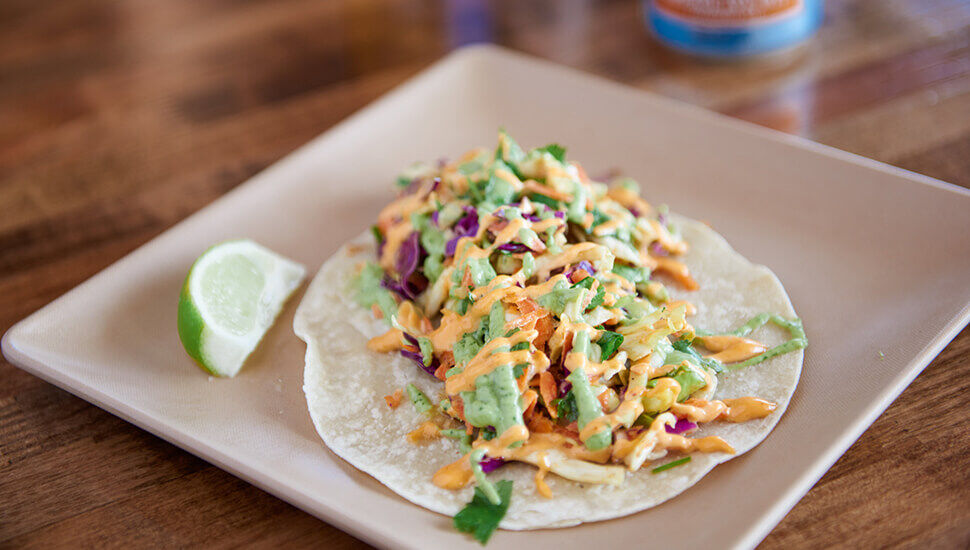
elote taco fish shop
Each location has neighborhood-specific offerings as well so that nearby residents can lend a hand in their own backyards. In Point Loma, the restaurant offers specials that provide donations to the Point Loma Foundation which provides opportunities to raise capital and fund projects in the area through art, historical preservation, education, safe byways, and landscape improvement for visitors.
Not in the mood to eat? You can put your love of wine to good use instead. “We collaborated with our [wine] reps and talked about our cause marketing efforts and wanting to get involved with giving back.” The Fish Shops now carry wines that have ties to various national organizations.
If you purchase a bottle of Chloe, proceeds will be donated to Dress for Success, an organization to empower women to achieve economic independence as well as the National Breast Cancer Foundation which provides help to those affected by breast cancer through early education and support services.
Grab a glass of Cupcake Wine and you’ll be donating to three causes: Direct Relief which is determined to improve the health and lives of people affected by poverty or emergencies; No Kid Hungry, a foundation dedicated to end childhood hunger in the United States; and Pets for Patriots, giving the gifts of fidelity, joy, and love to veterans and pets through companion animal adoption.
Really, it’s a no-brainer. Fresh fish, great wines, beachside cities, and good causes—is there anything more San Diegan?

Sabrina Medora is a national food writer living with her husband and golden doodle Albus in San Diego. Her work has appeared in award-winning publications like Food & Wine Bon Appetit Wine Enthusiast and more.
Zenbu closing La Jolla, opening Downtown? And more more more more.
The restaurant business ain’t easy. The first notable closing is Chaplos in Downtown—the eatery opened at 10th & B Street last year with former El Vitral chef Norma Martinez. Owner Edwin Seymour says he’ll be keeping the space open for special events, but will be closed for lunch and dinner from this point on. That location was just too tough to overcome. The second is one of the higher profile sushi restaurants in the city. After 14 years, Zenbu La Jolla will serve their final meal tomorrow night. Owners Matt and Jacqueline Rimel have been looking to sell that space for a while, and they still have their Zenbu Cardiff location, as well as multiple outposts of Rimel’s Rotisserie. The closing of La Jolla seems like a well-timed cutting of bait for the rumor we’ve been hearing—that they’ll open a big, spanking new Zenbu at Petco Park sometime soon…. Convoy just cracked open Common Theory Public House (4805 Convoy), focused on Korean fried chicken and 30 craft beers… AJ’s Fish Merchant has opened in East County (7407 Jackson Dr.) with chef Stephen Bennett (ex-Martini’s Above Fourth) is helming a menu of chowder, and fresh market seafood plates (halibut, swordfish, catfish, snapper, etc.), plus a few specialty items (scallops Provencal, Ballast Point fish & chips, etc.)… The Fish Shop—which has had a good run in Pacific Beach—is opening their second location in Encinitas at the former spot of St. Germain’s Café. The signs are currently up and it’s looking like a June open… Terryl Gavre is having a busy year. The restaurateur/chef who co-owns Bankers Hill Bar + Restaurant and solely runs Downtown breakfast joint Café 222 opened Acme Southern Kitchen earlier this year and now she’s hatching Bake Sale. It’ll be a bakery and commissary at 815 F Street, selling morning buns, cinnamon rolls, scones, croissants, pies, biscuits, you name it…. Organic pie concept Na Pizza is hatching a few new locations over the next few months—including one at Commons Center in 4S Ranch and another next to Panera in Hillcrest (1270 Cleveland Ave.).… Golden Hill will be getting a new joint, Sonny’s Southern California BBQ at the corner of 25th and C Streets sometime in the next month orr two with master barbecue chef Joe Lewis Jones’ Mississippi-style cue… Over in Barrio Logan, a family beef jerky enterprise Srozzi SoCal Italian is going to be taking over the former Blueprint Café space (1805 Newton Ave.), opening sometime in June with a meat-centric menu… Also in Downtown, Doner Mediterranean Grill will take over the former home of The Grape at 823 5th Ave….
Zenbu Sushi.
Zenbu closing La Jolla, opening Downtown? And more more more more.
The restaurant business ain’t easy. The first notable closing is Chaplos in Downtown—the eatery opened at 10th & B Street last year with former El Vitral chef Norma Martinez. Owner Edwin Seymour says he’ll be keeping the space open for special events, but will be closed for lunch and dinner from this point on. That location was just too tough to overcome. The second is one of the higher profile sushi restaurants in the city. After 14 years, Zenbu La Jolla will serve their final meal tomorrow night. Owners Matt and Jacqueline Rimel have been looking to sell that space for a while, and they still have their Zenbu Cardiff location, as well as multiple outposts of Rimel’s Rotisserie. The closing of La Jolla seems like a well-timed cutting of bait for the rumor we’ve been hearing—that they’ll open a big, spanking new Zenbu at Petco Park sometime soon…. Convoy just cracked open Common Theory Public House (4805 Convoy), focused on Korean fried chicken and 30 craft beers… AJ’s Fish Merchant has opened in East County (7407 Jackson Dr.) with chef Stephen Bennett (ex-Martini’s Above Fourth) is helming a menu of chowder, and fresh market seafood plates (halibut, swordfish, catfish, snapper, etc.), plus a few specialty items (scallops Provencal, Ballast Point fish & chips, etc.)… The Fish Shop—which has had a good run in Pacific Beach—is opening their second location in Encinitas at the former spot of St. Germain’s Café. The signs are currently up and it’s looking like a June open… Terryl Gavre is having a busy year. The restaurateur/chef who co-owns Bankers Hill Bar + Restaurant and solely runs Downtown breakfast joint Café 222 opened Acme Southern Kitchen earlier this year and now she’s hatching Bake Sale. It’ll be a bakery and commissary at 815 F Street, selling morning buns, cinnamon rolls, scones, croissants, pies, biscuits, you name it…. Organic pie concept Na Pizza is hatching a few new locations over the next few months—including one at Commons Center in 4S Ranch and another next to Panera in Hillcrest (1270 Cleveland Ave.).… Golden Hill will be getting a new joint, Sonny’s Southern California BBQ at the corner of 25th and C Streets sometime in the next month orr two with master barbecue chef Joe Lewis Jones’ Mississippi-style cue… Over in Barrio Logan, a family beef jerky enterprise Srozzi SoCal Italian is going to be taking over the former Blueprint Café space (1805 Newton Ave.), opening sometime in June with a meat-centric menu… Also in Downtown, Doner Mediterranean Grill will take over the former home of The Grape at 823 5th Ave….
Zenbu Sushi.
At The Delicate Squash, Shannon English is rethinking cookies, cakes, and pastries with seasonal ingredients and natural sweeteners
Midway through my phone conversation with Shannon English, owner of The Delicate Squash, I hear an alarm shrilling in her background.
“Sorry, I’ve got to pull some cookies out of the oven right now!” she apologizes. After a few beats, she picks the phone back up and laughs. “I feel like I’m bouncing around all over the place.”
After hearing her run through a list of her professions and current hobbies, I’d have to agree. English runs The Delicate Squash, a gluten- and dairy-free bakery; teaches cooking demos; pops up at farmers markets; wrote a book of poetry (Deep Water came out this month from Beyond the Veil Press); hosts a monthly open mic night; dipped her toe into ballet; recently joined a running club; volunteers at local farms; and finally, teaches at a play-based, nature-based preschool.
I’m tired just talking to her.
Surprising no one, English seems to have unlimited energy and enthusiasm for all this work, notably in education. Early childhood education is one of the most pivotal times for nurturing lifelong learning, but she also aims to educate the public on how to eat cleaner, feel better, and support your local food systems. She started The Delicate Squash in late 2023 after discovering she has a chronic illness, going through the typical standards of care and even strict elimination diets, to no avail.

“I’m not going to say I found a diet that has ‘cured’ me, but I have found that taking a more mindful approach to a lot of things, including diet, has made symptoms far more manageable for me,” she says.
Even people with dietary restrictions deserve a little treat from time to time, but she had a hard time finding anything that tasted good and made her feel good. Thus, The Delicate Squash was born.
All of her baked goods avoid gluten and dairy, and use natural sweeteners like coconut sugar or maple syrup as well as herbs, fruits, foraged flowers, and other natural flavorings. Her signature cookie, the “Delicate” cookie, is a sea salt dark chocolate cookie that’s soft, a little salty, a little sweet, and made with oatmeal to keep it gluten-free. Other crowd favorites are thumbprint jam cookies with jams made from scratch with change seasonally; breakfast pastries like orange, dark chocolate and cardamom scones; brownies; orange and black sesame banana bread; seasonal pies; and custom and seasonal cakes (currently, the late summer flavor is a dark chocolate coconut milk ganache with berry jam).
English says some people are surprised she can produce such a variety of goods with the dietary restrictions she adheres to. “A lot of feedback I get is ‘I could never do that,’” she says. But if she can do it, she assures me that anyone can. “I like to say ‘practice makes progress, not perfection.’”
Her advice? Focus more on being present than presentation, and don’t be afraid to experiment to keep things interesting. And if that doesn’t work, you can always hit her open mic night to ask for tips.
Customers can order from The Delicate Squash’s online store, check her upcoming schedule of pop-ups, or find her goods at various independent retailers around San Diego.
Escondido is getting in on the listening bar phenomenon. On September 5, musicians Mat Rakers, Kevin Capacia, and Billy Petty will open Plot Armor, a Japanese-style vinyl listening bar that Rakers says they aim to feel “curated and intelligent.”
“Currently, there are not a lot of ‘cool’ spots in Escondido,” he says. Backed by The San Diego Music And Art Company and The Escondido Music And Art Company, Plot Armor will soon offer sake, wine, beer, and soju cocktails, plus Japanese non-alcoholic options and cold brew. Eventually, they’ll add Japanese-inspired snacks, but the focus will be creating a small place (very small—the seating capacity is 20) where vinyl junkies can come listen, linger, and libate.

Listen Now: The Latest in San Diego’s Food and Drink Scene
Have breaking news, exciting scoops, or great stories about new San Diego restaurants or the city’s food scene? Send your pitches to [email protected].
Beth Demmon is an award-winning writer and podcaster whose work regularly appears in national outlets and San Diego Magazine. Her first book, The Beer Lover's Guide to Cider, is now available. Find out more on bethdemmon.com.
Earlier this year, Fit quietly dropped "athletic" from its brand, from Fit Athletic Clubs to simply Fit, and started calling itself something new: a social wellness club.
There’s a version of San Diego that lives in two extremes. On one side, the 5 a.m. crowd: biohackers, marathoners, people who’ve already logged a cold plunge before your alarm goes off. On the other, the after-dark crowd, the ones chasing sunset happy hours and late dinners with friends. Everyone seems to be either optimizing or unwinding, and most of us feel like we’re failing at both.
Fit, San Diego’s reigning Best Gym for the third year running, has built its entire identity around erasing that divide.
Walk into one of Fit’s three San Diego locations on a Tuesday afternoon and the lines blur fast. Someone’s mid-set on the squat rack. Someone else has a laptop open at a café table a few feet away, half-working, half-people-watching. A group is trading plans for the weekend’s event by the recovery lounge. Nobody’s in a rush to leave.
“We’re not competing for the same people,” says Emily Waybright, Public Relations Manager at Fit, addressing the arrival of a national luxury gym chain in San Diego this year. “We don’t really feel like we’re in the gym category. It’s this unique thing.”
That unique thing has a name now. Earlier this year, Fit quietly dropped “athletic” from its brand, from Fit Athletic Clubs to simply Fit, and started calling itself something new: a social wellness club.
It’s a small wording change with a bigger idea behind it. Fit was never built around escaping the workday. It was built around the people who genuinely like what they do, and who want workouts, work, and friendships to happen in the same place instead of three separate ones. Because sometimes red light therapy with a stranger turns into weekend plans.
Fit’s philosophy traces back to its founder, who started the brand nearly two decades ago after failing to find a gym he actually wanted to belong to. He looked instead to the old-school country club, where people came for a shared interest and stayed for the community. His version was made for a younger generation, minus the golf, plus the loud music.
Which makes it a little ironic that the very award putting Fit back in the spotlight this year is Best Gym.
What does the best traditional gym look like when the definition of a gym is becoming less traditional? It’s a fair question, and Fit’s answer is that the fitness industry itself is shifting. The 45-minutes-in, 45-minutes-out model is giving way to something closer to a genuine third space, the kind of role the office and the bar used to play before remote work and changing nightlife habits rearranged how people spend their time
For Fit, community isn’t a marketing add-on to fitness. It’s the through-line. Members aren’t just paying for a treadmill; they’re paying for an entire day of social wellness that’s built on performance, recovery, connection, and a plan for the next event on the calendar. That’s a much harder membership to walk away from.
Ambition and ease aren’t opposites here, they exist side by side, where passion and play share the same morning. On September 12, Fit is hosting Sol, a full day wellness festival at Fit Social. The morning focuses on wellness classes and vendors and then the evening is a full party with multiple DJ sets and an open bar. Think of it as a kick-off to locals’ summer in San Diego.
Ready to see what a social wellness club actually looks like? Visit fitclubs.com, or follow along at @thefitclubs on Instagram.
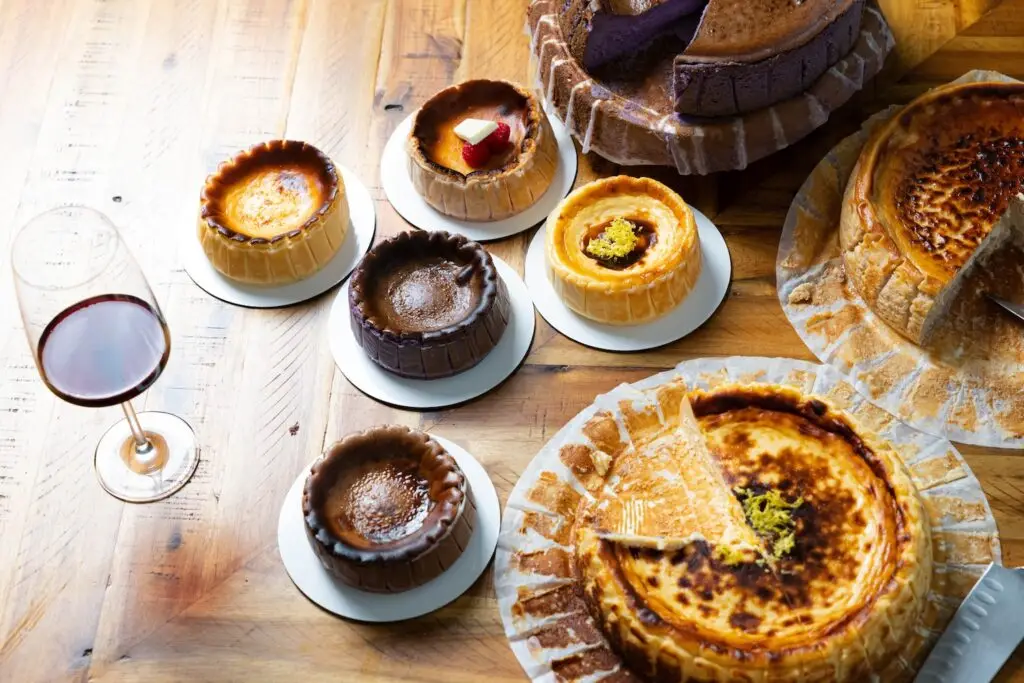
After a blind taste test, these four desserts came out on top—see the winners here
Basque grandmothers have not been making it for centuries. If you’re a millennial, there’s a strong possibility you’re older than the dessert itself. Yet somehow in less than 40 years, the Basque cheesecake—a half-pudding, half-cake creation with a top that looks like a mistake—managed to ooze its way onto menus all over the world.
It became the undisputed dessert star of San Diego’s restaurant world this year. So we invited 19 of the top restaurants, pastry chefs, and bakers to bring their best to the San Diego Magazine office for a blind taste test to find the best in the city.
First, a little history and context.
In 1987, after failing to find a job as an electrician, Santiago Rivera started working as a bartender at his parents’ unassuming pintxo bar La Viña, in San Sebastián, Spain. He was a naturally curious, self-taught cook who spent his free time testing recipes, tinkering with ingredients, and tweaking techniques.
So when it came to the cheesecake—which hadn’t changed much since its invention (a rudimentary version was served at the first Olympics in Greece 4,000 years ago, and the modern New York version in 1872)—he got radical with it.
He removed the crust (partly just to speed up the process because time is money for a small business). Without the crumbly crust, the experience was far creamier, less granulated. Then he cranked the oven to 400 degrees, nearly 100 degrees hotter than the normal baking temperature.
The result? The top became deeply caramelized, almost burnt, while leaving the center luxuriously soft and loosely set. The restaurant became a legend because of this breakthrough in the dairy arts, and his father never let him stop making it after that.
Now, 67 years after the restaurant’s opening, La Viña stands out for the unceasing line spilling onto the street, and the remarkable amount of curd cultists standing nearby, hovering over cream-smeared plastic containers. It’s the kind of scene that makes you stop and think: What the hell are they eating?
Now, the blind tasting. To keep things fair, the contenders were divided into four categories: Restaurant Traditional, Restaurant Flavored, Bakery Traditional, and Bakery Flavored. (It’s a tad unfair to pit a baker who specializes in the one glorious thing against a restaurant that cooks dozens of things.) Each entry was served blind and judged on texture, flavor, and number of vaguely inappropriate food moans.
The logistics were chaotic, to say the least. Our fridge—not a walk-in, sadly—was packed to the brim. Each cake was sliced, secretly labeled, and shuffled onto plates while the team gathered in the conference room. The whole shebang was not in any way sponsored by Lactaid, despite our various attempts to convince them of this ripe marketing opportunity.
The judging became gloriously unhinged. We heard it all, from “I don’t care how the cheesecake gets in my mouth, it just needs to happen,” and “Is it supposed to be this jiggly?” to “Kind of a baby throw-up situation,” “Straight cheese,” and “I’m getting vague socks there.”
But four Basque cheesecakes stood out among the rest, earning themselves the title of Best Burnt Basque Cheesecake in San Diego.

A restaurant for the people. Rosarito native chef Juan González and Megan Strom are the ideal married couple to be running a farm-to-table joint. She’s been a farmer for decades, selling top-notch produce to some of the best restaurants in California—which is how the two met. A couple years ago, she started working at the small organic farm in Valley Center run by Mike Reeske, who had spent decades breeding the perfect heirloom beans for SoCal’s climate. He recently retired, and gifted those strains to Strom—who grows them (and other crops) for their tiny Escondido taco/burrito shop specializing in guisados (Mexican stews).
A Basque cheesecake in a taco shop? You bet. Juan’s got family roots in Spain and has cooked in Spanish kitchens.
Mesa Agricola’s winning Basque is by far the most “burnt” of all contenders—so much so that an Instagram follower declared it a mistake. But as Chef Juan notes, there’s an art to hitting the sweet spot where “the bitterness of the char balances the richness and sweetness without turning it into ‘chicharrón.’” Plus, char is a core charm of Baja cooking. It’s the perfect Basque for the people who prefer setting their campfire marshmallows fully on fire.

With red leather booths and a retro steakhouse vibe, Moe’s in Mission Beach is a good cheat day destination. The menu is flavor maximalism—dry-aged steaks, housemade pastas, brown liquors, and sides like the lobster truffle mac ’n’ cheese. Pastry chef Eli Peralta (whom some might remember as the creator of The Patio on Lamont’s “Twisted Elvis”—a peanut butter-banana brûlée stunner) brings that same intensity to the dessert menu.
Baked at sister restaurant Molly’s (6 feet away), his Basque is served on a bed of caramel with walnut brittle and a dollop of whipped cream, an indulgent recipe that converted the pastry chef himself. “I wasn’t crazy about cheesecakes,” Eli admits. “Then I started making different flavors, and I started to like them.” He’s not the only convert: During our blind tasting, one judge likened the cake to crème brûlée, concluding, “I don’t even like crème brûlée, but I like this.”

Every creative pursuit starts with a muse—and Lada Sadovnyk’s has been the Basque cheesecake for years. In Ukraine, she baked them for friends and family gatherings, never imagining she would one day build an entire bakery around them in the US. “When we moved to San Diego,” she explains, “I kept thinking, ‘What can I do? What do I really love to do?’”
The answer is pretty fantastic.
After obsessing over proportion and techniques, chasing that molten center and deeply caramelized top, what began as an online recipe evolved into something entirely of her own.
She moved from her home kitchen to a rented commercial kitchen close to Sports Arena. The orders kept coming, and so did the pressure. “At one point, I was thinking about divorcing my husband,” she says with a laugh (while sitting next to him). The grind paid off: Today, Muse Cheesecakes bakes roughly 1,200 cheesecakes a month and is planning to open its first brick-and-mortar home in Pacific Beach.
For our competition, the expectations met reality. Muse has made a quick name in San Diego as the Basque to beat. In a blind taste test, there’s no bias, no reputational shine to sway a room. The response on reveal: “Oh, of course.”

Husband-and-wife duo Alex and Anastasia Kiperband pulled off the number of failures (and then some) that are required of any search for the best recipe. After adjusting baking temps, sugar rations, and experimenting with different brands of cream cheese and heavy cream—they finally landed on something worthy of a business license.
“When we started this business in America, we were really nervous,” Anastasia says, co-owner of Bite Cheesecakes & Bakery.
Once they won over those first customers, their confidence grew enough to start tinkering. When Dubai chocolate took social media by storm, they developed their own version, making the pistachio paste from scratch before layering the buttery kataifi pastry beneath a glossy chocolate shell to create its signature Dubai Chocolate Basque Cheesecake.
“In a lot of situations, we’re converting cheesecake haters to cheesecake lovers,” they say. “That’s probably the best feedback that we get.”
Camila Ibarra Gallego is a CaliBaja native pursuing a master's degree in culinary journalism at the Basque Culinary Center. Shaped by the culturally rich, bicultural megaregion, she's passionate about sniffing out stories that connect people, territory and culture through food. When she's not tumbling down internet rabbit holes, you can find her pretending to be a wine connoisseur at a local wine bar or nose-deep in a good book.
Casa Del Lobo blends coffee culture with Mexican design, serving seasonal drinks alongside its own handcrafted ceramics
There aren’t many places left in San Diego with a lack of specialty coffee options. This week, we can add La Jolla Shores to that list—Casa Del Lobo has arrived. Life-and-business partners Christine Silver and Saul Moreno came to San Diego the same route so many of us have: coming for vacation and falling in love with the city and each other.
Silver was working on Wall Street in New York City and decided to visit some friends in SoCal after the pandemic clouds lifted. Moreno happened to be visiting from Mexico City at the same time. The two met, moved here, got married, had a baby, and thought, “Hey, why not start our own business?”
Apparently, their whirlwind lives needed more windy whirls. (Windy whirls? They like to stay busy.) Casa Del Lobo isn’t either of their first rodeos, although it’s both of their first forays into the coffee space. “We’re both serial entrepreneurs,” laughs Silver. She runs a venture capital business that invests in women-owned wellness companies, and he runs his own logistics company out of Mexico City. “We keep saying, ‘Oh, it’s the last time we’ll start a business. Then all of a sudden, a year or two later, we can’t help ourselves.’”
The idea to open Casa Del Lobo initially started when the pair began decorating their house in Windansea. After looking for large-scale ceramic planters and outdoor fountains that met their quality expectations without egregious price tags (something Moreno was used to seeing in Mexico), they realized there simply weren’t any comparable options here.
So rather than continuing to drive over the border to go shopping, they decided to bring Mexican ceramic style to San Diego.
The partners now run a manufacturing facility in Tecate, specializing in large-format ceramics and specialty glazes. As they sought out potential locations to open a planter store, they realized they could go one of two routes. One, get a warehouse in an industrial area and rely on marketing to get the word out. Or two, they could diversify by opening a homey retail store where people have to walk through the shop area to get a cup of specialty coffee.
They went with option two, and coffee quickly became their primary objective.
“My husband and I, we love coffee,” she says, adding that whenever they go on vacation, no matter where they are in the world, figuring out where to get a java fix every day is their number one goal. (Side note: I can strongly relate.) Mexico City coffee and design culture lean heavily urban and industrial in feel, mixing both an Old World architecture with modern sensibilities—something Silver says they felt was missing locally, specifically in La Jolla Shores.
Casa Del Lobo, which translates to “house of the wolf” in Spanish, soft opened this week, with traditional coffee offerings like lattes, cappuccinos, and Americanos, along with four housemade syrups that will change seasonally (currently, they are vanilla, lavender, orange blossom, and brown sugar cinnamon). For now, the food is simple pastries from Knead Artisan Bakery, but Silver says they plan to add more options like breakfast burritos, paninis, and natural wine in the future. Eventually, customers will also be able to purchase their signature ceramics online, and one day, they may open more locations along the California coast.
But for now, they’re just getting started in La Jolla. “We’ll be here forever,” says Silver. “We want this to be the first of many.”
Casa Del Lobo is now open at 2246 Avenida de la Playa every Tuesday through Sunday, 7 a.m. to 1 p.m.
Beth Demmon is an award-winning writer and podcaster whose work regularly appears in national outlets and San Diego Magazine. Her first book, The Beer Lover's Guide to Cider, is now available. Find out more on bethdemmon.com.
Laika Nur, MD, takes her love of volleyball from the court to the clinic as team physician for the San Diego Mojo
Growing up, Laika Nur, MD, Scripps Clinic sports medicine specialist, loved watching beach volleyball when the Association of Volleyball Professionals tour came to her hometown of Chicago. A talented volleyball player herself, she remembers sitting in the stands all day, and once, even got a couple autographs. Years later, Dr. Nur was attending a professional event focused on women’s sports, and the discussion turned to a new professional women’s volleyball league. The general manager and coaching staff for San Diego’s team, the Mojo, happened to be in attendance, and Dr. Nur took the opportunity to ask them if they needed a team doctor. Flash forward to the Mojo’s inaugural 2024 season, when Dr. Nur officially became the team physician. Click here to read more about Dr. Nur and how she incorporates lessons she learned on the court into her practice.
For more nutrition, wellness, and healthy living tips, sign up for the San Diego Health newsletter here.