
Featured articles
Food News
Food News
Food & Drink
Featured articles
Things to Do
Things to Do
Everything SD
Featured articles
Things to Do
Things to Do
Everything SD
Featured articles
podcast-ep
podcast-ep
podcast-ep
Featured articles
Food & Drink
Everything SD
Everything SD
Featured articles
Food News
Things to Do
Things to Do
Ready to know more about San Diego?
SubscribeReady to know more about San Diego?
Larry lives in Clairemont, and Miles is a third grader in North Park
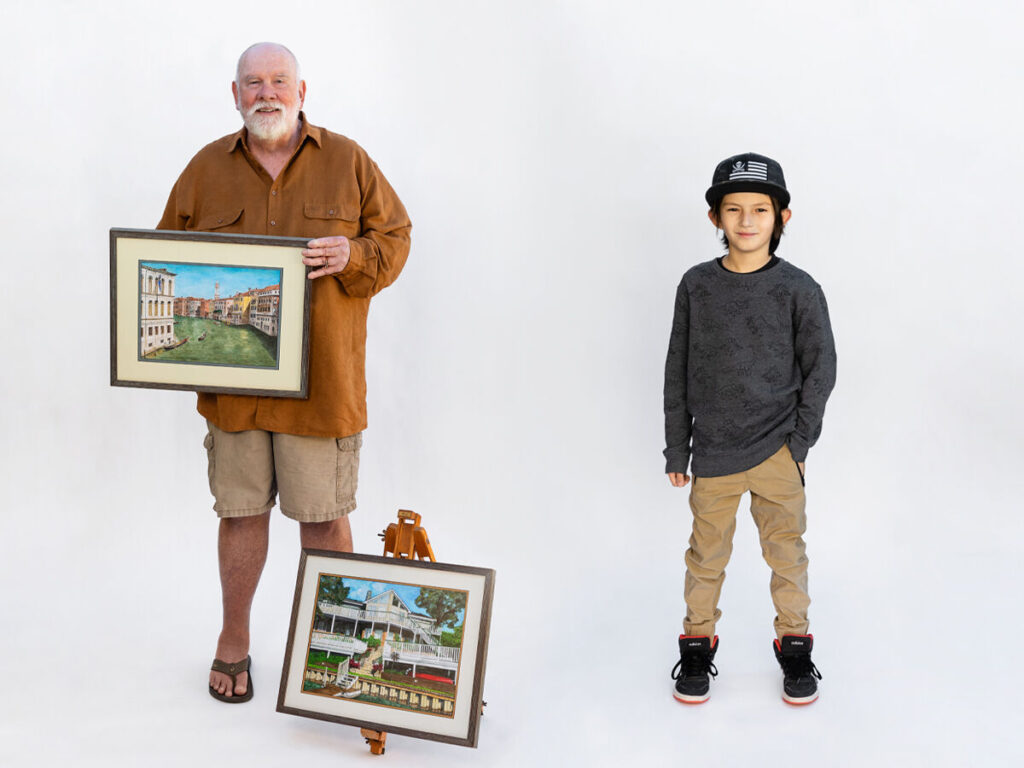
76, Retired Illustrator, Clairemont
I go to the YMCA to do some water workouts. I go by myself in the mornings, and my wife joins me in the afternoons. We’ve been together nearly 30 years.
To feel your frustrations, yell it out if you need to, and talk about what’s going on. Then let it go.
I was a scientific illustrator, so I like taking community college art classes and trying out different media, like watercolor. It was always a mystery to me how to avoid making a muddy mess.
I illustrated for a company in Sorrento Valley that was contracted by the federal government for the nuclear weapons tests in Nevada. Then I did the same for the US Geological Survey for 17 years.
I have lived in Clairemont my whole life. I actually still live in the duplex my folks bought in 1959. There used to be a runway for a little airport off Clairemont Drive, before Balboa Avenue existed.
9, Third Grader, North Park
I’ll play with my sister and our goldendoodle, Ziggy. Ziggy is super strong, so we’ll play tug-of-war until she knocks me over. I also like to go outside and just watch the cars go by.
I like Mustangs and an old one… I think it’s called a station wagon. My first car will be a Mustang in all black.
If you have a little sister like I do, maybe help her when she falls down and give her a Band-Aid.
Don’t turn the inside car light on when you’re driving at night. They say it’s illegal.
My dad says if I read five chapter books we can get a PS5. I’m reading my second book right now—I Survived the Great Chicago Fire, 1871. It’s really good.
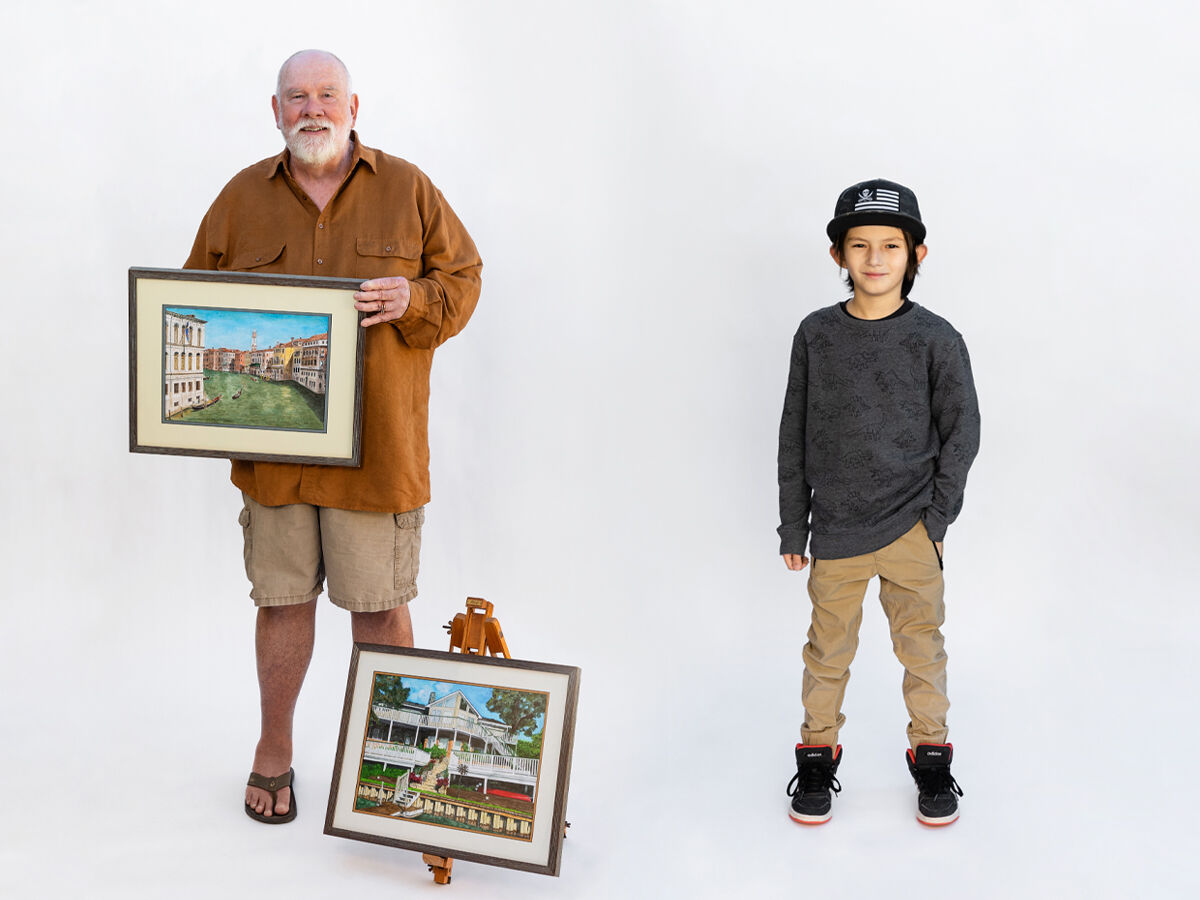
Larry (left) and Miles
Jenny Siegwart
Waypoint Public makes once-novel beer pairing dinners an everyday thing
Waypoint Public
Waypoint Public
Knowing that wine goes with food is like knowing guitars go with rock ’n’ roll. Pairing beer with dinner, on the other hand, takes a newish kind of faith. It’s not like Escoffier made his name serving his peach melba with Belgian ale. Until the current craft beer boom, there simply wasn’t enough variety to make the experiment very exciting. (“And for course three through six, we’ll just leave this pony keg of Heineken at your table.”)
Even during craft beer’s first couple of decades, pairing it with food was a pretty awful idea. To differentiate from watered-down mainstream lagers, upstarts like Sam Adams and Sierra Nevada made heavy, palate-wrecking beers. Instead of gracefully accentuating the briny oceanic flavor of a scallop, they gracefully beat the crap out of it.
But things have changed. Lighter, subtler, “session” craft beer is in. It’s a friend of food. And there’s no better place to integrate beer into the meal plan than San Diego, which is to craft beer what Napa is to angry Cabernets.
Po’boy tacos
Po’boy tacos
Chefs have tinkered with beer-pairing dinners for the last few years. Some longer than that. But the time is ripe for a full-on craft beer bistro—one with a real-deal chef and an exhaustive beer list that pretends it’s a 300-bottle wine list from the ’90s. After all, we know what to expect of wine and food. Beer and food is a largely uncharted, exciting new direction. It may not be the future, but it is a future.
And Waypoint Public is it.
Owner Brian Jensen first had success with Bottlecraft, a craft beer specialty shop. News broke last year that The Linkery was calling it a day. Loved, loathed, and highly discussed, The Linkery was the leading voice of San Diego’s farm-to-table movement. Its iconic location—a cavernous garage-style building on a prominent corner of 30th Street—is like the Sears Tower of San Diego’s most progressive part of town. Jensen took it over. Jensen is not a Starbucks franchisee, so he was already off to a good start.
Pappardelle
Pappardelle
All guesses were that he’d open yet another craft beer bar with “small plates” (read: half-assed nibbles to fulfill the “food” requirement of a liquor license). But then Jensen partnered with chef Amanda Baumgarten, a talent who’d worked as a sous in four Michelin-starred restaurants (including Melisse and Patina in L.A.) before coming to San Diego for a year at Herringbone. Their plan was a very intentional marriage of craft beer and top-notch bistro fare.
They smartly blew out the building’s last street-facing wall, making Waypoint completely roll-up garage doors on both sides. It’s just all light and air—like a yeasty greenhouse that grows stylish 30-somethings—and it’s terribly welcoming. One wall is fake shrubbery. There’s a chandelier made of antlers. And the entire southern wall is like an art gallery dedicated to this decade’s fascination with reclaimed wood. There’s door-wood, construction zone wood, fence wood, dresser drawer wood, wood wood. Above the bar are three TVs: One for the requisite ESPN, and two for the ever-changing, massive beer list, with 28 on tap and about 50 by the bottle. It’s like a NASDAQ ticker for beerheads.
Bartender Ben Marquart
Baumgarten’s menu is—well, what can we say about styles in the modern, globalized kitchen? Let’s try California-beer-French. Not many beer bars do blood sausage, and hers is made with pork blood, Belgian quad (a fancy beer), brandy, bacon, cream, and all sorts of spices. Served over toasted levain with apple butter, roasted apple, and creamed cabbage, it’s excellently sweet, with the spreadable texture that makes boudin noir so appealing (and polarizing). I try Jensen’s suggested pairing of a wee heavy Scottish Ale, and it’s a nice call—big blow for big blow. If that sounds too Michelin-starry, the excellent fried oyster tacos—with aioli, French fries, spicy slaw, and smoked tomatillo salsa—prove Baumgarten’s also adept at Louisiana pier-fishin’ food (suggested pairing: Belgian Ale, rauchbier).
Waypoint Burger
Waypoint Burger
For another app, the menu offers a warm “charred” octopus. But the crust of the single tentacle—cooked sous vide for nine hours—is the blackest I’ve ever seen. It’s a tad too close to a house fire for my tastes, even if the interior meat is perfectly tender (suggested pairing: Berliner Weisse, Gose). And with only walnut oil, lemon juice, feta, and walnuts, her kale salad feels more like a kale pile (pairing: saison, lager). Baumgarten smartly realizes that any respectable burger program should cater to the two camps—minimalists and topping-stuffers. The Waypoint has a protein load with beef patty (short rib/chuck/brisket), fried egg, mozzarella, and pulled pork (slow-braised in OJ, caramelized apples, and jalapeños). It could be overwhelming, but pickled carrots, radishes, and more jalapeños give it ample acid. For less fuss, they serve it “Public style,” which involves beef, a bun, lettuce, tomato, onion, and mozzarella. The best things on the plate, though, are the thick-cut fries—cooked three times (boiled, blanched, fried). The menu tells me to wash it down with an IPA. I do what menu says.
Waypoint Public
Waypoint Public
Ordering a dinner entrée at a pub isn’t chief among the natural impulses in life simply because, in the past, people who cared so much for beer didn’t have time to care for dinner. That’ll be a main challenge for Waypoint: overcoming the pub crowd’s instinct for finger food. But I’ll say this: The kitchen served me two of the better dinner entrées I’ve had. First, the most perfectly cooked piece of sturgeon—brilliant sear, medium-rare inside next to duck fat forked potatoes (suggested pairing: IPA, American Wild Ale). Second, the housemade pappardelle, with a made-to-order sauce of veal jus, oyster mushrooms, butter, and Parm. It’s simplicity executed perfectly, with separated, al dente pasta ribbons and a shockingly flavorful à la minute sauce (pairing: American Brown, Belgian Dubbel).
Pan-seared roasted sturgeon
The Aspen Ridge flatiron steak isn’t as successful. A friend’s order of medium-rare is served rare, and the compound butter—made with blue cheese, bacon, and sundried tomato—comes in an enormous, un-melted terrine that almost covers the entire steak. The reality is that every steak house is a butter bath. But seeing the cold, hard truth—before you dig in—is a little jarring. So maybe I’m a little too butter-dainty. For a steak pairing, Jensen recommends the Quadruple or Belgian Strong Ale.
With a full play section for kids, Waypoint has also joined the reproductive hipster movement. Nice to have a place to take our kids that doesn’t have a mascot or servers with seven-minute birthday songs. This is definitely better than your usual beer pub. And it’s a major testing ground for beer’s arrival on the dinner scene.
Waypoint Public makes once-novel beer pairing dinners an everyday thing
Waypoint Public
Waypoint Public
Knowing that wine goes with food is like knowing guitars go with rock ’n’ roll. Pairing beer with dinner, on the other hand, takes a newish kind of faith. It’s not like Escoffier made his name serving his peach melba with Belgian ale. Until the current craft beer boom, there simply wasn’t enough variety to make the experiment very exciting. (“And for course three through six, we’ll just leave this pony keg of Heineken at your table.”)
Even during craft beer’s first couple of decades, pairing it with food was a pretty awful idea. To differentiate from watered-down mainstream lagers, upstarts like Sam Adams and Sierra Nevada made heavy, palate-wrecking beers. Instead of gracefully accentuating the briny oceanic flavor of a scallop, they gracefully beat the crap out of it.
But things have changed. Lighter, subtler, “session” craft beer is in. It’s a friend of food. And there’s no better place to integrate beer into the meal plan than San Diego, which is to craft beer what Napa is to angry Cabernets.
Po’boy tacos
Po’boy tacos
Chefs have tinkered with beer-pairing dinners for the last few years. Some longer than that. But the time is ripe for a full-on craft beer bistro—one with a real-deal chef and an exhaustive beer list that pretends it’s a 300-bottle wine list from the ’90s. After all, we know what to expect of wine and food. Beer and food is a largely uncharted, exciting new direction. It may not be the future, but it is a future.
And Waypoint Public is it.
Owner Brian Jensen first had success with Bottlecraft, a craft beer specialty shop. News broke last year that The Linkery was calling it a day. Loved, loathed, and highly discussed, The Linkery was the leading voice of San Diego’s farm-to-table movement. Its iconic location—a cavernous garage-style building on a prominent corner of 30th Street—is like the Sears Tower of San Diego’s most progressive part of town. Jensen took it over. Jensen is not a Starbucks franchisee, so he was already off to a good start.
Pappardelle
Pappardelle
All guesses were that he’d open yet another craft beer bar with “small plates” (read: half-assed nibbles to fulfill the “food” requirement of a liquor license). But then Jensen partnered with chef Amanda Baumgarten, a talent who’d worked as a sous in four Michelin-starred restaurants (including Melisse and Patina in L.A.) before coming to San Diego for a year at Herringbone. Their plan was a very intentional marriage of craft beer and top-notch bistro fare.
They smartly blew out the building’s last street-facing wall, making Waypoint completely roll-up garage doors on both sides. It’s just all light and air—like a yeasty greenhouse that grows stylish 30-somethings—and it’s terribly welcoming. One wall is fake shrubbery. There’s a chandelier made of antlers. And the entire southern wall is like an art gallery dedicated to this decade’s fascination with reclaimed wood. There’s door-wood, construction zone wood, fence wood, dresser drawer wood, wood wood. Above the bar are three TVs: One for the requisite ESPN, and two for the ever-changing, massive beer list, with 28 on tap and about 50 by the bottle. It’s like a NASDAQ ticker for beerheads.
Bartender Ben Marquart
Baumgarten’s menu is—well, what can we say about styles in the modern, globalized kitchen? Let’s try California-beer-French. Not many beer bars do blood sausage, and hers is made with pork blood, Belgian quad (a fancy beer), brandy, bacon, cream, and all sorts of spices. Served over toasted levain with apple butter, roasted apple, and creamed cabbage, it’s excellently sweet, with the spreadable texture that makes boudin noir so appealing (and polarizing). I try Jensen’s suggested pairing of a wee heavy Scottish Ale, and it’s a nice call—big blow for big blow. If that sounds too Michelin-starry, the excellent fried oyster tacos—with aioli, French fries, spicy slaw, and smoked tomatillo salsa—prove Baumgarten’s also adept at Louisiana pier-fishin’ food (suggested pairing: Belgian Ale, rauchbier).
Waypoint Burger
Waypoint Burger
For another app, the menu offers a warm “charred” octopus. But the crust of the single tentacle—cooked sous vide for nine hours—is the blackest I’ve ever seen. It’s a tad too close to a house fire for my tastes, even if the interior meat is perfectly tender (suggested pairing: Berliner Weisse, Gose). And with only walnut oil, lemon juice, feta, and walnuts, her kale salad feels more like a kale pile (pairing: saison, lager). Baumgarten smartly realizes that any respectable burger program should cater to the two camps—minimalists and topping-stuffers. The Waypoint has a protein load with beef patty (short rib/chuck/brisket), fried egg, mozzarella, and pulled pork (slow-braised in OJ, caramelized apples, and jalapeños). It could be overwhelming, but pickled carrots, radishes, and more jalapeños give it ample acid. For less fuss, they serve it “Public style,” which involves beef, a bun, lettuce, tomato, onion, and mozzarella. The best things on the plate, though, are the thick-cut fries—cooked three times (boiled, blanched, fried). The menu tells me to wash it down with an IPA. I do what menu says.
Waypoint Public
Waypoint Public
Ordering a dinner entrée at a pub isn’t chief among the natural impulses in life simply because, in the past, people who cared so much for beer didn’t have time to care for dinner. That’ll be a main challenge for Waypoint: overcoming the pub crowd’s instinct for finger food. But I’ll say this: The kitchen served me two of the better dinner entrées I’ve had. First, the most perfectly cooked piece of sturgeon—brilliant sear, medium-rare inside next to duck fat forked potatoes (suggested pairing: IPA, American Wild Ale). Second, the housemade pappardelle, with a made-to-order sauce of veal jus, oyster mushrooms, butter, and Parm. It’s simplicity executed perfectly, with separated, al dente pasta ribbons and a shockingly flavorful à la minute sauce (pairing: American Brown, Belgian Dubbel).
Pan-seared roasted sturgeon
The Aspen Ridge flatiron steak isn’t as successful. A friend’s order of medium-rare is served rare, and the compound butter—made with blue cheese, bacon, and sundried tomato—comes in an enormous, un-melted terrine that almost covers the entire steak. The reality is that every steak house is a butter bath. But seeing the cold, hard truth—before you dig in—is a little jarring. So maybe I’m a little too butter-dainty. For a steak pairing, Jensen recommends the Quadruple or Belgian Strong Ale.
With a full play section for kids, Waypoint has also joined the reproductive hipster movement. Nice to have a place to take our kids that doesn’t have a mascot or servers with seven-minute birthday songs. This is definitely better than your usual beer pub. And it’s a major testing ground for beer’s arrival on the dinner scene.
Meeting new friends is a scary and sweaty venture—that’s where the city's social event planners come in
Walking into a room full of strangers isn’t high on the fun index for most. It’s inherently awkward: Everyone’s standing in closed-loop clusters, deep in conversation, and, depending on your social aptitude, the feeling is somewhere between light apprehension and burning alive from the inside out. The pull to retreat or reflexively look busy on your phone is stronger than the drink you now deeply crave. Having friends is nice, but making friends can be brutal.
There’s plenty of commentary on the loneliness epidemic. Last year, the American Psychiatric Association reported that one in three adults feel lonely at least once a week; those aged 18 to 34 are more likely to feel isolated and even more likely to turn to social media as a result. Dr. Vivek Murthy’s “My Parting Prescription for America” cautioned that “being socially disconnected increases our risk of heart disease, dementia, depression, anxiety, and premature death.” So it’s not just an emotional need; it’s nearly nutritional—chit-chat and the occasional wine-fueled, emotional deep-dive are just as important as Pilates and a reasonable amount of kale.
Finding social connections in any city is hard, but San Diego has very specific challenges. This is largely a transient population that acts as a temporary hotspot for many and a permanent home for few. Pick your reason: high rent, surreal gas prices, housing shortage, meh job opportunities (ranked 71st in the country in 2025), or the fact that active military is a sizable chunk of us (110,000-ish)—stationed here for a stretch, then gone. This constant flow of departees sucks out the potential for deeply established families and friend groups, leaving a good share of nomads, searchers, and plenty of people feeling socially awkward.
“There’s an underlying loneliness in all of us,” says Ramel Wallace, the host of monthly meetup CreativeMornings. “There are not a lot of San Diegans who are born and raised here, so [even those] San Diegans end up being just as lonely as the person who just got here.”

Every month, in local libraries, breweries, and small businesses, there are ambitious social architects who have made a career out of undoing social sads. Extroverted champions of the awkward and searching, they’ve struck gold on in-person connection.
The first moments in a social situation are crucial. Sets the tone and cools the nerves.
At Pitch-A-Friend, singles recruit their close friends to present a slideshow of their dating green flags. The entry points for connection at Pitch-A-Friend are simple, old tech: stickers. Each colored sticker indicates if the wearer is single or taken, queer or straight, or practicing ethical non-monogamy (in a partnership but open to others under a mutual understanding).
At the helm of each showcase is Arielle Fuller, aka Chief Wingwoman, who is making dating hopeful again. As Fuller explains, this takes some of the fear of rejection out of a first interaction. “Putting a sticker on immediately means, ‘I wanted to leave my house and talk to someone, and I am a safe space to come and speak to me,’” she says.
Of course, not all of San Diego’s events designed to make connections are romantic. On the last Friday of every month, hundreds gather at San Diego Central Library for the local chapter of CreativeMornings—an org formed to unite creatives in various cities across the world (designers, artists, writers, producers, performers, architects, etc.).

These aren’t your standard business card swaps, though. Coming from a hip-hop background, host Wallace uses call-and-response to break the fourth wall. “This is not my stage at all, this is our stage,” he says.
In your standard lecture-based meetup, the crowd silently faces the host and acknowledges nobody except those they came with. At CreativeMornings, everyone is encouraged to look around, pay attention to the strangers in the audience—not just the host. Wallace will pull volunteers to read the CM manifesto aloud, and he passes the mic to creatives, who make 30-second pitches to the community about projects they’re working on—and there’s always an invitation to connect and collaborate with the presenters whose ideas struck a chord.
The U.S. Chamber of Connection (yes it exists) says people experience life transitions nearly every year, and in these stretches are more open to forming new habits, relationships, and communities. In a revolving-door city like ours, the transition often comes when someone moves away. In 2023, the Census Bureau reported San Diego had the ninth-highest rates of domestic out-migration in the US.
This poses an issue for friendships that IRL SD addresses in monthly friend-making events called 619 Night.
“San Diego isn’t a place a lot of people stay forever,” says Alex Hunter, the creator of IRL SD. “They leave, and people [who stay] lose that community, so they’re hungry for community again.”
Their website describes the vibe as “backyard party meets college fair meets networking event meets happy hour.” Each follows a theme—wellness, sports, refresh and reset, etc.—with related community groups joining as well.
“The people I encounter are trying to get a fresh start in some capacity, so they’re more open, receptive, and ready to meet new friends,” Hunter says. “They need the circle.”

Another way adults can break out of this disconnection is to revert in unison, says artist Elisa Summiel-Bey. The 2015-ish adult coloring book moment in the US was based on some real science, with multiple studies finding coloring has a noticeable meditative and stress-release effect by taking the brain away from anxieties and mental inventories, and focusing it on a simple, easy art. Summiel-Bey’s company Illustrated Melanin throws “Color & Chill” events, turning that trend into a group exercise, along with live DJ sets, wellness experts doing sound baths, and food and drink from BIPOC-owned local businesses. “I tend to think of coloring as your way to tap back into your childlike play,” she says. “As adults, I think we’re almost scared to let loose and have that unabashed joy.”
All of these social meetups attract crowds of likeminded connection-seekers, but high attendance is not the only thing that matters. Metrics nuts can track RSVPs, but spreadsheets can’t capture intangible wins: friendships made, innovative ideas sparked, collaborations kicked off. At CreativeMornings, Wallace redefines ROI as Return On Imagination. Resounding success means thoughtful inquiries over coffee, curiosity about the monthly meeting themes, and requests to take the microphone.
A simple, observable ROI is an increased number of window shoppers to the experience—on the periphery, watching from afar, looking for the right way in. Hunter from IRL SD sees the anxiety in her DMs. “The scariest part for you right now is not meeting new friends: It’s the unknown,” she says. “It’s the gap between ‘I’m here’ and ‘That’s where I need to be.’ If I can help you understand, or get a little bit of a shape around that unknown, it’s much more approachable.”

Being able to bridge that gap, however, depends on your ability to step out of your own mind. “It’s not a connection crisis; it’s a courage and confidence crisis,” says Fuller. The first hello could be as easy as, “Hey, cool shirt.” These are the types of things she includes in her confidence lab reels on Instagram and weekly newsletters.
Ever left a social event and shot straight into a spiral? Was I being weird? Why did I tell that story? I hope that person moves to another state very soon.
The experts say that post-event self-interrogation is a standard-issue part of being alive.
“I love awkward people, and I love being awkward myself,” says Wallace. “It’s humbling to experience: ‘I’m not alone. Finally someone is not put together.’ So give yourself that grace.”
Jeannine Boisse (she/her) is a freelance writer and professional creative with a background in Radio & Television. Based in sunny San Diego, Jeannine spends her time exploring the city's vibrant brewery scene, cooking up new recipes in the kitchen, and connecting with new people.
Stake Chophouse & Bar brings contemporary classics and old-school service to the heart of Coronado
Stake Chophouse & Bar isn’t your average steakhouse. Blue Bridge Hospitality’s Coronado outpost is a modern interpretation of a big-city steakhouse nestled in the heart of the small coastal community. The team at Stake has reimagined the whole steakhouse experience. By prioritizing a seasonal farm-to-table sourcing philosophy, a personalized guest experience, and unique service touches, like a formal steak presentation and a bespoke knife selection process, Stake distinguishes itself in a sea of steakhouses.
Exceptional steaks, including Wagyu from Japan, Australia, and the U.S., and fresh seafood flown in daily form the core of Stake’s culinary identity. The menu features a five-course omakase-style steak experience highlighting house favorites, plus an array of cuts, and classic steakhouse staples—think a wedge salad, baked potato, or pasta carbonara—refined for a contemporary palate without losing their traditional appeal. Stake focuses on seasonal sourcing from the region’s best family farms and specialty purveyors, and incorporates intentionally unexpected touches to create something truly unique.
“I challenge our chefs and myself to take it a step further in sourcing,” says Chef Ronnie Schwandt. “It’s important to us to highlight different farms, unique one-off farms—whether it’s cattle, strawberries, a local fisherman or from anywhere in the United States, we’re always trying to find that niche.”
Beyond the menu, Stake emphasizes outstanding service, says Vinny Spatafore, Director of Hospitality Operations. Staff maintains detailed notes, allowing them to remember guests by name, recall previous orders such as a favorite martini (also memorable for the customer since it’s served in an extra tall, distinctly-shaped glass), and celebrate special occasions like birthdays and anniversaries.
“When you have those points of topic that you remember about a guest, they appreciate that,” he says. “Our servers are really good with that—we have a couple servers who have been here since the beginning and they’ll remember somebody from years ago, their name, their kids’ names, where they live. I’m really thankful to have a great front of house staff.”
Award-winning wines, rare whiskeys, special events, and a complementary black car service that provides transportation for guests throughout Coronado add to Stake’s appeal.
Schwandt stresses that Stake offers more than a meal; they aim to give patrons something unforgettable.
“It starts when you walk up the stairs and are greeted by the hostess—that sets the tone for the night. Then you’re greeted by a server, who may know you by name, and can guide you through the menu and curate as they get to know you,” says Schwandt. “Most people leave kind of blown away; they leave feeling like they just had an experience. That’s the goal, right? Whether you’re serving smash burgers or high-end steak, you want somebody to leave thinking, Wow, that was awesome.”
San Diego's "First Couple of Tennis" reflects on the past as they get ready to move on from Ray's Tennis, a Hillcrest landmark
Ray’s Tennis doesn’t look like much from the outside. Never has. It’s just a green box with cloudy windows in Hillcrest, just steps away from a McDonald’s on University Avenue. But for nearly 60 years, this place has been the genesis for three generations of San Diego tennis dreams. Head inside, and you enter one of the tennis world’s great cornucopias.
For years, there was a tennis court behind the store, where owner Bob Ray gave countless lessons. It was like a racket-sport speakeasy; most customers didn’t realize the court existed unless Bob or his wife, Hiroko, guided them through the back door of the shop. Eventually they converted it into a half-court indoors—where a patron might take a racket for a few trial thwacks, trying to avoid rounders of tennis clothes that shared the space.
The shop is an abridged living history. Relics hang from the ceiling: a model of an old metal racket used by fiery lefthander Jimmy Connors in his heyday, and a version of the wooden Donnay that Björn Borg wielded on his way to five consecutive Wimbledon championships from 1976 to 1980.
And just inside the front door is Hiroko eternally stringing new rackets, carefully threading and adjusting the tension of the polyester strings, back and forth, until she has the entire racket head strung.

“I worked seven days a week—five days off in the year,” she says. “My hearing is still good. Physically, I’m as good as I was. Working seven days a week, standing all day. I’m mentally healthier than most people.”
The racket stringing is an operation she does up to 20 times a day—and one that, in some ways, resembles the thread work done by her father decades ago, when he ran a tailor’s shop in Japan.
Hiroko, now 81, was born in the city of Yokosuka at the tail end of the WWII. Her family evacuated to the countryside to escape the bombing raids, and she remembers growing up surrounded by rice fields and mountains. It was in Japan that Hiroko met Bob, a third-generation San Diegan, in the late 1960s, when he was stationed there with the Navy.
Among his possessions at the time was a tennis racket. Inherited from his father, who died when Bob was 11, this racket changed the trajectory of his life: He played constantly, filling up his school days, afternoons, and evenings on the tennis court. He was one of the highest-ranked teen players in the state, and he dreamed of joining the international tournament circuit after his stint in the Navy. But—speaking plainly—he acknowledges that he wasn’t quite good enough to compete with the best of the best. So, instead, he modified his dreams. He and Hiroko returned to San Diego in 1968, and he took a job as the club pro at Morley Field. By their mid-20s, in lieu of touring the world on the tennis circuit, the couple was running the club’s tennis store.
They spent 11 years at Morley Field, which at the time was one of the city’s tennis epicenters, hosting major tournaments for juniors. When the city handed over the store lease to a wealthier applicant, the Rays took over the property on University Avenue and moved in their tennis gear. They have been there ever since—through the McEnroe and Navratilova and Evert eras; the rise of Agassi and Sampras and Graf; the reign of the Williams sisters; the Federer-Nadal-Djokovic rivalry; and into the Alcaraz era. In the near-half century they have sold tennis gear in Hillcrest, the Rays became beloved anchors of the neighborhood’s business community, symbols of stability in an ever-changing environment.
At 84, Bob is still lean and, in his Lacoste tracksuit and Adidas cap, remains every bit the club pro. Like Hiroko, he comes to the store every day—though sometimes, if he is playing tennis in the morning, he might arrive a little later.

But time has started to take its toll. His hearing isn’t what it used to be, and the aging process is revealing itself to be true. And much to the disappointment of their loyal clientele, San Diego’s “First Couple of Tennis” is retiring, a milestone that marks the end of an extraordinarily long chapter in the city’s tennis history.
But Ray and Hiroko didn’t sell the building to a developer for condos or to a big-box retailer looking to open a boutique outpost. Determined that Ray’s should remain a tennis temple, they have negotiated a sale to a former employee who wants to continue the Rays’ legacy.
As of this writing, Hiroko and Bob remain in charge, Hiroko stringing rackets, Bob sharing his expertise about new gear. As much as they love what they’ve built, their hope is to move on soon.
For Hiroko, the prospect of retirement is bittersweet. “What am I going to do?” she asks. “Am I going to be ok? I never had a boring life. Always busy. Business first. I’m so involved in the business—because I didn’t want to fail.”
She looks around her store as she continues stringing. For her, the gladiatorial nature of tennis has always been a metaphor for how to succeed in life. “People have to have a drive,” she says. “You can’t just quit because you lose to so-and-so. Tennis players have that mindset.”
She pauses to talk about all the people who have come through the store’s door over the decades, and the relationships she has built with them. “It’s wonderful to have a great customer. That’s probably the reason I lasted this long.”
Sasha Abramsky is the West Coast correspondent for the Nation magazine and the author of nine books. His tenth book, Chaos Comes Calling, will be published by Bold Type Books in September.
In Carlsbad, a 31-year-old, family-owned company churns out city and pop-culture versions of Monopoly and other iconic Hasbro games
At the 1996 Atlanta Summer Olympics, Dane Chapin had a problem. He found himself in possession of tens of thousands of excess Monopoly games, with no plan on how to sell them. What he didn’t know at the time is that this Herculean task would shape the future of his business.
In 1994, Chapin and his sisters started their Carlsbad company, USAopoly, with a two-year license from Hasbro to make city editions of the popular Monopoly board game. “The game is a great canvas,” Chapin remarks. While some aspects of the game are “sacrosanct,” according to Chapin—the four corners, for example—many of the details can be customized to fit a theme.

USAopoly appealed to local customers by including San Diego and La Jolla editions in the original six games it created (alongside New York, San Francisco, Boston, and Atlanta versions). The tokens of the San Diego board included a surfer, a beach cruiser, and a copy of the Union-Tribune. Instead of Park Place or Reading Railroad, players land on the Gaslamp Quarter or the San Diego trolley. But after two years of city-specific boards, the siblings were ready to branch out.
In 1996, Hasbro gave them license to create an Olympic edition of Monopoly to commemorate the Atlanta games. The Olympic Committee had agreed to purchase 20,000 copies, a huge number for USAopoly in those days. They decided to manufacture 35,000, figuring they could sell the extra 15,000 on their own. The games went into production, but the Olympic Committee hadn’t actually sent over a purchase order.
“I finally get the buyer on the phone,” Chapin recounts. “And she says, ‘We’re going to order 90 games.’ Nine-zero. Not 900, not 9,000, not 90,000. Ninety.”

When he reminded her of the initial request for 20,000, she said that the team had changed their mind. “There was no point for me to get angry or get mad at her,” he adds, laughing. “I just had to figure out what I was going to do.”
Chapin landed in Atlanta for press coverage the week before the opening ceremony. “The Olympics are a white-hot deal, and then it’s done,” Chapin explains. “And once it’s done, there’s really no market for all those goods.” So, he shipped 20,000 games to the city. If nothing else, he’d have them on hand to replenish the stock for local stores. But, while Chapin was walking to an interview with an Olympic Monopoly board under his arm, a man stopped him on the street and asked where he bought it. Chapin sold it to him for 20 bucks. A lightbulb went off.

“We’re sitting with a warehouse of 20,000-plus games that need to find a home,” he recalls. Why not get them directly into consumers’ hands? He rented a van, bought a dolly, and got to work. “I spent the next two weeks on the streets of Atlanta, schlepping games,” he says. At the end of those two weeks, all the boards had been sold at $20 apiece.
Hasbro never knew the full story. But the company did notice how successful the Olympic board had been—and it was all the proof it needed to increase USAopoly’s licenses. “That was the inflection point for USAopoly,” Chapin says. “After that, [Hasbro] expanded our purview, our grants, well beyond city editions.”
Chapin and his sisters started to create pop-culture versions of Hasbro games, producing tributes to everything from Harley-Davidson to Metallica to The Simpsons. Now, three decades later, USAopoly (also known as The Op) is on track to sell over seven million games this year. It’s grown into an international family entertainment company that designs original best-sellers like Telestrations and Flip 7 in addition to twists on the Hasbro classics.

Peek in the archives at the Carlsbad offices, and you find shelves jam-packed with a copy of each game the company has produced since its inception, from the Atlanta Olympics Monopoly that changed USAopoly’s fate to Dragon Ball Z chessboards and RuPaul’s Drag Race Clue.
Chapin shows off the original San Diego Monopoly, still sealed in its packaging. “Think about some of your fondest memories in life,” he instructs. “My fondest memories include going to my grandparents’ house with my brother when I was 10 years old—we’d have a sleepover and play canasta for hours. Talk about joy, laughter, and lifetime memories.” He smiles. “So, that’s my job—to create games that will do that, that will bring people together and get them to put their phones away. It’s pure, and people can be present. That’s more important than ever.”
Cora Lee was born and raised in San Diego. More of her work can be found at coralee.net.
Scripps study shows that some patients may be able to taper their dose and maintain results
While glucagon-like peptide-1 (GLP-1) receptor agents have been used to treat Type 2 diabetes for more than 20 years, their recent emergence as weight-loss wonder drugs marked a new frontier in medicine. But their effectiveness has left some patients wondering what to do once they’ve reached their goal. Stopping the medication could mean regaining some, if not all, of the weight. A Scripps Clinic internal medicine physician recently conducted a small study of whether GLP-1 patients who had reached their goal weight could maintain that weight by taking their regularly prescribed injection every other week instead of weekly. Spoiler alert: 30 of 34 patients did. Read more about the study here and what that may mean as pharmaceutical companies roll out oral GLP-1s.
For more nutrition, wellness, and healthy living tips, sign up for the San Diego Health newsletter here.

