Featured articles
Food & Drink
Food & Drink
Things to Do
Featured articles
Things to Do
Arts & Culture
Arts & Culture
Featured articles
Charitable SD
Things to Do
Things to Do
Featured articles
podcast-ep
podcast-ep
podcast-ep
Featured articles
Arts & Culture
Arts & Culture
Features
Featured articles
Charitable SD
Charitable SD
Food & Drink
Ready to know more about San Diego?
SubscribeReady to know more about San Diego?
'Tis the season for cakes, cookies, pastries, pies, profiteroles, and other sweet treats—just don't tell your dentist to send us the bill
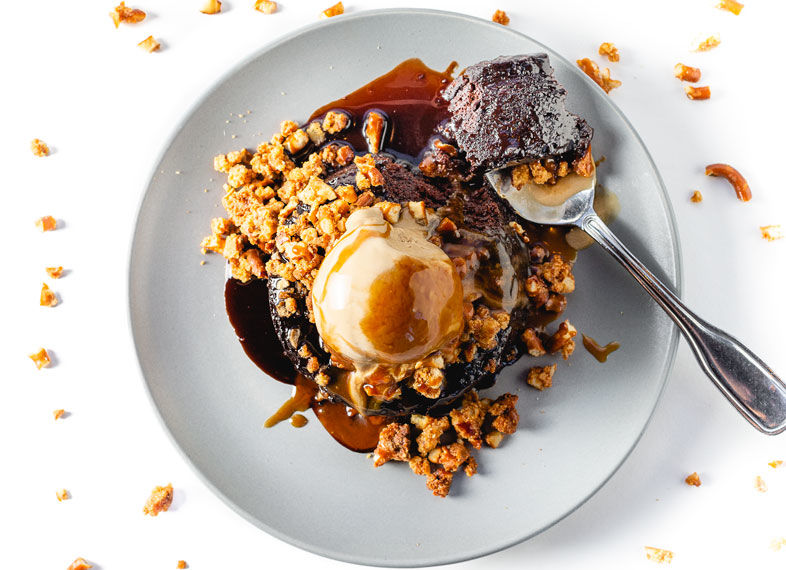
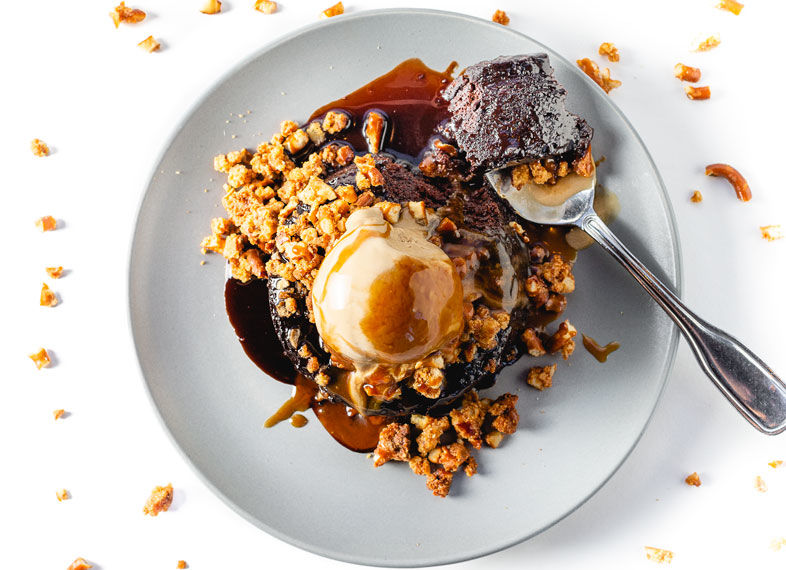
It’s a cardinal sin to serve a cold brownie à la mode. Thankfully, this restaurant always plates a soft, warm chocolate brownie topped with their signature espresso-Bailey’s ice cream. And thanks to Chef de Cuisine Tyler Nollenberger’s love for chocolate pretzels, the most recent iteration includes pretzel crumbles with a drizzle of chocolate sauce. “This dish really takes me back to my childhood,” says Nollenberger. “When you’re 10 years old, what’s better than a brownie and ice cream? And making the ice cream with Bailey’s? Well, that appeals to my adult side.”
2202 Fourth Avenue, Bankers Hill

73 Must-Try Desserts in San Diego
Justin McChesney-Wachs
“I love the idea of a toasted frosting where you dig in to discover what’s inside,” says Vivian Hernandez-Jackson, owner and chef of the Ocean Beach dessert shop that combines her Cuban background with French pastry training. At the center of this white chocolate soufflé cake—served in individual portions—is a tart passion fruit cream, and on the outside are raspberries and a glossy vanilla bean cooked meringue icing. “Passion fruit tastes like a tropical vacation—it really transports people and has such a unique taste. I use it anywhere I see lemon in recipes.”
4820 Newport Avenue, Ocean Beach
73 Must-Try Desserts in San Diego
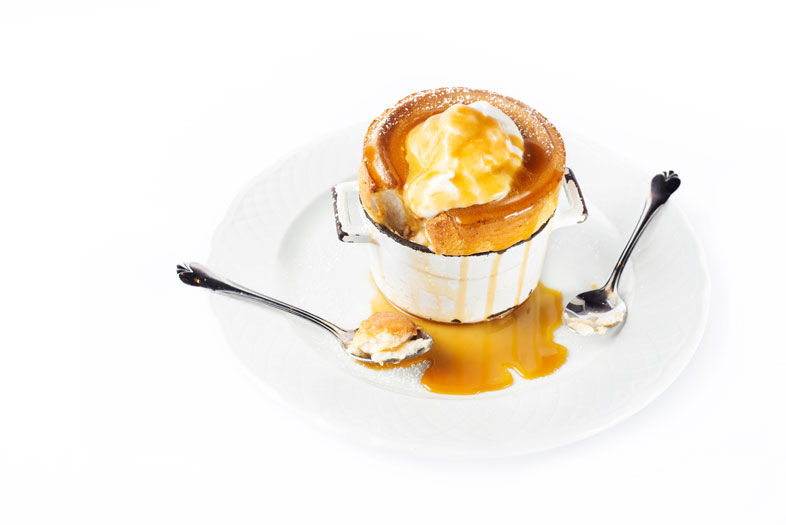
Pulling from his tenure at the two-Michelin-star Spago in Beverly Hills, Herb & Wood’s Executive Pastry Chef Adrian Mendoza has a slate of five-star desserts at this glam Little Italy restaurant. The showstopper is the soufflé, a gluten-free option with flavors that rotate seasonally (blueberry in the summer, pear currently). He uses Bartlett pears sourced from Penryn Orchard Specialties in Northern California and a touch of sugar to create the base, then folds in meringue and lavender whipped crème fraîche. On top is a drizzly caramel sauce and salted caramel gelato. It’s quick to prepare but requires the precision of a scientist with the sugar, the ramekins, and especially the egg whites. “If you underwhip, it won’t rise as high, but if you overwhip, the soufflé will rise tall then deflate within seconds,” Mendoza says. “If it’s whipped just right, the soufflé has a three-to-five-minute window before it starts descending.”
2210 Kettner Boulevard, Little Italy
73 Must-Try Desserts in San Diego
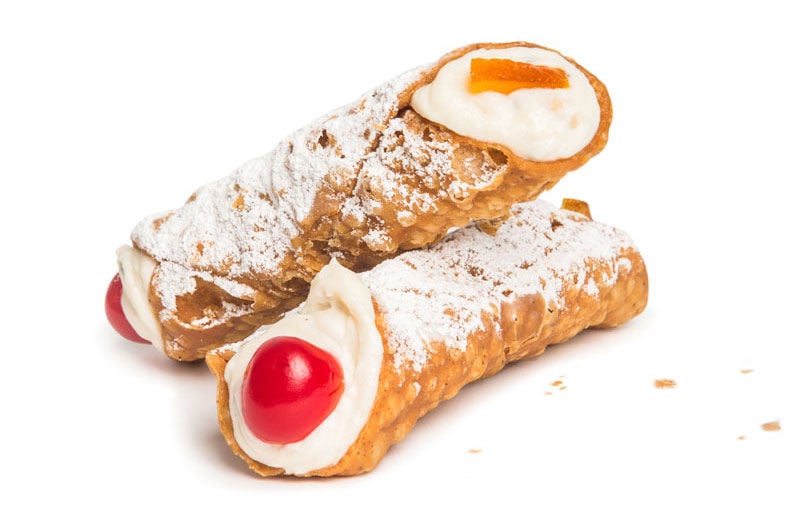
Cannoli can fall victim to stale shells and overly sweet cream. Not so at this traditional Italian deli owned by a sweet husband-and-wife team. After the arancini, pasta, and focaccia, save room for this one. They’re not reinventing the cannoli wheel, and we’re thankful for that. Expect a perfectly balanced ricotta filling and a crunchy shell for an ideal contrast. Bellissimo!
7918 Ivanhoe Avenue, La Jolla
73 Must-Try Desserts in San Diego
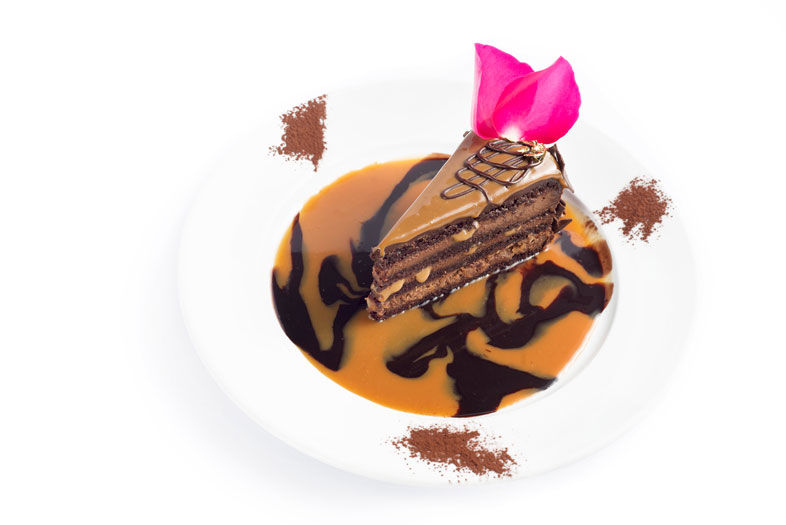
Owner and pastry chef Karen Krasne pulled inspiration from a cake she had in Uruguay for her version, made with a dark chocolate sour cream base, chocolate mousse, and burnt caramel, plus a crunchy layer of macadamia nuts and crushed French wafers. The genius is in the housemade dulce de leche (a caramelized condensed milk). It’s been on the menu since Extraordinary Desserts opened, but it shot to stardom after chef Marcela Valladolid picked the cake on the Food Network’s Best Thing I Ever Ate: Cake Walk. Krasne may be closing her original location near Balboa Park, but she’ll open a larger, more modern one a few blocks away at Bankers Hill’s Louie Lofts soon.
2870 Fourth Avenue, Bankers Hill; 1430 Union Street, Little Italy
73 Must-Try Desserts in San Diego
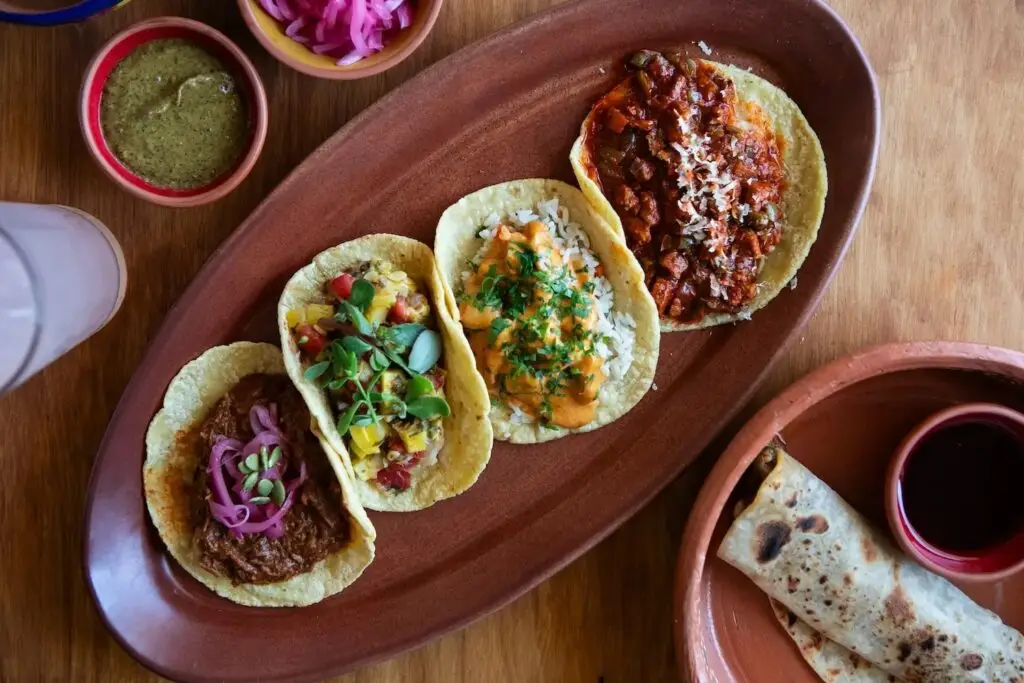
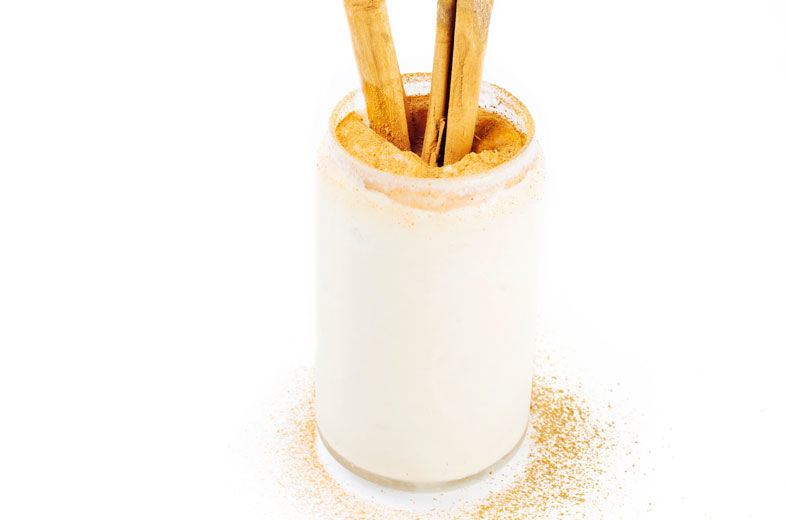
On the menu since Puesto’s first location (in La Jolla) opened in 2012, the frozen horchata was the brainchild of cofounder Eric Adler and Executive Chef Luisteen Gonzalez. The idea was to present the traditional Mexican drink in a fun new way. As for the recipe, that’s a family secret, but it does involve Straus organic cream and cinnamon. Best of all, $1 of every frozen horchata is given to a charity, which rotates monthly. To date they’ve raised $48,000 for No Kid Hungry and the Surfrider Foundation, among others. This month your buck will go to Workshops for Warriors, a veteran-focused nonprofit.
789 West Harbor Drive, Downtown; 1026 Wall Street, La Jolla
73 Must-Try Desserts in San Diego
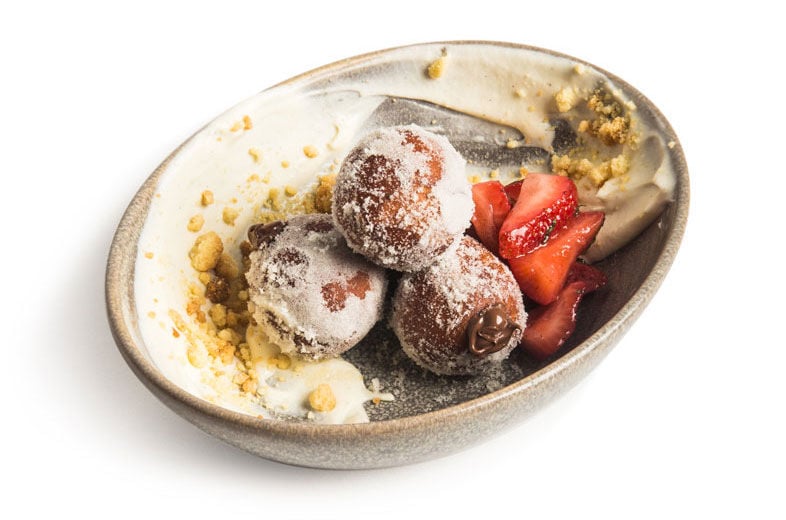
The menu and wines are Italian, so it only makes sense that the Bankers Hill restaurant would want authentic desserts, too. They pulled from the Italian tradition of restaurants frying and sugaring leftover dough to serve to kids after school in brown paper bags. Cucina Urbana (and their Kensington offshoot, Cucina Sorella) no longer uses the paper-bag presentation, but the crux of the dessert remains the same. Flavors for their dipping sauce change seasonally, like a blood orange syrup. “They are just so simple and dependable,” says Executive Chef Joe Magnanelli. “It’s fried dough, sugar, and Nutella. There’s nothing complicated, and that’s comforting.”
505 Laurel Street, Bankers Hill; 4055 Adams Avenue, Kensington
73 Must-Try Desserts in San Diego
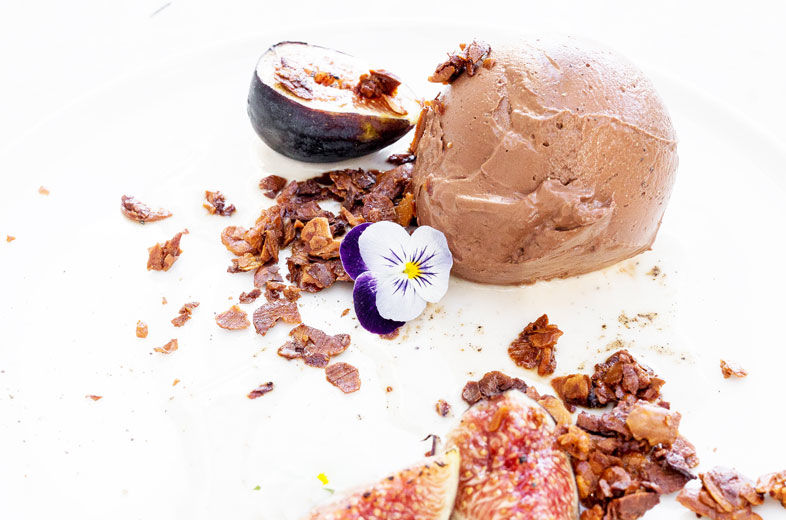
In a quaint corner of South Park lies this vegan, Victorian gothic restaurant-bar with its pink wallpaper and occult decor touches. And the menu is just as delightfully irreverent—think charcuterie boards made with fig sausage. There’s lots of fun in the plant-based dessert menu, too. “There’s no lack of inspiration or innovation in a dairy-free world,” says Kindred’s head chef, Emmy Miller. She combines dark chocolate blended with oat milk and Tcho chocolate with a black pepper crème anglaise, gingered almonds, nasturtium flowers, and seasonal fruit. “Each element plays its part. Sweet, salty, creamy, crunchy—sugar, spice, and everything nice!”
1503 30th Street, South Park
73 Must-Try Desserts in San Diego
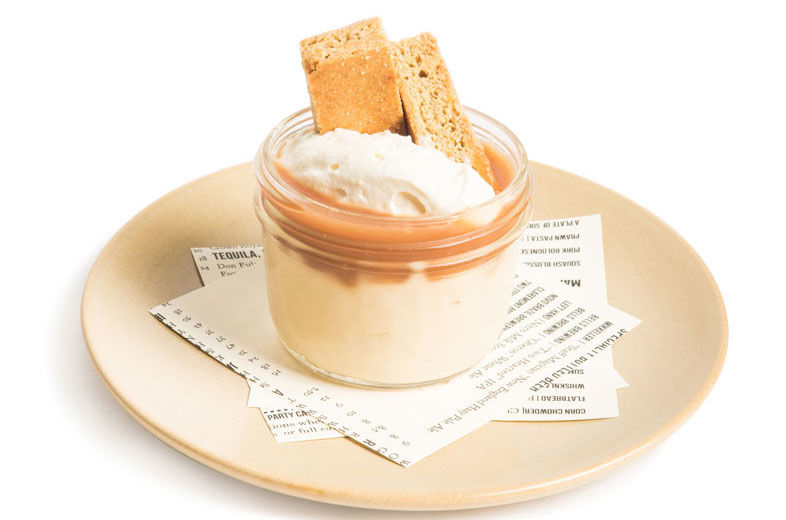
Look around at this La Jolla restaurant and you’re bound to see most tables finish their meal with this budino, a grown-up take on pudding. Theirs is a butterscotch custard topped with salted caramel, whipped cream, and housemade brown butter blondies. “It’s been off and on the menu since the opening,” says Culinary Director Ryan Johnston. “Every time we attempt to replace it, it always makes its way back on.” The budino is the brainchild of Whisknladle’s first pastry chef, Tracy Wei, and is a staple of the dessert menu. “Even if you think you don’t have any room left for dessert,” Johnston says, “we definitely subscribe to the ‘treat yourself’ mentality.”
1044 Wall Street, La Jolla
73 Must-Try Desserts in San Diego
Justin McChesney-Wachs
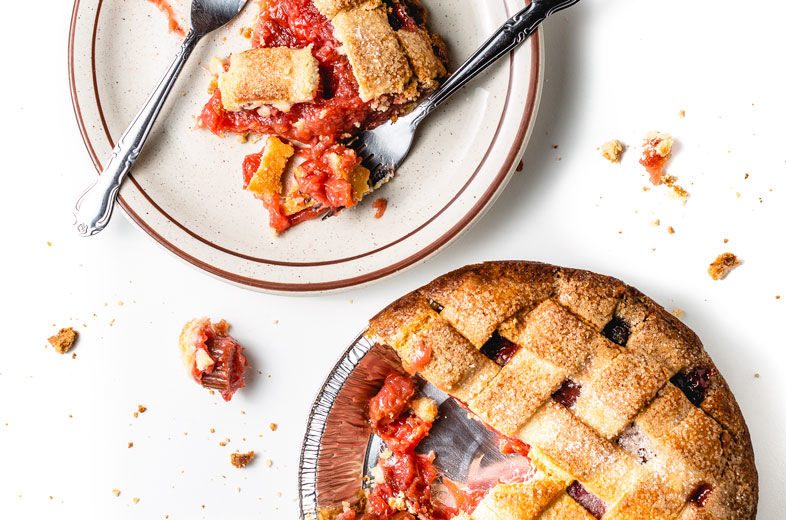
Many pies at this Encinitas bakery are seasonal—the peach and pecan are particularly great for summer and fall, respectively—but thankfully, the strawberry rhubarb is available year-round. A buttery lattice crust encapsulates chunks of juicy berries and tart rhubarb. You can add fixings like butterscotch, whipped cream, or ice cream. And if you want to add a traditional touch to the holiday spread, try their Thanksgiving pie, a buttermilk biscuit crust filled with roasted turkey, gravy, mashed potatoes, green beans, and stuffing baked golden in a sage buttermilk biscuit crust that’s served with chipotle cranberry sauce (available through December).
155 Quail Garden Drive, Encinitas
73 Must-Try Desserts in San Diego
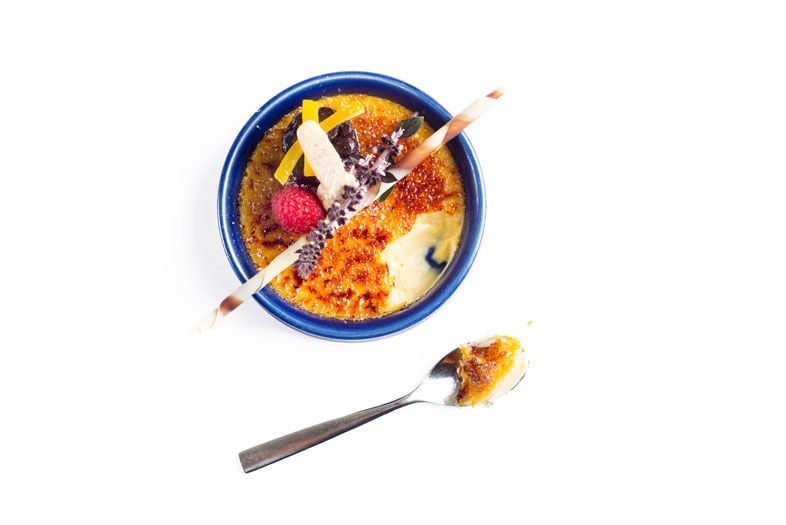
On the menu since Executive Chef Bernard Guillas joined the team 24 years ago, the Marine Room’s crème brûlée is almost as famous as its high-tide spectacle. This version, on the menu since May, has a macadamia-liqueur-spiked custard that gives off nutty scents of roasted almonds, plus notes of dried citrus and pepper. It also includes macerated blueberries soaked in passion fruit syrup, preserved orange peels, cardamom-flavored shortbread cookies, and a raw turbinado sugar on top to give it a crunch. That stoneware dish? It’s made by Guillas’s friend Mike Totah at Leucadia pottery shop The Wheel.
2000 Spindrift Drive, La Jolla
73 Must-Try Desserts in San Diego
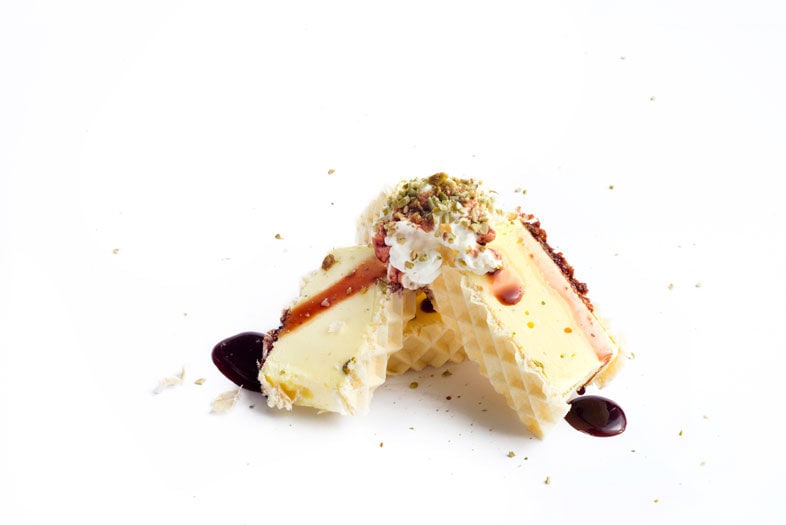
Some believe Akbar Mashti was the owner of the first ice cream parlor in Tehran, Iran, but there are other origin stories too. “An Indian man suggested it was named after Akbar the Great, the 16th century Mughal king of India who promoted Persian art, fine cuisine, and poetry,” says Soltan Banoo co-owner Sanam Govari. “He loved the ice cream so much that his cooks learned to make it for him.” Folklore aside, the traditional saffron-flavored ice cream, with hints of rose water and pistachio, comes sandwiched between two thin wafers. “The wafer for Iranians is like the cone for Americans.” The final touch is a drizzle of tart sour cherry syrup on to top balance the sweetness.
4645 Park Boulevard, University Heights
73 Must-Try Desserts in San Diego
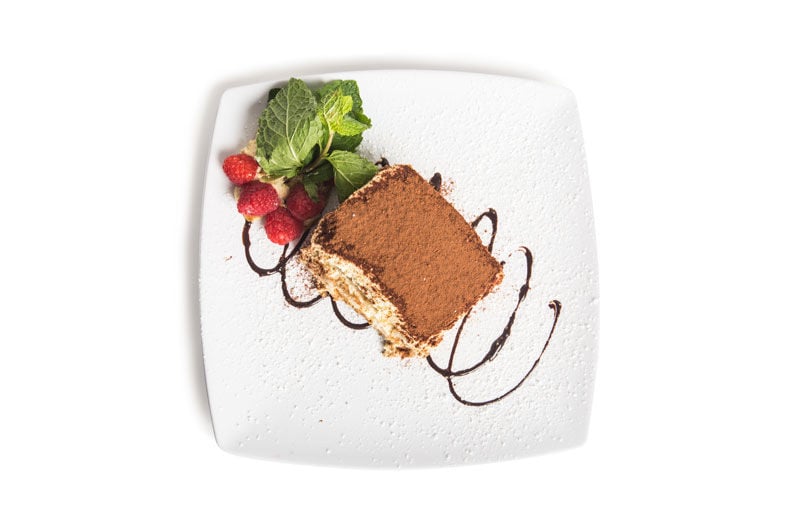
Neapolitan pizza may be its calling card, but it’d be a sweet sin to miss out on Buona Forchetta’s desserts, curated by owner Matteo Cattaneo’s mother, Augusta. Every October, she comes to San Diego from Italy for a few months to make the desserts herself. She has a new lineup this fall, including an Italian riff on cotton candy, but we love the classics, like her tiramisu, just as much. “I grew up eating this,” Matteo says. “It’s a traditional summertime dessert for us because it’s so hot in Umbria!”
3001 Beech Street, South Park;
Officine Buona Forchetta: 2865 Sims Road, Liberty Station
73 Must-Try Desserts in San Diego
Danielle Jackson
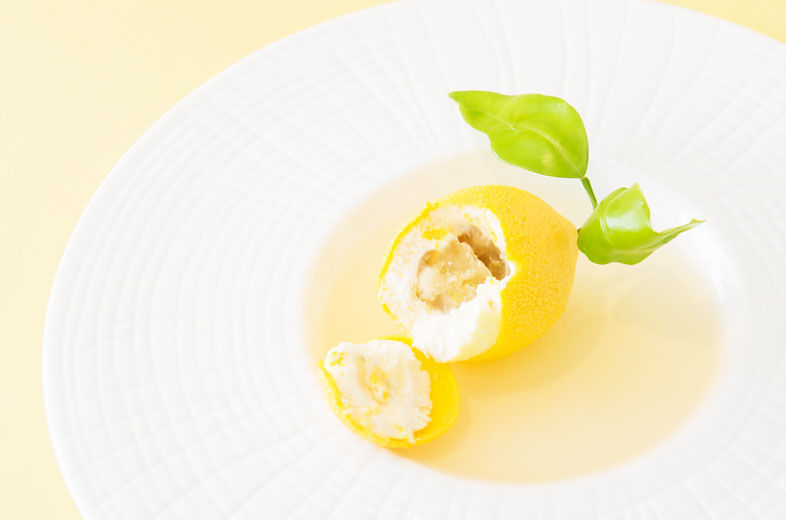
Luxurious and delicious? We’d expect no less from the Hotel del Coronado restaurant, run by Master French Chef Patrick Ponsaty. Like many of his fellow European-trained chefs who began putting a playful touch on more serious cuisines, Ponsaty created a lemon dessert that looks like, well, a lemon. He starts with a special silicon mold in the distinctive shape. The center of the dessert has a poached Meyer lemon core with chocolate mint from The Del’s on-site garden and a yuzu-spiked white chocolate mousse. He then coats the frozen dessert with white chocolate and natural yellow colorant. The finishing touch is a dust of gold spray. Luxury all the way.
1500 Ocean Avenue, Coronado
73 Must-Try Desserts in San Diego
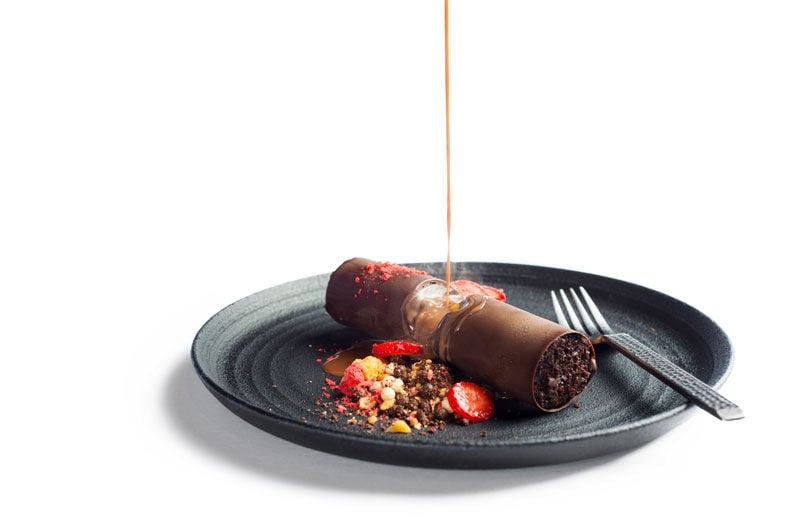
It’s the most popular dessert on the menu at Richard Blais’s Little Italy restaurant. For proof, just look at all the tables around you ogling at the theatrical way they serve it. Pastry chef Bradley Chance whips up a cylinder of tempered dark chocolate filled with hazelnut brittle, coffee “soil,” chocolate pudding, chocolate pearls, freeze-dried and fresh strawberries, chocolate cake, and white chocolate chiboust cream. Make sure to get your camera out when the server begins pouring the milk chocolate ganache on top. As Chance says, “It’s all in the presentation.”
2228 Kettner Boulevard, Little Italy
73 Must-Try Desserts in San Diego
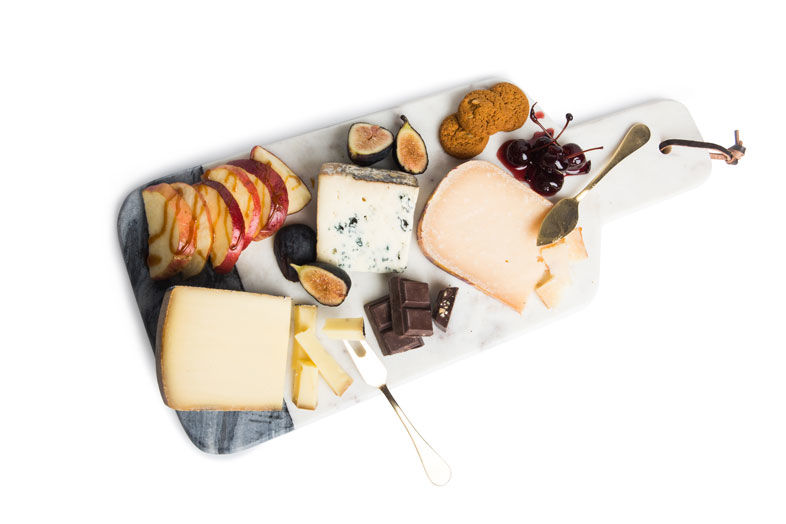
Cheese as dessert? “Leave it to the French to propose such a thing!” says Gina Freize, co-owner of Venissimo Cheese. “But cheese is like crème brûée for those who prefer savory to sweet, since cheese is essentially creamy milk with salt. And creamy things are a wonderful digestive.” She suggests a blue cheese to cleanse and a Brie to soothe the palette, and an aged gouda, which is naturally sweet and texturally crunchy. Her picks? Bayley Hazen Blue cheese served with fresh figs, chocolate, and balsamic; the hard cow’s milk Appenzeller from Switzerland paired with apple slices and caramel sauce; and ginger snaps and sour cherries with Ewephoria, a sweet sheep’s milk gouda out of the Netherlands.
Locations in Del Mar, Liberty Station, Mission Hills, and North Park
73 Must-Try Desserts in San Diego
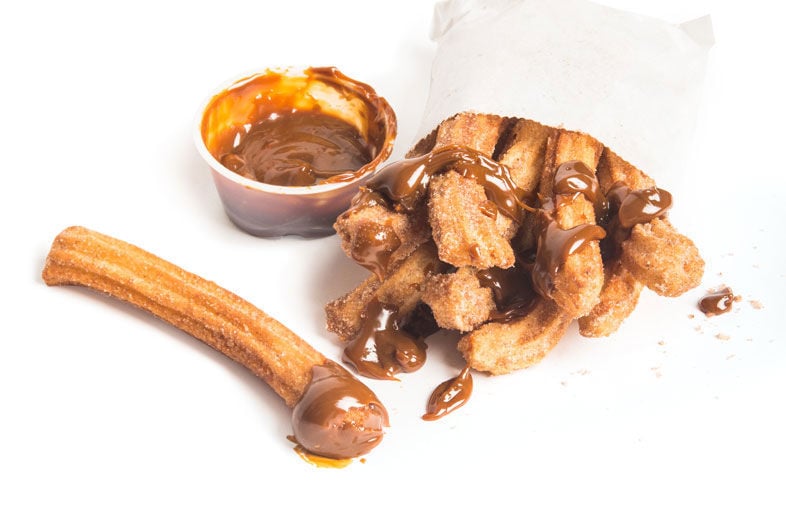
You don’t have to cross the border to get piping-hot, sugar-dusted churros. Just visit this small kiosk inside Las Americas Premium Outlets in San Ysidro. The churro masters make sundae and ice cream sandwich spins on the namesake, but we prefer them clásico. Served in six- and nine-piece batches or a fun 20-piece mini option, you can dip the churros in chocolate or cajeta (caramel) sauce. For an extra $1.50, add Bavarian cream, strawberry preserves, or lechera, a sweetened condensed milk.
211 Camino de la Plaza, San Ysidro

73 Must-Try Desserts in San Diego
Owner Crystal White honed her skills at San Francisco’s famed Tartine Bakery before opening Proof Bakery in LA, then launching a series of pop-ups. Thanks to a successful Kickstarter campaign, she now has her own brick-and-mortar—which recently got a write-up in the New York Times—where she slings loaves, tarts, morning buns, and more. The cream bun is our favorite, a croissant bun filled with pastry cream and a seasonal component. “It’s a way to showcase San Diego’s incredible produce in a morning pastry,” she says. “The outside of the croissant can expand as it bakes, which makes the outer texture flaky, crispy, and crunchy. But the inner and bottom of the bun are confined in a muffin tin, so they remain soft, chewy and buttery.” Future flavors for fall include apple butter with honey, pear vanilla, and maple date.
5525 La Jolla Boulevard, Bird Rock
73 Must-Try Desserts in San Diego
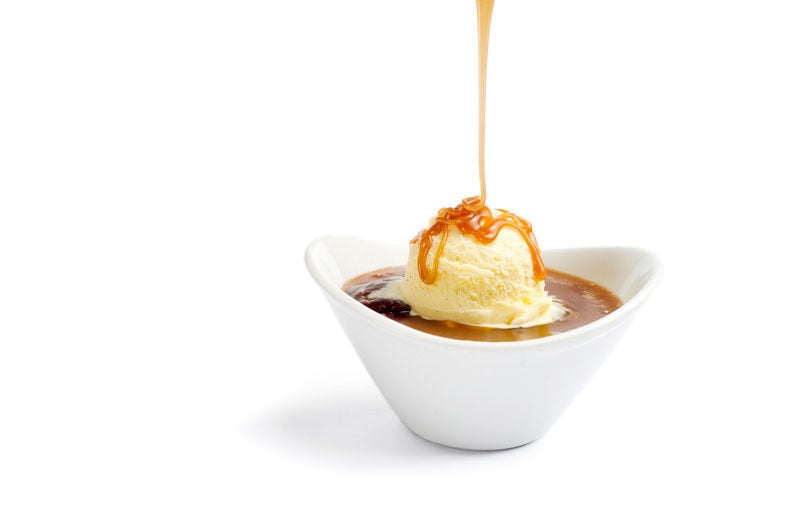
The La Jolla restaurant has served more than 50,000 of these cakes since its opening—that’s 2,375 pounds of dark chocolate, 20,000 eggs, another 20,000 egg yolks, 1,250 pounds of sugar, and 172 pounds of flour. Crafted by Nine-Ten’s first pastry chef, Jack Fisher, who wanted to create his own version of the famous molten chocolate cake made by acclaimed chef Jean-Georges Vongerichten, the cake comes with a housemade vanilla bean ice cream and caramel sauce. The secret to its success is ensuring the sides are fully baked, so it holds its form while the middle remains melted.
910 Prospect Street, La Jolla
73 Must-Try Desserts in San Diego
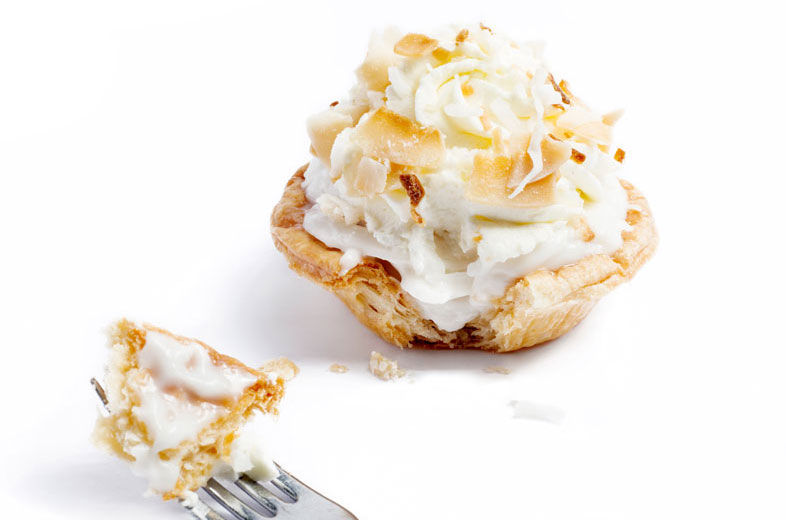
They may have just opened an ice cream shop next door (Stella Jean’s), but we’re still suckers for the original concept, an ode to sweet and savory pies of all shapes and sizes. For dinner, the five-inch steak and ale pie and roasted veggies with curry pie are popular, but we don’t leave without the 3.5-inch coconut cream pie. The best-seller combines tender young coconut from Thailand with a coconut-milk-based pastry cream that’s topped with fresh whipped cream and toasted coconut flakes.
4404 Park Boulevard, University Heights
73 Must-Try Desserts in San Diego
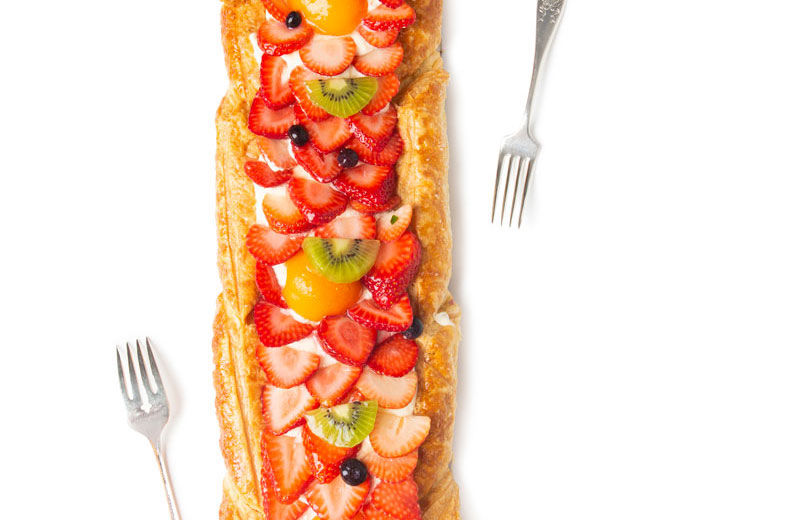
The eponymous pastry chefs learned how to make European-style cakes in their native Holland before opening this low-key Bonita bakery in 1991. Their menu spans cheese Danishes, caramel walnut tortes, lemon bars, and elaborate cakes like Colombian mocha buttercream, but the fan favorite—especially during the holidays—is the fresh fruit strudel, a thick puff pastry base layered with fluffy Bavarian cream and topped with berries, kiwis, apricots, and more. The dessert stretches two feet long, but you can also find individual-size strudels in the dessert case if you’re not one for sharing.
5080 Bonita Road, Bonita
73 Must-Try Desserts in San Diego
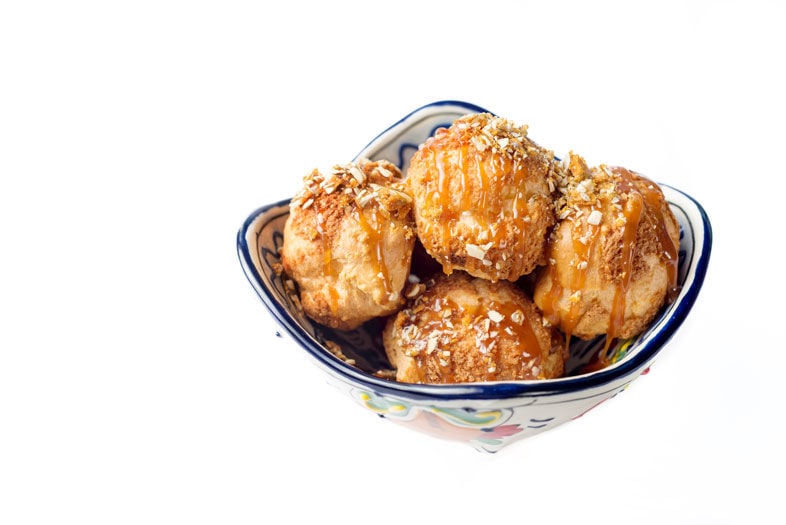
Pastry chef Jeremy Harville takes flour, milk, butter, eggs, and salt and transforms them into pillow-soft dough balls topped with a brown sugar crumble and seasonal cream fillings. “I wanted a play on a croquembouche,” he says. This month, he’ll serve horchata cream profiteroles with cajeta (a goat milk caramel sauce) and pumpkin seed brittle. “I put them on the second dessert menu after opening and haven’t been able to take them off since—due to possible protests and rioting.”
3752 Park Boulevard, Hillcrest
73 Must-Try Desserts in San Diego
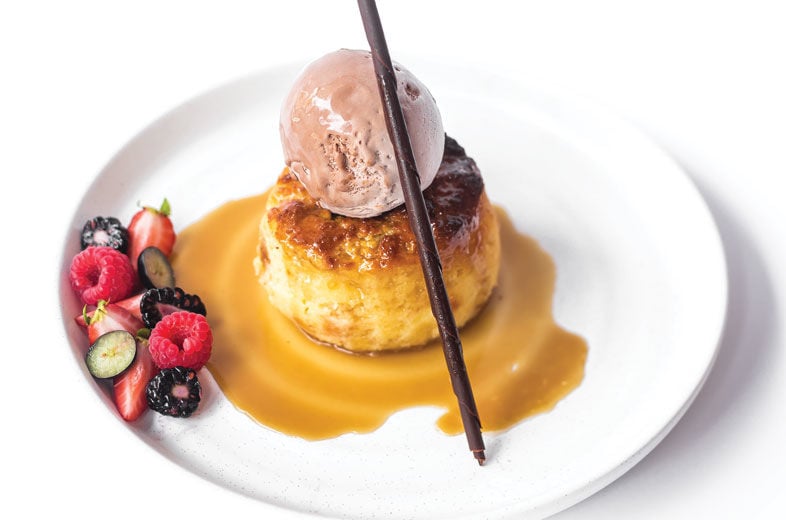
The menu at Cowboy Star reads a little like its decor—Old West tradition (cowboy gear and wooden beams) mixed with some industrial touches (exposed brick, steel accents). The same goes for this dessert, a staple since the East Village steakhouse opened in May 2008. Chef-partner Victor Jimenez wanted a “wow factor” dessert, so he took inspiration from a memorable bread pudding he had tasted in New York City. Now a signature dish, the pudding is made with housemade brioche, chocolate chips, and custard—the perfect post-steak palate cleanser.
640 10th Avenue, East Village
73 Must-Try Desserts in San Diego
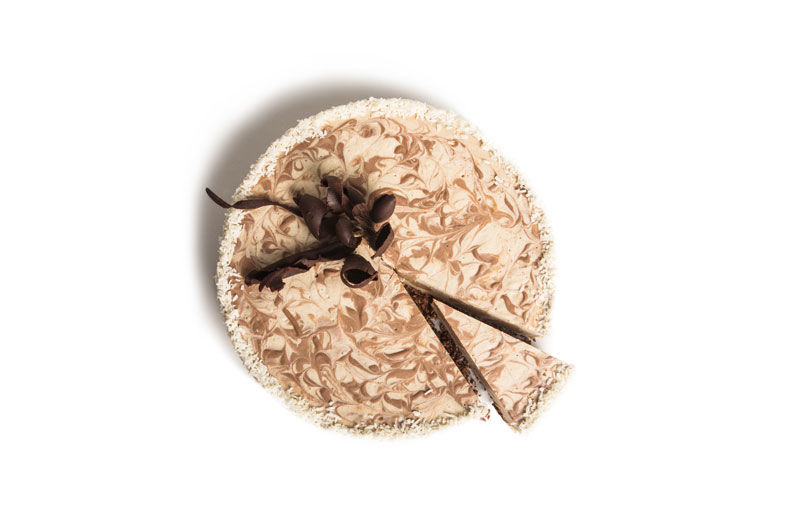
The stylish, plant-based restaurant—basically vegan except for its use of honey in some dishes—is known for lentil bowls, raw pesto kelp noodles, and mole tempeh, but don’t overlook their menu of sweets, made sans egg or dairy. There’s the vegan riff on Almond Joy chocolate bars and gluten-free chocolate chip walnut cookies, but we always head straight to the cakes and pies. The highlight is the coconut cream pie, which has a photogenic swirl of dark chocolate and a crust made out of dates. Look for it on the menu under the eatery’s signature affirmation-style name, the Irresistible. We couldn’t agree more.
1980 Kettner Boulevard, Little Italy
73 Must-Try Desserts in San Diego
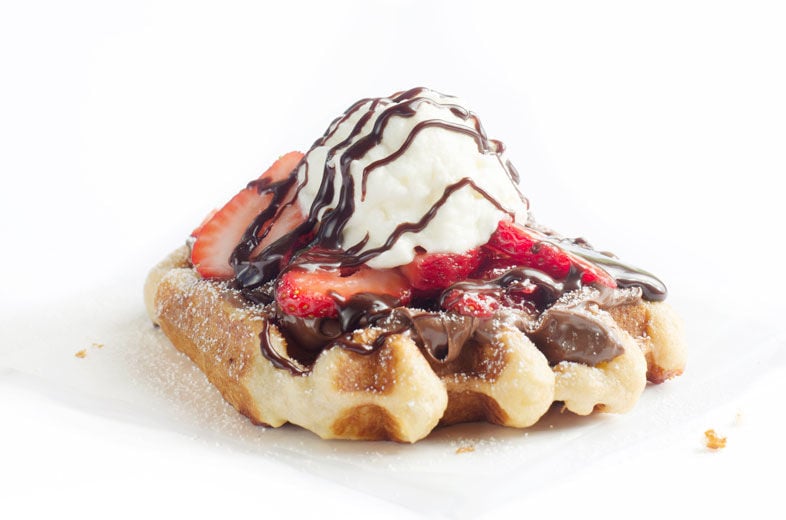
Formerly known as Wow Wow Waffle, the charming eatery behind a laundromat may have changed its name, but the thick, fluffy, Liège-style waffles are all the same. The menu, which offers “Sweet,” “Not So Sweet,” and “Savory” waffles also serves seasonal spins, like a pumpkin butter with bananas. We go for the Nutella, with its generous layer of hazelnut spread, sliced strawberries, whipped cream, and powdered sugar (also offered in a smaller size for kids). Take it to the fire pit, preferably with a cup of Coffee & Tea Collective coffee by your side.
3519 30th Street, North Park
73 Must-Try Desserts in San Diego
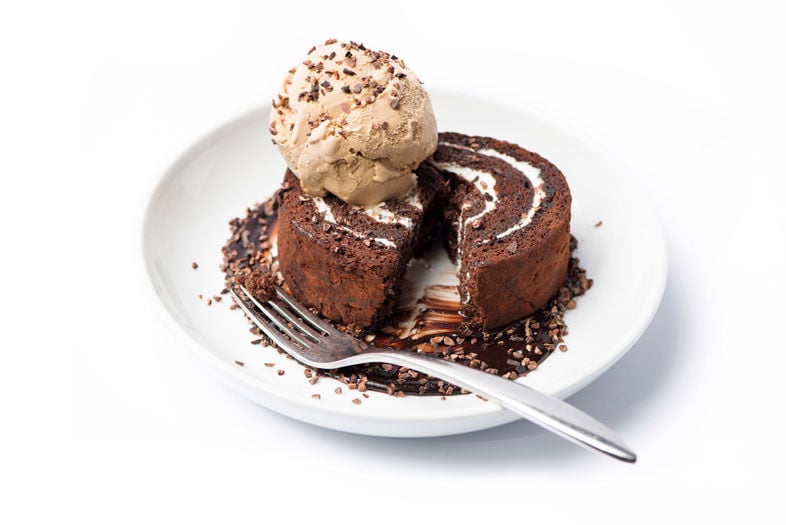
When the Coronado eatery retired its first Hostess-inspired dessert, the Naughty Ding Dong, Executive Pastry Chef Lori Sauer decided to continue the trend. Her gourmet Ho-Ho is made of a chocolate sponge cake with marshmallow whip, fudge, cacao, and a large scoop of MooTime Creamery coffee ice cream. “It’s a twist on a nostalgic American sweet treat,” Sauer says. “The name and description alone just sucker you into trying it.”
1015 Orange Avenue, Coronado
73 Must-Try Desserts in San Diego
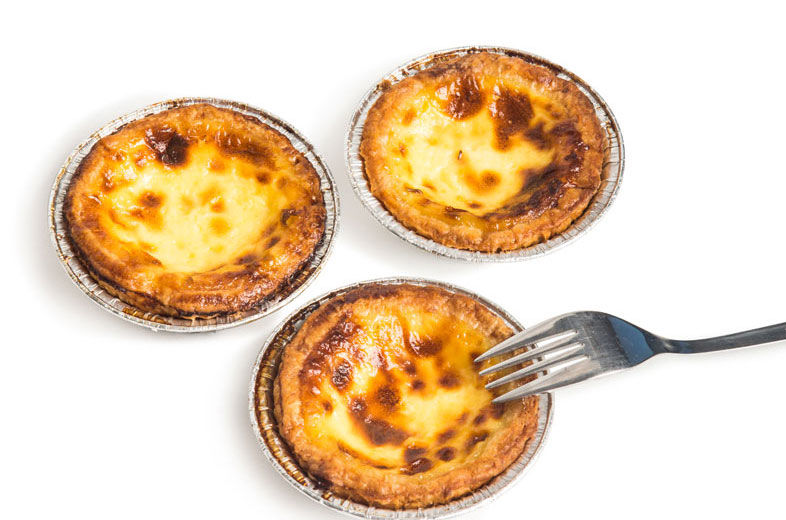
Tracing the origins of this dessert involves a little history. The egg custard tart in a puff pastry shell, or pastel de nata, was created in Portugal but also found a fan base in the Portuguese colony of Macau and in its neighbor, Hong Kong. Bakers in the megalopolis put their own spin on the dessert by adding more egg yolk and cutting down on the sugar. The resulting dan tat has proliferated in Taiwanese bakeries, like the 85°C chain, where the palm-sized tart (and all their other pastries) are made hourly. It’s soft like panna cotta with a flaky crust like pie.
Locations in Kearny Mesa, Mira Mesa, National City, Point Loma, and UTC.
73 Must-Try Desserts in San Diego
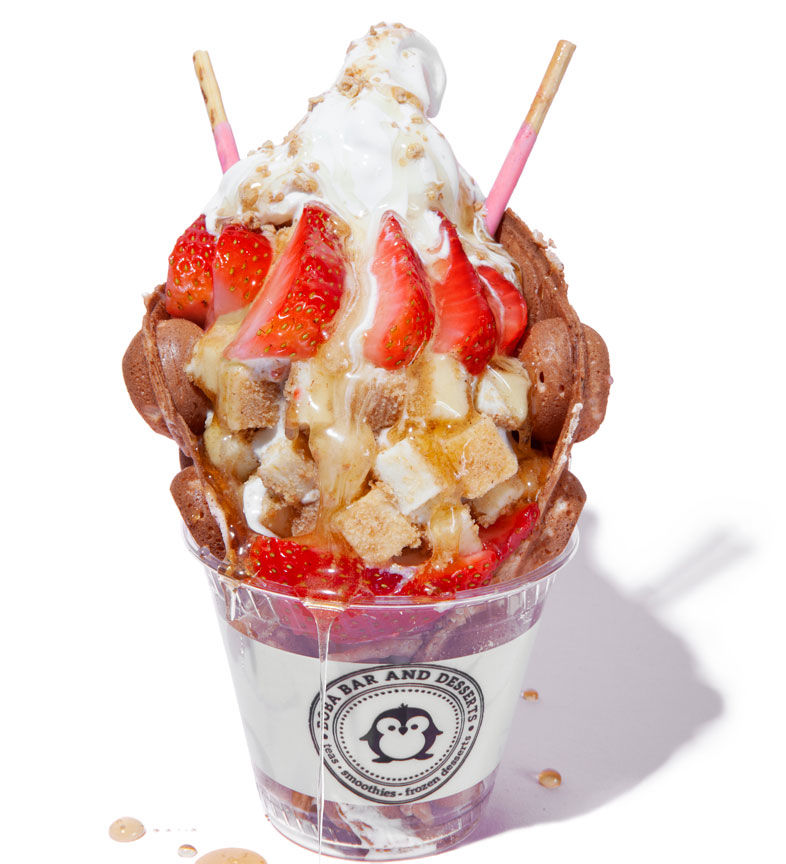
Keeping with the tradition of creative desserts born in Asia, this Kearny Mesa spot has brought over one of Taiwan’s most popular street foods. The sundae starts with a soft, bulbous waffle—the puffle—and gets a hefty dose of custard. Then comes the fun part: the variety of themed toppings. You can get the Perfect Matcha with a green-tea-tinged puffle, green tea custard, mochi, and a condensed milk drizzle; the Black Out, an Oreo puffle paired with vanilla custard, Oreo cookies, and a chocolate drizzle and others.
4619 Convoy Street and 7655 Clairemont Mesa Boulevard, Kearny Mesa
73 Must-Try Desserts in San Diego
Rose Donuts
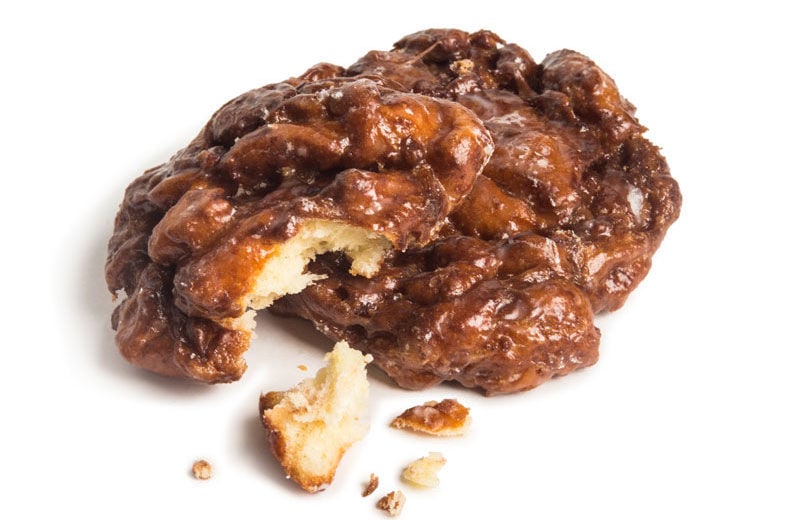
In a sea of out-there flavors, this legendary bakery near USD remains true to classics, like glazed and cinnamon sugar donuts and maple bars. The cash-only shop is lined with cases of the fried goodies that are just as fresh in the afternoon as they are at 5 a.m. We wake up early for the apple fritters, the huge pastry that’s glazed and crunchy on the outside, soft on the inside, and dotted with juicy apple chunks throughout. Word to the wise: The fritters are often the first item to sell out.
5201 Linda Vista Road, Morena
73 Must-Try Desserts in San Diego
Justin McChesney-Wachs
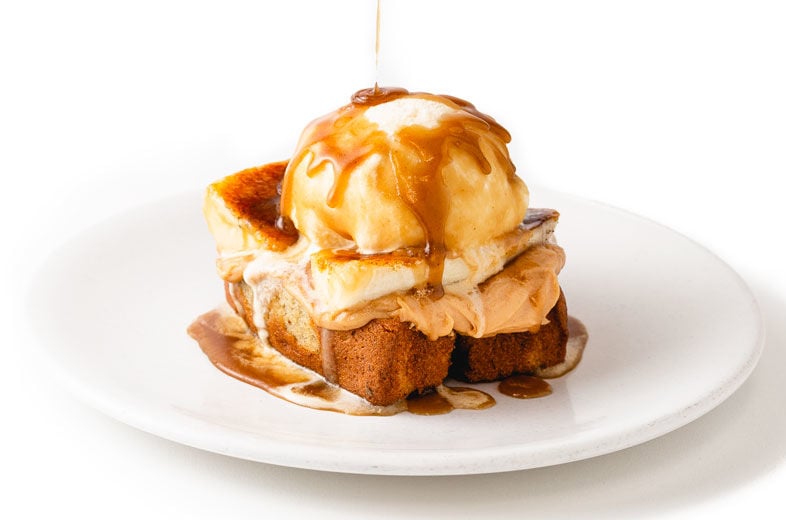
Pastry chef Eli Peralta wanted to put something on the menu at The Patio on Lamont that paid tribute to his favorite sweet, banana bread. But this is no subtle dessert. The housemade bread comes with peanut butter mousse, a rich topping balanced by vanilla ice cream, brûléed banana, and foster sauce. Since hitting the menu in 2012, it’s now become available at The Patio on Goldfinch in Mission Hills and The Patio on 101 in Encinitas.
4445 Lamont Street, Pacific Beach
The Patio on Goldfinch: 4020 Goldfinch Street, Mission Hills
The Patio on 101: 345 South Coast Highway 101, Encinitas
73 Must-Try Desserts in San Diego
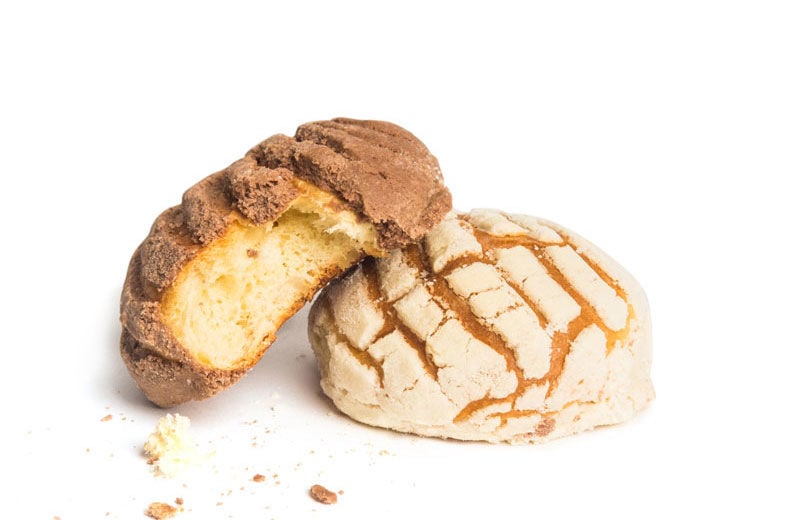
This traditional Mexican sweet bread, named for its shell-like appearance, is a breakfast staple and coffee snack whose origin is said to trace back to brioche, brought over by the French during European settlement in Mexico. The base is a yeasted, sweetened wheat dough covered in a crumbly sugar topping. Beyond the classic version, it also comes in chocolate.
Locations in Barrio Logan, City Heights, Golden Hill, and North Park
73 Must-Try Desserts in San Diego
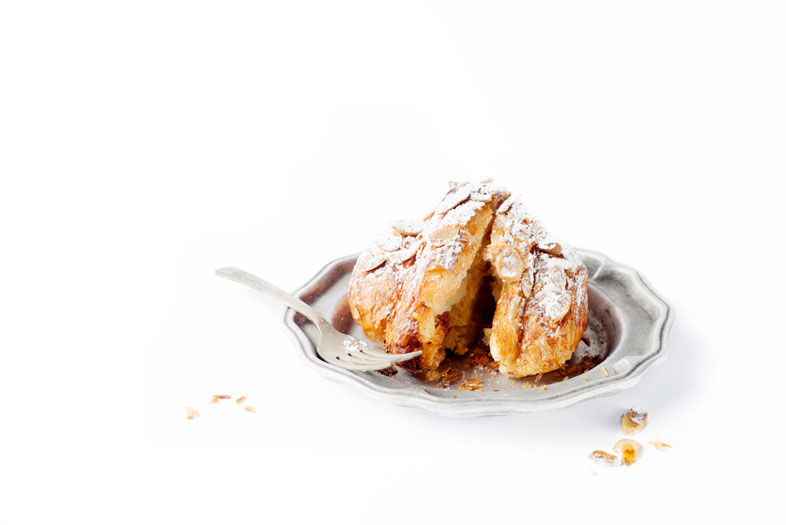
At the fast-casual component of Herb & Wood, Executive Pastry Chef Adrian Mendoza crafts some of the city’s best croissants. While his butter version is the number-one seller, we prefer the almond. The process begins with an 18-hour dough starter that then proofs, or rises, for one hour before it’s chilled and folded with (a lot of) butter. After it’s divided and shaped, it’s left to rise for another two hours before it bakes for 22 minutes at 385°F to get the deep brown, flaky exterior.
2210 Kettner Boulevard, Little Italy
“>”>
73 Must-Try Desserts in San Diego
Warm chocolate brownie

The new Hawaiian- and Japanese-inspired cafe will serve locally caught bluefin, fresh spring rolls, housemade sauces, and plenty of matcha
Not all monsters have to be scary. In fact, entrepreneur Pinyada “Ada” Primpray’s is delightful. Sea Monster, a small cafe that will serve poke bowls, fresh spring rolls, and matcha, will open in Mission Valley by the end of the year.
“The concept is a Hawaiian- and Japanese-style cafe,” Primpray explains. She calls it Sea Monster in homage to her friend’s popular restaurant Big Monster Sushi & Thai in Hawaii, but “the idea really started to take shape after I came back from a solo trip to Italy,” she says. The experience inspired her to start her own concept that mixed her culture, experience, and passion for food.
Sea Monster will be her first restaurant as an owner, but Primpray has worked in restaurants for 15 years in places like Kauai, Chicago, New York, and San Diego. She realized a similar health-conscious, seafood-forward, quick-service restaurant could work here, especially in that corner of Mission Valley where pizza and burgers reign. Plus, she points to the massive development plans for the area—between Riverwalk bringing thousands of new homes to the area and even more coming from San Diego State University, there are lots of new locals looming on the horizon.
She brought on Head Chef Wasu Gibb Palipote from Sushisamba in Los Angeles to develop the menu and signature sauces, like ink wasabi and a larb sauce. “Every couple of months, we plan to introduce a new signature sauce created exclusively for Sea Monster by [Chef Palipote],” she says. All the sauces will be homemade, including a basil creamy sauce and sesame vinegar.

Sea Monster’s menu centers around fresh poke bowls—mostly locally-caught bluefin tuna and hamachi as well as salmon, served California-style rather than Hawaiian-style (the sauces are added to order rather than marinating on the fish, which can overpower its flavor). Toppings will range from the usual, like edamame and green onion, to upscale, like uni (sea urchin). She’ll also serve fresh salad rolls, a popular light snack in Vietnam and her native Thailand, with vegetables and seafood like salmon, shrimp, and imitation crab. Everything will be served to-go, although there will be very limited seating for people who want to dive in right away.
The matcha program will start small, with six iterations planned for opening and potentially more in the future. “I really want to have mango sticky rice,” she adds. Beyond adding items to the menu, Primpray says she hopes Sea Monster will be more than a restaurant. “I want it to grow into a lifestyle brand with its own little world,” she says, pointing to the restaurant’s mascot, Smoo. A monster with aspirations of growing bigger and bigger until it takes over? Yeah, sounds about right.
Sea Monster will open daily for lunch and dinner in late 2026 at 6110 Friars Road in Mission Valley.
Listen Now: The Latest in San Diego’s Food and Drink Scene
Have breaking news, exciting scoops, or great stories about new San Diego restaurants or the city’s food scene? Send your pitches to [email protected].
Beth Demmon is an award-winning writer and podcaster whose work regularly appears in national outlets and San Diego Magazine. Her first book, The Beer Lover's Guide to Cider, is now available. Find out more on bethdemmon.com.
Kuya Sharpens owner Joshua “Jhun” de Andres turned a meditative practice into a business caring for prized kitchen knives—one whetstone at a time
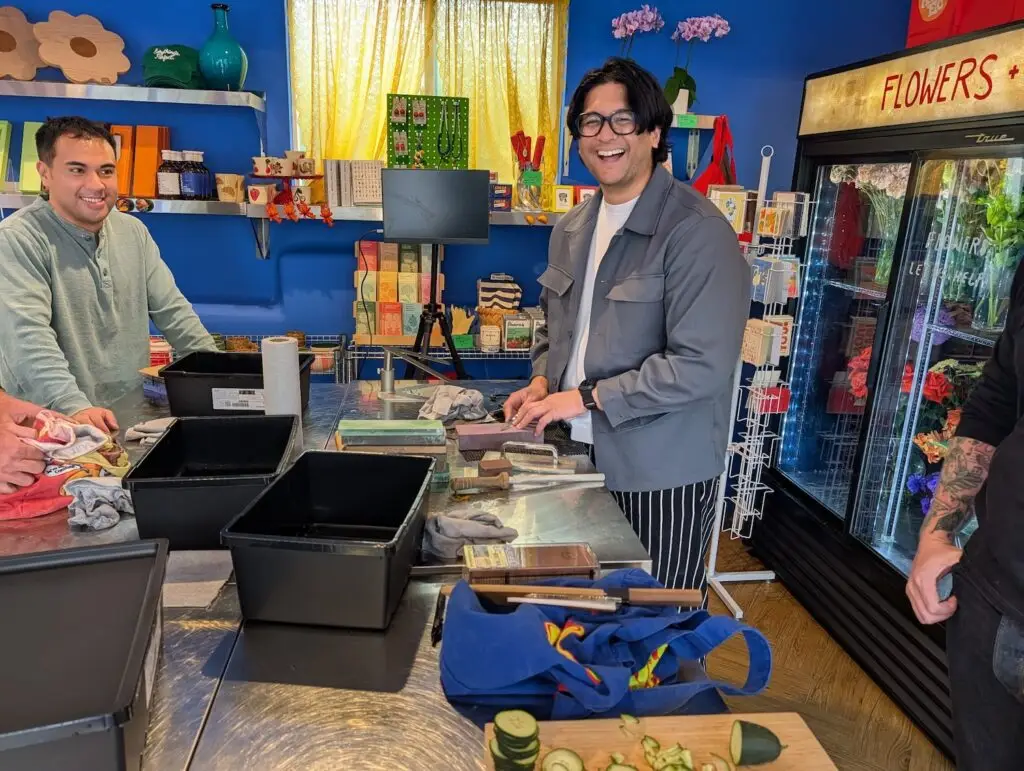
“A sharp knife is a safe knife,” says Joshua “Jhun” de Andres, owner of Kuya Sharpens. It only takes a light touch to guide a properly-sharpened knife, while dull knives require much more force to cut through an object, increasing the likelihood and severity of an injury. “If you slip, that’s a lot of force that is now going into your finger, your hand, and that’s where it becomes extremely dangerous.”
De Andres started sharpening knives as a meditative practice during a time of personal grief, a way to zone in on a task with a useful and satisfying outcome. “[It was a] reminder to myself that you can fix something that’s broken and give it purpose again.” Once he ran through his own collection of knives, he started asking friends and family if he could sharpen theirs. When he’d sharpened everyone’s knives he could think of, he started posting videos on TikTok, where his first professional chef customer found him: Chef Tanner Stanich, chef de cuisine at Michelin-recognized Bib Gourmand Mabel’s Gone Fishing.

“That’s when things really started to take off,” he laughs. He uses whetstones rather than motorized belt sanders to sharpen, which gives him the ability to make microadjustments during the process for a more customized and controlled result. Whetstones also preserve steel more efficiently than other mechanical processes, which are faster, but take off more of the knife’s edge in exchange, reducing the lifespan of the knife.
Learning how to master whetstones takes a lot of time and practice, and while de Andres specializes in sharpening Japanese knives, he’ll sharpen a knife from anywhere. “Every knife deserves to be sharp,” he says.
Japanese kitchen knives are designed for extremely specific purposes: there’s a knife to break down a fish (deba), cut through boneless raw fish for sushi and sashimi (yanagiba), slice vegetables (nakiri), carve meat (sujihiki), debone poultry (honesuki), and even knives only the executive chef can use (kiritsuke). Few other culinary cultures utilize such ultra-specialized tools, and Japanese steel is prized for its extreme hardness and ability to maintain a razor-thin edge for decades when properly cared for.
De Andres is still figuring out different ways to expand his business: hosting workshops at Home Ec on Adams Avenue, creating knife restoration tutorials, and launching private lessons, all while continuing to sharpen knives people bring to him or even send from across the country. And he knows that for both home cooks and professional chefs, sharpening a knife that may have cost hundreds of dollars on a whetstone can feel overwhelming. Will I ruin it? Will I break it?
“You’re most likely not going to break it,” he promises. “But you are going to make it yours, and you have to kind of be okay with that.” Knives age and change just like humans do. Sharpening is an essential part of maintenance, and shaving away the dull edges to restore a shine takes care. And de Andres cares a lot.
“It’s just been really life-giving to me,” he says. “I know it seems really silly that taking a knife and putting it on a whetstone can change your perspective on how you view the world, but for me, it came to me at a time when I needed it most.”

Listen Now: The Latest in San Diego’s Food and Drink Scene
Have breaking news, exciting scoops, or great stories about new San Diego restaurants or the city’s food scene? Send your pitches to [email protected].
Beth Demmon is an award-winning writer and podcaster whose work regularly appears in national outlets and San Diego Magazine. Her first book, The Beer Lover's Guide to Cider, is now available. Find out more on bethdemmon.com.
Check out the stacked lineup of talent participating in this year’s celebration of food, cocktails, wellness, and SoCal energy
Tickets to the Del Mar Wine & Food Festival get you in the door. The real fun is figuring out who you’ll run into once you’re there. This year’s weeklong schedule of exclusive events, running September 30–October 4, includes dinners, tastings, and loosely-supervised chaos where celebrity chefs and local icons finally let their hair down.
The festival has a track record of the unexpected: Bryan Cranston and Aaron Paul once toasted their mezcal brand Dos Hombres with an intimate dinner at the Lodge at Torrey Pines (and then, evidently unsatisfied, kept drinking it on the cliffs above Blacks Beach with a rotating cast of San Diego and Food Network chefs. Alex Morgan showed up for a dinner under the lights honoring the country’s most badass women chefs). Drew Brees ran a celebrity pickleball tournament where the guy from It’s Always Sunny in Philadelphia got absolutely humbled by locals.
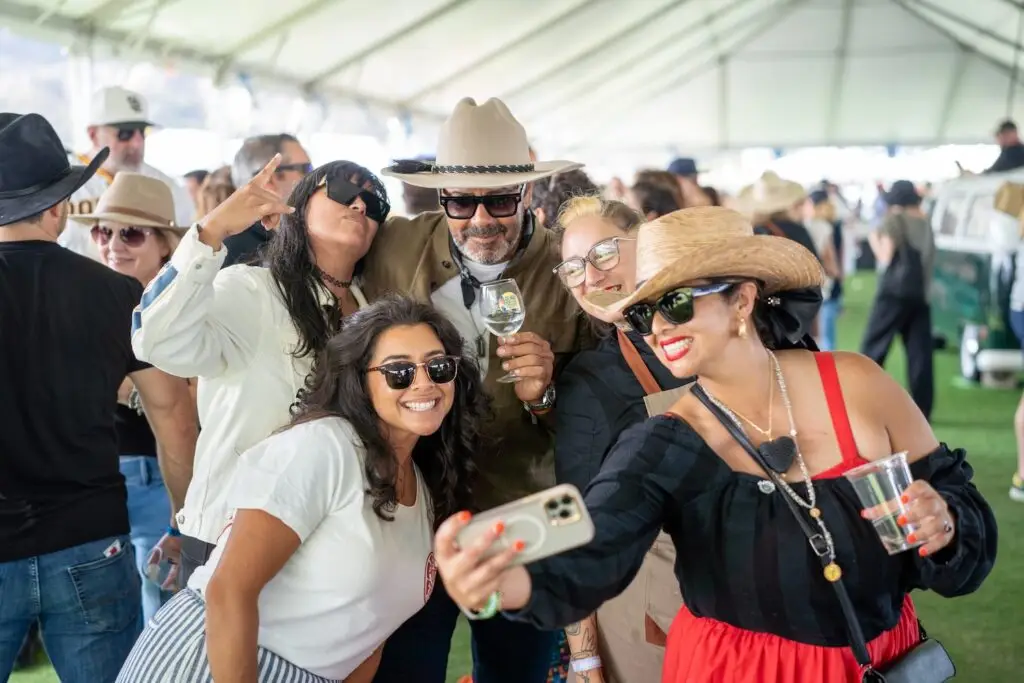
If you scored a ticket to last year’s Grand Tasting, you might’ve caught Guy Fieri doing exactly what Guy Fieri does: strolling the grass, signing t-shirts and foreheads, and hanging off the DJ surf van like it was built for him. Meanwhile, local chef Ethan Yang of Glass Box walked off with the Chef Competition surfboard.
So whether your plan for 2026 is to corner legendary San Diego chefs like Victor Jimenez of Cowboy Star and Jon Sloan of Juniper & Ivy in person, or just aim for a spontaneous golf cart ride with a Food Network star—here’s your cheat sheet for where to run into a celebrity chef, TV personality, award-winning winemaker, or pro athlete at this year’s Del Mar Wine & Food Festival.

Consider this your soft landing into festival week—the walk-around tasting that eases you in before things get chaotic later on. Monarch Ocean Pub hands its patio over to the flavors that define San Diego eating: Baja seafood done right, coastal bites, Mexican flavors with some heat behind them, all the staples locals will fight you over.
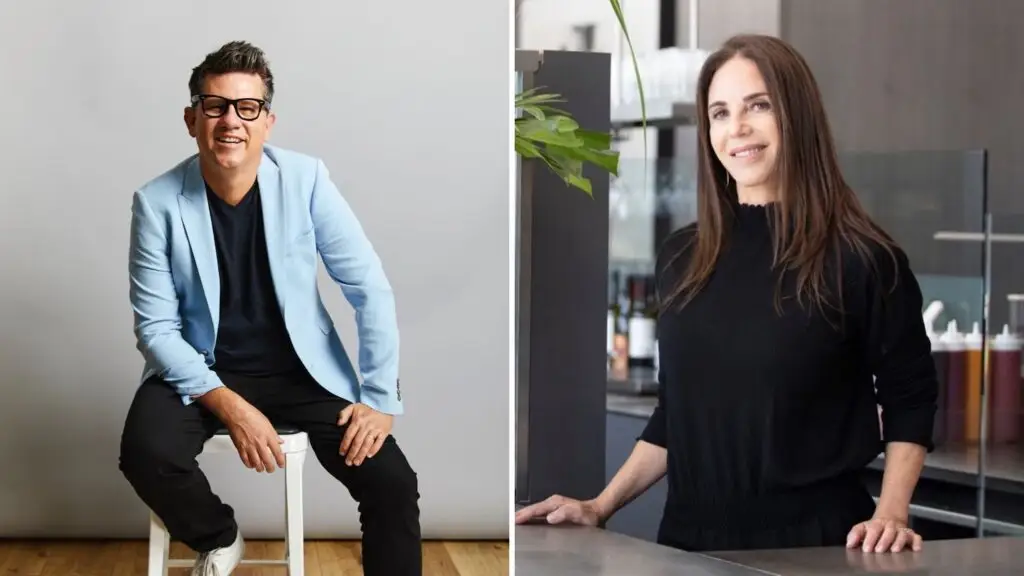
The celebrity sightings here lean more “bump into” than “spot from across the room.” Troy Johnson—Food Network judge, San Diego Magazine chief content officer and co-owner, Emmy-winning host, a man who has eaten his way across the entire country professionally—is the type to materialize at whichever station has the longest line, because he already knows it’s worth the wait. Ask him what he’s had so far. He’ll have opinions.
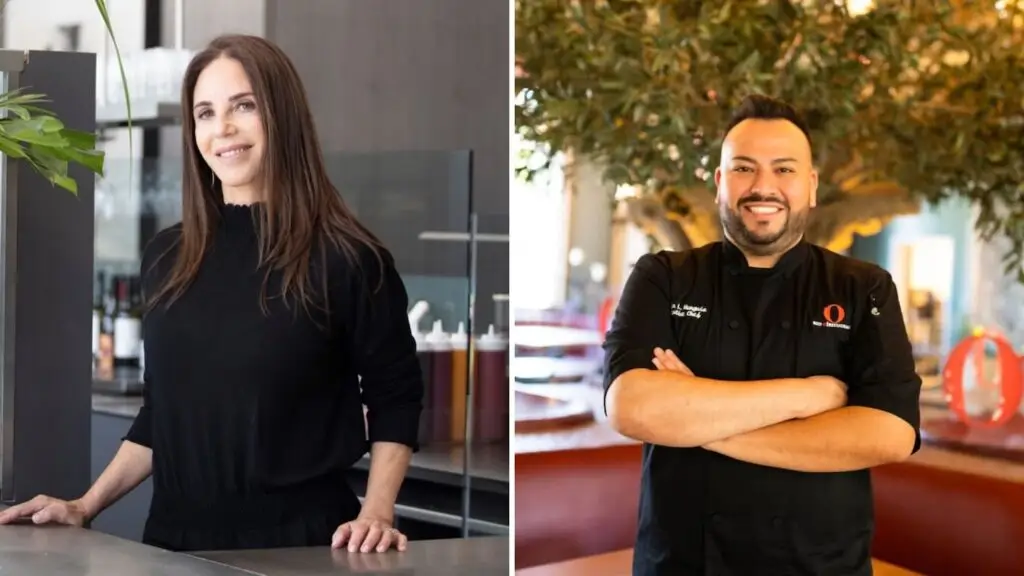
Then there’s celebrity pastry chef Karen Krasne, owner and executive pastry chef of Extraordinary Desserts, James Beard House alum, and a woman Forbes once ranked among the top 10 pastry chefs in the country—which tracks, because you might find her holding court next to a tray of her roasted pecan shortbread dipped in white chocolate, explaining exactly why this is the flavor combination. You will listen to every word, too, because you’ll want to try that cookie.
This is an opening night party where the person next to you in line might just be the one who baked the thing you’re about to eat.

Fifty years ago, a Napa Chardonnay beat France at its own game and rewrote what the world thought it knew about wine. This dinner is that legacy, poured by the family who built it, course by course.
Under the arches at Fairmont Grand Del Mar, Ernie Hahn and the Hahn family, who partnered with the Barretts to revive Chateau Montelena into the Napa powerhouse it is today, host an evening built entirely around the winery’s most iconic pours. Every course gets its own pairing straight from the Montelena portfolio, so you’re not just hearing about the Judgment of Paris, you’re tasting the wine that started it.

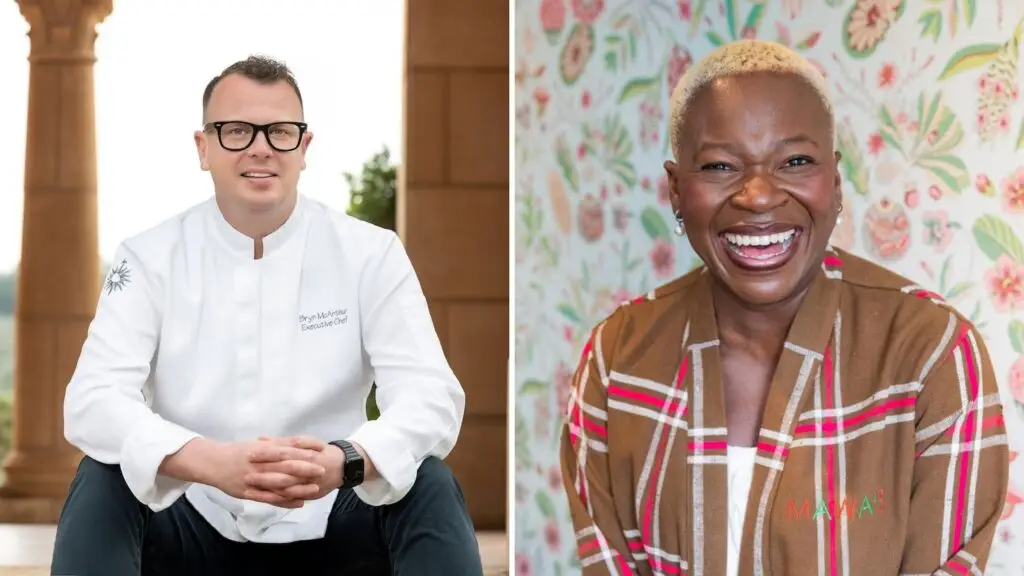
Chef Mawa McQueen, a former James Beard Best of the West winner out of Aspen, brings globally inspired cuisine and serious technique to the table. Alongside her, Fairmont Grand Del Mar’s executive chef Bryn McArthur leans into farm-to-table sensibility shaped by a career of global kitchens. Together they’re building a menu meant to hold its own against wine that already changed history once.
This is the rare dinner where the wine isn’t just accompanying the meal, it’s the reason the meal exists. Fifty years after Paris, the rematch is happening right here in Del Mar.

Isabella Dallas is a freelance writer for San Diego Magazine and the Arts and Culture Editor at The Daily Aztec in her final year at San Diego State University. She previously worked as an editorial intern for SDM, but when she’s not writing, you can find her trying the best coffee spots in SD, devouring the latest rom-coms, and indulging in anything and everything pop culture.
At Vi at La Jolla Village, residents don't have to choose between security and adventure, connection and independence. They get all of it.
Today’s seniors are more connected than ever, with a renewed focus on retirement as a time of discovery and enriching experiences. The ultimate reward for a retirement well-earned is the wisdom to appreciate it all, and what better place to enjoy that unique perspective than Vi at La Jolla Village, in the heart of San Diego.
All-access pass to good living.
As a Continuing Care Retirement Community (CCRC), Vi provides access to a connected and fulfilling community while making it easy to plan for future care, should the need ever arise. With a care plan in place, residents enjoy greater financial predictability and long-term value, freeing them to focus on making the most out of retirement.
Resort-style amenities at the epicenter of a cultural hub like San Diego offer a retirement experience unlike any other. Paired with exceptional dining, spacious accommodations and dedicated staff, the best of maintenance-free living is all around. And with the introduction of Vista 360 Well-Being, Vi’s panoramic approach to wellness, there are more ways than ever for residents to access it all.
The harmony of mind, body and community.

The key to longevity is striking the right balance in maintaining an active lifestyle with an active mind in a fulfilling community. With newly renovated community spaces and restaurants, Vista brings a variety of opportunities for residents to elevate their well-being through Vi-exclusive “Signature Experiences.”
Vista Enrich takes an evidence-based approach to brain vitality, keeping residents at the forefront of cognitive health through exergaming (exercising + gaming), nutritional plans and informative workshops. It is also home to The Brain Vitality Studio, an innovative facility dedicated to cognitive fitness that has garnered national recognition.
Vista Discover invites residents into stimulating educational experiences, from chef-led cooking demos and guided wine tastings to lectures at local universities and intimate lectures following cultural outings.
While Vista Enrich focuses on brain health and Vista Discover engages residents intellectually, Vista Explore cultivates a sense of adventure through curated travel and local excursions. But broadening one’s horizons doesn’t always require a plane ticket. One recent event brought a taste of the world right to the community: an onsite “jazz cruise” featuring live music and global cuisine served at a series of themed “ports” all within the community’s own ballroom.
“Location, location, location”

One of the biggest perks of life at Vi at La Jolla Village is its proximity to just about everything. With easy access to transportation and local attractions just steps away, residents can explore and engage with their community at their own pace.
“There are trolley and bus stops within a 5-minute walk that will get you to the beach, UCSD Campus, medical appointments, downtown La Jolla or San Diego, et cetera. We rarely use our car,” said resident Tom Yager.
With the best of San Diego just steps away, residents don’t just live in the city, they live within reach of everything that makes it special.
The best of all worlds.

At Vi at La Jolla Village, retirement isn’t a chapter to slow down; it’s an invitation to discover more. Tailored community experiences created by Vista, paired with the vibrant pulse of San Diego just outside the door, mean that residents don’t have to choose between security and adventure, connection and independence. They get all of it.
This is what an all-access pass to good living looks like: the comforts of an elevated lifestyle, a community built for growth and a city made for discovery – all in one place.
To learn more about Vi at La Jolla Village or for details on available floor plans, visit ViatLaJollaVillage.com/SDM.
Jonathon Glus on the Art + Design District, investing in the creative economy, keeping artists in the city, and what we can learn from places like London and Chicago
Jonathon Glus is the Prebys Foundation senior fellow leading the development of the Art + Design District at the Downtown San Diego Partnership. He has been asked what an arts and design district is many times. In our conversation, I asked him instead to describe what it isn’t. His answer opened up a broader discussion about what San Diego has and hasn’t invested in, what it has the capacity to become, and what other cities have done that we haven’t. Glus speaks about global art fairs and architecture biennials in Chicago and long tables at dinner parties all with the same fluency. He also discusses who gets to live in the neighborhoods where creative work happens, and what it means when they can’t afford to stay.
Jonathon Glus: It is not a place designed intentionally and specifically for tourists. Of course there will be opportunities for tourists to come, but the district is really focused on creatives, on creative education, and on the creative workforce—as well as our major performing arts organizations. That is the emphasis.
[It needs to] develop greater connectivity between the anchor institutions—the symphony, Broadway San Diego, the opera, all the wonderful things happening in Balboa [Park]—and the creative workforce that will be living and working in that neighborhood 24/7.
We have not been intentionally investing in the contemporary art product that other major cities have been building. A contemporary art fair. A biennial that reflects the ethos of this region. Chicago developed an architecture biennial about eight years ago. London has a design biennial. Desert X, right here in Southern California, invests in and elevates contemporary artists inside a city. We have not really been playing in the global art market in a way that we have the capacity to.
We have a wonderful foundation. Two theater companies that produce work that goes to Broadway more than many regional theaters in the country, major museums, artists teaching at UC San Diego and University of San Diego. What a city does when it wants to take itself to the next level is intentionally create the product. Miami went after the Art Basel fair; they did not passively receive it. You have to have the intention and the will, and you have to go after it. We haven’t done that in the way that other cities have.
Look at what we did with the tech sector; we’re now a major tech center. That was intentional. Leadership organized around it. We have to do the same thing around the arts. We have a lot of contemporary art collectors here. We have a lot of galleries. But the ecosystem of the business of contemporary art is not as organized or as visible as it should be.
It’s bits and pieces of different cities. Dubai has invested very quickly and very intentionally in contemporary art—art fairs, design fairs, higher education, artist residencies from all over the world. London has centered artists and creatives in the contemporary zeitgeist in a way that was not true 40 years ago. They built biennials. They ensured British artists had affordable housing and workspace. They made sure the media paid attention to what they were doing.
If you don’t have an artist at your dinner table, it’s not a dinner party. That sounds elitist, but it’s true. It shows the value that artists have in a community. Our relationship culturally with Tijuana is really significant here because artists in Baja seem to be at the table.
They aren’t. When super creative people are in a community doing extraordinary work, that draws other super creative people doing extraordinary work. That’s why other arts and design districts around the world end up populated with some of the most interesting restaurants and young fashion designers. Creatives want to be around other creatives.
Our creative economy already employs about 170,000 people and generates more than $11 billion in economic activity. It’s large and robust. But we must center all of this in accessibility and affordability. Williamsburg used to be affordable. Artists can’t afford to live there anymore. Wicker Park and Bucktown in Chicago—artist central, now unaffordable. If we’re going to invest in this district, we have to be really intentional about housing and workspace, so creatives have a place in the future of this district.
I think the lesson is that nothing changes. What do people love? Long tables. Why? Because you’re with a lot of people—some you may have known your entire life, but most you don’t. And if it’s driven by a creative process, all the better. We know one of the best ways to do that is around food, but also music.
For the Art + Design District, part of why we’re leaning into the process is because, culturally, we’re bringing down the barriers between film, fashion, multimedia, tech, and architecture. It’s an experiential mashup in the best possible way.
And it’s not just about art and design, but community writ large. Creative expression is something we all desire. Whether it’s at a long table, at the opera, or in your studio, we gravitate toward creative expression as a way of building community and communicating with the people around us.
I hope you are writing about this in seven years when the district is fully mature. But this is just the beginning for all of this. I think that’s what’s most exciting to me. We don’t know what this is going to be like, but we know it’s going to be creatively centered, and that’s super exciting to me.
A conversation with Sebastián Morúa on art, community, and why the club’s future heroes should include the creatives helping build it
Sebastián Morúa is the Senior Vice President of Brand & Innovation for San Diego FC. He oversees Playmakers, the program through which the club has, over the past three years, engaged with over 80 working artists—not as marketing partners, but as co-creative directors.
Morúa didn’t build Playmakers as a community-outreach program bolted onto a Major League Soccer franchise. He built it as the identity of the franchise. When we sat down, he talked about the World Cup, San Diego’s creative workforce, his challenge to other sports franchises in the city, and the mural of heroes he hopes people will see one day when they close their eyes and picture San Diego FC.
Sebastián Morúa: I want to answer that in two parts. Philosophically first—because I think what you’re really asking is why should any sports team do this when most don’t.
Sport is a platform for transformation. It has proven that over and over. We saw it this summer with countries participating in the World Cup for the first time and what that did in their home countries—the sense of self-identification, pride, possibility. That is the power of sport.
When you take a sports team that’s fueled by that principle and understands what it could mean for other stakeholders in a community, you start to think about what you can accomplish in collaboration with them. One of those stakeholders, very early on, was the creative community. If we were going to build a team that represents this place and its people, we needed to go to the source. Artists are uniquely positioned to translate the essence and the soul of a community. When you zoom out and look at the multitude of artists in a place, you start to see the fabric of that local culture. That’s where the sense of pride and possibility gets unlocked.
Our mission is to create opportunities for talent to flourish and make San Diego shine. That means the club is a platform. When we started doing the early research for the brand, we brought artists into our focus groups. The response was immediate. There was a clear need. In 2024, we ran the first full year of what became Playmakers, working with more than 20 artists to help us tell the story of how San Diego FC could weave 18 distinct communities together.
We’re in the business of developing communities through sport. We’re not in the business of fútbol to entertain communities. That is an outcome—but not the purpose.
No. I wasn’t thinking about where this was going or how much it would cost. It instinctively felt aligned with our organizational purpose, and we made a decision to go for it. Now it’s become what it’s become.
If a fan closed their eyes 20 years from now and tried to paint a mural of the heroes that make up the club, they would see a big percentage of Playmakers artists on that mural. Ask any fan about the team they’ve supported for decades, and they’ll tell you about players, maybe a coach, maybe an owner. We’re expanding that. In our mural, there’ll be artists, entrepreneurs, community leaders, youth coaches. The community will be present.
Three to five years from now, Playmakers is an established community of creatives who have co-directed the identity of the club and the evolving identity of San Diego. If we keep the pace we’ve kept, we should have collaborated with 150 to 200 artists whose stories we’ve told and whose next steps we’ve helped support.
There’s a huge benefit for us as a club and as a brand. This is symbiotic. The artists have a need, we can support that need, and in return the community cares more about our club because of the investment we’re doing in the community. That’s what I would tell another organization.
San Diego is waking up to how much it has to offer the global conversation around culture. There’s a purity to life here—partly because of the weather, which allows us to spend so much time outside, in nature—and that exists alongside this incredible richness in food, music, art, and now sports.
I have a sense that San Diego is ready to unlock its full potential. You see it in the artists and creatives here. They’re ready. There’s very little hesitation. It’s more like: “Hell yeah, of course I want to do this. I know I’m talented. I’ve been waiting for something like this.”
That energy, combined with the unique lifestyle and character of this place, creates a really exciting sense of what San Diego can become in the years ahead.
I would ask: What would you say to the other big players in San Diego who are—or could be—shaping the cultural fabric of our community? Do they understand the symbiotic benefit? Are they supporting it?
Because Playmakers, in the end, is a cultural compass. It’s making sure that San Diego still feels—and will always feel—represented in the creative process of building San Diego FC and what that means for San Diego.
The pitch is a canvas. Athletes are painting collectively during every game. There is a story in every game. That’s the link between sport and art. At the core, it’s the same creative process.
San Diego Magazine's Private School Guide 2026
NewBridge School is San Diego’s only school dedicated to the education of students with dyslexia and related learning profiles. For 30 years we have successfully served students with dyslexia, dysgraphia, dyscalculia, receptive/expressive language disorders, ADHD, executive functioning and memory deficits. Students transition successfully into academically rigorous high schools and colleges across the country. Why NewBridge? Training, training, training (plus intensive individualization, and comprehensive program design). All teachers are trained and retrained biennially in Orton-Gillingham, the only approach proven to remediate dyslexia based on Science of Reading research, and complete a year-long training program. Every aspect of our program is designed around our students’ learning styles and needs. Every class is taught by a highly-trained expert, and our Speech/Language and Occupational Therapy teams embed throughout the day. Our multisensory, multi-tiered math program has been developed in conjunction with sister schools and experts across the country. Don’t wait—early intervention is magic!
Enrollment: 100
Grades: K – 8
Tuition: $30,000
Deadline: Rolling
Gender: All-inclusive
Details Nonsectarian
Open House Tours by appointment

12285 Oak Knoll Road • Poway, California 92064
858-679-5744 • [email protected] • thenewbridgeschool.com