Ready to know more about San Diego?

Subscribe
Features JUNE 2, 2025

The Future of Fish Is Farmed: In the Water at Baja’s Largest Tuna Ranch

Pacific bluefin once dominated San Diego, but in our modern food system, wild fish come from cages
The Future of Fish Is Farmed: In the Water at Baja’s Largest Tuna Ranch
Courtesy of Baja Aqua Farms

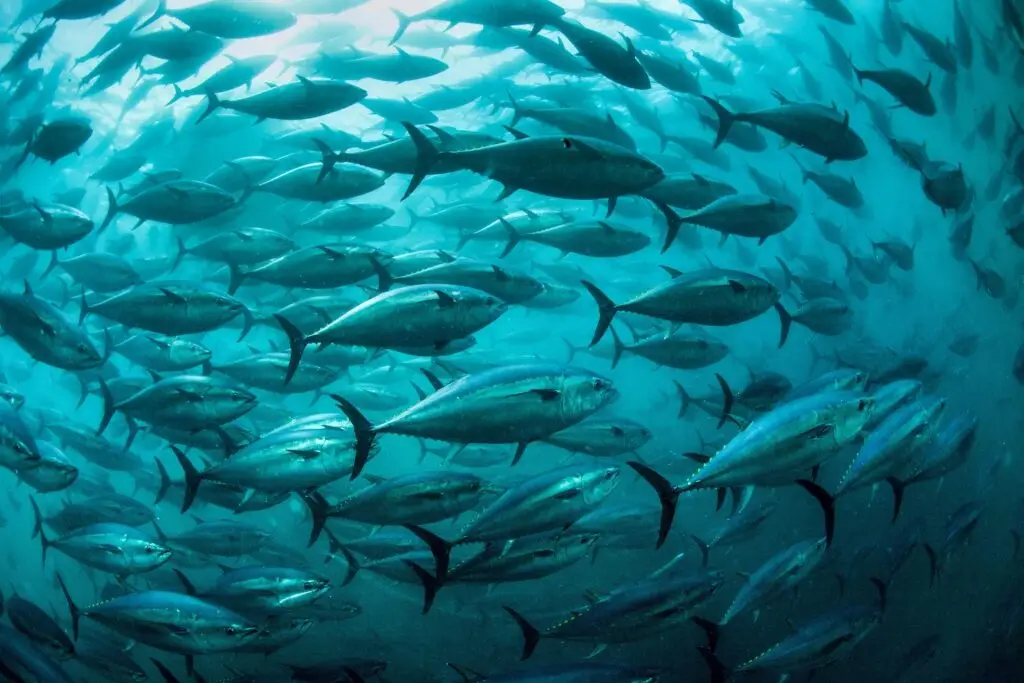
Swimming above a thousand bluefin tuna in the deep waters of the Pacific, one feels a dizzying calm. Below, the fish move in endless, unhurried loops, slowly growing plump in their monotony. Weighing around 170 pounds each, the fish in this net-pen are considerable. Heavy as a man and as wide as a surfboard, they move like hydrodynamic refrigerators, pewter backs reflecting water-filtered light like suncatchers.

Not long ago, these fish were in the open ocean, gunning 18 miles an hour through cold currents, possibly detecting our planet’s magnetic field using mineral deposits in their snouts, and tracing ancient migration patterns through the largest ocean on Earth. But here, with a gringo in a wetsuit bobbing above them, the fish merely draw lazy loops inside a giant aquaculture cage tethered far offshore, awaiting their fate as some of the most sought-after and expensive cuts of protein on the planet.

This is Baja Aqua Farms (BAF). Located in Mexican waters southwest from San Diego, BAF is, at any given time, home to tens of thousands of tuna worth tens of millions of dollars, making it one of the largest tuna ranching operations in the world and a major player in a modern global fish farming industry that now supplies more than half of the world’s seafood.
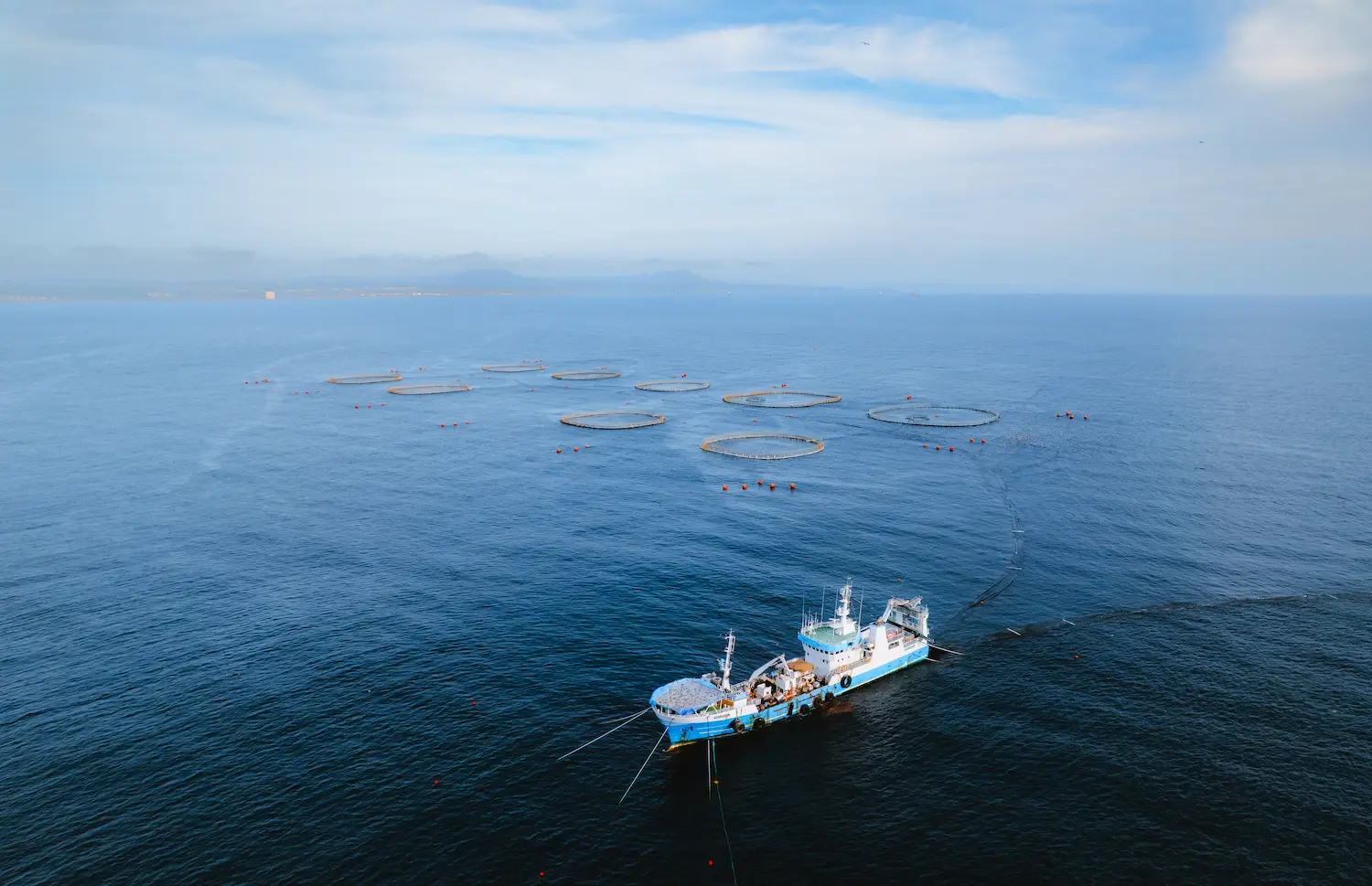
A Baja Aqua Farms boat pumping thousands of pounds of small fish into dozens of net pens filled with bluefin tuna
Courtesy of Baja Aqua Farms
Anchored in the deep waters of the Pacific, the main feeding vessel at Baja Aqua Farms pumps thousands of pounds of small fish into dozens of net pens filled with slow-circling bluefin tuna.

If one were to, say, fly a helicopter over this operation, the view through the omnipresent cloud of gulls would prove impressive. Thirty Olympic pool–sized net-pens float in an open-water grid, each filled with a single school of a thousand or more bluefin. Some are huge, weighing more than 400 pounds, and some are smaller, around 45 pounds (still a lot of fish). And anchored in the middle of it all is a sizable, computerized central feeding vessel where specialists sit on aging rolling chairs inside an air-conditioned cabin, monitoring each school’s food consumption and their pen’s water quality on screens 24/7. A ship that thousands of pounds of feeder fish visit briefly each day after being offloaded from sardine boats and before being pumped into the bellies of tuna.

I ventured here on an educational mission. As a lover of both the ocean and tuna, I wanted to find out how bluefin—an animal fished nearly to extinction within my lifetime—makes its way into the tartares and chirashi bowls of today. My search led me here, face down in the water, listening to the sound of my breath through a snorkel and contemplating the vast machinations that keep these incredible fish churning through the global food system.

Silent as they are, these tuna tell a story about the future of fish and the future of how we interact with the ocean.

All of which we’ll get to. But first, let’s eat.
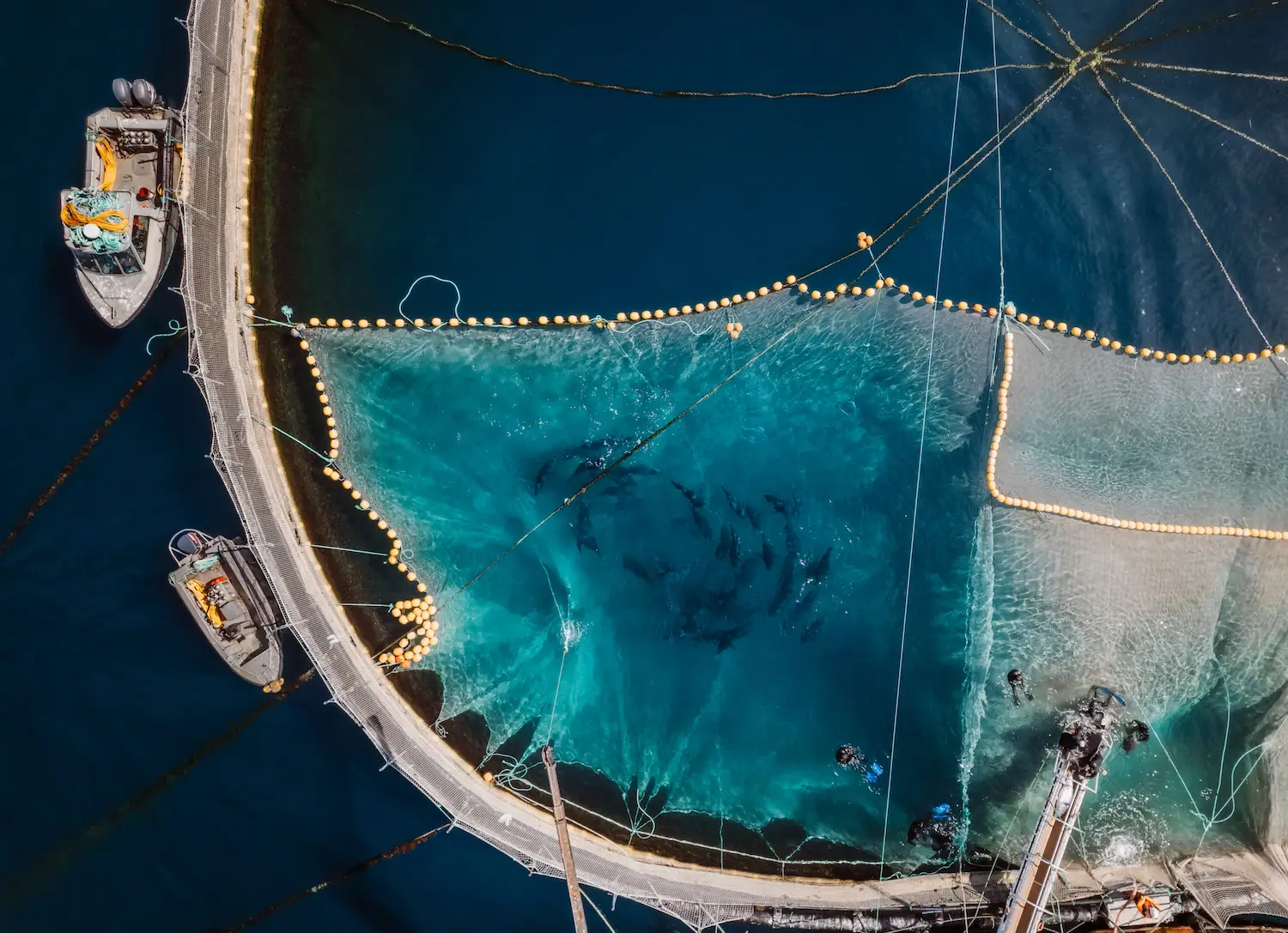

Baja Aqua Farm workers separate  tuna from the school and stun them with electricity before bringing them aboard the harvest boat
Courtesy of Baja Aqua Farms
Workers separate a select number of tuna from the school and stun them with electricity before bringing them aboard the harvest boat.

By the time the bluefin arrives on my plate as glistening, fatty slices of pink otoro at Ophelia restaurant in Ensenada, it has already crossed oceans, boundaries, and moral terrain.

This fish was part of a school of tuna born in the open Pacific from eggs laid off the coast of Japan, captured as juveniles in Mexican waters by BAF boats in vast purse seine nets, towed for months to the BAF ranch, and fattened for many more months with feeder fish harvested from our coastal ecosystem by the BAF sardine fleet, then efficiently and bloodily killed, refrigerated, and brought to shore here in Ensenada to be packaged and driven over the border to LAX, where they either get exported—mostly to Japan— or eaten in high-end omakase and strip-mall sushi joints throughout San Diego, once the world’s tuna fishing capital.

Bluefin tuna, recent developments have shown, is both a symbol of past overfishing and a surprising conservation success. And its future now lies in operations like Baja Aqua Farms, which represent the next phase of human seafood consumption.

With me at the table, talking tuna, is Rodrigo Armada Tapia, the head of sustainability at BAF. Having grown up in Ensenada, Tapia speaks with pride about the region’s food culture—where tuna is often a star ingredient. Before taking me to the farm the next day, he wanted me to try the product, which BAF packages under the name Bluefiná.
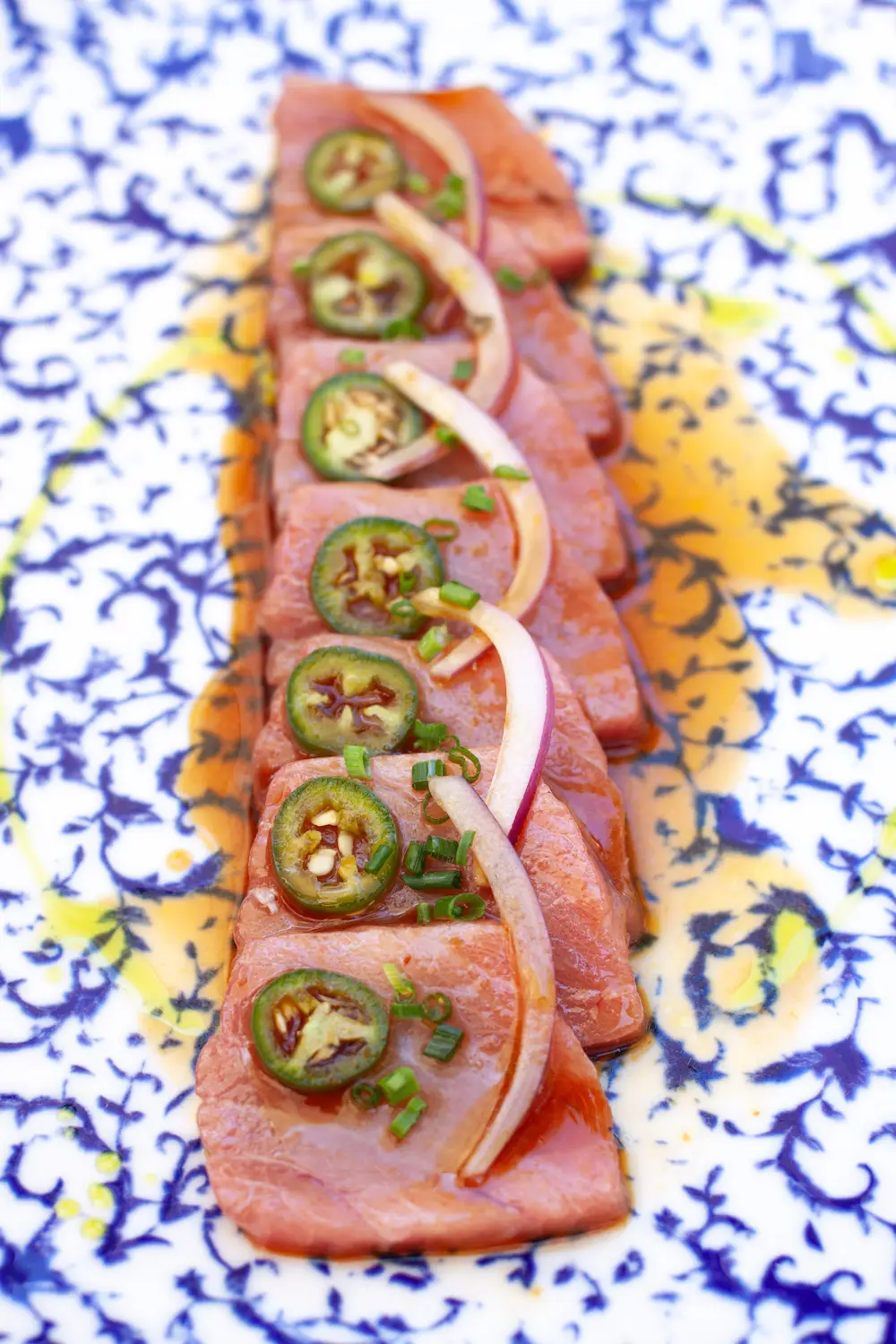
Bluefin tuna otoro from Ensenada restaurant Ophelia featured on the Mexico Michelin guide
Photo Credit: Mateo Hoke
Otoro at Ophelia in Ensenada.

“You can’t understand the fish until you taste it,” he tells me.

Ophelia is Michelin-recognized. It sources bluefin from BAF, as do some notable restaurants in San Diego.

This is because BAF fish is some of the best bluefin money can buy. Fast-swimming wild tuna store fat in their bellies; the rest of the meat is relatively lean by comparison. But with the caged and portly BAF tuna, pillowy fat veins run throughout the entire fish, like a spider got inside and spun a web of tallow.

Dishes arrive, highlighting meat from various parts of the fish—akami from the side, a pile of flesh scraped from the ribs. Bluefiná tuna is not frozen for transport (it can make it from the ranch to Japanese markets in 72 hours), and the freshness of the fish combined with the high fat content translates to a peach-skin, custardy episode on the palette. It’s distinctive, delightful, and somewhat disorienting. I love tuna, but I don’t always love eating it. For my entire adult life, the stakes have felt too high. Every fish consumed was one fish closer to zero.

But that story is changing. Fished nearly to extinction from the mid-1900s to the early 2000s, today’s Pacific bluefin populations are back to near-heyday levels.

“Not only have we met the rebuilding targets, but we’ve actually already exceeded them,” says Josh Madeira of the Monterey Bay Aquarium Global Ocean Conservation team. The bluefin population rebound is a full decade ahead of schedule, thanks to international conservation efforts.

For the first time since the Monterey Bay Aquarium Seafood Watch program began telling consumers in 1999 which fish are ocean-friendly to eat and which should be avoided, consuming certain Pacific bluefin populations—like those caught in California waters—is considered only a moderate environmental risk. That may not sound like much, but it signals a major step for bluefin.

“This is a great success story,” Madeira says. “But there’s much more work to be done.”
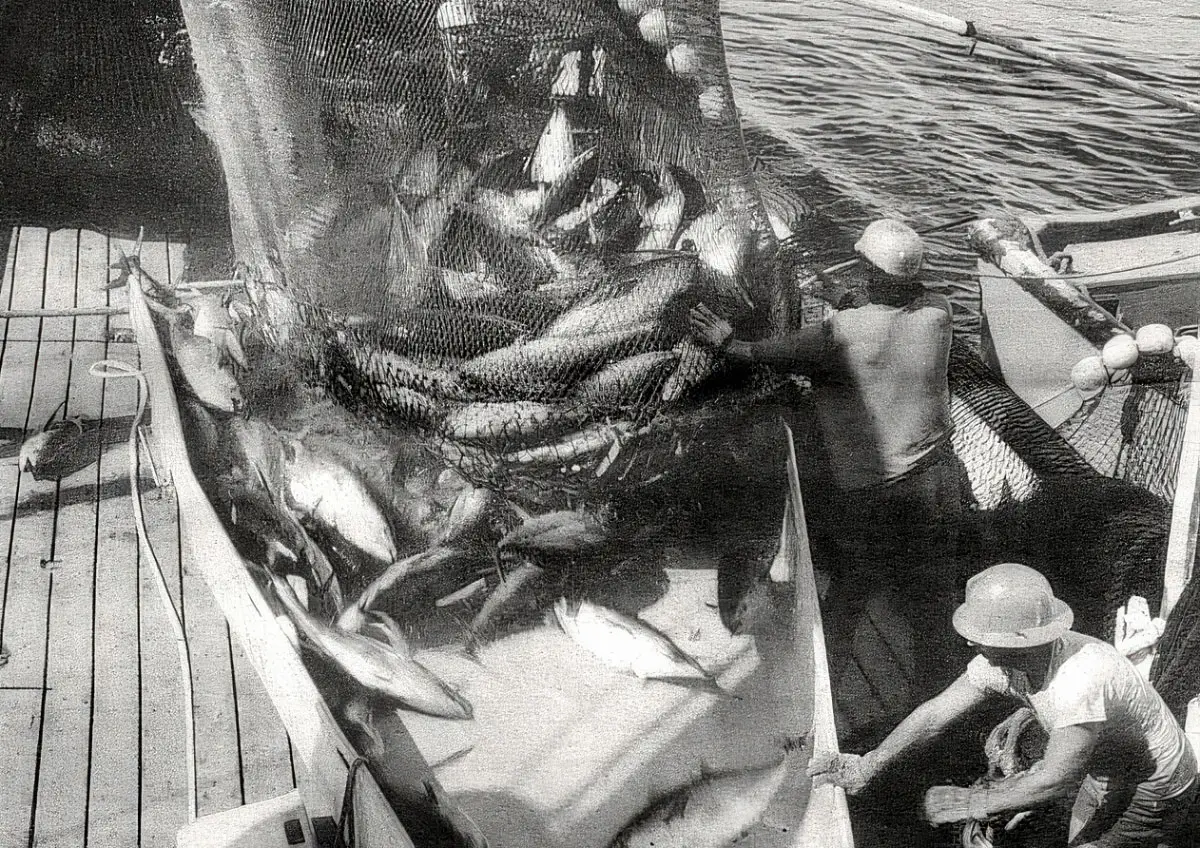

Historical photo of San Diego's tuna fishing industry
Courtesy of Maritime Museum of San Diego

Tuna, of course, means a lot to San Diego. And to understand how we got here, it helps to look back.

Throughout most of human history, tuna were seasonal, wild, and revered—an oceanic mystery glimpsed briefly, then gone. For millennia, various peoples chased tuna with harpoons and caught them in elaborate stone weirs. Aristotle wrote of their migratory patterns hundreds of years before Christ was multiplying fishes, marveling at their strength, speed, and uncanny navigational sense. It wasn’t until the 20th century, when canned tuna became a pantry staple, that the fish transformed into a mass-market American commodity.

In San Diego, bluefin were hauled in by immigrant fishermen from Portugal, Japan, and Italy; packed in salt; and canned—cheap protein for various war efforts and school lunches. Forty-thousand San Diegans worked in the tuna trade. Communities lived off it; entire neighborhoods came to be defined by it. Two of the largest canneries in the country were here. The city smelled, quite literally, like tuna.

New coookbook San Diego Seafood: Then and Now by

But overfishing soon led to declining populations. By the 1980s, the canneries were gone. Tuna didn’t disappear, though. It simply went upscale.

Sushi—once an exotic, niche cuisine—became not just popular but aspirational. Bluefin prices soared. By 2012, Pacific bluefin populations had plummeted to around two percent of historic levels.

Which is where strict regulations came in.

As Tapia tells it, today’s tuna industry is largely controlled by a complex system of catch quotas heavily regulated by international agencies referred to by five-letter acronyms. Only certain countries are permitted to commercially fish for bluefin. Japan—which consumes 80 percent of the world’s bluefin tuna—gets the highest quotas. Mexico’s quotas are respectable, higher than those of the US.

It’s a system that’s imperfect, controversial, and not overly friendly to American fishermen in San Diego and beyond, but something about it is working to contribute to species recovery. In the US, catch limits for commercial Pacific bluefin tuna vessels increased almost 80 percent for the 2025–26 season. Bluefin, it seems, are back. The question is, will they last?
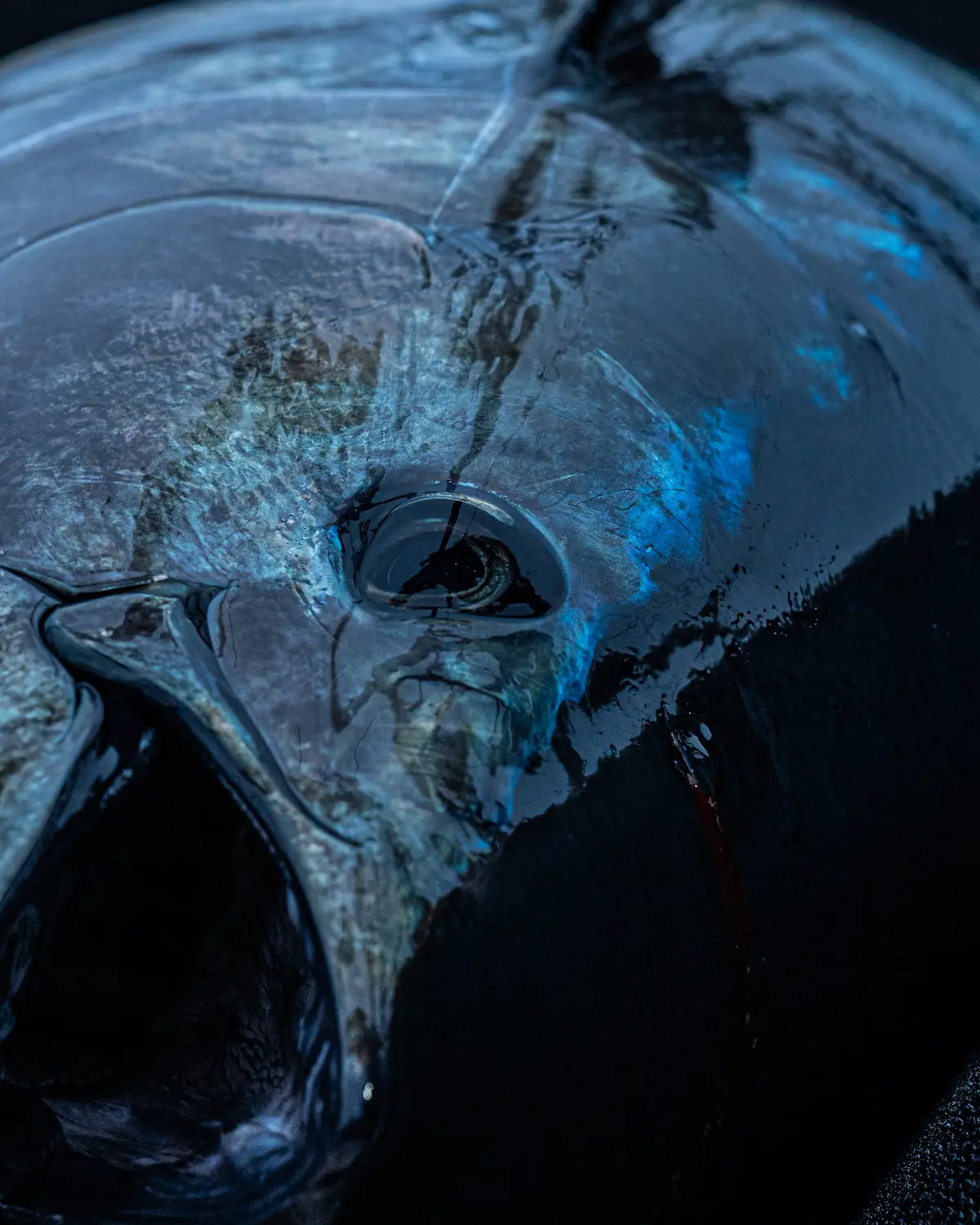

Close up of a bluefin tuna fish
Courtesy of Baja Aqua Farm

To better understand how tuna farms play into this, I cast a line out to the Scripps Institution of Oceanography in La Jolla. Soon, I was talking with Luke Gardner, an aquaculture specialist at California Sea Grant, a state-federal partnership that funds coastal and marine research.

According to Gardner, tuna ranching operations like BAF and other similar operations in Japan, Spain, and Australia are able to abide by catch-weight quotas while still providing large amounts of fish. Essentially, they catch skinny and sell fat.

“Tuna aquaculture means that people still get to eat bluefin tuna without fishing the stock to commercial extinction,” he says.

But tuna farms are not without their problems. BAF, and other smaller, seasonal Mexican operations, rely on wild tuna stocks to fill their pens (closed-loop, egg-to-plate tuna ranching is still in its nascent stages, with only one company in Japan claiming to have figured it out), and the ranches require large amounts of wild feeder fish stocks to fatten their fancy fish once they’re caged. Concentrated waste can negatively impact nearby habitats.
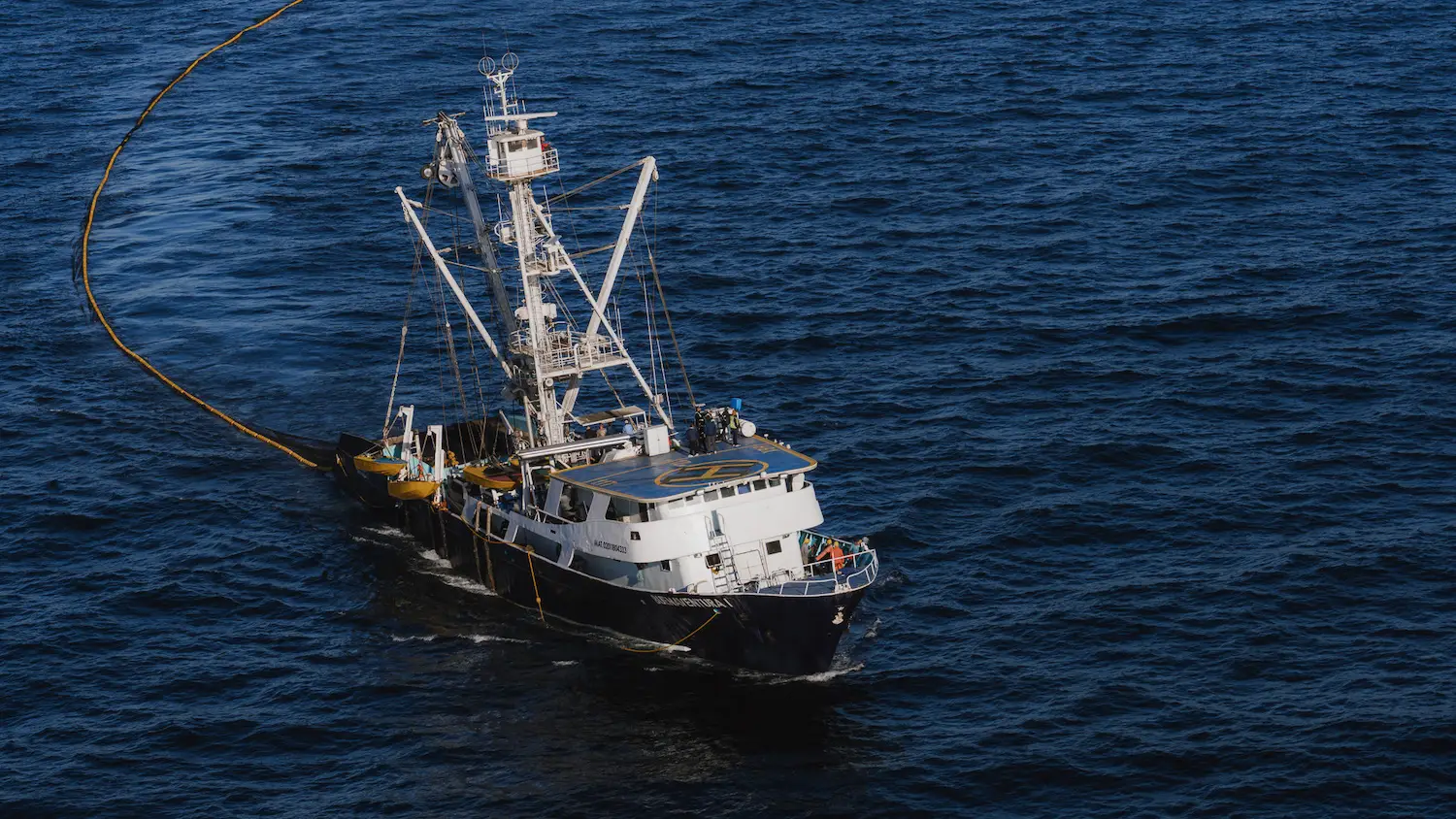
Fishing vessel working on the  Baja Aqua Farms off of Ensenada
Courtesy of Baja Aqua Farm

All this means that, despite the potential benefits of tuna ranching, as of its last report in 2021, Seafood Watch categorizes Mexican net-pen tuna as a fish to avoid eating. But that, too, could change soon when the next Seafood Watch report comes out, Madeira suggests.

“We have an update in progress, and we do know there’s a lot of new information,” he says.

Crunching a Bluefiná tuna tostada, Tapia explains that BAF is doing all it can to improve its sustainability, working with a staggering number of regulatory and certification bodies.

Blue Nalu labgrown seafood sushi roll featuring artificial fish from Blue Nalu

“Everything that we catch at sea, we report. You can trace every single catch. We have observers on board all our tuna boats and cameras that are audited by a third party,” he says. “It would be borderline insane to not make sure that the tuna and sardine resources are there for the prolonged future.” He adds that BAF is also working closely with the Marine Stewardship Council toward a certification for its sardine fleet and is certified dolphin-safe by the Friend of the Sea program and the International Marine Mammal Project.

“I know Baja Aqua Farms is working hard to try to make improvements and is paying close attention to things like the Seafood Watch assessment,” Madeira says. “Consumers are saying that sustainability matters. I’m encouraged by that.”

Finally, the otoro—the benchmark of bluefin—hits the table. Served as sashimi, rosé-colored and ribbed with blubber, it dissolves like a pat of cold butter dipped in the sea. For a moment I turn off my mind, allowing myself to simply and blissfully enjoy one of the ocean’s greatest gifts.
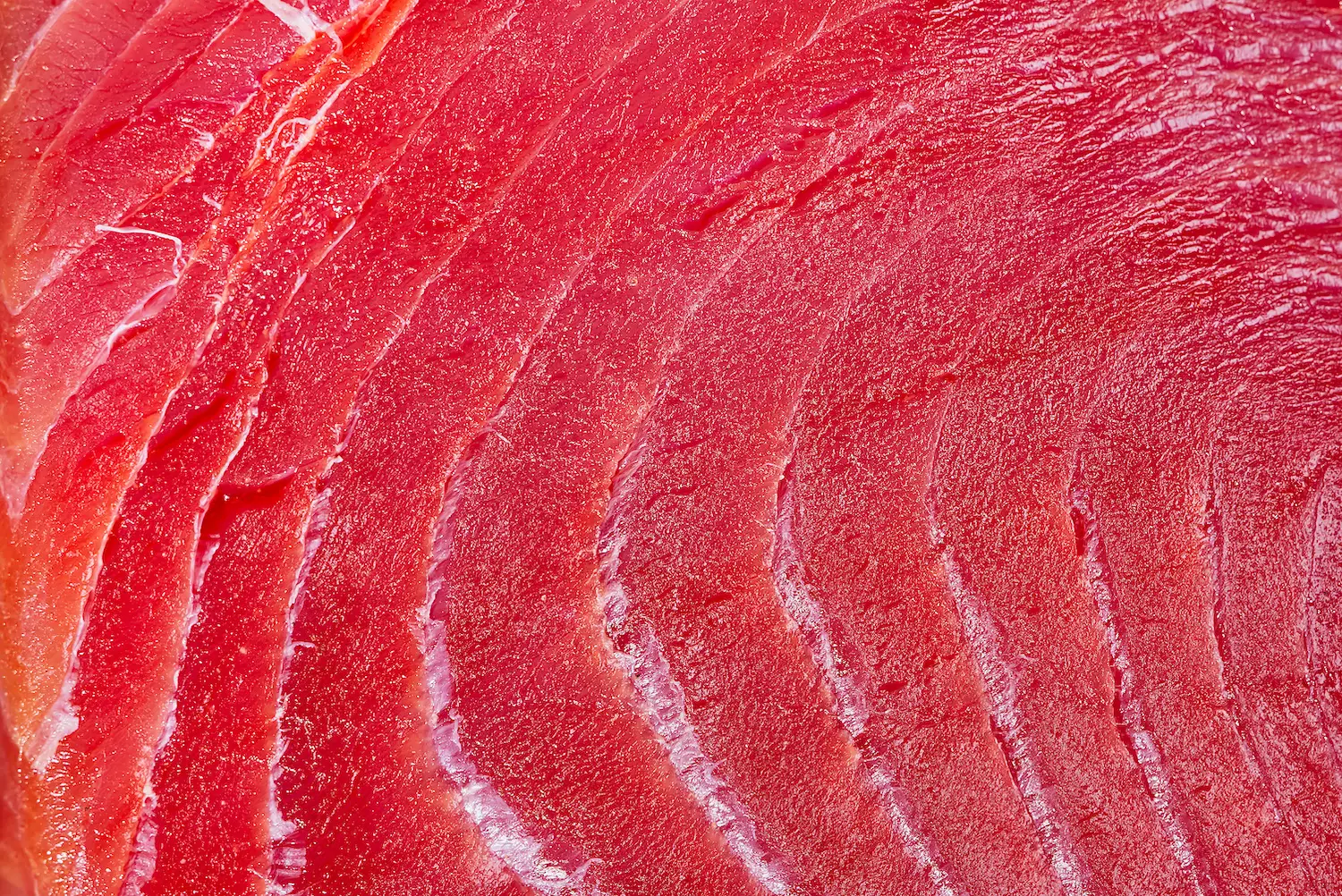
Macro photo of tuna sashimi harvested from the Baja Aqua Farm

“Quality-wise, Bluefiná tuna is [expletive] amazing,” one highly regarded SD chef of a Michelin Bib Gourmand restaurant tells me. “It’s crazy fat, even on the top loin. Every sushi chef’s dream.”

But, he adds, he doesn’t want to be associated with Bluefiná fish, no matter how chubby.

“As a Southern California restaurant owner who believes in sustainability and buying local, farm-raised bluefin is not in line with our ethos,” he says. “We wait for our wild bluefin to come in, and we know where it was caught and when.”

That tension—between wild and farmed—remains at the core of the modern bluefin story.

Gardner doesn’t buy it. “People have this perception that a farmed fish is bad, but they eat farmed everything else. Why not fish?” he says. “These operations can be good for bluefin tuna when they’re regulated and overseen.”

The otoro is simple and divine, a near-perfect meal. Fighting an urge to order more, I am reminded that we live in an age where to eat seafood is to make a series of quiet negotiations: between ocean and operation, local and global, sustainable and extravagant. And no species captures the contradictions and complexities of modern seafood like the Pacific bluefin. A single fish can sell for millions of dollars. This is the Wagyu of the sea: a delicious, fatty luxury that relies on an even more complex system than its bovine counterpart.

So, full of tuna and questions, the next morning, I board a speedboat for an up-close view of the ranch.
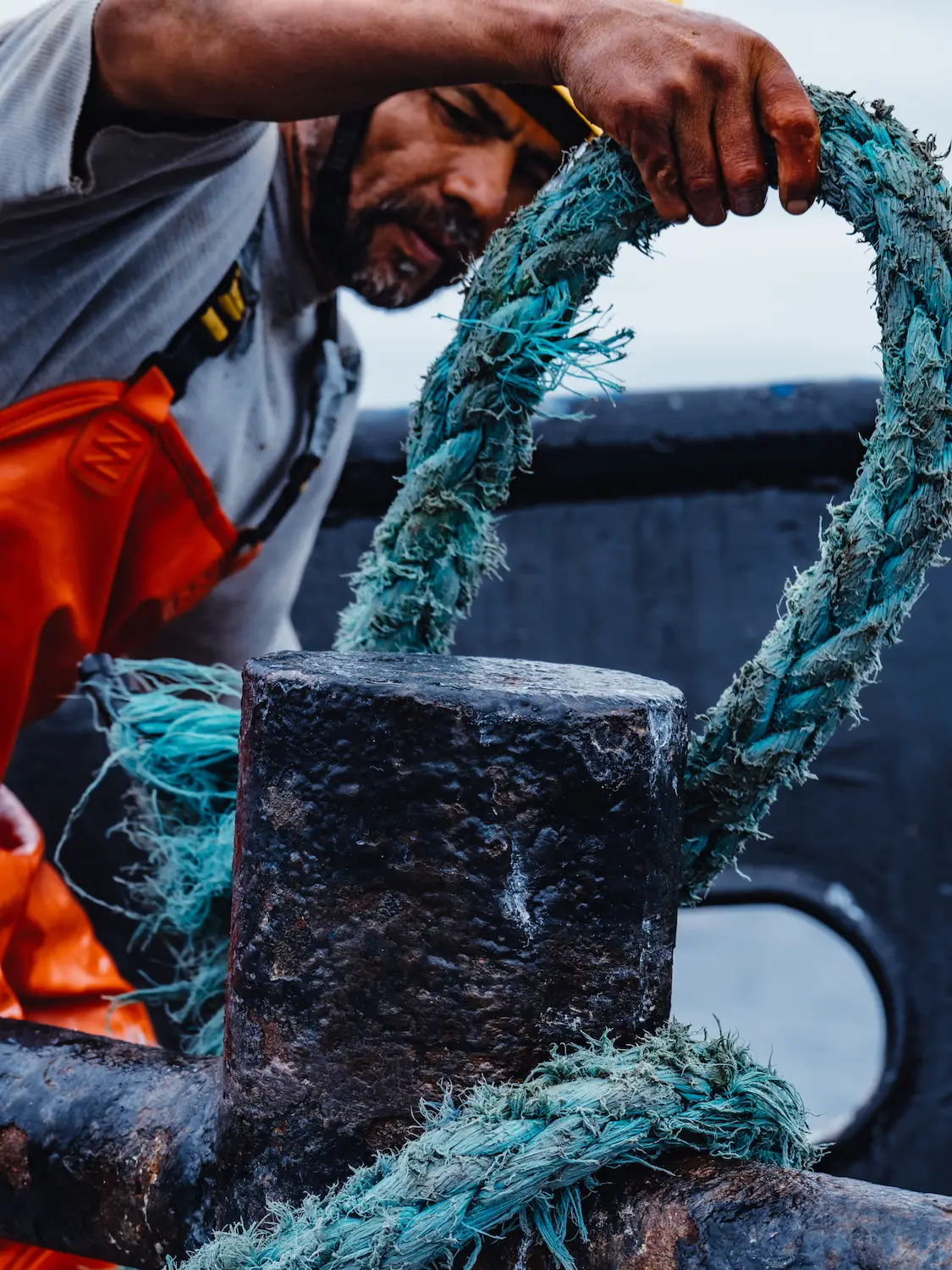

Baja Aqua Farm worker tying a knot on a fishing boat
Courtesy of Baja Aqua Farms
Upwards of 100 people work at the floating Baja Aqua Farms operation on a given day.

Getting to the farm means two hours of cold, rough porpoising from Ensenada. With me as chaperone is Tapia, plus a handful of other workers simply needing a ride to the ranch where they live and work for weeks at a time. I can hear Gardner’s voice in my mind: “They call it tuna ranching, and there are definitely people [at the ranch] you could associate with a kind of cowboy mentality,” he’d told me. “You have to be a little bit out there to do it.” No one speaks much during the loud trip in the dawn light.

The prevalence of gulls and sea lions hunting for scraps hint at the operation before the floating circles of the tuna pens come fully into view, each topped with chain-link fencing sticking many feet into the air for sea-lion defense—a hard-learned requirement, Tapia tells me as our boat slowly approaches the colossal main feeding barge, stained with rust and gull droppings. The place smells of fish flesh. We climb a ladder up the side of the vessel; hoist our bags up to the deck; and make our way over and around various tubes, ropes, riggings, and machinery to the main operations room.
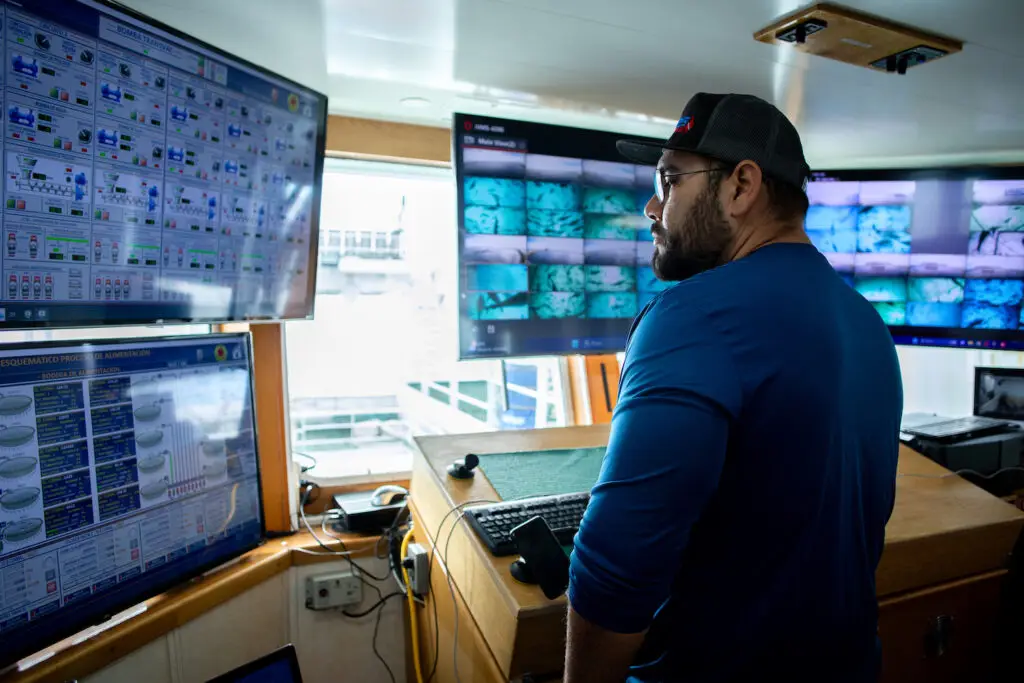
A Baja Aqua Farm worker monitoring the pacifc bluefin tuna feeding process on their offshore operations
Courtesy of Baja Aqua Farms
The main deck of the feeding boat offers an inside view of the modern food system. Here, specialists remotely monitor water quality and feed the tuna through tubes. Underwater cameras show a glimpse of life inside the cages.

Here in this room and out these windows, a large, invisible part of the contemporary tuna trade becomes visible. At the head of the operation, marine science experts point to giant screens displaying views from the dozens of underwater cameras that BAF uses to keep tabs on the fish in each pen. Specialists monitor when the fish have ceased eating and turn off the hose, so to speak. The screens show oxygen levels and temperature, checked three times a day at three different depths. BAF also routinely tracks phosphorus and pH levels below the pens, Tapia says. Behind us, with the help of AI, a specialist pauses a video to count each fish that came in from the most recent capture. Out on the water, small boats zig-zag from pen to pen.

Divers are consistently in the water with the fish, hand-cleaning and repairing nets (Tapia tells me BAF does not use the industrial net protectants that many operations do) and keeping a close eye on the product. On any given day, upwards of a hundred people—deckhands, divers, engineers, captains, maintenance crews—are out here working. The scale takes time to process, partly because I was not prepared for just how many small fish are required to fatten tens of thousands of large fish.

I suppose I had never seen literal tons of fish in person before—that is, until a sardine boat ties up alongside the floating warehouse on which we stand and begins pumping a few thousand pounds of burrito-sized fish into the big boat’s refrigerated hold like loose ammunition.

The sardines are dead, but not frozen. This is a big selling point for BAF, Tapia tells me—that its tuna don’t eat frozen fish or any of a number of fish-feed slurries that other tuna ranches around the world at times have to rely on and then medicate around.

“We don’t use antibiotics because we don’t need to,” Tapia says. “Because we’re feeding them only fresh fish like they get in the wild, our tuna don’t get sick.”
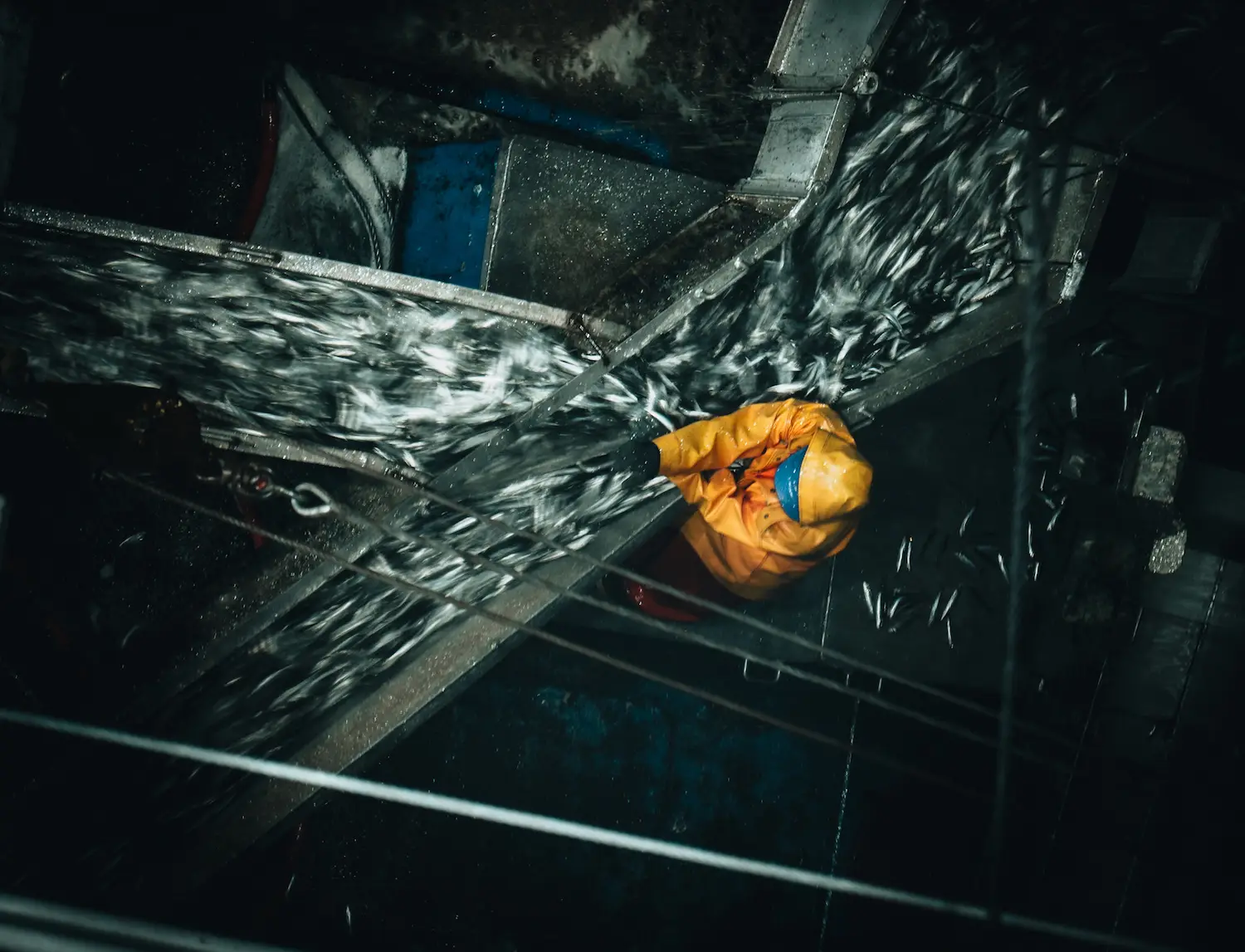
Baja Aqua Farm worker sorting sardines which make up a majority of the pacific bluefin tuna diet
Courtesy of Baja Aqua Farms
Baja Aqua Farms relies on costal sardine populations to keep its operation running. It takes about 25 pounds of small fish to convert to a single pound of bluefin.

The operation requires so many feeder fish because bluefin are not efficient weight-gainers. They have to keep swimming to force water through their gills and stay alive, so they are constantly burning calories. According to Gardner, this means it takes upwards of 25 pounds of small fish to produce one pound of bluefin. Not the most efficient farm animals.

“Compared to other species of fish aquaculture, bluefin are expensive to run,” Gardner says. “It’s like taking the Ferrari to the corner store to get milk, instead of your Volkswagen.”

During our time at the ranch, Tapia explains that, due to timing, I can either swim with the tuna or see the tuna harvest up-close. Rather than watching hundreds of tuna be killed, I choose life. I want to pay my respects.

But, before departing back to Ensenada, our cold little speed boat stops by the harvest ship to pick up a hitchhiker, so I end up with a view of the marine slaughterhouse after all. On board, men in waterproof bibs move with a kind of practiced urgency. The harvest is still in progress, precise and bloody.

First, divers section a specific number of fish off from the rest within the chosen pen and stun them with electricity to make them safe to handle. Then comes an assembly line of efficient killing. In the humane ikejime fashion of dispatching fish, crew members drive steel spikes into the tuna’s brains and a wire through their spinal cords to preserve the quality of the meat. The fish are bled and gutted. The gills and guts go to a fish meal plant. The blood spills quickly into the sea.

Tapia tells me BAF only kills fish it’s already sold, harvesting around 1,500 tuna per week.

As we motor away, I run some back-of-the-napkin math. According to the Bluefiná website, wholesale bluefin starts around $20 to $40 per pound and goes up from there.

Tapia won’t disclose how many tuna BAF has at any given time, but he does say the pens can hold upwards of 1,500 tuna each. If each of the 30 pens contain, conservatively, 1,000 tuna, and each fish weighs—again conservatively—say, 80 pounds, that’s a modest estimate of $48 million in the water. Today’s global tuna industry is worth $40 billion. The ocean is rich.

And bluefin, it seems, reveal not just the complexity of a single industry, but a larger moral calculus now embedded in every bite of seafood in our modern food systems: the shift from hunting to ranching, from wild to managed. We’ve already done it with pigs, chickens, cows, and corn. Now, for better or worse, we are doing it with the sea.

Still, you can net a fish but not the current.

The ocean resists our domestication. It is too vast, too unwieldy. So we improvise—floating pens, AI tracking, revered fish in holding patterns, constant feeding, and massive amounts of labor to ensure that sushi bars and seafood restaurants stay stocked with the good stuff.

Mateo Hoke

About Mateo Hoke

Mateo Hoke is a journalist and author. His books include Six by Ten: Stories from Solitary, and Palestine Speaks: Narratives of Life Under Occupation.

Subscribe to our newsletters

Select Options

By subscribing you confirm that you agree with our Terms and Conditions and Privacy Policy.

Food & Drink JULY 7, 2026

This Popular Ice Cream Pop-Up Is Opening Its First Permanent Shop

After building a loyal following through coffee shop pop-ups, Scoopy Scoopy is putting down roots in Leucadia

This Popular Ice Cream Pop-Up Is Opening Its First Permanent Shop
Courtesy of Scoopy Scoopy

There’s a saying in business that if you’re not evolving, you’re dying. I personally have a saying that if you’re not eating ice cream, you’re also probably dying, but of sadness.

Scoopy Scoopy doesn’t have either of those problems. The premium ice cream pop-up launched last year with the idea of setting up in coffee shops after hours, helping those businesses maximize their profitability while also avoiding the costs of a brick and mortar. But it turns out, a lot of people in Leucadia really like ice cream—so much so that Scoopy Scoopy decided to open their own scoop shop in the same building as Moto Deli and Cadence Cyclery (in the former Queenstage Coffee House space) on July 8.

Evolving doesn’t mean leaving the old ways behind. Zach Zien, who runs Scoopy with his partner Steven Segal and wife Sophia, says they will continue to pursue the shared space model on weekends at Coffee Coffee in Leucadia through the summer and are still open to popping up at other venues. “That’s still a core part of our business,” he says. But with steady demand in the Encinitas area, it gave them the confidence to put down roots of their own. 

“People have really welcomed us and we’ve been well-received,” he explains. “We think this is the market to succeed in.”

The super-premium ice cream is still sourced from Chocolate Shoppe Ice Cream in Wisconsin, but instead of the eight flavors they’re limited to for popups, the permanent storefront will be able to offer 12. “There will be three or four that regularly rotate, with probably eight staples that are our best sellers,” says Zien, pointing to flavors like peanut butter, oatmeal cookie, and the alternating vegan options. They’ll also be able to fill pints to order, something they haven’t been able to do in the past. 

Currently, Moto Deli closes at 4 p.m. daily, but once Scoopy Scoopy is up and running, it will offer beer and wine until 8 p.m. for a shared drinks-and-dessert Happy Hour. “We’re hoping to get a food truck vendor on regular rotation to have food options available after hours as well,” says Zien. 

The spontaneity of pop-ups can be as exciting as it is efficient. But when it comes to ice cream, I like knowing exactly when and where I can get a scoop—before the sadness kicks in. 

Scoopy Scoopy soft opens on July 8 at 190 N. Coast Hwy 101 in Encinitas. Initial operating hours are Wednesday and Thursday, noon to 8 p.m.; and Friday through Sunday, noon to 9 p.m. (subject to change). 

Courtesy of Cold Smoke BBQ

San Diego Restaurant News & Food Events

Cold Smoke BBQ Is San Diego’s Newest Meat-Centric MEHKO

Speaking of pop-ups, San Diego’s culinary entrepreneurs keep ramping things up with more concepts launching every week. But after a parade of pastry prodigies and brilliant breadmakers, it might be nice to sink your teeth into something with a bit of protein. (Shoutout to all my carboholic brethren out there.) 

Jim Adamski is joining the ever-swelling ranks of MEHKO (Micro Enterprise Home Kitchen) businesses alongside the likes of The Hidden Gazebo Eatery in Lemon Grove and Warung RieRie in Serra Mesa with his new venture, Cold Smoke BBQ. He’s not following a specific regional barbecue style like Central Texas, Kansas City, or St. Louis—he’s driven by whatever inspires him at the time (or, whatever he’s craving). He’s also not following a specific schedule. “My loose plans are weekends… then eventually maybe during the week,” he says. His menu and pick-up schedule get updated regularly, with pre-orders available to pick up from his house in 4S Ranch. So far, he says the dry-rubbed ribs and rib tips have been the best-sellers. But if you absolutely can’t resist adding a bread-adjacent item, you’re still in luck—he’s got cornbread.   

Beth’s Bites

Beth Demmon

About Beth Demmon

Beth Demmon is an award-winning writer and podcaster whose work regularly appears in national outlets and San Diego Magazine. Her first book, The Beer Lover's Guide to Cider, is now available. Find out more on bethdemmon.com.

Food & Drink JUNE 30, 2026

An Emo-Themed Bar & Pizza Joint is Rolling Into OB

Drink 182 will pair pop-punk nostalgia with New England-style pizza starting this summer

An Emo-Themed Bar & Pizza Joint is Rolling Into OB
Courtesy of Drink 182

If you’ve ever squeezed yourself into a pair of black skinny jeans with a studded belt, sported a track jacket under a band t-shirt, or swept your Manic Panic-hued hair so far to the side that your part got caught in your cartilage earring, I have good news: Ocean Beach will get a shot of emo and pop-punk nostalgia when Drink 182 opens this July.

The pop-punk bar and pizza spot comes with bonafide scene points. Co-founder Jay Nightride runs the music production studio Nightride Visuals, has worked with artists like Steve Aoki, Lil Jon, and Fall Out Boy, and also plays in Death Cab for Karaoke, a live karaoke band that performs every month at Soda Bar (among other venues). His partner Tony Jaw is easier to spot—he’s the guy with the sky-high mohawk manning the karaoke booth at Redwing Bar & Grill who’s been in the local bar and hospitality business for over a decade. 

Nightride says he’s had the idea for an emo enclave for years, but it wasn’t until after Covid that he partnered with Jaw and got the funding to move forward. “What I was looking to build was a place that I would want to be, where would I want to go to remember these nostalgic songs,” he says. 

Pending permits and final inspections, Drink 182 is slated to open the second half of July. The vibe will be dive bar meets emo night, with memorabilia from different bands who have supported the project splashed across the walls, plus a few arcade games, TVs, and (I assume) a decent sound system. The hours are still undetermined, but Nightride says they tentatively plan to be open until 2 a.m. on weekends and Wednesdays for the OB Farmers Market. In the mornings, they’ll serve fresh pastries and coffee from the similarly music-aligned James Coffee Company (whose co-owner David Kennedy is a member of Angels & Airwaves with blink-182’s Tom DeLonge).

But it’ll be the pizza that really stands out—or at least, they hope. “We’re doing New England beach pizza… a really niche pizza that not a lot of people would know about, unless you’re from North Shore, Massachusetts,” says Nightride, a former Bostonian. “It’s a thin crust, very sweet sauce, very simple, fast, go-to-the-beach kind of thing.”

“Beach pizza” is characterized by its rectangular shape, very thin crust, sweet tomato sauce, and slices of Provolone cheese with minimal toppings. Drink 182’s version will feature homemade dough and sauce, as well as freshly sliced Boar’s Head Provolone. And yes, they are aware there are already a lot of pizza options in the area. It won’t be the same, Nightride promises. 

“Everybody’s first reaction when they hear ‘pizza’ is like, ‘Oh great, another pizza place in OB,’” he laughs. “But we’re trying to do something different, just enough to differentiate it and give people another option.” If you’re not keen on the style, try one of their “drunkables,” another nostalgic riff they hope the pop-punk and emo crowd will appreciate. And if you still need a reason to give Drink 182 a try, I have more good news—you don’t actually have to break out your old skinny jeans. (In fact, please don’t.)

Drink 182 opens July 2026 at 5049 Newport Avenue in Ocean Beach.

Courtesy of Margaritaville Hotels & Resorts

San Diego Restaurant News & Food Events

Beth’s Bites

  • If the steak hype wasn’t hot enough already, The Heritage Steakhouse in Santee just announced Meredith Manée will serve as executive chef of the New York-style steakhouse when it opens in August. Her star-studded kitchen resume spans over 25 years, with stints at the Hotel del Coronado, the Four Seasons, and The Ritz-Carlton Maui, so I think it’s safe to assume we’ll be in good hands. 
  • Rather than waste away in Margaritaville, you have the chance to support the San Diego Music Foundation at the annual Jimmy Buffett-inspired Day of Service at Margaritaville Hotel San Diego Gaslamp Quarter. On September 4 starting at 5 p.m., the rooftop bar will be rocking with live music and plenty of flowing cocktails, plus a silent auction and other activations to raise money for the local music education organization. I’ll drink to that. 
  • The early bird gets the worm and you can get the early ticket to Celebrate the Craft, the annual culinary festival that takes place at The Lodge at Torrey Pines on October 18. If you snag your ticket before the end of June, you can save $50 (which is nothing to sneeze at), plus you’ll be helping support the San Diego Food Bank. 
  • Mani e Grani, the pizza spot from the same people behind Ciccia Osteria, seems to be inching ever closer to opening its doors in Barrio Logan. I know I’m not the only one anxiously awaiting sinking my teeth into some wood-fired, chewy but crispy, hot-from-the-oven, authentic Italian pizza.

Listen Now: The Latest in San Diego’s Food and Drink Scene

Have breaking news, exciting scoops, or great stories about new San Diego restaurants or the city’s food scene? Send your pitches to [email protected].

Beth Demmon

About Beth Demmon

Beth Demmon is an award-winning writer and podcaster whose work regularly appears in national outlets and San Diego Magazine. Her first book, The Beer Lover's Guide to Cider, is now available. Find out more on bethdemmon.com.

Features JUNE 29, 2026

5 San Diego Food Trends to Know About

From surprise revivals to changing dining habits, these are the shifts redefining the local culinary landscape

5 San Diego Food Trends to Know About
Photo Credit: Arlene Ibarra

Comebacks Are the New Kickoffs

If absence makes hearts (and stomachs) grow fonder, then shuttered restaurants quickly become the hottest tickets in town—something a number of iconic institutions found out after taking very public hiatuses after historically long runs. For instance, following a lengthy (and extremely flip-floppy) closing process after 92 years in business, Las Cuatro Milpas reopened two blocks away in Mercado del Barrio. Similarly, Carlsbad butcher shop Tip Top Meats reopened in the same location (albeit a smaller space) after the death of founder Joachim “Big John” Haedrich in 2023. Finally, after a whopping decade out of business, Sami Ladeki and chef Alfie Szeprethy brought back Roppongi to its original Prospect Street space, where it was the talk of the town in the late ’90s. All came back under the same proprietors, so they weren’t third-party nostalgia-licensing deals. The algorithm may have ravaged our attention spans away from all but the newest and shiniest, but this proves there’s still hope for our collective prefrontal cortex.

New Generations Take the Reins

Other local eateries honored their pasts by bringing in new perspectives. The Lion’s Share in Embarcadero, Milton’s Deli in Del Mar, Dudley’s Bakery in Santa Ysabel, and J-K’s Greek Cafe in La Mesa handed over the keys to new owners willing to take on a big task: maintain the soul of icons through particularly rough economic circumstances for restaurants, navigate big feelings from longtime regulars (who often don’t take kindly to change), and make some necessary changes to keep going for another few decades. Taking over a project in process can be a lot harder than starting from scratch. But building that feel-good nostalgia doesn’t happen overnight, so it sure helps to have a well-established playbook of success passed down from those who came before.

Courtesy of Sugarfish

The Expansion Class Arrives

It wasn’t just restaurant groups from Los Angeles that decided to put down roots en masse, although San Diego saw plenty of LA transplants recently (Sugarfish, Mr. Charlie’s, For the Win, Katsuya Ko, Bacari). Global brands like Chef Fei, Zuma, and Pepper Lunch have locations of their own on the way, and upscale Canadian eatery Joey joined to the inescapable gravitational pull of Westfield UTC’s culinary cosmos for its first spot in America’s Finest City. Good to see the rest of the world is catching up with what we’ve been seeing the last few years—San Diego is a dining destination already on the rise.

Choosing To Not Choose

Between the never-ending news cycle of doom and perimenopause brain fog, I’m at the stage in life where I’m more than happy to let someone else make a decision for me, especially when it comes to what’s for dinner. And based on the way a lot of menus look right now, I’m not alone. It seems like half the places I visit offer some version of a prix fixe, omakase, or tasting menu. Restaurants are embracing the curated experience to solve the problem of affordability (a fixed menu reduces food and labor costs, guarantees an acceptable check average, etc.) and critical thinking in one fell swoop. Omakase (meaning “I leave it up to you”) is far from a new concept in high-end Japanese sushi culture, but now that it’s popping up everywhere from coffee experiences to grab-and-go sushi and sandwiches, it’s gone from somewhat niche to nearly omnipresent.

Courtesy of Rikka Fika

Local Coffee Hit the World Stage

The world got an up-close look at San Diego’s coffee industry when we hosted the premier specialty coffee expo World of Coffee for the first time this April. San Diego’s long and rich coffee history stretches back to the late 19th century. Things percolated fairly quietly for around a century before really picking up steam. Today, there are nearly 200 specialty roasters and cafes across the county, with many earning national accolades like the Good Food Award (Steady State Roasting, 2020; Bird Rock Coffee Roasters, 2023, 2021, 2019, 2017, 2016), Roaster of the Year by Roast Magazine (Mostra Coffee, 2020; Bird Rock Coffee Roasters, 2012), and the Specialty Coffee Association Coffee Design Award for packaging (Rikka Fika, 2026). Now that we’ve moved past the comically insufferable coffee snob era of the early 2000s, even java newbies can feel comfortable walking into pretty much any coffee shop in San Diego, asking questions, trying a few things, and feeling confident they’re going to get great service and a great beverage.

Beth Demmon

About Beth Demmon

Beth Demmon is an award-winning writer and podcaster whose work regularly appears in national outlets and San Diego Magazine. Her first book, The Beer Lover's Guide to Cider, is now available. Find out more on bethdemmon.com.

Studio S FEBRUARY 26, 2026

Chef Aidan Owens Thinks Your Fish is Boring

The 29-year-old culinary director at Herb & Sea is making seafood sexy (and approachable) again

Implementing a farm-to-table model hardly deserves acknowledgement these days. It’s not a stretch. It’s not innovative. “It’s the bare f**king minimum,” says Herb & Sea‘s executive chef Aidan Owens.  

When I arrive at the Encinitas restaurant, I’m ready to talk sustainability, farm-to-table stuff, with Owens. “Did you see the chin on that?” he says of the extra big jiggly chin on the sheephead that just arrived with the day’s fresh catch. I did. It was Jay Leno adjacent.

I learn quickly that he somehow oozes both charm and stone-cold honesty. Maybe he could construct a new dish with chin goo, like he did when he had a bunch of tuna scraps and voila’d it into a smooth and crowd-pleasing ‘nduja. “I want to know what’s in there,” he says.    

Courtesy of Herb & Sea

The instinct to look closer, to dig into what others might discard, says a lot about the chef’s approach. I guide him back to our topic, but he has something else on his mind. “We’re overcomplicating food—what happened to just cooking good food and having fun with it?”

Owens grew up on a farm in Byron Bay, Australia, where sustainability wasn’t a concept you chat about so much as a way of life. Think dirt roads, backyard chickens, pulling vegetables straight from the ground, and a mother who believed that if you couldn’t pronounce the ingredients on a package, you shouldn’t eat what was inside.

Food wasn’t precious or performative. Making it was what you did because you were hungry and that’s still what inspires Owens today. “I like to cook good food because I like to eat good food,” he says.

His approach to sustainability at Herb & Sea began so naturally that it felt just like instinct. “I was just like, ‘Let’s order food from the people who live and work here,’” he says.

Courtesy of Herb & Sea

And why wouldn’t he when lives in San Diego? Cities all over the world vie for our goods. Our tuna is sent overseas. Our spiny lobsters hit dinner plates in China and Japan. Not to mention California’s producing a third of the country’s vegetables and three-quarters of its fruits and nuts. 

“Why would we outsource when it’s all here?” Owens asks.

Sustainability, in this context, is about cooking what exists in abundance, nearby, right now. “I love the local fish here. It’s f**king delicious and San Diego citrus, I mean, it is so f**ing good,” he says.

Instead of importing ingredients, Owens also looks for nearby alternatives. “You can find really cool things in the local waters,” he says, pointing out that stingray cheeks taste similar to scallops.

Courtesy of Herb & Sea

Whatever he finds in that sheephead chin might just be the next substitute for marrow. But to make this work, it means getting diners amped up about the slightly unfamiliar. 

Tasting menus, where diners are completely in his hands, become an opportunity to gently push boundaries. “I’ll serve mackerel, because people think they hate it,” Owens says, noting that the abundant local fish can have some fishiness. “But when it’s fresh, it’s arguably one of the best fish in the ocean.”

He also tweaks the language on the menu so people might feel more compelled to give dishes a try without preconceived notions. He might use “lengua” instead of “tongue.” “Whelk” instead of “snail.” When he puts “stingray throat” on the menu, he disarmingly calls it “skate.” 

To reduce waste, scraps aren’t always discarded but rather turned into something new. Sometimes they’re smoked, cured or fermented. Apples going bad turn into apple ponzu. Lemons turn to marmalade, which stretches their usefulness far beyond peak season. “And it’s super tasty on our pizza,” he says.

What makes the food even richer, is the relationships he’s built with farmers. Though it didn’t always feel natural, Owens sought personal connection first. He recalls approaching a fisherman at the Tuna Harbor Dockside Market. “I was awkward,” he says. “I went up to him and said, ‘I like your fish.’”

Owen’s is now so close to his suppliers—like fishermen Ryan Sebo and Joe Daly—that he gets texted pictures of fresh catches right as they flop on the boat. The messages always ask if he wants first dibs. “I say yes to a lot of fish,” Owens says, noting that Herb & Sea can go through 2,000 pounds of seafood a week.

Courtesy of Herb & Sea

The next evolution of sustainability, in his view, will be chefs working directly with producers such as his alliance with Sebo, cutting out middlemen and purveyors where possible. “It will put more money in the pockets of the people doing the work,” he says.

It will mean that chefs can’t just know their local farmers and producers, but they’ll choose to work with the ones who have the best practices. Dining and sustainability will become much less about the final plate. “It will be more about the impact that plate has on the Earth,” he says.  

Ultimately, he believes sustainability doesn’t need to be loud. It doesn’t need hashtags. It just needs to be honest.

“We aren’t saving lives. We’re feeding people good food,” he says.

And yet, in feeding people well—simply, thoughtfully, responsibly—something meaningful happens. Guests leave satisfied. Ingredients are respected. Local ecosystems are supported and food returns to what it has always been at its core: nourishment, pleasure, and a quiet reflection of the place it comes from.

No buzzwords required.

Food & Drink JUNE 25, 2026

Global Fork Food Hall Opens in Little Italy

Offering everything from smashburgers to sundaes, the latest food hall from Tiger Hospitality opens its doors this weekend

Global Fork Food Hall Opens in Little Italy
Courtesy of Global Fork Food Hall

Omakase and fixed-price menus are one way hospitality businesses are addressing our collective food decision-making fatigue. But on the opposite end of the spectrum, some restaurateurs are offering a bonanza of totally unrelated options for people ordering on a whim. Why not pair a lobster grilled cheese sandwich, açaí bowl, and ridiculously loaded hot dog? 

Starting June 27, diners can satisfy their spur-of-the-moment appetites at Global Fork in Little Italy, the latest food hall from Southern California-based Tiger Hospitality. 

Six different food concepts will be featured in the 4,685-square-foot, indoor-outdoor space along the Piazza della Famiglia promenade. The space’s inaugural lineup includes a mix of Tiger Hospitality-owned concepts (Cosmos Burger, La Vida, Lobster Lab, and Prik Ki Nu Thai) and outside operators (Seattle-based Moto Pizza and Handel’s Homemade Ice Cream). The space next door, Good Enough Cocktail Club, is another Tiger-backed brand, operated by the team behind Same Same and Amor y Magia in Carlsbad.

Cosmos Burger serves smashburgers stacked with classic toppings, while Lobster Lab focuses on seafood favorites including lobster rolls, shrimp rolls, and lobster mac n’ cheese. Prik Ki Nu Thai adds Thai street food to the mix, with traditional noodle, rice, and stir-fry dishes. And for those looking for something on the lighter side, La Vida offers things like smoothies, salads, and wraps. 

Courtesy of Global Fork Food Hall

Moto Pizza focuses on Detroit-style square pizza with Filipino influences and, despite the name, is not affiliated with Mr. Moto Pizza. Handel’s, which began in Ohio in 1945, will offer dozens of flavors ranging from staples like chocolate and vanilla to rotating specialties packed with candies, cookies, and other mix-ins. (Handel’s already has a number of locations across San Diego, with a La Mesa store coming later this year.) 

Some of these vendors already operate at Miramar Food Hall, the other Tiger-owned food hall in San Clemente. And some of them will also appear in Station8, the next food hall slated to open in UC San Diego’s Theatre District Living and Learning Neighborhood later this fall. But if you ask me, reviving the space that housed the Little Italy Food Hall before its closure last February is a far better outcome than leaving empty suites smack in the middle of an area saturated with fantastic food options. Plus, where else can you order a slice of beef adobo pizza alongside squares of caviar toast and a banana split?

Global Fork opens June 27 at 550 W. Date Street, Suite B, in Little Italy. Initial operating hours are from 9 a.m. to 9 p.m., seven days a week, but vendor hours may differ. 

Courtesy of Holland Partner Group

San Diego Restaurant News & Food Events

Beth’s Bites

  • La Jolla is reviving one of its own shuttered spaces this August with Tacos & Jarros, coming to the space on Wall Street that formerly housed Comedor Nishi and Coffee Cup. The all-day Mexican restaurant is the latest project from the family behind Cazadores Mexican Grill in Santee and Cotija’s Taco Shop, and will offer wine, beer, tacos, traditional breakfast dishes, as well as lunch and dinner. Some concepts may have hit their ceiling (craft beer, anyone?), but thankfully, it seems that Mexican food still has a long way to go before that. 
  • In the latest hilariously-named collaboration, on June 9, The Lion’s Share will host executive chef Tara Monsod from Animae for a one-night event called Animaeniacs. (Millennials who know, know.) The three-time James Beard Award Semifinalist Monsod will work with Lion’s Share executive chef and co-owner Dante Romero to create a multi-course, family-style dinner inspired by Romero’s Mexican background and Monsod’s Filipino heritage. Tickets get you a seat at the table, plus access to an afterparty in the Marina neighborhood hotspot’s loft, with seatings at 5 p.m. for the early birds and 8:30 p.m. for the night owls. 
  • Thanks to my son’s lifelong obsession with boba, I’m always on the lookout for the latest bubble tea place to check out. Next on my list is Tera Tea House, a boba, matcha, and fruit tea joint coming this month (maybe?) to City Heights near the Copley-Price YMCA. Will I go because their logo is a cartoon dinosaur sipping on boba tea? No, but it sure doesn’t hurt.
  • After opening their latest outpost in North Park, Moniker Group announced plans to open their third Moniker General later this year inside West, a 37-story mixed use building coming to downtown at 1011 Union Street. The space will continue the group’s signature menu of coffee, cold brew, matcha, small bites, wine, and beer, and founder Ryan Sisson says they identified downtown for their next location due to the area’s “tremendous amount of momentum.” I’ve never lived in a building with a built-in coffee shop, but I’ve got to admit, it does sound like a pretty nice perk.

Listen Now: The Latest in San Diego’s Food and Drink Scene

Have breaking news, exciting scoops, or great stories about new San Diego restaurants or the city’s food scene? Send your pitches to [email protected].

Beth Demmon

About Beth Demmon

Beth Demmon is an award-winning writer and podcaster whose work regularly appears in national outlets and San Diego Magazine. Her first book, The Beer Lover's Guide to Cider, is now available. Find out more on bethdemmon.com.

Food & Drink JUNE 24, 2026

Michelin Chooses San Diego for Its Big Show

How the now iconic rating system became the biggest name in the food and how it made its way to our backyard

Michelin Chooses San Diego for Its Big Show
Photo Credit: Elodie Bost

So, Michelin chose San Diego to host its annual awards show this week. Big thing for our city, which people wrote off as the flaccid mozzarella stick or the “fish tacos bro” of California food culture.

Michelin Guide is a pretty fascinating story. It started as a marketing brochure for a tire company and evolved into the strongest global marketing platform for restaurant culture in history.

In 1900, there were less than 3,000 cars in all of France. André and Édouard Michelin were trying to sell tires. A niche market. If people drove more, they figured, tires would go bald faster. They’d sell more rubber.

So they published a guidebook with maps, gas stations, mechanics, hotels, restaurants, and travel advice. The “How to Go Bald” book with food as the bait. By the 1920s, people were buying the guide just for the restaurant recs.

In 1926, Michelin introduced stars. This changes everything.

Originally just one. Five years later, it expanded to three. One meant “very good restaurant.” Two meant “worth a detour.” Three stars meant “worth a special journey.” In other words, wear those tires down to a nub in search of Dover sole.

Photo Credit: Elodie Bost

By WWII, Michelin was the gold standard guide to French food. And French food was the gold standard for western food. Which was half the world.

Michelin first came to the US in 2005.
New York only.
(Knicks in five).

In 2007, San Francisco. Then LA and Vegas in 2008.

Michelin stopped publishing in LA and Vegas after two years and stayed dark until 2019.

Major theories for this?

First, print is expensive. I can attest. ROI on a printed story is hard.

Second, people wanted local critics, and they were finding them online.

Third, Michelin landed like a stuffed shirt in LA, which had taco carts in its heart. LA swiped hard left.

Then Michelin discovered a new way to fund what it does. Instead of trying to sell enough books to justify the cost (inspectors, printing, restaurant bills, etc.), it had tourism marketing districts pay for inspectors to come analyze their cities or states.

Tourism marketing districts are massive organizations whose primary goal is to sing the priases of their cities and states—attract tourists, who pay for hotels and spend money in the city. Heads in beds.

The first to swipe its credit card was California, which paid $600,000 in 2019 for Michelin to come back to LA, Orange County, Monterey, Sacramento, Santa Barbara, and… San Diego.

It’s an overwhelmingly positive thing, which is never without its doubters and critics.

Namely, not everyone is down with the pay for play model.

The biggest reason is that it means cities without big tourism budgets get left out. Chefs in those cities are chefs non grata in the eyes of Michelin. Which is a fair complaint, though also, sadly or not, kind of how capitalism works.

Michelin isn’t a government organization, or a nonprofit culinary organization. It’s a publicly traded company with real bills to pay and investors and shareholders to answer to.

Since it feels like a tad of a PR dilemma for Michelin, I have a proposal that may or may not work.

What if Michelin took a portion of the money it receives from larger cities and used it to fund its expansion into an underserved city or state that can’t afford it? Bake it into the price it charges California or any other state.

Again, Michelin’s not obligated to do this; there is no penalty beyond the paper cuts of public sentiment. But that sort of pay-it-forward model could help other cities without the resources to play the game, while simultaneously making Michelin’s reach bigger and more holistic.

Second, people claim this TMD-funded model somehow taints the winners.

I don’t buy that at all. All tourism boards are doing is paying a marketing business (Michelin) to come operate in their city. They’re not telling Michelin which restaurants to choose for awards. As I understand it, Michelin has retained independence, and its inspectors only award restaurants that they feel are absolutely worth it based on merit.

True pay for play would be if a restaurant group paid Michelin in exchange for a star. Or if tourism boards had a say in which restaurants received attention or awards.

I haven’t found any proof of that happening, and so I won’t ding the validity of the awards until (and if) I ever do.

All tourism boards can control is which areas they’re willing to pay to have analyzed. For instance, San Diego could technically ask that only the city be analyzed and not the county. Which it did not, most likely because Visit San Diego (our TMD) is in charge of marketing the entire county (and thus why Michelin stars like Jeune et Jolie, Lilo, and Addison are outside of SD city limits).

So, if you’re dead set on criticizing Michelin, I’m not sold yet on the pay-for-play model being the right route.

Troy Johnson

About Troy Johnson

Troy Johnson is the magazine’s award-winning food writer and humorist, and a long-standing expert on Food Network. His work has been featured on NatGeo, Travel Channel, NPR, and in Food Matters, a textbook of the best American food writing.

Partner Content JULY 2, 2026

Top Lawyers 2026: Panakos LLP

Discover San Diego’s Top Lawyers — the region’s most trusted legal professionals across diverse practice areas.

Top Lawyers 2026: Panakos LLP
SDM: Top Lawyers 2026

Daniel A. Kaplan

Daniel A. Kaplan is a founding partner of Panakos LLP with more than three decades of civil litigation experience in both state and federal courts. Mr. Kaplan pursues and defends legal claims on behalf of companies, entrepreneurs, and business owners in high-stakes disputes. He focuses on business disputes including breach of contract, unfair competition, trade secret theft, securities disputes, fraud/misrepresentations, and employment matters.

“The best advocacy combines preparation, perspective, and a client relationship built on trust and candor.” — Daniel A. Kaplan

His clients include real estate investors, private and public corporations, and individuals seeking sophisticated legal counsel. Known for practical judgment and strategic advocacy, he works closely with an experienced and diverse legal team to protect, enforce, and defend his clients’ interests.

555 W. Beech Street, Ste. 500, San Diego, California 92101
619-8000-LAW
Panakos.law

Partner Content

Eat Like a Local (Who Knows a Guy).

Restaurant news, culinary storytelling, and Troy Johnson’s sharp takes delivered straight to your inbox twice a month.

Close the CTA

Contact Us

1230 Columbia Street, Suite 800,

San Diego, CA