Featured articles
Food & Drink
Food News
Food & Drink
Featured articles
Everything SD
Everything SD
Arts & Culture
Featured articles
Everything SD
Things to Do
Things to Do
Featured articles
podcast-ep

podcast-ep

video
Featured articles
Everything SD
Things to Do
Everything SD
Featured articles
Everything SD
Everything SD
Food & Drink
Ready to know more about San Diego?
SubscribeReady to know more about San Diego?
These five hikes offer the opportunity to explore gorgeous natural falls
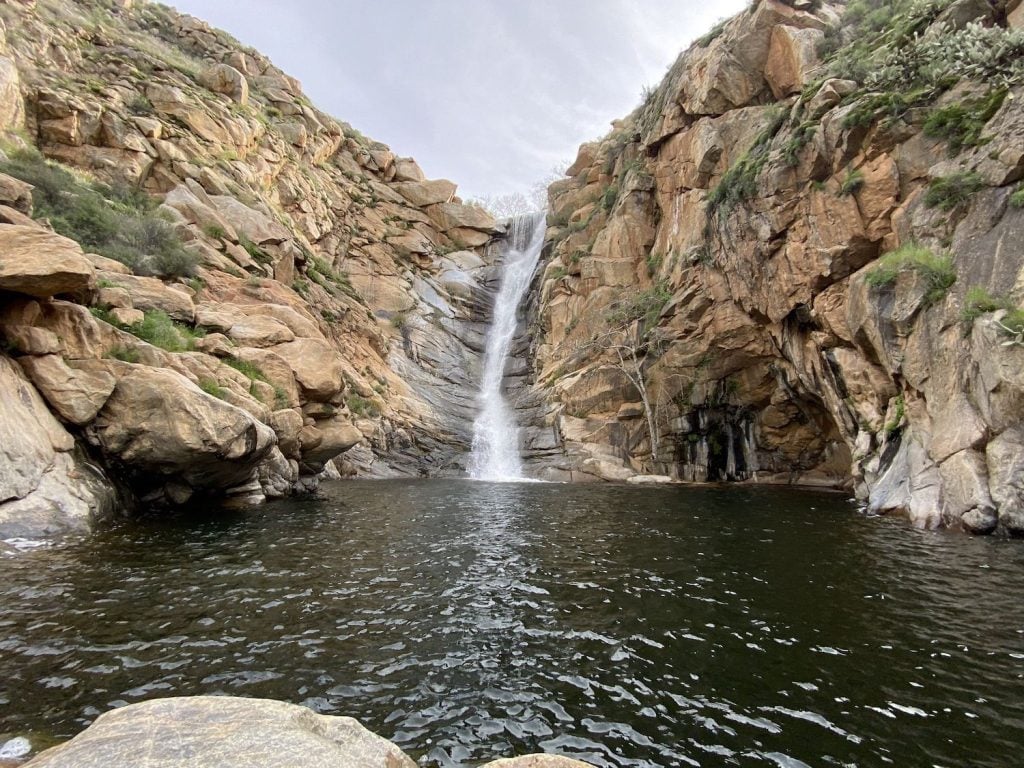
When I moved to San Diego two years ago, I quickly learned that residents love their hikes. And why wouldn’t we? Hiking is great exercise. It’s the perfect way to clear your head and—let’s be real—an ideal environment for gossiping with your friends.
But San Diego’s hiking culture stands out because, here, you can hit the trails year-round. Though spring’s typical rains may make us scowl at the sky, they also resurrect our soil, turning once dry and arid places vibrant and vegetated. The rain also replenishes the various waterfalls that pepper San Diego’s landscape, sprucing up the views on some of locals’ favorite hikes. Here are a few of the best trails for spotting waterfalls in San Diego.
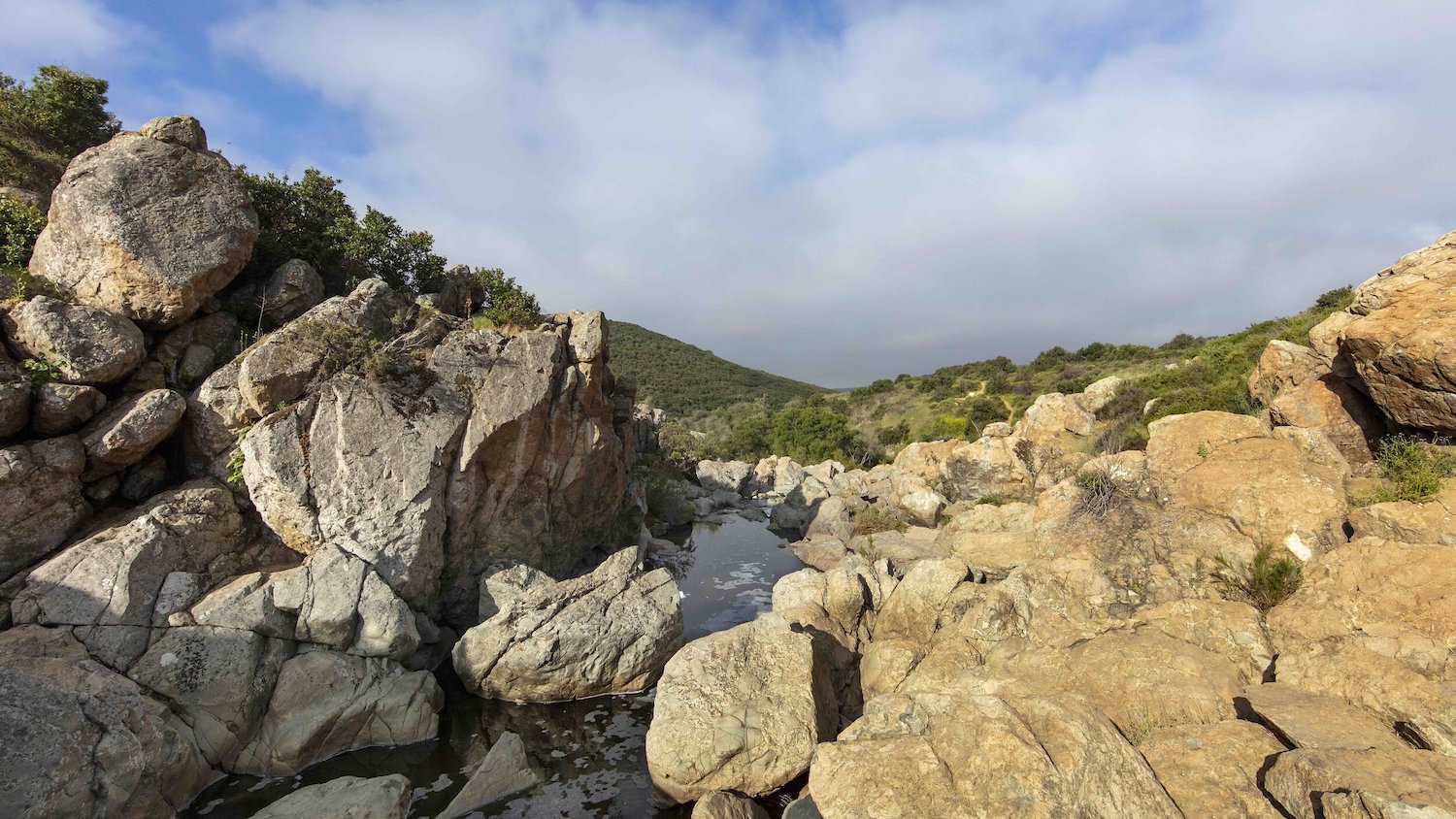
This long but low-effort hike offers a perfect opportunity to psychoanalyze every relationship you’ve ever been in as you reconnect with nature. On the way to the waterfall that trickles over volcanic rock, you’ll meander through one of the most biodiverse regions in Southern California, spotting giant California oak trees and hopefully a few red-tailed hawks and mule deer. Be sure to check the park’s website beforehand to ensure that the trails aren’t closed due to weather conditions.
Length: 6.7 miles
Estimated time: 3 hours
Price: $3 parking fee (cash only)
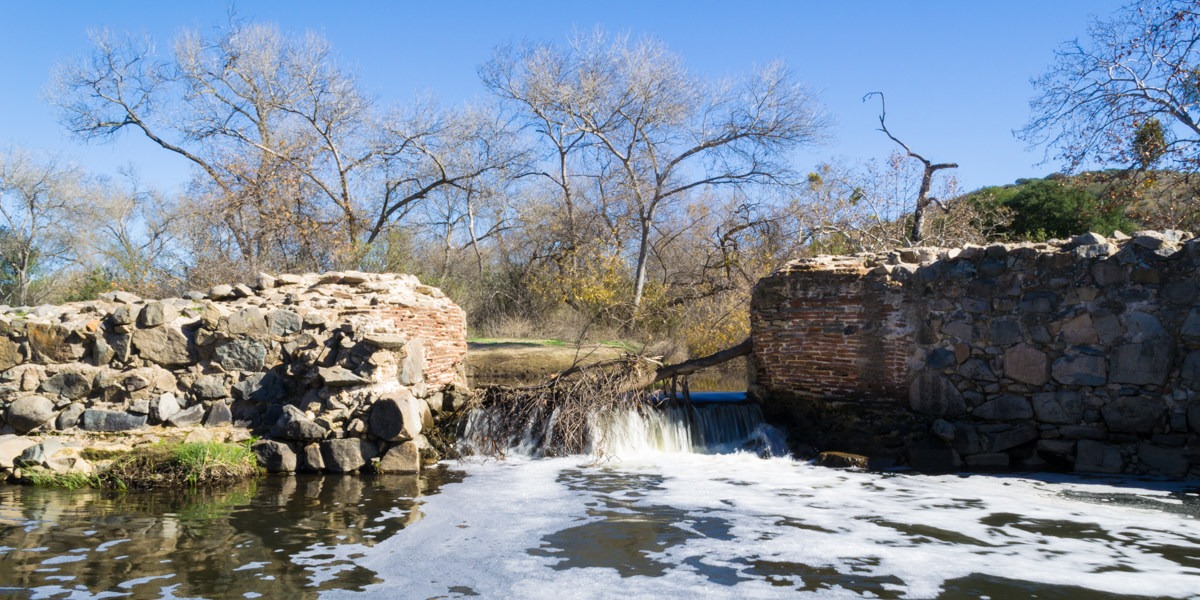
This moderately difficult trail looks its best after heavy rainfall, when a bubbling creek runs through the canyon and creates many small waterfalls that stream over the jutting, tiered rocks. You can bring your pup, but keep them leashed so as not to disturb the visitors jogging, biking, and bird-watching in the area. Because of the many rocks and uneven terrain, be sure to wear sturdy shoes that you don’t mind getting a little wet.
Length: 3.3 miles
Estimated time: 1.5 hours
Price: Free
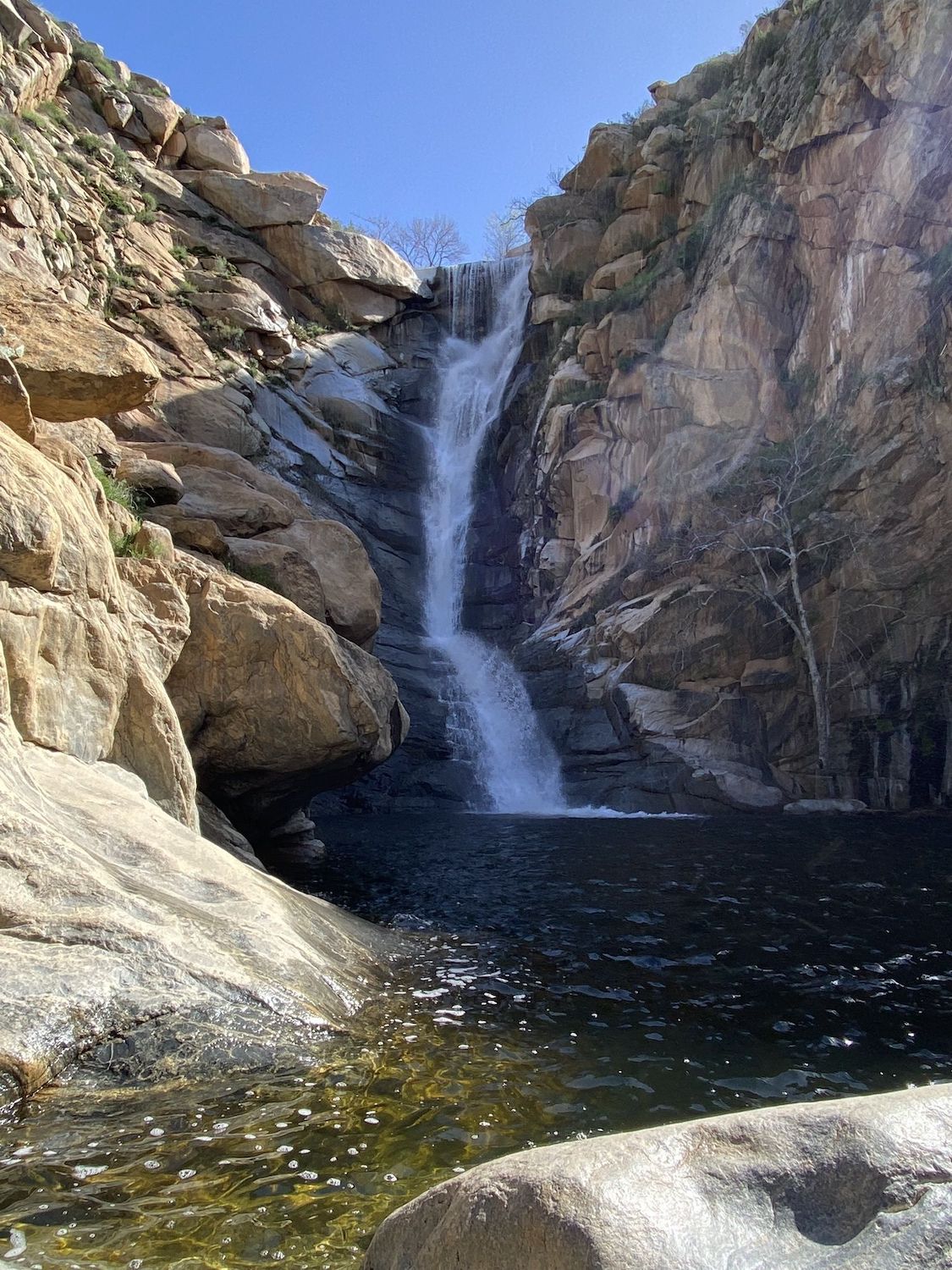
Cedar Creek Falls is one of the more well-known San Diego hikes. Studded with massive hills, the trail seems to beckon trekkers into a Lord of the Rings–style quest. You’ll begin by heading downhill to reach the waterfall, so be sure to bring enough water to sustain you on the way back up, especially on hot days. Follow the trailheads, which will lead you past large boulders, small streams, and maybe even some sunbathing snakes (always be on the lookout!) to the falls. The water cascades into a small pool, a perfect spot for swimming and cooling off.
Length: 5 miles
Estimated time: 3 hours
Price: A $6 reservation permit needs to be purchased before arrival. The permit covers up to five people in a group.
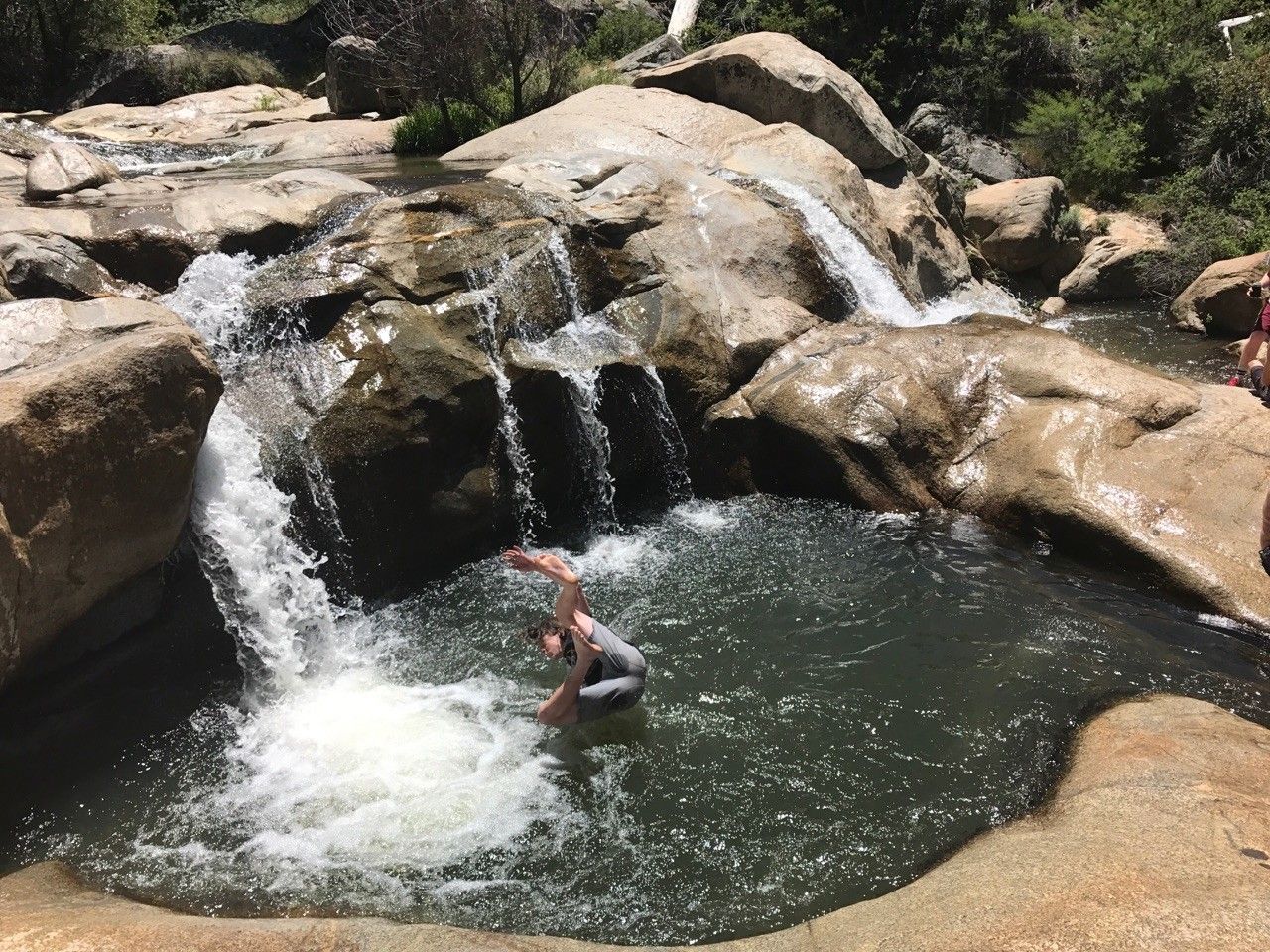
If you want a low-commitment, high-reward trail, the Green Valley Falls provide a relaxed, scenic environment where many locals enjoy picnicking, sunbathing, bird-watching, and swimming in the several chilled pools at the bottom of the waterfalls. Get to the site early, as parking can fill up quickly. Check one of the four “Birds of Cuyamaca Rancho State Park” identification stations and see if you can spot an acorn woodpecker, a northern flicker, or a barn owl. Unfortunately, dogs are not allowed on this trail, so your pup will have to come along on the next adventure.
Length: 0.5 miles
Estimated time: 20 minutes
Price: $10 parking fee

Named after the three different waterfalls you will encounter on this moderately intense hike, Three Sisters is for those who want more than just your average flat trek. There are a few areas along the popular path that require descending steep rocks, aided by ropes that have been bolted down, so take all the necessary precautions: Have enough water, shoes with grip, and a courageous attitude. While leashed dogs are allowed, ask your pooch ahead of time if they’re okay with doing some scrambling. The view of the waterfalls makes up for the rigorous journey it takes to get there, so relish in the beauty, splash some fresh water on your face, and stay alert to avoid slipping on wet rocks.
Length: 4.1 miles
Estimated time: 3–4 hours
Price: A California Adventure Pass must be purchased and displayed in the car to cover the cost of parking.

Amanda Parmele is a third year undergraduate student at UCSD and works at SD Magazine as a Photography/Visual Editing intern. She takes photos for her school newspaper, is a writing mentor, and loves surf photography, though she cannot surf to save her life.
Live Nation is turning the historic Wonder Bread Building into a 4,000-capacity concert hall designed to bring more touring acts to the city
Imagine being the song continuously getting skipped on the playlist. Not because no one wants to hear you, but because you never quite fit the moment. For years, San Diego has been that song on the touring circuit. Artists who have outgrown intimate clubs but aren’t yet filling arenas and stadiums have often passed us by, heading north to venues better suited to the size of their show. San Diego wasn’t missing the audience, it was missing the room.
That’s all about to change.
On August 17, Live Nation Entertainment announced plans to transform the historic Wonder Bread Building, which it purchased in June for $16.8 million, into a 4,000-capacity indoor venue slated to open in fall 2028. The new space will host music acts as well as private, corporate, and community events.
Currently, San Diego’s concert landscape jumps quickly from intimate clubs like the Casbah, Winston’s, and Belly Up to larger theaters, amphitheaters, arenas, and stadiums. What’s largely missing—particularly downtown—is a modern indoor room built specifically for roughly 4,000 concertgoers. This leaves a gap in mid-size venues for touring acts that land stages like the Hollywood Palladium or Boston’s MGM Music Hall at Fenway.
“We are filling a void in the market,” says John Schalk, Live Nation’s Vice President, San Diego Market. “There are other venues in town, but this […] building is just something that doesn’t currently exist.” Although SDSU’s Cal Coast Credit Union Amphitheater serves the 4,000-capacity range, its outdoor, fixed-seating arrangement isn’t as versatile as the proposed Live Nation project.
Located at 171 14th Street, just a six-minute walk from Petco Park, the building carries a century of history. Architect Eugene Hoffman designed it in 1924, a year after completing the Barcelona Apartment Hotel in Bankers Hill. The landmark brick building served as a bakery and warehouse for the Southern California Baking Company before Continental Baking Company, producers of Wonder Bread, took over in the 1950s and operated there through 1988 continued at the site until 2007.
In the early 2000s, Bob and Gay Sinclair, the couple behind a portfolio of East Village properties, purchased the building. After Bob—the founder of Pannikin Coffee & Tea—died in 2011, Gay sold much of their real estate portfolio but held onto the Wonder Bread Building. Mission Brewing eventually took over the space, where it operated for more than a decade before announcing its 2026 departure.
Now, the building is preparing for another reinvention. Live Nation plans to preserve the historic bakery’s four exterior walls, red brick façade, grain silo, barrel-vaulted trusses, and skylights as part of its next chapter.
Live Nation isn’t looking to erase its history but to celebrate it, allowing the building’s past to give the new venue some soul. “It’s really important for us that we maintain the integrity and the history of that building,” Schalk says. “There will be new construction and design elements as we go through the process to create the concert venue, but we’re working really hard to preserve it.”
Blueprint Studio, Live Nation’s in-house design and development group, and Gensler, the architecture firm behind San Diego International Airport Terminal 1 and Snapdragon Stadium, will be heading the project. The plan is to design the ground-floor space as an open, general-admission area with a premium level above with 600-plus fixed seats, in addition to box and suite sections. There will also be an additional structure built on top of the historical portion of the building (the four original walls that house the lobby) called the Vinyl Room—a Japanese-inspired hi-fi listening VIP lounge serving elevated food options.
One of the most reassuring aspects of the project is the focus on the concertgoer’s experience—specifically the “pet peeves” we all know too well: long bathroom lines, cramped exits, obstructed views. According to Schalk, one of the best things about building upon the existing structure is having the ability to consider potential obstacles and tackle them before construction begins. “I’d say we are ‘purpose building’ the entirety of the project for a music venue,” says Gensler lead project architect Garrett van Leeuwen. “As part of our design process, we do an in-depth sightline analysis to make sure that sightlines are optimized from every point and seat within the venue.”
Circulation design is also being implemented to ease traffic flow, alongside acoustic optimization and a transformative outdoor beautification effort. According to van Leeuwen, this “public realm space” will grow the existing 14-foot sidewalk to a 32-foot sidewalk complete with plazas and landscaping.
“This venue is for the fans. For the music lovers,” Schalk explains. The vision is intimate: “I want a fan to walk up to that building, see that red brick facade, grab their ticket from the box office, go into the lobby and see some of the history that will present itself… and feel like you entered a home.” Schalk also expressed a “keen interest in making sure that we work with the local artists, the local bands, the local musicians in town.” It’s a project that recognizes San Diego as a growing market that is hungry and ready to see a vibrant arts and culture community thrive.
According to an analysis by Oxford Economics analysis shared by Live Nation, the venue is projected to deliver a significant boost to the local economy, generating approximately $97 million in annual economic impact and supporting 660 jobs. This also includes welcoming 316,000 fans each year—with 126,000 traveling from outside the San Diego metro area—and driving $53 million in local spending at nearby restaurants, hotels, and retail establishments.
Considering its proximity to other major event spaces and overall busy urban areas, traffic and parking may be a concern, especially on nights of overlapping events. But in those cases, Schalk said they would work together on communication efforts; parking availability; and staggering start, end, and loading times; as well as providing easy access to designated rideshare areas. With transit stations nearby (the closest one being a 4-minute walk at 12th & Imperial), public transportation is another great option for enjoying your night out.
There are still two years of design, construction, and plenty of logistics between now and opening night. But the bigger promise of the Wonder Bread Building is simple: San Diego finally gets a venue built for the artists who have historically passed it by. After years of getting skipped on the touring playlist, the city may finally be getting its turn on repeat.
Camila Ibarra Gallego is a CaliBaja native pursuing a master's degree in culinary journalism at the Basque Culinary Center. Shaped by the culturally rich, bicultural megaregion, she's passionate about sniffing out stories that connect people, territory and culture through food. When she's not tumbling down internet rabbit holes, you can find her pretending to be a wine connoisseur at a local wine bar or nose-deep in a good book.
From getting your sweat on at hip-hop class to celebrating with a zero-proof cocktail, here are San Diego's top fitness and wellness spots
For thousands of years, the Kumeyaay who lived in this area called a mountain south of Julian Cush-pii, meaning “sharp peak.” Then, after the Civil War, Confederate sympathizers saw that same mountain and decided to rename it Stonewall Peak—after General Stonewall Jackson. The name stuck for nearly a century and a half, until Cuyamaca Rancho State Park announced earlier this year that the name will return to its original, Cush-pii. Hike to the summit for expansive views of the Coronado Islands to the west and Mexico to the south.

In 1993, Angie Bunch gathered a group of hip-hop dancers—called Culture Shock Dance Troupe—and gave them a space to practice and perform. As hip hop grew through the ’90s, so did Culture Shock. It has since become a nonprofit, a space for young and old, beginner and expert dancers. Culture Shock has also expanded to Los Angeles, Oakland, Las Vegas, Chicago, Atlanta, New York City, and Washington, D.C., as well as Ottawa and Toronto, Canada.
In 2019, Amanda Leach created the Yoga Box method, which takes high-energy flows and adds strength-building poses in heated, vibey, lava-lamp-lit studios. What started on Grand Avenue in Pacific Beach has spread to 15 locations across the county, with even more trickling into Denver, Chicago, and Brooklyn. The best part? Mindfulness newbies who can’t touch their toes and six-packed contortionists can hang in the same class. You can customize each session based on your ability and fitness level.

A gym taking over a historic beachfront pool sounds like the setup for a new season of Love Island, but Fit Mission Beach operating the nearly 100-year-old Plunge at Belmont Park is real. The independent fitness brand has spent the past several years building a loyal following through group fitness classes, community events, and a members’ social club overlooking the ocean. Upstairs, members can work remotely, meet friends, or hang out long after their workout ends. Between the Plunge, the coworking-style lounge, and a packed calendar of events, Fit has evolved into something bigger than a gym. It’s a clubhouse for San Diego’s fitness crowd.
The wellness world is finally transitioning away from HIIT workouts and cult-like spin classes, where your heart rate hits Zone 5 within minutes and stays there until cooldown. Good. At Breathe Degrees, wellness takes the form of zenned-out communal breathing sessions or vagus nerve–activating cold plunges. Breathwork is said to boost your mood in the short term and improve your heart health in the long term, and maybe that’s why everyone’s coming back for more. You can’t run into someone in Carlsbad who hasn’t dropped into at least one breathwork session, and now the studio has opened a second location in Liberty Station.

Pilates wasn’t just popular this year; it was practically a requirement for maintaining your San Diego residency. New studios seemed to appear weekly across San Diego, each promising stronger cores and better posture, but Soul Pilates and Care found a way to stand out by addressing a challenge many parents know well: finding time to exercise at all. Fitness doesn’t have to compete with parenting responsibilities. Parents can drop their kids off with trained caregivers while they head into reformer classes, eliminating one of the biggest barriers to working out. The studio has earned strong reviews for both its instruction and family-friendly approach.
The Hotel del Coronado’s sweeping $550 million restoration touched nearly every corner of the historic resort, but one of the most anticipated unveilils was the debut of its redesigned spa. The oceanfront wellness destination now features 21 treatment rooms, a relaxation lounge, a sauna, steam room, and a treatment menu inspired by the coastal environment just steps away. The redesign blends the Del’s Victorian legacy with a cleaner, more contemporary aesthetic, creating a space that feels distinctly SoCal rather than generic luxury hotel. For locals who don’t have time for a vacation, it’s the next best thing.
As non-alcoholic beverages continue their meteoric rise, Good News Bar has become one of San Diego’s most compelling arguments for a booze-free evening. The University Heights hotspot serves a menu of carefully crafted zero-proof cocktails that borrow techniques and ingredients from traditional cocktail programs (it’s not just fancy juices and soda water), minus the hangover. The space also hosts regular community events and has quickly become a gathering place for everyone from sober San Diegans to the merely sober-curious. In a nightlife industry built around alcohol sales, Good News proved there’s plenty of demand for connection without the buzz.
Whether you love theater, music, dance, or public art, these are the cultural experiences that stood out this year
Arts District Liberty Station officially became one of the state’s designated cultural districts, joining a list reserved for places with thriving creative communities. Considering the campus is home to more than 100 galleries, artist studios, museums, and arts organizations—not to mention The Joan, the 42,000-square-foot performance center housing Cygnet Theatre—it was only a matter of time until the district got its flowers.
If you can’t beat ’em, join ’em. The National City Public Works building has been a target of graffiti artists for years, only to be constantly painted over (and the cycle restarts). Now, it’s working with the local artists from Vision Culture Foundation to create intentional public murals. A win-win in our book.
One of the biggest questions this year is who will show up for San Diego arts and culture—so a Best Of nod goes to a nonprofit that’s been doing it for years. Founded by longtime arts advocate Susanna Peredo Swap, Vanguard Culture has staged events for creatives, told their stories, and just created an SD ARTS Pass—a single ticket that gets you access to 39 creative spots.

Ballet’s already got a sort of otherworldly thing going for it, with people morphing into 90-degree angles and defying gravity with each pirouette. The Rosin Box Project feels like a raw, creative new force in the classic art form, though—especially with its annual Ghost Light Masquerade. It’s a dance of eerie spirits that makes you second-guess what’s real and what’s not.
Once upon a time, Gallagher Square was just a grassy knoll behind the outfield wall at Petco Park. Now, it’s a concert venue, playground, play ball field, dog park, and unofficial home for those who prefer the vibe of baseball more than the actual game. Big-time performers are showing up: Ms. Lauryn Hill, Cypress Hill, and Peach Pit.
Casa Casillas has filled a long-standing gap in Chula Vista’s art scene. Open since last August, the space gives local artists a dedicated venue to display their work and visitors a chance to explore the neighborhood’s vibrant art. Two rotating resident artists always keep the space moving, so it rarely looks the same twice.

El Cajon translates to “the box” in Spanish—a nod to the city’s surrounding hills—but Alley Cat Art Fest (previously called Artivál) doesn’t stay inside it. As the first arts festival in East County, it celebrates local galleries, sculpture, live music, and food trucks—the whole nine.
Every second Saturday, Barrio Logan turns into a choose-your-own-adventure with the Barrio Art Crawl, a free self-guided art tour through galleries, museums, and murals, with street food and music filling in the gaps. Barrio is one of the city’s most thriving arts neighborhoods, and it’s worth getting a bit lost in.
MCASD is showcasing two powerhouse exhibits—Giants: Art from the Dean Collection of Swizz Beatz and Alicia Keys and The Dean Collection Presents: Hometown Heroes. The pop music titans are highlighting local artists, with an intentional focus on diverse experiences. It was one of the biggest (and coolest) art openings of the year, and it closes August 9. So get on it.
Leave it to The Old Globe to give the local theater scene some Hollywood glamour. Katie Holmes led the premiere of Henrik Ibsen’s Hedda Gabler this past spring, turning the classic Norwegian play into one of the most buzzed-about theater productions of the year.
Inspired by the effortless charm of French cafés, this taste of France on Orange Avenue invites guests to embrace the simple pleasure of taking their time.
Strolling down Orange Avenue on a sunny afternoon, you’ll hear the hum of beach cruisers rolling by and visitors making their way toward the Hotel del Coronado. Dogs pause to greet one another on the sidewalk, palm trees sway overhead, and for a moment, you’re convinced you’re living inside the postcard from the gift shop you just passed.
Then the scene shifts. Towering white columns, black café awnings and gold-trimmed windows frame Little Frenchie, where woven bistro chairs spill onto the sidewalk and servers deliver bubbling crocks of French onion soup. The scent of caramelized onions and melted Gruyère is practically an invitation to ask, “How long for a table for two?”
That feeling of pulling up a chair and staying awhile is exactly what inspired Little Frenchie. French cuisine has a reputation for feeling a little intimidating, but the restaurant is rewriting that narrative with food and wine that feels approachable.
“Sometimes when you read a French menu, you come across words you can’t even pronounce,” David Spatafore, the owner of Little Frenchie, says. “We wanted to create a restaurant where people felt comfortable.”
Little Frenchie was designed to capture the spirit of the French sidewalk cafés that inspired it. Dating back to 1917, the space already carried the charm of a Parisian bistro, with architectural details that felt more at home on a European street corner than in Coronado. The team saw an opportunity to create a restaurant that matched the character of the space while filling a gap in the neighborhood.
The result is a French restaurant that honors tradition without taking itself too seriously.
At Little Frenchie, classic French techniques are at the heart of the menu, but there is always room for creativity. A cassoulet featuring Toulouse sausage and duck confit pays homage to the recipes and regions that inspired it, while a rich hot chocolate made with ingredients imported from France brings a taste of French café culture to Coronado.
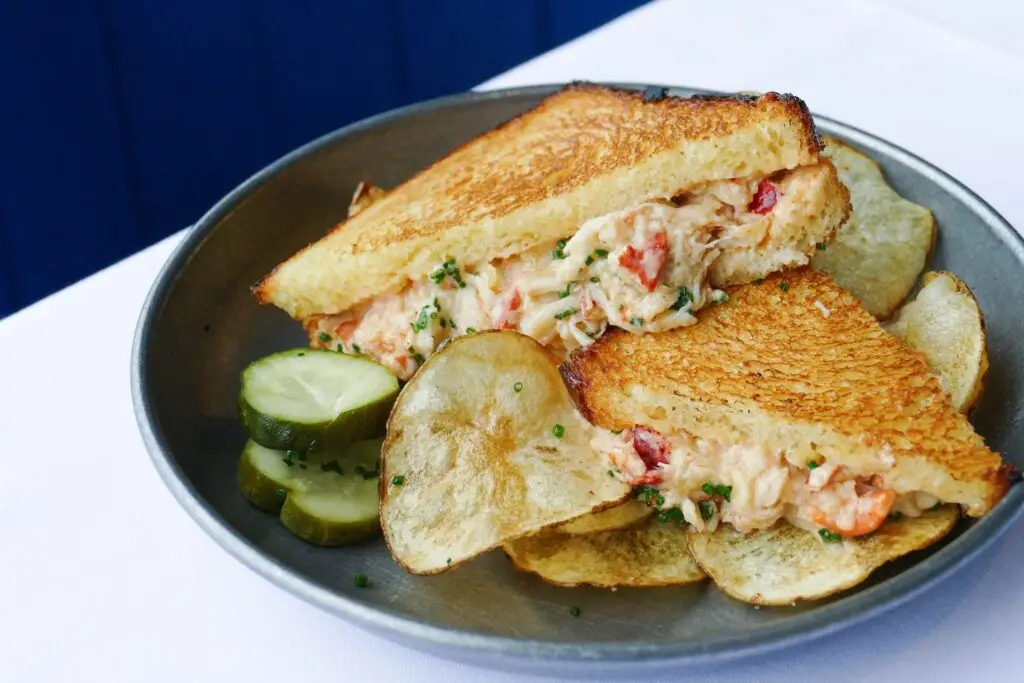
The team loves finding unexpected ways to make familiar dishes feel new. A burger becomes a showstopper when it is finished tableside with melted raclette, while a French Dip gets elevated with prime beef and Wagyu makes its way into the burgers. Even Eggs Benedict gets a French twist, swapping the traditional English muffin for a buttery croissant. The GB&J, Little Frenchie’s take on a grilled cheese, brings that same playful approach with seasonal jam and French Brie layered into a comforting classic.
Nearly everything at Little Frenchie is made from scratch, with ingredients carefully chosen to match the restaurant’s standards. Even the bread receives special attention. Each morning, the team sends a car to Prager Brothers Artisan Bread to pick up freshly baked loaves, ensuring every element of the meal reflects the restaurant’s commitment to quality.
Wine is woven into the experience just as naturally as the food. Inspired by the effortless pairings found in French cafés and bistros, Little Frenchie’s by-the-glass selection invites guests to sip their way through different regions and discover new favorites without the pressure of knowing all the rules.
For a city that lives outdoors, these hometown makers understand exactly what your complexion is up against
San Diego has always worshipped at the altar of good skin. Equal parts surf town, biotech hub, and wellness capital, it’s a city where lunch breaks become beach walks and sunscreen sits beside car keys by the front door. The products that get used here earn their place. With 266 sunny days a year and one of the highest rates of skin cancer in the country, we take skincare seriously. Dr. Bronner’s has been making soap in North County since the 1960s. Sun Bum was born in Encinitas and is now on shelves in over 70 countries. The tradition runs deep.
“Living in San Diego means your skin is exposed to sun almost every day of the year,” says Sue Zhang, M.D., a San Diego physician specializing in aesthetic medicine. “The products that tend to succeed here are the ones that can keep up with daily life, UV exposure, sweat, and movement, while still supporting long-term skin health.”
From a mineral powder that solves the sunscreen-over-makeup problem to an acorn oil serum rooted in Indigenous plant medicine, the local San Diego shelf is more diverse, and comprehensive, than most of us realize.

A hydrating gel-oil hybrid that applies like a body treatment and leaves skin with a sheen that reads as healthy rather than oily. La Jolla–founded Kopari built its reputation on cold-pressed coconut oil sourced from family farms in the Philippines, and the Sun Shield Body Glow SPF is exactly that in summer form: coverage that doubles as skincare.

The name is intentional. The founder got a basal cell carcinoma diagnosis that his dermatologist caught—she’s now his business partner. The question he couldn’t shake was why the skincare industry hadn’t yet figured out how to talk to men, and 4-Skin is the answer: a premium sunscreen and skincare line built around the kind of blunt, self-aware humor that gets guys to pay attention. Men’s skincare has needed this for a long time, and the formulas are serious enough to deliver.

Carlsbad-based Coola was formulating organic SPF before “clean sunscreen” was a marketing category, and the Classic Face Sunscreen is the brand’s thesis: protection that disappears into skin and layers cleanly under makeup. Sheer and lightly hydrating, it makes sunscreen easy to reapply before an afternoon walk at Torrey Pines.

Squalane, argan, jojoba, and CoQ10: a short ingredient list that does a lot. The Glow Finishing Oil from Mission Hills wellness sanctuary Saffron and Sage is plant-based, scientifically grounded, and formulated to absorb rather than sit on the skin. The brand started as an integrative health practice where acupuncture, naturopathic care, and functional medicine share a roof, and the skincare line runs on the same philosophy.

The Restorative Skin Complex is powered by TriHex+, a patented peptide blend developed by Carlsbad-based Alastin’s team of SkinMedica veterans. It promises to clear out damaged collagen and elastin while supporting new production, the kind of gradual improvement that makes a product hard to quit.

Beldi is a multi-functional cleansing tradition rooted in Moroccan hammam culture, dating back over 12 centuries. Alia Jouj is the brand’s flagship product, and San Diego–based founder Dr. Mia Chae Reddy built a brand around it. Alia Jouj uses 100 percent organic, cold-pressed argan oil and the same ancient saponification method to produce a honey-thick liquid cleanser that softens skin without stripping it.

Acorn oil has been used by California’s Indigenous communities as plant medicine for generations. Ruth-Ann Thorn, an enrolled member of the Rincon Band of Luiseño Indians, built N8iV around it as the first Native American–owned skincare brand to reach the national mainstream. The Móyla Moon Polish, named for the Luiseño word for moon, is an exfoliant centered on acorn oil Thorn gathers herself each year from the La Jolla reservation. Find it at the Gaslamp Quarter store Thorn owns at the historic Yuma Building.

This product solved the reapplication problem. As a brush applicator, this mineral SPF goes over makeup without disturbing it, which is why it has been on derm-office retail shelves in Carlsbad and beyond for over two decades. The tinted version doubles as foundation.

This steroid-free, petroleum-free eczema treatment was built specifically for babies and toddlers (although grown-ups can use it, too). It’s centered on FDA-approved 1 percent colloidal oatmeal with a base of sunflower seed oil, beeswax, and jojoba. The “linoleic-acid-rich sunflower oil is helpful for atopic, eczema-prone skin that is often deficient in that fatty acid,” says Dr. Zhang. Gentle enough for newborns, safe for daily use, and tested by both pediatricians and dermatologists.

The Mandelic Night Serum pairs mandelic acid, an AHA derived from almonds and gentler than glycolic acid on sensitive skin, with lactic acid, niacinamide, and urea to brighten, smooth texture, and reduce breakouts overnight. Fragrance-free, vegan, cruelty-free. The brand name is the initials of the founder’s five daughters, pronounced like courage. Dr. Zhang also says she “really value[s] [the founder’s] mission to create pregnancy-safe skincare products that are both effective and wallet-friendly.”
Ingrid Yang, M.D., J.D. is a hospital-based physician in San Diego, CA, certified yoga therapist, and longevity specialist. She loves *double hearts* San Diego and spends her days helping people fully engage in long, healthy lives through evidence-based lifestyle medicine. Her books include Adaptive Yoga, Zen Mindfulness, and Hatha Yoga Asanas. When she’s not leading international wellness retreats, she is chasing sunsets, handstanding in nature, or geeking out over mitochondria.
Explore restaurants, activities, and shops within this affluent North County community
The inland North County community of Rancho Santa Fe is often associated with wealth. It’s one of San Diego’s most expensive residential markets and is consistently ranked one of the highest-income zip codes in California and the U.S. Rancho Santa Fe is known for its large equestrian community including riding facilities and horse trails, as well as its country club lifestyle and associated golf courses.
At the center of this luxury master-planned community is a small, walkable downtown area referred to as the “village,” with The Inn at Rancho Santa Fe acting as both a landmark and social hub. Much of the community, including the historic Inn, was designed by acclaimed architect Lilian Rice, one of California’s earliest female architects. The Spanish Colonial-style architecture she brought to the village is still one of its defining characteristics today.
Whether you’re coming to Rancho Santa Fe for golf, horseback riding, or pampering at a resort spa, be sure to start with a short walk around the village to take in the neighborhood’s charm. Plan your next visit here with our neighborhood guide to the area’s best restaurants, things to do, and shopping.
Jump To: Restaurants | Things to Do | Shopping

Families congregate at The Pony Room for elevated California ranch-style cuisine. Lamb lollipops, carne asada tacos, burgers, and weekly dinner specials are offered here, alongside an extensive collection of wine and spirits (especially tequila) and sizeable kids menus. As the signature restaurant of Rancho Valencia Resort & Spa, this all-day eatery is a lively centerpiece of the local social scene.
5921 Valencia Circle
The piano bar at Mille Fleurs is the buzziest spot to be on Friday and Saturday nights in Rancho Santa Fe. French classics like escargot, lobster bisque, duck confit, and steak frites are the main dinner attractions at this local institution that has been around for more than 40 years. Spring for the four-course prix fixe menu before nabbing a coveted bar seat near the piano entertainer.
6009 Paseo Delicias
Nick & G’s is one of the most prominent restaurants in the village, with an outdoor patio that overlooks the main thoroughfare. Enjoy modern Italian food, steaks, and seafood dishes here, including homemade pasta, pizza, wagyu beef, and oysters. Be sure to check their live music schedule and events calendar for the latest happenings.
6106 Paseo Delicias
Named after renowned architect and planner Lilian Rice, Lilian’s is The Inn at Rancho Santa Fe’s flagship restaurant. Their upscale menus feature sustainable seafood, grass-fed meats, local produce, and even sushi rolls during dinner. Outdoor seating provides a bird’s-eye view of the village and an elegant backdrop for weekend brunch. Stop by Bing’s Bar (a nod to Bing Crosby) for craft cocktails, beer, wine, and light bites in a refined setting.
5951 Linea Del Cielo
Quaint cafe and bakery Thyme in the Ranch serves a small selection of breakfast and lunch items (don’t miss the tarragon chicken salad), but is perhaps best known for its pastries and baked goods. Cakes, pies, muffins, scones, and cookies fly off the shelves here, where locals come for special occasions, parties, and group catering orders.
16905 Avenida De Acacias
Located inside a historic building once home to Rancho Santa Fe’s original schoolhouse, Paseo RSF is one of the village’s newest dining options. The charming American bistro has pasta, salads, burgers, meat and seafood entrees, plus a thoughtfully selected California wine list and new sushi and omakase program. Kids and dogs are both welcome here.
6024 Paseo Delicias, Suite C
Grab a quick coffee to go from this walk-up window in the same shopping center as the post office. Cinnamon roll lattes, cold brew, spiced chai, smoothies, protein bowls, and more can be found at Rancho Roasters, where they brew beans from Dark Horse Coffee.
16950 Via De Santa Fe
Casual pizzeria and martini bar Goli is a popular spot for catching the latest sports games. Order one of their unique specialty pizzas like the Casbah with hummus and veggies, build your own pizza or burger, or go with one of their hearty wraps that’s made with an extra thin version of pizza dough.
18021 Calle Ambiente, Suite 403
Find generous portions of Mexican food at Cocina del Rancho, run by the same owners as Carlsbad’s Cicciotti’s Trattoria Italiana and Village Kabob. Get classic dishes like burritos, tacos, and enchiladas, plus their specialty items including pulpo, carne asada, and fajitas with lobster tail. Don’t skip the margaritas.
16089 San Dieguito Road
Kai Oliver-Kurtin is a San Diego-based writer who covers travel, dining, events, and culture. Her writing has been published in USA Today, Condé Nast Traveler, Fodor's Travel, Marie Claire, and HuffPost, among others.
The William and Mary Jane Rohn Brain Tumor and Brain Metastases Clinical Care and Research Program provides expert care and innovation
Central nervous system tumors are some of the most complex conditions in medicine. Scripps Cancer Center committed to expanding its neuro-oncology services, and has recruited some of the top medical professionals in their field, including neurosurgeon Jeremy Ciporen, MD, and neuro-oncologist and researcher Tresa McGranahan, MD, PhD. But that was just the start. Expert nurses, sophisticated imaging and surgical equipment were also added with philanthropic support. Most importantly, Scripps Cancer Center designed a program that puts the patient at the center of it all. Click here to read more about Scripps’ neuro-oncology program, and here for more on the pair of donors for which it’s named.
For more nutrition, wellness, and healthy living tips, sign up for the San Diego Health newsletter here.