Featured articles
Food & Drink
Food & Drink
Food & Drink
Featured articles
Everything SD
Things to Do
Things to Do
Featured articles
Guides
Things to Do
Things to Do
Featured articles
podcast-ep
podcast-ep
podcast-ep
Featured articles
Food & Drink
Features
Food & Drink
Featured articles
Food & Drink
Guides
Everything SD
Ready to know more about San Diego?
SubscribeReady to know more about San Diego?
Interior designer Cindy Courson turns a new leaf with custom art deco wallpaper, postmodern lighting, and large unexpected prints
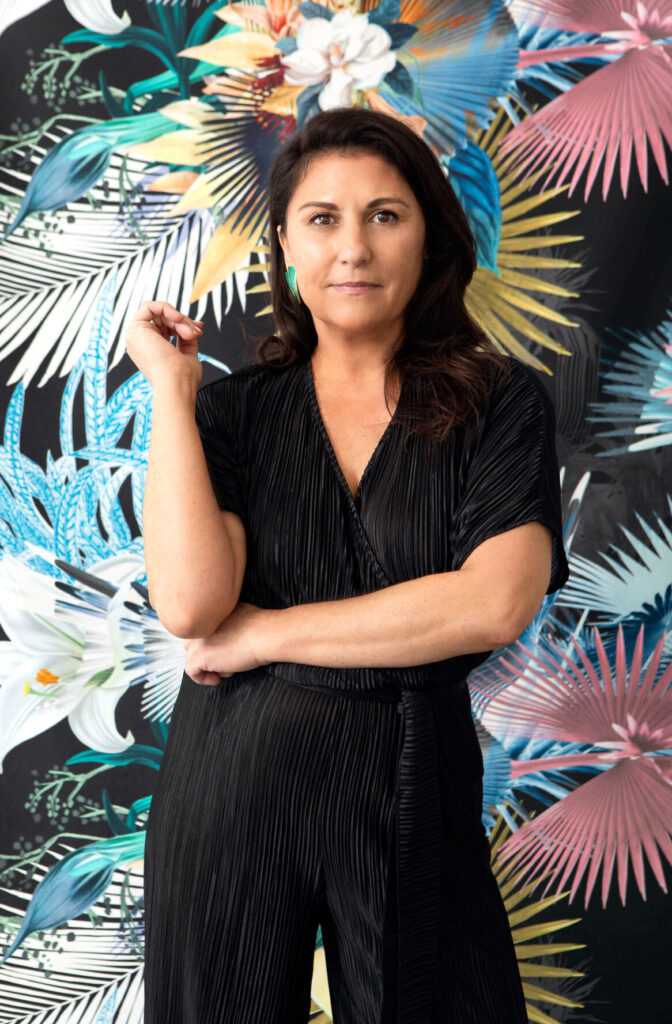
Cindy Courson
Becca Batista
Encinitas-based interior designer Cindy Courson has decked out the homes of pro athletes (Tony Hawk) and award-winning cult-hit eateries (Death by Tequila). Now, her new line of furnishings has helped inform Oceanside’s latest arrival, The Brick Hotel. She decidedly skipped over familiar boho design tropes in favor of Tropical Modern’s sumptuous, breezy glamour.
For this historically reimagined property, built in 1888, Courson played with contrasting patterns, larger-than-life florals, and color combinations inspired by her muse Dorothy Draper.
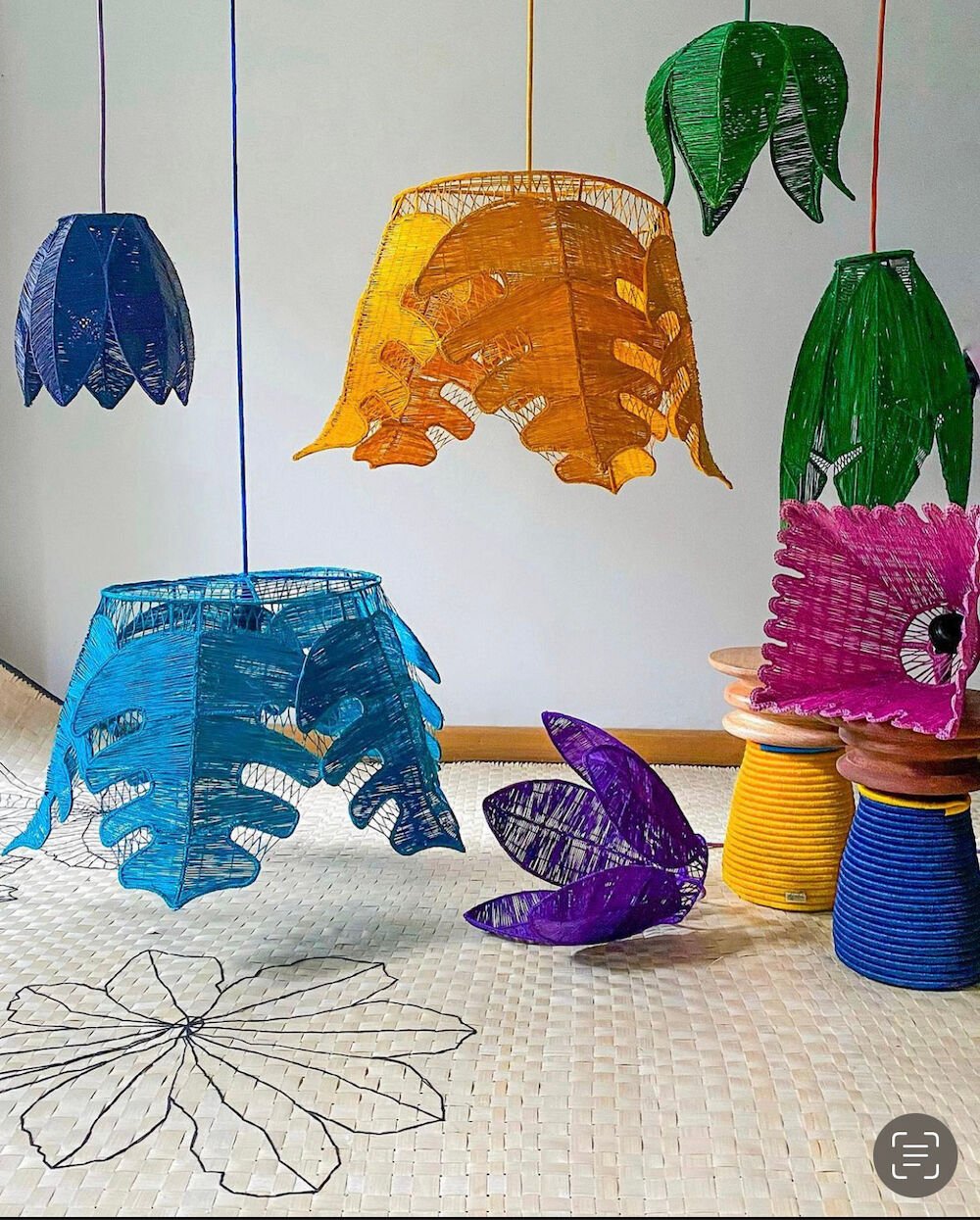
Hand-woven pendants made with dyed straw
Paula Luna
The new queen of pink-and-green dreamt up custom rattan headboards upholstered in Christian Lacroix fabric, soft sculptural curved side tables, and wallpaper inspired by the art deco movement and 1960s prints. Plus: No room is complete without her trademark greenery arrangements.
“It looks like a vacation, and I love evoking that feeling of something chic and exuberant,” says Courson. “Draper believed that bright colors have a vital effect on our happiness.”
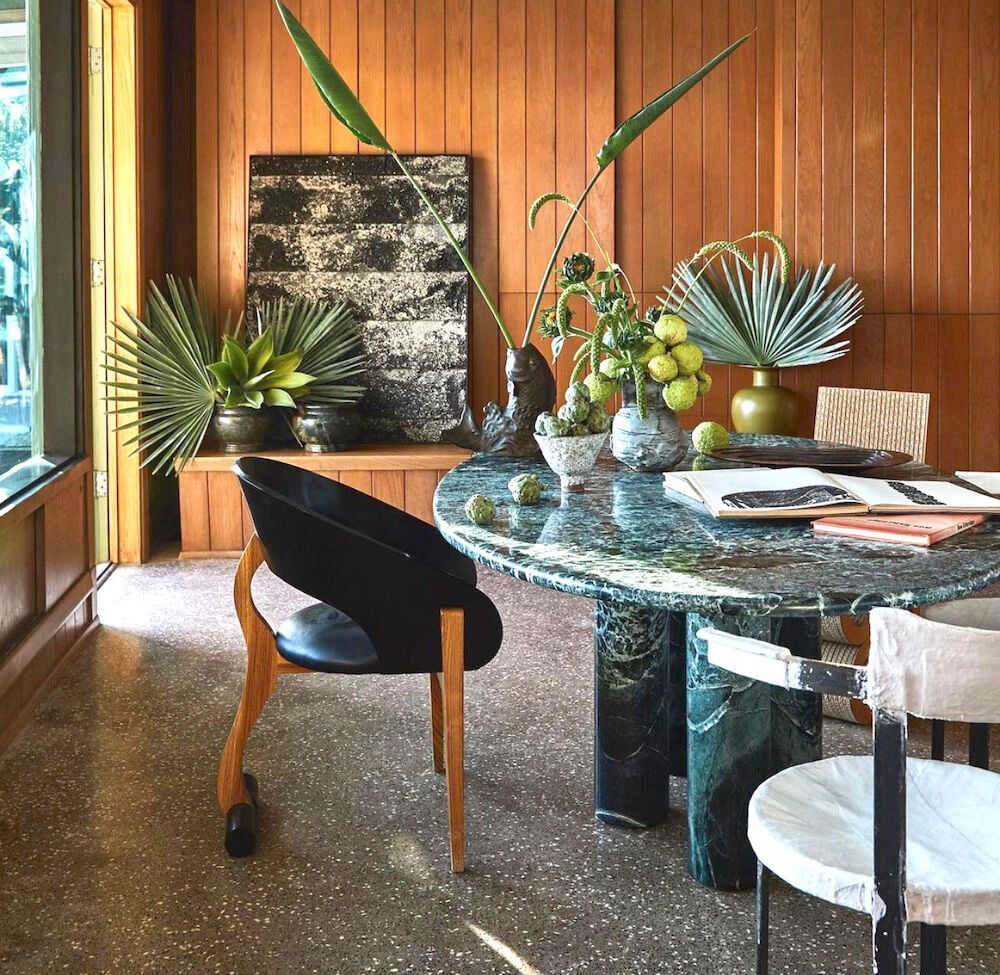
Inspiration from LA’s design doyenne Kelly Wearstler
Paula Luna
Built for warm climes and lush island environments, Tropical Modern is an anti-minimalist approach that embraces laid-back glamour, an awareness of balance, and a feeling for light. The movement is rooted in balmy locales such as Sri Lanka, Brazil, Hawai‘i, and Florida. Architects like Geoffrey Manning Bawa, Paulo Mendes da Rocha, Vladimir Ossipoff, and Paul Rudolph pioneered the built environment, fusing the relationship between exterior and interior—the home and the natural world.
“Interiors can still be clean, purposeful, and neutral while the tropical elements add so much texture and punch to a space,” says Courson. “Clients come to me for that coastal-cool aesthetic but with a throughline of unexpected playfulness.”

Courson’s new line of furniture and custom wallpaper informed a suite at The Brick Hotel
Paula Luna
Courson’s new line, available through her website, features wallpaper, headboards, side tables, and pillows. The wallpaper at The Brick, for example, is emblazoned with Cattleya orchids and pink-and-black Monstera. It absolutely sets the tone for happy hour at the hotel’s Cococabana rooftop.
Meanwhile, for another client, she paired custom fan palm wallpaper with a cane-and-tubular-steel chair by Ludwig Mies van der Rohe.
“When done right, overlaying patterns, textures, and greenery can create this harmony,” she says. “It has the modern expressiveness of a jungle.
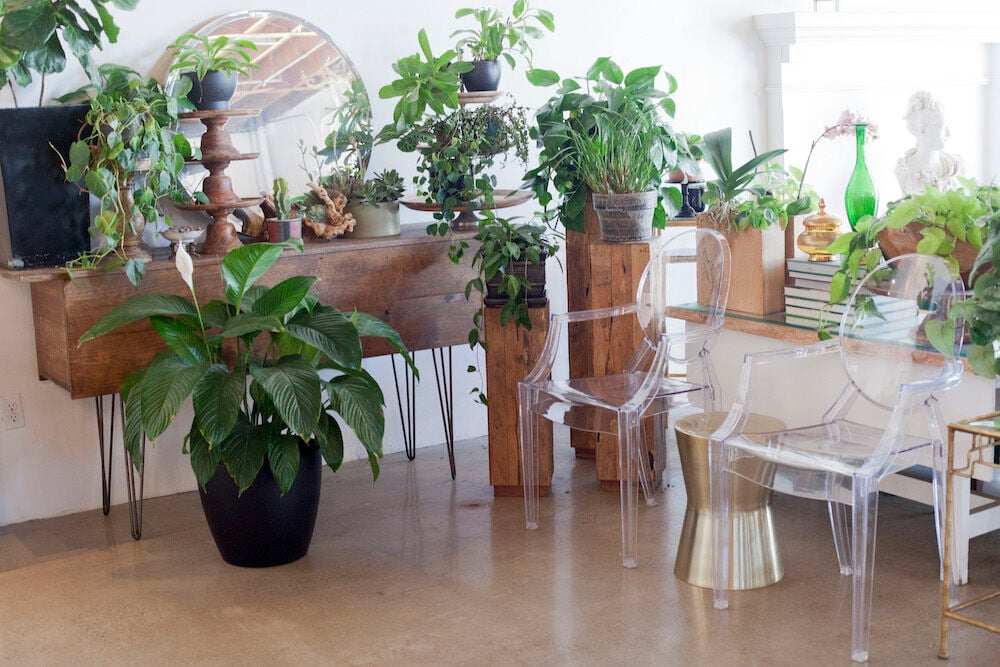
Greenery is central to all of Courson’s projects
Paula Luna
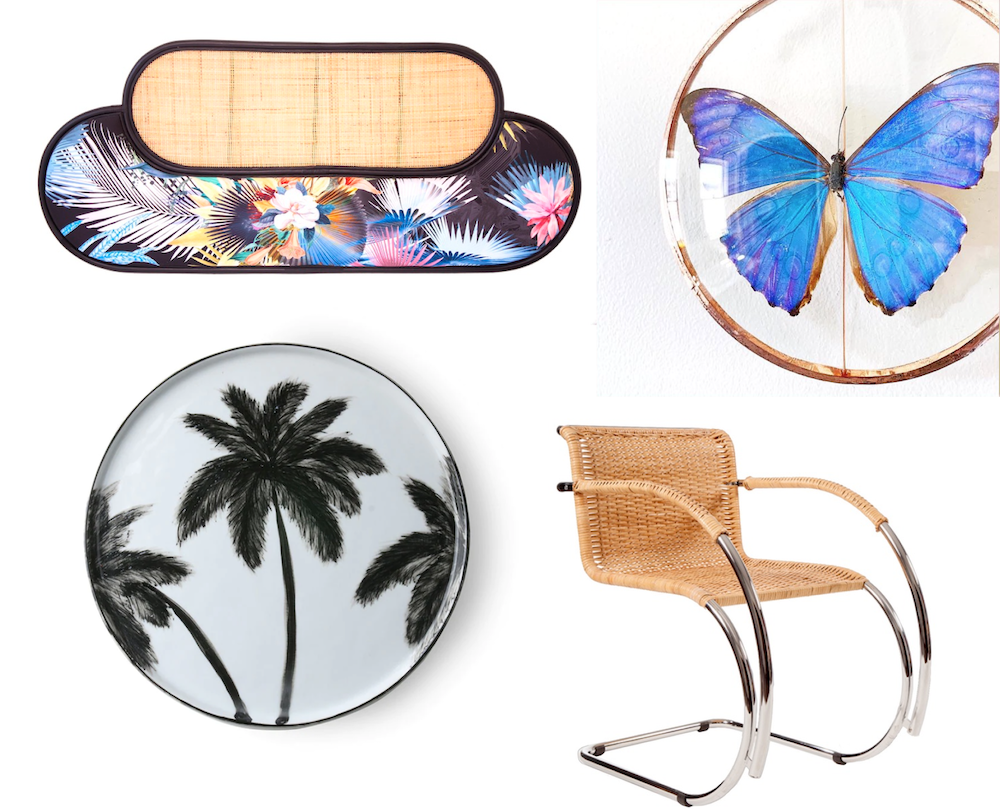
Clockwise from right: Pendant butterflies by decayedbrocade.com from $68; vintage cantilevered chair by Ludwig Miles Van der Rhoe for Knoll sourced from San Diego vintage dealer @ever.style.
Paula Luna

Custom wallpaper from Courson’s new line
Puala Luna

Courson used Kings Star Nero til on a project for Death by Tequila
PARTNER CONTENT
Paula Luna
The Imperial Beach–born fiber artist ponders texture and softness in her exposition on display through October 12
A khaki bathing suit made Imperial Beach hometowner Denja Harris an artist, though she didn’t know it yet then.
As a middle schooler growing up in San Diego County, fiber artist Harris “had to wear uniforms,” she recalls. “I cut a pair of old Paul Frank uniform bottoms and made a swimsuit out of them. I think that’s where [I began] repurposing found materials. From there, I started embroidering. I started sewing handmade handbags when I was [around 20].”
You won’t find fashion, however, at Harris’ solo exhibition at the Oceanside Museum of Art (OMA), which opened June 28. “In 2018 or 2019, I discovered the tufting machine”—a handheld device used to make rugs—“and, during the pandemic, I was able to buy one, and I had lots of free time,” she says. “I started experimenting in a little corner of my living room. And here we are.”
Many of her large-scale works do, indeed, resemble rugs. Harris, however, refers to her process as “painting with yarn—or doodling.” She unfolds a few big pieces inside her small home studio in Lemon Grove, enveloping the space in a cozy riot of color. Draped near one wall is a cartoonishly oversized, spiked chain made of yellow yarn; a rippling orange lamp base sits in a corner. Harris calls these three-dimensional objets d’art “soft sculptures,” stuffing them with scrap materials. Through the studio’s doorway, a well-loved ottoman upholstered in Harris’ signature patchwork style is visible in the living room, where a nature documentary drones quietly on.

“It’s so visceral, the way she utilizes texture and yarn,” says Katie Dolgov, OMA’s director of exhibitions and collections. “I think she’s working through a lot of personal ideas in her work, and that ends up being very easy to connect with.” That resonant style has landed her exhibitions all over San Diego County and beyond, including solo shows and installations at local galleries like Sparks, Intervals Room, and Mortis Studio and spots in group exhibits at Ohio’s McDonough Museum of Art, North Park’s Art Produce, and OMA’s extension at The Seabird Resort in Oceanside.
The new OMA exhibition title, The Space Between: Texture Studies, reflects the rug-like works’ inconsistent surfaces. Portions of soft, high-pile yarn give way to smooth organic shapes. On one piece rendered mostly in soft and neutral shades—ivory, butter yellow, rose pink, a muted turquoise—the eye catches a thin scribble of cobalt.

“My process is really intuitive,” Harris says. “I choose a color palette that speaks to me—one that starts a conversation, where the colors interact with each other. Then I grab the yarn, I build compositions through line work, and I let each decision inform the next.” Sometimes she’ll tear out a portion and start again. “Sculptural, dimensional layering is really important,” she adds. “If it’s looking too flat or not activating my brain, then I don’t feel like it’s successful.”
Those shifts in hue and texture are also driven by pure necessity: Because Harris uses primarily deadstock and vintage yarn, she only has so much of each. The varying materials—synthetic and natural, wool and cotton and mohair—add to the visual interest of the work.
The OMA show arrives amid a larger resurgence of interest in fiber art. It’s possible that it’s a natural evolution of the way crafting exploded during the pandemic, creating talented hobbyists who, through exploration and self-instruction, became artists like Harris. Dolgov sees a more immediate motivation, though.

“I wonder if it’s inherently due to the nature of fabric,” she muses. “There is a softness there. Maybe we’re all feeling like we need to fall into something that’s comforting—not too hard, not too edgy, but still incredibly emotionally evocative. We still need and want to feel the feelings that we’re feeling in the world right now. We don’t need to run away from them, but we do need to be comforted in those feelings, and I feel like that’s what [Harris’] work is doing. It’s surrounding. It’s enveloping.”
And then there is fiber’s familiarity. Not everyone grew up with paintings or sculptures in their homes, but, from our early days, we’ve been wrapped in baby blankets, felt rugs under our feet once we started to walk. Suspended on gallery walls as arresting testaments to their maker’s wayfaring creative mind, the works are undeniable in their artness. Yet they look like home, too.
That’s part of Harris’ point. “I didn’t grow up in art spaces. I’m self-taught. I started doing this when I was 34 or 35, and this is my first time expressing myself through large-scale art. I just started calling myself an artist this year,” she says. “It’s important to me that people who come from a similar socioeconomic background as me or anyone that doesn’t see themselves as an artist can look at my work and see that it’s yarn and that’s familiar to them, and they feel inspired by it. [In my pieces,] I see softness and comfort and joyfulness, and those are all things that I want people to feel when they interact with my work.”
Amelia Rodriguez is a writer and journalist and winner of the San Diego Press Club's 2023 Rising Star Award and 2024 Best of Show Award, she’s also covered music, food, arts and culture, fashion, and design for Rolling Stone, Palm Springs Life, and other national and regional publications. After work, you can find her hunting down San Diego’s best pastries and maintaining her five-year Duolingo streak.
Local Nate Wells is giving hunting a stylish, holistic approach from inside his 100-square-foot micro-shed
Nate Wells’ home happens to sit on the wrong side of the freeway for an Oceanside-dwelling former surf grom and lifelong waterman. But it’s not the house we’re interested in. It’s his charming backyard micro-shed, where he crafts and repairs his sleek—gamine even—spearguns. Slats of cubed, wooden dowels are casually slotted in bins, while pliers and vices take up real estate in this 100-square-foot-ish workshop tucked to the side of his calming backyard veranda.
Wells grew up in San Diego and, in his youth, spent a few years at his grandparents’ Lakeside ranch, where both his father and grandfather were woodworkers. Wells remembers endless hours “in the sawdust” with his predecessors, absorbing the craft from afar. Wells’ grandfather even made spearguns, unbeknownst to Wells until he picked up the trade. “It’s unreal to see how it’s come kind of full circle,” he says.

After all, it wasn’t Wells’ family that got him into the sport. Instead, a 2014 fishing trip on a neighbor’s boat piqued his interest. “He took me offshore, and I got hooked just watching him catch yellowtail and tuna and dorado and all these things,” Wells recalls. “I was like, ‘I didn’t even know we had all this kind of stuff right here.’”
Pulling the trigger himself, he soon found, was “addicting.”
The same neighbor commissioned Wells’ first custom speargun. Wells supplemented his knowledge of woodworking with info from myriad YouTube videos and online forums.

“As you progress as an artist or craftsman, you start to see, ‘Oh, this is pretty rudimentary. This is pretty basic, you know? Let’s expand,’” he says. “With every batch of guns, I just keep improving.”
Ten years later, Wells is still fine-tuning his work under the eponymous moniker Wells Spearguns, but he’s got his basic materials down to a science. “I strictly use Burmese teak because of how well it holds up,” he says. It’s something people [have used] on boats forever, right? So I use it for the longevity of it—and the beauty of it, too.” Florida-based company Neptonics supplies the parts required to build the gun’s inner mechanisms.

Still, no two guns are quite the same. “I come from a surfing background, and my favorite thing was getting a custom surfboard. That’s like the dream, right?” Wells says. “That’s kind of what I tried to do with the guns.” Buyers can choose custom epoxy colors and engraving, so their device is as beautiful as it is functional.
“I love connecting with people through this, helping them find exactly what they want in this process,” Wells says. “There’s just something about all the little layers of spearfishing, you know, from building your own gear to diving with people and then bringing that catch home to friends and family.”
Danielle is a freelance culture journalist focusing on music, food, wine, hospitality, and arts, and founder-playwright of Yeah No Yeah Theatre company, based in San Diego. Her work has been featured in FLAUNT, Filter Magazine, and San Diego Magazine. Born and raised in Maui, she still loves a good Mai Tai.
How a quiet kid from Oceanside went from sleeping in a parking lot to becoming one of the nation's biggest personalities
Come close. Jordan Howlett is about to open his book of secrets.
In his instantly recognizable minimalist videos, the 27-year-old Oceanside local (known in feeds as @jordan_the_stallion8) beckons his viewers near. He then dons his reading glasses, opens his famous leather-bound recipe book, and becomes a type of Gen Z Robin Hood, sharing the classified methods behind popular fast food items with his more than 29 million followers across TikTok, Instagram, and YouTube. Want to know how to make Taco Bell’s Baja Blast or Olive Garden’s alfredo sauce? Howlett is your huckleberry.

As founder of what he calls the Fast Food Secrets Club, Howlett has become one of the most popular raconteurs on the internet, spouting wisdom and hot takes with self-effacing humor and an infectious love of food (while bringing icons like Kevin Hart and Method Man in for cameos). Yet, despite speaking to more followers on TikTok (12M+) than Jimmy Fallon and more on Instagram (8M+) than Chris Rock, his path to bonafide internet stardom remains mysterious. So how did he get here? What’s his secret?
Meeting Howlett and speaking to those who know him best, a picture emerges of an introverted kid with a unique fire in his belly, carrying the weight of growing up in a family struggling to stay afloat. “We definitely were strapped for money all the time, and I knew it,” Howlett says. “I was aware of it very early.”
Born in LA County, Howlett spent his early childhood in the high desert city of Victorville, CA, where his dad worked jobs at the nearby federal prison and at Best Buy, among other places. When his parents got an offer to help start a new branch of a mailbox installation company in San Diego, the family moved to Oceanside.
Howlett attended a small public school before transferring to Oceanside High sophomore year in order to have access to sports. This, his friends say, is when the early whispers of Howlett’s potential for big things first could be heard. He seemed to know who he was far earlier than most teenagers, carrying himself with the maturity of someone much wiser than the rest of his peers. But that doesn’t mean high school was easy. Quite the opposite, in fact.


“My first impression with Jordan was I saw this tall, awkward guy with a very big, nappy afro,” says Howlett’s longtime friend Saúl Sandoval Estrada, whom Howlett met soon after transferring. “He had this faded old zip-up hoodie, oversized shorts, really big feet, and mismatched socks that went up to his calves. He was polite and he was humble, but because he looked poor, people made fun of him and would pick on him. A lot.”
“All the girls rejected him,” Estrada adds. “All of them. I mean, in high school you’re not looking for a mature guy with good morals and values and ethics.”
Howlett acknowledges it was tough.
“Every time I tried to talk to girls— or talk to anybody—it was awkward,” he says. “I would always want to give them the utmost kindness, but I was not smooth in the slightest.”
Despite his setbacks, when Howlett found baseball, he didn’t take awkward for an answer. Having never played sports before, he worked maniacally hard to catch up to the kids who’d been playing tee ball since preschool. In a matter of months, Howlett was saying he wanted to play Division 1 ball, with hopes of making it to the big leagues.
“People didn’t like that,” Estrada says. “So they would tell him, ‘You’re not going to college. Look how goofy you are. Look how uncoordinated you are.’”
But Howlett’s ego was unphased.
“When you get coaches in high regard telling you this is not achievable, you have to be half delusional, half mature enough to be like, ‘Hey, I’m gonna do this because I need to see it for myself,’” Howlett says.
He worked out before school at 5 a.m., did his homework at lunch, and attended freshman, JV, and varsity practices in the evenings. Then, he’d be in the batting cages with Estrada into the night, trying to connect with his dream.
After stints in community college, Howlett transferred to UC Riverside in hopes of playing baseball as a walk-on. Unable to afford more than a partial first tuition payment, he was sleeping in his ’97 Chevy Suburban near the field while attending classes and going through tryouts, aiming to make the team and get on scholarship.

“I’m sleeping in my car, so I’m not getting any sleep. I have no money for food, so I’m not eating much. And I’m stressed about this walk-on,” Howlett explains. “I was so exhausted. I was sleeping in classes, and I failed my first test. I was scared. And the same day I failed that test, the financial aid office told me I owed $3,000 because the second payment was due way quicker than I thought. It was a lot of pressure that I’d never experienced before.”
Mateo Hoke is a journalist and author. His books include Six by Ten: Stories from Solitary, and Palestine Speaks: Narratives of Life Under Occupation.
Yes, Chef! winner Emily Brubaker leads the robust culinary program at Omni La Costa Resort & Spa
For Executive Chef Emily Brubaker, Omni La Costa Resort & Spa feels like home. She grew up just a mile-and-a-half away from the 400-acre property and fondly recalls walking the golf course perimeter as a kid. Though her ambitions led her away from San Diego for nearly two decades in which she honed her craft in some of the highest of high-profile Las Vegas restaurants—including triple Michelin-starred Joël Robuchon at MGM Grand—they ultimately brought her back to North County.

Today, the classically French-trained chef, who’s fresh off a victory on NBC’s Yes, Chef!, judged by Martha Stewart and José Andrés, oversees Omni La Costa Resort & Spa’s seven distinct dining concepts. Her goal is to elevate the resort’s culinary program with her creative, hyperlocal ingredient-driven approach while maintaining the Spanish- inspired flavors and fresh California coastal cuisine that are the bedrock of its culinary identity.
“The San Diego food scene is really growing, and in North County alone, it’s really exploded in the last five years,” Brubaker says. “There are Michelin stars, beautiful tasting menus, craft bakers, and all this food—when I was growing up in La Costa, it was fish tacos. Now there are really cool things popping up, and I’m so happy to be here to see where it’s going to go.”
Brubaker gives chefs de cuisine at each individual restaurant autonomy, however, her influence is evident across the resort.
For example, lobby restaurant Bar Traza serves as Omni La Costa’s culinary centerpiece and features bold Spanish flavors in a lively, social atmosphere. Brubaker overhauled the menu to be more consistent and centered on casual bites with that signature vibe. Think smoky paprika, vibrant citrus, and Spanish meats and cheeses.
At VUE, the focus is on seasonal offerings, California coastal cuisine, and Baja-inspired dishes. She and Chef de Cuisine Cameron Dixon change the menu biannually, which heading into summer, will highlight farm-fresh produce and hyperlocal ingredients—the resort even has its own herb garden and honeybee hives.

Poolside dining options are leaning into the country’s 250th this summer with a selection of classic American dishes with an Omni La Costa twist. And Bob’s Steak & Chop House (Brubaker is a trained butcher) offers a classic steakhouse experience with elevated service.
The chef and company also plan menus for special events at the resort where her creativity can really shine. For an upcoming National Ski Association dinner, the banquet hall will be transformed into an Alpine-themed winter wonderland complete with a snow machine, savory sausages, and melty, decadent raclette. A recent dinner was built around the Carlsbad Flower Fields and each course was matched to a color of ranunculus (Did you know pink dragonfruit are grown in North County? You do now.).
“It’s my zen to be in the kitchen playing with food,” Brubaker says.
Omni La Costa’s culinary program is a key part of the resort experience. And with Brubaker’s leadership, it’s becoming a draw for visitors and locals alike.
“These aren’t just hotel restaurants, these are restaurants that you should go to. They’re destinations, and I’m really hoping for the future that’s where we’re going,” Brubaker says.

Brubaker is also channeling her experience on Yes, Chef! into the culture at Omni La Costa—more emphasis on teamwork and collaboration, empowering her staff to share constructive critiques, and embracing different perspectives. Alongside her leadership role, Brubaker has become an advocate for mental health in the hospitality industry, serving as chief ambassador for the Burnt Chef Project and serves on the Board of Advisors for the Apex Culinary Program, where she mentors and develops future talent.
For more on Omni La Costa Resort & Spa and its dining program, please visit omnihotels.com/hotels/san-diego-la-costa.
Badlands Vintage offers desert-meets-city vibes with minimalist pieces that have a touch of glam
Brittany Joseph, owner of Badlands Vintage
Originally published Dec 2020 | Updated February 2023
Just because you’re shopping secondhand doesn’t mean it can’t look high-end or glamorous, says Brittany Joseph, owner of Badlands Vintage. The Oceanside shop is a collection of Joseph’s favorite things—statement furniture pieces and decor from the midcentury modern and ’80s postmodern design eras. “Badlands is kind of desert-meets-city vibes,” she says. “It’s minimalist pieces that have a touch of glam.”
Step inside her brick-and-mortar and you’ll see what she means. Joseph has carefully curated the store to reflect her style and ditched the cluttered look often found in most vintage shops, making it a point to lay out the furniture as one would a home. “I wanted the space to feel warm and inviting,” she says. “I think it’s helpful for people to see how the pieces look in a completed space instead of being positioned on their own.”
Badlands Vintage / Living Space
Her inventory changes often, as she shops for new pieces nearly every day. The key to finding them is simple: She only purchases things she absolutely loves, ensuring that every item in her inventory is something easy for her to sell.
Joseph has had a knack for thrifting for most of her life. She started with vintage clothing, slowly building a closet of secondhand items, then expanded into finding vintage home goods as she started designing her own spaces and helping her friends with theirs. It felt like a natural move to turn it into a business and, when she moved to Oceanside eight years ago, decided to do just that.
She’s been running her online shop ever since, operating out of her home, warehouse, and a small pop-up in Sea Hive Marketplace. But in 2020, despite the pandemic, Joseph says her business was growing exponentially. “So many people were at home suddenly and I think they realized they wanted to make their home a really comfortable and inviting place to be,” she says.
Badlands Vintage / Candles
That spike in sales led her to scout for a more permanent home. She found her ideal location on South Coast Highway, flipped it in an impressive three weeks, and opened just in time for Small Business Saturday. And if that sounds like a crazy feat, it’s because it is. “I’m very goal driven,” she says, “so in the moment I just get to work and do what needs to be done, but I’m starting to realize just how crazy it was to do it all so fast.”
It’s a testament to her impeccable work ethic. Now, she’s been able to pursue a lifelong passion even amid a global health crisis. But that’s just one aspect of it. For Joseph, the real reward comes from opening a Black- and female-owned business. “I love living in Oceanside and I love this community,” she says. “There are only a few Black-owned businesses here, so I’m proud to help represent people of color, especially women.”
The Oceanside eatery is a working model for what restaurants can be—memorable food and all
Most dishes at The Plot have some element (kimchi, sauce) made of perfectly good food (rinds, stems) that most restaurants discard.
Photo Credit: James Tran
The Plot is a restaurant, sure. But sitting here staring at the on-site garden, reading menu items like “lentil caviar” and “kale stem marrow,” and listening to servers describe dishes with the words “pulp” and “spent” and “regenerative”—it feels more like a working model for the future of food.
Chef Davin Waite and his wife/partner Jessica Waite launched The Plot in January 2020 (yikes, timing). Their goal: to go beyond sustainability and become a regenerative business, not just minimizing impact, but actively rebuilding the loam and air and sky and environment. There’s still much work to do (convincing vendors to reduce packaging, a more robust municipal composting system, etc.). So for now, they’re sourcing ingredients from mostly regenerative local farms (regenerative farms forego fertilizers and pesticides in lieu of tactics like biodiversity and compositing, doing everything they can to build super-soil through natural processes, and sequestering carbon into the soil rather than in our atmosphere), and subsidizing with plants from their on-site garden.
Jessica and Davin Waite at their small vegetable garden behind the restaurant.
Photo Credit: James Tran
The list of The Plot’s Earth-first practices is astounding and requires a biblical scroll, but Jessica Waite says they divert 100 percent of waste from landfills. Nothing ends up in the trash, and much less than one percent of food product they bring in-house is discarded (industry standard is four to 10 percent). Other measures include: making all meat substitutes in house (avoiding monocrops); leftover rice is sent to local refinery, Kismet, which turns it into rice syrup for salad dressings; tofu whey becomes caramel; pulp from stock is dried into powder for their mac & chorizö; mushroom scraps are dried and smoked to create the desirable “funk” of their house-made cheese; beet scraps become ketchup; to-go boxes are compostable.
Plant-based food is gaining steam for a few pretty simple reasons, including: health (overeating steak is more harmful than overeating squash), because Billie Eilish did it, and because the ecological future of our planet has never been so dicey and eating plants is the most sustainable way to eat (plants require less resources than animals). Plant-based eating has always been a noble idea. Its problem was that it was largely a flavorless jumble of almost-food that treated your mouth the same way 1980s college freshman treated a can of Coors Light, shotgunning the joy out of your pleasure center. Those days are over. Now plant-based food is good to excellent.
The Plot is part of the scene in South Oceanside, a thriving, largely local part of town.
Photo Credit: James Tran
And there is some excellence at The Plot. Their ceviche replaces raw fish with chayote squash that has been pickled in citrus, with a touch of seaweed added for the sushi mimicking. It’s tart, crunchy, almost an aguachile. A very simple kale salad is excellent due to the dressing, an almost effervescently delicious mix of the rice syrup and orange peels. Cäviar and potato cake is beluga lentil caviar flavored with konbu, but the star is that cashew creme fraiche with pickled onions and preserved lemon. They do sushi rolls, and the one to order is the Chronic—spicy tüna made of chickpeas, cräb of lion’s mane, avocado, and a tofu-based aioli affectionately called “yum yum sauce.” It’s saucy, like starter sushi, but good.
In the running for the best thing I eat is the cräb cake, made with lion’s mane mushrooms from local company, Mindful Mushrooms—the stringy texture mimicking crabmeat, seasoned with Old Bay, kumbu, and seawater with a Catalina dressing made from brine left over from their beet pastrami. But tops is the roasted cauliflower, made with a faux fish sauce (konbu, mushroom powder, salt, chiles, garlic, ginger, lime, and sweetness). Phenomenal.
The “GardenParty” brunch bloody with chickën nugget garnish.
Photo Credit: James Tran
The Plot goes awry in some dishes that lather the sauce (plant-based cooking often does, to make up for the lack of fat in plants as compared to, say, a ribeye), lean too sweet, or haven’t counter-balanced the mushy texture that is a challenge in plant-based cooking (anyone who ate early veggie burgers know the anti-texture I speak of). A shepherd’s pie filling is made with lentils and wild rice, but the “stew” portion is too deep, too rich, and the demiglace just adds to it, bullying any flavor nuance from the individual ingredients. The interior of the takoyaki hush puppies are a bit too creamy, almost the same texture as the accompanying yum yum sauce. And the Okinawan sweet potato gnocchi with the sweetness of a carrot puree is too sweet.
Chefs and restaurants used to be stewards of local environments, so close to the food they serve (oftentimes grown out back) that they were ambassadors for ecology. Through technology and science and freezer advancements, we got away from that. The Plot is one of many restaurants bringing us back. And there are enough hits here that, even if you ignore the halo they’ve earned, you can just have a very good meal.
Cäviar and potato cakes with beluga lentils and cashew creme fraiche.
Photo Credit: James Tran
Staff enjoys a brief moment of solace before opening for dinner rush
Photo Credit: James Tran
A cräb cake made with lion’s mane mushrooms in a Catalina dressing made of leftover brine from their beet pastrami.
Photo Credit: James Tran
Editor’s Note: This review was featured in our December 2022 issue. Since publication, the chef at The Plot has moved on.
Troy Johnson is the magazine’s award-winning food writer and humorist, and a long-standing expert on Food Network. His work has been featured on NatGeo, Travel Channel, NPR, and in Food Matters, a textbook of the best American food writing.
Scripps study shows that some patients may be able to taper their dose and maintain results
While glucagon-like peptide-1 (GLP-1) receptor agents have been used to treat Type 2 diabetes for more than 20 years, their recent emergence as weight-loss wonder drugs marked a new frontier in medicine. But their effectiveness has left some patients wondering what to do once they’ve reached their goal. Stopping the medication could mean regaining some, if not all, of the weight. A Scripps Clinic internal medicine physician recently conducted a small study of whether GLP-1 patients who had reached their goal weight could maintain that weight by taking their regularly prescribed injection every other week instead of weekly. Spoiler alert: 30 of 34 patients did. Read more about the study here and what that may mean as pharmaceutical companies roll out oral GLP-1s.
For more nutrition, wellness, and healthy living tips, sign up for the San Diego Health newsletter here.