Featured articles
Food & Drink
Food & Drink
Food & Drink
Featured articles
Everything SD
Everything SD
Things to Do
Featured articles
Things to Do
Things to Do

Guides
Featured articles
podcast-ep
podcast-ep

podcast-ep
Featured articles
Everything SD
Everything SD
Food & Drink
Featured articles
Everything SD
Everything SD
Food & Drink
Ready to know more about San Diego?
SubscribeReady to know more about San Diego?
The new taproom will feature 14 taps and a small-batch brewing facility
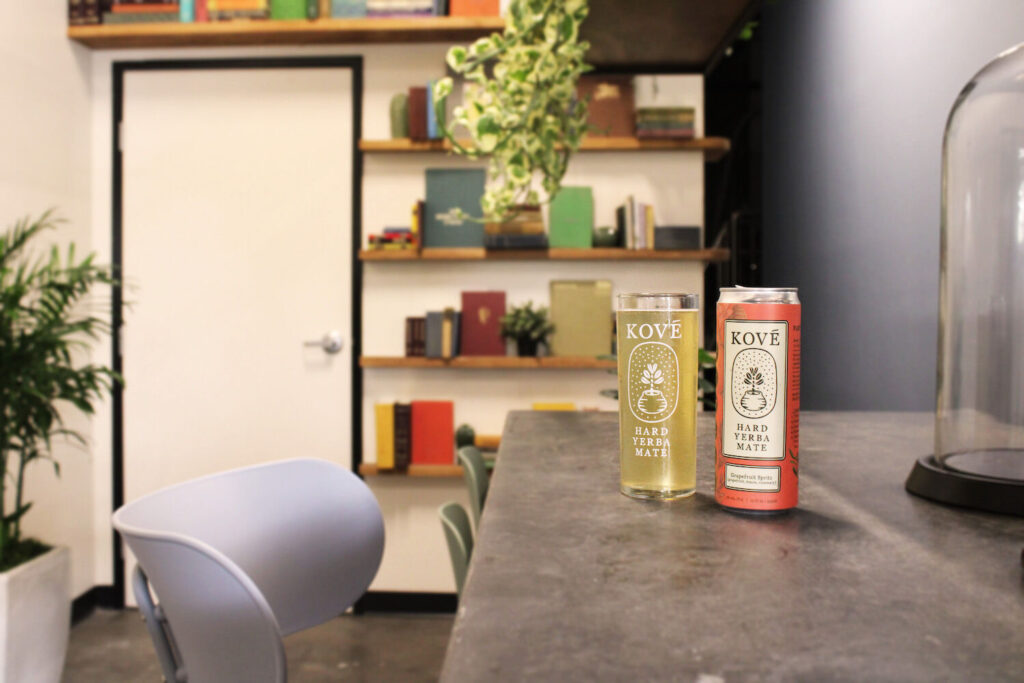
Kové Hard Yerba Mate opens June 7 in Miramar
Photos Courtesy of Kové Hard Yerba Mate
One year after opening their inaugural tasting room and brewing facility in Barrio Logan, Kové Hard Yerba Mate is ready to open their second location in Miramar. Yerba mate, an herbal tea popular in South America, has yet to achieve mainstream popularity in the American alcohol industry, but as the world’s first 100% organic, gluten-free, vegan hard yerba mate, Kové hopes to introduce the lightly caffeinated beverage to more people through distribution and expanding roster of San Diego locations.
The new space—which lies smack in the middle of a fermentation hub that includes Pure Project, Duck Foot Brewing Company, Ballast Point, Cutwater Spirits, and more—is the first of several planned outposts for Kové.
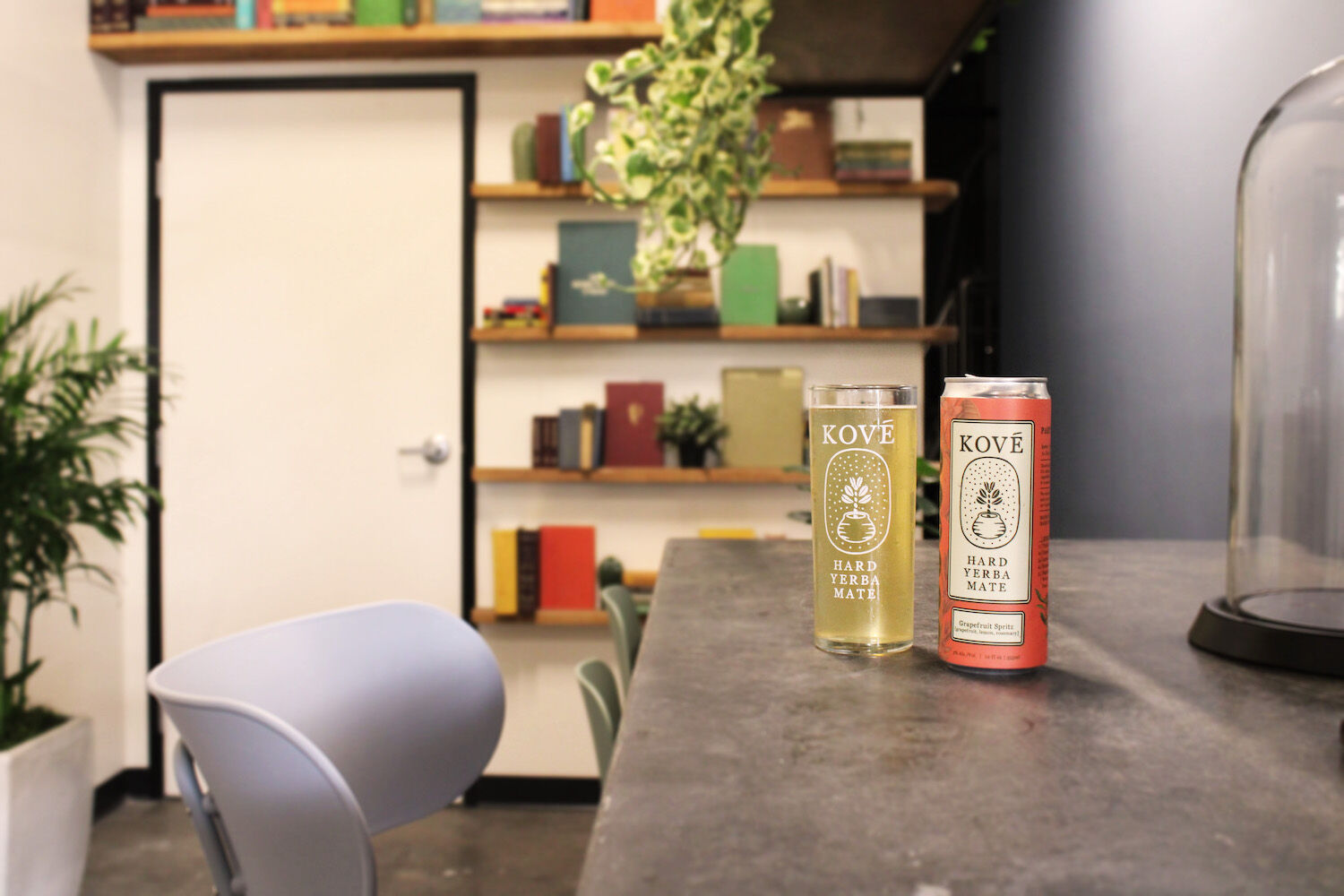
Alex Montelbano, Kové co-founder & CEO says with this new location, they aim to transcend the standard taproom setting, calling it a “unique visual experience” complete with artist collaborations and an emphasis on greenery.
“Visually, it is more of an artist curation space with botanicals weaved in, rather than an outdoor botanical experience,” Montelbano says. “Customers will have access to exclusive varietals from Kové’s expert brewer while enjoying beautiful art in various forms from local artists.”
A cozy corner inside the new Kové Hard Yerba Mate
Collaborations with artists, cocktail experts, yoga teachers, professional snowboarders, and other brand ambassadors have been a defining part of Kové’s ethos since its original launch in 2021. Montelbano says these partnerships are “incredibly purposeful” and a key part of their lifestyle image. Plus, as one of the few alcoholic drinks that naturally contains caffeine, their 5-percent-ABV cans are specifically designed to be enjoyed any time of day to complement any activity. “Party with a purpose!” Montelbano laughs.
The 720-square-foot tasting room will also feature a small batch brewing facility. Guests can expect 14 taps with core offerings, rotating specials, and seasonal flavors, as well as plenty of cans, growlers, and variety packs for to-go purchases. Plus, Montelbano promises, they plan to announce several partnerships and new flavors for release later this year. With the added brewing capabilities of the Miramar space, Montelbano says they hope to produce 4,500 barrels of hard yerba mate over the next 12 months. (For comparison, in 2021 Modern Times Beer reported an output of 53,000 barrels.)
The Miramar tasting room will soft launch on June 7 with a grand opening planned for June 25. Operating hours will be 4 p.m. to 8 p.m., Monday through Thursday; noon to 10 p.m. Friday and Saturday; and noon to 8 p.m. Sundays.
PARTNER CONTENT
Visit the new Kové tasting room at 9030 Kenamar Drive, Suite 309 and follow their progress at drinkkove.com.
The matcha pop-up is inviting locals to get their caffeine fix while learning more about Japanese tea culture
Humans are naturally drawn to vibrant hues like bubblegum pink, amethyst purple, and super-duper lime green. But as appealing as those colors are to our eyes and the algorithm, Nguyen Le says they’re rarely natural.
For example, pure, unadulterated matcha gets its Kermit color from tea leaves (specifically, Camella sinensis leaves), which are then cultivated under shade to boost their chlorophyll and amino acids. Matcha tweaked for our maximum stimuli often include green dyes, or extracts from other leaves (suji, moringa), plus flavor enhancers. For pandan, it’s the same.
For the signature matcha latte at Prosperitea, Le’s pop-up tea service uses real pandan leaves to create a simple syrup and flavorless green chlorophyll to brighten it up. By avoiding artificial flavors and colors and using seasonal fruits to create different syrups, Le says they can highlight what should be the star of the show—the tea itself.

Le grew up casually drinking tea with meals, but found himself getting more and more into coffee during the pandemic in order to support local coffee shops. “My caffeine intake was getting out of control,” he laughs. He switched to loose leaf tea and eventually matcha, which contains less caffeine and releases it more slowly than coffee. But when he tried matcha in Japan, he realized there was an opportunity to bring its ceremonial-grade to San Diego.
Often used liberally, the term “ceremonial grade,” has no official meaning or criteria, Le explains. It’s an unregulated marketing term that anyone can use to suggest a level of quality (and isn’t used in Japan).
“I think the more accurate description of ‘ceremonial’ would be the first harvest of the tea,” he says. “There’s multiple harvests throughout the year, and the first harvest of the year will always yield the best flavor and color for matcha… typically that’s used for ceremonies for the tea schools.”
Propsperitea offers drinks like lattes and Americanos made with matcha or houjicha (a savory Japanese roasted green tea), milk teas, and cold brew teas infused with seasonal fruits. For fall, Le says they’re bringing on fig leaf, sweet corn, white peach, and maple, along with the signature pandan. For now, Propsperitea pops up every weekend at Relic Bageri’s commerce kitchen at 8585 Commerce Avenue in Miramar, but he hopes to increase the amount of pop-ups and private catering events and eventually find a brick-and-mortar space of its own.
“I would like to be able to do the whole tea ceremony for patrons that want to experience it, but that’s just not possible in the [pop-up] setting,” he says. “Really, drinking tea is meant to be slowed down, and you’re supposed to enjoy the process. But right now, in America, everything’s just like, go, go, go, and they want that instant gratification. I want to be able to share that experience of slowing down the process.”
Find Propsperitea most Saturdays and every Sunday at 8585 Commerce Avenue.
Listen Now: The Latest in San Diego’s Food and Drink Scene
Beth Demmon is an award-winning writer and podcaster whose work regularly appears in national outlets and San Diego Magazine. Her first book, The Beer Lover's Guide to Cider, is now available. Find out more on bethdemmon.com.
Former Boochcraft and Cutwater brewer/distiller Koo Miyake launches his first San Diego beverage brand
When Koo Miyake moved from Japan to the United States for college, he brought with him a deep-seated cultural appreciation for craftsmanship and attention to detail—something he thinks is falling to the wayside in American-made products.
“You see a lot of drinks, something on Instagram, you don’t even know who owns it or where it’s coming from,” he explains. “It’s just another capitalism product.”
So, he decided to do something about it.

Next month, Miyake will open his first beverage line in Miramar, in the former Kové tasting room. Dubbed Koobrew, he’ll offer a core series of functional spritzers made with fermented teas, wine yeasts, and different botanicals, plus a few classic European-style beers like pilsners and witbiers. By tying together Japanese attention to detail and California’s spirit of entrepreneurship and innovation, Miyake hopes to help resurrect that sense of craftsmanship that once earned San Diego the title “The Capital of Craft.”
He has the experience to do it, too—Miyake has made hard kombucha at Boochcraft, distilled spirits at Cutwater Spirits, and was head of product and a partner at Kové until it closed earlier this year. He’s also a prodigious homebrewer and former beertender at Mikkeller in Tokyo, and he plans to use all of his beverage-making skills at Koobrew. For the soft opening this October, he’ll have around six different beverage options on draft before expanding to packaged bottles and kegs of around four different beers and around 10 “better for you” beverages. He’ll (eventually) need some help, but for now, Miyake says he wants to keep it a solo show to ensure everything is to his standards.

“I want to be grounded, put my soul and energy into what I’m making—because after I produce my product, it will be released from me,” he explains. “But until everything comes together, I want to try to make everything by myself so I understand everything, and then [I can] feel like I actually own the product and the space and the philosophy behind it.”
Koobrew opens at 9030 Kenamar Drive, Suite #309 this October. Follow @koobrew.co for more updates.

Listen Now: The Latest in San Diego’s Food and Drink Scene
Have breaking news, exciting scoops, or great stories about new San Diego restaurants or the city’s food scene? Send your pitches to [email protected].
Beth Demmon is an award-winning writer and podcaster whose work regularly appears in national outlets and San Diego Magazine. Her first book, The Beer Lover's Guide to Cider, is now available. Find out more on bethdemmon.com.
The team behind Harumama and Blue Ocean will open Little Kiki Katsu & More on June 15, serving premium cutlets, Japanese sandos, and curated sake pairings
Every culture has its own comfort foods—cozy dishes that nurture the soul as much as the body. In the US, dipping a grilled cheese sandwich in a bowl of tomato soup can feel as satiating as pulling a warm sweater out of the dryer. In China, a steaming bowl of congee is basically a miracle remedy for anything you can imagine. I’m pretty sure Italian carbonara could achieve world peace. And in Japan, katsu remains one of the most universally satisfying inventions of the past century.
Katsu was originally invented as a riff on côtelette de veau, the classic French veal cutlet coated with breadcrumbs and pan-fried in butter. In 1899, a Western-style restaurant called Rengatei in Tokyo decided to put their own spin on the dish by pounding the cutlets until thin, then coating them with softer panko and deep-frying versus pan frying (like tempura) for a crispier, lighter, crunchier bite. Today, pork—called tonkatsu in Japanese—tends to be the most common base for katsu.
The dish has yet to achieve the same mainstream status as say, chicken nuggets, in the US. But Little Kiki Katsu & More hopes to change that, when the katsu-focused restaurant opens in Carlsbad on June 15.
Created by the team behind Harumama and Blue Ocean, Little Kiki will focus on premium katsu dishes paired with sake and around a dozen small bites like miso soup, karaage, edamame, and Japanese pickles. Executive chef James Pyo, who co-owns all three restaurants with his wife Jenny, created a menu that features proteins like Berkshire Kurobuta pork, Jidori chicken, salmon, scallops, and dry-aged Pacific cod for the katsu and grilled stone selections. (Note: the grilled stone options will be offered for dinner only.)

The lunch menu includes Japanese-style sandos like a tonkatsu sandwich with pork, housemade bread, and tonkatsu sauce (available regular or spicy). Dessert options are simple to start—yuzu cheesecake, matcha crème brûlée, and mango/yuzu mochi ice cream. The Pyos curated a selection of premium sakes as well, specifically for pairing purposes, as well as offering some beer and cocktails.
Little Kiki, which is named for Jenny’s cat, seats 25-30 guests inside with room for only a few more on the small outdoor patio as well. Designer and assistant Yoojin Jang says the vibe is meant to be warm and welcoming but modern, using colors like olive green, cream, and pops of orange against Japanese-style wood slats.
Initially, Little Kiki will only be open for dinner service, but aims to introduce lunch hours for the grand opening on July 1. Due to the limited seating, Jang encourages guests to make reservations, and while the restaurant will offer takeout, it will not be available on food delivery apps like Uber Eats or DoorDash to motivate guests to come experience it for themselves.
“Come in curious and leave satisfied,” says Jang. And keep your eyes open for subtle cat motifs—she promises they are hidden all over the place. Whimsy, it seems, is also on the menu.
Little KiKi Katsu & More soft opens on June 15, 2026 at 2958 Madison Street, Suite 101 in Carlsbad. Hours are Monday, Wednesday, Thursday, and Sunday from 11:30 a.m. to 3 p.m. for lunch and 5 p.m. to 9:30 p.m. for dinner; Friday and Saturday from 11:30 a.m. to 3 p.m. for lunch and 5 p.m. to 10 p.m. for dinner; closed Tuesday.

Listen Now: The Latest in San Diego’s Food and Drink Scene
Have breaking news, exciting scoops, or great stories about new San Diego restaurants or the city’s food scene? Send your pitches to [email protected].
Beth Demmon is an award-winning writer and podcaster whose work regularly appears in national outlets and San Diego Magazine. Her first book, The Beer Lover's Guide to Cider, is now available. Find out more on bethdemmon.com.
Stake Chophouse & Bar brings contemporary classics and old-school service to the heart of Coronado
Stake Chophouse & Bar isn’t your average steakhouse. Blue Bridge Hospitality’s Coronado outpost is a modern interpretation of a big-city steakhouse nestled in the heart of the small coastal community. The team at Stake has reimagined the whole steakhouse experience. By prioritizing a seasonal farm-to-table sourcing philosophy, a personalized guest experience, and unique service touches, like a formal steak presentation and a bespoke knife selection process, Stake distinguishes itself in a sea of steakhouses.
Exceptional steaks, including Wagyu from Japan, Australia, and the U.S., and fresh seafood flown in daily form the core of Stake’s culinary identity. The menu features a five-course omakase-style steak experience highlighting house favorites, plus an array of cuts, and classic steakhouse staples—think a wedge salad, baked potato, or pasta carbonara—refined for a contemporary palate without losing their traditional appeal. Stake focuses on seasonal sourcing from the region’s best family farms and specialty purveyors, and incorporates intentionally unexpected touches to create something truly unique.
“I challenge our chefs and myself to take it a step further in sourcing,” says Chef Ronnie Schwandt. “It’s important to us to highlight different farms, unique one-off farms—whether it’s cattle, strawberries, a local fisherman or from anywhere in the United States, we’re always trying to find that niche.”
Beyond the menu, Stake emphasizes outstanding service, says Vinny Spatafore, Director of Hospitality Operations. Staff maintains detailed notes, allowing them to remember guests by name, recall previous orders such as a favorite martini (also memorable for the customer since it’s served in an extra tall, distinctly-shaped glass), and celebrate special occasions like birthdays and anniversaries.
“When you have those points of topic that you remember about a guest, they appreciate that,” he says. “Our servers are really good with that—we have a couple servers who have been here since the beginning and they’ll remember somebody from years ago, their name, their kids’ names, where they live. I’m really thankful to have a great front of house staff.”
Award-winning wines, rare whiskeys, special events, and a complementary black car service that provides transportation for guests throughout Coronado add to Stake’s appeal.
Schwandt stresses that Stake offers more than a meal; they aim to give patrons something unforgettable.
“It starts when you walk up the stairs and are greeted by the hostess—that sets the tone for the night. Then you’re greeted by a server, who may know you by name, and can guide you through the menu and curate as they get to know you,” says Schwandt. “Most people leave kind of blown away; they leave feeling like they just had an experience. That’s the goal, right? Whether you’re serving smash burgers or high-end steak, you want somebody to leave thinking, Wow, that was awesome.”
Telefèric Barcelona will open its first San Diego location early this summer
Westfield UTC mall is adding yet another “first” to the ever-growing roster of restaurants. The first US location for China’s stir-fry sensation Chef Fei is on the way later this year, Japan already reinvented crispy rice pioneer Katsuya by opening the first Katsuya Ko, and now, it’s Spain’s turn—Telefèric Barcelona opens early this summer.
The family-owned, Barcelona-based tapas joint first opened in the US 10 years ago in Walnut Creek, California, but co-founder and CEO Xavi Padrosa says they’ve had their eye on San Diego for years. Westfield UTC “just clicked,” he says, pointing to the burgeoning collection of world-class eateries already within the mall’s walls. Plus, La Jolla’s breezy vibe echoes Spain’s easygoing tapas culture.
The indoor/outdoor space spans 5,526-square-feet, with seating for 150 inside, 60 on the patio, and 16 more at the bar. Xavi’s sister and co-owner Maria Padrosa designed the Mediterranean-inspired space as a contemporary take on coastal Catalonia, using imported furniture and materials from Spain like hand-glazed tiles and wood accents. And if all the dining spaces are planets, the center of the suite’s universe is the bar.

Padrosa points to signature favorites like patatas bravas (fried potatoes drizzled with a spicy red sauce and house aioli), jamón ibérico de bellota (Spanish ham from free-range pigs raised on acorns, cured for 38 months and sliced to order), gambas al ajillo (garlic shrimp), pulpo Telefèric (octopus with potato purée and pimentón XO, a spicy Spanish/Cantonese fusion sauce), and croquetas (a popular fried tapas dish coated in breadcrumbs and made with béchamel mixed with fillings like jamón or king crab.
There are a very small handful of legit paella spots in San Diego (Costa Brava in Pacific Beach and Cafe Sevilla in Gaslamp Quarter come to mind), so I’m personally looking forward to giving Telefèric’s a go—especially the squid ink paella negra, which is perhaps the most goth paella of all. Every location also offers different weekend specials, La Jolla’s being seafood-driven and meant to pair with beverage director Alex Serena’s drinks. There are over a hundred Spanish wines, Spanish-inspired cocktails, sangria, and of course, plenty of twists on the iconic gin and tonic. The restaurant will also have a gourmet market called The Merkat with imported Spanish sundries.

With more US locations in the works (Newport Beach will open soon after La Jolla), Padrosa says the company hopes to open more across California, but are open to anywhere in the country that feels right. “We don’t know exactly what new cities will appear on our map in the coming years,” he says. But in true Catalan fashion, anywhere they go should be ready for big plates of hearty Spanish cuisine.
Telefèric Barcelona La Jolla opens early summer 2026 in Westfield UTC. Opening hours will be Monday through Thursday, 11:30 a.m. to 10 p.m.; Friday and Saturday, 11:30 a.m. to 11 p.m.; and Sunday, 11 a.m. to 10 p.m.

Most of the time, you have to be 18 years old to change your name. In Arcana’s case, it was about a month. The immersive speakeasy behind Archive in Encinitas updated their moniker to Animga (a play on “enigma”) earlier this month, after what one can only assume was an upset letter from a similarly-named business. However, partner Paula Vrakas promises that the concept remains the same—mystery, cocktails, and a forthcoming bottle locker membership club. Since the only constant is change, Anigma is off to a good start!

Listen Now: The Latest in San Diego’s Food and Drink Scene
Have breaking news, exciting scoops, or great stories about new San Diego restaurants or the city’s food scene? Send your pitches to [email protected].
Beth Demmon is an award-winning writer and podcaster whose work regularly appears in national outlets and San Diego Magazine. Her first book, The Beer Lover's Guide to Cider, is now available. Find out more on bethdemmon.com.
Talking farm to table, fraud-to-table, and the feasibility of the movement with the beloved restaurateur who saw it all
Garden Kitchen was special. During its seven-year run on a quiet street in Rolando, even the farmiest-to-table devotees were pointing to chef-owner Coral Strong and slow-clapping. When the restaurant’s lease was up without the option to renew, which forced her to close in 2022, Strong wasn’t sure what to do next.
Farm-to-table wasn’t new by any means—chef Alice Waters spawned the movement at her pioneering restaurant Chez Panisse in Berkeley in the early ‘70s, and many San Diego chefs did it right. But by the mid-2000s, the idea had been so co-opted by the mainstream that the meaning was almost completely lost.
“In the beginning, I used to get very honestly angry and upset when I would go to other restaurants that were claiming they were farm-to-table, but knowing some of the chefs or prep cooks inside [telling me] ‘Oh no, that comes from Restaurant Depot,’” she says.
Food critic Troy Johnson’s cover story in 2015 documented the fraud, titled “Farm to Fable.” At Garden Kitchen, Strong only used produce and meat sourced from local San Diego farms—an honorable, if not arduous endeavor.
Strong grew up in Cardiff before her parents moved the family to Costa Rica in 1989. They’d bounce between the two countries for months at a time, but when they lived in a motel by the beach while building their own house, she witnessed an incredibly tight-knit food culture. “As a Latin American country, everyone kind of cooks together,” she says. Everyone chopped, prepped, prepared, and served as a unit. “[That] definitely shaped my adolescence as to how I thought about food and the community of food.”

When her father, a commercial fisherman, brought the family back to San Diego, Strong leaned into an entrepreneurial streak, moving from coffee to accounting and eventually bartending to pay the bills. But food remained a passion, especially after she met her future husband, who introduced her to his Be Wise CSA and the wonderful world of truly fresh, farm-grown vegetables.
“We were just always disappointed with the vegetables out at restaurants and were like, ‘Why can’t they just make vegetables taste good?” she wondered. She realized that despite having more small farms than any other county in the country, most restaurants in San Diego simply weren’t using local ingredients.
So she decided to do it herself.
Strong opened Garden Kitchen without any formal culinary training—just a commitment to getting the freshest vegetables, meat, fruits, and other produce onto people’s plates. Her first chef quit within a month, telling her it was impossible. “So I got in the kitchen one day and said, ‘I can do this, let’s figure it out.’ I taught myself how to cook.”
She already had connections with farmers, fishermen, and ranchers, and designed a different menu almost daily based on what she could get. “My farmers sometimes delivered in the middle of dinner service,” she laughs.
Garden Kitchen lasted until after the pandemic, but before the current economy cut into already razor-thin margins. Could Garden Kitchen exist today? She’s not sure.
“The biggest thing right now is just looking at the finances and how expensive it is,” says Strong. “Obviously, the cost of food is up right now, gas is crazy right now… it just crushes you.” Despite that, she believes that committing to the true farm-to-table ethos is as easy as one decides to make it.
“If you think it’s hard to order directly from your farmer, if you don’t understand the absolute pleasure in doing that and you’d rather order from a computer, then that’s your own difficulty,” she says. “People say they’re into it, but are they willing to make the effort like I am, to drive an hour to go get my meat, or drive 35 minutes to go to my farm to go pick it up? I don’t know.”
Today, Strong works as a private chef, hosts pop-ups, and offers catering services, all still using seasonally available ingredients from San Diego. And while she has no intentions of opening another restaurant, she says we might see even more of her in the future.
“I have a large property [in Valley Center], and let’s say that there will be more of my food to come,” she promises.

Listen Now: The Latest in San Diego’s Food and Drink Scene
Have breaking news, exciting scoops, or great stories about new San Diego restaurants or the city’s food scene? Send your pitches to [email protected].
Beth Demmon is an award-winning writer and podcaster whose work regularly appears in national outlets and San Diego Magazine. Her first book, The Beer Lover's Guide to Cider, is now available. Find out more on bethdemmon.com.
Scripps study shows that some patients may be able to taper their dose and maintain results
While glucagon-like peptide-1 (GLP-1) receptor agents have been used to treat Type 2 diabetes for more than 20 years, their recent emergence as weight-loss wonder drugs marked a new frontier in medicine. But their effectiveness has left some patients wondering what to do once they’ve reached their goal. Stopping the medication could mean regaining some, if not all, of the weight. A Scripps Clinic internal medicine physician recently conducted a small study of whether GLP-1 patients who had reached their goal weight could maintain that weight by taking their regularly prescribed injection every other week instead of weekly. Spoiler alert: 30 of 34 patients did. Read more about the study here and what that may mean as pharmaceutical companies roll out oral GLP-1s.
For more nutrition, wellness, and healthy living tips, sign up for the San Diego Health newsletter here.