Ready to know more about San Diego?

Subscribe
Everything SD SEPTEMBER 6, 2024 (Updated Oct 24, 2023)

6 of the Best Outdoor Climbing Spots Within an Hour of San Diego

The best local crags, boulders, and slabs for climbers to conquer
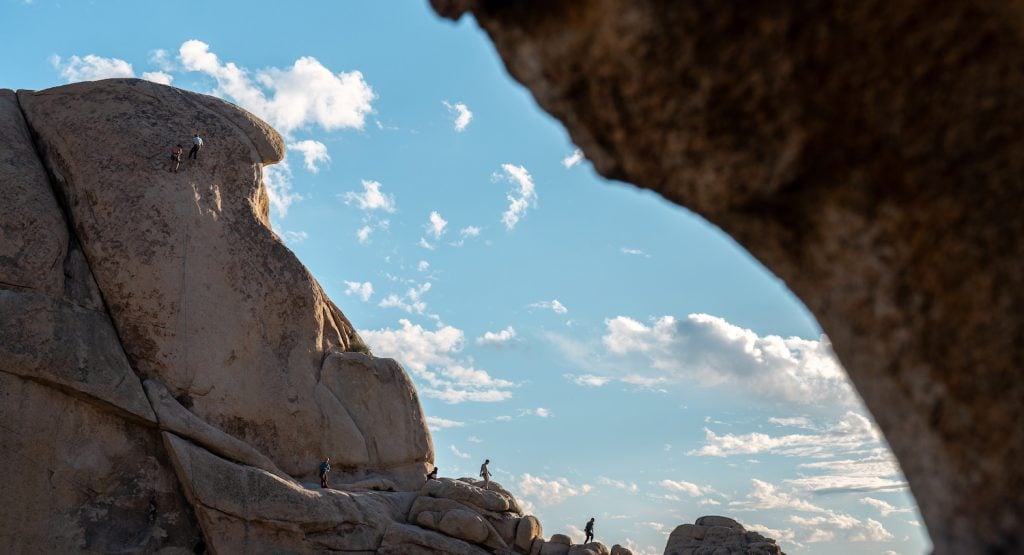
6 of the Best Outdoor Climbing Spots Within an Hour of San Diego
Photo Credit: Cole Novak

Rock climbing is all the rage these days. Since its debut in the Olympics in 2020, the sport has experienced a meteoric rise, with more than 600 climbing gyms now scattered across the US—eight of which call San Diego home. While climbing gyms provide a fantastic way to hone skills and find a community, outdoor climbing delivers a unique, exhilarating experience that can take your love of the sport to new heights.

Fortunately for us, San Diego boasts a wealth of rocks, crags, and mountains—all within an hour’s drive. Ready to get climbing? Here are six of the best outdoor climbing spots around San Diego:
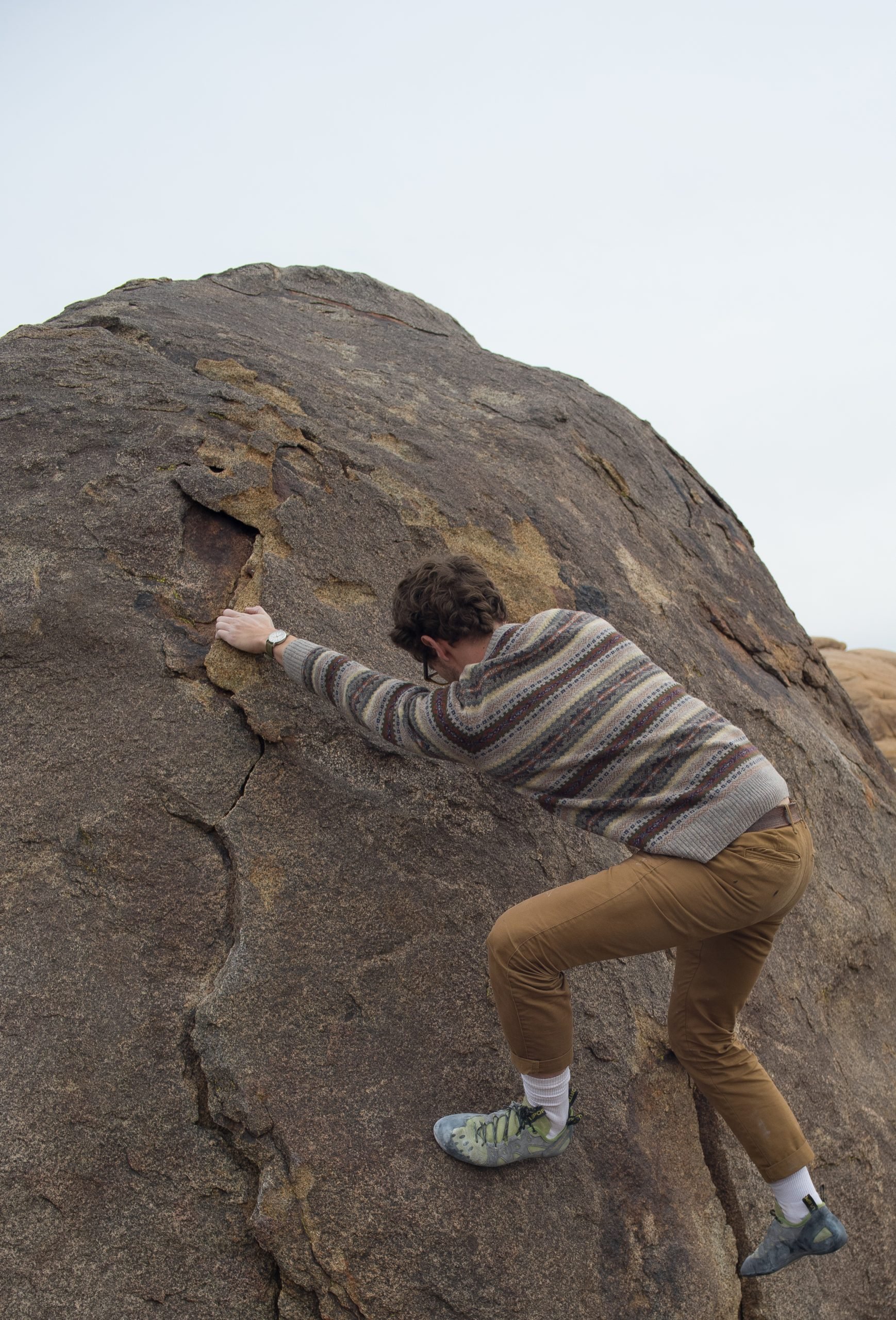
Best San Diego outdoor climbing spots featuring Santee Boulders
Photo Credit: Cole Novak
One of the various beginner-friendly boulder routes found at Santee Boulders

Santee Boulders

Arguably the most accessible and beginner-friendly climbing spot in San Diego, Santee Boulders is located just 45 minutes from downtown with parking available at the West Hills Park. 

This outdoor jungle gym is home to 151 climbing routes, including beginner boulder routes like The Knobs (V0) with its distinct jug holds indoor climbers will appreciate, fun slabs like The Face (5.9) where you can test your balance, and more advanced projects like Bullet Hole Face (5.10+), perfect for top roping or dicey high-ball bouldering. Santee Boulders is an excellent introduction for indoor climbers to the more abrasive realities of outdoor rock climbing. 
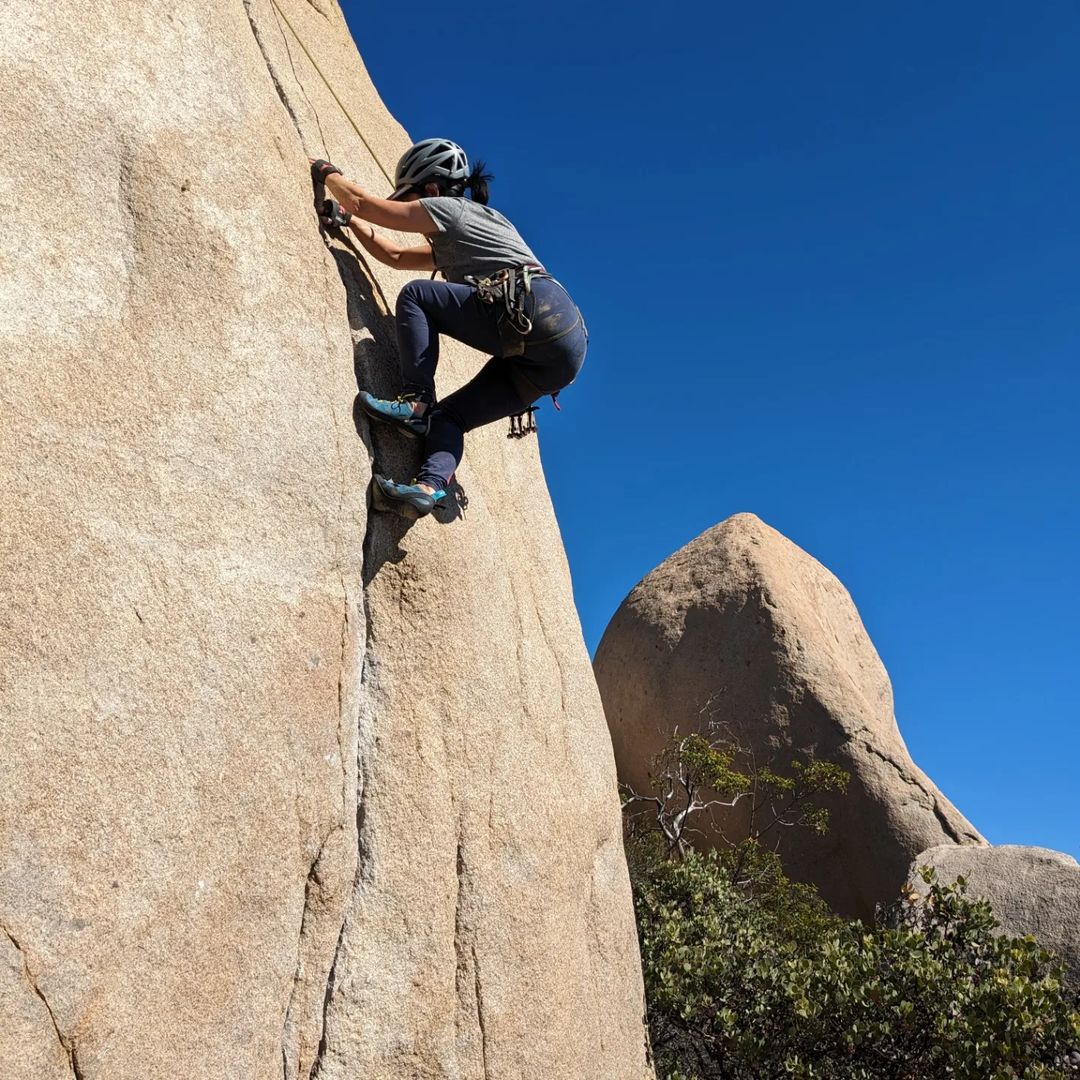
Best San Diego outdoor climbing spots featuring Mount Woodson
Courtesy of Chillino Rock Climbing
A local climber ascends one of the many cracks Mount Woodson has to offer

Mount Woodson  

Known for its iconic Potato Chip Rock, Mount Woodson offers far more than Instagram photo ops and casual switchback hiking. This Poway-adjacent climbing spot has 400 unique climbing routes making it a prime spot for lead, top rope, and crack climbing. 

Originally popularized by climbing legends Royal Robbins and John Bachar in the 1950s, Mount Woodson is a granite playground with popular routes like Robin’s Crack (5.10a) a famous 20-foot crack wall; Jaws (5.11a), a cracked boulder with a name more ominous than than the climb itself; and Uncertainty Principle (5.11c), a sort of Pride Rock for Mount Woodson, testing your endurance and often attracting the attention of nearby hikers.  
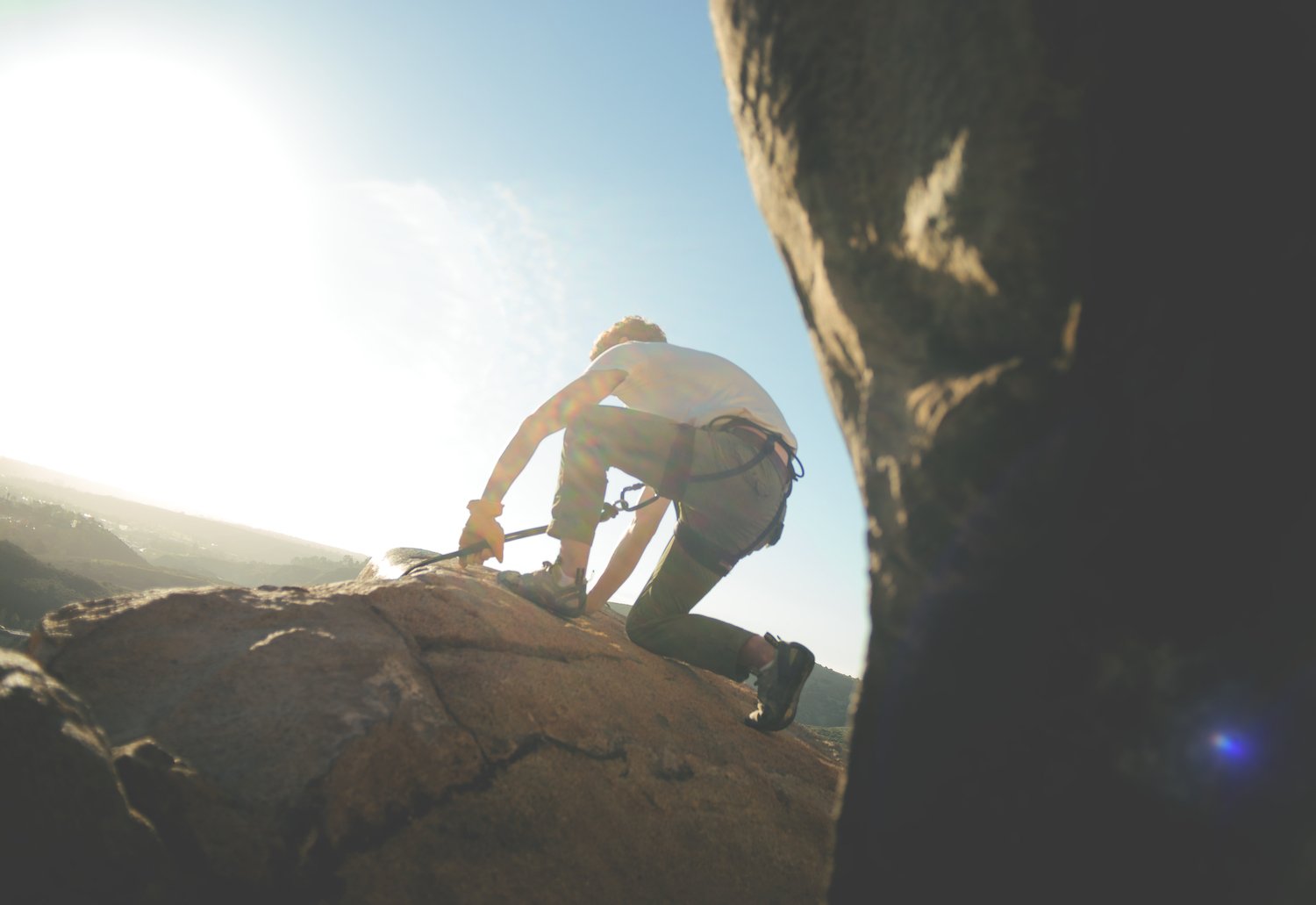
Best San Diego climbing spots featuring a top-rope route at Mission Gorge
Web content editor Cole Novak preparing a top rope route on the Main Wall at Mission Gorge
Photo Credit: Cole Novak

Mission Gorge  

Only 20 minutes from downtown, Mission Gorge is a trad and top rope climber’s dream. The area is home to butter-like walls spanning three sections: the Main Wall, Limbo Area, and Middle Earth (although you won’t find any hobbits there). These west-facing walls provide much-needed shade during morning ascents, helping prevent sweaty palms on the park’s notoriously slick holds. 

You’ll find more than 200 climbing routes, including The Tower (5.7), an enjoyable 50-foot route with bolts and a views of the San Diego River upon completion; Craig’s Crack (5.8), a Limbo area spot ideal for working on your hand jams; and Orange Sunshine (5.10d), a technical climb that demands precision footwork.
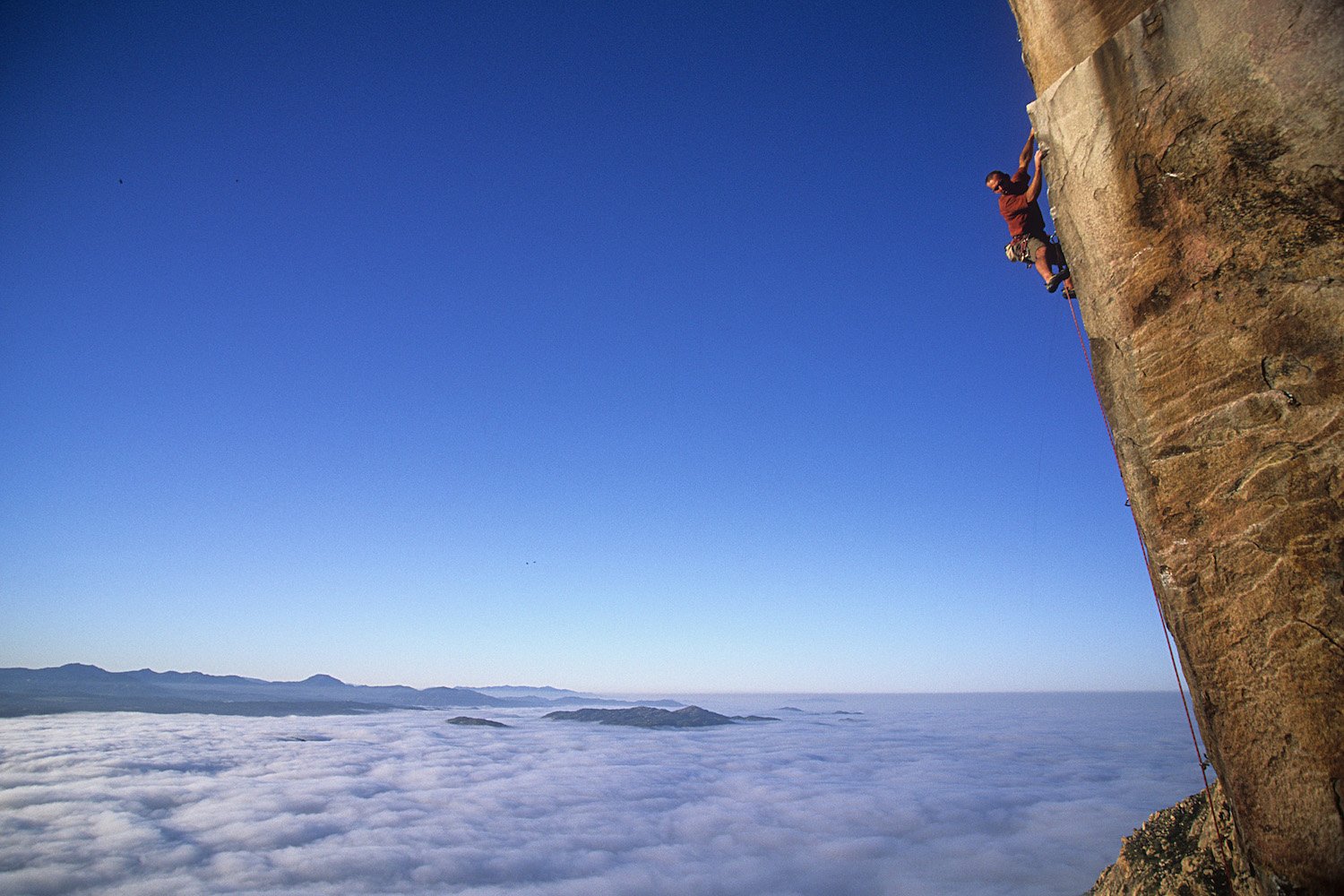
El Cajon Mountain trad climbing spot San Diego
Rock climbing pioneer, Randy Leavitt, seen 3,600 feet above the clouds on El Cajon Mountain
Photo Credit: Jorge Visser

El Cajon Mountain  

Located 50 minutes from San Diego, El Cajon Mountain boasts 200-plus sport and traditional climbing routes. After accessing the area via the paved roads of Lake Jennings, climbers must embark on a strenuous two-mile, 1,800-foot hike in direct sun before choosing between the beautiful granite cliffs of the Main Wall (The Wedge), Fly Dog Buttress, or the Mountaineering Wall. 

Popular routes include Lenoids (5.9), one of the most traveled multi-pitch sport routes in San Diego; Triton Tower (5.11a), a challenging 360-foot, three-pitch climb under a granite slab roof; and Sleeping Giant (5.10a), a 1,000-foot, 10-pitch climb on the lesser traveled Mountaineer Wall. Bring water, hiking boots, and binoculars for an incredible view of the ocean when you top out on this peak .  
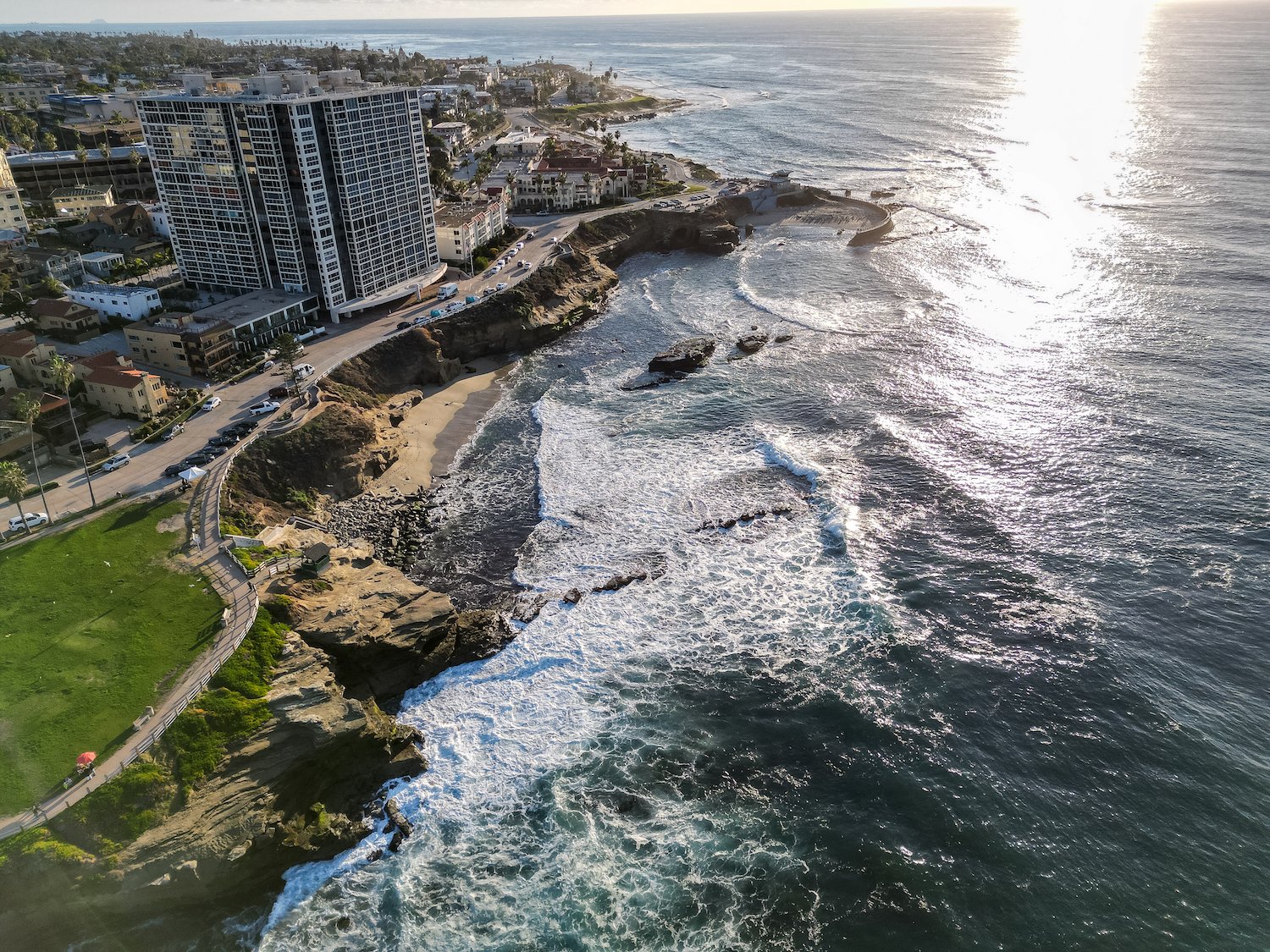
Aerial view of La Jolla People's Traverse climbing spot
Photo Credit: Cole Novak

People’s Wall & Sunset Cliffs Pump Wall Traverses

Often overlooked, the People’s Wall and Pump Wall offer excellent traverse practice for climbers wanting to stay local. The People’s Wall located steps from the Museum of Contemporary Art San Diego in La Jolla, provides climbers with a 200-foot-long stone wall traverse along the coastline. 

The Pump Wall offers a more challenging climb with less-distinguished handholds along the exposed north side of Sunset Cliffs Boulevard above Claiborne Cove. After a few traverses, these seemingly simple walls will leave arms pumped and your hands barely capable of gripping a steering wheel—making the short car ride home a relief for city-bound climbers.
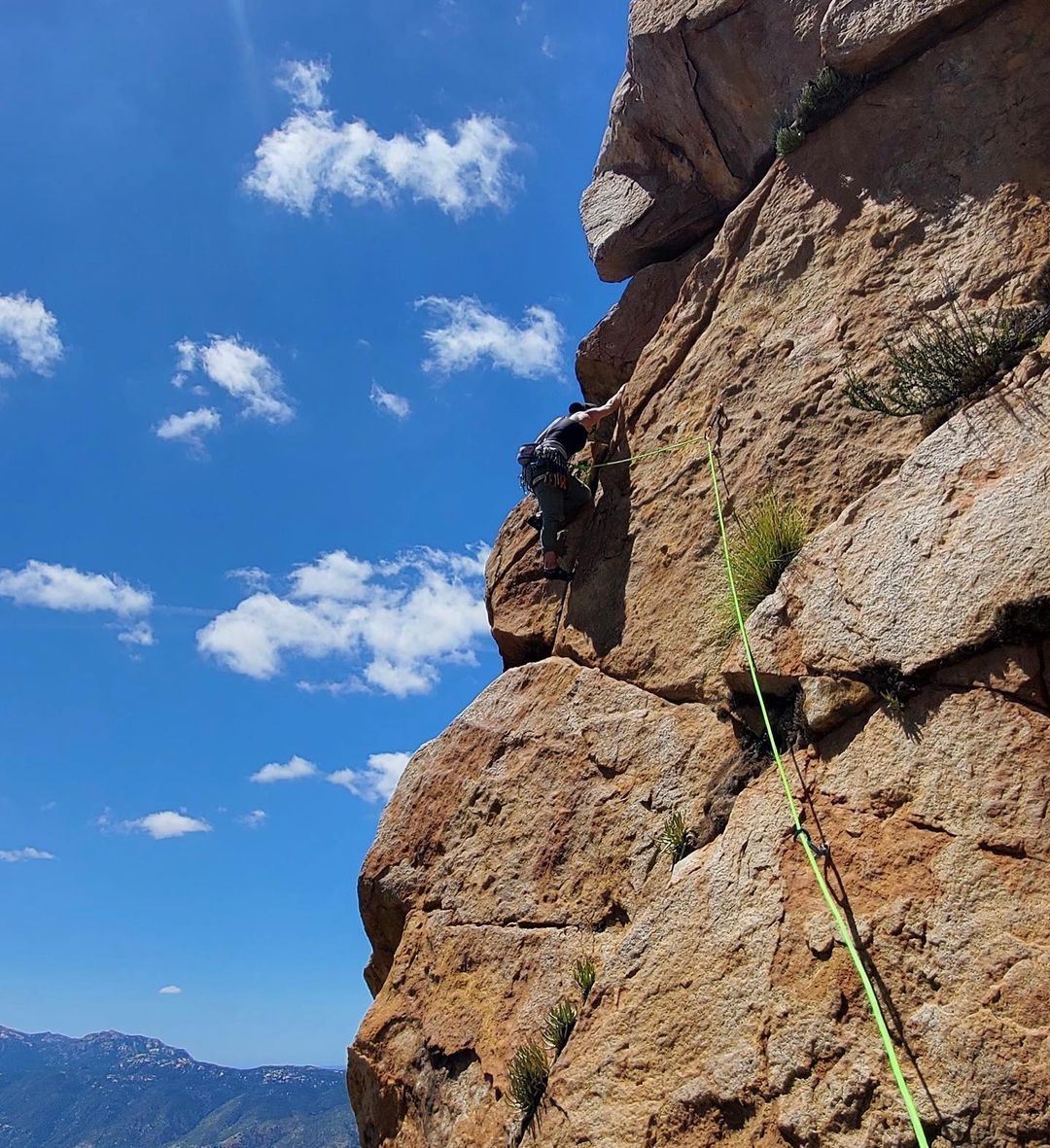
 Baby Face (5.11a) climbing route at Eagle Peak
Photo Credit: Anna Gerber
Drew Alldredge up in the clouds traversing Baby Face (5.11a) at Eagle Peak

Eagle Peak 

Just over an hour’s drive from the city, Eagle Peak is a haven for sport climbers seeking challenging single- and multi-pitch climbs in San Diego County. With 65 routes spread across four 100-foot tall granite rock faces—Left Wall, Right Wall, Tan Man Tower—Eagle Peak rewards those who scale the Eagle Peak Trail’s switchbacks, brave the East County heat, and dodge dive-bombs by birds before on their approach to  the climbing area.

Notable routes include Cruise Line (5.10c), a five-pitch ascent on the Left Wall that serves as a great intro to Eagle Peak; Baby Face (5.11a) a crimpy four-pitch climb to challenge your technique; and Irie Corner (5.10b/c), a 200-foot, two-pitch route featuring a panoramic view to share with the spot’s avian overseers.
Cole Novak

About Cole Novak

Cole Novak is an award-winning writer with a passion for highlighting local figures, small businesses, and nonprofits. Born and raised in San Diego, Cole is passionate about photography, surfing, art, the local food scene, and the great outdoors.

Subscribe to our newsletters

Select Options

By subscribing you confirm that you agree with our Terms and Conditions and Privacy Policy.

Everything SD JUNE 25, 2026

The Breakout Idea: Gameday Men’s Health

The Carlsbad-based concept has exploded nationally by turning men’s health clinics into man caves

The Breakout Idea: Gameday Men’s Health
Collage by Casiel Sanchez

Rub some dirt on it. Walk it off. Be a man. The tropes and reasons for men ignoring their health and doing preventive care are many, reinforced by action heroes and generational norms. As a result, compared to American women, American men live an average of five years less, seek healthcare treatment half as often, and die by suicide nearly four times more often.

Many national campaigns have tried to change this. This year’s “Relax Your Tight End” ad from Novartis during the Super Bowl—in which NFL legends advocated for early prostate cancer screenings—was a high-profile example. Meanwhile, in San Diego, Evan Miller seems to have figured it out.

Miller founded Gameday Men’s Health in 2018 as a small clinic in Carlsbad. The idea was to create a space men would actually want to spend time in. So he built Gameday to feel more like a sports bar or a man cave—snacks, sports on oversized, high-def flat screens in the waiting room. He personalized the care for each client, made the experience more casual, and, above all, efficient. If the wait for payoff is too long, Miller says, men won’t show up for their health.

“We need to feel better quick,” he says. “So that’s where the real hook with Gameday is: It’s fast; it works quick.”

The idea has worked. Big time.

Gameday now has 430 locations spread across 46 US states and parts of Canada, with hundreds more set to open over the next three years.

Prior to Gameday, Miller—who has a Ph.D. in clinical psychology—ran Akua Mind Body, an addiction treatment center in Newport Beach. After selling the center, Miller says he searched for a new way to help his community.

He drew from his behavioral health training and dispiriting past experiences with “sketchy” men’s clinics, albeit with a slightly different concept at first.

Courtesy of Gameday Men’s Health

“My original idea for Gameday, funny enough, was men’s group therapy,” Miller says. “I wanted to put it in this ‘man cave’ environment because I knew guys wouldn’t show up otherwise.”

Initially envisioned as safe spaces to encourage men to open up emotionally, Miller pivoted to a more clinical approach with an athletic design that personally appealed to him. Soon, it evolved into a one-stop shop of compounded medication treatments for weight loss plans, hair loss treatments, anti-aging injections, sexual wellness strategies, and testosterone replacement therapy. The hotly debated trend of peptides—mini amino acid proteins that the FDA has yet to approve—has become a popular feature.

New patients undergo in-clinic assessments for testosterone and prostate levels with the goal of producing test results in just a quarter of an hour. “Our philosophy with our treatments is we only do what the research supports,” Miller says.

An Orange County native, Miller found Carlsbad to be a natural headquarters. He found a much bigger market in coastal North County of men seeking a boost—both in their marriages and their overall livelihoods. The pandemic proved to be a watershed moment, with front-yard gyms and outdoor, highly visible exercise sparking a wave of self-care. According to Cleveland Clinic, after the pandemic, about 20 percent of men started to exercise more and eat healthier, with a quarter of men reporting they scheduled more sleep and spent more time with family.

“When Covid happened, [suddenly] everyone looked in the mirror and was like, ‘I need to take care of my health; I have to do everything possible to get in shape,’” Miller says.

Two years after Gameday first began, Miller opened a second clinic in Temecula, followed by locations in Laguna Beach and Newport. Demand kept coming, so they started franchising in 2023. They sold 1,000 licenses in the first year. By 2025, they had over 400 clinics across the country.

When asked about the rapid growth, Miller cites the feedback he received along the way: “People were so excited about men’s health, cash-pay medicine, and not having to wait for insurance. They understood the model. It was for guys; it felt like ESPN meets healthcare.”

Now Miller says Gameday is starting to map out a global expansion—to Europe, Latin America, and the Middle East. Since the company first cultivated a following, Miller says there have been persistent questions about whether Gameday would ever expand its focus to include women. Their answer: Her Way.

“We only offer a very narrow menu, almost like In-N-Out Burger, because we stay in our lane, we do it really, really well, and we gain trust that way,” Miller says. “So we created the Her Way model to do the same thing for women [that] we’ve done with men.”

Her Way Health & Hormones launched in 2024 in clinics with more neutral and calming décor. With locations in Carlsbad and Mission Valley, it will officially start franchising this summer. Miller seems incapable of thinking small and expects around 1,000 Her Way locations to open nationwide within a few years.

Ryan Hardison is a freelance arts and entertainment writer and recent graduate of San Diego State. When he's not staring at his laptop, he's likely eating an adobada burrito or getting sunburnt at the beach.

Guides JUNE 11, 2026

A Guide to the FIFA World Cup 2026 in SoCal

From San Diego’s coastline to Los Angeles stadium and fan zones across the region, here’s how to experience soccer’s biggest event

A Guide to the FIFA World Cup 2026 in SoCal
Courtesy of FIFA

When three nations and 16 cities come together to host the FIFA World Cup 2026, the scale stops feeling like a tournament and starts feeling like geography. A continent becomes the stage as borders soften into corridors. And Southern California—shaped by migration, sport, entertainment, and constant movement—sits inside that landscape with all eyes on it.

San Diego and Los Angeles have always felt connected. Hop on the Pacific Surfliner, and the trip unfolds in one continuous stretch of coastline, passing beach towns, neighborhoods, and city centers.

Traveling from San Diego, everything still feels slightly suspended as the Pacific Surfliner follows the coast north with ocean on one side and a slow suburban blur on the other. San Diego stays in exhale. Los Angeles is already building toward something louder.

This summer, Los Angeles will host eight matches of the FIFA World Cup at Los Angeles Stadium, including the US Men’s National Team opener on June 11, while the region stretches into 39 days of programming across stadiums, parks, transit hubs, beaches, and neighborhoods. Instead of one massive fan hub, Los Angeles is embracing a citywide celebration, with fan zones spread across its entirety.

But this pattern has been rehearsed here for decades. In 1994, Southern California became one of the defining stages of the World Cup, when matches at the Rose Bowl placed global attention on the region and turned local stadiums into international landmarks, confirming its ability to hold the world at scale.

What distinguishes Southern California is not just infrastructure, but cultural permeability. Fashion, music, film, art, and sport constantly overlap here, creating an environment where identity is flexible and always in motion. From the Venice boardwalk, where skate culture shaped modern street style, to global soccer stars rubbing shoulders with Hollywood celebs, to authentic Spanish cuisine moving up and down the I-5 corridor, everything circulates.

The World Cup is not introducing anything new here, it’s showing up for the summer and showing out, revealing what this city has always known about itself. What follows is a look at the fan zones and how Los Angeles turns itself into a city-wide stage for the tournament, one neighborhood at a time.

Courtesy of Los Angeles Tourism & Convention Board

Los Angeles Union Station

As the heart of Los Angeles, Union Station is an official Fan Zone June 25-28 during the World Cup, but in practice it never really stops being one.

It is the city’s circulation point, its meeting ground, its pressure valve. Commuters, travelers, match-day crowds, and everyday Angelenos all move through the same space, and everything mixes, overlaps, and scales in real time. In a way, this is where the World Cup stops arriving in Los Angeles and starts moving through it.

The Pacific Surfliner from San Diego to Los Angeles makes that shift feel almost too easy. No stress or  gridlock anxiety, just a straight line up the coastline with ocean on one side and everything slowly becoming more built on the other. It’s one of the rare ways into LA that doesn’t feel like arrival as friction. You can sit with a laptop, watch the Pacific drift past, grab coffee from the café car, and let the city come to you in pieces.

That’s the beauty of arriving at Union Station. Instead of feeling like you’re on the edge of the city, you’re immediately surrounded by it. And, inside, the station already reads like a World Cup nerve center: banners, movement, multilingual energy, the sense that something global is about to funnel through this exact point. The Heart of the City Fan Zone only sharpens that feeling, with simultaneous match screens, DJ sets, meet and greets, and immersive activations built around marquee games like USA vs. Türkiye.

From there, the city splits outward.

ROW DTLA feels like the first exhale after arrival. A converted industrial campus turned creative district where restaurants, retail, and open-air courtyards form a self-contained ecosystem. If you’re looking for the perfect first meal in LA, make it lunch at Pizzeria Bianco. The thin-crust pizza is reason enough to go, but the space leaves just as much of an impression.

What I liked most about ROW DTLA is how quickly it resets you after the train. One minute you are stepping off at Union Station, and the next you are in a space that feels like its own version of LA, a city inside a city with some of the most curated shopping I’ve ever seen.

Bodega hides itself behind a convenience-store front, a sneaker and streetwear space disguised as something ordinary, like LA refusing to make anything feel too obvious. The whole campus moves like that, part retail, part gallery, part neighborhood you are only temporarily inside.

Isabella Dallas is a freelance writer for San Diego Magazine and the Arts and Culture Editor at The Daily Aztec in her final year at San Diego State University. She previously worked as an editorial intern for SDM, but when she’s not writing, you can find her trying the best coffee spots in SD, devouring the latest rom-coms, and indulging in anything and everything pop culture.

Food & Drink JUNE 5, 2026

Del Mar Wine & Food Fest Returns With SoCal’s Top Chefs

San Diego’s biggest food and drink festival is back for a week-long celebration of SoCal’s best restaurants, chefs, and wineries from Sept. 30–Oct. 4

Del Mar Wine & Food Fest Returns With SoCal’s Top Chefs
Courtesy of Del Mar Wine & Food Festival

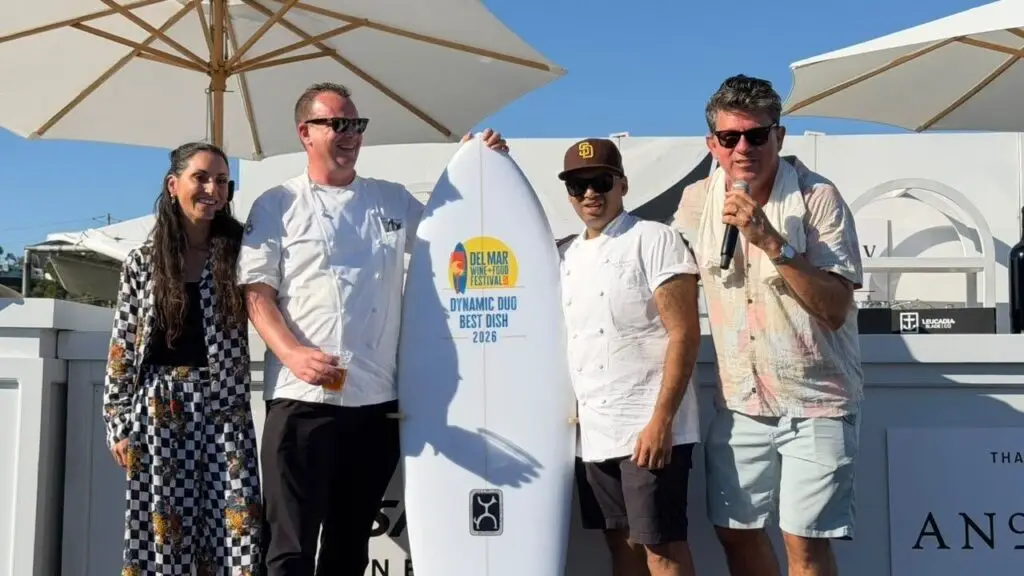
Maybe it was when Breaking Bad stars Bryan Cranston and Aaron Paul drank mezcal with chefs from San Diego and Food Network on the cliffs over Blacks Beach. Or the dinner outside under lights with Alex Morgan, celebrating some of the country’s most badass women chefs. Or the celebrity pickleball tournament hosted by NFL Hall of Famer Drew Brees, where the star of It’s Always Sunny in Philadelphia made thwacking sounds with locals. Or when Iron Chef winner Beau MacMillan commandeered (some say “stole”) a golf cart and delivered drinks and ice to chefs.

Whatever it is, Del Mar Wine & Food seems to have become the food and wine festival for people who don’t usually like food and wine festivals. The most San Diego thing.

Courtesy of Del Mar Wine & Food Festival

Two years ago, Thrillist named it one of the best food festivals in the country. Last year, 10,000 people came out to experience it, including Guy Fieri. Afterward, the founders spent a couple days trying to put their finger on why it felt so special. They had to name it, lean into whatever that was.

“It all came back to play,” says one of those founders, SDM co-owner Troy Johnson, a longtime San Diego food writer and Food Network judge. “Making world-class bread is serious, but breaking bread shouldn’t be. We gather all these incredibly talented people who take their craft very, very seriously—work their butts off all year to make some of the best food and drink in the country—and then we all just kinda play in the grass. We believe it’s possible to create something of incredible value and make the experience of that thing a laidback, easygoing, unpretentious experience. That’s what this is, and who we are in San Diego. The whole reason we did this was to shine a national spotlight on the people who make our food and drink culture hum.”

Courtesy of Del Mar Wine & Food Festival

The festival dropped its 2026 lineup today.

Headlining the fest are Food Network chefs Jet Tila, Maneet Chauhan, and Aarti Sequeira; Top Chef winner and Michelin-starred Buddha Lo; Iron Chef alum Beau MacMillan; MasterChef winner Kelsey Murphy; MasterChef Latinos winner Michelle Mathelin, chef and Guy’s Grocery Games judge Catherine McCord,  chef and former Masterchef Mexico judge Benito Molina, Top Chef alum Jackson Kalb, Michelin-starred chef Drew Deckman, Michelin-starred chef Javier Plascencia, James Beard award-winning chef Brady Ishiwata Williams, and James Beard-nominated chef Mawa McQueen.

The party kicks off on Wednesday, September 30 at Monarch Ocean Pub with Signature San Diego, a walk-around tasting of the city’s greatest bites, from Baja seafood to bold Mexican flavors. From there, the energy carries into a celebrity pickleball tournament hosted by Drew Brees at Barnes Tennis Center on October 2, pairing friendly competition with an all-inclusive tasting experience in support of Feeding San Diego.

The main event is the two-day Grand Tasting at Surf Sports Park on Oct. 3 and 4. The city’s top chefs, food people from TV lands, and local tastemakers gather on the weirdly perfect grass to serve up everything from juicy Wagyu burgers and beef tallow fries to yellowtail tuna tostadas and veggies dressed up in their Sunday best. Wine and cocktail pairings are designed to round out the whole experience, including activations from Aperol Spritz, Hendrick’s Gin, Tequila Ocho, Mezcal Vago, Rioja wines, and Temecula producers.

Courtesy of Del Mar Wine & Food Festival

A VIP lounge offers exclusive access to curated small plates from Michelin-level chefs and pour from some of SoCal and Napa’s finest wineries and drink makers. The Official After Party at Guesthouse La Valle on October 3, a spirited walk-around tasting just steps from the Grand Tasting, where cocktails take center stage through imaginative bites inspired by the smoky, citrus-forward, and bittersweet flavors of classic drinks.

Zones return with activations including the Big Queer Food Fest celebrating queer chefs and queer-owned businesses; the Wellness Zone led by Novo Dia offering a built-in reset with non-alcoholic mocktails, movement-driven activations, and wellness-forward moments. Coastal lifestyle and locally made brands are also integrated throughout the festival.

“We are excited for the fourth edition of the Del Mar Wine & Food Festival this fall, which has quickly become one of the largest food and wine experiences on the West Coast,” says co-founder Chris Finn. “As the festival continues to grow, we are constantly looking to add events, experiences, and partners that will resonate with our San Diego community, and embody the Southern California way of life.”

Returning as the festival’s partner is local nonprofit Feeding San Diego. To date, Del Mar Wine & Food has raised $100,000 to support their ongoing fight against hunger across the region. 

Stay tuned for additional events hosted by festival partners including Rob Machado, San Diego Wave, San Diego FC, Town & Country, and San Diego Mojo.

Courtesy of Del Mar Wine & Food Festival

Del Mar Wine & Food Fest: Frequently Asked Questions (FAQs)

When is the 2026 Del Mar Wine & Food Festival?

The 2026 Del Mar Wine & Food Festival will take place September 30–October 4 throughout San Diego County.

Where is the Del Mar Wine & Food Festival?

The week culminates with the Grand Tasting at Surf Sports Park (formerly the Del Mar Polo Fields) at 14989 Via De La Valle, Del Mar. 

A wide variety of exclusive dinners, drink tastings, and other lifestyle events will be announced soon and available for purchase individually on Del Mar Wine & Food Festival’s website. These festivities include chef-curated dining experiences across San Diego’s hottest restaurants, a celebrity pickleball tournament, wine tastings, and more. 

When is the 2026 Grand Tasting?

The Grand Tasting takes place this year on Saturday, October 3 and Sunday, October 4. 

How much are tickets? 

General admission for the single-day Grand Tasting starts at $185. An Early Access option is also available at $235, which includes an extra four hours before general admission to meet, mingle, and feast. For a two-day pass, General Admission starts at $275, while Early Access is $375.

VIP tickets begin at $425 for a single day, offering access to pre-festival experiences, exclusive food vendors, a dedicated VIP area, and more. For the full weekend in VIP, passes are priced at $765.

Where can I buy tickets for the 2026 Del Mar Wine & Food Festival?

Buy tickets today at DelMar.Wine.

Are pets or kids allowed?

Unfortunately, only service animals are allowed at the venue. All attendees must be 21 years or older.

Sponsors: 

  • Alaska Airlines 
  • Aperol Spritz
  • Brandt Beef
  • Coola
  • Glenfiddich
  • Hendrick’s Gin 
  • Justin Winery
  • La Croix 
  • Mezcal Vago 
  • Milagro Tequila 
  • One World Beef
  • Pechanga Resort Casino
  • Rioja Spain’s Finest Wine Region 
  • San Simeon
  • Tequila Ocho
  • The Balvenie
  • Tito’s Handmade Vodka
  • Tullamore D.E.W
  • William Grant & Sons

Lifestyle Partners

  • Big Queer Food Fest 
  • Novo Dia Wellness Experience
  • Town & Country 
  • San Diego Mojo 
  • San Diego FC
  • San Diego Wave

Isabella Dallas is a freelance writer for San Diego Magazine and the Arts and Culture Editor at The Daily Aztec in her final year at San Diego State University. She previously worked as an editorial intern for SDM, but when she’s not writing, you can find her trying the best coffee spots in SD, devouring the latest rom-coms, and indulging in anything and everything pop culture.

Studio S JULY 1, 2026

Get Your Home Ready for (San Diego) Summer

Tips from the trusted experts at Mauzy Cooling, Heating, Plumbing, and Electrical

Get Your Home Ready for (San Diego) Summer
Courtesy of Mauzy Heating and Air

San Diego summers can be brutal. But since the hottest period is typically late summer into early fall, San Diegans still have time to prepare. The pros at Mauzy Cooling, Heating, Plumbing, and Electrical are standing by to help homeowners fortify their homes against the elements and ensure their air conditioning is as frosty as the penguins that serve as the company’s mascots. 

Many homeowners underestimate the load their AC system faces, especially in the inland valleys where temperatures regularly top 100 degrees. San Diego regularly sees multi-day heatwaves each summer, and a system that struggles on the first day will likely fail by the third. Longer run times, unusual sounds or smells, and uneven cooling from room to room are all signs that your system may not survive the next hot spell.  

Systems typically last 12 to 17 years, but there are exceptions. If a system is approaching that, or is already there, a professional evaluation is recommended before summer really heats up. A good rule of thumb: If you can’t remember when your system was last serviced, it’s due. 

“As technology changes, systems become smarter and smarter,” says Sean O’Connor, an install manager at Mauzy with 42 years of experience. “There are a lot of people out there who will say a system’s only good for 10 years. I don’t buy that—these systems are built to last as long as they’re taken care of.” 

There are also a few steps homeowners can take between services to extend the life of their system. Regularly changing a dirty filter—especially if you have kids or pets—and keeping an outdoor unit clean can help head off problems in the future, says O’Connor. 

Also, be realistic about whether it’s time to replace a unit. O’Connor likens pouring money into salvaging a faulty unit with patchwork repairs and replacement parts to “tripping over a dollar to pick up a dime.” When one part fails, others are sure to follow, and newer parts may not be compatible with older units. Mauzy recommends homeowners use the 50% rule: If a repair costs more than 50% of the system’s replacement value, and the equipment is over 10 years old, replacement is usually the better long-term value. And don’t forget the ducting. An older house that was built with heat and later had air conditioning added may not have sufficient airflow, regardless of how good the system is. 

Last but not least, homeowners should know who to trust when it comes to their homes. Built on three generations of professional integrity, Mauzy has grown into not just a leader for cooling, heating, plumbing, and electrical services, but a leader in the community known for supporting local nonprofits across an array of causes. To ensure complete peace of mind, Mauzy stands behind a comprehensive 12-point guarantee that outlines its commitment to outstanding service, quality equipment, expert technicians who understand how the local microclimates affect HVAC performance, and no upsells or surprises on the bill. 

“We go the extra mile. That’s what sets us apart,” O’Connor says. To get a free quote today, visit mauzy.com.

Courtesy of Mauzy Heating and Air
Partner Content
Food & Drink JUNE 3, 2026

You’ve Had a California Burrito, Now Try the CA Banh Mi 

Một Bánh Mì melds Vietnamese and Mexican traditions in a new pop-up concept featuring its take on a local favorite

You’ve Had a California Burrito, Now Try the CA Banh Mi 
Courtesy of Một Bánh Mì

Is there any food more quintessentially San Diegan than the California burrito? That was a rhetorical question since the French fry-stuffed, flour tortilla-wrapped torpedo of carne asada bliss came into being in the 80s (either invented by Lolita’s or Santana’s, depending on who you ask). But now, Vietnamese-Mexican pop-up Một Bánh Mì may be giving the longtime champ a run for its money.

Một Bánh Mì’s original California banh mi takes cues from both cultures, using traditional Vietnamese baguettes from Paris Bakery filled with carne asada and garnished with cilantro-jalapeno crema, Vietnamese mayonnaise, pickled vegetables, cilantro, cucumber, jalapenos, and of course, French fries.

“It’s so San Diego—it’s so us,” says Desmond Bui, pop-up founder and owner with partner Marisol Santiago. “It really encapsulates the Vietnamese-American and Mexican-American journey and identity here.”

Both grew up in San Diego. Bui is Vietnamese. Santiago is Mexican-American. The sandwich makes utter personal sense.

Neither of them cooked professionally before launching Một Bánh Mì earlier this year, when they popped up for the first time at Convoy Rising for Lunar New Year. But after seeing the rise of the local Vietnamese coffee scene with shops like Saigon Coffee, Chance’s Coffee, and Em Coffee House, Bui knew there was an opportunity for a new generation to put a fresh spin on Vietnamese food in San Diego.

While there are plenty of places to grab a banh mi around town (K Sandwiches, Ba Le French Sandwich Shop, Lee’s Sandwiches, and so on), we’ve yet to hear of a California banh mi. Firsts are being firsted. 

“Banh mi is regarded by top chefs as the best sandwich in the world,” says Bui. (Side note: I concur.) And after discovering overlap between Mexican and Vietnamese cuisines through common ingredients like cilantro, lime, jalapeno, white onion, and pickled vegetables, they began planning a menu. 

Courtesy of Một Bánh Mì

Một Bánh Mì also serves Bánh Mì Đặc Biệt (Vietnamese cold cuts), Bánh Mì Thịt Nướng (grilled lemongrass pork banh mi), and Bánh Mì carnitas de hongos (mushroom pâté banh mi), along with some specials like Thịt Nướng tacos (grilled lemongrass pork) and hopefully soon, al pastor trompo banh mi (marinated pork shaved off a spit) and charcoal-grilled adobada.

Other banh mi shops Americanize names for English-speaking audiences—for example, listing “grilled chicken sandwich” instead of Bánh Mì Gà Nướng. Not Một Bánh Mì. If you’re not sure how to pronounce something, Bui says they’re happy to help. It’s an educational opportunity, he explains, as well as a chance for them to be “unapologetically Vietnamese and Mexican.” 

Part of the immersive experience is playing Vietnamese tunes from the ‘60s and ‘70s. 

“When you think of universal languages, what are ways when you travel or meet a different group of people that you can still find common ground and connect and feel like we’re a lot more alike than we are different?” Bui asks. “Food and music.” 

The musical element is part of Một Bánh Mì’s greater vision. They’d like to evolve into a lifestyle brand and media company, with merch, jars of pickled vegetables, you name it. Eventually, they’d like to open a brick-and-mortar somewhere in Mid-City. In the meantime, they’ll continue to pop up at places like Mixed Grounds and Chance’s Coffee, or wherever they can. (Bui called Provecho Coffee their “dream collab,” hint hint.) 

San Diego Restaurant News & Food Events

Beth’s Bites

  • San Diego bartenders have been making serious waves over the past few years, and it looks like 2026 is carrying on that momentum. Dominique Muñoz, bar lead at Polite Provisions, just nabbed a top spot on Punch’s Best New Bartenders 2026 list. She’s hardly new to the game, having been behind the stick for nearly a decade and founding the Sirens and Spirits collective to elevate women and nonbinary bartenders in the industry, but it’s fabulous to see some (well-deserved) San Diego representation on the short list. Congrats to Muñoz—we can’t wait to see what you do next.
  • Speaking of awards, Tribute Pizza just earned a prize of its own. The North Park pizza palace hit #38 on the 50 Top Pizza list this year (for the fourth year) right before its 10th anniversary on June 2. Here’s to another decade of delightful pies, ridiculously good Caesar salads, and the weird-to-have, but delicious-to-eat Sichuan spicy noodles.  
  • But the recognition doesn’t stop there. San Diego’s only three-Michelin-starred restaurant Addison by William Bradley (which is freshly re-open after a thorough renovation) just made San Diego history by being the first restaurant in the city to make it on North America’s 50 Best Restaurants 2026 list at #31. Considering there are something around 70,000 restaurants in North America (if not more)—I’d say landing in the top 50 is pretty monumental. 
  • San Diego has one of the highest concentrations of people in the African diaspora, including one of the nation’s largest East African populations behind Minneapolis and St. Paul, Minnesota. To celebrate the huge diversity of cuisines from countries like Somalia, Eritrea, Ethiopia, and beyond, head to the annual San Diego Soul Food Fest on August 1 at the North Park Mini Park from 11 a.m. to 4 p.m. Soul food’s roots come from the American South, where generations of enslaved people made do with what resources they had; today, it’s a celebration of culture, cooking, and community. I, for one, am salivating at the thought of getting some legit collard greens and fried catfish.  
  • In lieu of catfish, I just might pop over to Bica in Normal Heights on June 20 for the Tuna Takedown, where chefs from Kingfisher, Mabel’s Gone Fishing, Ironside, À L’ouest, Fish Guts (plus a few more) will go full nose-to-tail on a 150-pound bluefin tuna. That’s about as fresh as it gets, and with beer, wine, and a DJ on top of that, I’m hard-pressed to make any other plans that night.

Listen Now: The Latest in San Diego’s Food and Drink Scene

Have breaking news, exciting scoops, or great stories about new San Diego restaurants or the city’s food scene? Send your pitches to [email protected].

Beth Demmon

About Beth Demmon

Beth Demmon is an award-winning writer and podcaster whose work regularly appears in national outlets and San Diego Magazine. Her first book, The Beer Lover's Guide to Cider, is now available. Find out more on bethdemmon.com.

Everything SD MAY 4, 2026

San Diego’s Sleep-Friendly Nightlife Is Here

With wellness-centered lifestyles on the rise, party culture is getting a 10 p.m. rebrand

San Diego’s Sleep-Friendly Nightlife Is Here
Photo Credit: Meagan Shuptar

A ’90s pop hit is blasting as I drive up to Solana Beach to go dancing. I’m dressed in the millennial nightlife uniform: black tee, cute jeans, heels. It is 6:30 p.m. on a Tuesday. The dance party starts soon. I’ll be home by 10 p.m. at the latest. I may even catch an episode of Summer House.

I am acutely aware of my age in this moment. I haven’t willingly chosen the club life since my 20s and early 30s. Yet here I am, transported back to 2014 with a few more wrinkles, a lot more ibuprofen, and a touch of “pandemic stole this from me” in my pocket.

A few days earlier, a friend texted to suggest we go to a concert the upcoming weekend. “I can’t, I’m already tired on Friday,” I replied. At 42, two glasses of cabernet bend my space-time equilibrium. A hard sneeze risks a sprained neck. Did I mention the perimenopausal night sweats yet?

I arrive at the Belly Up at 7 p.m. Wilson Phillips comes on the stereo, and I sing-shout the lyrics before stepping out of the car.

Someday, somebody’s gonna make you want to turn around and say goodbye | Until then, baby, are you gonna let ’em hold you down and make you cry?

Tonight’s event is billed as “the dance party that starts earlier.” Surprisingly, I’m not the oldest person in the room. A 60-something man shoulder bops to the DJ set. A Gen X woman shimmies by and snaps photos of the glow-stick-spinning raver on stage. Few are drinking.

Started by two North County locals, Amal Chandaria (32) and Max Gold (37), Earlier is a dance party for older adults who want a club experience without the sleep-deprived, hungover physical toll. Running 6:30 to 10 p.m., attendees get home at a reasonable hour for a full night’s sleep.

Courtesy of Earlier

Seems I’m not alone in my tired.

“[We’re in] a time where loneliness is high, people are craving connection,” says Chandaria. “One thing we were really intentional about is that you don’t need to go and have drinks to have fun. It’s about the music and getting the wiggles out.”

Early is part of a national trend: the green-juice-ifying of party culture. Americans aren’t going out as much as they used to. They’re drinking less, and 10 p.m. has become the new 2 a.m. Wellness as a lifestyle concept is old hat, and each generation manifests itself in different forms (fitness booms in the ’80s, organic food in the 2000s).

According to a 2024 survey by consulting firm McKinsey & Company, the US wellness market now exceeds $500 billion annually, up from roughly $300–$350 billion a decade ago. More striking than the spend: Wellness as a top priority has surged from about 42 percent in 2020 to more than 80 percent today.

The timing makes sense. Studies show Covid led to long-term shifts in lifestyle patterns. We all began to reassess our lives and made some existential changes—like 6 p.m. soberish dance parties. In a recent Gallup poll, only 54 percent of US adults reported drinking alcohol, the lowest level in about 30 years. Conversations around longevity turned “treat yourself” into “invest in yourself.”

The downer of any wellness trend, though, has been the “can’t” philosophy—can’t eat that cake, can’t sip that marg, can’t binge that show. What if we could do health stuff and still dance and not totally suck the joy out of life? That’s what people like Chandaria and Gold are banking on.

Last year when they attended Atomic Groove—a variety dance band from 5–8 p.m. most Fridays at Belly Up—it sparked an idea. “People want to be healthy and active, and they don’t want to compromise on that by not feeling rested,” says Gold. “I thought, ‘I bet if we’re feeling this way, other people are looking for something like this, too.’”

He was right. Nearly 200 people showed up to the pair’s first dance party last July. Tonight’s crowd is nearing that number again. Among them is Cardiff-by-the-Sea resident and second-time attendee Lauren Marley.

“If you do one thing for yourself—and it means that you don’t have to be completely exhausted and wrecked for all the stuff you have to do the next morning—it’s great,” she says.

Though EDM isn’t quite my thing (give me some stank-face hip-hop from the 2000s), it’s clear from the number of return attendees that Chandaria and Gold have filled a need, one that isn’t just in famously health-forward cities like San Diego.

In DC, Dancing on the Waterfront occurs every Saturday from 5–9 p.m. while Extended Play DC wraps up at 10 p.m. Philly has Matinee Dance Party (5–10 p.m.). New York City finally chooses to sleep, with Friday Feeling and Matinee Social Club both ending at 10 p.m. Last year, Day Shift, geared toward those over 30, debuted at Bloom Nightclub in San Diego.

In Chicago, Earlybirds Club was founded in 2023 by high school friends Laura Baginski and Susie Lee. About 100 people showed up to the sold-out “dance party for ladies who got shit to do in the morning.” Two years later, Earlybirds Club is now held in nearly 60 cities and regions across the US.

“It’s an outlet that [middle-aged women] don’t get in our everyday life,” says Baginski, who also recently appeared on the Kelly Clarkson Show to share their story. “It’s movement and dance. We’ve learned now that it’s really essential to being a happy person.”

Encinitas-based RAGEher therapy class program utilizing elements of rage rooms into anger management and therapy

Admittedly, it’s a bit harder to be happy when I walk into the Music Box for Earlybirds’ event in San Diego. War’s about to start, protests are the new social gathering, and the economy is gaslighting me into believing salads should cost $18.

But soon the club is a sea of 700 people wanting to dance their asses off. Any negative emotions quickly begin to disappear. Tonight’s music features hits from the ’80s, ’90s, and 2000s: Madonna, Britney, Christina, 50 Cent, Ludacris.

Shuffling past the bar to the already-crowded dance floor, my heartbeat quickens. Pure, unadulterated joy is oozing in this place.

“The whole club was women’s bathroom culture,” said returning attendee and San Marcos resident Beth Avant, 50. “[You get to] freely dance, not care about what you’re wearing, you’re not trying to really impress people.” Soon Whitney Houston’s golden pipes set the room on fire, arms raise, smile lines deepen, and for a few hours, nothing else matters.

Oh, I wanna dance with somebody / I wanna feel the heat of somebody

While Baginski continues to run the operation, Lee lost her battle with stage IV metastatic breast cancer in August of last year. Honoring her memory at each event are words from Lee herself: “Sing f**king loud, dance like nobody gives a shit, and remember who the f**k you are.”

And who we are are sleepy people. If this new wellness era really takes off, imagine the possibilities. Dinner dates at 5 p.m., the Super Bowl at 2 p.m. EST, Justin Bieber headlining Coachella at 7 p.m. Until then, you’ll find me in bed shooting down plans past 8 p.m.

Nicolle Monico is an award-winning writer and the director of creative projects, digital editor for San Diego Magazine with more than 16 years of experience in media including Outside Run, JustLuxe and The San Francisco Chronicle.

Partner Content OCTOBER 15, 2025

Advancing Neuro-Oncology Care at Scripps

The William and Mary Jane Rohn Brain Tumor and Brain Metastases Clinical Care and Research Program provides expert care and innovation

Advancing Neuro-Oncology Care at Scripps

Central nervous system tumors are some of the most complex conditions in medicine. Scripps Cancer Center committed to expanding its neuro-oncology services, and has recruited some of the top medical professionals in their field, including neurosurgeon Jeremy Ciporen, MD, and neuro-oncologist and researcher Tresa McGranahan, MD, PhD. But that was just the start. Expert nurses, sophisticated imaging and surgical equipment were also added with philanthropic support. Most importantly, Scripps Cancer Center designed a program that puts the patient at the center of it all. Click here to read more about Scripps’ neuro-oncology program, and here for more on the pair of donors for which it’s named.

For more nutrition, wellness, and healthy living tips, sign up for the San Diego Health newsletter here.

Thousands of savvy locals already get it.

San Diego's best restaurants, experiences, and events—handpicked and delivered to your inbox weekly. You in?

Close the CTA

Contact Us

1230 Columbia Street, Suite 800,

San Diego, CA