Ready to know more about San Diego?

Subscribe
Features JANUARY 27, 2015

Get Fit & Have Fun in San Diego

From doggie bootcamps to intense bodybuilding programs, it's an exciting time to get in shape. What are you waiting for?

Get Fit & Have Fun in San Diego
Jay Reilly

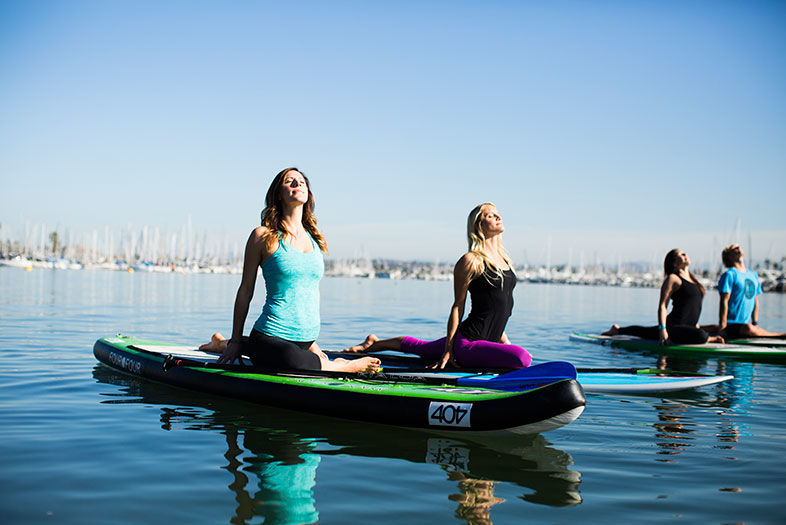
I Tried It: SUP Yoga

Jennifer Rea, 33, Mission Hills

You Try It!

Paddle Into Fitness
760-803-6293
$25 for a single class
paddleintofitness.com

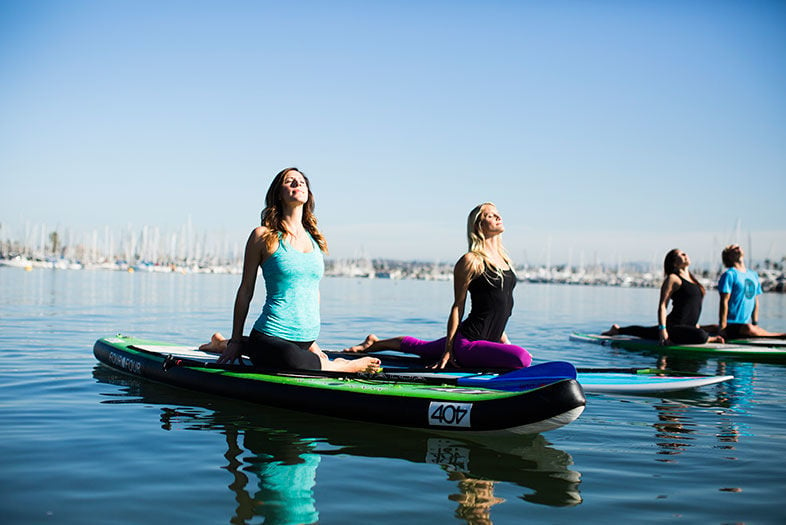
I’ve been practicing yoga for a few years and gravitate toward athletic styles like Vinyasa and Ashtanga, where the flow is continuous. I like leaving class feeling peaceful but strong. The idea of taking my practice to the water and trying SUP yoga had always been appealing. I thought the paddle workout combined with yoga would be like getting two workouts in one. Plus, even the nicest yoga studio can’t beat a bay view.

I met Gillian Gibree from Paddle Into Fitness on a Sunday morning at Kellogg Beach in Point Loma. For my first time trying SUP yoga, I was excited to have the water (almost) all to myself. I was also relieved—fewer boats in the bay meant calmer seas and a lower chance of my ending up in the water.

Gillian went over paddleboarding basics on the beach first, and then we paddled out. The paddling wasn’t strenuous and made for an ideal warmup. We stopped at a small cove away from boat traffic, in shallow water. My board was equipped with a small anchor that I was instructed to drop into the water to better stabilize my board during practice.

As we started class seated on the board with our eyes closed, the sun warmed my face. The sounds of the waves lapping and the seagulls overhead created a beautiful soundtrack. It was instantly calming.

We moved into standing sun salutations, then into the first downward dog. The most surprising part was how limited I was in movement. The tiniest step forward or backward would challenge my balance. I was keenly aware of where my feet were at all times, and my core was working overtime. Even familiar poses felt drastically different on the water. In most yoga classes, I am always thinking about getting into the next pose. For once, I was focused on keeping still.

I was surprised by the variety of poses that could be done on a paddleboard. Side plank, extended side angle, reverse warrior. I was more limited in my expression, but still felt the strength and stretch of each pose.

After 45 minutes, we came back to a seated position on the board, closed our eyes and brought our hands to our heart. I felt invigorated. I had been so focused on staying in the poses and out of the water, my mind really hadn’t wandered anywhere else. There was no clock to watch, no water to sip, no towel to wipe. I think I discovered the ultimate way to stay present.

Read More:
 

Get Fit & Have Fun in San Diego

Get Fit & Have Fun in San Diego

Jay Reilly

I Tried It: Taiko

Stephanie Thompson, 47, Mission Hills

You Try It!

Beginner Taiko Drumming
Classes start at $15
sandiegotaiko.org, naruwantaiko.org

Like many parents, I too have those days where dealing with kids, work, school, and spouse just makes me want to hit something really hard and yell really loud.

Thankfully, I found a way to channel that: taiko, the art of Japanese drumming. I wanted to challenge myself, learn something new, tap into an inner desire to make music, and be a good role model for my daughters. I’m not a gym rat or a yoga mom, and exercise bores me.

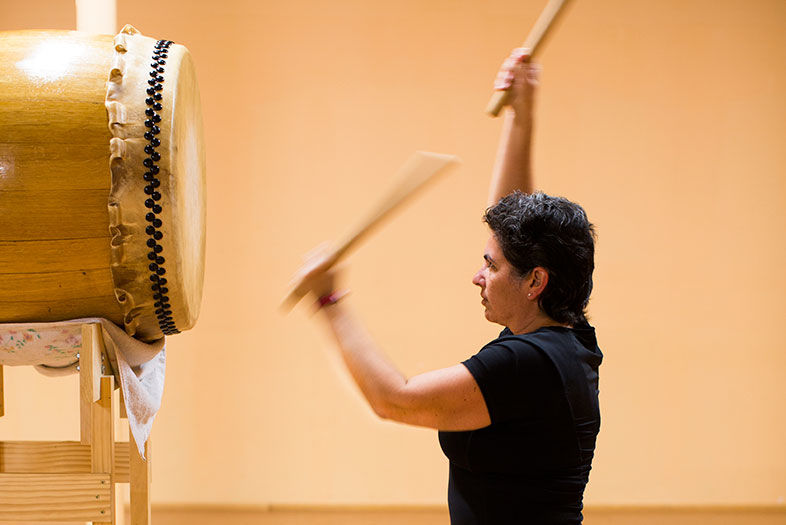
I wasn’t sure what to expect at the beginners’ class offered by San Diego Taiko, at the WorldBeat Cultural Center in Balboa Park. The first thing I saw was a row of huge traditional chu-daiko (medium-sized taiko drums) set up on the performance floor. It was exciting to imagine hitting the big drums and the sound it would make.

As we got started, I realized that taiko has a lot in common with Asian martial arts and karate. For example, the power and strength of your playing comes from the koshi (core), and your kata (form) is all-important, to strike the drum properly.

Taiko is about respect for the culture and its traditions, not just banging a drum. We learned musical patterns and made loud vocalizations (kiai) to motivate ourselves and the other students. It’s fun and distracting from the fitness required to play the daiko.

As for the fitness—every taiko class begins with stretching and warm-ups, from aerobics to push-ups and sit-ups to build core strength. Once you begin working on your form and strike, though, the pain really starts. Instructor Noel Garcia, who studied in Japan and has been performing taiko for 16 years, takes a traditional approach. I’m not in the best of shape, but I was relieved to see some of the more fit fellow beginners sweating and shaking as we held our form and practiced a proper strike.

Over at Naruwan Taiko, classes are held in North County. Instructor Diana Wu focuses on high energy and group drumming, with a level of enthusiasm that’s infectious. At Naruwan Taiko, we learned to strike with positive energy, and to listen to each other and feed off each other’s enthusiasm. Like Garcia, Wu also covers the cultural aspect of the art form, teaching the history of taiko in America and all the different styles of playing (I’m particularly interested in the giant o-daiko, that you play with your arms over your head, and yatai seated style, which is basically the craziest ab workout you’ll ever see).

Finally, we got to hit the drums. With the proper form, it’s like hitting the sweetest sweet spot in any sport you can imagine. For me, the sound was unbelievable—a deep BOOM that resonated through my arms and vibrated my insides. When you’re striking the daiko, you feel like you’re tapping into the energy of the earth itself, traveling up through your feet and energizing your entire body.

By the end of my first class, I was drenched in sweat and could barely lift my arms. With two classes a week, combined with practicing at home, I knew this would be a great way to get a workout (core, abs, legs, and especially upper body) and also learn about an exciting centuries-old art form. You get to push your musical and physical limits, and bang on big drums as hard as you possibly can. And every mom could use that once in a while.

Read More:
 

Get Fit & Have Fun in San Diego

Get Fit & Have Fun in San Diego

I Tried It: Mommy & Me Hip Hop

Erin Chambers Smith, 32, Allied Gardens

You Try It!

Culture Shock Dance Center
2110 Hancock Street,
Middletown
619-299-2110
$15 per class
cultureshock dancecenter.com

I’d say I was reluctant but open when I agreed to try the Shorty-N-Me toddler dance class with my almost-three-year-old, Jack. We watch as much Yo Gabba Gabba as the next family, but Jack isn’t the type to get up and dance with Foofa, Brobie, and DJ Lance. I’m not a great dancer, either, and have never been a gym-goer or fitness class-taker. We are more of a hiking, gardening, bike-riding, park-playing family. But after having two kids in three years, I needed to step up my game. As a busy working mom, being able to exercise while playing with my kid sounded great. And the 9:30 a.m. class on Saturdays is perfect for toddlers: on the week-end, after breakfast, before naps.

On our first attempt, the parking was hard (the center is in an industrial area), and Jack was already uneasy. He saw the teacher at the front, the kids in the line, and could tell he was going to be forced to do something. He tried to block me from opening the door, so we didn’t go in. I wanted it to be fun for him.

“As a busy working mom, being able to EXERCISE with my kid sounded great.”

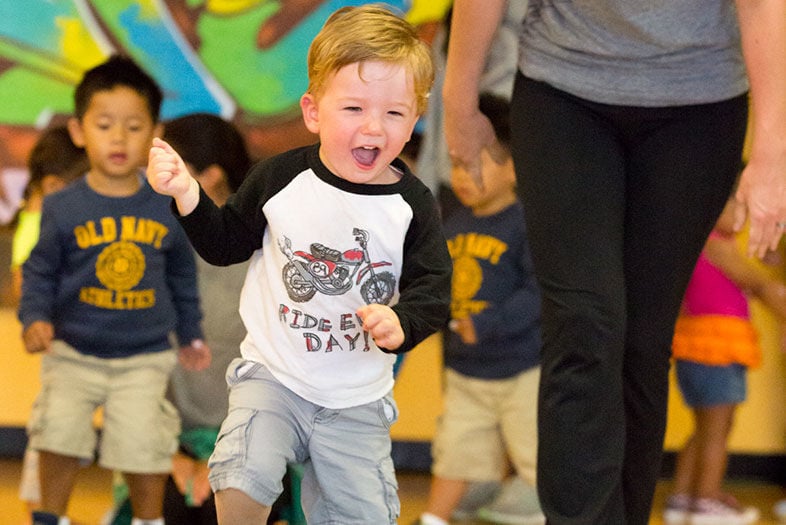
Then, on the last Saturday before this story went to print, we got to the class 10 minutes late and just busted in and started doing it. I’m sad to report that he didn’t like it. I think it was the music. It’s pretty loud. Like DJ music at a wedding. The instructor has to turn it off to give out the instructions. Jack also doesn’t hear a lot of hip hop in our house. We’re more Jimmy Buffet people. He immediately plugged his ears and climbed up my legs. I picked him up—all 35 pounds—and tried to slide and step and jump around. That lasted 10 minutes or so, and then it was just distracting to the class. Other kids wanted to be picked up, and I am not in good enough shape to do hip hop holding 35 pounds of kid. His shoes kept coming off. Squatting down while holding him to pick up his shoes was the real workout for me.

We both needed a time out. We stepped outside the class and sat in the hallway. I took his picture, still plugging his ears, and texted it to the editor and art director of this story. “Sorry.” We left and went to the park, where Jack ran wild for an hour.

But here’s the bright side: Every other kid in the class—all girls the day we were there—was loving it! Running and stepping and jumping with cute attitude. They wore tutus and sweat suits and bright sneakers. The instructor was patient, fun, go-with-the-flow. She even tried to move the speaker for us so it wasn’t so loud.

What did I learn, overall? First, I need to diversify the music my kids are exposed to. And second, our kids really are influenced by what we do, not what we tell them to do. I’m not a gym person, a class person, or a very organized person in general, and I see some of that in my kid. Which means we need to stay active in other ways, like walks, hikes, and running around outside.

I guess hip hop will have to wait ‘til his sixth grade dance.

Read More:
 

Get Fit & Have Fun in San Diego

Get Fit & Have Fun in San Diego

Jay Reilly

I Tried It: Cellular Fitness

Claire Trageser, 31, University Heights

You Try It!

The Sporting Club
8930 University Center Lane, UTC area
858-522-8000
$25–$35 per session, for members
thesportingclub.com

I’m not an elite runner by any stretch, but I do challenge myself to break my personal records, or PRs, when I race. Running a race faster than I ever have before makes me feel like I’ve trained hard and accomplished a goal.

When I lined up at the Silver Strand Half Marathon in November, I was hoping to break my record of 1:48:47. But it was not to be. I’d caught a cold the week before, and as I passed mile 8 my legs felt weak and my pace began to slow. I pushed as hard as I could.

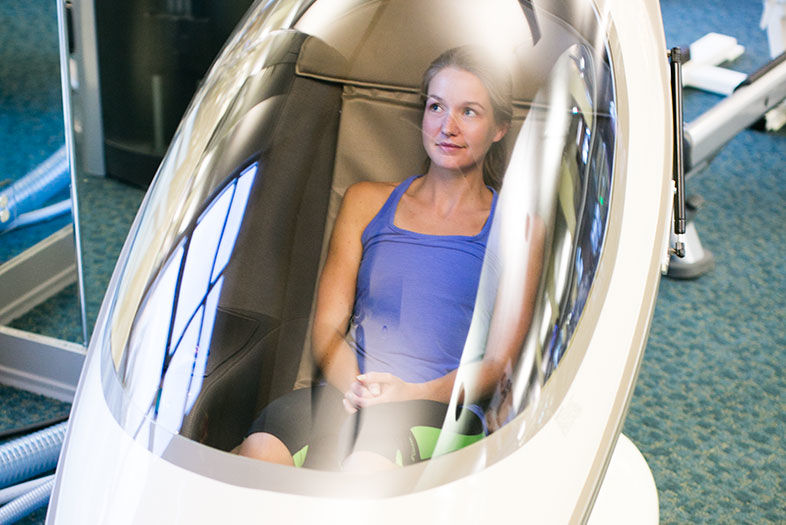
Shortly after that disappointing race, my editor asked me to try a new contraption. It’s called the Cyclic Variations in Adaptive Conditioning, or CVAC, pod.

“Advanced technology and science combine to deliver progressive low-pressure air changes that rhythmically squeeze and relax the whole body, including the organs and even blood, right down to a cellular level,” according to the website.

“All i had to do was sit there and let the pod do its thing.”

This “cellular massage” is supposed to help your lymphatic system reduce inflammation, which means your muscles are less tired and sore after hard workouts. It is also supposed to increase stamina and energy, and create deeper sleep.

I met CVAC representative Ian Robb at The Sporting Club, and he showed me to the pod. As I climbed inside I tried not to think about the spaceship from Contact and its ability to teleport to an alternate universe. Robb promised I’d be perfectly safe—all I had to do was sit there and let the pod do its thing. “Some people even fall asleep,” he said.

The CVAC pod doesn’t move, but it does take you on a journey. Using changing amounts of air pressure, it simulates elevations from sea level to mountaintops, and quickly raises you and drops you between those extremes over and over during a five-minute session. I started on the most mild level. I felt like I was in an airplane taking off. My ears repeatedly clogged.

“It gets a little more exciting at the end,” Robb said to me via walkie-talkie—the sealed door and rushing air mean you can’t hear outside. My ears popped again and again, until finally I glided smoothly back to sea level. I definitely wasn’t falling asleep.

Most pod devotees do two to three 20-minute sessions a week, and Robb said I’d need at least 10 to notice a difference. But after two sessions, I ran 14 miles with four miles at race pace and nailed it. Maybe it was the pod, or maybe its fancy science was tricking me into thinking I was stronger.

After a few more sessions and a lot more miles run, I lined up at the Holiday Half. I felt strong during the entire race and broke my personal record by more than five minutes, with a time of 1:43:25. I can’t say whether it was the CVAC or all the training I did, or because the race had a lot of downhills. I do know that during the race I ran from 700 feet to sea level without my ears popping once.

Read More:
 

Get Fit & Have Fun in San Diego

Get Fit & Have Fun in San Diego

Jay Reilly

I Tried It: Dog Fitness

Christina Orlovsky Page, 39, Eastlake

You Try It!

Leash Your Fitness
Locations available throughout the county
619-822-3296
$20 for a single class
leashyourfitness.com

I spent much of 2014 “off the wagon” of regular exercise, with the occasional heart-pumping burst during a quick jog around the block with my dogs. But those two rascals, Toby and Tilly—particularly Tilly, a beagle-dachshund mix with a lot of destructive puppy energy to burn—need more exercise than that. So it only makes sense the class that finally got me off the couch was “Bonding with Bootcamp,” a comprehensive cardio, strength training, dog-obedience, and agility class all in one. Offered by Leash Your Fitness, the hour-long session seemed like just what I needed to jump-start my workout routine and provide some extra exercise for my restless pooch.

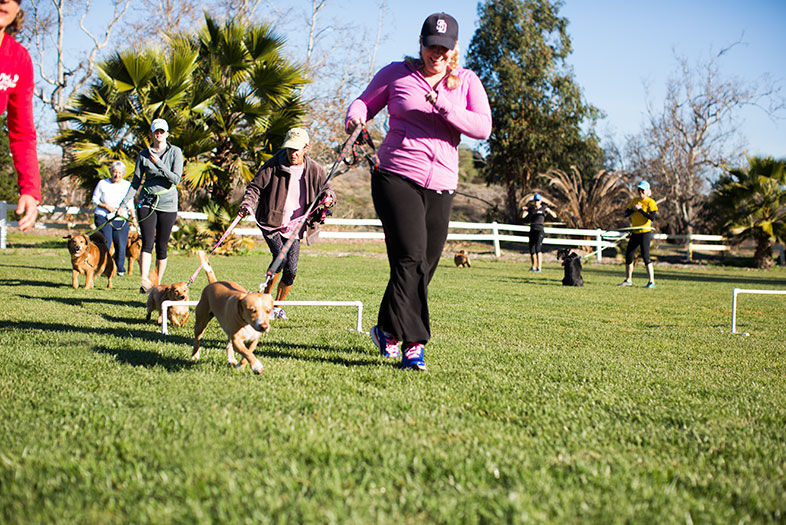
Tilly and I took a Sunday morning class at Markim Pet Resort in Carmel Valley. Class rules say one dog per participant, so Toby had to stay home, but it was for the best: It’s hard enough to hold the leash of one dog while focusing on the proper form for lunges. Two dogs would have been a disaster.

I’ve taken many a bootcamp class in my day and, workout-wise, this one was similar, with intervals of running, lunges, squats, ab work, resistance band work, and even some weighted hula-hooping. What made the class different—and so much more fun—was that Tilly was right alongside me the whole time, jogging, sitting and staying on command (well, we may have to work on the staying part), and enjoying the energy of 15 other dogs and their owners. The best part, for both my two-year-old pup and her proud owner, was the obstacle course that included the dog-only A-frame climb and a series of high and low hurdles for both of us. I’ve never taught Tilly a “jump” or “over” cue, but she was a natural, her short legs leaping through the air with ease. She was smiling and wagging her tail the entire time.

If the class sounds like it was more for Tilly than it was for me, make no mistake: I was tired, sore, and extremely well-exercised at the end of 60 minutes. But I also barely even noticed an hour had gone by. My dog provided a joyful distraction and even though there were times I didn’t want to run that second lap, Tilly was having so much fun I didn’t want to let her down.

A happy, tired dog is just one benefit of the Leash Your Fitness bootcamp, but there are plenty more: One woman in the class has lost 30 pounds. Another no longer has to take medication for high blood pressure. And all the participants enjoy the guilt-free feeling of not leaving their dogs at home alone while they enjoy the great outdoors. It was enough to make me want to go back—and maybe take Toby along for the fun next time.

Read More:
 

Get Fit & Have Fun in San Diego

Get Fit & Have Fun in San Diego

Luis :Garcia Luis Garcia

I Tried It: Feldenkrais

Derrik Chinn, 33, La Cachonda in Tijuana

You Try It!

Feldenkrais
Rancho La Puerta
800-443-7565
$300 for four hours of classes (Saturdays); $3,250 for one week
rancholapuerta.com

I’m out at Rancho La Puerta, a 3,000-acre spa-hotel that’s more than twice the size of Balboa Park, just south of the Mexico border on the outskirts of Tecate, where boulders, cows, and vineyards abound. I’m a mere 40 miles from central San Diego. But like most of the other people here—be it for a week, half-week, or just the day—I feel worlds away.

Simplifying the international commute comes as part of the package; staff members meet guests on the U.S. side of the border, walk into Mexico together, and chauffeur them back to the property, a five-minute car ride down the road.

Among the roster of some 75 classes offered daily is a crash course on the Feldenkrais Method, a somatic educational system developed by Israeli doctor Moshé Feldenkrais in the 1970s that’s described as an “internal journey to rediscover balance, flexibility, and coordination.”

I’m a fairly active 30-something who exercises as regularly as possible. Weights and cardio, mostly, with the occasional yoga or swim session. I’ve never heard of Feldenkrais, but my stiff, 30-something neck, lower back, and hamstrings—ever-reminiscent of our more agile days—are already signing me up.

Our instructor is Donna, a lanky woman with an aikido background who’s been practicing Feldenkrais for 19 years. She says it’s ultimately given her the ability to engage more fully in the world, and enhanced her creativity in how she habitually moves her body.

That’s pretty deep. Nevertheless, my neck, back, and hamstrings are now buckled up and ready for blastoff.

Taking shoes off in the middle of the room, I notice I’m the youngest of my nine classmates, who range from their 40s to 80s. And I’m the only man. But Donna assures me the beauty of Feldenkrais is that the same class can benefit anyone and everyone, be it a paraplegic or an Olympic medalist.

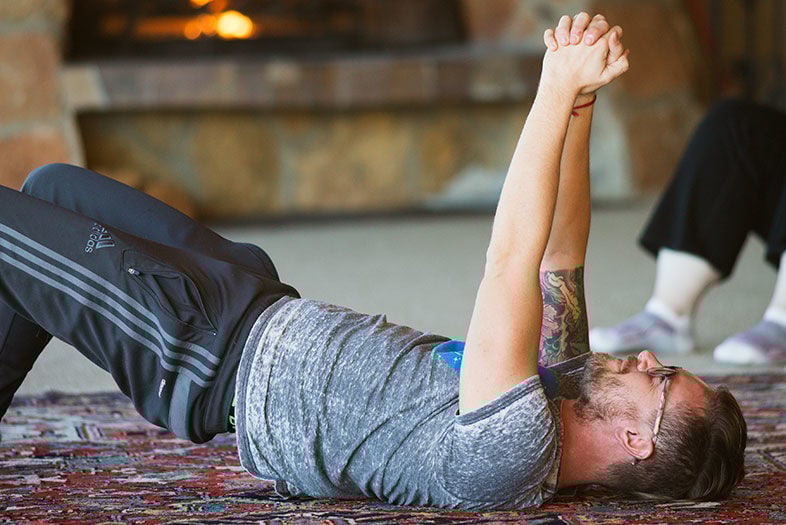
The session lasts an hour, enough time to take us through 10 basic movements. We observe how our bones connect with the floor, and notice how much effort it takes to lift our pelvises with our feet and knees together. We rest. Then we do the same, now with our feet and knees apart. Then we rest again, comparing how we feel while lying still before and after each move. We clasp our hands and point to the ceiling, drawing circles and lines in the air and noticing the movement of our shoulder blades. Then we clasp our hands again, but now with the opposite index finger on top, and do the same. Then we rest and observe again.

After an hour on the floor praying to the rafters and resting, I feel relaxed, sure. Almost as if I were sinking into the floor. But I haven’t broken a sweat. I haven’t exerted myself whatsoever. I actually feel as though I’ve done very little, and that’s exactly the idea, Donna says: to strain the body less by making each movement as efficient as possible. And, also, lots and lots of rests.

“Take a rest before you need a rest,” she says. “That way you never need a rest.”

And that’s when I realize I’ve been a Feldenkraiser all my life.

Read More:
 

Get Fit & Have Fun in San Diego

Get Fit & Have Fun in San Diego

Jacqueline Campbell for Birds of a Feather

I Tried It: Prenatal Massage

Kimberly Cunningham, 35, Point Loma

You Try It!

Prenatal Massage
Equilibrio Massage
3320 Third Avenue, Hillcrest
619-955-6670
equilibriomassage.com

A Thai masseuse once told me that massage is like yoga for lazy people. And like a religious zealot, I have clung to this idea ever since. Whenever I didn’t feel like downward dogging, I headed to Massage Envy. So I am no stranger to the many benefits massage can bring, including increased circulation and decreased stress.

But all of that changed when I became pregnant. I’ve developed common ailments like leg cramps, restless leg syndrome, lower back pain, and insomnia.

I tried one prenatal massage at a fancy resort, where the answer to my big belly was a foam pillow with cutouts for my stomach and breasts. Well-endowed women, beware! I think those pillows are made for smaller chests.

I have also found that, aside from the random person who rubs my belly, people are generally afraid to touch pregnant women. Rare is the soul willing to risk a lawsuit or worse by putting any kind of pressure on a woman with child.

Then my boss referred me to Equilibrio Massage in Hillcrest. Owner Nicole Trombley and her staff are experts in the needs of pregnant women. Most are doulas and make house calls for massage. Some will even come to the hospital to provide a rubdown during labor.

“I instantly feel like I might fall asleep.”

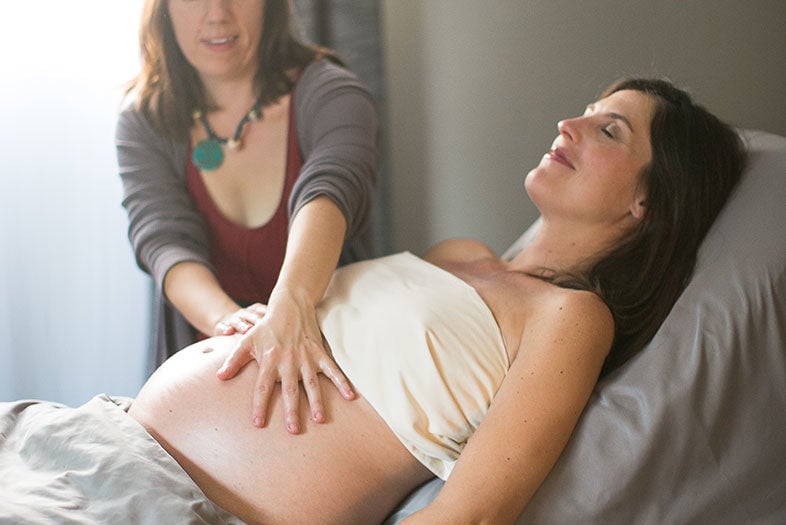
Nicole is not a fan of those foam cutout pillows, citing concerns like increased uterine pressure and nasal congestion, common in pregnancy, especially when lying facedown. She has me lie on my side and builds a mountain of pillows around me. I counted seven in total—under my head, side, stomach, knees, calves, feet, and elsewhere. I instantly feel like I might fall asleep.

She also tells me in a calm whisper that she prefers deep pressure, if I’m okay with that. I am. And as I drift in and out of sleep, she proceeds to work out the kinks. At some point, we switch sides. We finish on the back in a semi-reclined position, where she rubs my scalp, neck, and shoulders.

That night, while watching TV, I notice my restless leg syndrome is nonexistent. As are the leg cramps that sometimes wake me up at 1 a.m. I’m also so blissed out that I don’t bite my fiancé’s head off when he wants to watch football while I am in the middle of The Bachelor.

Before bed, I try to recreate Nicole’s mountain of massage pillows. The next morning I have an email from Equilibrio: “Did you like our massage pillows?” It directs me to a free download link. Turns out, Nicole has written a book, titled Sleeping While Pregnant Guide.

I went back to Equilibrio two more times—each as pleasant as the first visit, prompting similar results (75-minute sessions start at $105; discount packages available). If you have the means, it is a lovely gift to give yourself or someone you love who’s expecting. Here’s to a happy pregnancy, with restful nights and TV remote sharing without the threat of divorce!

Read More:
 

Get Fit & Have Fun in San Diego

Get Fit & Have Fun in San Diego

I Tried It: Free Yoga

Courtney Lund, 27, Pacific Beach

I’m on a tight budget. I’m saving for my wedding this summer, trying my best to stay zen and not turn into a Bridezilla. Yoga has always helped me find an open heart, clear mind, and stretched body. I decided to look for free or donation-based yoga classes. In San Diego, I found there’s at least one happening every day of the week.

The first place I discovered is the Bergamot Spa in Encinitas. It is packed with Buddha heads and bamboo, succulents, and plumeria. The instructor turns on a portable plastic fireplace to heat the yoga room. Jimi Hendrix plays on low, and we start on our backs in Shavasana. By the time the two-hour class is over, I am so sore I can barely walk to my car.

The next day, I opt for Laughter Yoga. I meet the class in Balboa Park, south of the playground at Spruce Street and Sixth Avenue. We stand in a circle and warm up by laughing. I have never felt so awkward. By the end of the class, though, I’m laughing naturally with them. “Laughter gives us a different way to react to the things life throws at us,” says Michael Coleman, founder of the nonprofit Laughter Matters. I leave the class feeling like nothing could awaken the Bridezilla inside me.

“The yoga is not too challenging and I leave with a tan.”

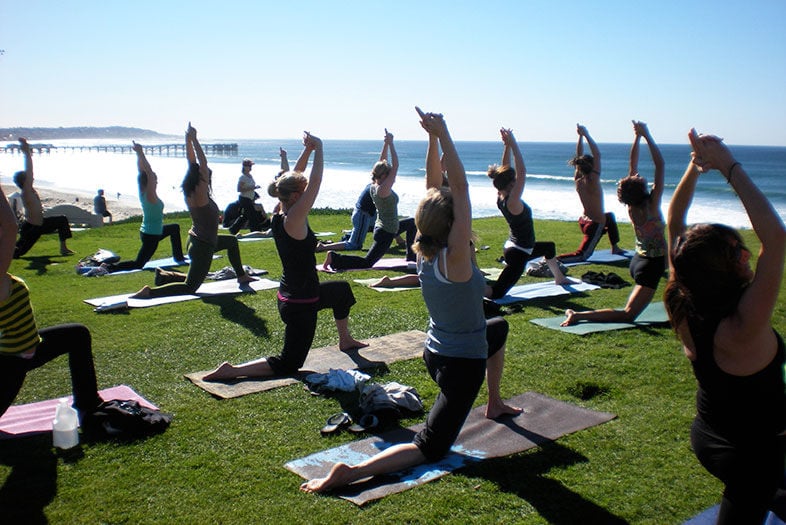
On day three I drag my mat to the beach for yoga with Namasteve, a local P.B. celebrity. The grass where he teaches every weekend at the end of Law Street is packed with more than 100 yogis.

On the fourth day of my yogic journey, I am craving some furry companionship. On Facebook, I find Sara, who teaches Puppy Yoga behind the Ocean Villa Inn, for some gentle Hatha yoga. The class takes place in O.B.’s dog park. On this day, it’s just the instructor’s Chihuahua. The yoga is not too challenging, and I leave with a tan.

On day five, I visit a class taught by Lauren, who is part of One Love Yoga, an online community that lists free and donation-based classes throughout the city. Inside the Swedenborgian Church in University Heights, we practice Vinyasa with Ashtanga inspiration in the downstairs hall. No organ here—the instructor has chosen a mellow playlist. Still, I feel as if I’ve had a kind of spiritual experience.

On the second-to-last day, I head to Lorna Jane in La Jolla for a free booty yoga class, which works the abs and core. The clothing store has its own private studio, with free classes offered every day. Luckily, there is no pressure to shop, nor mention of merchandise.

On the final day, I drive to Yoga One on Seventh Avenue, downtown. The place has a natural om vibe. The room is dark, with candles and smells of cinnamon and honey. The free weekly Candlelight Flow class is soothing and relaxing for my body and mind. As I leave my final class, I take a deep inhale and think about this journey. Great things in life can be found at little to no cost at all. Namaste.

Read More:
 

Get Fit & Have Fun in San Diego

Get Fit & Have Fun in San Diego

Jay Reilly

I Tried It: Bodybuilding

Hilary Achauer, 41, Pacific Beach

You Try It!

San Diego Athletics
5026 Cass Street, Pacific Beach
10 sessions for $230; memberships start at $149 per month
pbcrossfit.com

When my CrossFit gym, San Diego Athletics in P.B., began offering a bodybuilding program, my first reaction was “Oh, heck no.”

For four years I’d attended CrossFit classes four to five times a week. I learned about Olympic weightlifting, gymnastics, full-body functional movements, and the concept of intensity. I’d switched my focus from what my body looks like to what it can do. However, my progress had slowed down in the last year. I was battling chronic tendinosis in my knee, and I was looking to try something new.

But bodybuilding? Really?

If you’re a woman who’s been told most of her life that smaller is better, the idea of intentionally building up your body is slightly terrifying. There’s a reason the phrase “strong is the new skinny” became so popular. It’s the word “skinny.” While I don’t subscribe to celebrity trainer Tracy Anderson’s belief that women shouldn’t lift more than three pounds, I also don’t post aspirational photos of Arnold Schwarzenegger on Instagram. I want to be strong and cute.

Gym co-owner Bryan Boorstein wrote a convincing blog post about how a base of strength is important, and how building muscles spikes the metabolism, even when you’re not exercising. One line in particular hit home: “Your body is desperately hoping you stop breaking it down. It’s time to get strong.”

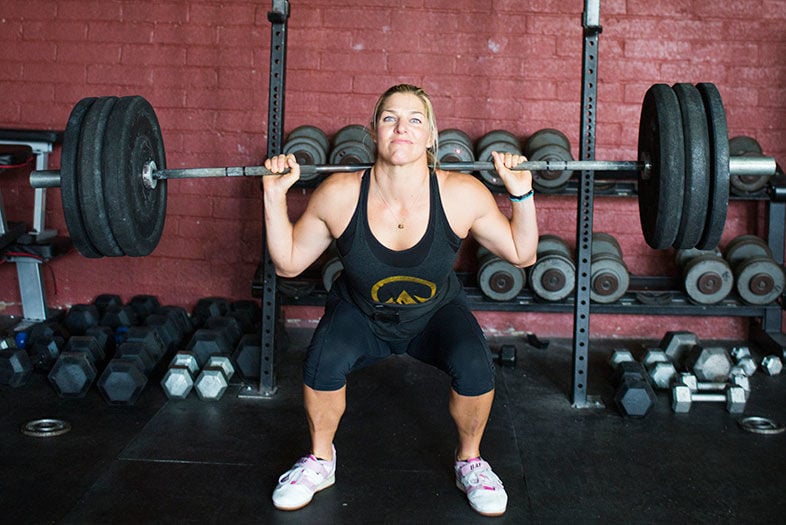
So, I committed to eight weeks of bodybuilding, exclusively. In the first few weeks, I was often the only woman in the class. Some of the exercises were familiar to me—like back squats, bench presses, pull-ups, and ring dips—but I was clueless about anything that involved a dumbbell.

The movements may be old-school, but the atmosphere in a San Diego Athletics bodybuilding class is completely novel. Instead of everyone following their own program and fighting over weights, the class works together, sharing benches and dumbbells. The music is loud—sometimes it’s Pearl Jam, sometimes it’s 2 Chainz, sometimes (sadly, for me) it’s country. The trainers lead everyone through the movements, offering guidance on form and technique and how much weight to use. Once a week we leave the gym and do hill sprints, followed by ab exercises.

The first week was rough. I felt like an addict, obsessing about what I was missing in the CrossFit workouts. What if I got too muscular? Or what if I got fat?

In the second week I started to figure out how to push myself and what weights to use for the seemingly endless variety of exercises.

After a few weeks I started seeing some interesting results.

My knee pain disappeared. Completely. Then, one day, I did three sets of eight strict pull-ups, something I had never managed to do in four years of CrossFit. And even though my weight stayed the same and I didn’t change my diet, I noticed more definition in my abs. For a 41-year-old mother of two, this was kind of a big deal.

As the weeks went on, more women showed up to class. I can now do dumbbell flies and hammer curls like a champ. And I’m happy to report, there is still no Schwarzenegger photo in my Instagram feed.

Read More:


Photography by Jay Reilly, Jacqueline Campbell & Luis Garcia
Get Fit & Have Fun in San Diego

Jay Reilly

Subscribe to our newsletters

Select Options

By subscribing you confirm that you agree with our Terms and Conditions and Privacy Policy.

Everything SD JULY 1, 2026

Editor’s Note, July 2026: Hello Again

New editor Emma Veidt gives an introduction and her ode to the once-sleepy, now slept-on North County

Editor’s Note, July 2026: Hello Again
Courtesy of Visit Oceanside

I am fairly sure they don’t let you graduate from Carlsbad High School without a W-2 from Legoland. Being a Legoland MC (Model Citizen, the employee’s moniker) is a rite of passage for all of us who grew up in North County. If you spent a day at the theme park in the 2010s, I probably pointed you toward the Granny Apple Fries or measured your height at a ride entrance.

And now we meet again. I can still point you to quality fries.

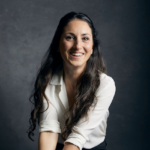
This is my first full issue as the new print editor for San Diego Magazine. But it’s not my first time here: I was an editorial intern for these pages back in 2018 (see photo). To be a part of a constant study of the city, its people, its culture, then finding the most compelling stories and bringing them to life—it was incredibly impactful and solidified my decision to pursue all of this (local, print magazine journalism) as a career. Since my internship, I’ve gotten my bachelor’s and master’s degrees from the Missouri School of Journalism and worked for nearly five years at Backpacker magazine. And I’m back at San Diego Magazine, baby. There’s a real magic to narrating the lives lived and dreams dreamt in the place that built me. I am excited to be a part of building the culture of where I’m from. And, born in Tri-City Medical Center and raised in Carlsbad, I can’t think of any other place than our North County issue for me to make my grand entrance as an editor.

Editor Emma Veidt at San Diego Magazine in 2018

To me, North County isn’t just where I’m from; it’s home. Throughout the years, I have run thousands of miles (I did the math) up and down the 101 between Oceanside and Cardiff. I’ve spent thousands of dollars (an estimation, too painful to do the actual math) on BRCs—beans, rice, and cheese burritos—from Lola’s, Juanita’s, and the late, great Pollos Maria.

The stretch of land between Camp Pendleton and the 56 is easy to love. We’re quieter and a little more zenned out than our lower-latitude neighbors, sure, but we’re neither sleepy nor boring.

Do you think Scrojo, the Belly Up’s punked-out poster artist featured on page 68, could last a day somewhere boring?

What I’ve always loved about North County is that the culture shifts every couple of miles as you reach a new town. For years, the media seemed to cast the realm above the merge as a two-toned monolith: sleepy surf towns to the west, suburbs and country living to the east. The nuance of each section seemed flattened or clumped. I think you’ll see the vastly different cultures of North County in this issue—but all distinctly San Diego. Which is to say a little mellower, fewer airs, come as you are.

It’s hard to imagine that the dusty trails and vibrant, muraled alleyways of Escondido are just miles from the barefoot surfers roaming Leucadia. Even though the SDM editorial staff is made up of two lifelong locals and other longtime residents, we don’t pretend to be the experts on every street. What a good city media company does is find the people who are experts, who have a unique hyper-local perspective—and give them the stage.

So we picked six North County neighborhoods—Oceanside, Vista, San Marcos, Leucadia, Rancho Santa Fe, and Escondido—and reached out to artists, community leaders, business owners, anyone making their neighborhood brighter, and we had them describe their perfect day out and favorite things that give their neighborhoods meaning and culture. These itinerary curators included San Marcos’ Patricia Prado-Olmos, Leucadia’s Jeff Schade, Oceanside’s Aaron Crossland, Escondido’s Suzanne Nicolaisen, Rancho Santa Fe’s Charo Garcia-Acevedo, and Vista’s Steve Glaudini. If there’s anyone who lives and breathes North County, it’s them. Check out their recommendations in our feature on page 56.

This month, we’re also going back in time almost 15 years to the Big Bay Boom. Yes, that meme-ified Fourth of July fireworks show where enough pyrotechnics for a 17-minute show went off at once over San Diego Bay. Content Chief Troy Johnson remembers the day and dug back through the story for a hilarious locals’ take on the big debate: Was it the worst fireworks show of all time, or the greatest? (Page 38.)

Before I leave you to our hard work, a sentimental note. When my parents moved from St. Louis to San Diego in the early ’90s, my mom subscribed to San Diego Magazine to learn about her new neighborhood. Now, over three decades later, I’m here—on this planet and in these pages. I thought about my parents a lot as we worked on this issue. Maybe there are a couple new San Diegans reading this magazine for the first time. Maybe that’s you.

Well then, to both of us, I say, “Welcome.” Let’s do this.

Emma Veidt

About Emma Veidt

Emma Veidt is an editor at San Diego Magazine. She earned her bachelor's and master's degrees from the Missouri School of Journalism. She loves running, hiking, and rock climbing, but really, she mostly loves encounters with the street cats around North Park.

Everything SD JUNE 30, 2026

The Fireworks Disaster That Made San Diego a Legend

Eighteen seconds, one unforgettable mistake, and a Fourth of July story that somehow gets better with age

The Fireworks Disaster That Made San Diego a Legend
Courtesy of The Port of San Diego

There’s a famous video.

“This is insane!” the guy filming it seems to proclaim. “It’s the best fireworks show ever!” a companion confirms, inspiring a debate lasting over a decade.

All told, 7,000 fireworks exploded in the span of 25 seconds over San Diego Bay on July 4, 2012. A Michael Bay amount of unison. $125,000 worth of shells, cakes, Roman candles, and skyrockets had been placed on a barge—enough for 17 minutes of decorative sky flares—and…

Boom.

The sky looked like someone had set a giant Rorschach test on fire. Or as if whatever we all see in our Rorschachs—butterflies, clowns, tongue kissing, dads—was being electrocuted and lifted heavenward, amen. It was shocking how bright it was, how much it sizzled the local cosmos. Could’ve been one of those sci-fi films where a hole is ripped open between warring universes. But angstier, more metal—the work of some methy creator in a sleeveless concert tee.

The sound?

Lou Reed once released an entire album that contained 64 minutes of mindflaying guitar screeches and machine noises. No regular songs, just a fascinating amount of ear distress. His record label reps no doubt heard the melodic outro of their careers, but everyone else was in pain and stumped. That album still sounded better than the bay did that night. The bay sounded like a god who struggled with emotional regulation had blown his speakers and was working through the anger stage of AV grief.

In the left frame of the video, a middle-aged woman is attempting to drag her husband off by the hand. In no way does he want to go, possibly because he had missed the time Roseanne Barr sung the national anthem at a Padres game, simultaneously disemboweling and amusing America through the power of song. He would not willingly abandon an equally worthy San Diego trainwreck.

Another woman in the video appears to have just filled her beer, rushing to sit down for the show. She pauses mid-sit and returns to the full and upright position to properly bear witness. What was supposed to be prolonged entertainment has been so radically shortened that she will have to find another reason to drink. Lucky for her, drinking will be the only way to adequately process.

Locals remember the conspiracy theories. People wondered if the fuses had been tripped by a saboteur who was sympathetic to dogs, fish, or the growing suspicion that late-stage capitalism is a gorgeously branded but impossible dream sustained by remarkably efficient top-tier wealth retention and the soft compliance of fireworks-watchers who can no longer afford a house, a beer, or the personal impacts of human reproduction.

Speaking of being terrified of babies, babies were terrified. The children who witnessed it probably still can’t go near a candle store. But those kids will be tougher, perfectly scarred kids. They’ll write better songs.

That night helped us absolutely dominate the national news cycle. For a hot minute, we became America’s water-skiing squirrel. Now, years later, when you Google “fireworks gone wrong,” San Diego is always a top contender, along with that poor Nebraska family who nearly wiped out a couple generations in their front yard, their minivan somehow turning into a howitzer of recreational TNT.

There is still debate as to whether Big Bay Boom 2012 is the worst or greatest fireworks show of all time. But the advanced parts of civilization arrived at the truth as quickly as the women in the video did. It was undeniably amazing.

First of all, the point of Fourth of July fireworks isn’t “the intricate choreography of sky fire over a guaranteed amount of show time.” It’s about creating a vivid memory shared with some people you like, love, or would like to love.

BBB2012 used large-scale chemical fire to create the ultimate memory.

Sure, some people who iron their jeans subjected their family to a sermon about how San Diego managed to botch America’s birthday like a Disney princess-for-hire who smelled of quite a few Sauvignons.

The rest of us saw how perfectly it nailed the actual feeling of being an American. Because only a miniscule percentage of us bake postcard apple pies where every inch of crust is perfectly laminated like the wood in an Irish bar. Very few of us can paint on par with Picasso. The rest of us—despite truly believing in our America-activated abilities to achieve greatness in almost any field of our choosing—burn pies. We try to paint only to realize it looks like our fine motor skills have entered active death.

That’s why BBB2012 was the most perfectly American fireworks show ever: A wildly ambitious idea galvanized thousands upon thousands of people to both work on it and come to hold a beer and gawk at it, only to have it fail in the most glorious TMZ-level spectacle.

America isn’t about immaculate, storyless wins. It’s about how the framework of a country is solid enough that we can accidentally detonate our entire lives—a few times—and still probably be OK.

No one has America’d quite like San Diego did on that day. It was performance art. Lou Reed’s heart slow-clapped. Any brief municipal embarrassment quickly became a pride of our people. I can only hope the same for the Nebraskan yard family whose Dodge Aerostar became a hyperactive Death Star.

P.S. Local writer Maya Kroth compiled a quite great oral history of that night for Thrillist. The bottom lines for me were—it took nine months to prepare, no one was hurt, and even though the pyrotechnics company tried to zero out the bill, Big Bay Boom founder H. P. “Sandy” Purdon refused and paid them in full. This year will mark the 25th Anniversary of the yearly Big Bay Boom.

Troy Johnson

About Troy Johnson

Troy Johnson is the magazine’s award-winning food writer and humorist, and a long-standing expert on Food Network. His work has been featured on NatGeo, Travel Channel, NPR, and in Food Matters, a textbook of the best American food writing.

Features JUNE 29, 2026

5 San Diego Food Trends to Know About

From surprise revivals to changing dining habits, these are the shifts redefining the local culinary landscape

5 San Diego Food Trends to Know About
Photo Credit: Arlene Ibarra

Comebacks Are the New Kickoffs

If absence makes hearts (and stomachs) grow fonder, then shuttered restaurants quickly become the hottest tickets in town—something a number of iconic institutions found out after taking very public hiatuses after historically long runs. For instance, following a lengthy (and extremely flip-floppy) closing process after 92 years in business, Las Cuatro Milpas reopened two blocks away in Mercado del Barrio. Similarly, Carlsbad butcher shop Tip Top Meats reopened in the same location (albeit a smaller space) after the death of founder Joachim “Big John” Haedrich in 2023. Finally, after a whopping decade out of business, Sami Ladeki and chef Alfie Szeprethy brought back Roppongi to its original Prospect Street space, where it was the talk of the town in the late ’90s. All came back under the same proprietors, so they weren’t third-party nostalgia-licensing deals. The algorithm may have ravaged our attention spans away from all but the newest and shiniest, but this proves there’s still hope for our collective prefrontal cortex.

New Generations Take the Reins

Other local eateries honored their pasts by bringing in new perspectives. The Lion’s Share in Embarcadero, Milton’s Deli in Del Mar, Dudley’s Bakery in Santa Ysabel, and J-K’s Greek Cafe in La Mesa handed over the keys to new owners willing to take on a big task: maintain the soul of icons through particularly rough economic circumstances for restaurants, navigate big feelings from longtime regulars (who often don’t take kindly to change), and make some necessary changes to keep going for another few decades. Taking over a project in process can be a lot harder than starting from scratch. But building that feel-good nostalgia doesn’t happen overnight, so it sure helps to have a well-established playbook of success passed down from those who came before.

Courtesy of Sugarfish

The Expansion Class Arrives

It wasn’t just restaurant groups from Los Angeles that decided to put down roots en masse, although San Diego saw plenty of LA transplants recently (Sugarfish, Mr. Charlie’s, For the Win, Katsuya Ko, Bacari). Global brands like Chef Fei, Zuma, and Pepper Lunch have locations of their own on the way, and upscale Canadian eatery Joey joined to the inescapable gravitational pull of Westfield UTC’s culinary cosmos for its first spot in America’s Finest City. Good to see the rest of the world is catching up with what we’ve been seeing the last few years—San Diego is a dining destination already on the rise.

Choosing To Not Choose

Between the never-ending news cycle of doom and perimenopause brain fog, I’m at the stage in life where I’m more than happy to let someone else make a decision for me, especially when it comes to what’s for dinner. And based on the way a lot of menus look right now, I’m not alone. It seems like half the places I visit offer some version of a prix fixe, omakase, or tasting menu. Restaurants are embracing the curated experience to solve the problem of affordability (a fixed menu reduces food and labor costs, guarantees an acceptable check average, etc.) and critical thinking in one fell swoop. Omakase (meaning “I leave it up to you”) is far from a new concept in high-end Japanese sushi culture, but now that it’s popping up everywhere from coffee experiences to grab-and-go sushi and sandwiches, it’s gone from somewhat niche to nearly omnipresent.

Courtesy of Rikka Fika

Local Coffee Hit the World Stage

The world got an up-close look at San Diego’s coffee industry when we hosted the premier specialty coffee expo World of Coffee for the first time this April. San Diego’s long and rich coffee history stretches back to the late 19th century. Things percolated fairly quietly for around a century before really picking up steam. Today, there are nearly 200 specialty roasters and cafes across the county, with many earning national accolades like the Good Food Award (Steady State Roasting, 2020; Bird Rock Coffee Roasters, 2023, 2021, 2019, 2017, 2016), Roaster of the Year by Roast Magazine (Mostra Coffee, 2020; Bird Rock Coffee Roasters, 2012), and the Specialty Coffee Association Coffee Design Award for packaging (Rikka Fika, 2026). Now that we’ve moved past the comically insufferable coffee snob era of the early 2000s, even java newbies can feel comfortable walking into pretty much any coffee shop in San Diego, asking questions, trying a few things, and feeling confident they’re going to get great service and a great beverage.

Beth Demmon

About Beth Demmon

Beth Demmon is an award-winning writer and podcaster whose work regularly appears in national outlets and San Diego Magazine. Her first book, The Beer Lover's Guide to Cider, is now available. Find out more on bethdemmon.com.

Studio S JULY 1, 2026

Get Your Home Ready for (San Diego) Summer

Tips from the trusted experts at Mauzy Cooling, Heating, Plumbing, and Electrical

Get Your Home Ready for (San Diego) Summer
Courtesy of Mauzy Heating and Air

San Diego summers can be brutal. But since the hottest period is typically late summer into early fall, San Diegans still have time to prepare. The pros at Mauzy Cooling, Heating, Plumbing, and Electrical are standing by to help homeowners fortify their homes against the elements and ensure their air conditioning is as frosty as the penguins that serve as the company’s mascots. 

Many homeowners underestimate the load their AC system faces, especially in the inland valleys where temperatures regularly top 100 degrees. San Diego regularly sees multi-day heatwaves each summer, and a system that struggles on the first day will likely fail by the third. Longer run times, unusual sounds or smells, and uneven cooling from room to room are all signs that your system may not survive the next hot spell.  

Systems typically last 12 to 17 years, but there are exceptions. If a system is approaching that, or is already there, a professional evaluation is recommended before summer really heats up. A good rule of thumb: If you can’t remember when your system was last serviced, it’s due. 

“As technology changes, systems become smarter and smarter,” says Sean O’Connor, an install manager at Mauzy with 42 years of experience. “There are a lot of people out there who will say a system’s only good for 10 years. I don’t buy that—these systems are built to last as long as they’re taken care of.” 

There are also a few steps homeowners can take between services to extend the life of their system. Regularly changing a dirty filter—especially if you have kids or pets—and keeping an outdoor unit clean can help head off problems in the future, says O’Connor. 

Also, be realistic about whether it’s time to replace a unit. O’Connor likens pouring money into salvaging a faulty unit with patchwork repairs and replacement parts to “tripping over a dollar to pick up a dime.” When one part fails, others are sure to follow, and newer parts may not be compatible with older units. Mauzy recommends homeowners use the 50% rule: If a repair costs more than 50% of the system’s replacement value, and the equipment is over 10 years old, replacement is usually the better long-term value. And don’t forget the ducting. An older house that was built with heat and later had air conditioning added may not have sufficient airflow, regardless of how good the system is. 

Last but not least, homeowners should know who to trust when it comes to their homes. Built on three generations of professional integrity, Mauzy has grown into not just a leader for cooling, heating, plumbing, and electrical services, but a leader in the community known for supporting local nonprofits across an array of causes. To ensure complete peace of mind, Mauzy stands behind a comprehensive 12-point guarantee that outlines its commitment to outstanding service, quality equipment, expert technicians who understand how the local microclimates affect HVAC performance, and no upsells or surprises on the bill. 

“We go the extra mile. That’s what sets us apart,” O’Connor says. To get a free quote today, visit mauzy.com.

Courtesy of Mauzy Heating and Air
Partner Content
Everything SD JUNE 25, 2026

The Former Comedian Who Became the Internet’s Bee Guy

Jeff Russell traded dreams of SNL for bee rescues, building a social media following of more than 4 million people along the way

The Former Comedian Who Became the Internet’s Bee Guy
Courtesy of Mr. & Mrs. Bee Rescue

The Groundlings improv theater has churned out world-famous comedic talents like Will Ferrell and Maya Rudolph. And in San Diego, a former Groundling has used that training to campaign for a higher power. The power to protect bees.

“The goal was to try and get on SNL,” says Jeff Russell of his time in the improv troupe. “[But now], I have an audience, and I get to crack jokes and be silly and entertain and educate.”

That audience? The over 4 million people who follow Mr. and Mrs. Bee Rescue in the socialmediaverse. Jeff and his wife, Julie, operate the business, which means they remove unwelcome bees without harming them and rehome them to apiaries throughout the county. Their social media is a hub of videos of Jeff peeling open car trunks, flooring, barbecues—any cozy spot for a bee to set up shop—and using smoke to coax them out of the hive (sometimes working sans gloves or protective gear).

Bees in a hive will follow their queen, so finding and moving her helps speed along the relocation process. It’s “a really hard game of Where’s Waldo,” Julie says. But there’s a secret to it: “If the bees start running completely in some random opposite direction in a hurry, then we know that the queen is probably that direction,” says Jeff. Their social videos document this process in a way that turns a reasonable nightmare (being swarmed by bees) into a form of entertainment and advocacy. The Russells spread the apian gospel, sharing why relocating bees is the only option to consider.
Since the 1960s, bee populations across the US have shrunk drastically for a slew of reasons—habitat loss (postwar industrialization led to fewer farms and crops), climate change (petulant temps affect blooming schedules), and pesticides (when used improperly, they can be toxic for bees).

Bees are also responsible for up to 75 percent of all flowering plants; 35 percent of food crops rely on animal pollinators to reproduce. So, basically, we’d be living in a flowerless world fueled by a diet of wind-pollinated oats and Red Dye 40 without them.

Jeff and Julie met on Tinder in 2016. “It would have been more appropriate if we met on Bumble,” Julie says. A photographer and graphic designer, she had no experience in a swarm of stingers before 2018. When Jeff broke his back surfing, she had no choice but to step in. Later, when she was laid off from her job in 2020, she focused on growing Mr. and Mrs. Bee Removal’s social media accounts. That’s when their business took off. These videos work. People are learning.

“Quite a lot of my customers were [initially] like, ‘Why don’t we just kill?’” Jeff says. “Now, the vast majority are like, ‘You take them alive, don’t you?’”

Emma Veidt

About Emma Veidt

Emma Veidt is an editor at San Diego Magazine. She earned her bachelor's and master's degrees from the Missouri School of Journalism. She loves running, hiking, and rock climbing, but really, she mostly loves encounters with the street cats around North Park.

Everything SD JUNE 25, 2026

The Breakout Idea: Gameday Men’s Health

The Carlsbad-based concept has exploded nationally by turning men’s health clinics into man caves

The Breakout Idea: Gameday Men’s Health
Collage by Casiel Sanchez

Rub some dirt on it. Walk it off. Be a man. The tropes and reasons for men ignoring their health and doing preventive care are many, reinforced by action heroes and generational norms. As a result, compared to American women, American men live an average of five years less, seek healthcare treatment half as often, and die by suicide nearly four times more often.

Many national campaigns have tried to change this. This year’s “Relax Your Tight End” ad from Novartis during the Super Bowl—in which NFL legends advocated for early prostate cancer screenings—was a high-profile example. Meanwhile, in San Diego, Evan Miller seems to have figured it out.

Miller founded Gameday Men’s Health in 2018 as a small clinic in Carlsbad. The idea was to create a space men would actually want to spend time in. So he built Gameday to feel more like a sports bar or a man cave—snacks, sports on oversized, high-def flat screens in the waiting room. He personalized the care for each client, made the experience more casual, and, above all, efficient. If the wait for payoff is too long, Miller says, men won’t show up for their health.

“We need to feel better quick,” he says. “So that’s where the real hook with Gameday is: It’s fast; it works quick.”

The idea has worked. Big time.

Gameday now has 430 locations spread across 46 US states and parts of Canada, with hundreds more set to open over the next three years.

Prior to Gameday, Miller—who has a Ph.D. in clinical psychology—ran Akua Mind Body, an addiction treatment center in Newport Beach. After selling the center, Miller says he searched for a new way to help his community.

He drew from his behavioral health training and dispiriting past experiences with “sketchy” men’s clinics, albeit with a slightly different concept at first.

Courtesy of Gameday Men’s Health

“My original idea for Gameday, funny enough, was men’s group therapy,” Miller says. “I wanted to put it in this ‘man cave’ environment because I knew guys wouldn’t show up otherwise.”

Initially envisioned as safe spaces to encourage men to open up emotionally, Miller pivoted to a more clinical approach with an athletic design that personally appealed to him. Soon, it evolved into a one-stop shop of compounded medication treatments for weight loss plans, hair loss treatments, anti-aging injections, sexual wellness strategies, and testosterone replacement therapy. The hotly debated trend of peptides—mini amino acid proteins that the FDA has yet to approve—has become a popular feature.

New patients undergo in-clinic assessments for testosterone and prostate levels with the goal of producing test results in just a quarter of an hour. “Our philosophy with our treatments is we only do what the research supports,” Miller says.

An Orange County native, Miller found Carlsbad to be a natural headquarters. He found a much bigger market in coastal North County of men seeking a boost—both in their marriages and their overall livelihoods. The pandemic proved to be a watershed moment, with front-yard gyms and outdoor, highly visible exercise sparking a wave of self-care. According to Cleveland Clinic, after the pandemic, about 20 percent of men started to exercise more and eat healthier, with a quarter of men reporting they scheduled more sleep and spent more time with family.

“When Covid happened, [suddenly] everyone looked in the mirror and was like, ‘I need to take care of my health; I have to do everything possible to get in shape,’” Miller says.

Two years after Gameday first began, Miller opened a second clinic in Temecula, followed by locations in Laguna Beach and Newport. Demand kept coming, so they started franchising in 2023. They sold 1,000 licenses in the first year. By 2025, they had over 400 clinics across the country.

When asked about the rapid growth, Miller cites the feedback he received along the way: “People were so excited about men’s health, cash-pay medicine, and not having to wait for insurance. They understood the model. It was for guys; it felt like ESPN meets healthcare.”

Now Miller says Gameday is starting to map out a global expansion—to Europe, Latin America, and the Middle East. Since the company first cultivated a following, Miller says there have been persistent questions about whether Gameday would ever expand its focus to include women. Their answer: Her Way.

“We only offer a very narrow menu, almost like In-N-Out Burger, because we stay in our lane, we do it really, really well, and we gain trust that way,” Miller says. “So we created the Her Way model to do the same thing for women [that] we’ve done with men.”

Her Way Health & Hormones launched in 2024 in clinics with more neutral and calming décor. With locations in Carlsbad and Mission Valley, it will officially start franchising this summer. Miller seems incapable of thinking small and expects around 1,000 Her Way locations to open nationwide within a few years.

Ryan Hardison is a freelance arts and entertainment writer and recent graduate of San Diego State. When he's not staring at his laptop, he's likely eating an adobada burrito or getting sunburnt at the beach.

Partner Content JULY 2, 2026

Top Lawyers 2026: Panakos LLP

Discover San Diego’s Top Lawyers — the region’s most trusted legal professionals across diverse practice areas.

Top Lawyers 2026: Panakos LLP
SDM: Top Lawyers 2026

Daniel A. Kaplan

Daniel A. Kaplan is a founding partner of Panakos LLP with more than three decades of civil litigation experience in both state and federal courts. Mr. Kaplan pursues and defends legal claims on behalf of companies, entrepreneurs, and business owners in high-stakes disputes. He focuses on business disputes including breach of contract, unfair competition, trade secret theft, securities disputes, fraud/misrepresentations, and employment matters.

“The best advocacy combines preparation, perspective, and a client relationship built on trust and candor.” — Daniel A. Kaplan

His clients include real estate investors, private and public corporations, and individuals seeking sophisticated legal counsel. Known for practical judgment and strategic advocacy, he works closely with an experienced and diverse legal team to protect, enforce, and defend his clients’ interests.

555 W. Beech Street, Ste. 500, San Diego, California 92101
619-8000-LAW
Panakos.law

Partner Content

Thousands of savvy locals already get it.

San Diego's best restaurants, experiences, and events—handpicked and delivered to your inbox weekly. You in?

Close the CTA

Contact Us

1230 Columbia Street, Suite 800,

San Diego, CA