Ready to know more about San Diego?

Subscribe
Features NOVEMBER 9, 2020

“We Flew Out and Walked Back”

The true story of a World War II lieutenant’s incredible journey home
“We Flew Out and Walked Back”
Veterans Day / Little One Crew

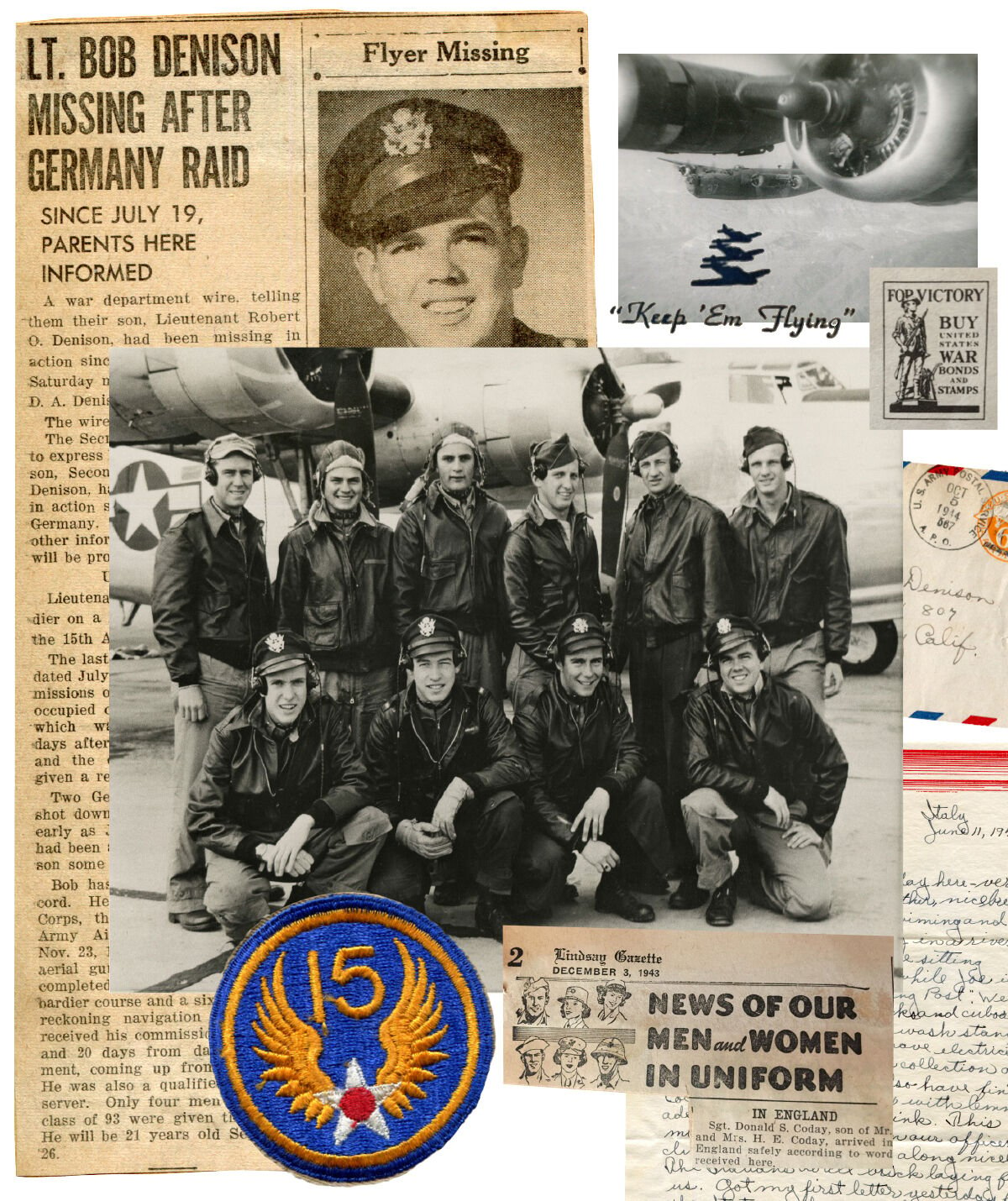
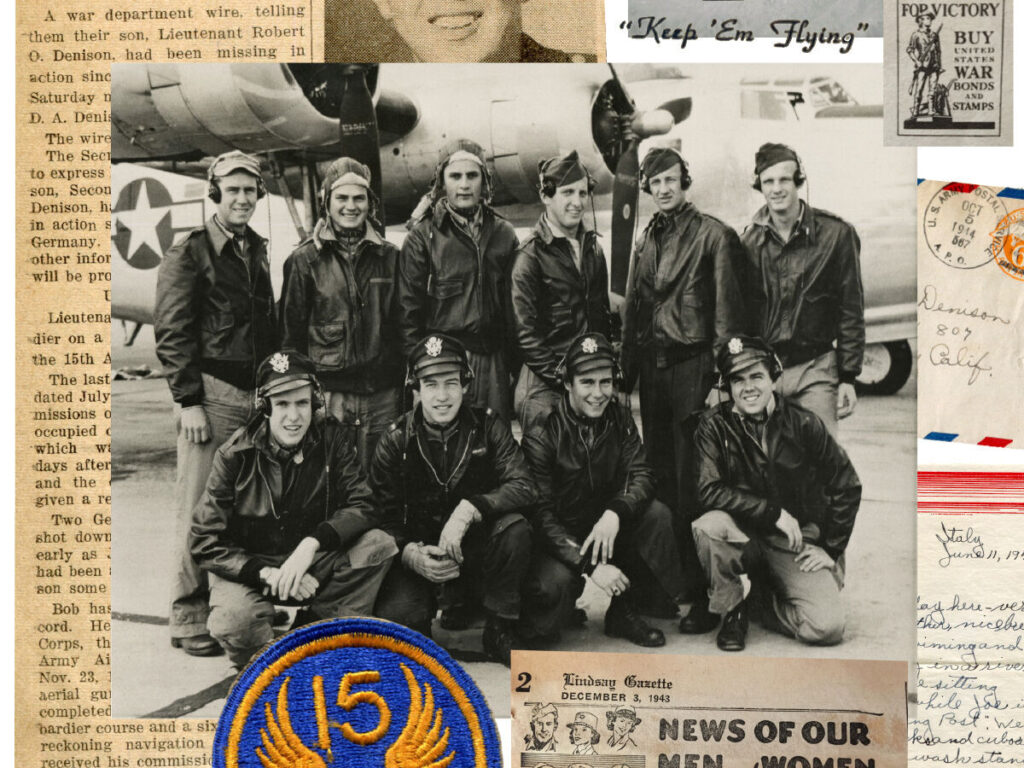
The Crew of the Little One—Rear: Charles Cartmille, ball turret gunner; Merle Weik, top turret gunner; John Lewis, tail turret gunner; Guy Howard, radio operator; Robert Marcum, nose turret gunner; Bob Garin, flight engineer. Front: Lt. Joseph Lidiak, navigator; Lt. John Rucigay, copilot, 1 Lt. Tom MacDonald, pilot; 2 Lt. Robert Denison, bombardier.

Robert Denison was serving as the bombardier aboard a B-24 when he was forced to bail out, separated from his crew, and survived for 40 days in Nazi-occupied Yugoslavia. In commemoration of Veterans Day, our copy chief put together this story, of his grandfather’s last mission in World War II. What follows is a composite, assembled from spoken and written accounts he gave over the years.


Between May and July of 1944, I flew 17 missions over Europe in the B-24 Liberator Little One. Most of the 10 men in our crew were fresh out of high school. I was just 19 years old, and the pilot was the “old man”—at 23.

Our plane was built right here in San Diego. As part of the 15th Air Force, we were sent to Pantanella Airfield in Southern Italy, to replace a crew who had just been lost. Over the previous year, the 15th alone had lost 186 planes.

We flew missions to Northern Italy, Bulgaria, Romania, Slovakia, and occupied France without major incident. Then on July 19, we embarked on our final mission—the one where we flew out and walked back.

When the curtains went up in the briefing room, they revealed our target: the BMW Aircraft Engine Factory in Allach, Munich—the third-most-defended city in the Reich, and we all knew what that meant. It was our first mission over Germany, and the chaplain announced that any Jewish soldiers among us could ask to be excused from it without fault.


Last Flight of the Little One

The entire 15th Air Force took part in the raid—nearly 3,000 planes in formation at once. We took off like an assembly line, in 20-second intervals.

It was very cold in the plane. I had to wear two sets of work clothes, my flight suit, my winter flying jacket, and even a second pair of fleece-lined boots over my GI boots. You could rest your beers on the bomb bay doors and they’d stay ice cold.

Things started going wrong before we were halfway to the target. First our new navigation unit caught fire; then Engine 1 quit on us. With just three engines, we had to drop out of formation and fell to a lower altitude.
Veterans Day / Little One Painting

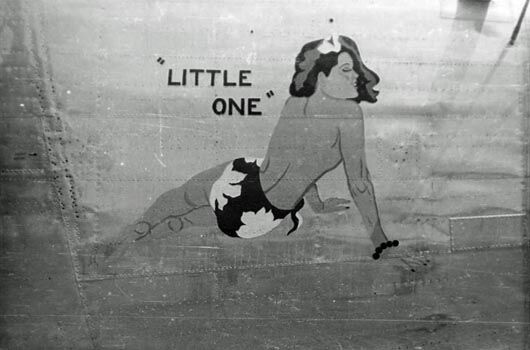
“I painted our plane’s nose art myself, out on the tarmac in the rain. ‘Little One’ was the pilot’s nickname for his wife.”

The sky over Munich filled with bursts of antiaircraft fire; it got so close I could hear the shrapnel tinkling on the hull. Since we’d broken formation, we had to pick out a different “target of opportunity” to hit; then we banked to head for home. Only then did someone notice the holes shot through the wings. It was shortly after noon.

When Engine 2 went out as well, all the aircraft’s power was coming from one side, creating a constant midair skid. The flak also shorted out our electrical system, which meant no power for the turrets, the radio, most of the instrumentation—or even the flight controls. Now the only force keeping the plane level was the pilots’ own physical strength, same as losing power steering in a car. They stood up and put all their weight on the rudder pedals to keep us from entering an uncontrollable tailspin. I relieved the engineer on the waist guns so he could go up and help the pilots. Unfortunately, this meant I could no longer keep track of our position.

We flew south for another hour until we passed over a well-defended city and the sky filled with flak again. Then, who should appear but two red-tailed P-51 Mustangs—those brave Black pilots of the Tuskeegee Airmen.

They could see we were in trouble. One flew closer to the city to draw the enemy fire, and the other came up alongside and escorted us awhile. We communicated with him out the window by sign language, since our radio was out. He smiled, and wiggled his wings. Eventually he had to return to his own mission.

Soon after that, Engine 3 failed. After three hours of fighting to stay airborne, we were down to 11,000 feet and falling. There was no way to make it home with a single engine.

The pilot gave the order to bail out.
 

Veterans Day / Little One

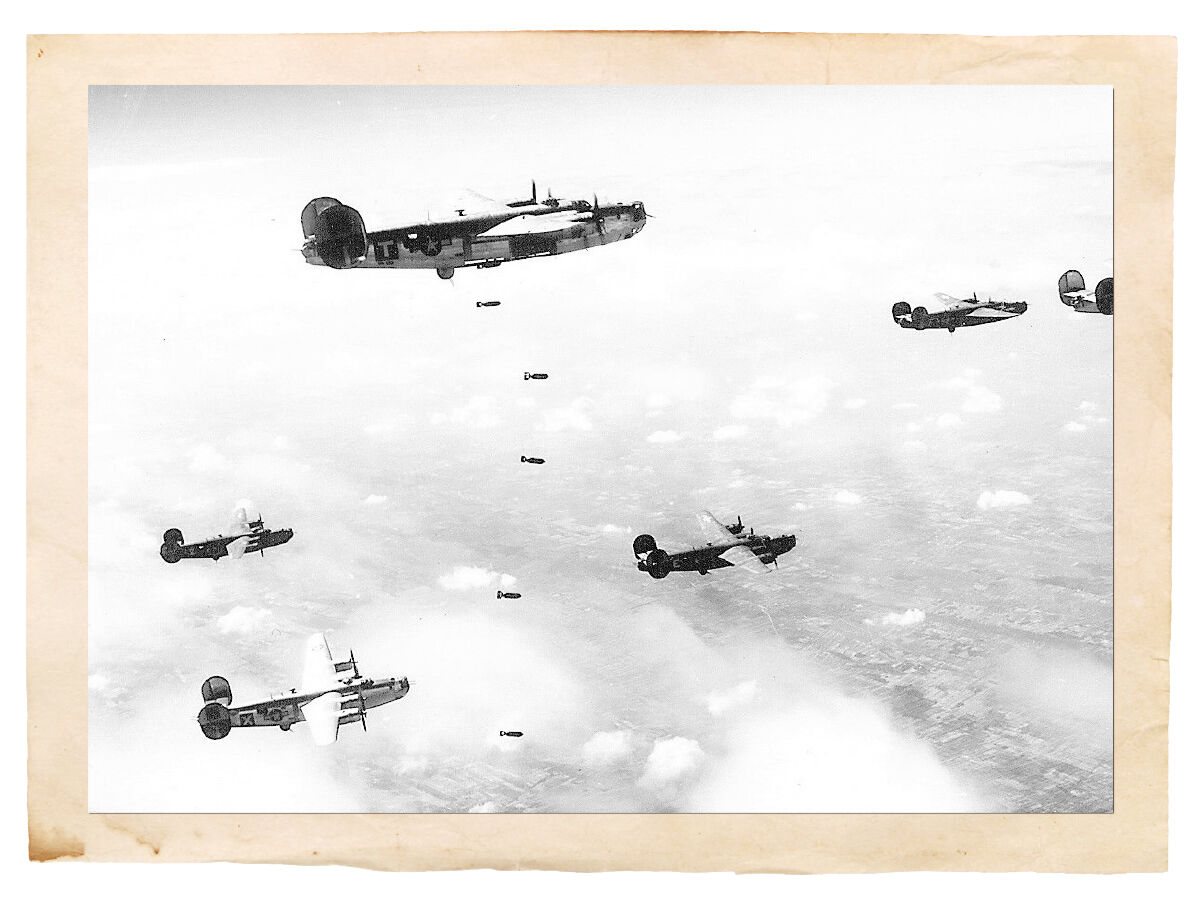
The Little One releases its payload while flying with other B-24s of the 464th Bomb Group, 15th Air Force.


Abandon Ship

I relayed the order to the four airmen in the waist gun section. They all just stared at me and shook their heads. “No sir,” they said. “After you.”

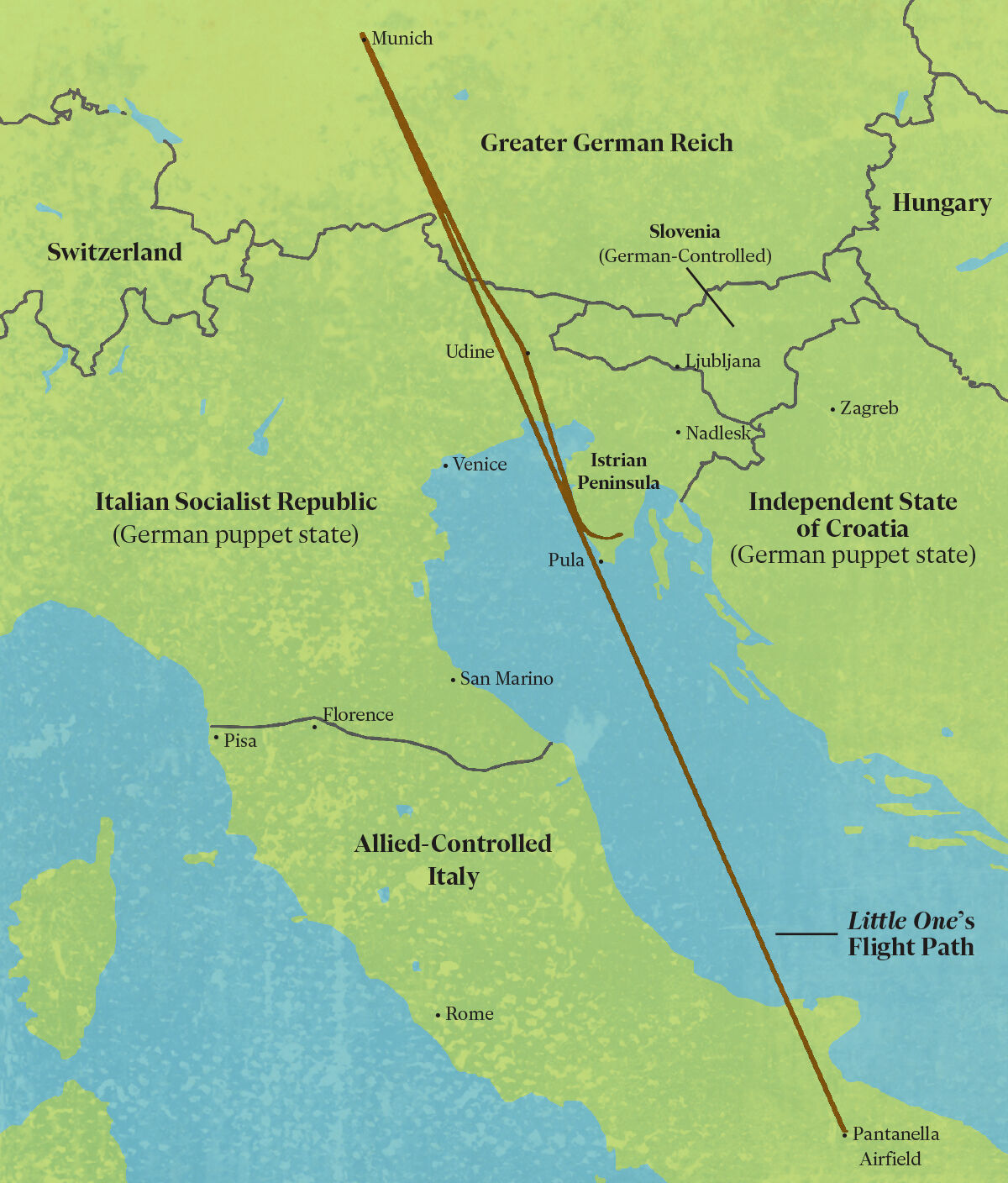
No time to argue. I opened the rear hatch and told the men to head southeast once they hit the ground, so they’d reach the Allied front line. We were turning back over land from the ocean, and I assumed we’d made it to the main “boot” of Italy, south of Venice. I was wrong.

I was first to tumble out. I caught a glimpse of everyone else opening their parachutes right away, high above me, but I knew what easy targets that would make us to ground fire, so I waited to pull my ripcord until I was just 300 feet up. We were trained to roll as we landed, to distribute the impact evenly—but in the confusion of the moment I tucked my knees and smacked hard heels-first, spraining my ankles.
Veterans Day / Little One Last Seen

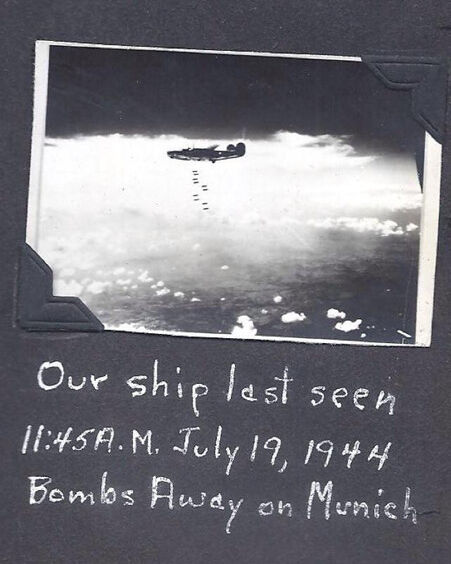
This photo shows Denison’s actual plane.

I was in a cornfield, and a three-gun antiaircraft battery was close enough that I could hear the soldiers’ voices. They also had two German shepherds—who were both looking right at me and barking.

I lay on my back, my ankles throbbing in pain, trying to gather my thoughts and expecting to be taken prisoner at any moment. I rolled up my parachute and took off my jacket, which was covered with identifying insignia. Now I saw that the dogs were wagging their tails. To my astonishment, no one came.

So finally I crawled away into a dry irrigation ditch at the edge of the field, where I hid my jacket and parachute. A little more safely out of sight, I decided to rest and give my ankles some time to recover. I kept looking around for my crew but never saw them. Having opened their chutes much earlier, they could have drifted miles away before landing.

Before I knew it I’d fallen asleep. I was awakened in the middle of the night when the gun battery opened fire—the sound shook me to pieces. British bombers were flying overhead, heading southwest.
 

Veterans Day / Little One’s Flight Path Map

Veterans Day / Little One’s Flight Path Map


Finding Food, Water, and a Boat

The next morning I ate some raw corn and took inventory of my escape kit: bouillon cubes, matches, needle and thread, a compass, waterproof silk maps of Europe, and 42 US dollars. Too late I realized I’d left my .45 pistol behind in the bombardier’s position when I went to relieve the engineer. My only personal item was the wristwatch my parents had given me at my high school graduation two year ago.

As soon as I could bear putting weight on my ankles, I set out, slowly and limping. The countryside looked just like California. I knew the Allies were gaining ground every day, so we were bound to run into them if we just kept heading southeast.

I picked up more corn and some tomatoes to eat as I passed through the fields. To my surprise, by late afternoon I reached the ocean. I’d had no water all day and was feeling awful, so I drank some seawater. Of course, following the coastline south, the next thing I came upon was a rock quarry where fresh water had collected in the bottom levels. I drank up all I could.

It was dark by the time I came to a small cove with an unattended boat. I swam out, untied it, and quietly rowed to sea. I was already exhausted, but I knew night would be the safest time to travel, so I followed the shore for hours and hours.

Based on how long we’d been flying since Munich, I expected to be just northwest of San Marino—but the coast was turning southwest, which didn’t resemble anything in that part of the map. So where was I?

The moon was just a tiny sliver. In the darkness, the water at the stern glowed softly green—phosphorescent algae, churned up by the oars. By the time dawn approached, I couldn’t row any longer. I returned to shore, found the nearest shelter from the wind, and fell right to sleep.


Saved by a Song

I walked along the coast for days, eating what I could from the fields I passed through. Eventually it became clear that I wasn’t going to just stumble upon friendly troops—I’d have to risk turning west, toward the village centers, and asking someone for help.

On the sixth day after bailing out, I spotted a well behind a farmhouse. I was so excited by the thought of fresh water I went straight for it—and didn’t notice the farmer and his dog coming out to meet me there.

We got to the well at the same time. His wife and daughter were standing in the doorway, watching us. I gestured asking for water, and the farmer asked, “Parla italiano?”

I shook my head no.

Then he said, “Sprechen Sie Deutsch?”

I knew I had to fake it somehow. The puppy was tugging on my pant leg, so I knelt down, started playing with him, and sang the only thing I could remember from the German class I’d taken in junior college: “Die Lorelei,” a poem that, incidentally, is about a siren leading a pilot to shipwreck.

When I looked up, the farmer was smiling. He probably thought I was some harmless nut. The family brought out some bread, and when they drew up the bucket from the well, it was full of beer!

A half mile down the road I stopped and turned back. They were all still watching me. They waved, and I waved. I spent that night in a haystack.
 

Veterans Day / Collage

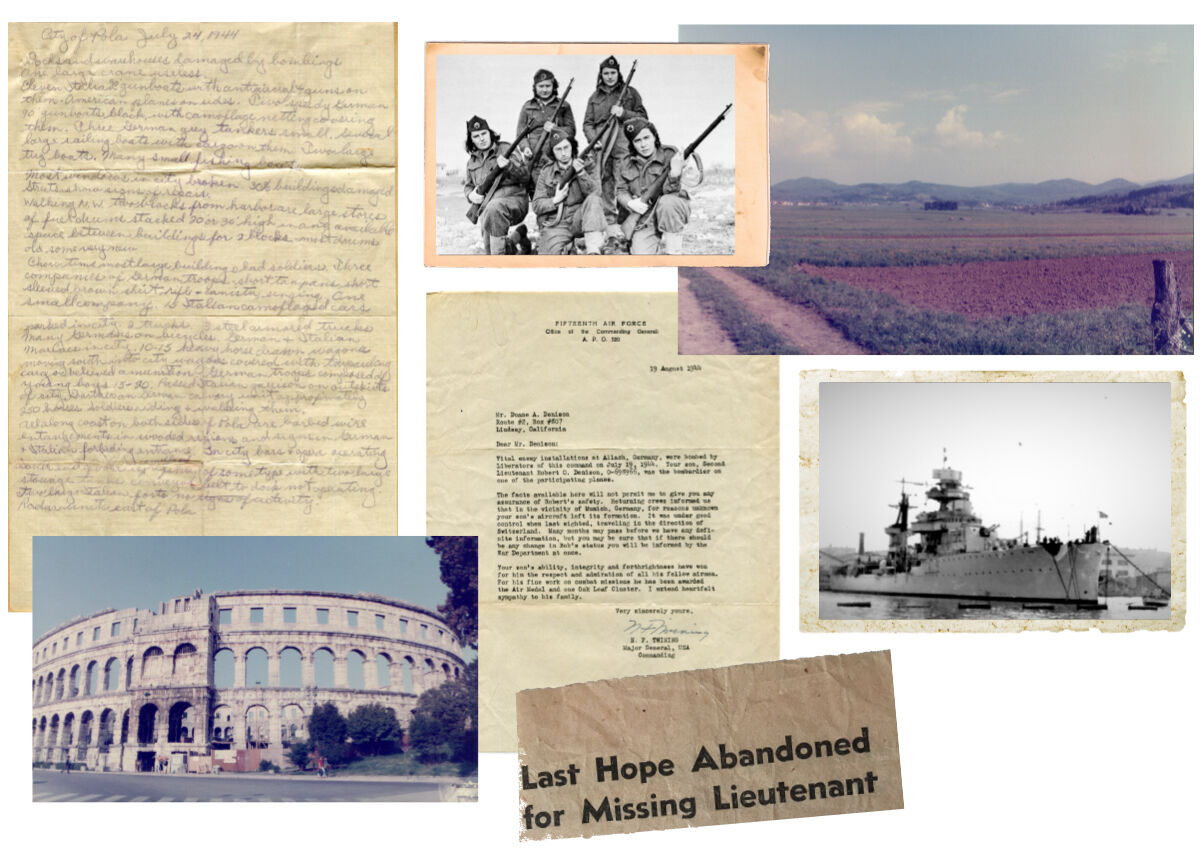
Clockwise from top left: Notes Denison took while in Pula; women of the Yugoslavian Partisans; the Istrian countryside; an Italian cruiser docked in Pula Harbor; a clipping from Denison’s hometown newspaper; Pula Amphitheatre. Center: A letter Denison’s father received while he was missing.


The City and the Colosseum

I set off at sunrise the next day. It was now July 24, and right away I saw a church steeple in the distance. I’d arrived at a major city. The street signs were in Italian, which clued me in a little—but the Italian Empire had also extended deep into Yugoslavia for years. I needed more concrete information.

Wearing a nondescript gray sweatshirt and khaki pants, I must have blended in somewhat with the Italian workforce—lucky for me, since there were so many German soldiers on the sidewalks, I had to walk in the middle of the street.

I went toward the center of town. It had seen a lot of damage, and recently. Radar installations and fuel depots lay in ruins; the aftermath of those British bombers that had awakened me the first night.

I came to the city seaport, where about a dozen torpedo boats were docked one right after the other, flying swastika flags. Painted on the conning tower of each one were red silhouettes of American ships—their kills.

My spirits fell. That really got to me. Those were my people.

I left the seaport in a daze, and there looming overhead, I could’ve sworn, was the Roman Colosseum. I thought, There’s no way I’m in Rome—am I?

I sat on a park bench and watched the German troops marching past those ancient arches. They were all such young men, and for over an hour there was no end to them. Yet performances were still happening in that amphitheater; posters all around it advertised the evening opera.

Finally I shook myself back to my senses. I had to get out of here.


The Wrong Country

On my way out of the city, I saw a girl about my age lean her bicycle against her house as she went in. It was a quieter neighborhood, and I thought, A bicycle would be much faster, and easier on my ankles.

I looked around, saw no one else, and right as I was reaching for the bike, the girl came back outside. My hands were already outstretched, so I had to do something—I mimed asking for food and water.

She gave me a suspicious look, but after a minute she nodded and opened the door. Two other women were inside—her mother and grandmother, I assumed—speaking Italian and preparing lunch. They invited me to join them.

Then the mother asked me, “Chi sei, ragazzo?”

I must’ve felt safer there because they were women. So I answered in English, “I’m an American flyer.”

The mother’s face turned white. She quickly stood up and closed the front door. Hanging on the inside of the door was a fascist uniform.

I was the enemy. But I was also their guest. I could barely breathe; I had no idea what was coming next.

Then the girl asked me in English, “How long until the war is over?”

I said, “I don’t know. ’46, maybe.”

Her family waited for her to translate, and when she did, none of them were happy about it.

“Please, can you help me?” I asked. “I don’t know where I am.”

The girl got up and came back with an atlas. She pointed to Pula, the largest city on the Istrian Peninsula.

I was shocked. The entire Adriatic Sea lay between me and friendly territory. But then I remembered our briefings on the political situation there. Istria was close to the borders of Croatia and Slovenia. All of this land was still occupied by the Germans, but it had just been reclaimed as united Yugoslavia the previous November by the Communist National Liberation Army, better known as the Partisans. If we landed anywhere in Yugoslavia, we were supposed to seek them out for help.

I asked the girl how I could contact the Partisans. She glanced at her family, then traced a line northeast out of the city. “Follow this road and they will find you.”

Then she closed the atlas and said, “My father will be home soon.”
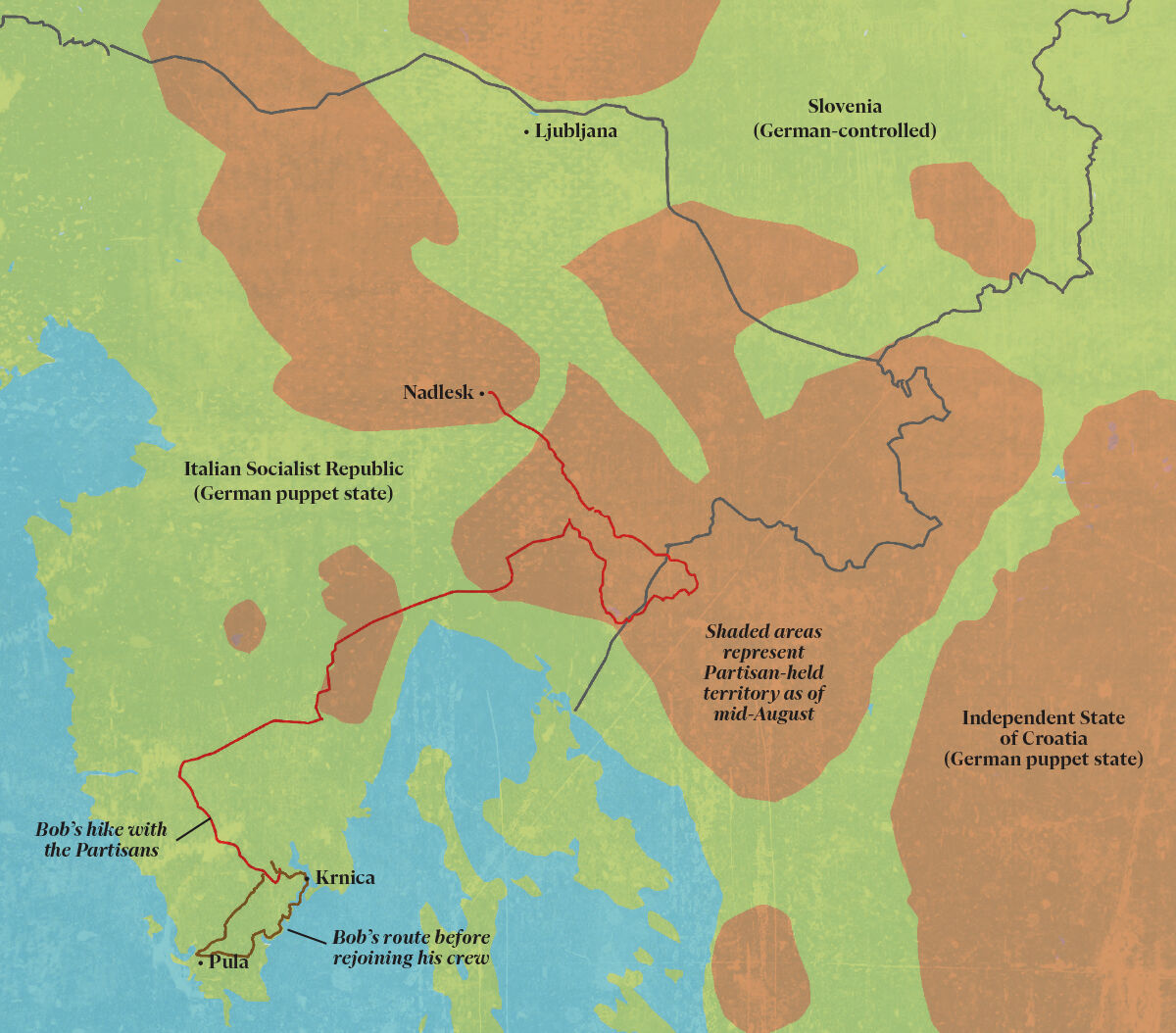
 

Veterans Day / Bob’s Hike Map

Veterans Day / Bob’s Hike Map


Nowhere Left to Run

The only way out of Pula was through a gated checkpoint. By the time I saw the German guards, the pedestrian crowd had drawn down to single file, and turning back would only look more suspicious.

My turn. A Wehrmacht officer pointed his finger at me and I stopped. We sized each other up at the same time. I glanced over his immaculate green uniform, his jackboots, jodhpurs, his black-visor cap with the Nazi eagle dead center. He seemed disgusted by my seven-day unwashed clothes—and he squinted at my boots.

Then it hit me. Even the dirt couldn’t hide that my boots were brand-new leather. And the dead giveaway: stamped in large font right across the soles were the initials “U.S.”

The moment stretched on forever. But then he waved me through.

My knees went weak and as soon as I was out of sight I sat down at the side of the road. I didn’t know how I was still alive and walking free.

I followed the road northeast like the girl had told me, and made much faster progress than in the fields. Toward evening I came across a woman chopping wood near a small group of cabins. I greeted her with gestures as I had the others, but she backed away, gripping the ax tighter.

Without thinking, I said, “It’s okay! Me Americano!”

She nodded as if to say, So what? And when I kept advancing, she turned and ran.

The path led up a steep hill and I started up it as quickly as I could. Someone shouted—a crowd of people had come out of the cabins, and three armed soldiers were coming up the road toward me.

I started running, and they started running. If I could just make it over the top of the hill first, they would lose sight of me and I could hide. But I was exhausted, hungry, my ankles in agony; before I knew it they’d all caught up.

There was no way out.

I turned to face the soldiers. One approached me and said, “Tu americano?”

I nodded.

Then he grabbed my shoulders—and kissed both my cheeks. The other two did the same.

At the bottom of the hill, everyone who’d been watching the chase started cheering.

The Partisans had found me.
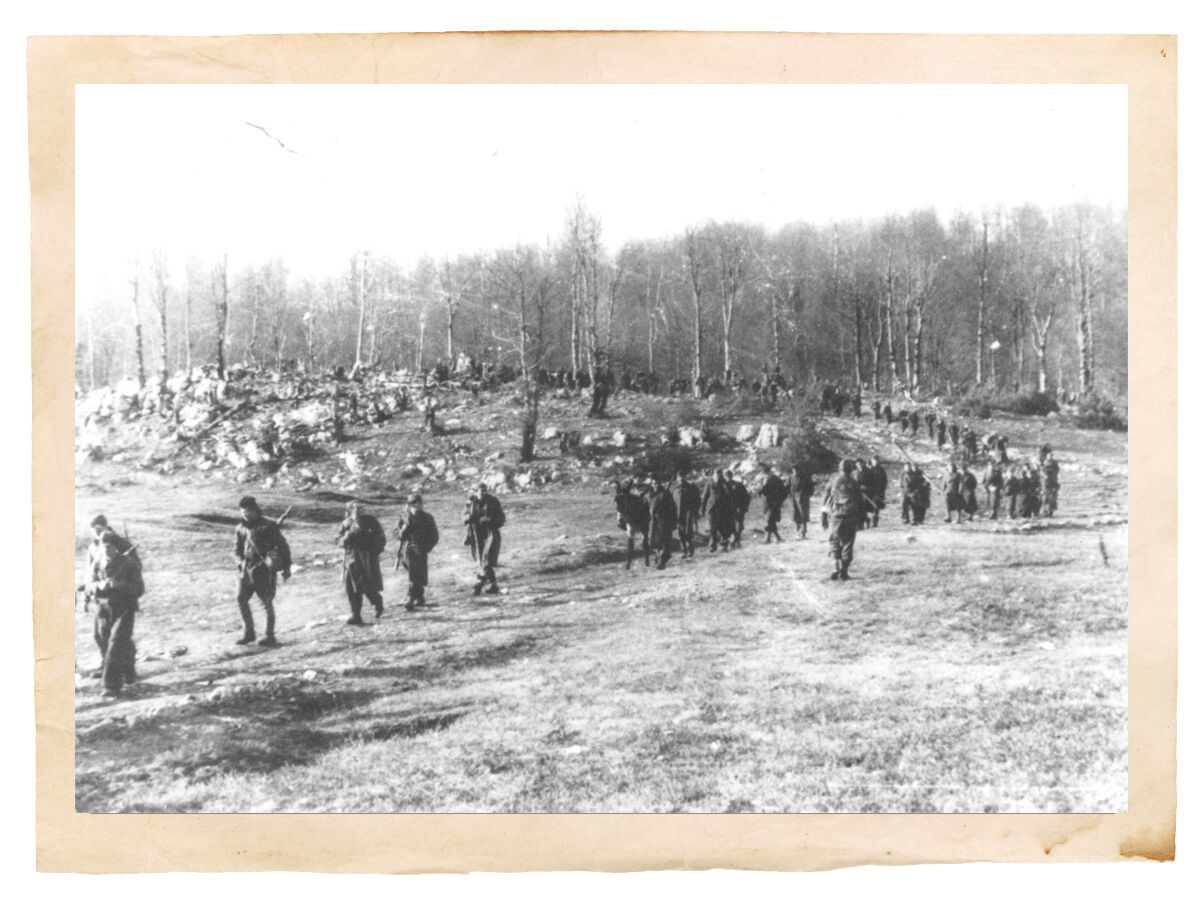
 

Veterans Day / Partisans

The Partisans on a long march through the mountains.


Reunited

When I told my story to the person back at the cabins who spoke the most English, he said his comrades had picked up some Americans a few days ago and taken them north, to one of their secret headquarters in the mountains. He offered to take me there.

We set out at dusk and hiked all night long, until finally we arrived at a farmhouse just before dawn. The inside was filled with people hard at work on typewriters, decoding messages by lamplight. My guide checked in with them, and then showed me out back to a tall barn.

Sleeping in the hayloft, above the cows, were all nine of my crewmates safe and sound.

It was a joyous reunion. I couldn’t believe their story, and they couldn’t believe mine. A Partisan happened to be in the field where the copilot and top turret gunner landed, so they were rescued immediately. Six more joined them at their camp by evening, so except for the pilot, who caught up to them the next day, everyone except me had been reunited within four hours of bailing out!

That first night, while I’d been hiding in a ditch next to a German cannon, my crew was drinking wine, eating lettuce and black bread with strawberry jam, and dancing with the locals in Krnica, the very first village I would pass the next morning.

My spirits were soaring at seeing their faces again after an entire week alone. But our journey home was just beginning. The Partisans were taking us north, on a sort of “underground railroad” to the closest friendly airstrip—350 miles across the southeastern Alps, in Slovenia.
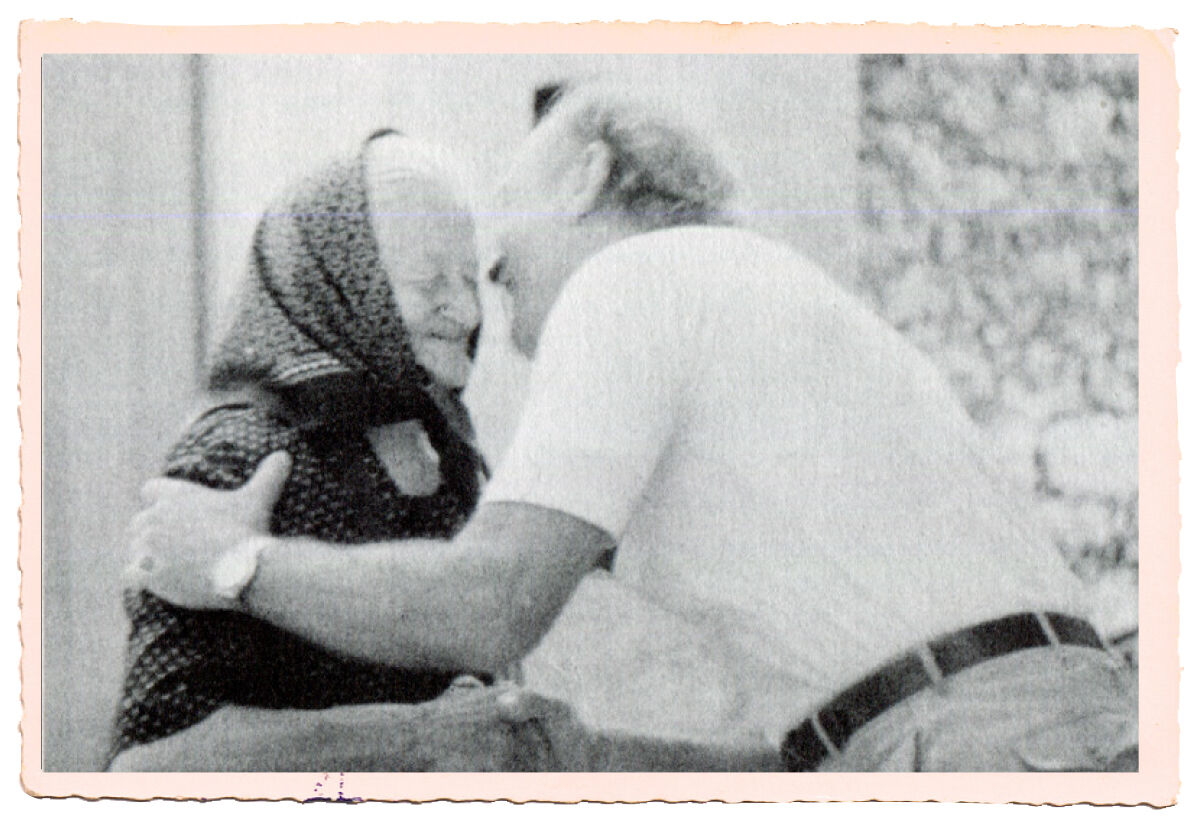
 

Veterans Day / Reunite

Copilot John Rucigay reunites with one of their rescuers, Marija Benčina, in 1971.


The Long Road to Nadlesk

We had one day to rest. The next evening, the Partisans served beef stew with plum brandy and Charms lollipops. Turns out, they’d tracked down the Little One’s crash site and scavenged everything they could from the wreckage—they were serving us dessert from the survival kits of our own airplane.

From then on it was 11 miles a day at least; the ten of us, plus half as many Partisans who joined or left at certain points to pursue their own missions. Usually that number included a couple civilian women, who carried big flasks of milk from village to village.

We marched, single file, over the mountains every night for almost three weeks, sleeping by day, until we finally entered Slovenia, which was still mostly under German control.

We arrived in a lush valley that the Partisans had recently liberated; they’d driven the Germans back to the head of the valley, just a few miles north. A makeshift landing strip there proved a crucial staging point, and the Partisans suffered heavy losses to maintain control of it.

In the tiny village of Nadlesk, a woman named Marija Benčina let us stay in the hayloft of her barn. Her husband had joined a Slovene anti-communist force, and giving us shelter was her way of subverting his cause. She had two little children, and before we left we gave her all the money we had to support their education.

Other downed Allied troops came into the valley every day, until about 500 of us were all waiting for a spot on the next plane out. A cargo resupply plane came and went on August 19, and another one week later; but so many wounded deserved first priority, we had to wait our turn.

Finally, on August 27, all ten crewmembers of the Little One boarded a British C-47 en route to Southern Italy. We were infested with lice and underweight—I’d lost over 35 pounds—but for the first time in 40 days, we felt safe. Our adventure had come to an end.

John Rucigay, our copilot, was a second-generation Slovene immigrant, so he’d been able to communicate with our rescuers somewhat. He ended up returning decades later to find the village where his parents grew up, and reconnect with the people who saved our lives. Marija Benčina was still living there at her farm. Her children were both well, but her husband never returned from the war.


A Chance Meeting in Yokohama

The story of my service in Europe is filled with unbelievable coincidences, but the greatest of them came years later.

In 1965 I was on R&R in Yokohama, Japan, during the Vietnam War. On our air base there, I met a woman employed in the US Civil Service and invited her to dinner.

I asked her about her German accent. She was about my age, and though she was now an American citizen, she had lived in Munich during the war.

“I bombed Munich during the war,” I admitted.

She didn’t seem surprised. “And I was defending Munich during the war.”

She explained that she’d been a marksman in the German Army; she and two other women were stationed on an anti-aircraft battery. A strange idea popped into my head. “Were you on the guns on July 19, 1944?”

She gave me a funny look. “Yes I was. I remember because we got credit for a possible kill that day.”

“I’ll be god damned.” I burst out laughing. “I think you might’ve shot me down.”

She took another drink. “I bet I did.”

“Aren’t you sorry?” I asked.

“Are you sorry for dropping bombs on my city?”

Well, neither of us would apologize. We were both doing our duty to our country. And now here the two of us were, 21 years later, laughing over drinks and having a great time.
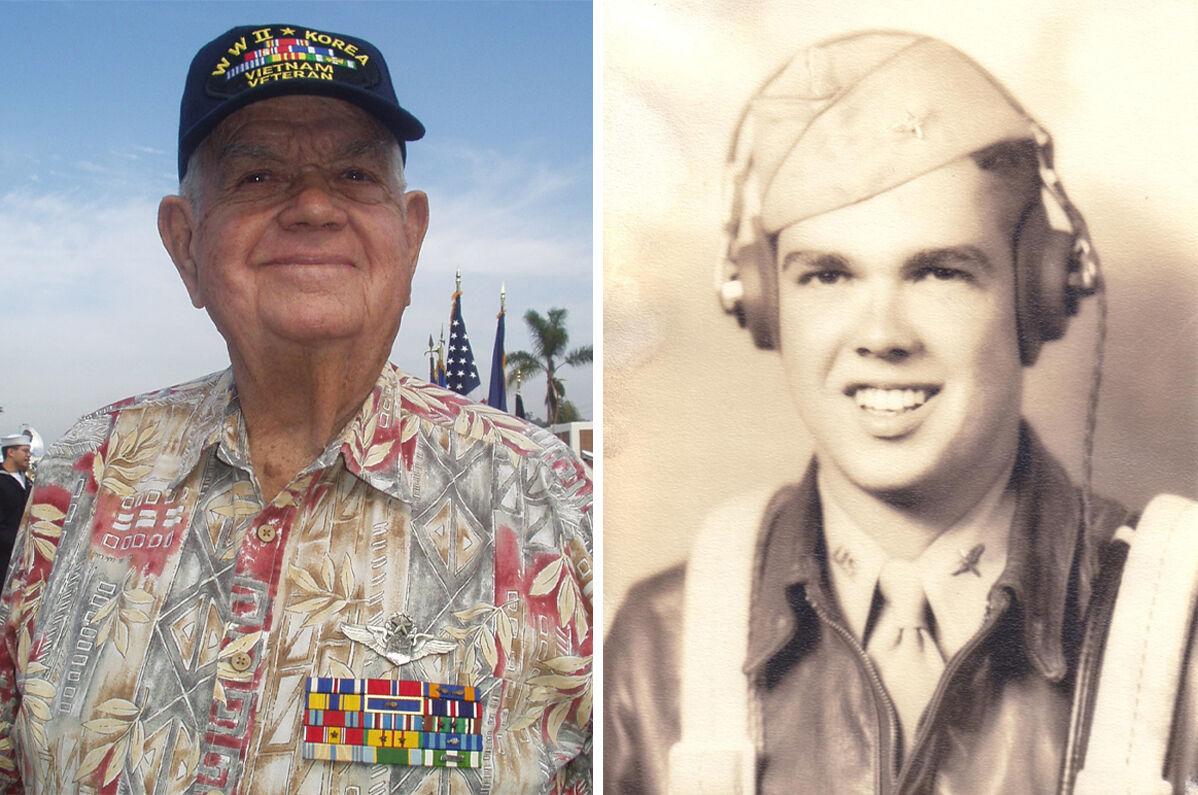
  

Veterans Day / Robert Denison

From left: Denison in the 2007 San Diego Veterans Day Parade, and Denison at bombardier school in 1943.


The Distinguished Flying Cross

For our final mission, everyone on my crew was awarded the Distinguished Flying Cross—even though we missed our target, destroyed our plane, and had to be rescued by the Partisans. I have always found that ironic. In fact, practically everyone who came to our aid were either Communist soldiers or women (sometimes both) or Black men. Those women helped us at great risk to themselves, because the men in their family had joined the other side.

I think about my experience every single day of the year. The problems we had were amazing, and I can’t help but wonder how we did it. We were all just a bunch of kids. They said go, and we went.


Bob Denison retired from the Air Force in 1970 as a lieutenant colonel and lived in San Diego for the rest of his life. When he passed away in 2017, he was the last surviving crewmember of the Little One.

Dan Letchworth is the copy chief of San Diego Magazine. His print column Dansplaining explores San Diego trivia, and his theater review blog Everyone’s a Critic was a finalist for best online column in the 2019 National City & Regional Magazine Awards.

Subscribe to our newsletters

Select Options

By subscribing you confirm that you agree with our Terms and Conditions and Privacy Policy.

Features JUNE 18, 2026

The Perfect Shot with SD’s Top Food Photographers

We ask the city's best food photographers to choose their favorite pics and share their secrets to capturing a drool-worthy pic

The Perfect Shot with SD’s Top Food Photographers
Photo Credit: Luciana McIntosh

Food is a notorious diva to photograph. The wrong lighting can make José Andrés’ paella look like a jaundiced grain bowl. You could be staring at the best sandwich of your life, but shoot it from above and—hey, congrats on that abandoned piece of lettuce bread. A cottage meme industry has been built around the hilariously bad photos on review sites that make Michelin-star food look like Michelin tires.

Especially in a visual modern media world, food culture depends on great photographers capturing the painstaking work in equally deserving ways. We asked four of San Diego’s top food photographers for their favorite shot from another year of documenting what we eat.

Photo Credit: Kimberly Motos

Kimberly Motos

Birdman Sandwich at Chick & Hawk

Getting this kind of shot takes a bit of yoga. Asana yourself into the corner, hold your breath, pray that a chef on the move doesn’t back into your light stand.

“You’re stepping into someone’s workspace during their busiest moments, so it’s a balance of being present to get the shot and being invisible to not slow anything down,” Kimberly Motos says.

The subject here is the Birdman sandwich from Chick & Hawk—hot fried chicken thigh, tangy slaw, kimchi comeback sauce, sweet and spicy pickles, potato brioche bun—getting a hearty dousing of its difference-maker seasoning. Motos captures the parts of the process that diners don’t usually see: the chaos behind something that looks so simple.

Photo Credit: Lucianna McIntosh

Lucianna McIntosh

Oysters + Jewel of the Sea Martini at The Fishery

“I love this image because it feels like a moment you want to step into,” says Lucianna McIntosh. A warm, sunny day at The Fishery in PB with oysters, caviar, and martinis. Yes, please.

The little details—the glass sweating a little, the direct afternoon light creating stark shadows, the oyster glistening on the tray—are the main characters. Instead of trying to overly control the setup, McIntosh “followed the light and lines that draw you in more,” she says. “This was one of those moments where everything lined up on its own for a second. I love it when the shadows end up being just as important as the food itself.”

Photo Credit: Eric Wolfinger

Eric Wolfinger

Herb-Roasted Golden Chicken at Fleurette

La Jolla native Eric Wolfinger—who won a James Beard Award for Tartine Bread, one of the most stunning bread books of all time—says he doesn’t have a signature style. His style is a conduit.

“I see my job is to translate the chef’s point of view into something you can feel,” he says.

For this shot, Fleurette chef Travis Swikard had one directive: cuisine du soleil (“cuisine of the sun”). With a spread of leeks vinaigrette, herb-roasted golden chicken, and beets, Wolfinger wanted to create a scene that felt straight out of the French Riviera, relaying the light, bright style of Swikard’s new spot.

Some bonus additions here: Extra lights—to add lots of warmth—and a clipping from an olive tree.

Photo Credit: Dee Sandoval

Dee Sandoval

Espresso Ice Cream at Lucien

Timing and light are everything in food photography. In Lucien—La Jolla’s tasting-menu-only restaurant with moody ambiance—a single strobe flash creates the ideal spotlight.

Dee Sandoval says she uses the “natural, just-plated energy” of the dish to “create a portrait of moment and craft.” That’s why this Mostra Ghost Bear espresso ice cream—with San José dark chocolate mousse, soy-miso caramel, and koji shoyu chocolate sauce—looks like it might dissolve halfway to your mouth.

Emma Veidt

About Emma Veidt

Emma Veidt is an editor at San Diego Magazine. She earned her bachelor's and master's degrees from the Missouri School of Journalism. She loves running, hiking, and rock climbing, but really, she mostly loves encounters with the street cats around North Park.

Everything SD JUNE 18, 2026

How to Find & Build Community in San Diego

Meeting new friends is a scary and sweaty venture—that’s where the city's social event planners come in

How to Find & Build Community in San Diego
Photo Credit: Gina Ribando

Walking into a room full of strangers isn’t high on the fun index for most. It’s inherently awkward: Everyone’s standing in closed-loop clusters, deep in conversation, and, depending on your social aptitude, the feeling is somewhere between light apprehension and burning alive from the inside out. The pull to retreat or reflexively look busy on your phone is stronger than the drink you now deeply crave. Having friends is nice, but making friends can be brutal.

There’s plenty of commentary on the loneliness epidemic. Last year, the American Psychiatric Association reported that one in three adults feel lonely at least once a week; those aged 18 to 34 are more likely to feel isolated and even more likely to turn to social media as a result. Dr. Vivek Murthy’s “My Parting Prescription for America” cautioned that “being socially disconnected increases our risk of heart disease, dementia, depression, anxiety, and premature death.” So it’s not just an emotional need; it’s nearly nutritional—chit-chat and the occasional wine-fueled, emotional deep-dive are just as important as Pilates and a reasonable amount of kale.

San Diego Magazine reader-submitted best friend stories Best of San Diego 2025 edition

Finding social connections in any city is hard, but San Diego has very specific challenges. This is largely a transient population that acts as a temporary hotspot for many and a permanent home for few. Pick your reason: high rent, surreal gas prices, housing shortage, meh job opportunities (ranked 71st in the country in 2025), or the fact that active military is a sizable chunk of us (110,000-ish)—stationed here for a stretch, then gone. This constant flow of departees sucks out the potential for deeply established families and friend groups, leaving a good share of nomads, searchers, and plenty of people feeling socially awkward.

“There’s an underlying loneliness in all of us,” says Ramel Wallace, the host of monthly meetup CreativeMornings. “There are not a lot of San Diegans who are born and raised here, so [even those] San Diegans end up being just as lonely as the person who just got here.”

Photo Credit: Blair Kirby

Every month, in local libraries, breweries, and small businesses, there are ambitious social architects who have made a career out of undoing social sads. Extroverted champions of the awkward and searching, they’ve struck gold on in-person connection.

The first moments in a social situation are crucial. Sets the tone and cools the nerves.

At Pitch-A-Friend, singles recruit their close friends to present a slideshow of their dating green flags. The entry points for connection at Pitch-A-Friend are simple, old tech: stickers. Each colored sticker indicates if the wearer is single or taken, queer or straight, or practicing ethical non-monogamy (in a partnership but open to others under a mutual understanding).

At the helm of each showcase is Arielle Fuller, aka Chief Wingwoman, who is making dating hopeful again. As Fuller explains, this takes some of the fear of rejection out of a first interaction. “Putting a sticker on immediately means, ‘I wanted to leave my house and talk to someone, and I am a safe space to come and speak to me,’” she says.

Of course, not all of San Diego’s events designed to make connections are romantic. On the last Friday of every month, hundreds gather at San Diego Central Library for the local chapter of CreativeMornings—an org formed to unite creatives in various cities across the world (designers, artists, writers, producers, performers, architects, etc.).

Photo Credit: Gina Ribando

These aren’t your standard business card swaps, though. Coming from a hip-hop background, host Wallace uses call-and-response to break the fourth wall. “This is not my stage at all, this is our stage,” he says.

In your standard lecture-based meetup, the crowd silently faces the host and acknowledges nobody except those they came with. At CreativeMornings, everyone is encouraged to look around, pay attention to the strangers in the audience—not just the host. Wallace will pull volunteers to read the CM manifesto aloud, and he passes the mic to creatives, who make 30-second pitches to the community about projects they’re working on—and there’s always an invitation to connect and collaborate with the presenters whose ideas struck a chord.

The U.S. Chamber of Connection (yes it exists) says people experience life transitions nearly every year, and in these stretches are more open to forming new habits, relationships, and communities. In a revolving-door city like ours, the transition often comes when someone moves away. In 2023, the Census Bureau reported San Diego had the ninth-highest rates of domestic out-migration in the US.

This poses an issue for friendships that IRL SD addresses in monthly friend-making events called 619 Night.

“San Diego isn’t a place a lot of people stay forever,” says Alex Hunter, the creator of IRL SD. “They leave, and people [who stay] lose that community, so they’re hungry for community again.”

Their website describes the vibe as “backyard party meets college fair meets networking event meets happy hour.” Each follows a theme—wellness, sports, refresh and reset, etc.—with related community groups joining as well.

“The people I encounter are trying to get a fresh start in some capacity, so they’re more open, receptive, and ready to meet new friends,” Hunter says. “They need the circle.”

Photo Credit: Elysian Visions by Deaune Boyd LLC

Another way adults can break out of this disconnection is to revert in unison, says artist Elisa Summiel-Bey. The 2015-ish adult coloring book moment in the US was based on some real science, with multiple studies finding coloring has a noticeable meditative and stress-release effect by taking the brain away from anxieties and mental inventories, and focusing it on a simple, easy art. Summiel-Bey’s company Illustrated Melanin throws “Color & Chill” events, turning that trend into a group exercise, along with live DJ sets, wellness experts doing sound baths, and food and drink from BIPOC-owned local businesses. “I tend to think of coloring as your way to tap back into your childlike play,” she says. “As adults, I think we’re almost scared to let loose and have that unabashed joy.”

All of these social meetups attract crowds of likeminded connection-seekers, but high attendance is not the only thing that matters. Metrics nuts can track RSVPs, but spreadsheets can’t capture intangible wins: friendships made, innovative ideas sparked, collaborations kicked off. At CreativeMornings, Wallace redefines ROI as Return On Imagination. Resounding success means thoughtful inquiries over coffee, curiosity about the monthly meeting themes, and requests to take the microphone.

A simple, observable ROI is an increased number of window shoppers to the experience—on the periphery, watching from afar, looking for the right way in. Hunter from IRL SD sees the anxiety in her DMs. “The scariest part for you right now is not meeting new friends: It’s the unknown,” she says. “It’s the gap between ‘I’m here’ and ‘That’s where I need to be.’ If I can help you understand, or get a little bit of a shape around that unknown, it’s much more approachable.”

Courtesy of IRL SD

Being able to bridge that gap, however, depends on your ability to step out of your own mind. “It’s not a connection crisis; it’s a courage and confidence crisis,” says Fuller. The first hello could be as easy as, “Hey, cool shirt.” These are the types of things she includes in her confidence lab reels on Instagram and weekly newsletters.

Ever left a social event and shot straight into a spiral? Was I being weird? Why did I tell that story? I hope that person moves to another state very soon.

The experts say that post-event self-interrogation is a standard-issue part of being alive.

“I love awkward people, and I love being awkward myself,” says Wallace. “It’s humbling to experience: ‘I’m not alone. Finally someone is not put together.’ So give yourself that grace.”

Jeannine Boisse (she/her) is a freelance writer and professional creative with a background in Radio & Television. Based in sunny San Diego, Jeannine spends her time exploring the city's vibrant brewery scene, cooking up new recipes in the kitchen, and connecting with new people.

Everything SD JUNE 16, 2026

Teenage Car Theft Drove Me into NASCAR’s Arms

As NASCAR lands in San Diego this weekend, a recently burgled dad is irregularly excited

Teenage Car Theft Drove Me into NASCAR’s Arms
Courtesy of NASCAR San Diego

My 15-year-old daughter tried to steal our car this week, so I’m ready to become a NASCAR dad. It would be appropriate discipline. We just relocated to a nice suburb within walking distance of her high school. The suburbs are like living in a Tesla commercial. I am pretty far from the wealthiest dad in this neighborhood (I am the least wealthy dad in this neighborhood), more than a few engineering degrees short of being in the running.

I’m fairly certain watching NASCAR is a violation of our HOA and a violation of my daughter’s emotional HOA. But NASCAR hits San Diego this weekend and I have a fever I’ve never felt before. I want to watch 111 drivers do dangerous things in cars and trucks on an active military base in the ocean. Since my lifelong exposure to NASCAR is limited to Talladega Nights and every single iteration of the movie Cars, I can only base my plan of attack on oafish stereotypes.

So while other neighbor dads are sizing bubble jackets for their golf simulators, I’m gonna grow a Ricky Bobby, run the extension cord for the TV out into the carport we share with six other condos, fill a cooler with a proper 80-20 split of Hamm’s and Mountain Dew, treat a lawn chair like an ADU, and spend a few hours yelling ohsheeeit as if it’s a single, nine-syllable word.


The quality parents in our neighborhood seem highly attuned to the sound of any vehicle breaching the 6 MPH threshold, so I should gather a crowd pretty fast. They may come over with strongly worded emails in their hearts, but one glimpse of Shane van Gisbergen and hometown hero Jimmy Johnson guzzling the last remaining drops of gasoline on the planet in a dazzling display of carmanship—they’ll join my NASCAR pop-up party.

By the time my daughter brings her friends over, we’ll have a real welcoming committee.

Because, like I said, my daughter tried to steal my car.

She wasn’t going to Mexico. But while Claire and I were off doing businessy stuff to afford my teen’s skincare rituals, she and a friend decided to teach themselves stick shift. She’s never driven a stick before. I’m not saying she has, but if she has driven a vehicle at all—it would have been done in a remote, abandoned parking lot where the only possible thing she could destroy was the concept of driving itself.

But a couple TikTok videos later, she and her friend felt a certain level of mastery had been achieved, and they gave it a go. They backed our VW Bug out of the garage with a series of stalls and transmission seizures, and managed to get it into the carport, attempting to do “donuts.” That’s when I got a call from a resident, who had taken an active interest in this experiment.

Which got me wondering about the power and might of vehicles. Turns out, even at carport speeds there exists a bit of potential fireworks. A garage door could become not a garage door anymore. At 145 MPH on Naval Base Coronado this weekend (don’t worry, they slow down to 100 MPH for turns), NASCAR drivers are essentially doorbell ditching gods. I didn’t register the temperature after my daughter’s trial run, but the track at NASCAR races usually hits a cool 130-150 degrees, enough to lightly sear some Nikes (the tires themselves hover in the 200 degree range).

And that is at least part of our fascination with NASCAR (the other fascination is the legendary pit parties, which either set humanity back a few evolutionary links, or advance it by the same amount of links). These drivers do something all of us do every day in a very efficient, boring way—drive a car—and take it to its extreme impulse. Grace and precision at the thunderous edge of shit going terribly wrong. Most of us have looked at San Diego home prices and felt a burning desire to see how fast our Honda Pilot could make it to our new home in Vegas. So NASCAR drivers are acting on our own wildest impulse.

Troy Johnson

About Troy Johnson

Troy Johnson is the magazine’s award-winning food writer and humorist, and a long-standing expert on Food Network. His work has been featured on NatGeo, Travel Channel, NPR, and in Food Matters, a textbook of the best American food writing.

Studio S JUNE 15, 2026

A Modern Take on Steak

Stake Chophouse & Bar brings contemporary classics and old-school service to the heart of Coronado

A Modern Take on Steak
Courtesy of Stake Chophouse

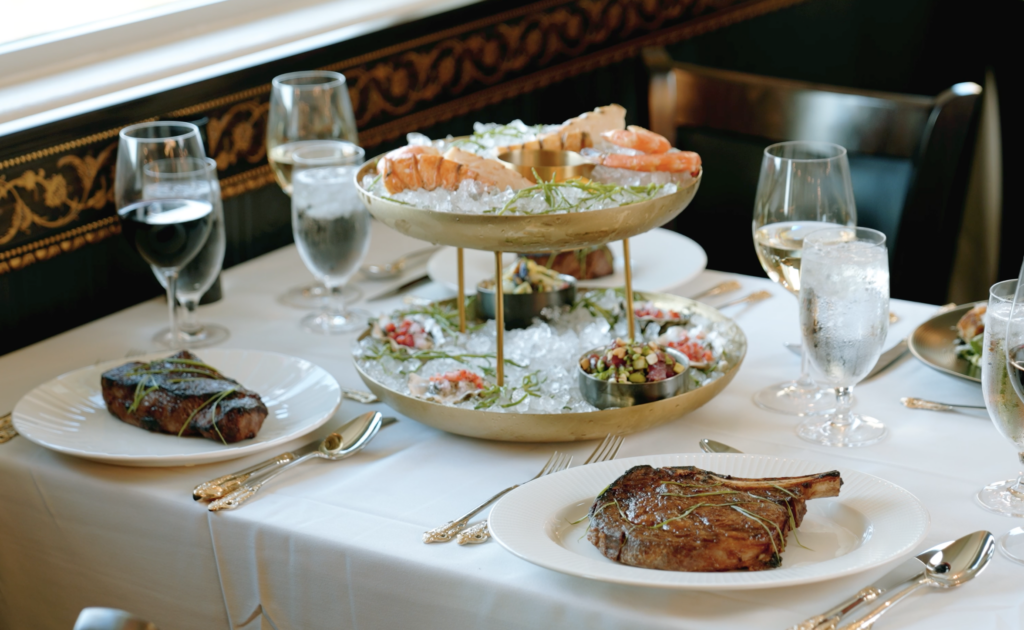
Stake Chophouse & Bar isn’t your average steakhouse. Blue Bridge Hospitality’s Coronado outpost is a modern interpretation of a big-city steakhouse nestled in the heart of the small coastal community. The team at Stake has reimagined the whole steakhouse experience. By prioritizing a seasonal farm-to-table sourcing philosophy, a personalized guest experience, and unique service touches, like a formal steak presentation and a bespoke knife selection process, Stake distinguishes itself in a sea of steakhouses.

Exceptional steaks, including Wagyu from Japan, Australia, and the U.S., and fresh seafood flown in daily form the core of Stake’s culinary identity. The menu features a five-course omakase-style steak experience highlighting house favorites, plus an array of cuts, and classic steakhouse staples—think a wedge salad, baked potato, or pasta carbonara—refined for a contemporary palate without losing their traditional appeal. Stake focuses on seasonal sourcing from the region’s best family farms and specialty purveyors, and incorporates intentionally unexpected touches to create something truly unique.

“I challenge our chefs and myself to take it a step further in sourcing,” says Chef Ronnie Schwandt. “It’s important to us to highlight different farms, unique one-off farms—whether it’s cattle, strawberries, a local fisherman or from anywhere in the United States, we’re always trying to find that niche.”

Beyond the menu, Stake emphasizes outstanding service, says Vinny Spatafore, Director of Hospitality Operations. Staff maintains detailed notes, allowing them to remember guests by name, recall previous orders such as a favorite martini (also memorable for the customer since it’s served in an extra tall, distinctly-shaped glass), and celebrate special occasions like birthdays and anniversaries.

“When you have those points of topic that you remember about a guest, they appreciate that,” he says. “Our servers are really good with that—we have a couple servers who have been here since the beginning and they’ll remember somebody from years ago, their name, their kids’ names, where they live. I’m really thankful to have a great front of house staff.”

Award-winning wines, rare whiskeys, special events, and a complementary black car service that provides transportation for guests throughout Coronado add to Stake’s appeal.

Schwandt stresses that Stake offers more than a meal; they aim to give patrons something unforgettable.

“It starts when you walk up the stairs and are greeted by the hostess—that sets the tone for the night. Then you’re greeted by a server, who may know you by name, and can guide you through the menu and curate as they get to know you,” says Schwandt. “Most people leave kind of blown away; they leave feeling like they just had an experience. That’s the goal, right? Whether you’re serving smash burgers or high-end steak, you want somebody to leave thinking, Wow, that was awesome.”

Partner Content
Everything SD JUNE 15, 2026

Sunday Golf Is Making the Game Lighter

In a sport obsessed with prestige, a San Diego–born golf brand is betting on something more fun and less fussy

Sunday Golf Is Making the Game Lighter
Courtesy of Sunday Golf

Music drifts across the fairway. Someone’s in flip flops. The Pacific flashes in the distance. Sun peeks onto shoulders through the palm trees. It’s spring, technically, but the air reads suspiciously like summer. At the par-3 course at Liberty Station, the longest hole barely stretches past 120 yards, and no one looks particularly interested in becoming the next PGA legend.

This is where Sunday Golf was born.

“I got dragged to a par-3 course in 2019 —The Loma Club—and it was way more my jam,” says Ronan Galvin, CEO and co-founder of Sunday Golf, a company that makes lightweight golf bags for players who’d rather carry less and laugh more. “It was a lot different than the stereotypical ideas you have about golf where it’s kind of long, uptight, and exclusive.”

Galvin spent over a decade in the golf industry working in product development, sourcing and manufacturing. But he didn’t grow up swinging clubs. Basketball and football were more his speed. What clicked for him was a simpler, more relaxed kind of play: shorter rounds and weekend games built for fun rather than formality. The kind of golf that resonated for him felt accessible, effortless, and surprisingly his lifestyle.

Courtesy of Sunday Golf

He noticed something else, too.

On a course where five clubs do the job, players were still lugging 14. So Galvin built something smaller. Lighter. A bag designed specifically for par-3 rounds, the Loma Bag is sleek, functional, and refreshingly unfussy. It’s practical minimalism in a sport known for excess.

Sunday Golf was slated to launch in January 2020. Then, COVID hit. Shipments stalled; lost at sea. The future felt shaky. But the series of catastrophes for the young company turned out to be anything but: By the time inventory arrived that August, golf had become one of the few activities people could safely do.

“It introduced and brought so many people back to the game,” Galvin says. “It created a habit for a lot of people, which is a big reason golf is on its growth trajectory.” 

San Diego golf company TaylorMade golf in Carlsbad featuring The Kingdom golf club fitting and production facility

It turns out Americans can’t get enough of golf. Forty-eight million of them swung clubs last year, a 41 percent jump since 2019, and the National Golf Foundation says the total could top 50 million by the end of 2026.

The brand rode this unlikely momentum. Since 2021, Sunday Golf has expanded into larger lightweight bags and continues evolving from there. A major reason for the company’s success is its approachability, a value so central that it’s literally written on the office walls in the form of the company’s guiding mission: “Get 500,000 golfers having more fun by 2027.” This goal is measured, fittingly, by golf bags sold. 

Sunday Golf has already passed 300,000 bags sold.

But the numbers aren’t the point.

Courtesy of Sunday Golf

“To remind the world that life is meant to be enjoyed,” Galvin says of the brand’s why. In an era dominated by screens, golf offers something analog. “People are outside, touching grass with their friends. A golf bag is a golf bag, but our products are vehicles to help support that.”

Unlike legacy golf giants promising proximity to Rory McIlroy-level greatness, Sunday Golf leans into what Galvin jokingly calls “diet golf” or “golf light”—weekend rounds, driving range sessions, company scrambles. The bags are built for the casual golfer, and the fit feels obvious.

That philosophy resonates across Southern California, where year-round sunshine means golf courses never really hibernate for winter. As Galvin puts it, “the laid-back lifestyle of San Diego kind of seeps into everyone’s veins.”

Sometimes the validation arrives via email: a 76-year-old customer is able to walk the course again because their golf bag is lighter. Parents are able to take their children out with Sunday Golf’s kids line.

For Galvin, that’s the real win. Not perfection. Not prestige. Just more people outside, enjoying themselves. In San Diego, that might be the most natural mission of all.

Isabella Dallas is a freelance writer for San Diego Magazine and the Arts and Culture Editor at The Daily Aztec in her final year at San Diego State University. She previously worked as an editorial intern for SDM, but when she’s not writing, you can find her trying the best coffee spots in SD, devouring the latest rom-coms, and indulging in anything and everything pop culture.

Arts & Culture JUNE 15, 2026

Art Plus Story Equals Culture

Announcing a partnership between Art & Design District, SDFC Playmakers, and San Diego Magazine

Art Plus Story Equals Culture
Photo Credit: Richard Barnes

FOR IMMEDIATE RELEASE

SAN DIEGO, CA — [June 15th, 2026] — Art plus story equals culture. Today, three local groups deeply invested in advancing San Diego arts and cultureSan Diego FC Playmakers, Art & Design District, and San Diego Magazine—have joined forces to tell its stories.

The initial project will be a landmark September edition of San Diego Magazine—fully dedicated to the people, ideas, and identities of the city’s creative community. After its release, those stories and more will extend across six months of integrated digital, social, and multi-platform coverage. Art & Design District and SDFC Playmakers will serve as co-publishers of the expanded editorial vision.

The Art & Design District is evolving into San Diego’s first home for the performing arts at iconic downtown venues like the Civic Theatre and Jacobs Music Center alongside research and development programs focused on artist live/work spaces, galleries, studios, and New School of Architecture & Design.

“[The Art & Design District initiative] is a long-term investment in San Diego’s creative life and the creative workforce that powers our cultural experiences and creative industries here at home and across the world,” says Jonathan Glus, Prebys Senior Fellow for Art & Design in Residence at Downtown San Diego Partnership. “But infrastructure alone is not enough. The public needs to see, understand, and participate in what’s being built and why. Joining as co-publisher of this issue means helping ensure that the story of San Diego’s creative community—its artists, its institutions, its future—gets told at the level of ambition the moment requires.”

San Diego has entered a defining chapter in how the region invests in its creative community, with civic and philanthropic leaders working alongside artists, brands, institutions, and people to chart a new model of public-private support for arts and culture.

As digital co-publishers of San Diego Magazine‘s arts and culture coverage, SDFC’s Playmakers partnership will include a six-month integrated collaboration designed to sustain the visibility of San Diego’s creative community well beyond a single issue.

“The Playmakers program was built on the belief that the creative community is essential to what makes San Diego, San Diego,” says Sebastian, San Diego FC’s SVP of Brand and Innovation. “Investing in local media that tells those stories—and reaches the audiences who need to hear them—is one of the most direct ways we can support the artists, organizations, and cultural leaders shaping this city’s future. We’re proud to step in as digital co-publishers of San Diego Magazine‘s arts and culture coverage and the founding partner of this new editorial program.”

Under the partnerships:

  • The Art & Design District joins as Co-Publisher of the September 2026 Arts & Culture Issue, undwriting San Diego Magazine‘s most ambitious editorial event of the year. 
  • SDFC Playmakers joins as Digital Co-Publisher of San Diego Magazine‘s arts and culture coverage, founding a six-month integrated partnership that includes co-publisher presence in the September issue. 

The partnership represents a new model for regional media: civic and cultural institutions providing the resources required for sustained, ambitious, local editorial media focused on the neighborhoods it serves. 

“For 78 years, the magazine has told the story of arts and culture here,” says Claire Johnson, CEO of San Diego Magazine. “But the fragmentation of traditional media has made it harder than ever to cover this community at the depth and scale it deserves. SDFC Playmakers and the Art & Design District have recognized something critical: Media is not separate from the civic conversation, it’s the stage for the conversation.”

San Diego Magazine retains full editorial control over all reporting, features, and original content produced under both partnerships.

“Our role in this ecosystem is to tell the story of San Diego’s culture and provide context for our readers.” says Johnson. “These partnerships give us the resources to do justice to that responsibility—and to extend that commitment well beyond a single issue. Our readers also deserve to know exactly how this work was funded. I’m grateful to our partners, and to the arts and culture community in San Diego for letting us tell this story.”

The September Arts & Culture Issue will be released early September 2026, with digital, social, video, and podcast coverage rolling out through early 2027.


ABOUT SAN DIEGO MAGAZINE For 78 years, San Diego Magazine has been the region’s leading lifestyle and culture publication, reaching approximately 6 million readers monthly across print, digital, newsletter, and social platforms. Owned and operated locally, the magazine has been the connective tissue of San Diego’s cultural conversation since 1948.

ABOUT SDFC PLAYMAKERS The Playmakers program is an ongoing initiative that seeks to identify and showcase the talent of San Diego creatives who are contributing to the culture, substance, and flow of our community. We want to bring the San Diego community together by marrying football and creativity to provide a platform for these Playmakers who are positively impacting our culture by pushing the boundaries through innovative ideas. The goal is to create a program that consistently provides growth and exposure opportunities for San Diego creatives, while shaping an authentic direction for San Diego FC’s brand and community-building process. Through this program we hope to contribute to the creative fabric of our city by providing paid jobs, projects, collaborations, as well as networking opportunities for Playmakers.

ABOUT THE ART & DESIGN DISTRICT The Art & Design District is a Downtown San Diego Partnership initiative, supported by the Prebys Foundation, working to shape a connected, vibrant arts and design district in downtown San Diego. Led by Art and Culture Expert Fellow Jonathan Glus, the initiative convenes artists, cultural leaders, civic stakeholders, and residents in service of a downtown that reflects the creativity, identity, and diversity of the region. Learn more at downtownsandiego.org.

Partner Content JUNE 10, 2026

New Options for GLP-1 Users

Scripps study shows that some patients may be able to taper their dose and maintain results

New Options for GLP-1 Users
Courtesy of Scripps Health

While glucagon-like peptide-1 (GLP-1) receptor agents have been used to treat Type 2 diabetes for more than 20 years, their recent emergence as weight-loss wonder drugs marked a new frontier in medicine. But their effectiveness has left some patients wondering what to do once they’ve reached their goal. Stopping the medication could mean regaining some, if not all, of the weight. A Scripps Clinic internal medicine physician recently conducted a small study of whether GLP-1 patients who had reached their goal weight could maintain that weight by taking their regularly prescribed injection every other week instead of weekly. Spoiler alert: 30 of 34 patients did. Read more about the study here and what that may mean as pharmaceutical companies roll out oral GLP-1s.

For more nutrition, wellness, and healthy living tips, sign up for the San Diego Health newsletter here.

Partner Content

Thousands of savvy locals already get it.

San Diego's best restaurants, experiences, and events—handpicked and delivered to your inbox weekly. You in?

Close the CTA

Contact Us

1230 Columbia Street, Suite 800,

San Diego, CA