Featured articles
Food & Drink
Features
Food & Drink
Featured articles
Food & Drink
Things to Do
Things to Do
Featured articles
Food & Drink
Food & Drink
Food News
Featured articles
podcast-ep
podcast-ep
podcast-ep
Featured articles
Food & Drink
Features
Food & Drink
Featured articles
Food & Drink
Features
Partner content
Ready to know more about San Diego?
SubscribeReady to know more about San Diego?
The Mission Hills restaurant is a masterful show of the cooking style that made us human
1011 Fort Stockton Drive, Mission Hills
fortoaksd
BEST DISHES
Burrata
Australian Wagyu
Gianduja Tart
Progress is nice. But in an age when everything is relentlessly new and improved, I increasingly want the old and unimproved. I have an intense need for anything somewhat even remotely ancient. And nothing is more ancient than fire. Living in a smartphone world makes me crave dumb fire.
It’s an instinct 1.8 million years in the making. That’s about the time paleoanthropologists believe the first hominids threw raw food over an open flame and discovered cooking. It didn’t just make meat and vegetables taste better—it was crucial to our evolution as a species. Most foods have nutrients we can’t process in their raw form. Cooking broke those nutrients down—essentially performing the role of an exterior stomach. It allowed us to tap into a treasure trove of nutrients not available to other species. That’s why our brains doubled in size and we came to rule this earth, to the chagrin of those other species.
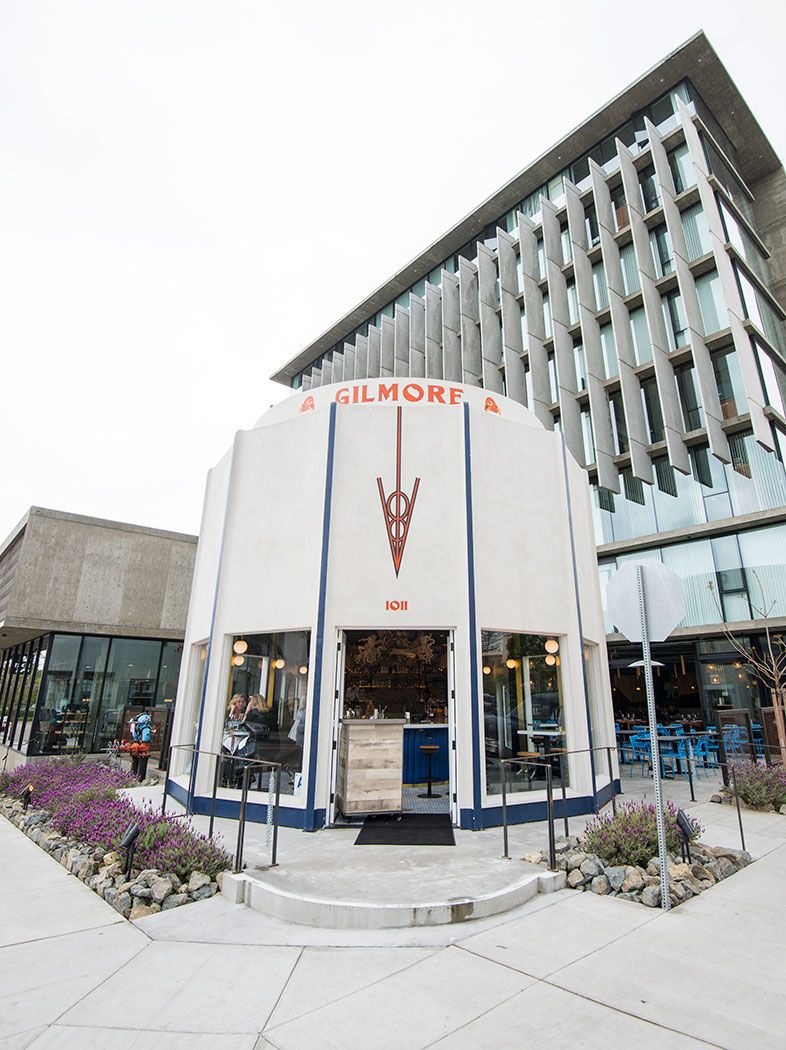
Fort Oak restaurant review
Fort Oak is inside the old Ford dealership in Mission Hills.
And how was that food cooked for nearly two million years? Over burning wood. Human culture was built around fire. Entire villages would gather around it for warmth and food, form bonds and social hierarchies and roles. Every sensory element associated with wood-fired cooking—smoke, char, ash—has been deeply stitched into our DNA.
Wood-fired cooking began to disappear in cities in the early 1900s when gas lines became commercially viable. We moved farther and farther away from that ancient meal-smoke. The last few decades in higher-end restaurants has been dominated by sous-vide and sci-fi creations (cheese balloons!), made with anti-griddles and centrifuges. That future food may be wild and fun and mind-expanding, but as eaters we simply don’t have an evolutionary desire for them.
Fort Oak restaurant review
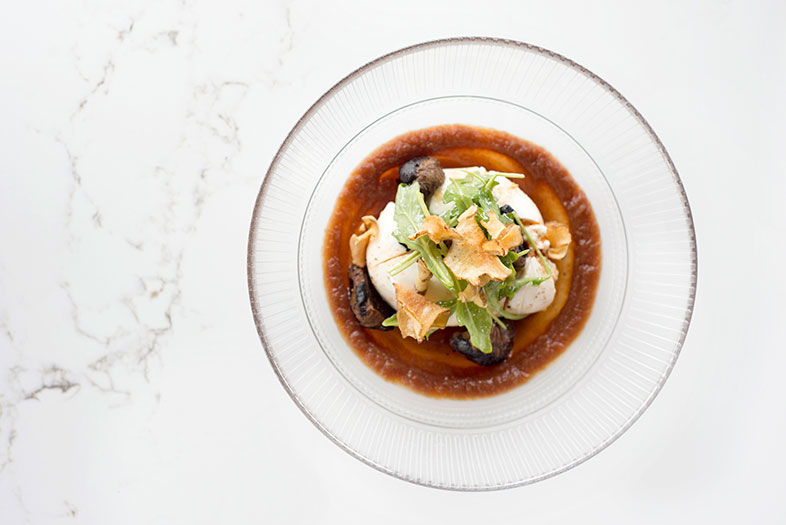
Burrata with sunchokes and apple butter
That’s why wood-burning restaurants—from Otium in LA to Lilia in Brooklyn—are booming across America right now. Many of the chefs behind these restaurants saw Francis Mallmann’s episode of Chef’s Table, and it hit them like a ton of hot bricks. For nearly an hour, we watched the famed Argentine chef wrestle with burning wood—to the extent that he came off like a supporting actor to the flames. It was mesmerizing on an epochal level.
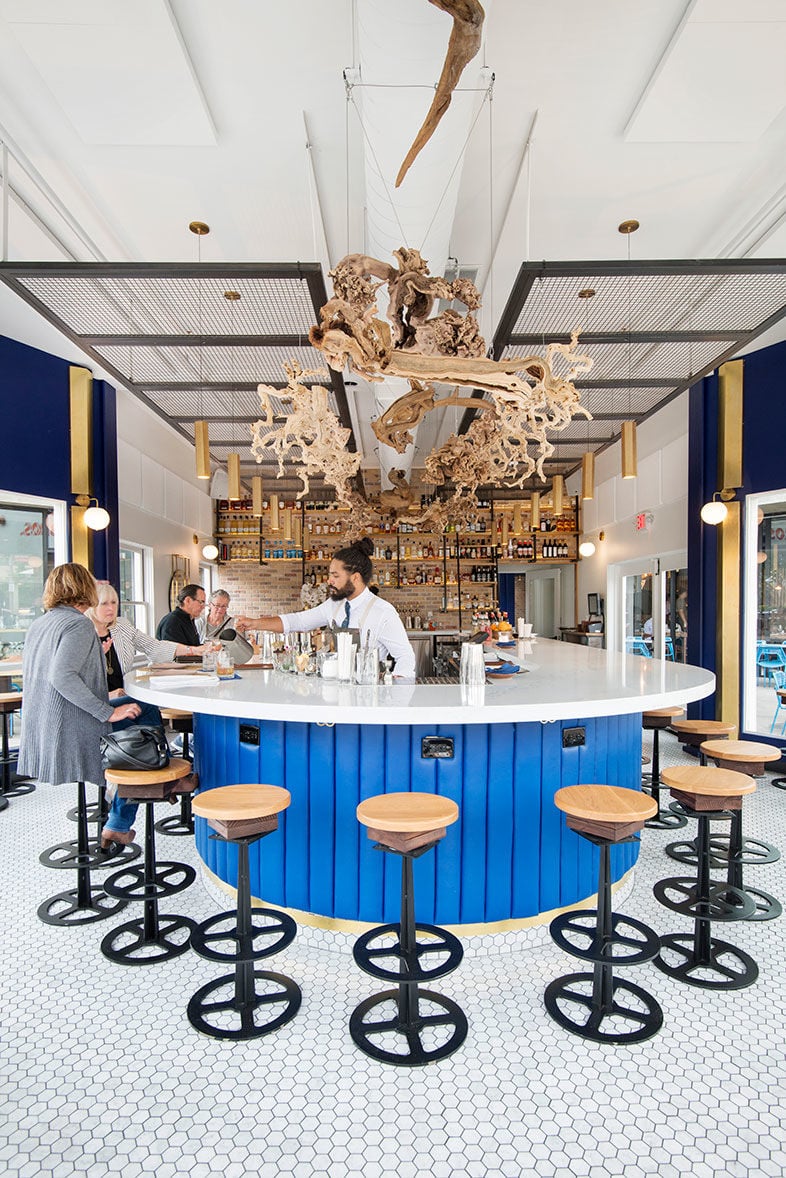
And this is the mission of Fort Oak. During its installation into a former Ford dealership on a sleepy corner in Mission Hills, the entire building facade had to be removed so that a crane could lower chef Brad Wise’s 7,000-pound grill inside. A stack of red oak logs stands 15 feet tall next to the central bar (located in an atomic-age circular space that was once a shiny showroom with freshly waxed Thunderbirds).
Fort Oak restaurant review
The bar at Fort Oak
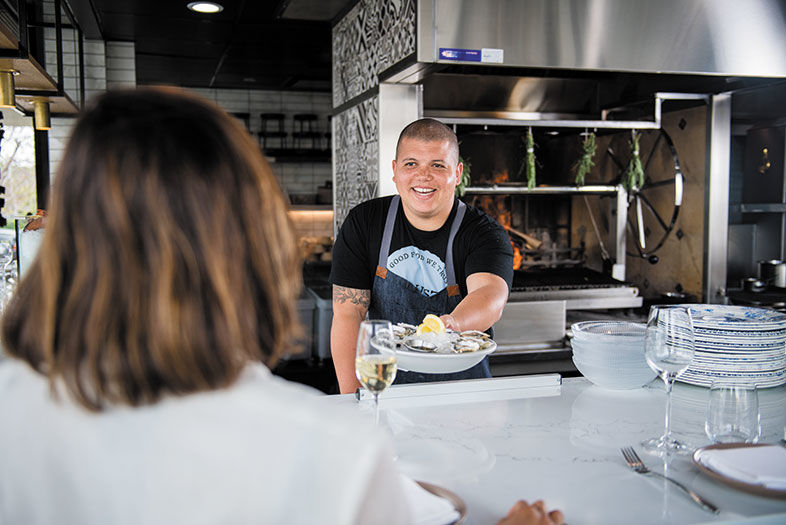
That grill—a custom Jade Range hearth with Argentine-style grates—is the star of the show at the 16-seat chef’s counter. Whole branzinos sizzle in pans on the lower grate and various vegetables and meats rest on the top grate, taking in the clean wood smoke. Long metal stakes impale pineapples and lemons, smoking the fruit for use in craft cocktails, all of which are named after classic Fords. Try the Fairlane, where gin gets a sprucing of grapefruit, lemon, and elderflower, topped with a touch of prosecco for bubbles. Or the Monaco martini, with French rum, aromatized wine, and Castelvetrano olives.
The chef’s counter is the ultimate experience here, where Wise, chef de cuisine Mark Schmitt (ex–Cucina Urbana), and team cook and plate two feet in front of you.
Fort Oak restaurant review
Chef Brad Wise in front of the custom-made grill | Photo: Anne Watson
The stools must be mentioned. They are wide, comfortable, elegant. Too many restaurants right now are crowding their counters with tiny metal stools whose comfort level is somewhere between not good and medieval torture. If given the option, however, skip the seats directly in front of the cauldron of the grill. The room’s beautiful pane-glass walls don’t open, so this summer they may need to hand out free SPF and damp towelettes.
It’s a good idea to start with the raw bar—Old Bay prawns, oysters, Jonah crab claws—and slowly nibble it through the meal as a relief, because they’re some of the only items at Fort Oak not smoked or grilled.
Fort Oak Is All About Smoke and Wood Fire
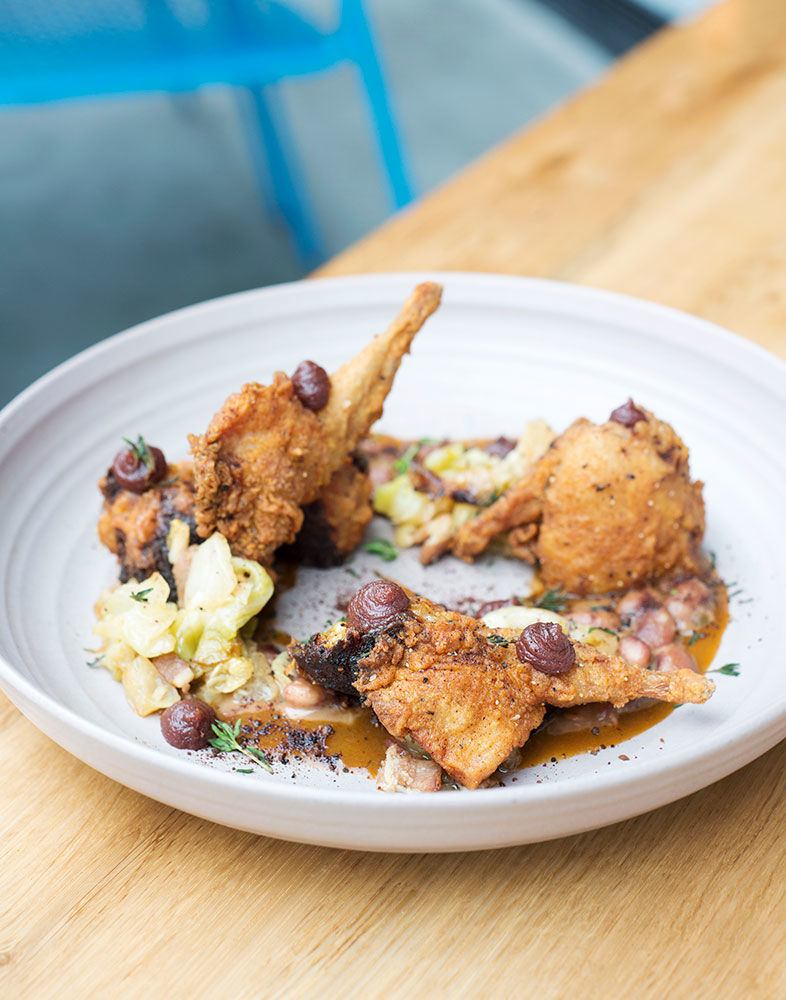
Chicken-fried quail
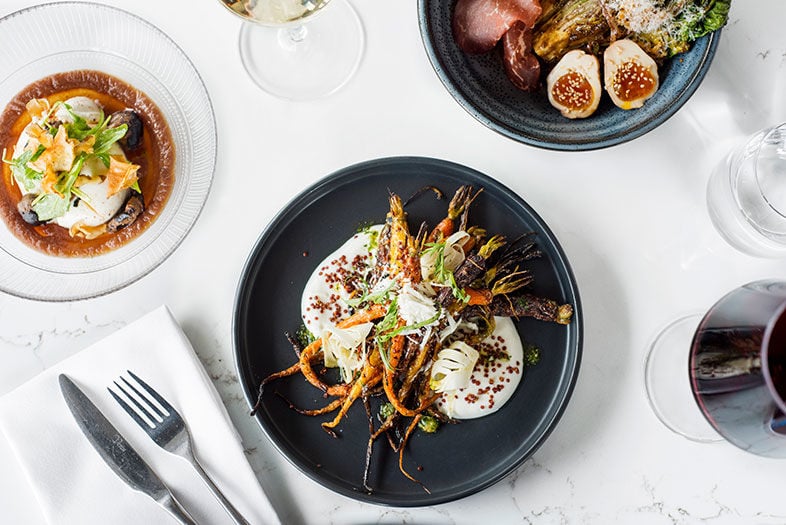
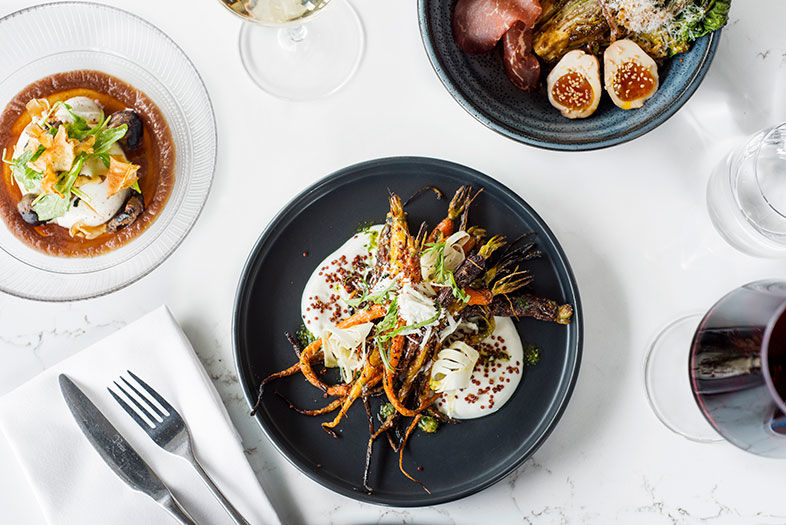
Remarkably for a chef who made his name with roasted proteins at the group’s first restaurant, Trust, it’s Wise’s plant cooking that shines the brightest. The natural sugars in carrots explode when charred, and here they’re roasted and tossed with tarragon vinaigrette, spicy pickled fennel, dehydrated quinoa for a crunch, carrot-top pesto, shaved Humboldt Fog goat cheese, and a yogurt that’s cold-smoked for five hours. That’s neck-and-neck for best garden dish with the charred baby gem lettuce, wet with a black garlic and anise dressing, saddled with housemade 90-day bresaola, a seven-minute ramen egg, shaved Parm, and Parm crisp. Also try the grilled caulilini (a cauliflower-broccolini hybrid) in a shallot vinaigrette. The fermented chili aioli—spicy, floral, with the deep umami only fermented foods can attain—makes the dish, as do the sweet-tart pops of currants.
Co-owner and general manager Steven Schwob is the other reason Fort Oak is an attraction. He was trained in fancy Vegas institutions and Addison Del Mar. He orchestrates the room like an obsessive engineer, charting to make sure all pathways are clear and the staff all move in the same direction so there’s never chaos on the floor. His servers can recite poetry about each dish, down to the farm and the cooking technique. In the current restaurant climate that’s getting rid of costly servers and going all grab-and-go, their service echoes back to an era when diners, beleaguered from work and life, could feel pampered for a couple hours.
Fort Oak Is All About Smoke and Wood Fire
Australian Wagyu | Photo: Anne Watson
The small-plate section nods to the fancy-toast generation with two standouts: an opah belly pastrami (hot smoked for four hours) with herb salad, pickled mustard seeds and egg yolk caviar; and housemade coppa ham with bread-and-butter pickles, raclette (melted cheese), and rye bread that eats like a far superior croque monsieur.
Wise is not subtle. Every dish is a flavor riot. It’s thrilling for individual creations, but can be overwhelming when ordering multiple, which the menu encourages. For instance, the clams and mussels broth (white wine, housemade chorizo) is intoxicating, but it’s served with rouille toast smothered with saffron aioli and cheese. Two steroidal flavors compete and cancel each other out.
Fort Oak Is All About Smoke and Wood Fire
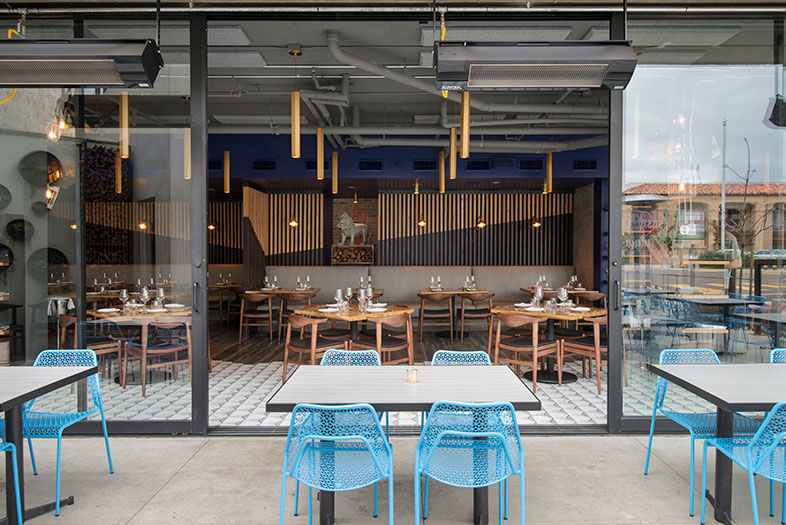
The interior dining room
That said, we try 21 dishes over two meals and, genuinely, find only one we wouldn’t gladly order again: the hamachi poke. Poke should let quality seafood be the star, the dressing a complementary accent. But the yellowtail is drowning in poke sauce made of soy, rayu (Japanese chile oil), fermented chiles, and rice wine vinegar. They’d do well to tread lighter here, and overall to have a few more bright-and-light dishes to offset the awesome roast-and-smoke of the rest.
Oh, and we have to talk about the plating of the rabbit sausage—which comes out in a coil resembling, well, a turd. Doesn’t matter how good it is with the apricot mostarda (it’s very, very good). I’m a generally unsavory person who’s hard to repulse, but this dish comes close.
At Trust, the oxtail raviolini was the swooner; at Fort Oak it’s the cavatelli—an al dente pasta made of goat milk and ricotta cheese in a white wine and truffle stock, tossed with housemade spicy fennel sausage, charred broccoli, and grana di capra (goat’s milk Parm).
Fort Oak Is All About Smoke and Wood Fire
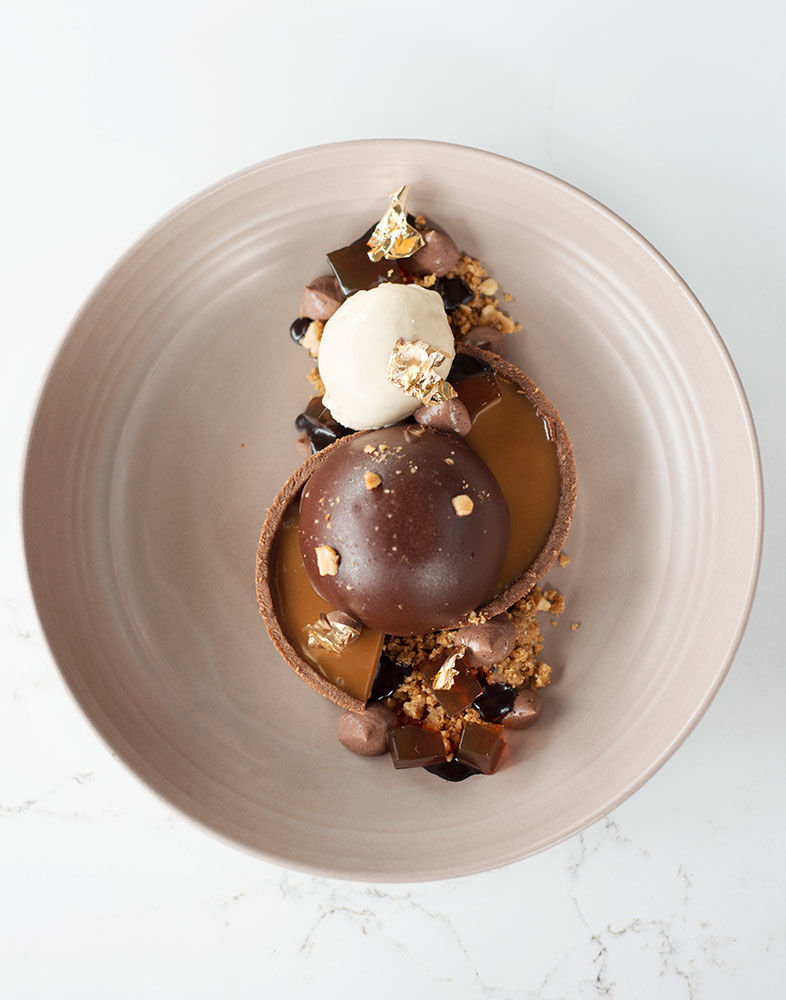
Gianduja tart
Their burrata is listed on the savory menu, but really belongs with desserts: The softball of creamy cheese rests in cinnamon-rich housemade apple butter and sunchokes—both roasted and as chips—in a citrus vinaigrette and hot honey. We demolish it in a feral, desperate way. I’ve tasted burrata prepared hundreds of ways in San Diego, and this is my favorite, even if I’d prefer they include toast points.
Fort Oak’s quail is a minor revelation—chicken fried with a curry flour and stuffed with sweet cornbread, served with pan-fried cabbage (Wise’s mom’s recipe), bean ragout, red-eye gravy using coffee from local roaster Caffè Calabria, and dusted with ground coffee and sumac. The salty, crisp fry is a perfect foil to the sweet, soft, stuffing-like cornbread and tender meat.
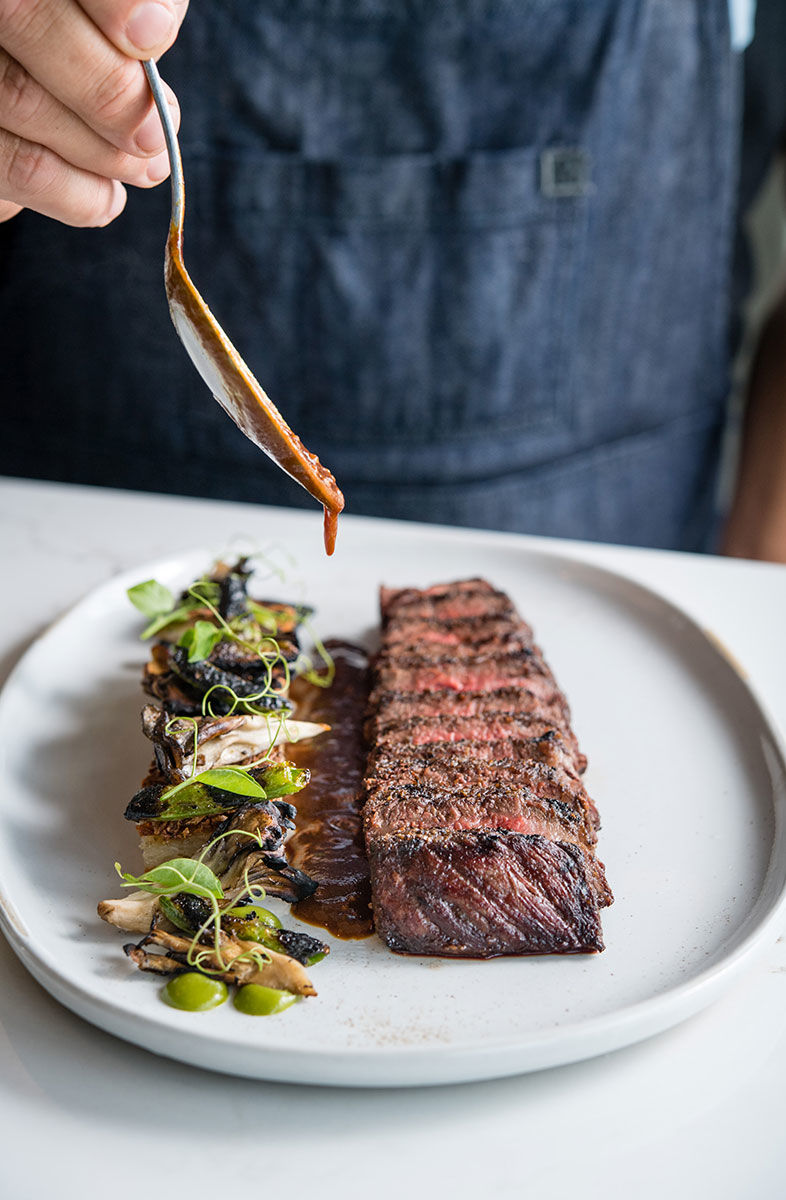
For entrées, the Australian Wagyu is worth the price ($44)—the shoulder fillet cooked perfectly rare-plus and sliced, finished with sea salt. The meat stands on its own but induces inappropriate food moaning when dipped in the sauce Robert (Dijon-infused demi-glace). A Gonestraw Farms chicken is done two ways—breast sous vide then pan-seared, leg confit in duck fat—with porcini gnocchi, coal-roasted trumpet mushrooms and a chicken demi. Pork chops are often my least favorite order, since chefs still overcook it out of outdated concern over pink meat. But Fort Oak’s is luscious and blushing, served with a sweet black garlic sauce with just the right amount of funk.
Fort Oak restaurant review
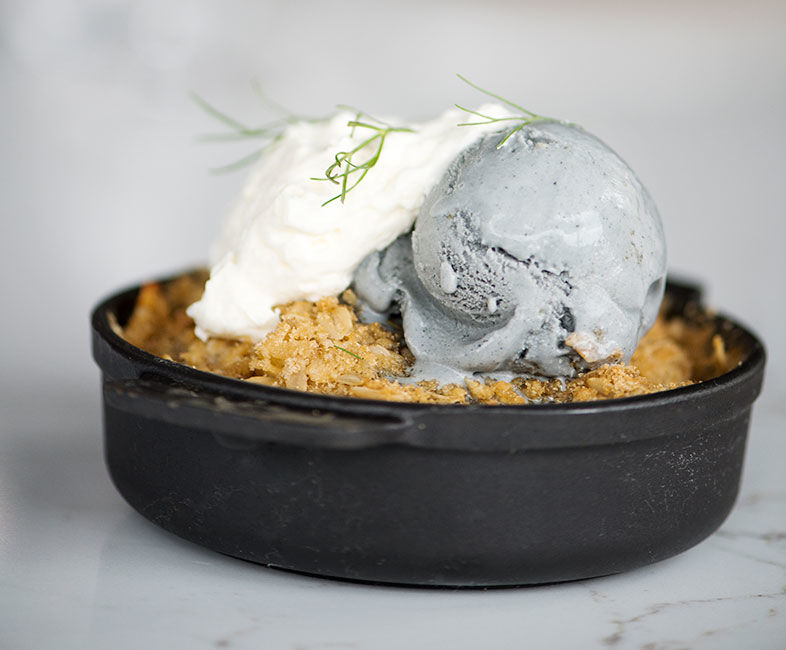
Apple-fennel crisp topped with vanilla-oak ice cream
Do not skip dessert at Fort Oak. Pastry chef Jeremy Harville is special, and shows off best with the gianduja tart—a chocolate shell filled with hazelnut cheesecake, topped with caramel gel and a scoop of banana ice cream, hazelnut streusel and coffee gelée. For something different but delicious, try the apple-fennel crisp. Granny Smiths and diced fennel are tossed in brown sugar, cinnamon, and salt, baked under an oat streusel, and topped with vanilla-oak ice cream (the heavy cream base is infused with oak embers to create a smoke-colored scoop) and ginger chantilly. They also riff on 1980s Costco star Otter Pops—fresh fruit sorbets served in those trademark plastic tubes with scissors to cut off the tops.
Fort Oak is about as good as it gets. Not just here. Anywhere. They bring a four-star skill set to a quiet San Diego neighborhood and to simple, ancient food of smoke and fire.
Fort Oak Is All About Smoke and Wood Fire
PARTNER CONTENT
Roasted carrots with smoky yogurt; charred baby gem lettuce with housemade bresaola and a ramen egg.

Inside the plant-based steakhouse from the creatives behind Kindred and Mothership
The Perfect Order: Vulture Martini | Potato Pavé | Crab Cake
Kory Stetina is a long way from learning what vegan food was through a pamphlet at punk-rock shows in his teens. He stands in his dream restaurant, Vulture, wearing a non-sportsy sports coat. He’s married with a child. There’s a very non-punk potato pavé on the monogrammed plate, the servers are in tux-adjacent attire, and this whole building in University Heights has been turned into a plant-based funhouse with formidable, obsessive style.

Despite the earmarks of midcentury continental formalism, five out of 10 people in here wear arcane t-shirts. Word got out early on that Vulture was a fine-dining experience, and while there’s a tableside Caesar and velvet curtains and soft, artful furniture, that was never the intent. Stetina had to do some PR legwork to pop the “special occasion” balloon that floated over the project—another collaboration between himself and Arsalun Tafazoli of CH Projects—and it seems to be working.
One of the t-shirt people I recognize: Justin Pearson of The Locust and Three One G Records. A thoughtful and progressive punk force in SD, he’s seated at a corner table with individuals who look like they’ve at least dabbled in if not dedicated their lives to graphic design and can casually play a theremin near a rare fern. Vulture captures that same dinner-party-for-creative-people mood that the Middletown bar Starlite first brought to the city.

It’s a place for grown-up punks, for ideas and ideals.
(Obtrusive but important note about punk rock and plant eaters: The rather genuine punk music of the 1970s and ’80s that eventually birthed Green Day and Nirvana and even, I guess, My Chemical Romance emerged from a philosophical and creative instinct to challenge status quos, which often meant expressing unpopular and political opinions in an excessively loud and urgent manner—pretty much exactly what Simon & Garfunkel were doing but far more invigorating and annoying. There were plenty of bands who got big because they had great hair and a good producer; there were other bands who got cult-famous based on the holy-wow way they expressed uncomfortable ideas, making people question the way they lived. Eating only plants was a part of this live-different worldview, and, like any good movement, it got co-opted by the tad too righteous, moral, and shame-mongery. It should be said that Stetina made his name in San Diego by being a philosophical vegan who’s un-mongery.)

To get to Vulture, you enter through Dreamboat, a well-lit, bright, Mr. Clean-ish, ’60s-era, plant-based, romantically American diner that’s all white and chrome and charm—poodle-skirt notions and connoisseur coffee and smoked potato latkes and Impossible burgers and baked goods and milkshakes and cocktails. Seating occupancy: one-and-a-half people on Ozempic (fine, it’s 10).
In the back corner of this tiny diner is an antique host stand. The host takes you through a velvet curtain, down the short hall, and through a door, until you enter into, what?

Some will call it a speakeasy, but it’s really just a fun surprise restaurant (“speakeasies” do still exist, but they’re not on OpenTable, and almost everyone with a project they call a “speakeasy” will, on their most honest days, admit it’s not a speakeasy).
You’ll step into cavernous, amber-glow, lava-lamp darkness. So, the first experience Vulture offers all of us is temporary blindness, followed by the opportunity to behold the shockingly slow ability of human eyes to adjust to radical shifts in light. The music is on point, a mix of obscure indie tracks and guilty-pleasure soft-rock bangers. Thanks to listening bars, restaurants have become the stereo-system showrooms of America. Remember that guy in high school who one day showed up with box speakers in his trunk and a $6,000 head unit, an amp, subwoofers, and EQs, and his car sounded like Dr. Dre’s and Rick Rubin’s place of business? That guy is restaurants.

Troy Johnson is the magazine’s award-winning food writer and humorist, and a long-standing expert on Food Network. His work has been featured on NatGeo, Travel Channel, NPR, and in Food Matters, a textbook of the best American food writing.
After two decades of work and four years of waiting, the Carlsbad restaurant's opening came with a big splash
It had been open six weeks when it got the Michelin star. At six weeks, a restaurant is a newborn. Newborns wail and struggle to breathe. They’re cracking open their first panic attack. Nine months in the flotation tank of the mom spa, then—blammo—the landlord shuts off the water and fairly traumatically evicts them into a drafty world that has no clue about mood lighting.
It’s old food critic wisdom that restaurants need six months to get running and ready for real analysis. Crew members will have lied on their resumes, narcissists will find themselves bored, the strangely emotional demands of diners will break newbies. It’s a fresh organism dedicated to executing nightly public theater, and it takes time for all the parts to learn how to operate as a fluid whole—develop mutually beneficial roles, nail the timing, speak the unspoken language.
Granted, the team at Lilo in Carlsbad aren’t newcomers, and they’ve had way more time than they ever wanted to plan this out. Plus, the partners—restaurateur John Resnick and chef Eric Bost—helped earn their restaurant across the street, Jeune et Jolie, a Michelin star (and they run its raved-about sister restaurant, Campfire, down the block).

“We’re lucky,” Resnick says. “About 80 percent of the people on our team, we either worked with immediately or they came back because they were excited about this project.”
The project is a 22-seat, tasting menu–only restaurant featuring Bost, longtime chef de cuisine Dusan Todic, wine director Savannah Riedler (formerly of Post Ranch Inn and two-Michelin-starred Saison), and beverage director Andrew Cordero (Jeune et Jolie and Campfire). It’s four years in the making. When a 10,000-square-foot building became available on State Street in 2021—the last of its kind on one of Carlsbad’s most up-and-coming drags—they jumped at it. The plan was to build a massive all-day restaurant (Wildland, now open) and, behind it, tiny Lilo, where they could showcase what their vision of the ultimate San Diego dinner experience could be. It’s the kind of James Beard Award and Michelin bait that ambitious restaurateurs dream of and makes basic sense when they have a chef-partner like Bost.
“Campfire and Jeune—from the time leases were signed to opening doors—took about 12 months,” Resnick says. “So I kind of felt like, alright, 18 months should be doable.” He pauses. “It was not.”

At that time, the pandemic was still slowly releasing its chokehold. Supply chains had been shot with a billion tranquilizer darts. Building two restaurants at a time while exhibiting a noble American amount of ambition was no picnic. The week after the project finally broke ground, the construction lead on the project—“the only person more essential to the buildout than us as owners,” Resnick says—departed. A fun idiosyncrasy of construction in North County is that most contractors live 40 minutes away and prefer freelance gigs closer to home. So, finding help was hard. Plus, a new ordinance had been passed in Carlsbad since Resnick opened his first two restaurants.
“I was down in Baja having lunch when I got an email about needing a ‘minor site development plan,’” Resnick remembers. “I was like, ‘Well, it’s got the word minor in it; it’s probably not a big deal.’ That one thing added nine months to the project.”
Project costs ballooned. Hems were hawed. The buzz on this project had been loud, and now the scene wondered and whispered. I ask Bost and Resnick if there was a time they considered giving up or drastically reducing the vision.
“It came up, yeah,” Resnick says. “At the end of the day, it was a ‘the only way out is through’ type of thing.”
They thought they’d launch in July 2023. The doors opened in April 2025.

For Bost, the unveiling of that restaurant was especially redeeming. In 2020, he’d lost what felt like everything. He’d spent 20 years working his way through some of the world’s best kitchens: Le Cirque, The Ritz-Carlton in St. Thomas, Alain Ducasse, and both The Lodge at Torrey Pines and The Inn at Rancho Santa Fe in San Diego. He hit the top when he was named executive chef for Guy Savoy, launching the famed French chef’s elaborate Vegas restaurant and then overseeing his places in Singapore. In 2017, ready to do his own thing, he returned to SoCal and spent two years developing the idea for his dream restaurant. He finally opened his unpretentious tasting-menu place, Auburn, in LA in 2019.
Troy Johnson is the magazine’s award-winning food writer and humorist, and a long-standing expert on Food Network. His work has been featured on NatGeo, Travel Channel, NPR, and in Food Matters, a textbook of the best American food writing.
The Middletown restaurant reminds us that when you invent something as iconic as the taquito, you’re allowed to rest a bit on your laurels
Every year for the Best of San Diego issue, we ask readers to nominate and vote for a San Diego classic restaurant they want food critic Troy Johnson to review. Whichever they vote for, he goes. Last year, they sent him to Rocky’s Crown Pub. This year… Mexican classic, El Indio.
The Perfect Order: Taquitos with Everything | Chicken Tamale | Mordiditas
When you’re credited with inventing the entire concept of the taquito, pretty much every other dish you create is going to pout in that cigar-shaped shadow. Unless you sous vide a couple narwhals, the taquito is gonna dominate your story.
San Diego’s El Indio is widely cited as the global birthplace of the taquito. (Note from our nonexistent legal team: Like any food origin story, it’s contentious—many will tell you a small, rolled taco had been a staple in Mexico for generations; others claim an LA taco stand beat SD to it. But by and large, El Indio has been granted paternity for the word “taquito” and cited as the first in the US to both sell and widely popularize the iconic thing—which happens to fit our narrative nicely, so we’re leaning in.)
So, El Indio’s mordiditas are that almost-famous entourage dish that deserves more applause. Sliced segments of taquito, about the size of pigs in a blanket, are assembled in a heap on a plate and absolutely waterboarded with nacho cheese and pickled jalapeños. They’re essentially loaded taquito nachos, an idea whose glory, in a just world, will outlive us all and echo in Valhalla. They solve a longstanding problem with every single batch of nachos that has been made in humankind—that each and every chip is denied an equitable amount of cheese or load.

Most nachos are built as an altar to American capitalism: The top couple of chips accumulate a vast majority of the cheese and the rest of the chips just keep hearing rumors of a trickle-down until they protest. If our species ever gets cut from the roster of the universe, the fact that we put a man on the moon but could never equally dress our nachos should be examined by our successor species as a possible cause.
El Indio’s taquito rubble comes in a biblical flood of nacho cheese. It’s a snack-bar treat for people whose therapists have listened to their fantasy of placing their open, eagerly receptive mouths beneath the queso pump—albeit with far better taquitos made from scratch.
The dish isn’t gonna knock your socks off, but it’s satisfying in a calorie-gargling way, a celebration of the fact that merely entering a taco shop releases us from acknowledging the physical limits of human arteries. Would El Indio’s mordiditas be better if the cheese was scaled back and partnered with a crema, or if the cheese was lovingly dirtied with chipotle in adobo, or if they came topped with a lawn-sized pile of cilantro and onions and activated charcoal ash from the sacred cenotes of Chichén Itzá? Shut up and eat your naquitos.

It feels simultaneously excessive and absolutely correct to say El Indio is a San Diego legend and global food icon. In 1940, Ralph Pesqueira Sr. was working in one of the many aerospace headquarters that surrounded Lindbergh Field (the SD International Airport’s original name), building planes and war machines. As a side dream, he started making and selling fresh corn tortillas by hand on the corner of Grape and India Streets.

As with most food success stories, there was a key moment of technological innovation (consider In-N-Out’s invention of the two-way speaker or Pizza Hut introducing online ordering to the pie masses). Around 1945, Pesqueira—who we might call the Thomas Edison of Mexican food—invented San Diego’s first tortilla-making machine. By hand, he could whip up 30 dozen a day; with the machine, he cranked out 30 dozen an hour. A full-fledged tortilla factory was born, the effect of which was massive for putting training wheels on the local Mexican food culture that would boom decades later.
When aero coworkers asked him if he could make a handheld, good-travelin’ food for lunch pails, he thought of flautas (a Mexican staple with global roots—a flour tortilla usually wrapped around meat and rolled into the shape of a flute, then fried).
He did a smaller version with fresh masa corn tortillas. The taquito entered the world. He sold each for 18 cents.

Troy Johnson is the magazine’s award-winning food writer and humorist, and a long-standing expert on Food Network. His work has been featured on NatGeo, Travel Channel, NPR, and in Food Matters, a textbook of the best American food writing.
Yes, Chef! winner Emily Brubaker leads the robust culinary program at Omni La Costa Resort & Spa
For Executive Chef Emily Brubaker, Omni La Costa Resort & Spa feels like home. She grew up just a mile-and-a-half away from the 400-acre property and fondly recalls walking the golf course perimeter as a kid. Though her ambitions led her away from San Diego for nearly two decades in which she honed her craft in some of the highest of high-profile Las Vegas restaurants—including triple Michelin-starred Joël Robuchon at MGM Grand—they ultimately brought her back to North County.

Today, the classically French-trained chef, who’s fresh off a victory on NBC’s Yes, Chef!, judged by Martha Stewart and José Andrés, oversees Omni La Costa Resort & Spa’s seven distinct dining concepts. Her goal is to elevate the resort’s culinary program with her creative, hyperlocal ingredient-driven approach while maintaining the Spanish- inspired flavors and fresh California coastal cuisine that are the bedrock of its culinary identity.
“The San Diego food scene is really growing, and in North County alone, it’s really exploded in the last five years,” Brubaker says. “There are Michelin stars, beautiful tasting menus, craft bakers, and all this food—when I was growing up in La Costa, it was fish tacos. Now there are really cool things popping up, and I’m so happy to be here to see where it’s going to go.”
Brubaker gives chefs de cuisine at each individual restaurant autonomy, however, her influence is evident across the resort.
For example, lobby restaurant Bar Traza serves as Omni La Costa’s culinary centerpiece and features bold Spanish flavors in a lively, social atmosphere. Brubaker overhauled the menu to be more consistent and centered on casual bites with that signature vibe. Think smoky paprika, vibrant citrus, and Spanish meats and cheeses.
At VUE, the focus is on seasonal offerings, California coastal cuisine, and Baja-inspired dishes. She and Chef de Cuisine Cameron Dixon change the menu biannually, which heading into summer, will highlight farm-fresh produce and hyperlocal ingredients—the resort even has its own herb garden and honeybee hives.

Poolside dining options are leaning into the country’s 250th this summer with a selection of classic American dishes with an Omni La Costa twist. And Bob’s Steak & Chop House (Brubaker is a trained butcher) offers a classic steakhouse experience with elevated service.
The chef and company also plan menus for special events at the resort where her creativity can really shine. For an upcoming National Ski Association dinner, the banquet hall will be transformed into an Alpine-themed winter wonderland complete with a snow machine, savory sausages, and melty, decadent raclette. A recent dinner was built around the Carlsbad Flower Fields and each course was matched to a color of ranunculus (Did you know pink dragonfruit are grown in North County? You do now.).
“It’s my zen to be in the kitchen playing with food,” Brubaker says.
Omni La Costa’s culinary program is a key part of the resort experience. And with Brubaker’s leadership, it’s becoming a draw for visitors and locals alike.
“These aren’t just hotel restaurants, these are restaurants that you should go to. They’re destinations, and I’m really hoping for the future that’s where we’re going,” Brubaker says.

Brubaker is also channeling her experience on Yes, Chef! into the culture at Omni La Costa—more emphasis on teamwork and collaboration, empowering her staff to share constructive critiques, and embracing different perspectives. Alongside her leadership role, Brubaker has become an advocate for mental health in the hospitality industry, serving as chief ambassador for the Burnt Chef Project and serves on the Board of Advisors for the Apex Culinary Program, where she mentors and develops future talent.
For more on Omni La Costa Resort & Spa and its dining program, please visit omnihotels.com/hotels/san-diego-la-costa.
Food critic Troy Johnson heads to Juan Jasper Kitchen & Wine, an eminently lovable and literal hole in the wall in his latest review
The Perfect Order: Wedge Salad | French Fries | Steak of Choice
Don’t come here.
If you do, locals will TP my place of residence. If you’re going to go, go at 4 p.m. If someone waddles over in their bathrobe with that feral need-a-steak look in their eyes, consider offering your seat as a tribute to their OG-ness. Or maybe they’ll sit on your lap. This feels like the kind of place where strangers become fast, lap-sitting friends.
Juan Jasper Kitchen & Wine isn’t a restaurant as much as it is a porch with a stove, a pop-up that stayed popped. It’s a granny dining flat in Golden Hill, a clubhouse with ribeyes and wine. It started with the old-school butcher shop next door, Sepulveda Meats & Provisions. Opened in 2016, Sepulveda is run by John Sepulveda and his nephew Nick Swing.

The shop serves the regional gold-standard Brandt beef (drug-free, source-ID’ed, ethically raised) in all its forms and in various marinades (prime cuts and off cuts, pâtes, bones, tri-tip, carne asada, sausages, ground beef, the whole meat rainbow), plus chicken and quail and turkey and pork and all the things, including housemade pastas and sauces. The sausages are local folklore, made fresh every Thursday (try the jalapeño-cheddar). Like The Wise Ox in North Park, the family-run joint is basically a house of high-quality protein consultants offering recipes and tips and tricks to people who know them by name. Indie butcher shops are a classic, more human American art form (with deep German immigrant roots) lost to the efficiencies of bulk grocering.
When the hairdresser beside Sepulveda closed, the team cut a hole in the wall, ripped out the salon chairs, and essentially built a test kitchen for the butchery’s array of goods. Named Juan Jasper in honor of the owners’ fathers, it quickly became the mighty, DIY meat-and-wine bistro that local food people tried to keep secret.

It doesn’t have a phone number. No reservations. It doesn’t take credit cards—only Venmo or whatever “cash” is. At some places, you can rack up credit card points. Dine at Juan Jasper, and I’m pretty sure Amex deducts some.
It’s got one-and-a-half seats that masquerade as 20 or so, and it seems everyone—owners, cooks, servers, guests, dogs—lives in the apartment complex across the street, sharing sourdough starters, reverse-sear tips, and a love for Gavi wine and a screamin’ deal on good food. Some hyper-local spots like this can give off a get-off-my-lawn wariness to outsiders (hi there, Rocky’s Crown Pub), but Juan Jasper is friendly as hell. As if you were invited to crash the dinner party of a family who truly gets along and isn’t trying to salve deep generational trauma with taco night.

We show up at 4 p.m. on a Wednesday, and we have to hurry for a seat. By 5 p.m., servers are bringing folding chairs onto the sidewalk for the crowd that’s patiently waiting. A man carries out an extra table, slaps a not-serious tablecloth on it, and makes room for a couple more.
Whoever’s doing the wine list knows a thing or two and doesn’t care for the usual suspects, which is what you want out of a wine bar (the thrill of discovery). There are Gavis and roussannes, Blaufränkisch (a great chilled red from Austria), a red from Palestine (baladi grapes). And the staff raves about them in detail and without pretense.

I’m not sure I’ve come across a more down-to-earth, likable, knowledgeable staff. There’s a certain “sit; chill; life’s pretty decent” that radiates from people when they genuinely dig working at a place. Solare in Liberty Station’s like that. Not since our dear, departed Cafe Chloe in East Village has a restaurant exuded so much plucky, open-arms charm. Chloe was San Francisco chic, had that art-major touch.
Juan Jasper’s charm is more “emotionally available dad in Home Depot.” You see it in the antique plates with floral patterns, in the wine bottles that have been turned into candle lamps for the outside tables (there are no inside tables, just a counter in front of the cooks). You see it in the photo of a dad teaching his son to pee on a side road (the manager’s dad and brother). Walking to the restroom, you often have to do the hands-up, “not trying to get fresh here” scoot.

Juan Jasper changes the menu just about all the time but keeps some local favorites on there pretty consistently, like the deviled eggs with chorizo made in-house at Sepulveda. The ones that hit our table are nice, but they’re served a tad too cold and missing something. That something is definitely acid.
The “devil” in deviled eggs has always been the mustard—the note that stings in the right ways; puts some welcome sado in the mouth masochism; offsets the big, fatty bass notes of eggs. This is why eggs are almost always better with hot sauce (or ketchup if you’ve got middle-America glory in your heart and you’re kinda nasty), because they need that foil. It looks like the arugula below is decorative, but it helps to eat the eggs with a few leaves.

There are always daily specials up on the board. The day we were there, a cook (formerly of Nolita Hall) had whipped up a skin-on mackerel filet with blistered tomatoes and chili oil on charred toast. Mackerel’s an oily little sucker, which can make it taste a bit too proud of its own musk. But this is perfectly done.
The wedge salad? One of the best I’ve had, and it is absolutely because of the decadent, slutty lardons on top (and the dressing). I’m not a wedge guy, mostly because iceberg lettuce has been bringing near-zero flavor or nutrients to the table for far too long. It’s the LaCroix of lettuce, and we’re implicit in its slacker brassica success because “it’s crunchy” and makes a cool sound when we eat it. Iceberg slow-quit us years ago and did some light embezzling and we’re still inviting it to the company Christmas party.

But I’ll order Juan Jasper’s every time. It’s more of a “loaded” wedge, with thin-sliced red onions, tomatoes, croutons, huge chunks of blue cheese, and a rough-chopped spice blend (a sort of Juan Jasper furikake or everything bagel seasoning that’s on a lot of dishes). Does the kitchen put too much blue cheese dressing on it? You bet. Know what a decent solution for that is? Scraping some off. But those lardons—thick, tender nubs of perfectly smoked pork—are party drugs.
The house-cut Kennebec fries are dreamy: sturdy and showing some skin, but fluffy on the inside. The fry scene is pretty evenly split between steak and shoestring, and these are the truce in the middle. They’re salted as fries should be—to aortically concerning levels.

The corn and shrimp fritters are more corn and shrimp than fritters, and the moisture content of both of those things makes the interior a tad soupy rather than fluffy. But the poblano sauce underneath is a floral beaut.
Juan Jasper’s burger patty is phenomenally good, made from the ribeye and NY strip trimmings next door at the butcher shop. Order it however you enjoy your quality steak— pink, leaning bloody. If you prefer quality steaks well-done, consider corrective surgery. The burger is a Spartan thing, just a potato roll bun and melted gouda, served floating in an infinity pool of Bordelaise. It’s excellent… save for the bread. Juan Jasper is house-making the potato roll. Noble spirit and effort, but it’s a little airy—and a patty that special deserves an equally special co-host.
Is Juan Jasper the apex culinary menu in San Diego? No. Is the food pretty effing good and the vibe immaculate, and do the people and neighborly pricing make it taste like 13 Michelin stars? You bet. Juan Jasper is not a secret. But it sure as hell feels like a shared one. I’d eat here a thousand times out of 100.
Troy Johnson is the magazine’s award-winning food writer and humorist, and a long-standing expert on Food Network. His work has been featured on NatGeo, Travel Channel, NPR, and in Food Matters, a textbook of the best American food writing.
Some of San Diego’s top food and drink minds riff on Cold War classics at Point Loma’s newest hotspot
The Perfect Order:
Deviled Eggs | Grilled Oysters A La Rockefeller | Jidori Chicken Kiev
I want a deviled egg shop. I would only visit that shop once a year, because deviled eggs are a deeply enjoyable food that bring a flood of best memories and briefly resuscitate your long-gone grandma, then, after one full serving—like a candy corn—you need to not see again for another 364-and-a-half days. But life would be better knowing this bistro existed (even if it was forced to become a money-laundering drug front to survive), because a solid deviled egg is a big bang of American happiness.
In absence of that, I’ll take Ponyboy. It’s less a restaurant than a poolside dinner party and R&D space at The Pearl Hotel in Point Loma. And it’s the debut of what could be the city’s next great restaurant group: Service Animals, from longtime San Diego drinks man Ian Ward (hailing from three-Michelin-starred Addison) and chef Danny Romero (also ex-Addison, plus opening chef at Wormwood and a guy with a great pop-up dinner concept, Two Ducks, with his brother Dante). They launched Ponyboy with chef Josh Reynolds (Wormwood), former Addison sommelier Kyle South, and hospitality expert Patrick Virata.
The heart of the concept is neo riffs on 1950s-era, moon-landing Cold War food and drink: TV dinners and stroganoffs and ambrosia and an absolutely remarkable chicken Kiev. It’s the cuisine of greasers, socs, Julia Child, MFK Fisher, duck-and-cover drills, low-grade nuclear paranoia, and Jell-O proliferation.

Cured in beets and hibiscus, Ponyboy’s deviled eggs (served on a bird’s nest of dried noodles) are the color of Crown Royal bags. Inside is a light, dreamy payload of traditional deviled-egg mousse whipped with pistachio praline, then topped with candied pistachios and a sprig of watercress. The flavors are incredible, and it’s a visual treat that looks like Easter around Salvador Dalí’s pool. The eggs do lose something with the psychedelic prettifying, though; either due to the curing liquid (salt dehydrates and hardens proteins) or because they’re a tad overboiled, the egg whites are vaguely rubbery. That said, if the ass-end of pencils tasted this good, I’d eat them with enthusiasm.

The drinks menu belongs at a backyard pool party to celebrate dad’s promotion to General Motors middle manager. It’s filled with dreamy tropicalism, which dominated cocktails in the ’60s because that’s when commercial air travel in the US took off.
People came back from trips to Hawai‘i and tried to replicate that mystical wonder through happy hours. Boozy tiki culture escapism was a guiding social light. So Ponyboy has banana daiquiris, Mexican Firing Squads, Singapore Slings, Bahama Mamas, and Pink Squirrels. Ian Ward is one of the most thoughtful, accomplished drinksmen in the country, so this ranks as one of the best poolside bars in the city now.

The team pilfers the Great Receptacle of Unduly Ignored Wedding Gifts and brings fondue for two tableside—a large ceramic pot painted with grandmotherly love and burbling with gruyère, aged white cheddar, Parmesan, wine, and a touch of sodium citrate (science’s great contribution to cheese society, it helps fromage stay smooth), served with roast vegetable crudo and bread from the fantastic upstart Companion Bakery. It’s exactly as you think it might be. “Pot of cheese” is the culinary precursor to Xanax; it eases all moods (even if staring at the nutritional realities of that much burbling dairy does sting the Pilates part of you).

Ponyboy serves an ambrosia salad. The lack of fruit salads in modern America continues to be a gross injustice. Remember when we discovered fruit in the 1980s? Every self-respecting potluck and party had a fruit salad. Not having one was like not having a carving station at your brunch buffet or low-key disappointment at your gender reveal party.

Ambrosia’s a classic Southern dish that showed up in the late 1800s when stores realized people would buy fruit despite the fact that it grows on trees. The original recipes were pretty much just three layers: orange slices, coconut, and sugar. In Greek mythology, ambrosia was the food that gave the gods their immortality. Without it, they became weak, and mortals would allegedly die if they ate the gods’ ambrosia. Old gods are brutal. Over the years, ambrosia got a bad rap because people made it like the lovably malevolent “fruit” “salad” that my mom brought to every party in the ’80s—just a bunch of fruit-in-corn-syrup cans dumped into a bowl with tiny, multicolored marshmallows… one part nature, six parts prediabetes.
Not in the business of slow-murdering my whole youth soccer team and their parents, Ponyboy’s recipe is different. The restaurant gives mandarins, fig, pomegranate, and coconut a light tossing in lime zest, melted marshmallows, Tajin, and mint. The fruit is in-season, with hints of chiles and herbs. What a treat.

If you’re going to do astronaut-glory-day food, Jell-O is required. It shows up as the centerpiece of the fisherman’s-catch ceviche (Ponyboy is one street over from the sportfishing docks, and star fishmonger Tommy Gomes brings over fresh arrivals from the dock behind his fish shop, Tunaville).
Admittedly, “seafood Jell-O” sounds like something they’ll serve on the last boat remaining after sea levels swallow life as we know it and the last chef standing is just trying to bring a little joy to the sopping-wet final bow of humanity (and managed to evade the aquapocalypse with some agar agar in tow). But it is excellent. The local catch of the day (rockfish, sometimes, or vermillion) is brined and cured in lime juice and tossed with pickled onions, avocado-chive oil, and borage flowers (a cucumber-esque edible). In the middle, molded in a canelé, is Clamato Jell-O (seasoned with charred shallots and cilantro). It doesn’t eat like a gimmick; it adds a fresh acidity and that famous texture. If you’re experiencing fear, think of it like the shrimp in your loaded bloody mary or remember the tons of other seafood dishes throughout history that have included a gelée.
The oysters “Rockefeller” should be called “Rajafeller.” They’re grilled, then loaded with Mexican rajas—roasted and stripped poblano peppers and crema with spinach, lemon, and crispy leeks. With all due respect to the iconic dish, this is far better and perfectly Californian.

Not all is flawless. Getting to the root of why the local tuna “casserole” unsettles me may require light therapy. Sashimi-size medallions of raw local tuna are seared and crusted with potato flour and plated with hot Parmesan tagliatelle and a tomato-tuna sauce (which is traditionally served in vitello tonnato). Maybe it’s because I was expecting a true casserole (which is dumb, given the playfulness of the group), and my disappointment about not getting a misshapen square of molten Betty Crocker doesn’t allow me to appreciate its deconstructed charms. Or perhaps the problem simply lies with this dish’s base phrase: “hot noodles, cold fish.”
The Baja riffing also takes the stroganoff into a wildly different planet than the classic dish.
The word “stroganoff” sparks a simian craving for meat, mushrooms, booze, broth, cream, and carbs—all hearty, bass-note flavors. At Ponyboy, a barbacoa rub brings sweet baking spices such as allspice and cinnamon to the party. It’s like expecting an everything bagel and only realizing it’s cinnamon raisin after you bite it: not bad, just jarringly misaligned with the dish you remember accidentally dripping onto Grandma’s crocheted tablecloth.

The undisputed star of Ponyboy’s show is the chicken Kiev, a dish once so popular that it was manhandled and reputationally destroyed by every cut-rate, dull-knifed diner cook. Ponyboy brines Jidori chicken breasts, pounds them out, then makes a truffle butter with real Perigord truffles. The chicken is wrapped around that compound butter to form a roulade, then it’s dredged in egg, flour, Dijon, and panko; deep-fried to a perfect golden brown; and topped with chives and a pipette of reduced chicken jus. It’s served over Robuchon potatoes with roasted veggies. It’s gotta be up for dish of the year.
If you’re going to lean into retro kitsch, lean hard. Get the tattoo. Ponyboy does, and the result is a hell of a good time, backed by some of the top food and drink minds in the game.
Troy Johnson is the magazine’s award-winning food writer and humorist, and a long-standing expert on Food Network. His work has been featured on NatGeo, Travel Channel, NPR, and in Food Matters, a textbook of the best American food writing.
San Diego Magazine's 2026 Guide to Balboa Park.
Balboa Park is San Diego’s cultural heart.
The iconic 1,200-acre preserve’s history dates back more than 150 years, evolving from a scrub-filled plot atop a mesa overlooking what’s now Downtown to an urban oasis—the largest of its kind in the country—filled with an array of museums, attractions, gardens, trails, restaurants, and more. Balboa Park is an epic playground where San Diegans and visitors alike can experience the great outdoors just as easily as they can enjoy a world-class performance or explore groundbreaking discoveries.
Tucked away in the Spanish Colonial Revival-style architecture are 18 diverse museums that allow visitors to spend the day learning about, well, anything. A great place to start is the San Diego History Center. Located in the Casa del Balboa building, the museum tells the story of the city’s past, present, and future through photographs and art, clothing and textiles, and interviews with people who witnessed history-making events firsthand. The San Diego Natural History Museum takes visitors even farther back with interactive exhibitions that show what the region was like up to 75 million years ago.
Blast off on a simulated trip to space at the San Diego Air & Space Museum, then check out artifacts from aviation legends, including the Wright brothers, Amelia Earhart, and Buzz Aldrin. Discover new perspectives revolutionizing the science world, learn about an often overlooked but overutilized utility, and exercise your creativity at the Fleet Science Center.
Calling all theater-lovers, Balboa Park has something for you, too. The San Diego Junior Theatre will present their musical take on beloved children’s book A Bad Case of the Stripes from June 26 through July 12. And laugh, cry, and marvel in awe as the pros of The Old Globe perform Kim’s Convenience, the award-winning comedy that inspired the popular series, from May 15 to June 14.
There’s nowhere else in Balboa Park quite like WorldBeat Cultural Center. The institution celebrates African diaspora and indigenous cultures around the world using art, music, dance, and education. The building, a renovated water tower covered in colorful murals, houses a performing arts center, museum, gift shop, cafe, and outdoor classroom.
If you’d like a side of nature with your culture, Balboa Park has you covered there, too. Stroll through the gardens of the Japanese Friendship Garden & Museum, a monument to the relationship between San Diego and its sister city, Yokohama, Japan. Inspired by traditional Japanese design dating back centuries, the 10-acre respite features a living exhibition that showcases plants native to both cities.
If there seems like a lot going on in Balboa Park, it’s because there is. Let the Balboa Park Cultural Partnership be your guide. The organization is the umbrella for 24 of the park’s institutions and offers an Explorer Pass that allows visitors to access multiple museums for one affordable price. The hardest part is picking where to start.

Save on admission to San Diego’s top museums with the Balboa Park Explorer Pass. Explore 16 museums of art, science, history and culture across Balboa Park — all with one affordable pass. Choose the option that fits your pace: the Limited Pass (one day for up to four museums), the Parkwide Pass (seven consecutive days of access to all 16 museums) or the Annual Pass (365 days of unlimited exploring).
Looking for an experience-driven gift? Let the museum lover in your life enjoy their favorite museums all year with a Balboa Park Explorer Annual Pass gift voucher.
BuyMyExplorer.com | Phone: 619-232-7502, Press 2 for Explorer

Bigger experiments, brighter ideas, and boundless curiosity await at the newly reimagined Fleet Science Center. This summer, the Fleet debuts Element 8 Cafe, an expanded theater queuing and concessions space, two new gallery spaces, and, for the first time, a free entrance gallery exploring science in and around San Diego. The transformation marks a new chapter for the Fleet, keeping it a vital, innovative, and accessible science hub for the region. Visitors are invited to explore the experience this summer and connect with the power of science like never before.
Address: 1875 El Prado, San Diego, CA 92101
Website: FleetScience.org
Hours: 10 a.m. to 5 p.m. daily
Phone: 619-238-1233

An accredited cultural gem, the Japanese Friendship Garden & Museum brings traditional Japanese garden design to life with koi ponds, curving walkways and layers of greenery. Guests explore bonsai trees, streams and peaceful nooks while taking part in exhibits, educational programs and festivals that illuminate Japanese culture. Situated in the heart of Balboa Park, the garden doubles as a meditative retreat and a dynamic gathering place, welcoming visitors to slow their pace and connect more deeply.
Address: 2215 Pan American Road E, San Diego, CA 92101
Website: Niwa.org
Hours: 10 a.m. to 7 p.m. daily; last admission at 6 p.m.
Phone: 619-232-2721

A San Diego summer favorite, The Old Globe invites audiences to experience a beloved local tradition in its outdoor Lowell Davies Festival Theatre.
This summer, the 2026 Shakespeare Festival presents two thrilling tales of power, passion and romance. Measure for Measure, running June 14 through July 12, 2026, is a riveting story of justice and hypocrisy that asks who holds power, who is punished and what it truly means to be virtuous. Much Ado About Nothing, playing Aug. 2–30, 2026, is a classic rom-com packed with schemes, sparks and laughter as opposites attract. Audiences can enjoy both shows for $44.
Address: 1363 Old Globe Way, San Diego, CA 92101
Website: TheOldGlobe.org
Hours: Box office open Tuesday–Sunday, 1 p.m. to final curtain
Phone: Box office, 619-234-5623

Aviation and space exploration come to life at the San Diego Air & Space Museum. See an airworthy replica of the Spirit of St. Louis, a Gee Bee racer and historic aircraft from World War I, World War II and the Korean and Vietnam eras. Get up close to the Apollo 9 command module — one of only 11 of its kind in the world — along with Mercury and Gemini capsules, Mission Control and space shuttle simulators, and a selfie spot beside a lunar lander on the moon. Running through 2026, Ripley’s Believe It or Not! brings oddities from around the world to Balboa Park.
Address: 2001 Pan American Plaza, San Diego, CA 92101
Website: SanDiegoAirAndSpace.org
Hours: 10 a.m. to 5 p.m.
Phone: 619-234-8291

History belongs to everyone. At the San Diego History Center, two experiences bring that history to life this summer: America at 250 and the Center for Women’s History. America at 250 traces San Diego’s place in 250 years of U.S. history, while summer programs invite children to learn and explore. The Center for Women’s History amplifies the voices of women whose leadership and creativity have shaped our region.
By understanding our past, we build a more vibrant and inclusive community together. These vital educational experiences are only possible through generous community support. Discover your roots, spark meaningful dialogue, and help keep San Diego’s stories alive for future generations.
Address: 1649 El Prado, Suite 3, San Diego, CA 92101
Website: SanDiegoHistory.org
Hours: 10 a.m. to 5 p.m. Wednesday–Sunday
Phone: 619-232-6203

Junior Theatre is San Diego’s longest-running youth theatre program, empowering students ages 4 to 18 to explore storytelling, performance, and collaboration in a supportive environment. Through classes, camps, and productions, young artists build confidence, creativity, and lifelong skills onstage and off. Each season features a wide range of opportunities, from introductory experiences to advanced training in acting and musical theatre.
Looking for a summer adventure? Junior Theatre’s Summer Camps deliver dynamic programs for grades K–12, including musical theater intensives, acting academies and immersive JT Studio experiences. It’s a place where imagination truly takes center stage.
Address: 1650 El Prado, Suite 208, San Diego, CA 92101
Website: JuniorTheatre.com
Hours: 10 a.m. to 5 p.m.
Phone: 619-239-1311

This summer, The Nat is talking trash—literally. Their newest exhibition, Washed Ashore: Art to Save the Sea, features larger‑than‑life marine sculptures made of ocean debris collected from beaches. It invites visitors to explore the impact of plastic pollution and discover ways to take action.
But the experience doesn’t stop at the gallery doors. Friday nights, the exhibition transforms into an ocean-themed “dive bar” during Nat at Night. Select Sundays bring something brand new: a rooftop brunch with sweeping Balboa Park views. Add two new giant-screen films and five floors of nature to explore, and The Nat is shaping up to be one of the season’s must-visit destinations.
Address: 1788 El Prado, San Diego, CA 92101
Website: SDNat.org
Hours: 10 a.m. to 5 p.m. daily; 10 a.m. to 11 p.m. Fridays in summer
Phone: 619-232-3821

The WorldBeat Cultural Center is a nonprofit multidisciplinary cultural organization dedicated to promoting, presenting and preserving Indigenous cultures worldwide through music, art, dance, education, sustainability and community programs. WorldBeat elevates multicultural artists, expands opportunities for cultural enrichment and fosters deeper understanding across traditions. WorldBeat offers a holistic cultural experience that inspires pride, unity, connection and belonging for all ages.
Address: 2100 Park Blvd., San Diego, CA 92101
Website: WorldBeatCenter.org
Hours: Classes: Monday, Wednesday, Thursday, 6–9 p.m. Exhibits and café: Friday–Sunday, 11 a.m.–6 p.m.
Phone: 619-230-1190

Step into a world of the weird and wonderful at Ripley’s Believe It or Not! at the San Diego Air & Space Museum in Balboa Park. Explore hundreds of bizarre artifacts, interactive displays and unbelievable stories that celebrate the curious and the extraordinary.
San Diego Air & Space Museum | 2001 Pan American Plaza, San Diego, CA 92101

Presented in partnership with the San Diego Museum of African American Fine Arts, San Diego’s Lost Neighborhoods uses augmented reality, oral histories, and archival materials to explore communities and residents displaced by redlining, freeway construction, and other discriminatory policies.
San Diego History Center | 1649 El Prado, Suite 3, San Diego, CA 92101

Spend a summer night at The Old Globe. The Lowell Davies Festival Theatre stages Measure for Measure (June 14–July 12) and Much Ado About Nothing (Aug. 2–30), offering two unforgettable Shakespeare productions for just $44.
The Old Globe | 1363 Old Globe Way,
San Diego, CA 92101

Summer camps at Junior Theatre spark creativity for grades K–12 with hands-on training, musical theatre intensives, acting academies, and JT Studio experiences.
San Diego Junior Theatre | 1650 El Prado, Suite 208, San Diego, CA 92101

A museum visit turns into a Sunday Funday with the addition of rooftop brunch, featuring mimosas, bloody Marys, and brunch bites from Wolfish by Wolf in the Woods (June 14, August 9) and Hash House a Go Go (July 12).
San Diego Natural History Museum (The Nat)
1788 El Prado, San Diego, CA 92101

Celebrate Juneteenth weekend with guided birding, storytelling, soul food, native planting and an African peace drum circle.
WorldBeat Cultural Center | 2100 Park Blvd., San Diego, CA 92101

Nagashi at the Japanese Friendship Garden & Museum by floating a lantern to honor loved ones who have passed. Stroll merchant booths, enjoy cultural performances in the Inamori Pavilion, and sample food vendors plus a beer and sake garden in the lower garden.
Japanese Friendship Garden & Museum | 1649 El Prado, Suite 3, San Diego, CA 92101

Explore arts, science, history, and culture in the Balboa Park Cultural District with one convenient, affordable Pass. The Balboa Park Explorer Pass is your ticket to up to 16 museums and endless fun! Purchase your pass at BuyMyExplorer.com.