Featured articles
Food & Drink
Food & Drink
Food & Drink
Featured articles

Things to Do
Everything SD
Everything SD
Featured articles
Things to Do
Things to Do
Things to Do
Featured articles
podcast-ep
podcast-ep
podcast-ep
Featured articles
Everything SD
Everything SD
Everything SD
Featured articles

Food & Drink
Things to Do
Everything SD
Ready to know more about San Diego?
SubscribeReady to know more about San Diego?
San Diego shaper Brian Szymanski based his installation on the iconic surfboard shapes from the 1950s and '60s
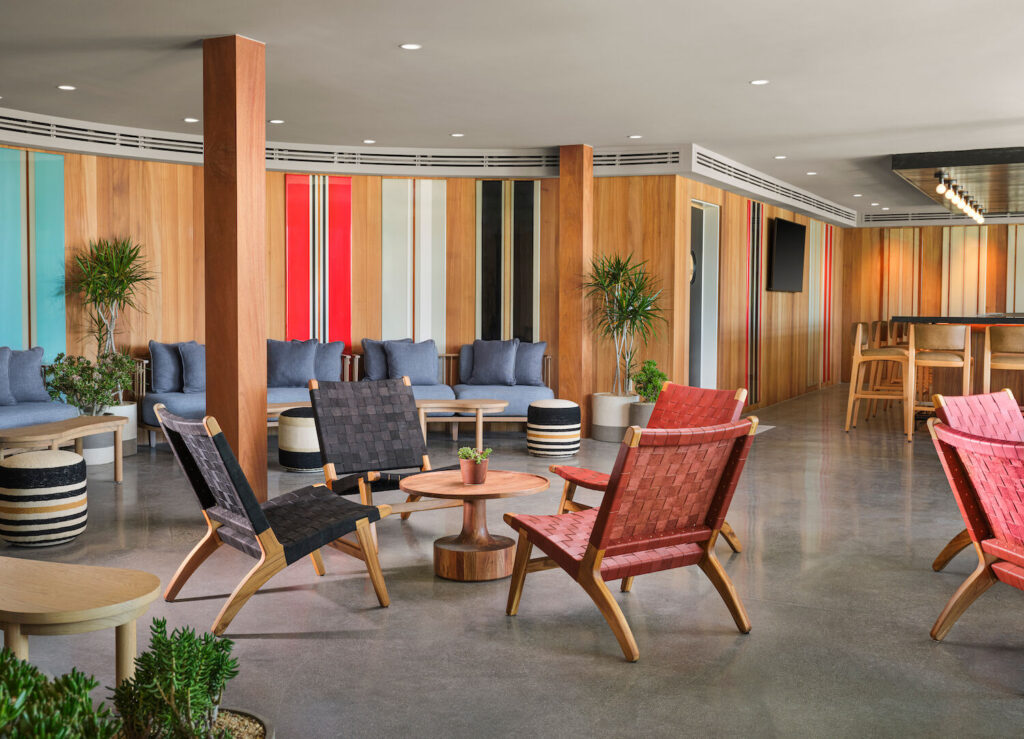
Alila Marea The Pocket Lounge
Courtesy of Brain Szymanski & Alila Marea Beach Resort
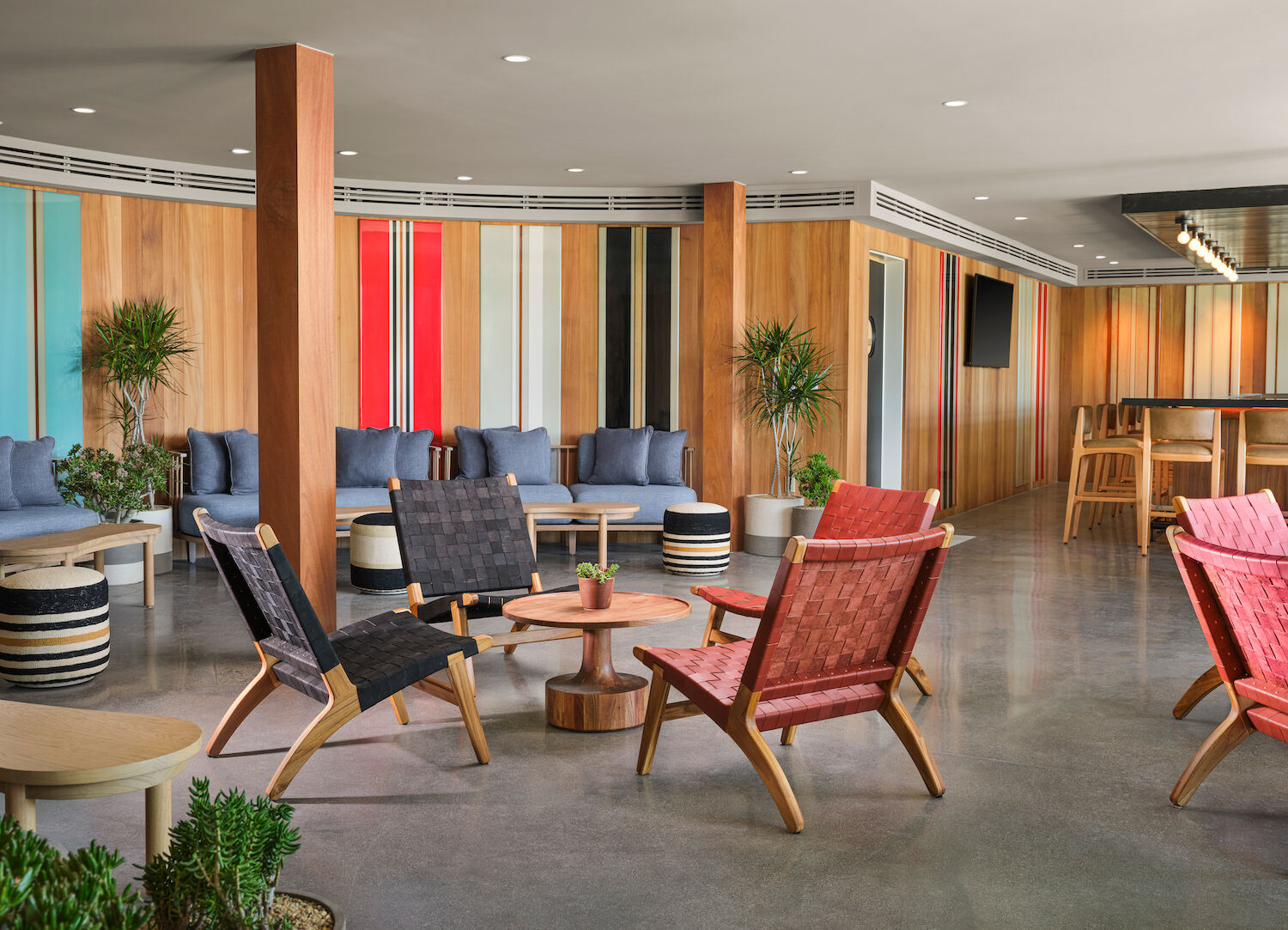
If you were to visit the Alila Marea Beach Resort—the breathtaking hotel perched upon the bluff between Carlsbad and Encinitas—and walk into its poolside bar area known as The Pocket, you’d glimpse the history of surfboard design along the surrounding sapele mahogany–lined walls.
Encircling the bar and the coastal-inspired lounge area are 17 hand-shaped, surfboard-esque wall panels—each over seven feet tall and nearly two feet wide—that pay homage to board design of the late ’50s and ’60s. Each panel boasts a different resin colorway—vintage reds, teals, whites, and so on—using pigments found during that era of shaping.
The installation is crafted by Brian Szymanski, local shaper and owner of the long-established surfboard repair shop known as The Ding King. Rather than simply creating replicas of historic designs using today’s board-building technology, Szymanski wanted to craft each panel using the materials and methods that were authentic to that era.
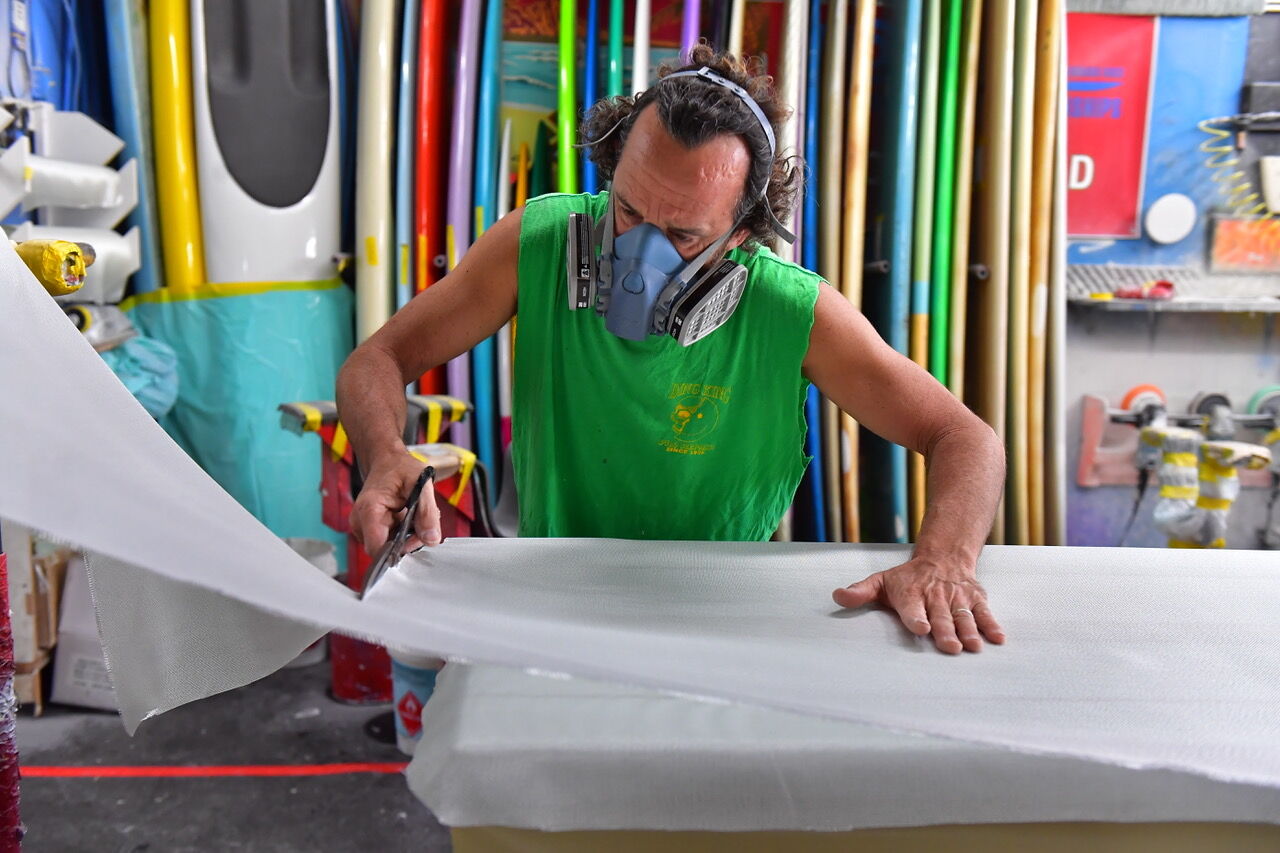
Brian Syzmanski in the Shaping Room
Courtesy of Brain Szymanski & Alila Marea Beach Resort
“The type of resin that we used, the pigments that we used, the spread of the stringers, and the different types of wood that went into it were all extremely specific to that time period,” says Szymanski. “I had guys that were building boards during that time help me put together some of the wood boards and hand- mix some resin color so they were authentic to the ’60s. Those traditional techniques are only really known by the people that were doing it—or someone lucky enough, like me, to be trained.”
Over the past 30 years, Szymanski has fabricated custom shapes and done production work for big hitters in the surfboard industry like Channel Islands, Rob Machado Surfboards, and windsurfing company Starboard. Having learned to handshape all types of boards from local Encinitas legends like Tom Eberly and Ed Wright of Sunset Surfboards, Szymanski worked hard to create an installation that honors the craftspeople who paved the way and gives visitors a brief look at the area’s rich surf culture.
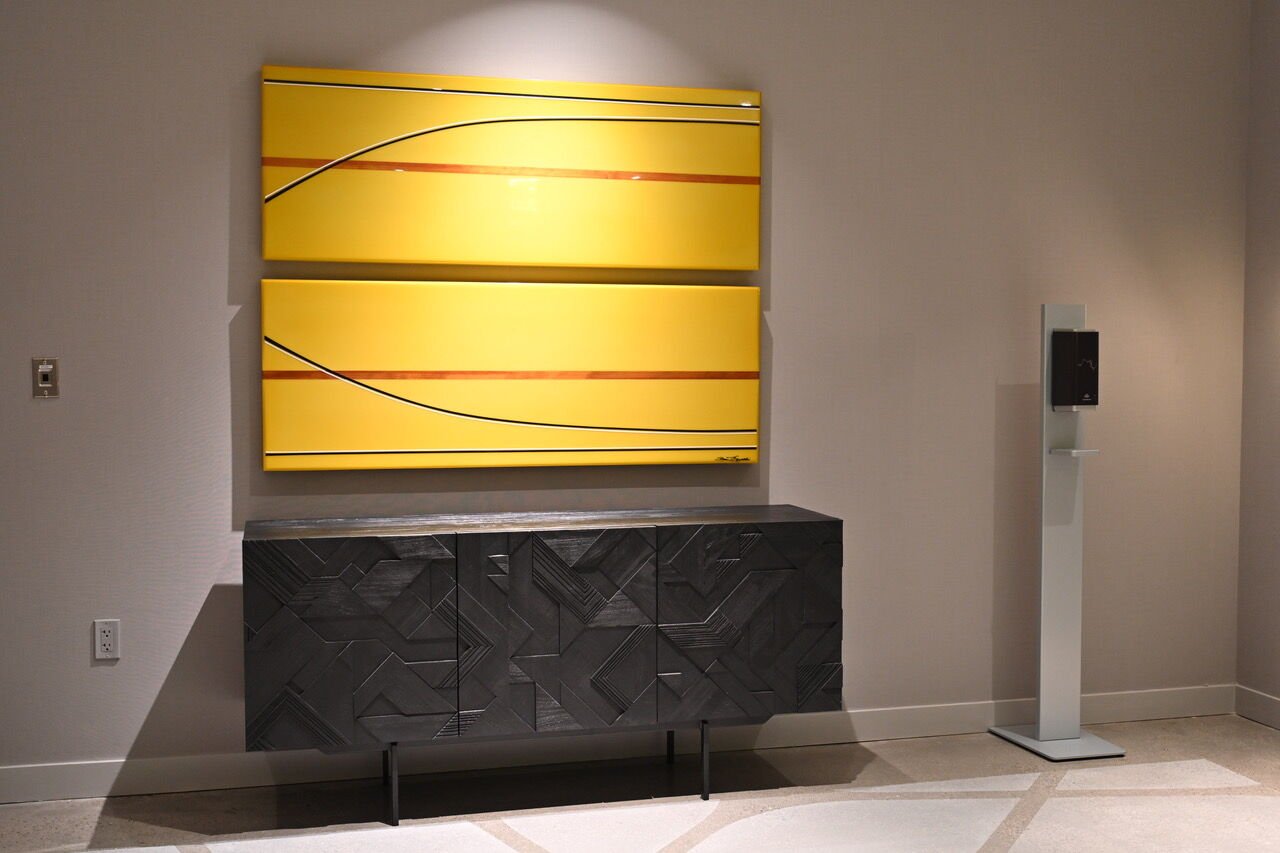
Brian Syzmanski Resin Installation
Courtesy of Brain Szymanski & Alila Marea Beach Resort
“He was always eager to learn,” says Eberly. “He is a great surfer and very intelligent human being, so it doesn’t surprise me that he wanted to replicate those boards as perfectly as possible. He knows his surfing history and he knows who came before him. [If ] you don’t know your past, [you] won’t know your future. He knows the difference between making a surfboard and making a quality surfboard.”
Perhaps one of the most recognizable pieces in the installation—a gorgeous glue-up of balsa and redwood— is an ode to the late Pat Curren’s celebrated rhino chaser that he rode at Waimea Bay (the famed big-wave spot on the North Shore of Oahu). Curren, in addition to shaping icons like Ben Aipa, Jim Phillips, Renny Yater, Mike Diffenderfer, John Kies, Gary McNabb, and more, once shaped boards in the same building Szymanski now works out of.
In alcoves of the hotel, Szymanski created additional resin pieces that highlight the typical colors, tints, and pin lines of surfboards from the ’70s, tapping the founder of Moonlight Glassing, Peter St. Pierre, to do the pin lines. With both projects, Szymanski’s main goal was to celebrate the cadre of artists and experimenters who have molded the direction of board design over the decades.
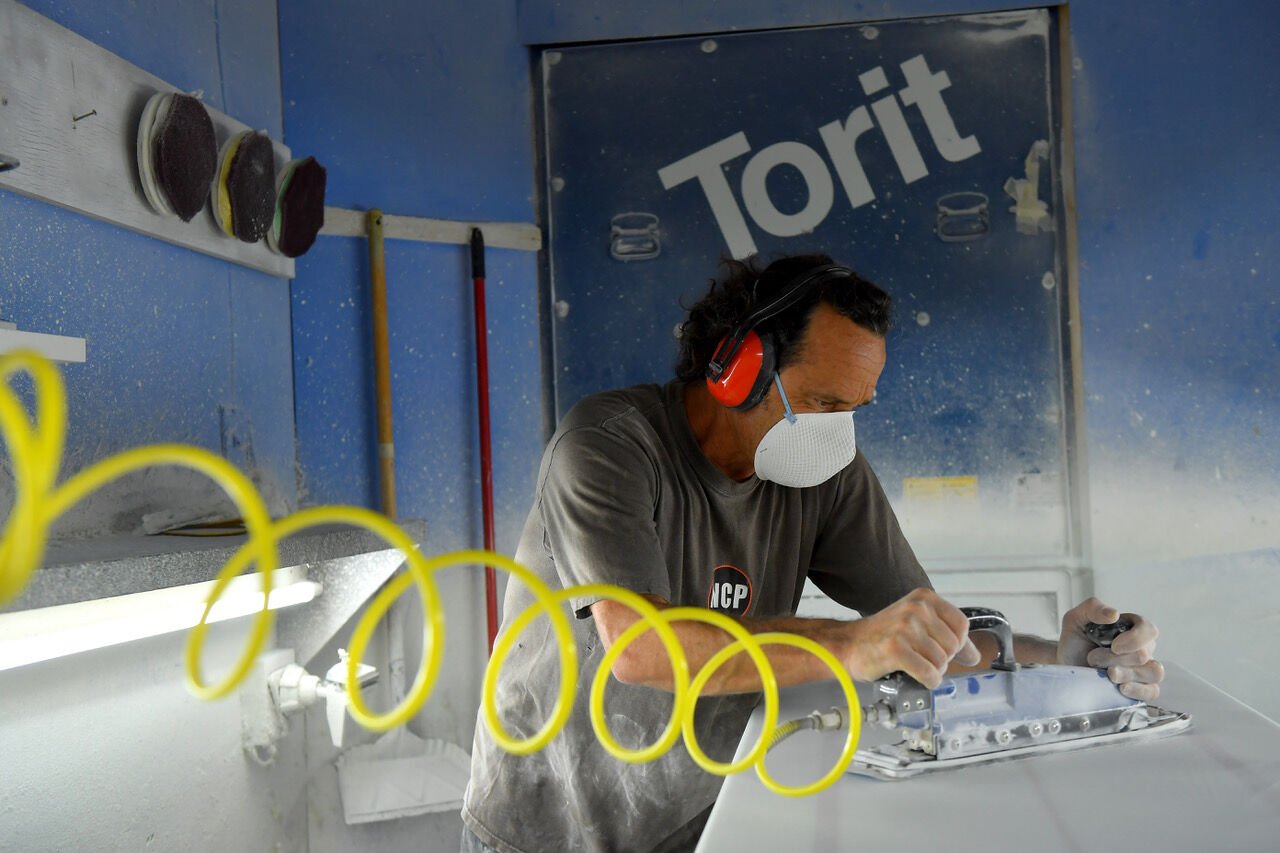
Brian Syzmanski Shaping Surfboard
Courtesy of Brain Szymanski & Alila Marea Beach Resort
PARTNER CONTENT
“With a beautiful hotel going in on the beach, it’s important to represent that part of the community. I mean, Encinitas is known for surfing,” says Szymanski. “I [chose to do this] out of respect for all the craftsmen before me. It’s a tight industry. There’s a comradery, passion, and respect for each other. It’s just a big family of board builders no matter where you end up going. I pay a lot of respect to the people who took the time to teach me.”
Announcing a partnership between Art & Design District, SDFC Playmakers, and San Diego Magazine
FOR IMMEDIATE RELEASE
SAN DIEGO, CA — [June 15th, 2026] — Art plus story equals culture. Today, three local groups deeply invested in advancing San Diego arts and culture— San Diego FC Playmakers, Art & Design District, and San Diego Magazine—have joined forces to tell its stories.
The initial project will be a landmark September edition of San Diego Magazine—fully dedicated to the people, ideas, and identities of the city’s creative community. After its release, those stories and more will extend across six months of integrated digital, social, and multi-platform coverage. Art & Design District and SDFC Playmakers will serve as co-publishers of the expanded editorial vision.
The Art & Design District is evolving into San Diego’s first home for the performing arts at iconic downtown venues like the Civic Theatre and Jacobs Music Center alongside research and development programs focused on artist live/work spaces, galleries, studios, and New School of Architecture & Design.
“[The Art & Design District initiative] is a long-term investment in San Diego’s creative life and the creative workforce that powers our cultural experiences and creative industries here at home and across the world,” says Jonathan Glus, Prebys Senior Fellow for Art & Design in Residence at Downtown San Diego Partnership. “But infrastructure alone is not enough. The public needs to see, understand, and participate in what’s being built and why. Joining as co-publisher of this issue means helping ensure that the story of San Diego’s creative community—its artists, its institutions, its future—gets told at the level of ambition the moment requires.”
San Diego has entered a defining chapter in how the region invests in its creative community, with civic and philanthropic leaders working alongside artists, brands, institutions, and people to chart a new model of public-private support for arts and culture.
As digital co-publishers of San Diego Magazine‘s arts and culture coverage, SDFC’s Playmakers partnership will include a six-month integrated collaboration designed to sustain the visibility of San Diego’s creative community well beyond a single issue.
“The Playmakers program was built on the belief that the creative community is essential to what makes San Diego, San Diego,” says Sebastian, San Diego FC’s SVP of Brand and Innovation. “Investing in local media that tells those stories—and reaches the audiences who need to hear them—is one of the most direct ways we can support the artists, organizations, and cultural leaders shaping this city’s future. We’re proud to step in as digital co-publishers of San Diego Magazine‘s arts and culture coverage and the founding partner of this new editorial program.”
Under the partnerships:
The partnership represents a new model for regional media: civic and cultural institutions providing the resources required for sustained, ambitious, local editorial media focused on the neighborhoods it serves.
“For 78 years, the magazine has told the story of arts and culture here,” says Claire Johnson, CEO of San Diego Magazine. “But the fragmentation of traditional media has made it harder than ever to cover this community at the depth and scale it deserves. SDFC Playmakers and the Art & Design District have recognized something critical: Media is not separate from the civic conversation, it’s the stage for the conversation.”
San Diego Magazine retains full editorial control over all reporting, features, and original content produced under both partnerships.
“Our role in this ecosystem is to tell the story of San Diego’s culture and provide context for our readers.” says Johnson. “These partnerships give us the resources to do justice to that responsibility—and to extend that commitment well beyond a single issue. Our readers also deserve to know exactly how this work was funded. I’m grateful to our partners, and to the arts and culture community in San Diego for letting us tell this story.”
The September Arts & Culture Issue will be released early September 2026, with digital, social, video, and podcast coverage rolling out through early 2027.
ABOUT SAN DIEGO MAGAZINE For 78 years, San Diego Magazine has been the region’s leading lifestyle and culture publication, reaching approximately 6 million readers monthly across print, digital, newsletter, and social platforms. Owned and operated locally, the magazine has been the connective tissue of San Diego’s cultural conversation since 1948.
ABOUT SDFC PLAYMAKERS The Playmakers program is an ongoing initiative that seeks to identify and showcase the talent of San Diego creatives who are contributing to the culture, substance, and flow of our community. We want to bring the San Diego community together by marrying football and creativity to provide a platform for these Playmakers who are positively impacting our culture by pushing the boundaries through innovative ideas. The goal is to create a program that consistently provides growth and exposure opportunities for San Diego creatives, while shaping an authentic direction for San Diego FC’s brand and community-building process. Through this program we hope to contribute to the creative fabric of our city by providing paid jobs, projects, collaborations, as well as networking opportunities for Playmakers.
ABOUT THE ART & DESIGN DISTRICT The Art & Design District is a Downtown San Diego Partnership initiative, supported by the Prebys Foundation, working to shape a connected, vibrant arts and design district in downtown San Diego. Led by Art and Culture Expert Fellow Jonathan Glus, the initiative convenes artists, cultural leaders, civic stakeholders, and residents in service of a downtown that reflects the creativity, identity, and diversity of the region. Learn more at downtownsandiego.org.
From dedicated line cooks to seasoned bartenders, these are the people making magic happen in city's top restaurants
Chefs have done gobs of thankless, lumbar-breaking work over years to land the role. Restaurateurs put their entire livelihoods on the line, microdosed sleep, took ultimate responsibility for every minor stress. They earned the spotlight they get. But ask one of them, and they almost always defer to a line cook who’s showed up for years, been deep in the thing, and whose absence would bring the kitchen to its knees. Or the bartender with a warmth that draws people whether they’re thirsty or not. Or the noble and spreadsheetable soul in charge of purchasing everything needed for the nightly show.
They call it the “heart of the house.”
Spotlight or not, these are the people who make a food culture hum at its daily core.
For this year’s “Best Restaurants” issue, we asked a handful of the top chefs and one restaurant owner—Tara Monsod (Animae/Le Coq), Jason McLeod (Ironside Fish & Oyster), Ananda Bareño (The Marine Room), Owen Beatty (A.R. Valentien), and Ryan Thorsen (Mister A’s)—who that person is for them.
These are the hearts of houses.

Roger Feria Krile is not only the guy you want to be friends with at work, but also the guy you want to hire: respectful, nose-to-the-grindstone, versatile. And he’ll drop off a fresh batch of cinnamon rolls at your house for the holidays. Born in Tijuana, Krile moved to the US with his mom and sister when he was in elementary school. He saw the sacrifices his mother made to give her children a better life, and he pushed himself to live up to that brighter future.
He came to cooking during the pandemic, asking himself, “What do I really love to do?” His answer: “Bake cakes for friends and break bread with people,” he says. That led to a culinary school degree and a stint in a Michelin-starred NYC kitchen, where he grew to “love and understand” fine dining. Now back in San Diego, Krile’s showing up at Animae in a major way. He does prep work three mornings a week and comes later in the day twice a week for dinner service. Most line cooks do one or the other, but he requested both tours of duty.
“Gotta get my reps, keep my skills sharp,” Krile says, “and I don’t want to miss the rush.” Prep work in the mornings helps him learn how Executive Chef Tara Monsod uses each ingredient to the fullest. Krile’s not just a line cook. One-quarter Filipino (and learning about his culinary heritage from mentor Monsod), he’s building his own Mexican-Filipino pop-up concept. Look for Sarsa—Filipino for salsa—where every dish is a play on words fusing Mexican and Philippine Spanish or Tagalog. He’s already R&D’d a breakfast sandwich, the tortantalong: a torta filled with a signature Filipino eggplant omelette called a tortang talong. Friends in the industry say it’s unexpectedly delicious.
“He shows up every day with a clear goal of one day opening his own restaurant, and that drive pushes him to go above and beyond,” says Monsod. “He is constantly learning, asking questions, and absorbing as much as possible, all while leading by example on the line.”

Ruben Martinez knows every bottle of wine at Mister A’s—not necessarily by taste (though he was on the tasting committee for years), but by where they are in storage and whether they need replenishment. Owner Ryan Thorsen wants the wine list at 100 percent available every night, and Martinez’s job is to make that a reality. He’s been keeping inventory on Mister A’s wines since the 1970s, back when he worked for founder John Alessio. And it’s not just vino: Martinez also procures the ingredients, arriving at 5 a.m. to meet delivery trucks, stock shelves, and alert chefs if anything’s amiss.
Then he hits the dining room for a once- or twice-over to find any imperfections. If a light is out, if the plumbing acts up, if something major happens after he leaves in the afternoon, he’ll fix it all. He’s the best guy to ask, anyway; he knows every inch of Mister A’s. “Before ‘Google it,’ there was ‘Call Ruben,’” Thorsen says.
Martinez started out in hospitality at 17 with his father at Hotel Del. “I thought it would be easy working with my dad,” he says. “But early on, he caught me fooling around with the boys and told me, ‘We’re here to make money for the company. If you’re not willing to work, get out of here.’” That set him straight and set the foundation for Martinez’s lifelong dependability.
He moved to Mister A’s a couple years later, and after over five decades, he’s now the indispensable purchasing manager who worked with Alessio, Betrand Hug, and now Thorsen. Later this year, he’s planning on retiring—though he’s already offered to keep showing up a couple days a week and help out with Thorsen’s new project at Liberty Station.
Thorsen knows this man is a gem. “I don’t think we fully grasp what it will feel like without him,” he says. Last year, he threw Martinez a surprise birthday party in Mister A’s Blue Room, inviting Martinez’s family and a whole cast of coworkers going back to Alessio days. Martinez says he had to leave the room to hide his tears.

There’s an hour most people never see, when a restaurant’s technically awake but not yet accountable, and that’s where Patrick Mattoon lives. He’s been the foundation of Ironside’s prep team for the past five years, quietly guiding the day toward success. He and his team are the first in, and they turn on ovens, check deliveries, catch mistakes before they become problems, and fix everything without ceremony so the chefs and line cooks walk into a day that already works.
Mattoon organizes, but more importantly, he owns. There’s no job too small, no detail beneath notice. In a kitchen, bad prep’s the one thing you can’t fix later, no matter how talented of a chef is at the helm.
Five years in, Mattoon still approaches each day with the same care and intensity that he had on day one. He takes every task seriously and sees it through completely—the kind of consistent work that doesn’t draw attention but makes everything else possible. When the restaurant got a soft serve machine, a notorious maintenance nightmare, he taught himself how to clean and run it just to make sure it never broke, not for credit but because that’s just how he’s wired.
“He is a silent leader who has the respect of the entire team due to leading by example,” says Ironside chef Jason McLeod.

Through 23 years, three executive chefs, and a recent kitchen remodel, lead line cook Arturo Celestino is a constant at A.R. Valentien. He’s there at 6:30 a.m. five days a week—sometimes six—for the Lodge’s breakfast service. That means he’s up early prepping potatoes, slicing mushrooms, whisking pancake batter, and stirring sauces “always with a smile,” says Owen Beatty, the restaurant’s new chef de cuisine. “He’s a good leader.”
Celestino shows the younger guys how to make the eggs fluffy, so the omelettes are always perfect (don’t stop twirling the spatula!). He keeps his line in line when their spirits start to naturally droop during the morning shift home stretch when his crew just wants to get out of there. As the lead, he’s also the one chefs turn to when newbies need motivation.
His secret sauce: “mucho talking!” It keeps people happy, and it also helps the chefs retain talent in the kitchen.
Celestino learned to cook out of “necesidad,” he says. He cut his teeth on fine dining at Pacifica Del Mar at the Hyatt and moved to A.R. Valentien in 2003, just a few months after it opened in 2002.
“I’ve had good jefes,” Celestino says of the three executive chefs he’s known at A.R. Valentien: Jeff Jackson, Kelli Crosson, and now Michelin-starred Eric Sakai. Under Jackson—who’s known for pioneering farm-to-table dining in San Diego—Arturo learned to appreciate local ingredients.
“My favorite is basil,” he says, “added to tomato sauce with garlic, it’s mmm.” Fresh basil plays the supporting role in A.R. Valentien’s signature brunch plate, which is also Celestino’s top choice on the menu (to make and to eat), via the Bull’s Eyes: slow-roasted eggplant with sunny-side-up eggs, tomato sauce, and La Quercia prosciutto.
“I love my job,” Celestino says as he flashes that smile. “It’s not just a plate of food. It’s an experience.”

If you’ve been to The Marine Room, you’ve probably met bartender Tony Suarez. With his charming Cuban accent and dapper vest and tie, he makes it his business to regale guests coming and going—even while he’s pouring, mixing, shaking, polishing glasses, and taking orders.
“Over 90 percent of our guests are celebrating a special occasion,” he says. “So I keep up the celebration throughout their whole visit.” He’ll make you a sparkling toast and a customized cocktail, and on your way out, he’ll wish you a happy birthday (again) and invite you back for drinks on him.
“My goal is always to delight the guest,” he says. “I like to discover how you feel and lead you to what you would like to drink.” That spirit of experimentation has led to new signature cocktails, such as the Gerald—crafted for a neighbor who’s a regular—featuring housemade pomegranate puree and bourbon, or the I Drink of You with local Bebemos tequila, Gran Marnier, and Green Chartreuse. You won’t find this anywhere else.
“[Suarez] has mastered the art of the personalized guest experience,” says Marine Room’s Executive Chef Ananda Bareño. “He remembers the small details and favorite orders that make our regulars feel like family.”
Suarez’s tenure at the Marine Room started with a walk on the beach and a knock on the door. He was impressed by the beautiful location, and he asked if they were hiring. He immediately started as a server assistant—right before Valentine’s Day. The bartender took Suarez under his wing, and he took to the books to learn all about spirits.
He’s taken on the bartender role with wisdom and grace, offering a sympathetic ear, a pick-me-up, and a “human to human connection,” he says. Ten years into his career, the surroundings still inspire him as much as they did on day one.
“The Marine Room, the windows onto the ocean, [all] have a healing effect,” he says.
Leorah Gavidor won her first essay contest at age 5. She writes features, news, and non-fiction in San Diego.
Running April 18 through August 9, MCASD presents monumental Black American diasporic art from the power couples' private art collection
Power couples make power moves.
When Swizz Beatz (Kasseem Dean) and Alicia Keys bought a home in San Diego in 2019, culture creatures buzzed about the potential impact. Expectations were tempered; we’d seen this before. A litany of celebrities own homes in San Diego, but most understandably treat them as hideouts to escape public life—not as base camps from which to explore local goings-on.
But the Deans are different. In February, Mr. Beatz bought out an entire photography exhibition at Por Vida coffee shop in Barrio Logan. The gesture signaled a genuine interest in the San Diego art world—in an artistically prolific but often overlooked neighborhood, at that. Days later, they announced the only West Coast showing of Giants: Art from the Dean Collection of Swizz Beatz and Alicia Keys at MCASD. This peek into their personal art collection, featuring more than 130 genre-defying works by Black American and diasporic heavyweights under one public roof, is a metaphorical opening of their home.

Originally organized by the Brooklyn Museum, Giants delivers the piercing photojournalism of Gordon Parks, the raw charge of Jean-Michel Basquiat, the interior emotion of Amy Sherald (we’re still obsessed with her portrait of Michelle Obama), the radical pastiche of Mickalene Thomas, and the transformative work of 33 other mostly-living artists. From photography and painting to collage and sculpture, Giants promises to have us up in our feelings. It seems obvious the Deans collect—and think it’s important to share—art that at once provokes and challenges, champions and celebrates. We plebes are certain to enjoy a collective historical interrogation we would otherwise not get to see, and the Deans are showing us their commitment to—and investment in—art by the people, of the people, for the people.
We’re lucky this dynamic duo has chosen to live in San Diego, to engage with its culture and people, and to let us view the masterpieces that usually hang on their walls. Because what good is art if people can’t see it?
Giants: Art from the Dean Collection of Swizz Beatz and Alicia Keys is on view at MCASD from April 18 to August 9.
Stake Chophouse & Bar brings contemporary classics and old-school service to the heart of Coronado
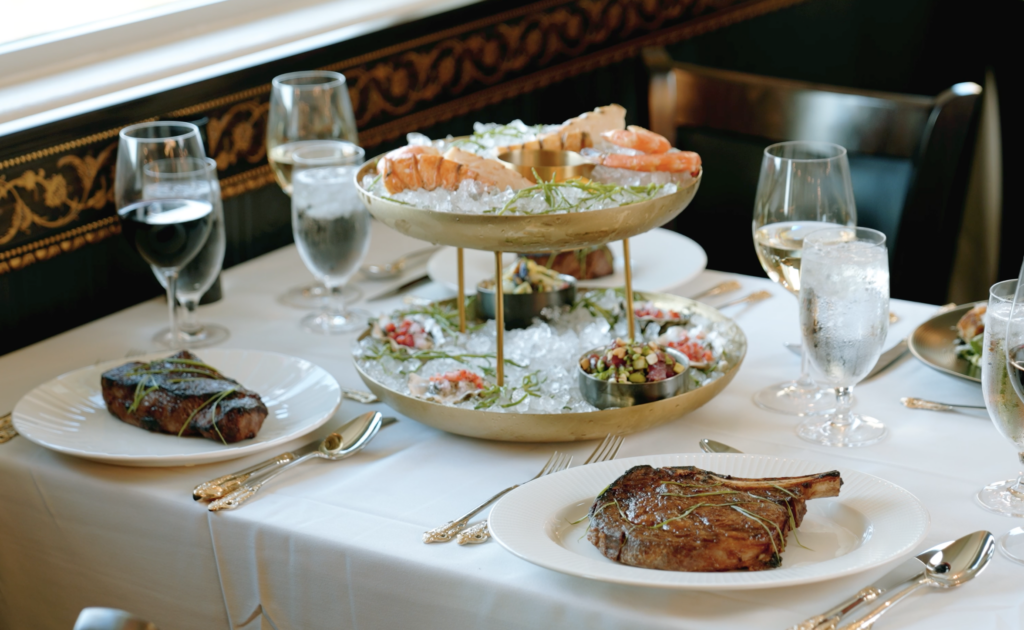
Stake Chophouse & Bar isn’t your average steakhouse. Blue Bridge Hospitality’s Coronado outpost is a modern interpretation of a big-city steakhouse nestled in the heart of the small coastal community. The team at Stake has reimagined the whole steakhouse experience. By prioritizing a seasonal farm-to-table sourcing philosophy, a personalized guest experience, and unique service touches, like a formal steak presentation and a bespoke knife selection process, Stake distinguishes itself in a sea of steakhouses.
Exceptional steaks, including Wagyu from Japan, Australia, and the U.S., and fresh seafood flown in daily form the core of Stake’s culinary identity. The menu features a five-course omakase-style steak experience highlighting house favorites, plus an array of cuts, and classic steakhouse staples—think a wedge salad, baked potato, or pasta carbonara—refined for a contemporary palate without losing their traditional appeal. Stake focuses on seasonal sourcing from the region’s best family farms and specialty purveyors, and incorporates intentionally unexpected touches to create something truly unique.
“I challenge our chefs and myself to take it a step further in sourcing,” says Chef Ronnie Schwandt. “It’s important to us to highlight different farms, unique one-off farms—whether it’s cattle, strawberries, a local fisherman or from anywhere in the United States, we’re always trying to find that niche.”
Beyond the menu, Stake emphasizes outstanding service, says Vinny Spatafore, Director of Hospitality Operations. Staff maintains detailed notes, allowing them to remember guests by name, recall previous orders such as a favorite martini (also memorable for the customer since it’s served in an extra tall, distinctly-shaped glass), and celebrate special occasions like birthdays and anniversaries.
“When you have those points of topic that you remember about a guest, they appreciate that,” he says. “Our servers are really good with that—we have a couple servers who have been here since the beginning and they’ll remember somebody from years ago, their name, their kids’ names, where they live. I’m really thankful to have a great front of house staff.”
Award-winning wines, rare whiskeys, special events, and a complementary black car service that provides transportation for guests throughout Coronado add to Stake’s appeal.
Schwandt stresses that Stake offers more than a meal; they aim to give patrons something unforgettable.
“It starts when you walk up the stairs and are greeted by the hostess—that sets the tone for the night. Then you’re greeted by a server, who may know you by name, and can guide you through the menu and curate as they get to know you,” says Schwandt. “Most people leave kind of blown away; they leave feeling like they just had an experience. That’s the goal, right? Whether you’re serving smash burgers or high-end steak, you want somebody to leave thinking, Wow, that was awesome.”
Inside the angular, detail-oriented world of San Diego architectural photographer Maha Bazzari
We live in a world of shapes. Look up, and you’ll notice it: the clean lines of your office building, the sharp angles of the neighborhood gym, the tidy symmetry of the bungalow down the street. San Diego architecture is woven together by angles, lines, and shadows, quietly doing their thing as we rush past.
At least, that’s how photographer Maha Bazzari sees it. A multi-disciplinary artist, architectural designer, full-time commercial photographer, and professor of photography for the San Diego Community College District, Bazzari has long been attuned to the overlooked shapes of the world.
With a childhood rooted in science—her father was a geophysicist for the United States Geological Survey in Saudi Arabia—Bazzari first built her career in the more structured world of commercial architecture. After more than a decade in that world, she pivoted to commercial photography around 2010, starting in fine art photography before naturally blending her architectural expertise with a creative eye. She has documented everything from the architectural progression of Little Italy in 2007 (and boy, has it changed since then) to the otherworldly geometry of the Salk Institute in La Jolla.
Her method is meditative: arrive in stillness, absorb, sit. Notice the way light slices through concrete or pools in a corner. See the shapes, capture the feeling, then click.
Here, you can browse some of her home and architecture images that moved us. We hope they make you tilt your head, squint your eyes, and never look at a parking garage the same way.
All Photos Credit: Maha Bazzari

“This building holds personal meaning for me. When I first moved to San Diego, I worked in architecture at Carrier Johnson, where I saw early design development and material studies for the Science Complex at Point Loma Nazarene University. I remember mockups of the perforated metal panels and façade systems long before the building existed onsite. Years later, after transitioning into architectural photography, I returned to photograph the completed project overlooking the Pacific. It felt like a full-circle moment, documenting the final expression of a project I had once known only as drawings, materials, and prototypes.”

“I photographed this building near Little Italy not long after moving to San Diego in 2007, when I began documenting the city’s changing urban landscape. The faded painted advertisements and low industrial structure stood in contrast to the growing skyline behind it. Over time, many small warehouses and commercial buildings like this have disappeared as downtown neighborhoods have continued to develop. Images like this feel important to me because they preserve fragments of San Diego’s visual history and reflect my early years exploring the city through photography.”

“I framed the oyster bar as a complete composition, letting the patterned floor lead the eye toward the counter and the shelving beyond. I made sure to include the rolling library ladder along the back bar, a distinctive design element that emphasizes the height and density of the floor-to-ceiling shelving. I photographed the space at a time of day when daylight enters through the windows while the warm interior lighting still reads, balancing natural light with the glow of the bar. I approach restaurant interiors by deciding what to include and what to leave out, so the atmosphere and structure of the space can come through in a single frame.”

“This project was meaningful to me because it brings my design background and my photography practice into the same frame. While working part-time at Tecture, I helped design and fabricate custom lighting and bar seating components for the space, developing sketches, building 3D models, wiring fixtures, and installing them onsite with the team. Later I returned as a photographer to document the completed restaurant. Being involved in both the making and the photographing of a space is where my work feels most complete. It lets me bring an architectural mindset to the camera and photograph with a deeper understanding of how the space was built.”

“This image was made while documenting sacred architecture across San Diego for the La Jolla Historical Society. With private, individual access to the building, I spent time observing how light moved through the structure and illuminated its materials. The layered wood framing and warm translucent panels create a rhythm of structure and glow that feels both architectural and contemplative. Photographing spaces like this reminds me how architecture can shape moments of stillness through light, proportion, and materiality.”

“This campus stands out within San Diego architecture for its sculptural concrete forms, warm wood elements, and quiet courtyards that frame the surrounding eucalyptus trees. I am drawn to spaces where architecture can feel monumental and intimate at the same time. Photographing here is less about coverage and more about observing how light moves across concrete surfaces and how material and form create a sense of calm within the landscape.”

“The repetition of the arches immediately drew my attention. By centering the composition and removing surrounding context, the architecture becomes about rhythm, proportion, light, and subtle shadow. Islamic architecture often uses geometry and repetition to create a sense of calm, and focusing on this detail allowed the photograph to reflect that quiet balance.”

“Photographing this Mission Hills midcentury renovation was especially meaningful because the project balanced preservation and transformation so thoughtfully. Originally designed by architect Richard Wheeler, the home reflects an important period of residential architecture in San Diego. The updated interiors maintain the warmth and material richness of midcentury design while feeling fresh and livable. I photographed the project for the architect and designer, and it was later featured on the cover of a special edition design publication Projects like this remind me how architectural photography can document not only buildings but the continued life of design across generations.”

“I was drawn to the alignment of the two staircases rising between tall concrete walls, forming a quiet, balanced composition. The blue glass softens the weight of the concrete and catches the coastal light that defines this part of La Jolla. Introducing a figure adds scale and a moment of color within the restrained palette. This is one of the ways I photograph architecture: by using structure and repetition to create a frame, then allowing a small human presence to activate it.”

“Kindred is one of those interiors people in San Diego remember—[it’s] bold, moody, and unapologetically its own. I was drawn to this booth vignette because it captures that signature contrast: black tufted seating against pink patterned walls, framed by repeating arches and reflective ceiling panels that amplify the lantern glow. When I photograph restaurants, I focus on more than wide angles. I look for intimate moments where the design language is distilled into a single frame. This is where the personality of a space lives—in the textures, color, and atmosphere guests experience up close.”

“While documenting the Wildlife Explorers Basecamp project at the San Diego Zoo, I was drawn to this patterned block wall and the shifting grid of shadows created by the afternoon sun. I love photographing moments where light reveals the geometry of a surface and a small detail becomes the subject. This image captures a design element that might otherwise go unnoticed.”
Lili Kim is a content coordinator and writer for San Diego Magazine, with experience highlighting local businesses and communities. When not writing or shooting film, she is likely brewing her seventh cup of tea of the day or strolling along Sunset Cliffs.
Chula Vista hometowner and artist Michelle Ruby travels all over the city (and the globe) painting murals that feature her colorful symbol of resilience
You’ve probably seen him around the city—a mischievous-looking creature with a Cookie Monster–blue head and a fuzzy body striped in scarlet, yellow, and green. He grins with a wide, red-lipped mouth as he hitches a ride on a a butterfly in San Ysidro, pours water down his back on El Cajon Boulevard, and plays poker with a motley crew of other critters in Barrio Logan.
His name is Chucho, and he’s the beloved brainchild of Puerto Rican- and Mexican-American artist Michelle Ruby, AKA Mr B Baby. Nowadays, he’s a world traveler, appearing in public art all over the globe, from Miami to Morocco to Paris. Ruby has worked with brands like Nike and Samsung and painted a mural at Dodger Stadium. Last year, the San Diego Metropolitan Transit System tapped her to design a limited-edition PRONTO card and put up a mural near the tracks.
“Chucho is a piñata, and he stands for resilience,” Ruby says. “Piñatas are meant to be broken, but instead of feeling defeated, he finds strength and growth from his cracks.”
The symbolism is personal for Ruby, who has utilized art to help manage her anxiety and depression since she was a child. At first, drawing was a hobby, a coping mechanism, but after overcoming addiction and giving birth to her daughter, Zariah (now 11), “I wanted to create artwork that people were gonna feel connected to, because my previous work was much darker. And I knew that I wanted to give it a shot— doing art as a profession,” Ruby says. “I had just basically transformed my life completely, and in doing so, oddly enough, I realized that I was actually a lot stronger and more capable than I had ever given myself credit for.”
As she developed her new signature style—colorful and maximalist, populated by round-eyed dolls and figures from traditional Mexican art and folklore—Ruby taught herself to spray-paint on hardware-store wood panels. “I used to drive for Lyft, and I’d go into random neighborhoods and pitch my services like a salesman,” Ruby recalls. “I didn’t know what I was doing. I didn’t have any connections. I didn’t know anyone in the art world. I just went on instinct.”
Now, with her dream of becoming a full-time artist achieved, she’s focused on bringing Chucho to a more handheld experience: a children’s book. “I want this book to celebrate culture but also touch on issues with mental health, so we can have these discussions among families,” Ruby says. “For me, Chucho is a daily reminder that despite the things that we go through, we’re just growing and learning from them.”
Amelia Rodriguez is a writer and journalist and winner of the San Diego Press Club's 2023 Rising Star Award and 2024 Best of Show Award, she’s also covered music, food, arts and culture, fashion, and design for Rolling Stone, Palm Springs Life, and other national and regional publications. After work, you can find her hunting down San Diego’s best pastries and maintaining her five-year Duolingo streak.
Scripps study shows that some patients may be able to taper their dose and maintain results
While glucagon-like peptide-1 (GLP-1) receptor agents have been used to treat Type 2 diabetes for more than 20 years, their recent emergence as weight-loss wonder drugs marked a new frontier in medicine. But their effectiveness has left some patients wondering what to do once they’ve reached their goal. Stopping the medication could mean regaining some, if not all, of the weight. A Scripps Clinic internal medicine physician recently conducted a small study of whether GLP-1 patients who had reached their goal weight could maintain that weight by taking their regularly prescribed injection every other week instead of weekly. Spoiler alert: 30 of 34 patients did. Read more about the study here and what that may mean as pharmaceutical companies roll out oral GLP-1s.
For more nutrition, wellness, and healthy living tips, sign up for the San Diego Health newsletter here.