Featured articles
Food & Drink
Features
Food & Drink
Featured articles
Features
Things to Do
What's next
Featured articles
Featured articles
Food & Drink
Features
Guides
Featured articles
Food & Drink
Partner content
Features
Ready to know more about San Diego?
SubscribeReady to know more about San Diego?
Where to grab food, spend time outdoors, and go shopping in this charming beach town
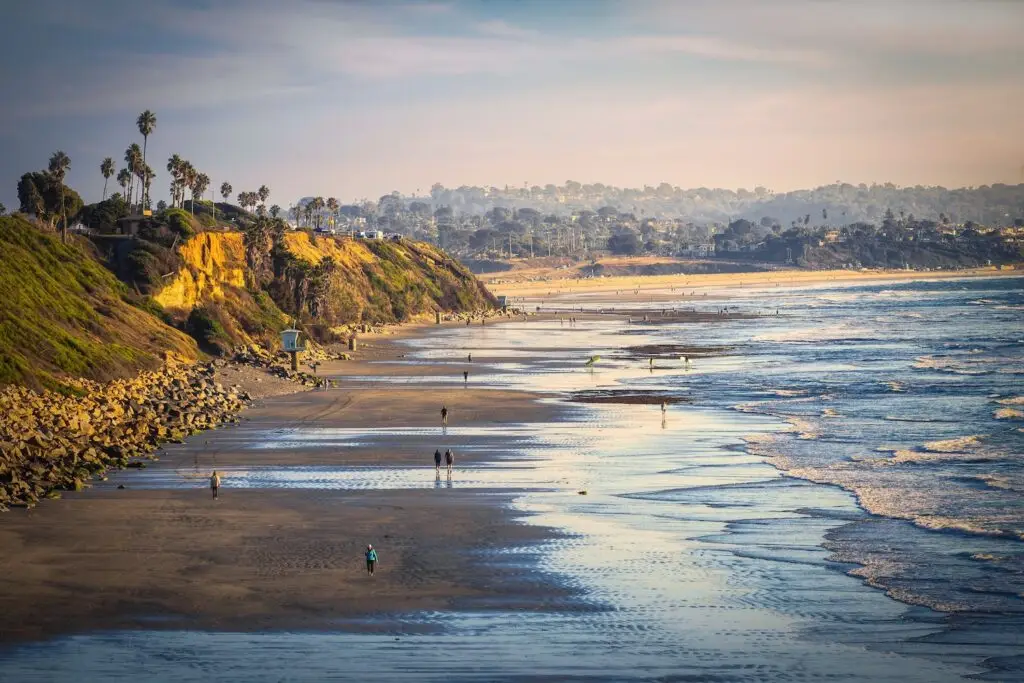
The coastal neighborhood of Cardiff-by-the-Sea is named after Cardiff, Wales—thanks to the earliest land developer’s wife and her hometown pride—which is also the reason so many of its streets bear the names of cities in the United Kingdom. “Cardiff” for short, this Encinitas community just north of Solana Beach is known locally for its “Cardiff crack” (marinated tri-tip) and The Cardiff Kook statue (a bronze surfer officially called Magic Carpet Ride).
Endowed with prime surf conditions, scenic hiking trails, and seaside walking paths, Cardiff has less than 12,000 residents in its upmarket zip code. The main business district runs along San Elijo Avenue, with several waterfront restaurants scattered further down Highway 101. Plan your next trip using this guide to some of the must-visit places that make Cardiff every beach lover’s paradise.

An ever-present line out the front door of VG Donut & Bakery is indicative of this humble dough shop’s extreme popularity. Family-owned and -operated, VG (short for “very good”) produces some of San Diego’s best donuts, as well as other baked goods like cookies, muffins, cakes, and pastries. The team makes donuts daily in the morning and afternoon to ensure freshness. When in doubt, order one with the shop’s beloved chocolate glaze.
106 Aberdeen Drive
Healthy, California cuisine and fresh juices are on the menu at Ki’s Restaurant, a casual all-day eatery with killer views of Cardiff State Beach from its upstairs dining room. Entrees are satisfying but not too heavy, including curries, fresh spring rolls, and eclectic bowls that can easily be made vegetarian. Check the restaurant’s online calendar for live music and special events like wine tastings, painting classes, and game nights.
2591 South Coast Highway 101
Undoubtedly one of the chicest dining options in Cardiff, Waverly has coastal boho décor and twists on classic American food served all day. Portions are on the smaller side, but dishes like Funfetti pancakes, brussels sprouts cacio e pepe, and a grilled pork chop with Peruvian sauce are memorable enough to keep you returning. Live DJs, beautiful cocktails, and indoor palm trees will make you want to sit and stay awhile.
2005 San Elijo Avenue
If your goal is to dine beachside with unobstructed ocean views, look no further than Pacific Coast Grill. With a menu that leans heavily into seafood, this is the place to go for oysters, seared ahi, and sushi rolls. The two-story restaurant is a great spot to watch the sunset or go for an after-dinner stroll. Be sure to start with an order of the shrimp dumplings.
2526 South Coast Highway 101
San Diegans head to Pipes Cafe for hearty breakfast burritos in a no-frills dining room packed with the après-surf crowd. Pipes has a full coffee bar, açai bowls, smoothies, egg scrambles, and sandwiches, but it’s the burritos (ordered by number) that have put it on the map as a local institution for 30 years.
121 Liverpool Drive
This gourmet grocery store is locally famous for its “Cardiff crack,” or marinated tri-tip sirloin. Grab some to cook at home or order a sandwich from the prepared foods counter to sample this tender beef prepared with a burgundy pepper marinade. Outdoor tables at Seaside Market make for a quick, no-hassle meal close to the beach.
2087 San Elijo Avenue
Dogs and kids are welcome at Rose Hill Purveyors, where you can glimpse the ocean from the small patio. Formerly Zumbar Coffee & Tea, this bustling shop has a simple menu of coffees, teas, and pastries, so you won’t find frou-frou syrup flavors or add-ons here—just high-quality java.
111 Chesterfield Drive, Suite 115
For more than 60 years, North County residents have flocked to The Shanty for cold beer and strong cocktails. Pool tables, foosball, and arcade games fill the nostalgic dive bar, which still looks much like it did in 1964. Play a game of cornhole on the patio while looking out at San Elijo State Beach, and check for local food vendors onsite every Friday through Sunday.
126 Chesterfield Drive
Besta-Wan Pizza House is more than merely a fun-to-say name—the eatery also claims to be the oldest restaurant in the area. It opened in 1965 inside a single-family home. Known for its tavern-style pizza—which is thin, crispy, and cooked well-done with cheese and toppings extending all the way to the edge—Best-Wan also serves burgers, pasta, salad, and chicken wings in a quaint, homey atmosphere.
148 Aberdeen Drive
Get your fish taco fix at Fish 101, a fast-casual seafood spot with burritos, bowls, sandwiches, and tacos. Chow down on mahi-mahi, salmon, yellowtail, shrimp, and Baja-style fish or shrimp with the shop’s chipotle crema sauce or diabla hot sauce. The outdoor patio is a great place to dig in and get your hands dirty.
2101 San Elijo Avenue
Healthy açai bowls are Sambazon’s specialty, served with toppings like housemade granola; coconut; honey; nuts; seeds; and juicy fruits such as strawberries, blueberries, and mango. The juice bar also has fruit smoothies made with organic and fair-trade açai that’s hand-harvested in the Brazilian Amazon. A superfood prepared like a dessert? Sign us up.
2031 San Elijo Avenue
For more than 40 years, Mexican restaurant Las Olas has offered up tacos, burritos, enchiladas, and combo plates from an order-by-number menu. Sandwiched between San Elijo Lagoon and Cardiff State Beach, Las Olas has a prime coastal location but remains a casual locale for the after-beach crowd. Don’t miss special deals like $5 margaritas during happy hour.
2655 South Coast Highway 101
Hopheads unite at The Lost Abbey’s Cardiff tasting room, The Confessional. You can grab pints of crowd favorites like Duck Duck Gooze sour ale and Carnevale Saison—or try several in a flight with four tasters. Outside food from neighboring restaurants is permitted in the tasting room, since it is strictly a beer establishment.
2007 San Elijo Avenue

You don’t have to travel to Utah for a slot canyon hiking experience. Annie’s Canyon is a 1.2-mile trail that’s relatively easy and flat, though it can get crowded due to its Instagrammable appeal. The sandstone canyon becomes quite narrow in certain places and requires hikers to climb a few ladders.
2550 Via Poco
Officially named Magic Carpet Ride, this 16-foot bronze sculpture of a surfer is the unofficial Cardiff mascot. Its nickname comes from the subject’s eccentric surf stance, dubbed by serious surfers as that of a “kook.” The statue is often embellished with personal birthday messages or dressed up in Padres gear, Santa hats, graduation regalia, and other seasonal fashions.
Chesterfield Drive & Highway 101
Surfers flock to Cardiff State Beach for the consistently good waves generated by a reef that runs parallel to the beach. It’s easily accessible and is the only dog-friendly beach in the area.
2500 South Coast Highway 101
A popular destination for walkers, runners, and cyclists, Coastal Rail Trail stretches along the railroad tracks next to San Elijo Avenue from Chesterfield Drive up to Santa Fe Drive for a scenic 1.3-mile route. The paved walking path includes an underpass at Santa Fe Drive near Swami’s Beach so you can cross over to Highway 101 and complete a full loop.
Chesterfield Drive & San Elijo Avenue
This 979-acre ecological reserve is one of San Diego’s largest coastal wetlands. San Elijo Lagoon is a shallow-water estuary that’s home to seven miles of easy to moderate trails for walkers, runners, and hikers, plus many native plants and animals. Visit the nature center for animal exhibits, cultural and historical displays, and information on local wildlife.
2710 Manchester Avenue
Pitch a tent at San Elijo State Beach Campground for views of the Pacific atop sea bluffs. There are showers, picnic tables, and 171 campsites available, though you should make reservations online ahead of time since they book up quickly.
2050 South Coast Highway 101
More than 80 vendors show up on Saturdays for the Cardiff Certified Farmers Market from 10 a.m. to 2 p.m. at Mira Costa College’s San Elijo Campus. Fresh produce, specialty food products, handmade crafts, and prepared foods are on offer each week, with special programming like kids’ days, yoga classes, dog adoptions, and live music taking place throughout the month. Large parking lots make for an easy market visit.
3333 Manchester Avenue

This family-owned surf shop sells and rents its own brand of custom-made surfboards. Cardiff Surf Co. is the spot to go for shirts and hats branded with Cardiff designs to show your local pride.
2107 San Elijo Avenue
Upscale women’s boutique Sea + Wander stocks clothes and shoes from designer brands like Alice + Olivia, Aviator Nation, and Larroudé. The shop’s apothecary collection of products includes everything from cleansers and lotions to serums and scrubs.
154 Aberdeen Drive
Keep it casual and beachy with clothes, shoes, and accessories from Fowler’s Boutique. Located in Cardiff Town Center, it’s an easy place to pop in and browse for gifts from brands like Brixton, Havaianas, and Toms.
2029 San Elijo Avenue
Outdoor clothing brand Patagonia’s only retail store in the county is located in a historic building that was once home to Hotel Cardiff. Here, you can find surf gear like wetsuits, surfboards, and paddleboards, plus clothing and hiking equipment for all the elements. The store donates money to local environmental and community-focused nonprofit organizations.
2185 San Elijo Avenue

Kai Oliver-Kurtin is a San Diego-based writer who covers travel, dining, events, and culture. Her writing has been published in USA Today, Condé Nast Traveler, Fodor's Travel, Marie Claire, and HuffPost, among others.
Offering everything from smashburgers to sundaes, the latest food hall from Tiger Hospitality opens its doors this weekend
Omakase and fixed-price menus are one way hospitality businesses are addressing our collective food decision-making fatigue. But on the opposite end of the spectrum, some restaurateurs are offering a bonanza of totally unrelated options for people ordering on a whim. Why not pair a lobster grilled cheese sandwich, açaí bowl, and ridiculously loaded hot dog?
Starting June 27, diners can satisfy their spur-of-the-moment appetites at Global Fork in Little Italy, the latest food hall from Southern California-based Tiger Hospitality.
Six different food concepts will be featured in the 4,685-square-foot, indoor-outdoor space along the Piazza della Famiglia promenade. The space’s inaugural lineup includes a mix of Tiger Hospitality-owned concepts (Cosmos Burger, La Vida, Lobster Lab, and Prik Ki Nu Thai) and outside operators (Seattle-based Moto Pizza and Handel’s Homemade Ice Cream). The space next door, Good Enough Cocktail Club, is another Tiger-backed brand, operated by the team behind Same Same and Amor y Magia in Carlsbad.
Cosmos Burger serves smashburgers stacked with classic toppings, while Lobster Lab focuses on seafood favorites including lobster rolls, shrimp rolls, and lobster mac n’ cheese. Prik Ki Nu Thai adds Thai street food to the mix, with traditional noodle, rice, and stir-fry dishes. And for those looking for something on the lighter side, La Vida offers things like smoothies, salads, and wraps.

Moto Pizza focuses on Detroit-style square pizza with Filipino influences and, despite the name, is not affiliated with Mr. Moto Pizza. Handel’s, which began in Ohio in 1945, will offer dozens of flavors ranging from staples like chocolate and vanilla to rotating specialties packed with candies, cookies, and other mix-ins. (Handel’s already has a number of locations across San Diego, with a La Mesa store coming later this year.)
Some of these vendors already operate at Miramar Food Hall, the other Tiger-owned food hall in San Clemente. And some of them will also appear in Station8, the next food hall slated to open in UC San Diego’s Theatre District Living and Learning Neighborhood later this fall. But if you ask me, reviving the space that housed the Little Italy Food Hall before its closure last February is a far better outcome than leaving empty suites smack in the middle of an area saturated with fantastic food options. Plus, where else can you order a slice of beef adobo pizza alongside squares of caviar toast and a banana split?
Global Fork opens June 27 at 550 W. Date Street, Suite B, in Little Italy. Initial operating hours are from 9 a.m. to 9 p.m., seven days a week, but vendor hours may differ.

Listen Now: The Latest in San Diego’s Food and Drink Scene
Have breaking news, exciting scoops, or great stories about new San Diego restaurants or the city’s food scene? Send your pitches to [email protected].
Beth Demmon is an award-winning writer and podcaster whose work regularly appears in national outlets and San Diego Magazine. Her first book, The Beer Lover's Guide to Cider, is now available. Find out more on bethdemmon.com.
How the now iconic rating system became the biggest name in the food and how it made its way to our backyard
So, Michelin chose San Diego to host its annual awards show this week. Big thing for our city, which people wrote off as the flaccid mozzarella stick or the “fish tacos bro” of California food culture.
Michelin Guide is a pretty fascinating story. It started as a marketing brochure for a tire company and evolved into the strongest global marketing platform for restaurant culture in history.
In 1900, there were less than 3,000 cars in all of France. André and Édouard Michelin were trying to sell tires. A niche market. If people drove more, they figured, tires would go bald faster. They’d sell more rubber.
So they published a guidebook with maps, gas stations, mechanics, hotels, restaurants, and travel advice. The “How to Go Bald” book with food as the bait. By the 1920s, people were buying the guide just for the restaurant recs.
In 1926, Michelin introduced stars. This changes everything.
Originally just one. Five years later, it expanded to three. One meant “very good restaurant.” Two meant “worth a detour.” Three stars meant “worth a special journey.” In other words, wear those tires down to a nub in search of Dover sole.

By WWII, Michelin was the gold standard guide to French food. And French food was the gold standard for western food. Which was half the world.
Michelin first came to the US in 2005.
New York only.
(Knicks in five).
In 2007, San Francisco. Then LA and Vegas in 2008.
Michelin stopped publishing in LA and Vegas after two years and stayed dark until 2019.
Major theories for this?
First, print is expensive. I can attest. ROI on a printed story is hard.
Second, people wanted local critics, and they were finding them online.
Third, Michelin landed like a stuffed shirt in LA, which had taco carts in its heart. LA swiped hard left.
Then Michelin discovered a new way to fund what it does. Instead of trying to sell enough books to justify the cost (inspectors, printing, restaurant bills, etc.), it had tourism marketing districts pay for inspectors to come analyze their cities or states.
Tourism marketing districts are massive organizations whose primary goal is to sing the priases of their cities and states—attract tourists, who pay for hotels and spend money in the city. Heads in beds.
The first to swipe its credit card was California, which paid $600,000 in 2019 for Michelin to come back to LA, Orange County, Monterey, Sacramento, Santa Barbara, and… San Diego.
It’s an overwhelmingly positive thing, which is never without its doubters and critics.
Namely, not everyone is down with the pay for play model.
The biggest reason is that it means cities without big tourism budgets get left out. Chefs in those cities are chefs non grata in the eyes of Michelin. Which is a fair complaint, though also, sadly or not, kind of how capitalism works.
Michelin isn’t a government organization, or a nonprofit culinary organization. It’s a publicly traded company with real bills to pay and investors and shareholders to answer to.
Since it feels like a tad of a PR dilemma for Michelin, I have a proposal that may or may not work.
What if Michelin took a portion of the money it receives from larger cities and used it to fund its expansion into an underserved city or state that can’t afford it? Bake it into the price it charges California or any other state.
Again, Michelin’s not obligated to do this; there is no penalty beyond the paper cuts of public sentiment. But that sort of pay-it-forward model could help other cities without the resources to play the game, while simultaneously making Michelin’s reach bigger and more holistic.
Second, people claim this TMD-funded model somehow taints the winners.
I don’t buy that at all. All tourism boards are doing is paying a marketing business (Michelin) to come operate in their city. They’re not telling Michelin which restaurants to choose for awards. As I understand it, Michelin has retained independence, and its inspectors only award restaurants that they feel are absolutely worth it based on merit.
True pay for play would be if a restaurant group paid Michelin in exchange for a star. Or if tourism boards had a say in which restaurants received attention or awards.
I haven’t found any proof of that happening, and so I won’t ding the validity of the awards until (and if) I ever do.
All tourism boards can control is which areas they’re willing to pay to have analyzed. For instance, San Diego could technically ask that only the city be analyzed and not the county. Which it did not, most likely because Visit San Diego (our TMD) is in charge of marketing the entire county (and thus why Michelin stars like Jeune et Jolie, Lilo, and Addison are outside of SD city limits).
So, if you’re dead set on criticizing Michelin, I’m not sold yet on the pay-for-play model being the right route.
Troy Johnson is the magazine’s award-winning food writer and humorist, and a long-standing expert on Food Network. His work has been featured on NatGeo, Travel Channel, NPR, and in Food Matters, a textbook of the best American food writing.
One of One combines creative seasonal drinks, ethical sourcing, and Filipino-American roots to stand out in San Diego's crowded cafe scene
In a city overflowing with cortados, ceremonial-grade matcha, and ambitious coffee startups, standing out isn’t easy. It’s even harder when your business doesn’t have a fixed address. That’s the challenge (and increasingly, the appeal) of One of One.
The Filipino-American coffee and matcha pop-up concept is the work of Kristin Cleavinger, a San Diego native who spent nearly a decade working in the Los Angeles specialty coffee business before returning home to build a concept of her own. The business takes its name from Cleavinger’s grandfather Gregorio Magnaye Bolor, who immigrated from the Philippines to the United States in the 1970s with almost nothing, but managed to build a life for him as well as his descendants.
It’s that sense of grit, perseverance, and identity that Cleavinger says fueled her to build One of One. “Throughout my time in specialty coffee, I was really curious about Filipino representation, because that wasn’t something that I saw,” she explains. She began to research coffee from the Philippines, but considering the island nation only produces about 0.25 percent of the world’s largest producer, Brazil, there wasn’t much to find.
Instead, she turned inward, drawing from her family’s history and her own Filipina-American identity to build something personal. “To me, this really is a way to honor my family’s legacy—my nanay, Maria Nieves Bolor, and my tatay Gregorio.”

For her drinks, Cleavinger never uses refined sugars, and syrups are made in-house from organic and regenerative ingredients. The Summer Peach latte, the current seasonal special, layers Ceylon cinnamon, unrefined cane sugar, Maldon sea salt, and ripe yellow peaches for a riff on one of summer’s most glorious treats: peach cobbler. Another new drink is Mint Chip, inspired by Thrifty ice cream with a fresh mint syrup, dark cocoa powder, and chocolate chunks with a base of either espresso or hojicha (roasted Japanese green tea with a mild, sweet, earthy flavor and lower caffeine content than other green teas).
Other crowd pleasers include the signature Neapolitan latte, which is inspired by childhood memories of her family using Neapolitan ice cream to create pan de sal ice cream sandwiches. She layers housemade organic strawberry syrup, Madagascar vanilla bean-infused oat milk, and dark cocoa-swirled espresso for a tricolored beverage experience that she recommends sipping before stirring to taste each layer on its own merit.
Past specials have ventured deeper into Filipino flavors, like a turon-inspired latte using jackfruit and banana; another was a coconut pandan matcha made with organic coconut water and topped with a pandan matcha cream.

The sourcing decisions behind these drinks are equally deliberate. Coffee comes from Boondocks, a Filipino-owned LA roaster whose founder is originally from National City. Its current offering, the Galleon blend, combines beans from southern Luzon in the Philippines with Chiapas, Mexico—a nod to the communities woven into San Diego’s own cross-border identity. Matcha is sourced through Este, a local San Diego company that works directly with producers in Mie Prefecture, Japan.
Every supplier is chosen for value alignment as much as quality—Boondocks’ current blend, for example, directly supports women-owned farms. “Each person has the power to choose where they want to put their dollar,” Cleavinger says.
You can catch her at regularly scheduled pop-ups at places like Olivewood Gardens in National City (every third Saturday), Ayi in South Park’s Summer Series (every Saturday morning in June), and on regular rotation at Home Ec and Best Bud Floral in Kensington. (More dates are listed on Instagram as well.) Cleavinger says she does have plans to launch a brick-and-mortar shop in the future, ideally with an expanded beverage menu, space for art shows, and a community gathering place for local and Filipino-owned makers.
In a crowded field of coffee concepts, One of One shows that a memorable drink can do more than wake you up. It can tell you something about the person behind the idea—who they are, where they’re from, and where they’re going next.
Listen Now: The Latest in San Diego’s Food and Drink Scene
Have breaking news, exciting scoops, or great stories about new San Diego restaurants or the city’s food scene? Send your pitches to [email protected].
Beth Demmon is an award-winning writer and podcaster whose work regularly appears in national outlets and San Diego Magazine. Her first book, The Beer Lover's Guide to Cider, is now available. Find out more on bethdemmon.com.
Tips from the trusted experts at Mauzy Cooling, Heating, Plumbing, and Electrical
San Diego summers can be brutal. But since the hottest period is typically late summer into early fall, San Diegans still have time to prepare. The pros at Mauzy Cooling, Heating, Plumbing, and Electrical are standing by to help homeowners fortify their homes against the elements and ensure their air conditioning is as frosty as the penguins that serve as the company’s mascots.
Many homeowners underestimate the load their AC system faces, especially in the inland valleys where temperatures regularly top 100 degrees. San Diego regularly sees multi-day heatwaves each summer, and a system that struggles on the first day will likely fail by the third. Longer run times, unusual sounds or smells, and uneven cooling from room to room are all signs that your system may not survive the next hot spell.
Systems typically last 12 to 17 years, but there are exceptions. If a system is approaching that, or is already there, a professional evaluation is recommended before summer really heats up. A good rule of thumb: If you can’t remember when your system was last serviced, it’s due.
“As technology changes, systems become smarter and smarter,” says Sean O’Connor, an install manager at Mauzy with 42 years of experience. “There are a lot of people out there who will say a system’s only good for 10 years. I don’t buy that—these systems are built to last as long as they’re taken care of.”
There are also a few steps homeowners can take between services to extend the life of their system. Regularly changing a dirty filter—especially if you have kids or pets—and keeping an outdoor unit clean can help head off problems in the future, says O’Connor.
Also, be realistic about whether it’s time to replace a unit. O’Connor likens pouring money into salvaging a faulty unit with patchwork repairs and replacement parts to “tripping over a dollar to pick up a dime.” When one part fails, others are sure to follow, and newer parts may not be compatible with older units. Mauzy recommends homeowners use the 50% rule: If a repair costs more than 50% of the system’s replacement value, and the equipment is over 10 years old, replacement is usually the better long-term value. And don’t forget the ducting. An older house that was built with heat and later had air conditioning added may not have sufficient airflow, regardless of how good the system is.
Last but not least, homeowners should know who to trust when it comes to their homes. Built on three generations of professional integrity, Mauzy has grown into not just a leader for cooling, heating, plumbing, and electrical services, but a leader in the community known for supporting local nonprofits across an array of causes. To ensure complete peace of mind, Mauzy stands behind a comprehensive 12-point guarantee that outlines its commitment to outstanding service, quality equipment, expert technicians who understand how the local microclimates affect HVAC performance, and no upsells or surprises on the bill.
“We go the extra mile. That’s what sets us apart,” O’Connor says. To get a free quote today, visit mauzy.com.

CoCo Ichibanya's wildly popular katsu curry has become a ballpark favorite—and now the chain is opening a second San Diego location
I’m a creature of habit. When I go to Petco Park for a Padres game, I order two things without fail: a Swingin’ Friar ale from Ballast Point and a Friar Frank (extra mustard, no ketchup). I might supplement with tri-tip nachos from Seaside Market, or splurge on fancy fish tacos from Deckman’s at the Draft, but there’s no way I’m going to a ballgame without enjoying the classic combo of a beer and hot dog.
But this season, I’m faced with a conundrum. CoCo Ichibanya, the world-famous Japanese curry chain with locations in Convoy District, Los Angeles, Orange County, and Texas, debuted this March at the Mercado near Section 104. I recently attended a game against the New York Mets when I noticed a woman sitting in the row in front of me with a giant helping of chicken katsu curry. I hadn’t seen CoCo’s curry in the wild at the ballpark yet, but the aroma of the crispy fried chicken bathed in savory curry wafting over her shoulder absolutely intoxicated me (and ended up being a nice distraction to the 7-3 loss). Hopefully, she didn’t notice me leering with envy, but I’m 92 percent sure I got some drool on the guy next to me.
The world’s largest Japanese curry chain isn’t done popping up in San Diego quite yet. This July, CoCo Ichibanya will open its second standalone store in San Diego on the ground floor of the Denizen building in Hillcrest.
First launched in Nagoya, Japan in 1978, CoCo Ichibanya specializes in Japanese-style curry dishes, a comfort food signature. Unlike fiery Thai and Indian curry, Japanese curries are often more like gravy, served over rice and alongside katsu pork, chicken, or beef, or as curry omurice (omelet rice). The chain expanded to the United States 15 years ago, and owner Teruyoshi Ono says they’d been eyeing more opportunities in San Diego for some time.

The location in Hillcrest spans 2,585-square-feet with seating for around 49 guests. Menu favorites like the chicken cutlet curry with vegetables, the pork cutlet omelet, and Thai tea will be available, but Ono said Hillcrest will be the first location in the US to offer one major crowd-pleaser: alcohol. And keeping with local baseball fandom, “We will also have Padres x CoCo Ichi limited merchandise at our Hillcrest location,” he promises.
Ono also revealed that CoCo’s future expansion plans include looking for more locations across Southern California and possibly more in San Diego. While the Japanese yen remains at a historic low against the dollar (making it an absolutely unbeatable time to visit the Land of the Rising Sun), why fly overseas when you can get a taste of Japan in your own backyard—or ballpark?
CoCo Ichibanya Hillcrest is slated to open at 3833 5th Avenue in July.
Listen Now: The Latest in San Diego’s Food and Drink Scene
Have breaking news, exciting scoops, or great stories about new San Diego restaurants or the city’s food scene? Send your pitches to [email protected].
Beth Demmon is an award-winning writer and podcaster whose work regularly appears in national outlets and San Diego Magazine. Her first book, The Beer Lover's Guide to Cider, is now available. Find out more on bethdemmon.com.
After eight years and numerous awards, the cafe and roastery expands its operations in North County
San Diego’s coffee industry has yet to hit its ceiling. There are at least 850 coffee shops across the county (possibly over 1,000 at this point) and more specialty cafes and roasters seem to join the roster every other week.
Some newcomers, like Chance’s Coffee, focus on specialties like Vietnamese coffee; other stalwarts, like Bird Rock Coffee Roasters, have helped put the local coffee scene on the map with internationally acclaimed beans and baristas for 20 years. You can get a classic pour-over or an ultra, whipped cream–topped strawberry lavender basil blueberry matcha latte sprinkled with unicorn glitter—whatever your coffee style, San Diego’s got it… somewhere.
Steady State Roasting falls more in the former category, focusing on traceable, sustainable sourcing and no-nonsense roasting (no unicorn glitter here, sorry!). Founder and lead roaster Elliot Reinecke first started Steady State in a garage behind his house, roasting small batches until expanding slightly to a shared and not-quite-permitted space before landing in a lucky spot on State Street in Carlsbad.
Now, eight years later, Steady State is scaling up once more, opening its second cafe in San Marcos next to their roastery. The new location offers the same food and drink menu as the original Carlsbad location, and Reinecke says he plans to add an onsite bakery to bake items like English muffins and country loaves to supplement Prager Brothers’ more specialized pastries.
He doesn’t plan on opening more cafes, though. Rather, Reinecke plans to expand roasting operations and strategic sourcing. Currently, he sources beans from Colombia, Panama, across Africa, and as of this year, Costa Rica. “We’ve had Costa Rican coffee before, but we went to origin a few months ago and bought six different lots from there, all from really good high-end local farmers,” he explains.
The rising cost of sourcing does present some challenges, as does changes within coffee culture itself. Coffee has moved from a mass-market beverage to a highly personalized artisanal experience, but the current feeling is moving back towards focusing on quality over flashiness, says Reinecke.
If Reinecke’s prediction is right, coffee is headed on a similar trajectory to craft beer. Ten years ago, no one knew what Citra hops were. Now, even casual beer fans are versed in hop varieties, and that attention to detail is spilling over to coffee as well. How many of San Diego’s 1,000 coffee shops will remain once the unicorn glitter’s luster fades? My bet is on anyone remaining steadfast to sourcing, sustainability, and simplicity.
Steady State San Marcos is now open at 1320 Grand Avenue, Suite #9, San Marcos. Initial operating hours are Tuesday through Saturday, 7 a.m. to 2 p.m.
Listen Now: The Latest in San Diego’s Food and Drink Scene
Have breaking news, exciting scoops, or great stories about new San Diego restaurants or the city’s food scene? Send your pitches to [email protected].
PARTNER CONTENT
Beth Demmon is an award-winning writer and podcaster whose work regularly appears in national outlets and San Diego Magazine. Her first book, The Beer Lover's Guide to Cider, is now available. Find out more on bethdemmon.com.
The 53rd Annual National Philanthropy Day Takes Place on November 21. Join us from 11:00 a.m. – 1:30 p.m. at the new Gaylord Pacific Resort & Convention Center!
Once yearly, AFP San Diego joins with others worldwide to celebrate National Philanthropy Day (NPD), a special day set aside to recognize the great contributions of donors and nonprofits that enrich of our community and the world. San Diego’s NPD is one of the largest and most successful in the U.S., attracting nearly 900 participants, including philanthropists, nonprofit leaders, CEOs, board members, development professionals, and business, community, and civic leaders.
Sponsorship proceeds from National Philanthropy Day are reinvested in education, training, scholarships, career development, and the advancement of fundraising professionals throughout San Diego. These resources and training provide fundraising professionals with the tools necessary to support our region’s diverse array of nonprofit organizations, which rely on charitable giving for close to half of their annual revenues.
The National Philanthropy Day Honorees are selected by the NPD Honorary Committee, a group of highly respected, diverse nonprofit and business leaders. Our 2025 Honorees include:
National Philanthropy Day San Diego provides an opportunity to reflect on the meaning of giving and to celebrate the selfless contributions of individuals and organizations across the region. We look forward to celebrating with you!
Sponsorship opportunities and individual tickets are available. Please visit www.afpsd.org for more information.