Ready to know more about San Diego?

Subscribe
Features OCTOBER 11, 2013

Below the Fold

An Oral History of the North County Times

Below the Fold
Below the Fold

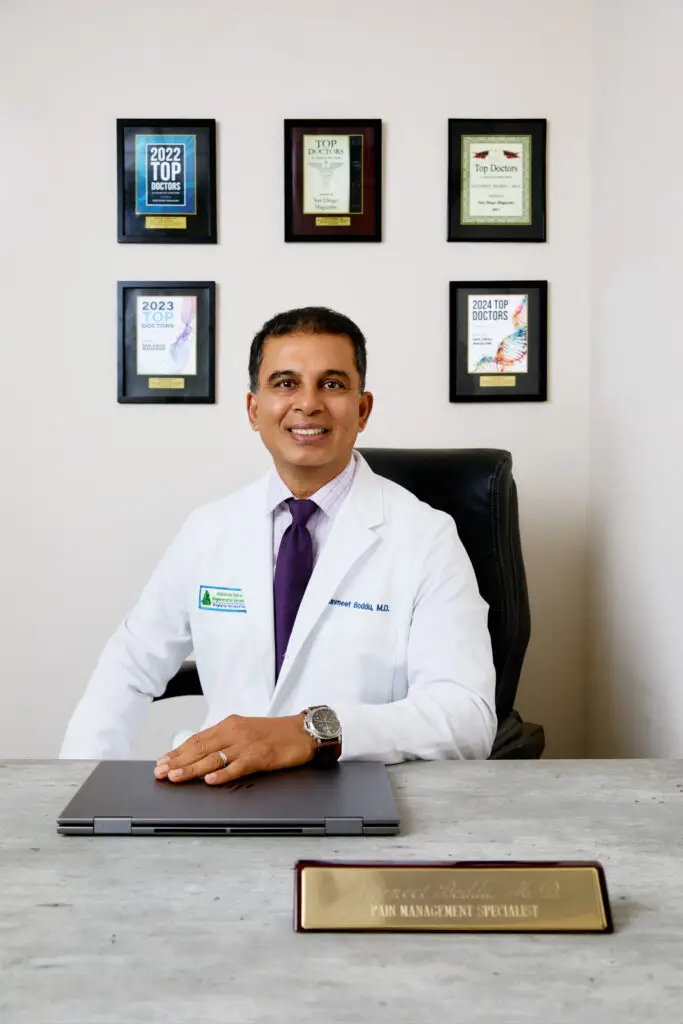
Kent Davy

Kent Davy served as editor of the North County Times for 16 of its 17 years. | Photo by Robert Benson

In October 2012, Doug Manchester, owner of U-T San Diego, bought out his biggest local rival, the North County Times, but it wasn’t until May that Manchester and U-T San Diego CEO John Lynch swept away the last vestiges of the northern paper when they shuttered its North County edition, laid off all the journalists at The Californian, and let go a dozen or more former NCT staffers. The move ended an 17-year run that began when Howard Publications merged the North County Blade-Citizen, the Escondido Times-Advocate, and The Californian in 1995. At its peak, the paper employed roughly 500 people. It covered three major wildfires, high school sports, local politics, and the 2001 power crisis, and even sent a team to Iraq three times. This is the tale of that paper, as told in the words of its staff to Eric Wolff, himself a reporter for the paper between 2009 and 2012.

DICK HIGH (Publisher, 1995–2007): The situation (in 1995) was, you had a problem: All three papers [the North County Blade-Citizen, the Escondido Times-Advocate, and The Californian] were seeing either a slow or rapid decline in profitability. Put them together and you had a negative 40 percent profit margin—and in decline. We set out with a very clear growth strategy: I’m going to put a lot more money into the things that other papers would be tight on. The result was that this thing turned around.

BRADLEY FIKES (Reporter, 1997-2000, 2001-2012): The joke was people at the Blade­-Citizen, they were the party-hearty types; the people at the Times-Advocate would have little teas and be eating their cookies.

KENDT DAVY (Editor, 1996–2012): There were two managing editors, Rich Petersen and Rusty Harris, at the Times-Advocate and the Blade. Rich became the first editor of the North County Times, and Rusty was managing editor. They had a crisis in the business office, couldn’t get the bills out, they were losing money. I remember standing in the newsroom in Munster, Indiana, saying, “Oh man, the Howards are going to close that thing down because the Howards are losing so much money.”

HIGH: The Howards were very tough. I remember, month after month, they would send me a check for a million dollars or more.
Below the Fold

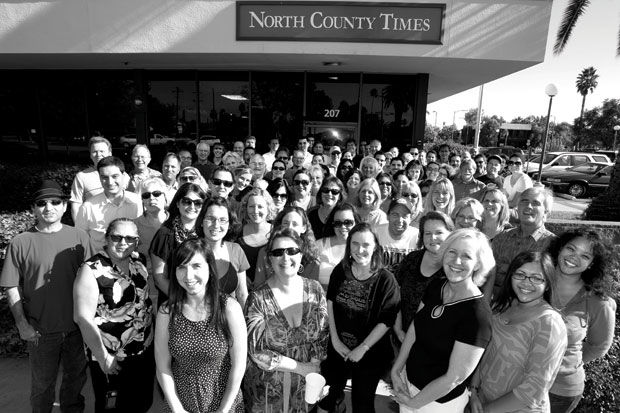
North County Times staff in 2012

The staff of the North County Times, outside the Escondido headquarters in September 2012.

High organized the North County Times circulation area into nine “zones,” meaning nine regions whose readers received unique front page and local pages based on their local news.

HIGH: We decided we would start zoning and sell a lot of little ads, sell a lot of the smaller mom-and-pop stores. If you look at the North County Times, we were full of a lot of little ads as well as big ads. If you have all big ads, it’s like monoculture. That’s okay, but it gets boring pretty fast. The ads themselves have readership value.

DAVY: One of Dick’s innovations was a letters page that was completely wide open. We were going to print every letter from the community and about the community, and as quickly as possible. This provided a forum for people to have debates there. When you got to election season, we ran four or five pages of letters to the editor in a given day.

“My view was, North County went to war. That’s all there was to it. Forty percent of all the fighting over there was done by guys stationed in North County.”
—Dick High, Publisher, 1995–2007

RUSTY HARRIS (Managing Editor, 1995–2010): We had this huge fire break out in western Escondido (the Harmony Grove Fire in 1996). Of course, the inland staff, from the old inland paper [the Escondido Times-Advocate], said, “Aha, this is our story.” The problem was, the fire was pushed by the wind so hard and so fast it became a bigger story in the coastal zones, which means the focus shifted to the old coastal paper, and then its staff covered the story. As hellish as it was and as heartbreaking as it was, it kind of tied the two staffs together.

In 1996, Rich Petersen left the paper for the Union-Tribune. High hired Kent Davy, then managing editor of the Times of Northwest Indiana.

DAVY: Newspapers that bind themselves or build a relationship to the community become mirrors, a mirror to the community itself. You do that by, first off, honoring what the community cares about. In trying to think about our role, we would say to our staff, we are North County-centric almost to the point of being parochial about it.

JAY PARIS (Sports Writer, 1995–2012): Friday nights were a complete fire drill. We were so local, we wanted to cover every high school and get names in the paper. Where a lot of papers maybe have a line score, we tried to be at every high school game.

CYNDY SULLIVAN (Photographer, Photo Editor, 1995–2007): I got a letter from a little girl. I had published a very candid photo of her, this little girl picking yellow flowers. She sent me a note saying she was famous now and people at her school were asking her for autographs. Maybe a month later, there was a horrific accident involving some Marines on a remote stretch of Winchester Road between Temecula and Hemet. They’re notoriously strict on access when it comes to anything involving the military. There was a very large police presence at the accident. I was not getting much cooperation, so I introduced myself to a police officer as Cyndy Sullivan with the Californian. The officer said, “Cyndy Sullivan? With the Californian?” I thought he was going to tell me to get out of there. He said, “We love you! Our family loves you! You took a picture of our daughter in the flower fields. We just love you, we have your picture on the refrigerator!” He told me he would help me in any way he could to gain access to this military situation.

In 1997, 38 members of the Heavens Gate cult committed suicide in Rancho Santa Fe.

JAMIE LYTLE (Photographer, 1995–2012): I came walking up with Timothy O’Hara, a reporter; we were way out in Rancho Santa Fe. He said, “There’s 38 dead people up in that house right there.” We were the only two guys there, there was one cop standing in front of the house. Four hours later, the whole world was there.

HAYNE PALMOUR IV (Photographer, 1995–2012): I remember flying in the helicopter above it. Kent sent me up there. We were just watching wrapped-in-white-sheet body after body after body coming out the door of that mansion and into a truck—the medical examiner’s truck. It went on forever.

In 2003, the North County Times sent reporter Darrin Mortenson and photographer Hayne Palmour IV to Iraq, the first of three trips the pair would make.

HIGH: My view was, North County went to war. That’s all there was to it. Forty percent of all the fighting over there was done by guys stationed in North County.

PALMOUR: [The newsroom staff] presented us with this cake and it had little plastic Army men on top of the cake. I do remember thinking, “How nice, a cake. A cake with Army men. Thank God it doesn’t have red icing pouring out.”

Palmour and Mortenson were embedded with a Marine battalion.

PALMOUR: We had a satellite modem we had gotten to work. We knew how to work it, but it was really hard, you had so many media trying to connect to it in that country. I had shot a ton, and Darren had a ton of stories, but by the time we stopped and put out the satellite gear, a massive sandstorm hit and we couldn’t do it. Five days passed before we could finally connect to the satellite. We kept envisioning that they were getting mad back in that newsroom. We found out when we came back that Kent didn’t even sleep at night.

DAVY: There’s a real helpless feeling when you are half a world away.

PALMOUR: There were a pair of Reuters photographers in the same battalion. They had a better satellite setup. I asked them, “Can you please let me send an email to my newsroom?” By the time I sent that email I’d seen a lot of death. I wrote, “We can’t connect to satellite, we’re getting error messages. Please tell our parents that we’re okay.” The Reuters photographer came back, “I got lots of replies to your email.” It was just this outpouring; we were so relieved. They thought we might have been killed.

In October 2003, the Cedar Fire swept through North County, burning 280,278 acres and killing 15 people.

PALMOUR: I was heading toward Scripps Ranch and I could see this gigantic brown cloud. This was a monster. This was a big dangerous monster and I just got into it, and next thing I got on a street and all the houses were burned down or still burning.

In 2002, Lee Enterprises purchased Howard Publications, and with it the North County Times, for $694 million. In 2005, the corporation bought Pulitzer Inc., for $1.5 billion.

HIGH: Lee is a good newspaper group, but they’re a corporation. They bought the Howard papers and it worked so well, they decided to do it again, so they decided to buy the Pulitzer papers. That time they went deeply into debt to do it. They paid a high price and then the Great Recession occurred. They got hung out to dry and pretty soon the company was basically de facto being run by the creditors. Wall Street creamed ’em.
Below the Fold

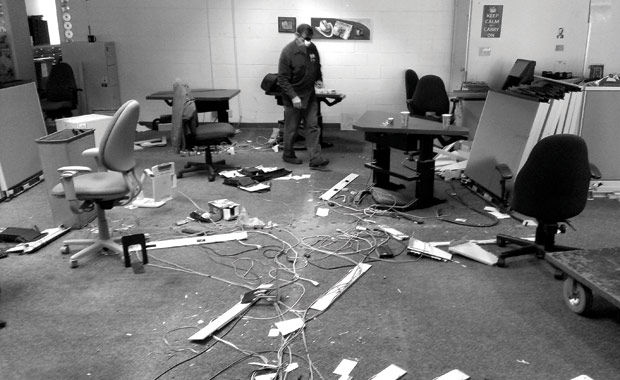
breaking up furniture in the old North County Times office

After the sale became official on October 1, 2012, workers employed by the U-T San Diego came in during the work day and broke up the furniture and carted it off. This shot faces the former locations of cubicles occupied by (from left to right) features editor Laura Groch, managing editor (now U-T business columnist) Dan McSwain, and editor Kent Davy.

In October 2007, the Witch Creek-Guejito fire and Rice Canyon fires killed two people and burned 197,990 acres in North County. The Rice fire burned 9,700 acres in Fallbrook.

DAVY: [Assistant editor for new media] Michael Donnelly was up all night on the website when we opened comments up and got thousands and thousands of comments. He engaged in conversation in Fallbrook and De Luz, which weren’t getting a huge amount of coverage. For a week or so, our comments section turned into this great conversation. People talked to us and as a community tried to sort out what was happening.

“Not a day goes by that someone doesn’t say [to me], ‘I hate the U-T, I wish the North County Times was back. I can’t get anything in the paper. They ignore us.'”
—Peter York, Publisher, 2007–2012

In Between 2007 and 2009, housing prices plummeted and foreclosures skyrocketed. The economy shook up the county and the paper.

ZACK FOX (Housing Reporter, 2007–2009): We could walk up and down the street and knock on people’s doors who’d had foreclosure notices. I could have a story on every other block. Nobody really knew what was going on. We came up with the idea of having a forum where we would discuss the state of the market. The response was completely ridiculous; we packed the [Escondido] library auditorium.

PETER YORK (Publisher, 2007–2012): It was a bell curve turned upside-down of newspaper revenues, starting in 2007 and bottoming out in 2012. We got down to three zones, we closed an office in Vista, we closed an office in San Marcos. We really got pretty lean and mean. We were still in the black.

DAVY: In the first 10 years or so of the North County Times, the shrinkage of the staff was all done by attrition. In 2007 we started seeing the signs. In 2008 it really accelerated; we started going through spasms of layoffs. It was the summer of 2008, I guess, in which 25 people were laid off. Those things were gut-wrenching for me. Most people took it with more grace and more courage than I would have expected. One guy left and was so angry. The publisher was driving out of the parking lot, [and] he slammed his fist into the hood of the publisher’s car.
In February 2009, 14-year-old Escondido resident Amber Dubois went missing. Her killer, John Albert Gardner III, confessed a year later to kidnapping and killing her along with 17-year-old Chelsea King.

Below the Fold

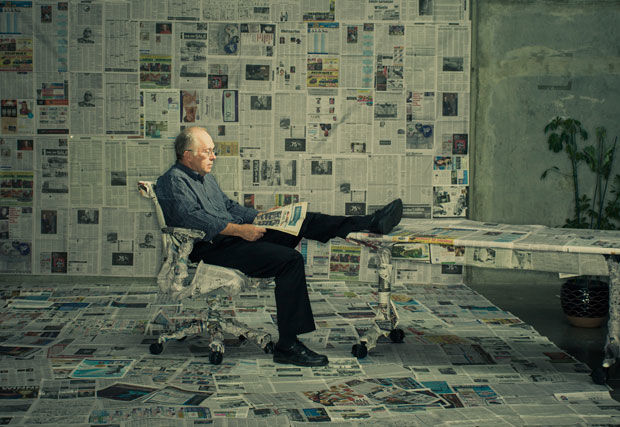
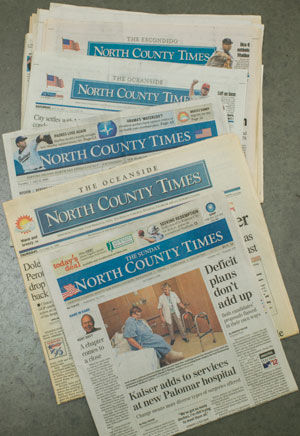
North County Times newspapers

North County Times newspapers.

CHRIS NICHOLS (Reporter, 2008–2012): It just so happens that I lived up the street from the Dubois family, about three or four blocks away. It was a very emotional time for the community. [Six months after the abduction], I went up to Amber’s room with her mother to go through all of her personal items and I watched her cry. That was one of the more difficult ones: Watching her mother cry, looking at all of Amber’s possessions, her posters, a Twilight poster on her wall, a sketchpad where she would draw wolves. It was a deeply personal experience—a direct window into their world and their pain.

YORK: (In early summer, 2012), myself, the finance director, Tim Bruinsma, and Peggy Chapman were told to meet our operating vice president [from Lee, in Iowa] over at the Carlsbad Airport. He and the VP of human resources flew in and said, “Hey, you guys have been sold.” That was the first time I heard. It was a shock to us as a management team.

NICHOLS: We all knew the North County Times’ parent company had financial troubles. Some of us were surprised, and maybe disappointed, that we were being purchased and the North County Times would go away.

HIGH: Wall Street took away North County’s newspaper and the execution was at the hand of Manchester.

YORK: Not a day goes by that someone doesn’t say [to me], “I hate the U-T, I wish the North County Times was back. I can’t get anything in the paper. They ignore us.”

DAVY: The sale of the newspaper was pretty stunning. I had bought the company line that they saw great value in us and would ride it up, just as they rode it down. So, when I was told of the sale, I was hit by a hammer. The worst part was living with the knowledge that the end was coming but being under orders to keep my mouth closed. There were only a handful of top NCT execs that knew in August or early September what was going to happen. And that knowledge carried with it the anxiety over what would happen to all the people who worked for us, after all, these people in a real sense were my family. I wrote in a column on the last day of September that this wasn’t the worst day of my life, but it was pretty hard nonetheless.

Subscribe to our newsletters

Select Options

By subscribing you confirm that you agree with our Terms and Conditions and Privacy Policy.

Everything SD JULY 1, 2026

Editor’s Note, July 2026: Hello Again

New editor Emma Veidt gives an introduction and her ode to the once-sleepy, now slept-on North County

Editor’s Note, July 2026: Hello Again
Courtesy of Visit Oceanside

I am fairly sure they don’t let you graduate from Carlsbad High School without a W-2 from Legoland. Being a Legoland MC (Model Citizen, the employee’s moniker) is a rite of passage for all of us who grew up in North County. If you spent a day at the theme park in the 2010s, I probably pointed you toward the Granny Apple Fries or measured your height at a ride entrance.

And now we meet again. I can still point you to quality fries.

This is my first full issue as the new print editor for San Diego Magazine. But it’s not my first time here: I was an editorial intern for these pages back in 2018 (see photo). To be a part of a constant study of the city, its people, its culture, then finding the most compelling stories and bringing them to life—it was incredibly impactful and solidified my decision to pursue all of this (local, print magazine journalism) as a career. Since my internship, I’ve gotten my bachelor’s and master’s degrees from the Missouri School of Journalism and worked for nearly five years at Backpacker magazine. And I’m back at San Diego Magazine, baby. There’s a real magic to narrating the lives lived and dreams dreamt in the place that built me. I am excited to be a part of building the culture of where I’m from. And, born in Tri-City Medical Center and raised in Carlsbad, I can’t think of any other place than our North County issue for me to make my grand entrance as an editor.

Editor Emma Veidt at San Diego Magazine in 2018

To me, North County isn’t just where I’m from; it’s home. Throughout the years, I have run thousands of miles (I did the math) up and down the 101 between Oceanside and Cardiff. I’ve spent thousands of dollars (an estimation, too painful to do the actual math) on BRCs—beans, rice, and cheese burritos—from Lola’s, Juanita’s, and the late, great Pollos Maria.

The stretch of land between Camp Pendleton and the 56 is easy to love. We’re quieter and a little more zenned out than our lower-latitude neighbors, sure, but we’re neither sleepy nor boring.

Do you think Scrojo, the Belly Up’s punked-out poster artist featured on page 68, could last a day somewhere boring?

What I’ve always loved about North County is that the culture shifts every couple of miles as you reach a new town. For years, the media seemed to cast the realm above the merge as a two-toned monolith: sleepy surf towns to the west, suburbs and country living to the east. The nuance of each section seemed flattened or clumped. I think you’ll see the vastly different cultures of North County in this issue—but all distinctly San Diego. Which is to say a little mellower, fewer airs, come as you are.

It’s hard to imagine that the dusty trails and vibrant, muraled alleyways of Escondido are just miles from the barefoot surfers roaming Leucadia. Even though the SDM editorial staff is made up of two lifelong locals and other longtime residents, we don’t pretend to be the experts on every street. What a good city media company does is find the people who are experts, who have a unique hyper-local perspective—and give them the stage.

So we picked six North County neighborhoods—Oceanside, Vista, San Marcos, Leucadia, Rancho Santa Fe, and Escondido—and reached out to artists, community leaders, business owners, anyone making their neighborhood brighter, and we had them describe their perfect day out and favorite things that give their neighborhoods meaning and culture. These itinerary curators included San Marcos’ Patricia Prado-Olmos, Leucadia’s Jeff Schade, Oceanside’s Aaron Crossland, Escondido’s Suzanne Nicolaisen, Rancho Santa Fe’s Charo Garcia-Acevedo, and Vista’s Steve Glaudini. If there’s anyone who lives and breathes North County, it’s them. Check out their recommendations in our feature on page 56.

This month, we’re also going back in time almost 15 years to the Big Bay Boom. Yes, that meme-ified Fourth of July fireworks show where enough pyrotechnics for a 17-minute show went off at once over San Diego Bay. Content Chief Troy Johnson remembers the day and dug back through the story for a hilarious locals’ take on the big debate: Was it the worst fireworks show of all time, or the greatest? (Page 38.)

Before I leave you to our hard work, a sentimental note. When my parents moved from St. Louis to San Diego in the early ’90s, my mom subscribed to San Diego Magazine to learn about her new neighborhood. Now, over three decades later, I’m here—on this planet and in these pages. I thought about my parents a lot as we worked on this issue. Maybe there are a couple new San Diegans reading this magazine for the first time. Maybe that’s you.

Well then, to both of us, I say, “Welcome.” Let’s do this.

Emma Veidt

About Emma Veidt

Emma Veidt is an editor at San Diego Magazine. She earned her bachelor's and master's degrees from the Missouri School of Journalism. She loves running, hiking, and rock climbing, but really, she mostly loves encounters with the street cats around North Park.

Everything SD JUNE 30, 2026

The Fireworks Disaster That Made San Diego a Legend

Eighteen seconds, one unforgettable mistake, and a Fourth of July story that somehow gets better with age

The Fireworks Disaster That Made San Diego a Legend
Courtesy of The Port of San Diego

There’s a famous video.

“This is insane!” the guy filming it seems to proclaim. “It’s the best fireworks show ever!” a companion confirms, inspiring a debate lasting over a decade.

All told, 7,000 fireworks exploded in the span of 25 seconds over San Diego Bay on July 4, 2012. A Michael Bay amount of unison. $125,000 worth of shells, cakes, Roman candles, and skyrockets had been placed on a barge—enough for 17 minutes of decorative sky flares—and…

Boom.

The sky looked like someone had set a giant Rorschach test on fire. Or as if whatever we all see in our Rorschachs—butterflies, clowns, tongue kissing, dads—was being electrocuted and lifted heavenward, amen. It was shocking how bright it was, how much it sizzled the local cosmos. Could’ve been one of those sci-fi films where a hole is ripped open between warring universes. But angstier, more metal—the work of some methy creator in a sleeveless concert tee.

The sound?

Lou Reed once released an entire album that contained 64 minutes of mindflaying guitar screeches and machine noises. No regular songs, just a fascinating amount of ear distress. His record label reps no doubt heard the melodic outro of their careers, but everyone else was in pain and stumped. That album still sounded better than the bay did that night. The bay sounded like a god who struggled with emotional regulation had blown his speakers and was working through the anger stage of AV grief.

In the left frame of the video, a middle-aged woman is attempting to drag her husband off by the hand. In no way does he want to go, possibly because he had missed the time Roseanne Barr sung the national anthem at a Padres game, simultaneously disemboweling and amusing America through the power of song. He would not willingly abandon an equally worthy San Diego trainwreck.

Another woman in the video appears to have just filled her beer, rushing to sit down for the show. She pauses mid-sit and returns to the full and upright position to properly bear witness. What was supposed to be prolonged entertainment has been so radically shortened that she will have to find another reason to drink. Lucky for her, drinking will be the only way to adequately process.

Locals remember the conspiracy theories. People wondered if the fuses had been tripped by a saboteur who was sympathetic to dogs, fish, or the growing suspicion that late-stage capitalism is a gorgeously branded but impossible dream sustained by remarkably efficient top-tier wealth retention and the soft compliance of fireworks-watchers who can no longer afford a house, a beer, or the personal impacts of human reproduction.

Speaking of being terrified of babies, babies were terrified. The children who witnessed it probably still can’t go near a candle store. But those kids will be tougher, perfectly scarred kids. They’ll write better songs.

That night helped us absolutely dominate the national news cycle. For a hot minute, we became America’s water-skiing squirrel. Now, years later, when you Google “fireworks gone wrong,” San Diego is always a top contender, along with that poor Nebraska family who nearly wiped out a couple generations in their front yard, their minivan somehow turning into a howitzer of recreational TNT.

There is still debate as to whether Big Bay Boom 2012 is the worst or greatest fireworks show of all time. But the advanced parts of civilization arrived at the truth as quickly as the women in the video did. It was undeniably amazing.

First of all, the point of Fourth of July fireworks isn’t “the intricate choreography of sky fire over a guaranteed amount of show time.” It’s about creating a vivid memory shared with some people you like, love, or would like to love.

BBB2012 used large-scale chemical fire to create the ultimate memory.

Sure, some people who iron their jeans subjected their family to a sermon about how San Diego managed to botch America’s birthday like a Disney princess-for-hire who smelled of quite a few Sauvignons.

The rest of us saw how perfectly it nailed the actual feeling of being an American. Because only a miniscule percentage of us bake postcard apple pies where every inch of crust is perfectly laminated like the wood in an Irish bar. Very few of us can paint on par with Picasso. The rest of us—despite truly believing in our America-activated abilities to achieve greatness in almost any field of our choosing—burn pies. We try to paint only to realize it looks like our fine motor skills have entered active death.

That’s why BBB2012 was the most perfectly American fireworks show ever: A wildly ambitious idea galvanized thousands upon thousands of people to both work on it and come to hold a beer and gawk at it, only to have it fail in the most glorious TMZ-level spectacle.

America isn’t about immaculate, storyless wins. It’s about how the framework of a country is solid enough that we can accidentally detonate our entire lives—a few times—and still probably be OK.

No one has America’d quite like San Diego did on that day. It was performance art. Lou Reed’s heart slow-clapped. Any brief municipal embarrassment quickly became a pride of our people. I can only hope the same for the Nebraskan yard family whose Dodge Aerostar became a hyperactive Death Star.

P.S. Local writer Maya Kroth compiled a quite great oral history of that night for Thrillist. The bottom lines for me were—it took nine months to prepare, no one was hurt, and even though the pyrotechnics company tried to zero out the bill, Big Bay Boom founder H. P. “Sandy” Purdon refused and paid them in full. This year will mark the 25th Anniversary of the yearly Big Bay Boom.

Troy Johnson

About Troy Johnson

Troy Johnson is the magazine’s award-winning food writer and humorist, and a long-standing expert on Food Network. His work has been featured on NatGeo, Travel Channel, NPR, and in Food Matters, a textbook of the best American food writing.

Features JUNE 29, 2026

5 San Diego Food Trends to Know About

From surprise revivals to changing dining habits, these are the shifts redefining the local culinary landscape

5 San Diego Food Trends to Know About
Photo Credit: Arlene Ibarra

Comebacks Are the New Kickoffs

If absence makes hearts (and stomachs) grow fonder, then shuttered restaurants quickly become the hottest tickets in town—something a number of iconic institutions found out after taking very public hiatuses after historically long runs. For instance, following a lengthy (and extremely flip-floppy) closing process after 92 years in business, Las Cuatro Milpas reopened two blocks away in Mercado del Barrio. Similarly, Carlsbad butcher shop Tip Top Meats reopened in the same location (albeit a smaller space) after the death of founder Joachim “Big John” Haedrich in 2023. Finally, after a whopping decade out of business, Sami Ladeki and chef Alfie Szeprethy brought back Roppongi to its original Prospect Street space, where it was the talk of the town in the late ’90s. All came back under the same proprietors, so they weren’t third-party nostalgia-licensing deals. The algorithm may have ravaged our attention spans away from all but the newest and shiniest, but this proves there’s still hope for our collective prefrontal cortex.

New Generations Take the Reins

Other local eateries honored their pasts by bringing in new perspectives. The Lion’s Share in Embarcadero, Milton’s Deli in Del Mar, Dudley’s Bakery in Santa Ysabel, and J-K’s Greek Cafe in La Mesa handed over the keys to new owners willing to take on a big task: maintain the soul of icons through particularly rough economic circumstances for restaurants, navigate big feelings from longtime regulars (who often don’t take kindly to change), and make some necessary changes to keep going for another few decades. Taking over a project in process can be a lot harder than starting from scratch. But building that feel-good nostalgia doesn’t happen overnight, so it sure helps to have a well-established playbook of success passed down from those who came before.

Courtesy of Sugarfish

The Expansion Class Arrives

It wasn’t just restaurant groups from Los Angeles that decided to put down roots en masse, although San Diego saw plenty of LA transplants recently (Sugarfish, Mr. Charlie’s, For the Win, Katsuya Ko, Bacari). Global brands like Chef Fei, Zuma, and Pepper Lunch have locations of their own on the way, and upscale Canadian eatery Joey joined to the inescapable gravitational pull of Westfield UTC’s culinary cosmos for its first spot in America’s Finest City. Good to see the rest of the world is catching up with what we’ve been seeing the last few years—San Diego is a dining destination already on the rise.

Choosing To Not Choose

Between the never-ending news cycle of doom and perimenopause brain fog, I’m at the stage in life where I’m more than happy to let someone else make a decision for me, especially when it comes to what’s for dinner. And based on the way a lot of menus look right now, I’m not alone. It seems like half the places I visit offer some version of a prix fixe, omakase, or tasting menu. Restaurants are embracing the curated experience to solve the problem of affordability (a fixed menu reduces food and labor costs, guarantees an acceptable check average, etc.) and critical thinking in one fell swoop. Omakase (meaning “I leave it up to you”) is far from a new concept in high-end Japanese sushi culture, but now that it’s popping up everywhere from coffee experiences to grab-and-go sushi and sandwiches, it’s gone from somewhat niche to nearly omnipresent.

Courtesy of Rikka Fika

Local Coffee Hit the World Stage

The world got an up-close look at San Diego’s coffee industry when we hosted the premier specialty coffee expo World of Coffee for the first time this April. San Diego’s long and rich coffee history stretches back to the late 19th century. Things percolated fairly quietly for around a century before really picking up steam. Today, there are nearly 200 specialty roasters and cafes across the county, with many earning national accolades like the Good Food Award (Steady State Roasting, 2020; Bird Rock Coffee Roasters, 2023, 2021, 2019, 2017, 2016), Roaster of the Year by Roast Magazine (Mostra Coffee, 2020; Bird Rock Coffee Roasters, 2012), and the Specialty Coffee Association Coffee Design Award for packaging (Rikka Fika, 2026). Now that we’ve moved past the comically insufferable coffee snob era of the early 2000s, even java newbies can feel comfortable walking into pretty much any coffee shop in San Diego, asking questions, trying a few things, and feeling confident they’re going to get great service and a great beverage.

Beth Demmon

About Beth Demmon

Beth Demmon is an award-winning writer and podcaster whose work regularly appears in national outlets and San Diego Magazine. Her first book, The Beer Lover's Guide to Cider, is now available. Find out more on bethdemmon.com.

Studio S JULY 7, 2026

Xplosion Box: A Customized Keepsake Your Loved Ones Won’t Forget

A customized memory-filled explosion gift box is a creative way to show someone you care

Xplosion Box: A Customized Keepsake Your Loved Ones Won’t Forget
Hero image – Birthday Explosion Gift Box

Finding a gift that feels truly personal can be surprisingly difficult. In a sea of generic options — flowers, gift cards, candles, and the like — Xplosion Box offers something more lasting: a customized keepsake built around the photos, messages, and memories that matter most. 

Founded by Southern California entrepreneur Jay Vijay, Xplosion Box LLC creates fully customized explosion gift boxes that arrive professionally designed, printed, assembled, and ready to gift. Each box opens layer by layer to reveal personal photos, heartfelt messages, pull-out albums, origami-style photo pockets, and hidden notes, turning a simple gift into an emotional reveal. 

The brand was built for people who want to give something meaningful without spending hours printing photos, cutting paper, folding cardstock, or assembling a DIY project. Customers simply choose a box, upload their favorite photos, add personal messages, and the Xplosion Box team transforms those details into a polished keepsake that feels thoughtful, personal, and beautifully made.

Xplosion Box offers personalized gift boxes for birthdays, anniversaries, weddings, graduations, Mother’s Day, Father’s Day, Valentine’s Day, Christmas, proposals, bridesmaid gifts, long-distance relationships, and thoughtful “just because” moments. 

Customers can choose from flexible customization options starting at $27. The Mini Surprise Box includes 10 photos, three message cards, and one hidden secret note, while the Mega Surprise Box offers a fuller keepsake experience with 40 photos, three message cards, and one hidden secret note. 

What sets Xplosion Box apart is its high level of customization combined with convenience. Filled with personal photos, custom text, decorative details, and layered surprises, each box gives customers the freedom to create a gift that feels one-of-a-kind — without having to make it themselves. 

At its core, Xplosion Box helps people turn favorite photos, stories, and words into something tangible: a keepsake that can be opened, revisited, and remembered long after the occasion has passed. asion has passed.

Partner Content
Everything SD JUNE 25, 2026

The Former Comedian Who Became the Internet’s Bee Guy

Jeff Russell traded dreams of SNL for bee rescues, building a social media following of more than 4 million people along the way

The Former Comedian Who Became the Internet’s Bee Guy
Courtesy of Mr. & Mrs. Bee Rescue

The Groundlings improv theater has churned out world-famous comedic talents like Will Ferrell and Maya Rudolph. And in San Diego, a former Groundling has used that training to campaign for a higher power. The power to protect bees.

“The goal was to try and get on SNL,” says Jeff Russell of his time in the improv troupe. “[But now], I have an audience, and I get to crack jokes and be silly and entertain and educate.”

That audience? The over 4 million people who follow Mr. and Mrs. Bee Rescue in the socialmediaverse. Jeff and his wife, Julie, operate the business, which means they remove unwelcome bees without harming them and rehome them to apiaries throughout the county. Their social media is a hub of videos of Jeff peeling open car trunks, flooring, barbecues—any cozy spot for a bee to set up shop—and using smoke to coax them out of the hive (sometimes working sans gloves or protective gear).

Bees in a hive will follow their queen, so finding and moving her helps speed along the relocation process. It’s “a really hard game of Where’s Waldo,” Julie says. But there’s a secret to it: “If the bees start running completely in some random opposite direction in a hurry, then we know that the queen is probably that direction,” says Jeff. Their social videos document this process in a way that turns a reasonable nightmare (being swarmed by bees) into a form of entertainment and advocacy. The Russells spread the apian gospel, sharing why relocating bees is the only option to consider.

Since the 1960s, bee populations across the US have shrunk drastically for a slew of reasons—habitat loss (postwar industrialization led to fewer farms and crops), climate change (petulant temps affect blooming schedules), and pesticides (when used improperly, they can be toxic for bees).

Bees are also responsible for up to 75 percent of all flowering plants; 35 percent of food crops rely on animal pollinators to reproduce. So, basically, we’d be living in a flowerless world fueled by a diet of wind-pollinated oats and Red Dye 40 without them.

Jeff and Julie met on Tinder in 2016. “It would have been more appropriate if we met on Bumble,” Julie says. A photographer and graphic designer, she had no experience in a swarm of stingers before 2018. When Jeff broke his back surfing, she had no choice but to step in. Later, when she was laid off from her job in 2020, she focused on growing Mr. and Mrs. Bee Removal’s social media accounts. That’s when their business took off. These videos work. People are learning.

“Quite a lot of my customers were [initially] like, ‘Why don’t we just kill?’” Jeff says. “Now, the vast majority are like, ‘You take them alive, don’t you?’”

Emma Veidt

About Emma Veidt

Emma Veidt is an editor at San Diego Magazine. She earned her bachelor's and master's degrees from the Missouri School of Journalism. She loves running, hiking, and rock climbing, but really, she mostly loves encounters with the street cats around North Park.

Everything SD JUNE 25, 2026

The Ancient Idea Behind One of San Diego’s Biggest Tech Success Stories

Jordan Glazier's Wildfire Systems is reinventing loyalty rewards for some of the world's biggest brands

The Ancient Idea Behind One of San Diego’s Biggest Tech Success Stories
Photo Credit: Matt Furman

You visit your favorite ancient Egyptian merchant, and as you’re buying some papyrus to hieroglyph your way to the 3000 B.C. version of a Pulitzer, he slips you a special token as a thank you for being so loyal. It’s the least he can do for keeping him in business, and you can use that reward to barter for anything you want—like beer.

A few thousand years later, those tokens would evolve to copper coins that American retailers handed out so you could spend. The Sperry & Hutchinson company introduced its groundbreaking “Green Stamps” program in the late 1800s. Today, your sandwich shop’s loyalty card is one hole punch away from giving you a free sub. And you’ve surely justified some extravagant purchases in the name of airline miles.

Point is: Free stuff has always been a compelling way to earn human loyalty. And with his Solana Beach–based company Wildfire Systems, Jordan Glazier has built one of the city’s biggest tech companies by modernizing that simple, ancient idea.

“Being able to save money when you shop is nice to have when times are good,” Glazier says. “When you have periods of inflation or financial stress, that nice-to-have becomes a must-have.”

He launched Wildfire in 2017. It’s essentially a white-label platform that builds and operates programs for enterprise brands across most industries—from banking (Visa, Citi) to travel (TravelArrow) to fintech (Sezzle, Acorns), to rewards (Shop Your Way, KashKick), you name it. Customers of, say, RBC (also a client), can install a browser extension or enable a feature on a mobile app that activates savings and cashback offers. Wildfire has now spent three straight years on Inc. 5000’s list of the fastest-growing private companies.

Glazier’s no stranger to scaling new ideas. As one of the early executives at eBay, he built and ran the consumer electronics, computer, and industrial equipment verticals. Later he turned San Diego tech company Eventful into the world’s largest online calendar and events discovery platform (CBS acquired it in 2014).

“Part of being an entrepreneur is building things and solving for things that haven’t been solved before,” he says.

It’s a lesson he learned early on. His grandparents started a women’s clothing manufacturing company in Chicago in the 1910s, and it remained a family business for over seven decades. Preteen Glazier would punch in as a stock boy and sit with the sales team making phone calls.

“That was my very first paycheck,” he says with a smile.

Now he and his own team of 70 have grown Wildfire’s revenue 721 percent over the past three years.

“I want to make sure we are building a business that’s built to last,” he says. “We are eight years in, and I feel like we’re just getting started.”

Glazier named the company because of how people recommend products and services to each other. Great shirt, where’d you get it? Anyone know of a good sushi spot? “Word of mouth,” he says, “spreads like wildfire.”

San Diego’s tech industry seems to come and go. There were predictions that the post-pandemic, remote work world would see all luminous brains migrating south to our famous clime, but that has been only partially the case. As tides turn, big names like Glazier’s hold anchor.

“San Diego is such a great place to live and to build a business,” he says. “I always feel sorry for people who don’t live here.”

Matt Eisenberg is an award-winning writer and photographer based in San Diego. A former ESPN editor, his work has also been published by CNN, Bleacher Report and the New York Daily News.

Partner Content JULY 9, 2026

You’ve Tracked Your Macros, Your Sleep, Your Steps. What About Your Drinking?

The Unconscious Moderation app is helping health-conscious professionals take an honest look at their drinking, without pressure, and without quitting as the only option.

You’ve Tracked Your Macros, Your Sleep, Your Steps. What About Your Drinking?
Courtesy of MyDry30

San Diego runs on optimization. Early mornings, clean eating, training logs, sleep scores. The people here take their health seriously and the results usually show. Most of them also have two drinks most nights, not because anything is wrong, but because the day was long and the glass is right there and it has always been right there.

That routine doesn’t get the same scrutiny as the rest of the stack. It doesn’t feel like something to examine. It feels like a reward.

Which is exactly what your brain has decided it is. When something reliably moves you from one state to another, your brain files it under things to repeat. Do it consistently enough and the cue stops requiring a decision. It’s 6pm, the laptop is closed, and some part of your brain has already placed the order.

Most habit-change tools work on the number. They count drinks, set weekly targets, send check-in texts. That’s useful for seeing what the pattern looks like. It doesn’t tell you where the pattern came from, or change it at that level.

Unconscious Moderation works underneath the habit. The app uses guided hypnotherapy sessions, structured journaling, and daily movement to address the subconscious associations that make reaching for a drink feel like the obvious next thing. The journaling isn’t a diary. It’s built to surface what your brain is actually reaching for, so you can meet that need directly rather than through a substitute.

The program runs 90 days. At day 30, you choose your own direction: cut back, drink more intentionally, or stop altogether. The app treats both as equally valid outcomes. The point isn’t to follow a rule you set on a Sunday. It’s to understand the pattern well enough that whichever path you choose, you’re choosing it clearly.

The people who tend to get the most out of it are not in crisis. They’re the ones who have tried tracking apps and found the count drifting back up regardless. They know exactly how much they drink and why. The awareness just hasn’t moved the habit. At some point, the work needs to happen somewhere the count sheet can’t reach.

San Diego’s wellness culture already knows that surface numbers tell only part of the story. What you eat matters, but so does why. How much you sleep matters, but so does the quality. The same logic applies here.

Learn more at um.app, or download the Unconscious Moderation app on the App Store or Google Play.

Partner Content

Thousands of savvy locals already get it.

San Diego's best restaurants, experiences, and events—handpicked and delivered to your inbox weekly. You in?

Close the CTA

Contact Us

1230 Columbia Street, Suite 800,

San Diego, CA