Featured articles
Food News
Food News
Food & Drink
Featured articles
Things to Do
Things to Do
Everything SD
Featured articles
Things to Do
Things to Do
Everything SD
Featured articles
podcast-ep
podcast-ep
podcast-ep
Featured articles
Food & Drink
Everything SD
Everything SD
Featured articles
Food News
Things to Do
Things to Do
Ready to know more about San Diego?
SubscribeReady to know more about San Diego?
Our food critic Troy Johnson visits Little Italy’s outdoor dining experiment
Editor’s note: This story was published in the January 2021 issue of San Diego Magazine, and was written when outdoor dining was permitted.
“The floor looks like pavement,” says my daughter. She’s nine, and she’s right. I had to explain to her that here, at this nice restaurant, we are eating in a parking space. Asphalt is the new dining-room floor.
It takes her a minute. She’s disoriented. Aren’t we all.
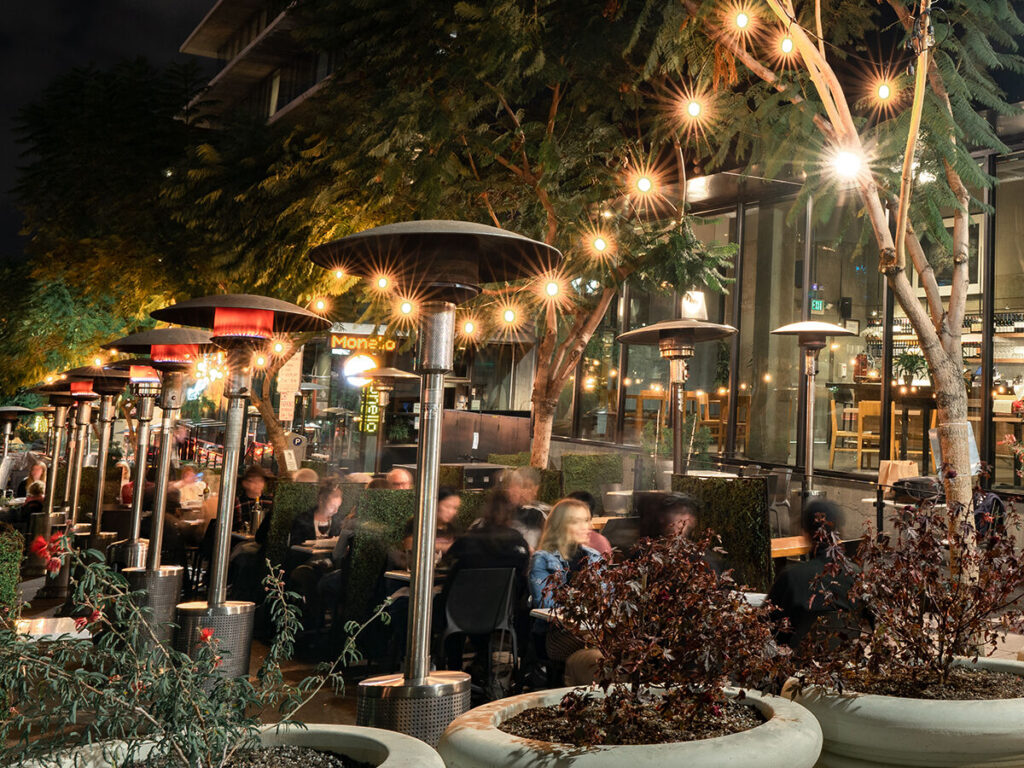
I didn’t eat at restaurants for four months after the pandemic started. I saw the pain of our restaurant people. I wanted to help, but I was scared. I wanted to support, but I didn’t want to be a reason this spread, a reason someone died. So I stayed home until the science coalesced, until I saw my personal green light to sit on a patio or a parking lot and pay a local chef and tip a local server. To scope out the seating area and mask habits, and make sure my daughter and wife have that famous six feet.
We all have to make our own decisions, read the tea leaves of the daily news. What’s safe, what’s not, what’s responsible, what’s reckless, what’s totally asinine and morally bankrupt. We draw the line, then adjust the line back and forth with each new study and stat. And as I sit here looking at my daughter, I feel safe.
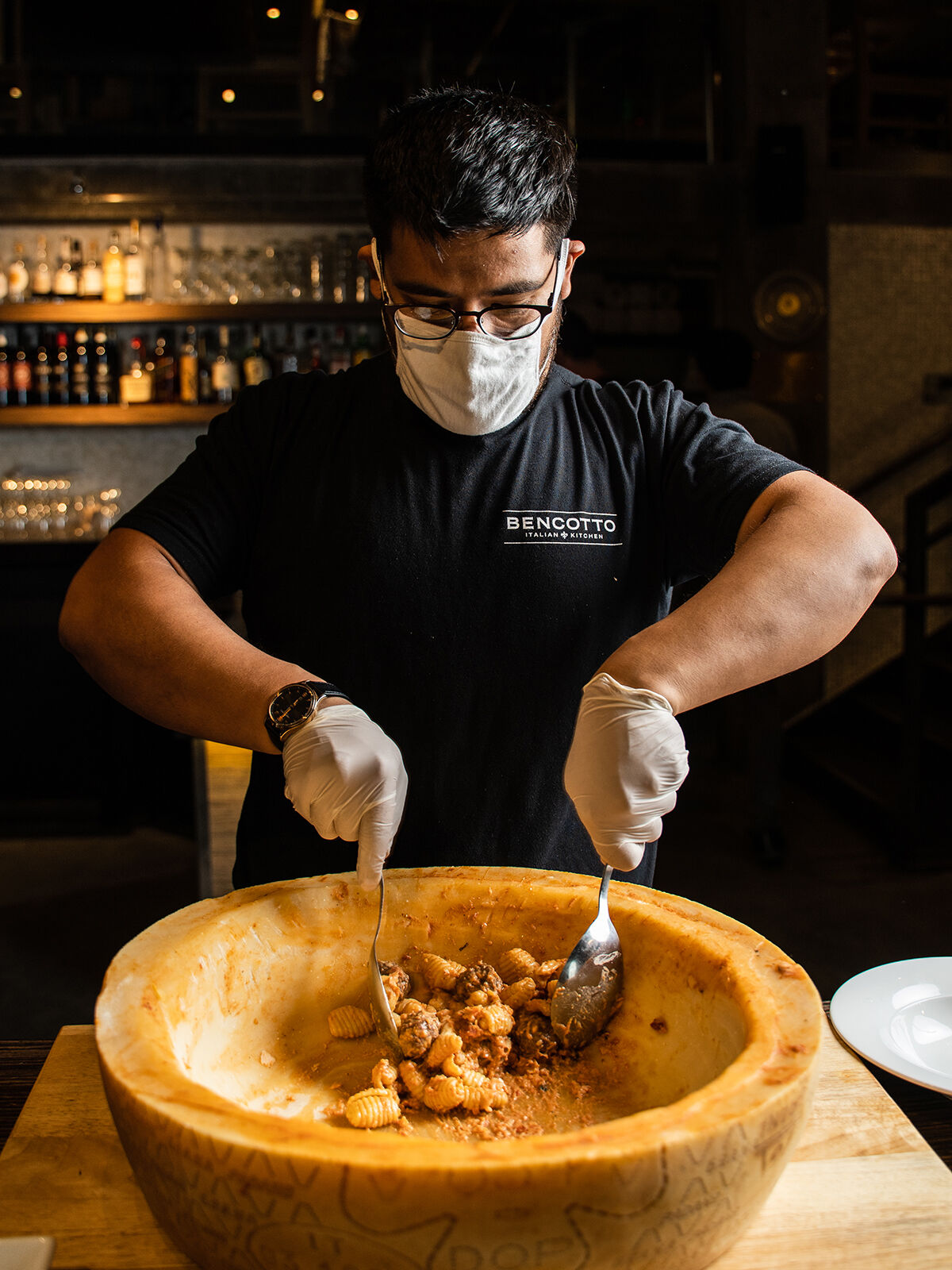
A server at Bencotto prepares gnocchi in a Parmesan wheel.
James Tran
It helps that I spoke with Dr. David Smith, chief of infectious diseases at UCSD School of Medicine. “I think dining outdoors is relatively safe. The biggest issue is who you bring to dinner with you,” he said. “People think, ‘Oh, they’re my friend, they don’t have the infection.’ That’s how bubbles become porous. When it comes to public health, I follow the guidelines. If officials say it’s okay to do something, then I think it’s okay.”
As I write this, outdoor dining is allowed. It’s okay. So I spent three days dining out.
Little Italy is the beating heart of San Diego’s food scene, and the pandemic has given it a murmur. This was ground zero for The Drastic Improvement. High-minded restaurants—Craft & Commerce and Prepkitchen first, then Juniper & Ivy and Herb & Wood later—gutted old warehouses and created food playlands, joining the timeless chorus of longstanding Italian bistros. That alchemy of old blood and new blood created a whole new scene. A heritage zone became a pan-cultural destination. Rent tripled, as did the good times. It’s a place to get octopus and negronis and art and design, a place to selfie and influence.
For me, the experience came down to a bottle of wine. I’m not sure how I saved it. Guess my body momentarily rediscovered fine motor skills, which have grown numb and clumsy from all the doomscrolling. I saw it out of the corner of my eye. It was sliding, picking up speed, making its move for the edge of the table, where it would have taken a swan dive three feet to the asphalt below, shattering and splattering 750 milliliters of very enjoyable cabernet sauvignon onto Date Street. But somehow, I snatched it.
The bottle was sliding because the excellent Italian restaurant Bencotto—like all San Diego restaurants—had been required to move their entire operation into the streets. And the street in front of Bencotto is slanted. It isn’t steep, not alpine by any means. But it slopes just enough that the nine-year-old sitting across from me is at a slightly higher elevation, appearing older and more able to impose her will on my life. Slanted enough that wine bottles occasionally make a run for it.
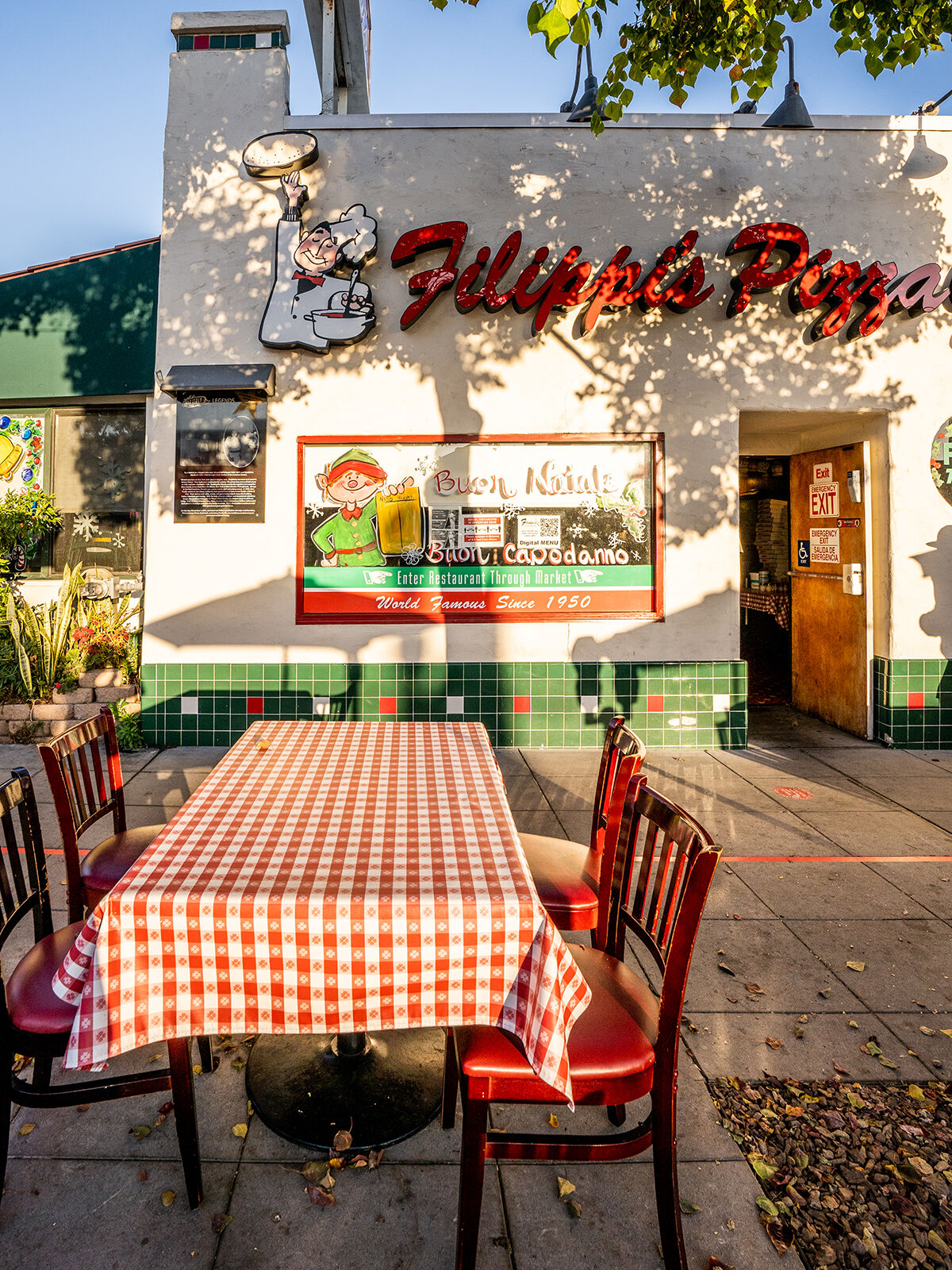
Filippi’s Pizza Grotto, which has been in Little Italy for 70 years, also adapted its dining service.
James Tran
Many restaurants here in Little Italy are getting a crash course in asphalt hospitality. On June 13, the neighborhood closed its major pedestrian streets to car traffic every Friday and Saturday, granting restaurants more room to reinvent themselves outdoors and creating more space for physical distancing and droplet avoidance. Restaurants turned themselves inside out, building both makeshift and sophisticated alfresco replicas. This experience spread to other parts of the city in August, as officials eased restrictions on “parklets,” allowing businesses to turn parking spaces into dining spaces. Mayor Todd Gloria was one of the early proponents. During his campaign, he told me, “Every time we have reclaimed space from parking and given it back to people it’s been a home run.”
I’m sure Bencotto’s owners don’t resent their incline. They must be glad they’re in popular Little Italy and have enough asphalt to put chairs and tables on, with a few temporary plant-wall partitions for charm. Many restaurant owners across the county aren’t lucky enough to have this kind of outdoor space to expand into. I’m sure Bencotto is grateful their parklet allows them to sell enough Barolo and cacio e pepe to pay enough of the rent, the gas, the electric, and a triage crew of employees until some vaccine or god brings a little mercy and we bid the coronavirus a middle finger. Grateful that in spite of what’s happened to the American restaurant industry during the pandemic, chef Fabrizio Cavallini is still back there layering his lasagna bolognese, which he and his staff have made from scratch every day in this location for 11 years.
As for what happened to the American restaurant industry—Statista created a graph that tracked the year-to-year daily change in “seated restaurant diners.” On February 29, 2020, the industry was seeing a 3 percent increase in customers over 2019. Optimism abounded. From that day on, the graph looks like a capital L. It goes straight south until it flatlines at the bottom. From March 21 through April 30, the restaurant industry was down 100 percent. The graph yo-yos through the fall, depending on how rosy or dark a picture news outlets were painting at the time. But on the very best day for American restaurants since the pandemic started—October 5—they still had 14.9 percent fewer diners than last year. As of press time in early December, the numbers have sunk again to 50 percent of normal business. According to Restaurant Business Magazine, in those darkest days around April, 5.9 million employees lost their jobs. Three decades of growth lost in six weeks. Every industry has suffered. But Google “industries most heavily affected by COVID,” and restaurants will be on every one of those lists.
Apologies for the momentary doomwriting. Point is, given all the perspective we should have by now—most crucially, about the lives lost—who gives a hint of a damn if that wine bottle had exploded? We’d just chalk it up as another punctuation mark in the grotesque run-on sentence that is 2020.
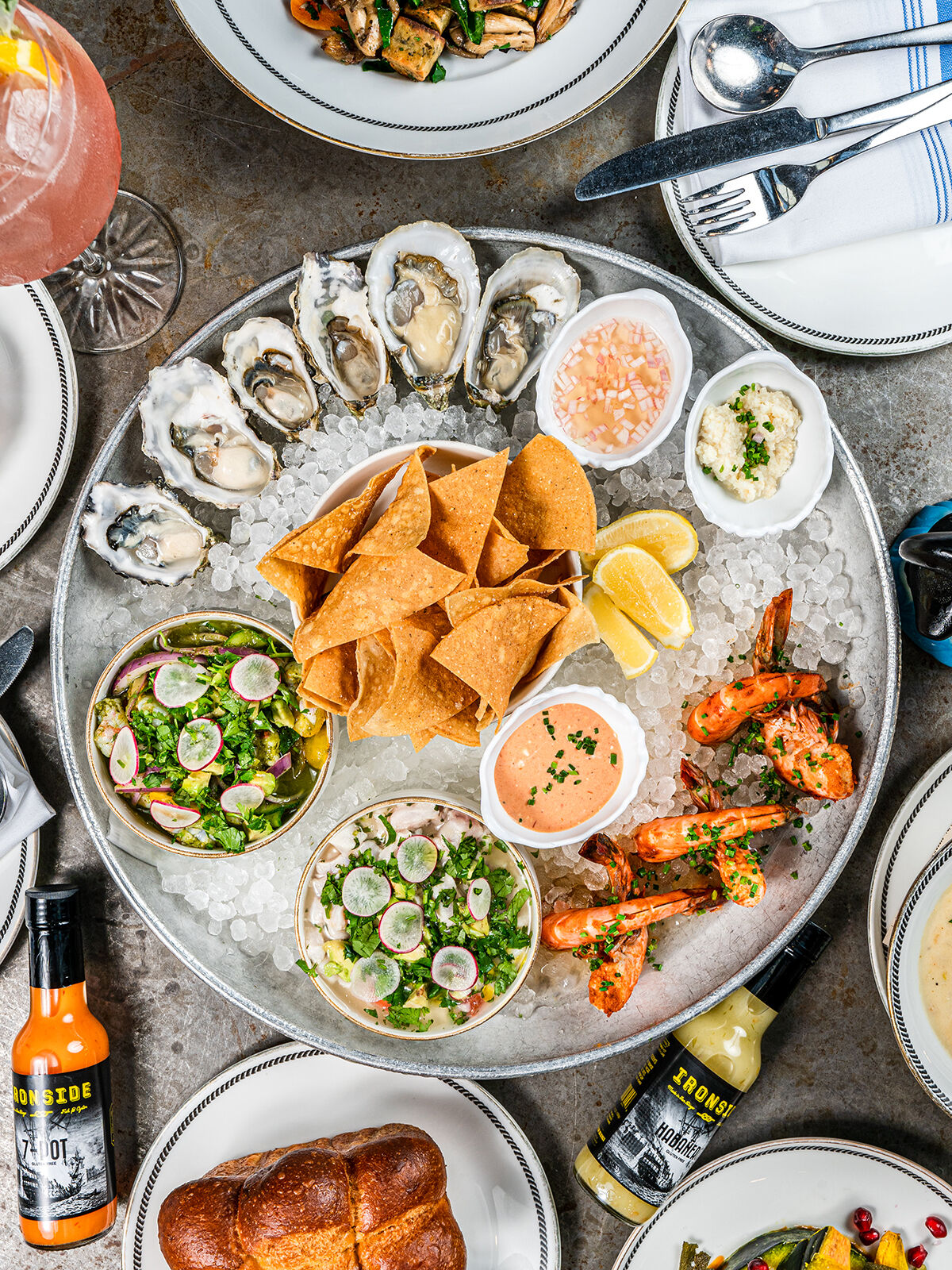
A seafood platter from Ironside’s raw ba
James Tran
But that in and of itself is a point. The barrage of terrible news makes it more difficult for the food-and-drink people—not just owners, but dishwashers, bussers, cooks, bartenders, food truck drivers, farmers, cleaners, brewers, everyone—to find or even ask for a sympathetic ear. Human sympathy is not a bottomless reservoir.
That wine also represents the small guilts of dining out during a pandemic. Guilt that I’m able to afford a restaurant meal, let alone a bottle of decent cabernet, when I know that in May the National Restaurant Association estimated that two-thirds of the country’s restaurant workers had lost their jobs. On the positive side, the bottle is a tangible expression of why I’m here: to support the people and industry I love. And the strongest way to increase the profits of a restaurant, aside from Venmo-ing them extra money, is to order drinks, which provide their biggest profit margin per item by far. The bottle represents the potential dangers of dining out while the virus is still at large and vaccines still just a promise, since we know that a couple glasses mean relaxed inhibitions. And with relaxed inhibitions come improper mask etiquette and loud talking and high fives and—god forbid—hugs or singing.
After spending three days here watching what it’s like for restaurants, I’ve decided: That sliding bottle is everything. It is just another small consequence of trying to be a responsible part of society while also trying to keep your business alive and your people employed. In the past, a broken bottle of wine was just an expected cost of doing business. Now, it’s more straw for the camel’s back. When I look around at Little Italy, every business seems a stalk away.
And so in the parking lot at Filippi’s Pizza Grotto—one of the oldest restaurants in San Diego, where an Italian family sold enough pizza and pasta to ensure a generation or two a decent life—I ate enough pizza and pasta to ensure a few more. A hostess with a firmly attached mask pointed an infrared thermometer at us before granting us a seat. Once cleared, we dined in the night air that smelled of stewed tomatoes and hand sanitizer. We saw the brown spots on the underside of the tent shades—a lesson learned about socially distancing heat lamps from flammable material. Their tables are more spread out than most restaurants I see (possibly because they’ve been here forever and control one of the only big parking lots in Little Italy). Still, I silently judge a table of eight for irresponsibly gathering, and am shamed when one stands to make a toast “to Dad.”
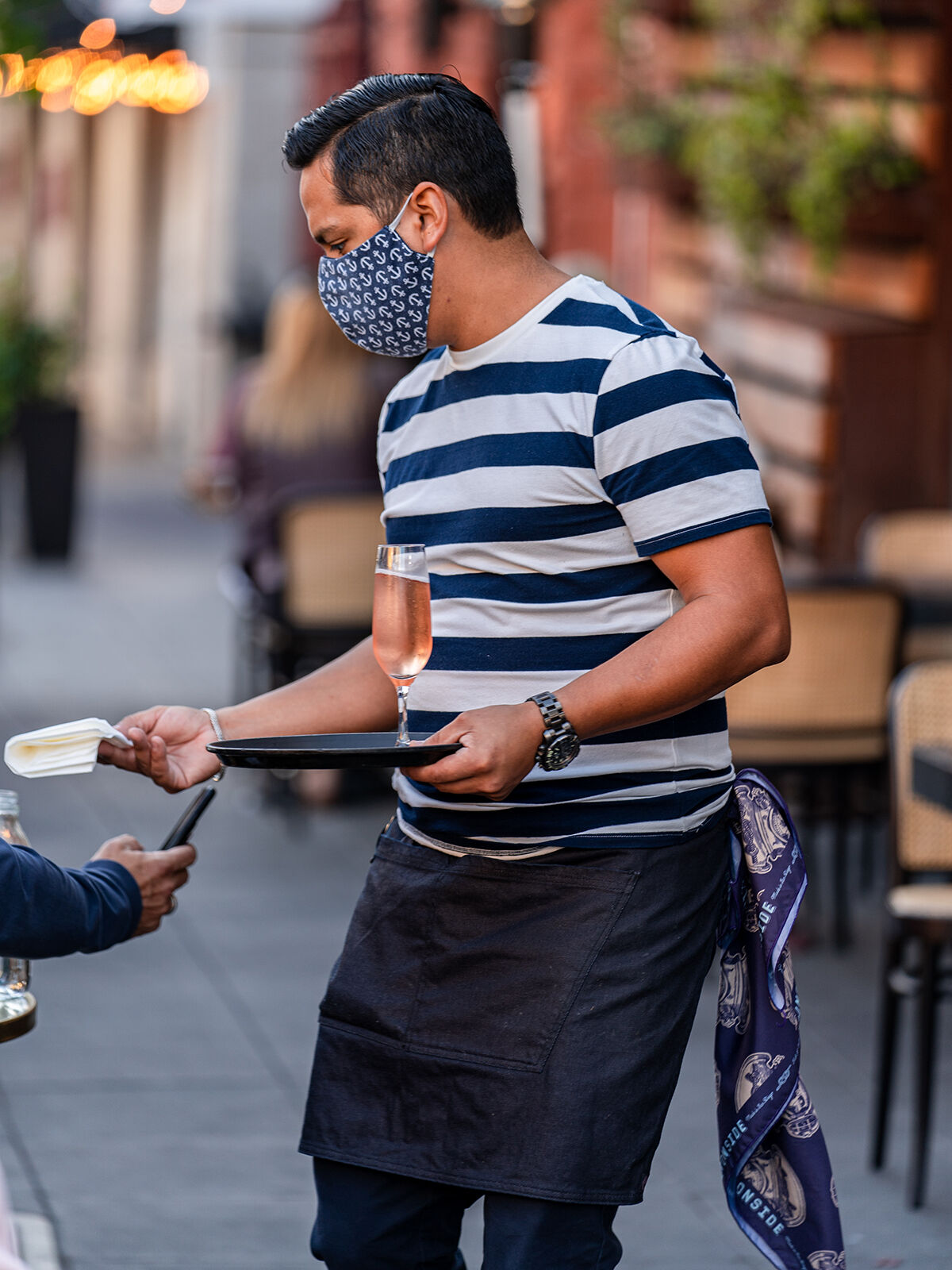
A masked server greets guests at Ironside.
James Tran
At Ironside Fish & Oyster Bar, where the daily bread is biblically good and chef Jason McLeod has earned a reputation for leading the sustainable seafood movement, keeping distance is honestly not as easy. Their sidewalk and parklet are smaller. I stare at the tables and use the mental measuring tape we’ve all developed—always looking for six feet.
We all dine out for different reasons. But since last spring, for me, it’s been a way to role-play normalcy. To listen to the music of forks on plates, of people conversing—not on Zoom, but in a shared physical space. I’ve realized I miss the sounds of restaurants the most. That joyful chaos. The remarkable thing about hospitality people is their ability to normalize the craziness. They make a little theater of it, and an elegance. Even their masks—designer and branded—look aspirational.
As we leave, I watch a vendor pull a wagon full of single roses in cellophane down the middle of India Street. He sanitizes them and sells them. A small band busks in the gutter for passersby. One of them plays a tuba, and I can’t help but envision a mist of corona coming out of his brass funnel. But I look at the small crowd—all spaced apart, wearing masks, being socially responsible—and I see them smile and groove for a brief moment before we all scatter back to our safe spaces. That smile and groove is why we leave the house at all.
Troy Johnson is the magazine’s award-winning food writer and humorist, and a long-standing expert on Food Network. His work has been featured on NatGeo, Travel Channel, NPR, and in Food Matters, a textbook of the best American food writing.
Offering everything from smashburgers to sundaes, the latest food hall from Tiger Hospitality opens its doors this weekend
Omakase and fixed-price menus are one way hospitality businesses are addressing our collective food decision-making fatigue. But on the opposite end of the spectrum, some restaurateurs are offering a bonanza of totally unrelated options for people ordering on a whim. Why not pair a lobster grilled cheese sandwich, açaí bowl, and ridiculously loaded hot dog?
Starting June 27, diners can satisfy their spur-of-the-moment appetites at Global Fork in Little Italy, the latest food hall from Southern California-based Tiger Hospitality.
Six different food concepts will be featured in the 4,685-square-foot, indoor-outdoor space along the Piazza della Famiglia promenade. The space’s inaugural lineup includes a mix of Tiger Hospitality-owned concepts (Cosmos Burger, La Vida, Lobster Lab, and Prik Ki Nu Thai) and outside operators (Seattle-based Moto Pizza and Handel’s Homemade Ice Cream). The space next door, Good Enough Cocktail Club, is another Tiger-backed brand, operated by the team behind Same Same and Amor y Magia in Carlsbad.
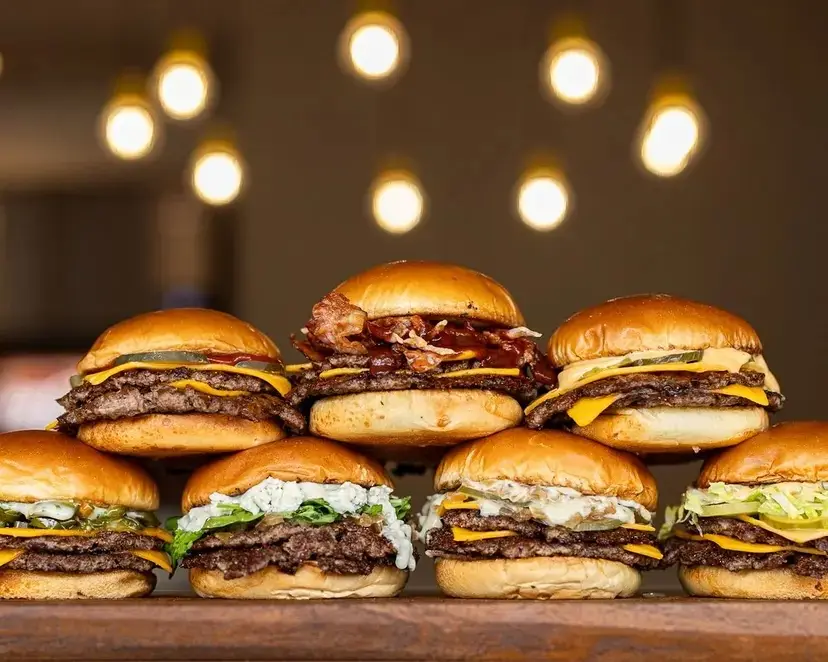
Cosmos Burger serves smashburgers stacked with classic toppings, while Lobster Lab focuses on seafood favorites including lobster rolls, shrimp rolls, and lobster mac n’ cheese. Prik Ki Nu Thai adds Thai street food to the mix, with traditional noodle, rice, and stir-fry dishes. And for those looking for something on the lighter side, La Vida offers things like smoothies, salads, and wraps.

Moto Pizza focuses on Detroit-style square pizza with Filipino influences and, despite the name, is not affiliated with Mr. Moto Pizza. Handel’s, which began in Ohio in 1945, will offer dozens of flavors ranging from staples like chocolate and vanilla to rotating specialties packed with candies, cookies, and other mix-ins. (Handel’s already has a number of locations across San Diego, with a La Mesa store coming later this year.)
Some of these vendors already operate at Miramar Food Hall, the other Tiger-owned food hall in San Clemente. And some of them will also appear in Station8, the next food hall slated to open in UC San Diego’s Theatre District Living and Learning Neighborhood later this fall. But if you ask me, reviving the space that housed the Little Italy Food Hall before its closure last February is a far better outcome than leaving empty suites smack in the middle of an area saturated with fantastic food options. Plus, where else can you order a slice of beef adobo pizza alongside squares of caviar toast and a banana split?
Global Fork opens June 27 at 550 W. Date Street, Suite B, in Little Italy. Initial operating hours are from 9 a.m. to 9 p.m., seven days a week, but vendor hours may differ.

Listen Now: The Latest in San Diego’s Food and Drink Scene
Have breaking news, exciting scoops, or great stories about new San Diego restaurants or the city’s food scene? Send your pitches to [email protected].
Beth Demmon is an award-winning writer and podcaster whose work regularly appears in national outlets and San Diego Magazine. Her first book, The Beer Lover's Guide to Cider, is now available. Find out more on bethdemmon.com.
As a wave of endings hit San Diego’s food and drink scene, we survey the damage and remain hopeful for an upturn in the industry
I know every day can’t be a Best Restaurants issue or badass food festival. But damn, it’s been a bleak week for San Diego food and drink (and it’s only Wednesday). Let’s start with Comedor Nishi, which closed this week without any warning. This La Jolla eatery had all the markings of The Next Big Thing when it opened last July. Two superstar chefs hailing from Mexico City destination restaurants Pujol and Máximo? Check. Totally drool-worthy wall of Instagram pics? Check. A menu of absolute breakfast bangers like a torta de cochinita pibil and cured salmon tostada? Check.
But even big names, a solid menu, and impeccable service aren’t surefire defenses against the powers that be. Just look at the James Beard Award-nominated Roma Norte, which closed in August after a year.
Monday may very well be remembered as one of San Diego’s worst restaurant industry days since the pandemic. At least three other hospitality ventures shuttered that same day, also without notice—Camino Riviera in Little Italy, Casa de Freds in Old Town, and Black Plague Brewing in Oceanside and Escondido.
Fred’s in particular struck me by surprise—it’s been around for 25 years. I’m unashamedly a huge fan of its patio and ridiculously giant margaritas. For such a longstanding figure to go so gently (not to mention suddenly) into that good night without even a whiff of warning ahead of time feels especially disheartening. “Like many small businesses, we’ve faced challenges that became insurmountable, including rising operational costs and a substantial decline in tourism,” stated its Instagram post.
Tourism, San Diego’s economic bread and butter, has been down since coronavirus shutdowns in 2020, and Old Town is ground-zero for visitors. If anywhere is going to get hit hard by a decline in travelers, it’s there. So I guess it’s less surprise, more sadness.
Black Plague has yet to make a public statement about its closure, which was first reported by San Diego Beer News. But again, huge bummer. Its gothic brewery branding was equal parts unique and macabre, and its beer more than held its own in a sea of world-class craft breweries. It stuck it out for an admirable eight years, and I doff my cap to them.
Camino Riviera acknowledged its sudden closure only after its final day of service, which was Sunday, September 28. According to owner and restaurateur Matt Spencer, the decision came following repeated noise complaints to the city from an anonymous neighbor.
“Over the course of several years, we invested heavily to address these concerns: installing a new roof, implementing sound mitigation strategies, hiring a sound engineer, reconfiguring indoor and outdoor operations multiple times, and building new seating areas,” said Spencer in a statement. “Despite these efforts, we found it impossible to operate the way we had been operating those years prior and we simply couldn’t afford to hang on.”
And these were just the closures on Melancholy Monday.
In September alone, Flap Your Jacks, Red House Pizza, Blackmarket Bakery, Copper Top Coffee & Donuts, and Woodstock’s Pizza in Pacific Beach all closed their doors forever.
Running a restaurant is hard and expensive. It always has been and it sure as hell isn’t getting any easier. In San Diego, rent prices are up, tourism is down, diet trends like Ozempic-use is potentially making a dent in some markets, and new business models are popping up specifically to maximize marketing efforts and rent costs. It’s a jungle out there, and sometimes even the strong, savvy, or skilled don’t survive. So what can we do?
Eat out when you can. Pick up a little something at your corner shop. Maybe get that avocado toast. Sometimes, businesses close due to a landlord issue or noise complaint and there’s just not a whole lot the average Josephine can do about that. But if you love something, shout it from the rooftops. Or in this scenario, on Yelp.
Listen Now: The Latest in San Diego’s Food and Drink Scene
Have breaking news, exciting scoops, or great stories about new San Diego restaurants or the city’s food scene? Send your pitches to [email protected].
Beth Demmon is an award-winning writer and podcaster whose work regularly appears in national outlets and San Diego Magazine. Her first book, The Beer Lover's Guide to Cider, is now available. Find out more on bethdemmon.com.
Through Good Enough, Mike Mayaudon and Shawn Seaman want to bring approachable bar culture to Little Italy
Is it me, or is it virtually impossible to spend less than $50 eating out nowadays? No shade to operators just trying to keep their margins high enough to pay workers and stay in business, but my wallet is definitely feeling the burn.
That’s far from a universal truth, of course. You’ve just gotta look. Plenty of places are leaning into budget-friendly specials (Herb & Sea’s “Happy Meal” comes to mind—a smash burger with fries, three oysters, and a glass of sparkling wine will set you back a very reasonable $20). Bars are responding in kind, adding ultra-premium items for high rollers as well as classic basics that keep prices in single digits, or at least close to it.
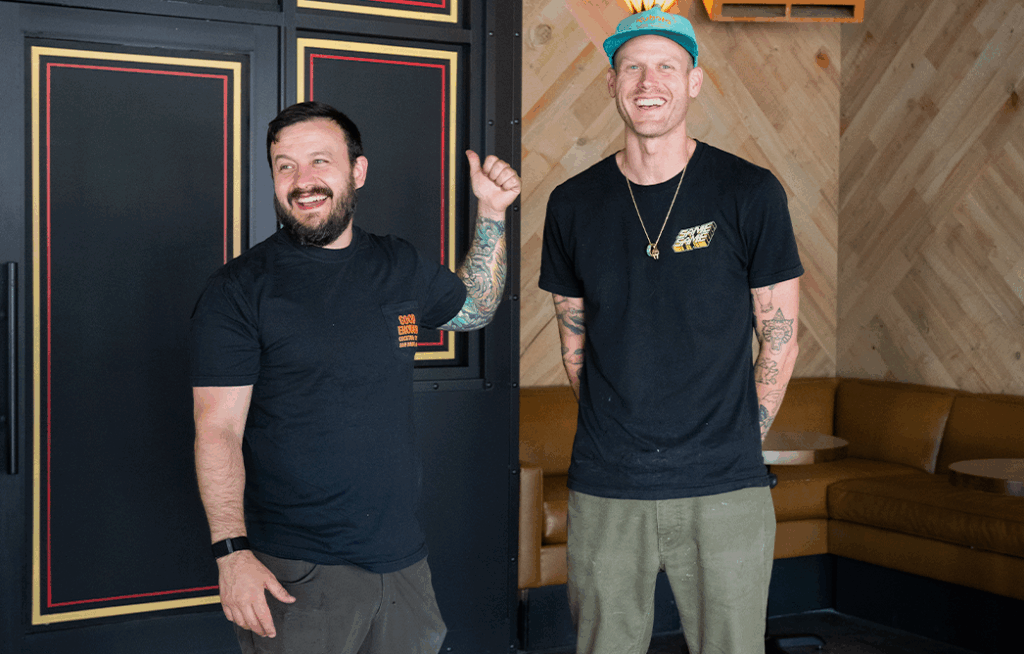
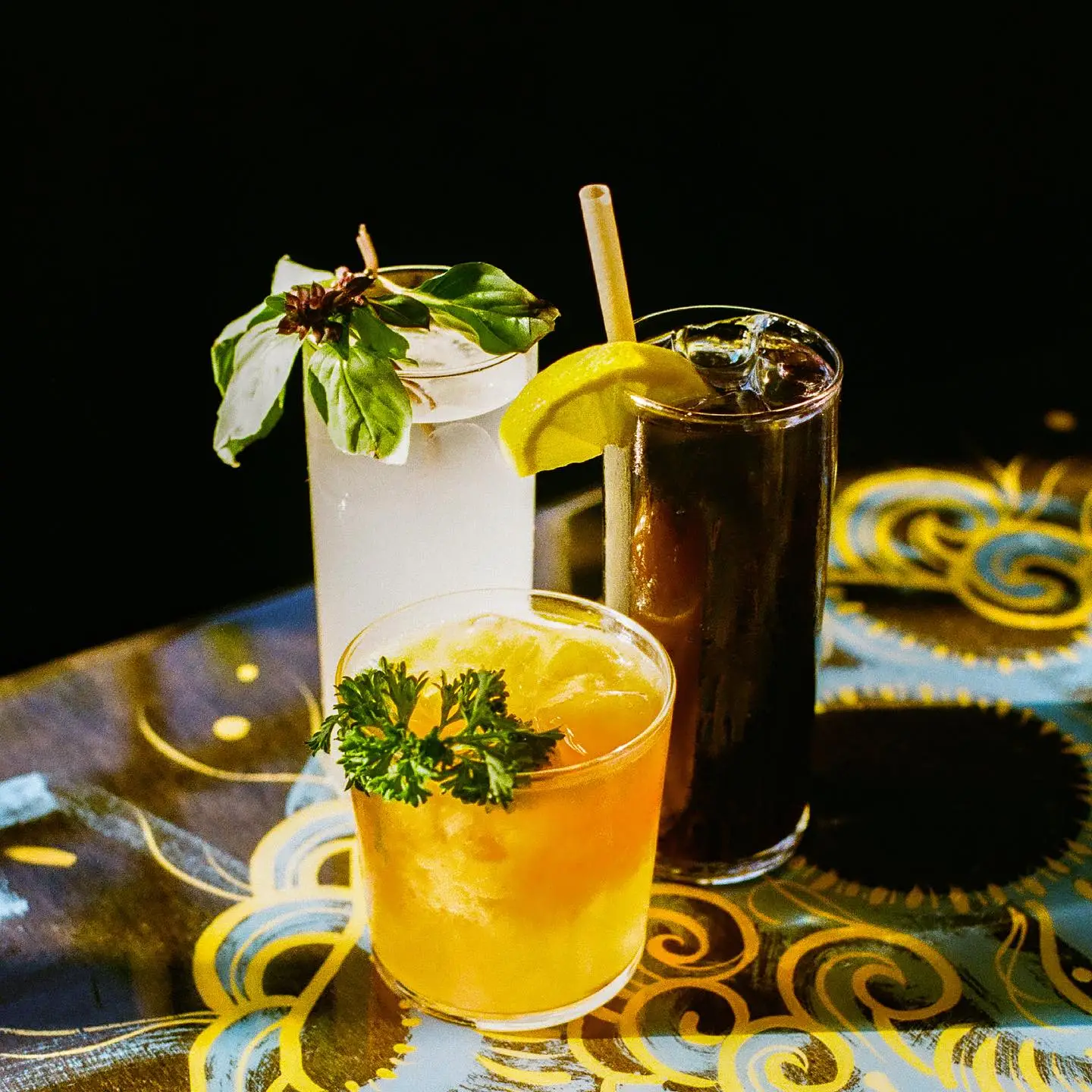
That’s precisely what Mike Mayaudon and Shawn Seaman hope to do when they open Good Enough in Little Italy. For $14, guests can get a signature house cocktail, most of which will be twists on traditional drinks. You may already be familiar with some of the drinks from the pair’s other venture, Same Same in Carlsbad—like the Sioux City Old Fashioned with bourbon, a root beer reduction, R&D cherry apple bitters, Angostura bitters, and absinthe.
“I think there’s a void that we can fill there, in terms of something that’s just really approachable,” says Mayaudon. “Shawn and I have both worked in really nice higher-end places and then dive bars… we’re kind of blending a mix of the two.”

Of course, operating in Little Italy doesn’t come cheap. The pair promises to offer plenty of premium items as well to accommodate all budgets. “We were even talking about, jokingly, putting on a baller menu,” laughs Seaman. “We might even do, like, $150 Manhattan or something.” But, Mayaudon adds, if you want to follow up a $30 Old Fashioned with a cheap beer and shot, they’re more than happy to oblige.
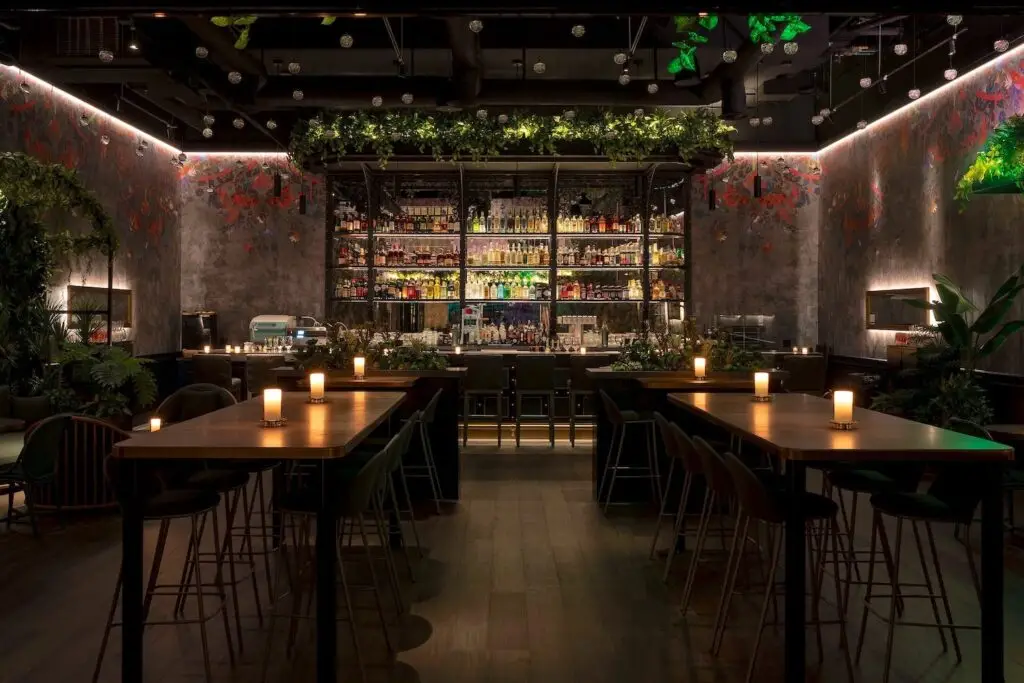
They’re not cutting corners on the drinks or food, which will feature Spanish-style tapas and pintxos like an off-menu Basque cheesecake limited to eight slices a day. Nor will the sound system be the typical bar speakers plugged into someone’s Spotify playlist. Vintage 1975 Cornwall speakers will provide an “old, warm sound,” promises Seaman. It’s not a listening bar, per se, but hi-fi vibes are definitely on the menu with lots of records and local art completing the space’s aesthetic.
From September 2 through December 5, Good Enough will feature bar takeovers for two-week stints with brands like Fernet-Branca, WhistlePig, and more. But overall, Seaman says they just want to be a place that’s approachable, affordable, and a good hangout spot. “It’s been wonky times, and everyone just keeps jacking their prices up,” he says. “We’ve got your back in these wonky times.”
Good Enough soft opens on Friday, August 22 in the former Basta space. Hours will be from 5 p.m. to midnight daily.

At 6:30 p.m. on Friday, September 12 at the Sheraton San Diego Resort, Rumorosa is throwing a four-course wine pairing with Clos Benoit. The Valle de Guadalupe–based winery specializes in “food wine,” meaning it’s specifically designed to pair with meals, and by the look of the menu, they know how to do it. The La Paloma White kicks things off with a shrimp ceviche, followed by sea bass with a rosé, Mexican-style birria osso bucco with a 2020 red, and of course everyone’s favorite chocolate cake with another red vintage. Tickets to the 21+ event are available now.

Listen Now: The Latest in San Diego’s Food and Drink Scene
Have breaking news, exciting scoops, or great stories about new San Diego restaurants or the city’s food scene? Send your pitches to [email protected].
Beth Demmon is an award-winning writer and podcaster whose work regularly appears in national outlets and San Diego Magazine. Her first book, The Beer Lover's Guide to Cider, is now available. Find out more on bethdemmon.com.
Stake Chophouse & Bar brings contemporary classics and old-school service to the heart of Coronado
Stake Chophouse & Bar isn’t your average steakhouse. Blue Bridge Hospitality’s Coronado outpost is a modern interpretation of a big-city steakhouse nestled in the heart of the small coastal community. The team at Stake has reimagined the whole steakhouse experience. By prioritizing a seasonal farm-to-table sourcing philosophy, a personalized guest experience, and unique service touches, like a formal steak presentation and a bespoke knife selection process, Stake distinguishes itself in a sea of steakhouses.
Exceptional steaks, including Wagyu from Japan, Australia, and the U.S., and fresh seafood flown in daily form the core of Stake’s culinary identity. The menu features a five-course omakase-style steak experience highlighting house favorites, plus an array of cuts, and classic steakhouse staples—think a wedge salad, baked potato, or pasta carbonara—refined for a contemporary palate without losing their traditional appeal. Stake focuses on seasonal sourcing from the region’s best family farms and specialty purveyors, and incorporates intentionally unexpected touches to create something truly unique.
“I challenge our chefs and myself to take it a step further in sourcing,” says Chef Ronnie Schwandt. “It’s important to us to highlight different farms, unique one-off farms—whether it’s cattle, strawberries, a local fisherman or from anywhere in the United States, we’re always trying to find that niche.”
Beyond the menu, Stake emphasizes outstanding service, says Vinny Spatafore, Director of Hospitality Operations. Staff maintains detailed notes, allowing them to remember guests by name, recall previous orders such as a favorite martini (also memorable for the customer since it’s served in an extra tall, distinctly-shaped glass), and celebrate special occasions like birthdays and anniversaries.
“When you have those points of topic that you remember about a guest, they appreciate that,” he says. “Our servers are really good with that—we have a couple servers who have been here since the beginning and they’ll remember somebody from years ago, their name, their kids’ names, where they live. I’m really thankful to have a great front of house staff.”
Award-winning wines, rare whiskeys, special events, and a complementary black car service that provides transportation for guests throughout Coronado add to Stake’s appeal.
Schwandt stresses that Stake offers more than a meal; they aim to give patrons something unforgettable.
“It starts when you walk up the stairs and are greeted by the hostess—that sets the tone for the night. Then you’re greeted by a server, who may know you by name, and can guide you through the menu and curate as they get to know you,” says Schwandt. “Most people leave kind of blown away; they leave feeling like they just had an experience. That’s the goal, right? Whether you’re serving smash burgers or high-end steak, you want somebody to leave thinking, Wow, that was awesome.”
The LA-founded brand and popular sushi joint will set up shop in Little Italy at 2100 Kettner
San Diego has no shortage of great sushi. Sushi Ota is the icon. Kinme Omakase oozes exclusivity (and quality). Hidden Fish brought omakase-only dining to the city. Soichi has a Michelin star for Pete’s sake, and Sushi Tadokoro is undeniably great. There’s Sushi Gaga and Hane and Shino and Maru and Wrench & Rodent and Kaito. Hotel del Coronado just got a Nobu.
But this top-notch scene comes with a cost, literally. Sushi tends to either get saved for a special occasion or, on the opposite side of the spectrum, picked up from a cold case at your local grocery store accompanied with a requisite blob of radioactive-green horseradish. (Let’s be honest, we’ve all done it.) Few places can balance general affordability with high quality.

But that’s what Sugarfish has done pretty successfully in Los Angeles, Orange County, and New York over the past 17 years. And it’s what they say they’ll bring to San Diego when they open next spring in Little Italy—at 2100 Kettner, the LEED-certified, six-story, mixed-use building that currently houses Postino WineCafe, Slice House by Tony Gemignani, and the HQ for the city’s pro soccer team, San Diego FC.
In 2008, the partners—chef Kazunori Nozawa (whose restaurant Sushi Nozawa had been a star in Studio City for decades), Jerry Greenberg, Tom Nozawa (Kazunori’s son, also a chef), Lele Massimini, Cameron Broumand, and Clement Mok—opened the first Sugarfish in Marina del Rey. Over 17 years, they’ve cautiously expanded to 10 more locations in LA and five in New York City (with one more on the way). Massimini says the slow growth was intentional.
“Our goal is always to deliver the best bite of sushi to every guest when they come to Sugarfish,” he explains. “When we were sure that we could deliver that in San Diego, that’s when we pulled the trigger.”

And the local bounty makes sense. Chefs in Japan will often source fish from San Diego and Baja, says Tom Nozawa: “Really good stuff comes out of the San Diego waters.”
One of the Sugarfish signatures is their approach to rice—made with a proprietary rice vinegar recipe and served warm and loosely packed, which contrasts nicely against the cool fish. But don’t look for funky fusion sauces or rolls. “We’re sticking with our roots… serving simple, great sushi,” says Nozawa.
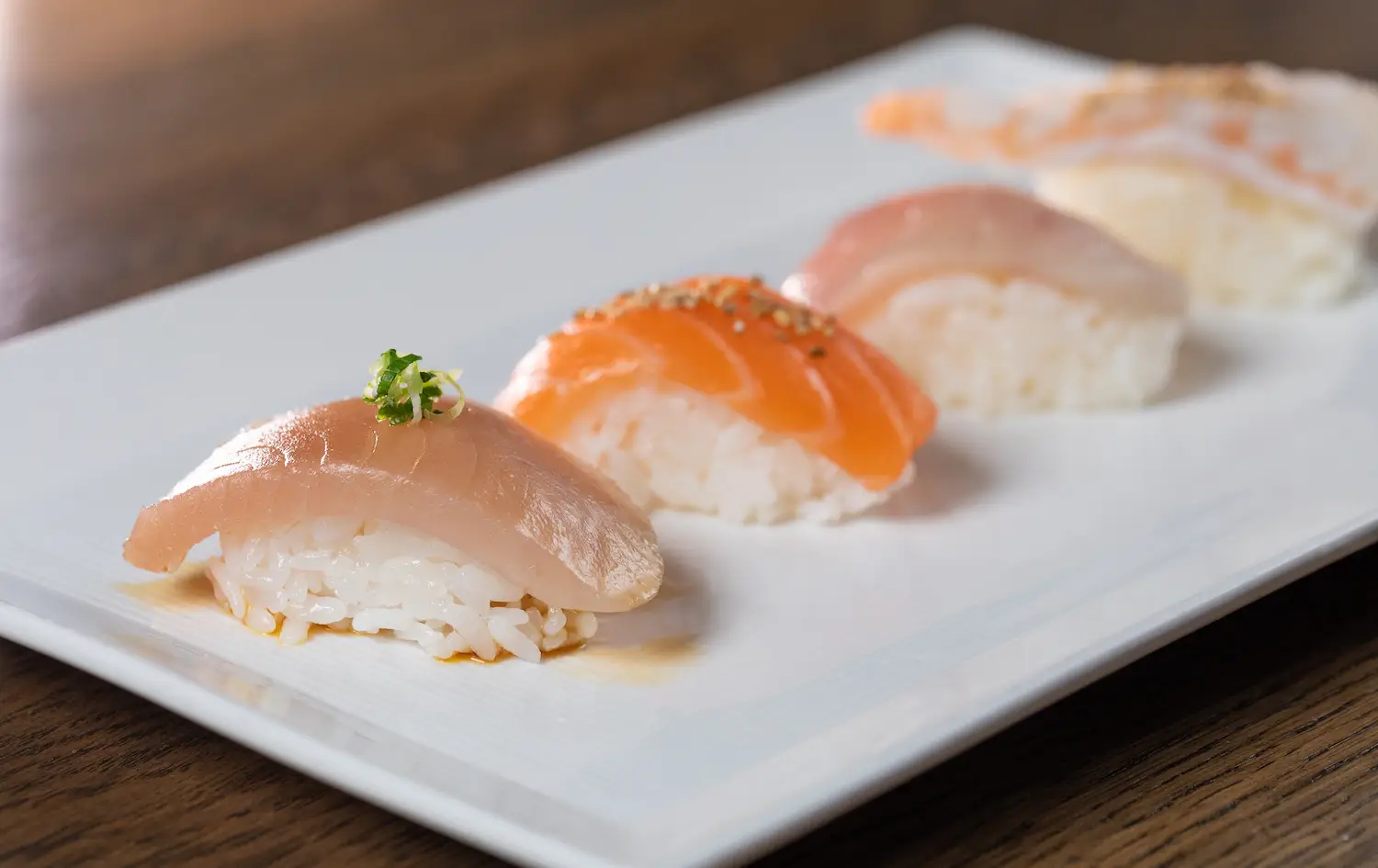
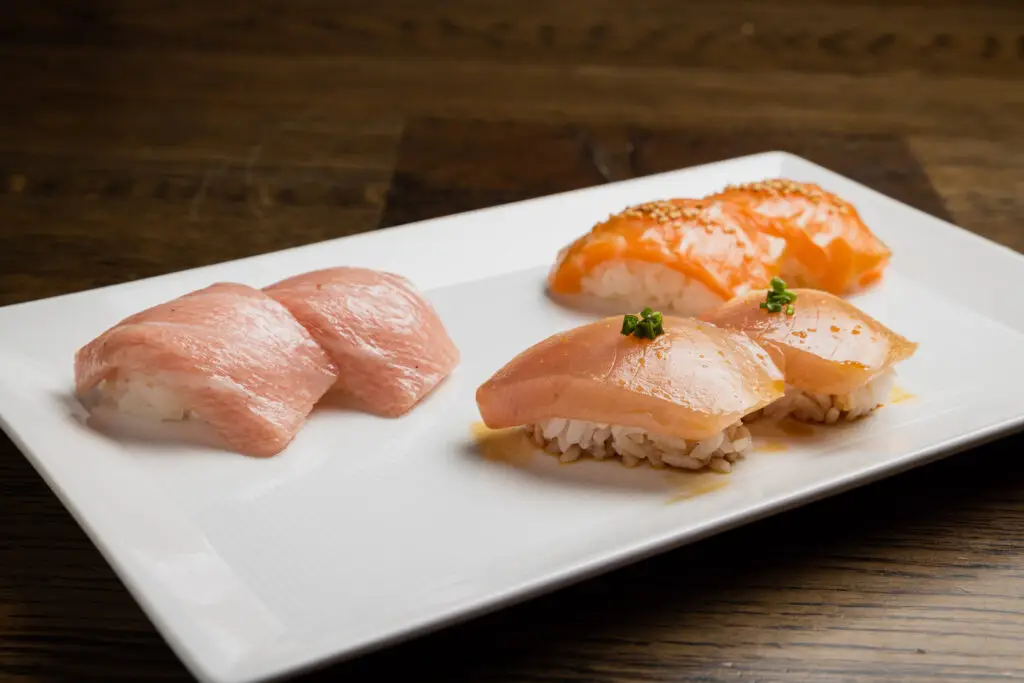
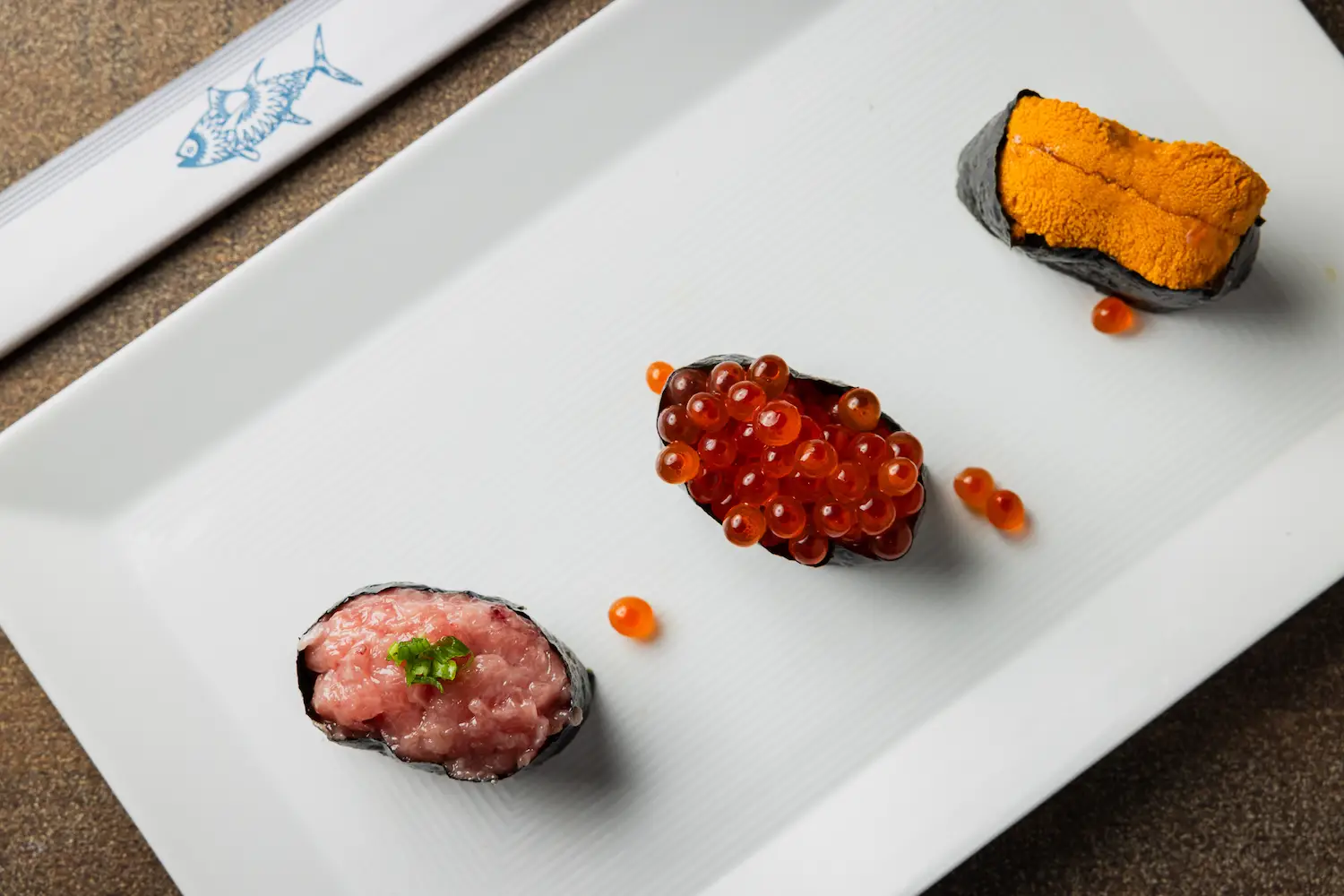
And the price is right—the cheapest lunch special on the Los Angeles menus runs $32 for edamame, tuna sashimi, two pieces of albacore sushi, two pieces of salmon sushi, a toro hand roll, one piece of Japanese yellowtail sushi, one piece of hirame sushi, and a blue and dungeness crab hand roll. The most expensive lunch option—called “Don’t Think. Just Eat. Trust Me”—tops out at $60 for a sashimi course, seven orders of nigiri, and two hand rolls. Everything is preselected on the Trust Me menu, but what it lacks in adventurous exploration, the team says they make up for in cost and consistency. Of course, you can always order à la carte. Might I recommend the pink lobster nigiri from New Zealand?
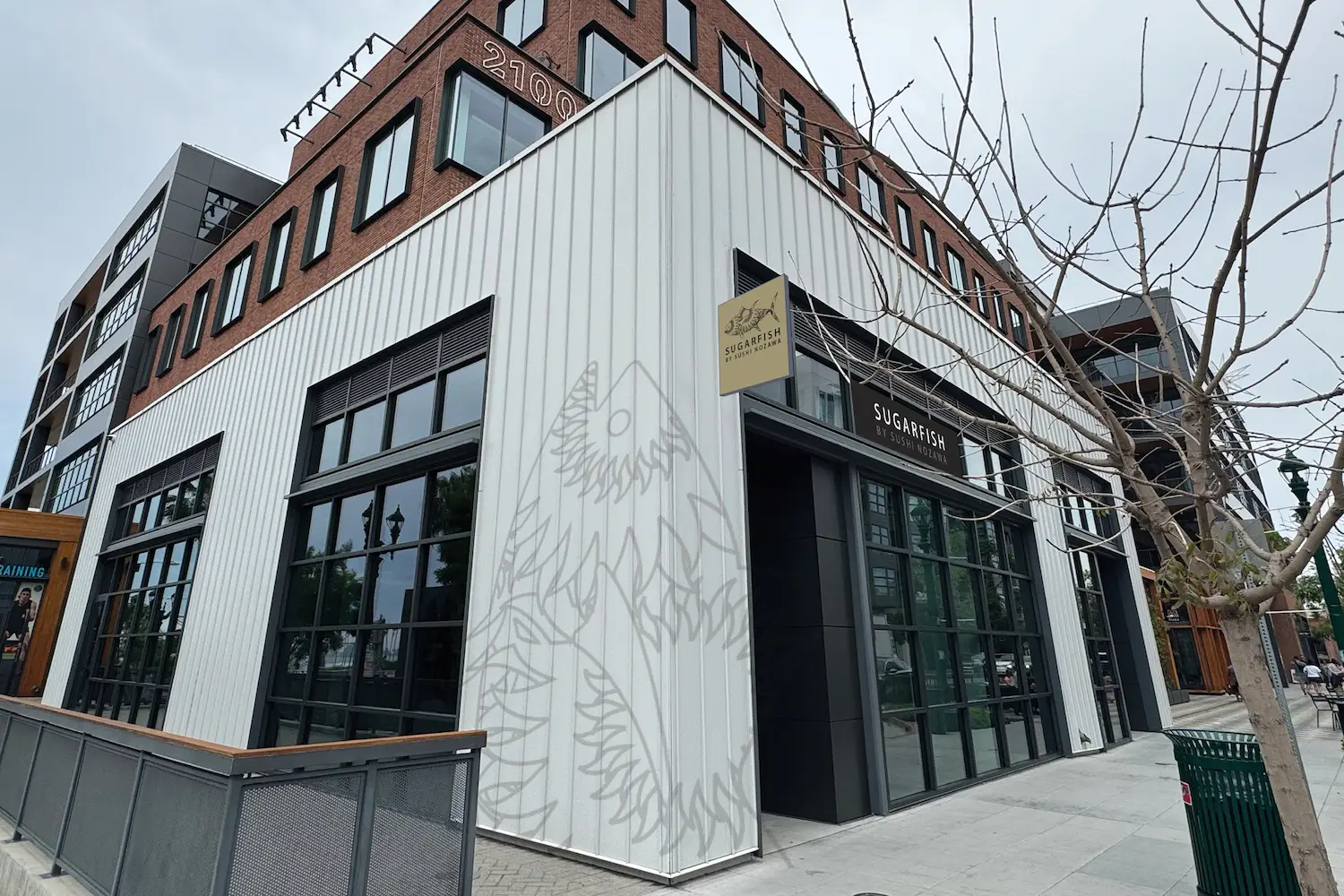
Architect Robert Tsurimoto Kirsten of A-RTK is designing Sugarfish Little Italy in a similar vein to the restaurant’s other locations, but drawing inspiration from famed building designer, architect, and San Diegan Cliff May. May, known for his California Ranch homes and mid-century modern designs, created spaces that mixed indoors with outdoors, with lots of warm woods and open spaces. This location will seat 40 guests and emphasize cozy colors like greys and blues, but Massimini says they plan to keep the design on the minimalist side to ensure the sushi remains the showstopper.
“For us, design is supportive,” he says. “It’s not the centerpiece.”
Sugarfish doesn’t try to blow your mind with exotic sauces or unbelievably rare fish. But for predictable, high-quality sushi that’s painstakingly sourced and served and won’t set me back a Benjamin or two? Seems like a pretty good deal to me.
Sugarfish by Sushi Nozawa opens spring 2026 at 2100 Kettner Blvd., Suite 1100.
Beth Demmon is an award-winning writer and podcaster whose work regularly appears in national outlets and San Diego Magazine. Her first book, The Beer Lover's Guide to Cider, is now available. Find out more on bethdemmon.com.
The restaurant's new reimagined bar area features statement furniture, wines-by-the-sip machines, and its own five-star snacks
Every latchkey kid who survived a decade or so on Totino’s pizza rolls and Hot Pockets needs to head to Juniper & Ivy. One of the best restaurants in town just made a tiny, chef’s-pride version of the iconic suburbia snacks. Jim Gaffigan, your table’s ready.
They’re technically gnocco frito. But, for emotional reasons, pizza rolls and pockets.
It’s part of the restaurant’s new thing, Juni—a revamped bar and lounge area into its own kind of lounge and bistro, still perched above the main J&I show. An everyday, living room version of J&I for neighbors and tire-kickers, with statement furniture, wines-by-the-sip machines, and its own five-star snacks menu, priced like it’s the ’80s and inflation hasn’t been invented yet.
We’ll get to that below, and what I’d order, but first, a note about emo chairs.
There are chairs made from scratchy, colorful sweaters worn by someone who loved lots of things but nothing as much as Death Cab for Cutie. New banquettes near the window have such high backs that they create a whole other, sun-spilled room without having to put up a wall and curse contractors who treat deadlines like irrational wishes.
The high-tops overlooking the industrial–art house dining room are gone. In their place is one long, tufted lounge nook colored aquamarine, recalling the Miami drug scene we all romanticize, when everyone had khaki skin and abs and a thousand dollars of jungle pharma in their flowy pants pockets. Or it looks like a very soft Jordan almond, giving off more of a come-one, drape-all vibe.
Part of J&I’s wow has always been the unshy statement pieces. Like that giant, shiny graffiti pear lording in the middle, emitting subway-tunnel-to-table energy. Or the giant Lichtensteins of what appears to be a topaz-haired Katy Perry shedding a tear. Now, these Death Cab sweater chairs.
As for the menu (see below), start with those pizza rolls. Five whole bucks (three during “pre-shift,” 5 to 6 p.m., when it’s two dollars off every item). Apparently, owner Michael Rosen went to Italy and was Jabberwockied by gnocco frito, the famed puffed fry bread from Emilia-Romagna. He pestered chefs Jon Sloan and Alex Penkin to figure it out. And so they tinkered and tinkered and came to this, stuffing it with a mousse of goat cheese, ricotta, and nduja (Calabria’s addictive, spreadable pork sausage). It’s topped with a paper-thin, spicy Calabrese salami; a little lemon zest; light Parmesan snow; and the kicker: EVOO spiced with oregano and peppers for that pizza-joint perfume.

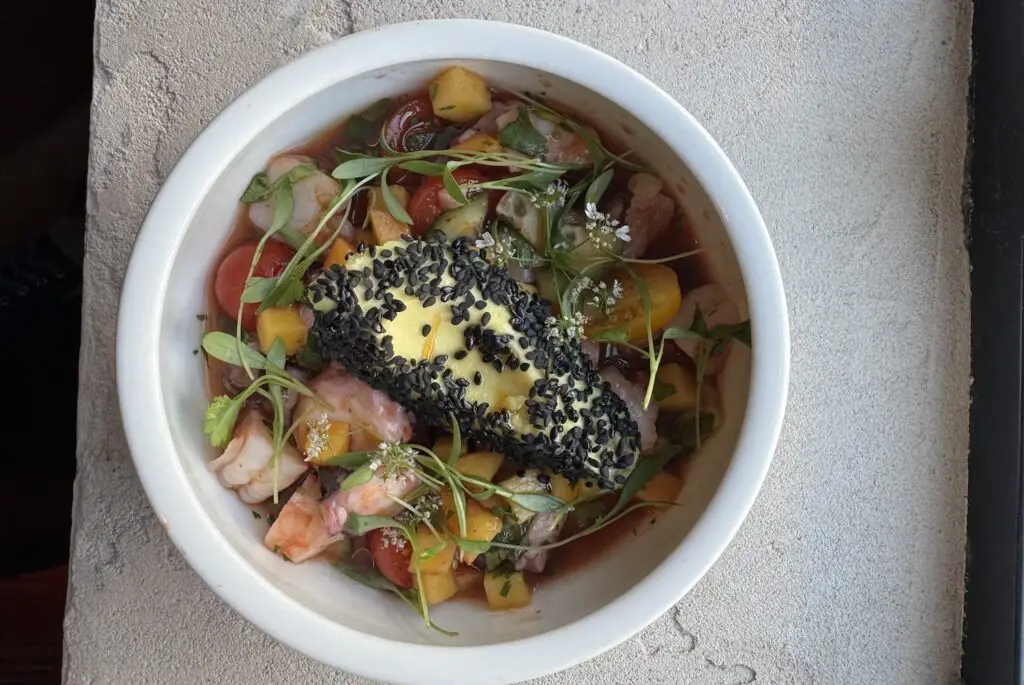
Why order a michelada and a ceviche when you can order a michelada ceviche? Chef de cuisine Penkin grew up in Chula Vista with its grade-A Mexican street food and salsa beers. This is his riff on that good life. Top-notch octopus and shrimp, tossed with stone fruit, baby heirloom tomatoes, cucumbers, and a gussied–up michelada sauce: Clamato, worcestershire, and—the key that gives it character and depth—guajillo pepper puree. Blue corn tortilla chips for the scoop.
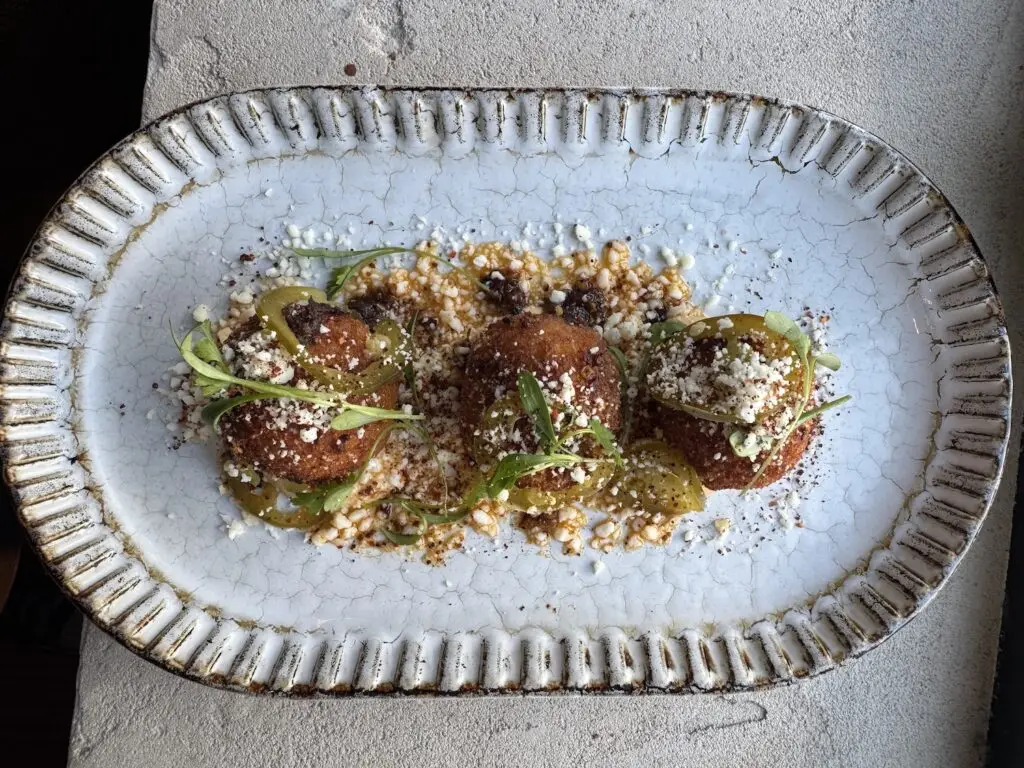
Penkin’s been with J&I since the beginning (after a stint at Searsucker). The only break he took was to work on Colorado’s famed corn farm Olathe Sweet Corn. So this dish—a riff on the fried Italian risotto ball—mixes his Mexican street-food roots and his chef-on-farm quest. He chars some raw corn, sautées some more, and uses Parmesan and Cotija cheese as a binder, then makes a stock using the corn bones (where all that starch is) for depth. It’s served with chile-lime mayo, spicy salsa macha oil, pickled jalapeño, and Tajin.

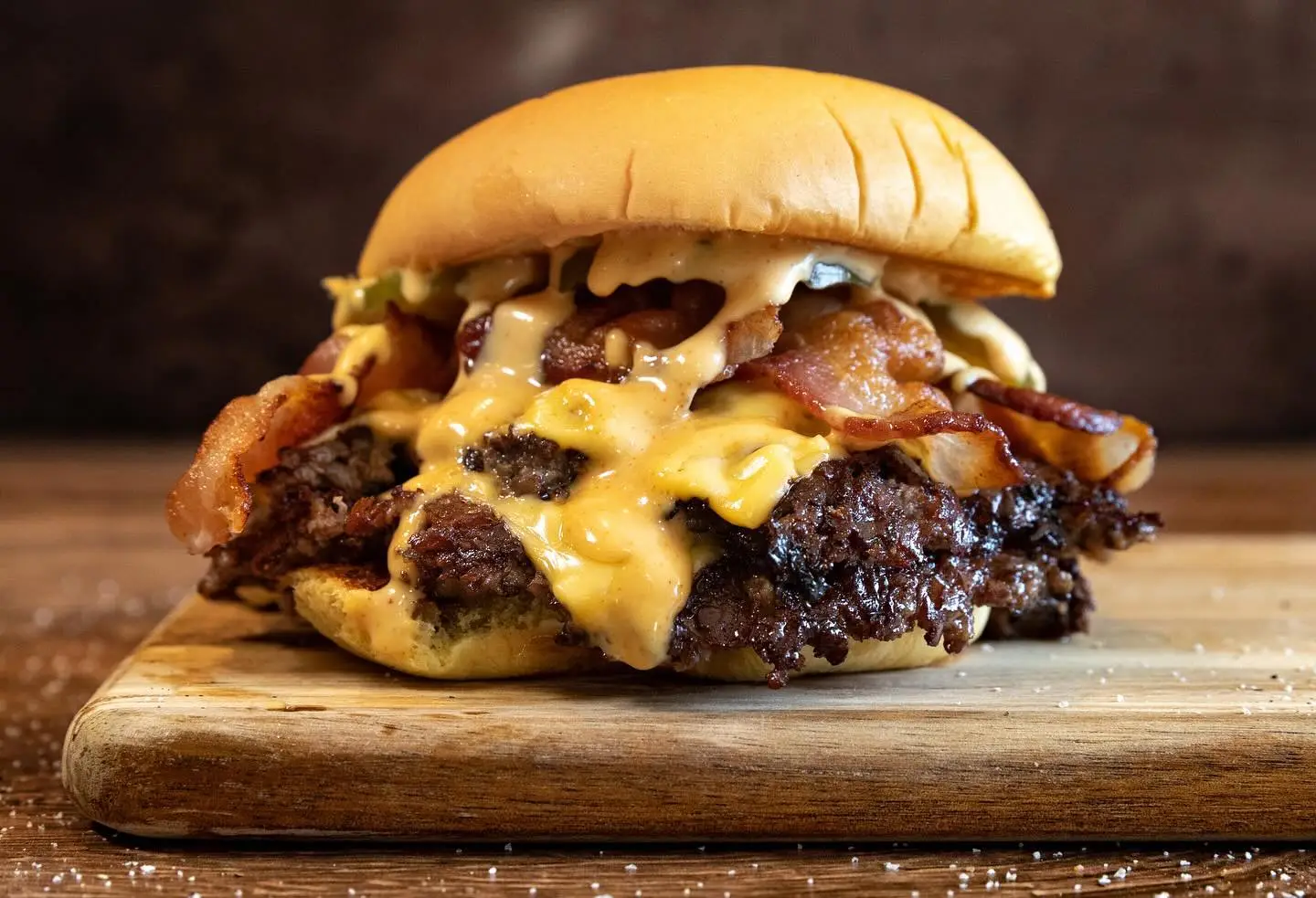
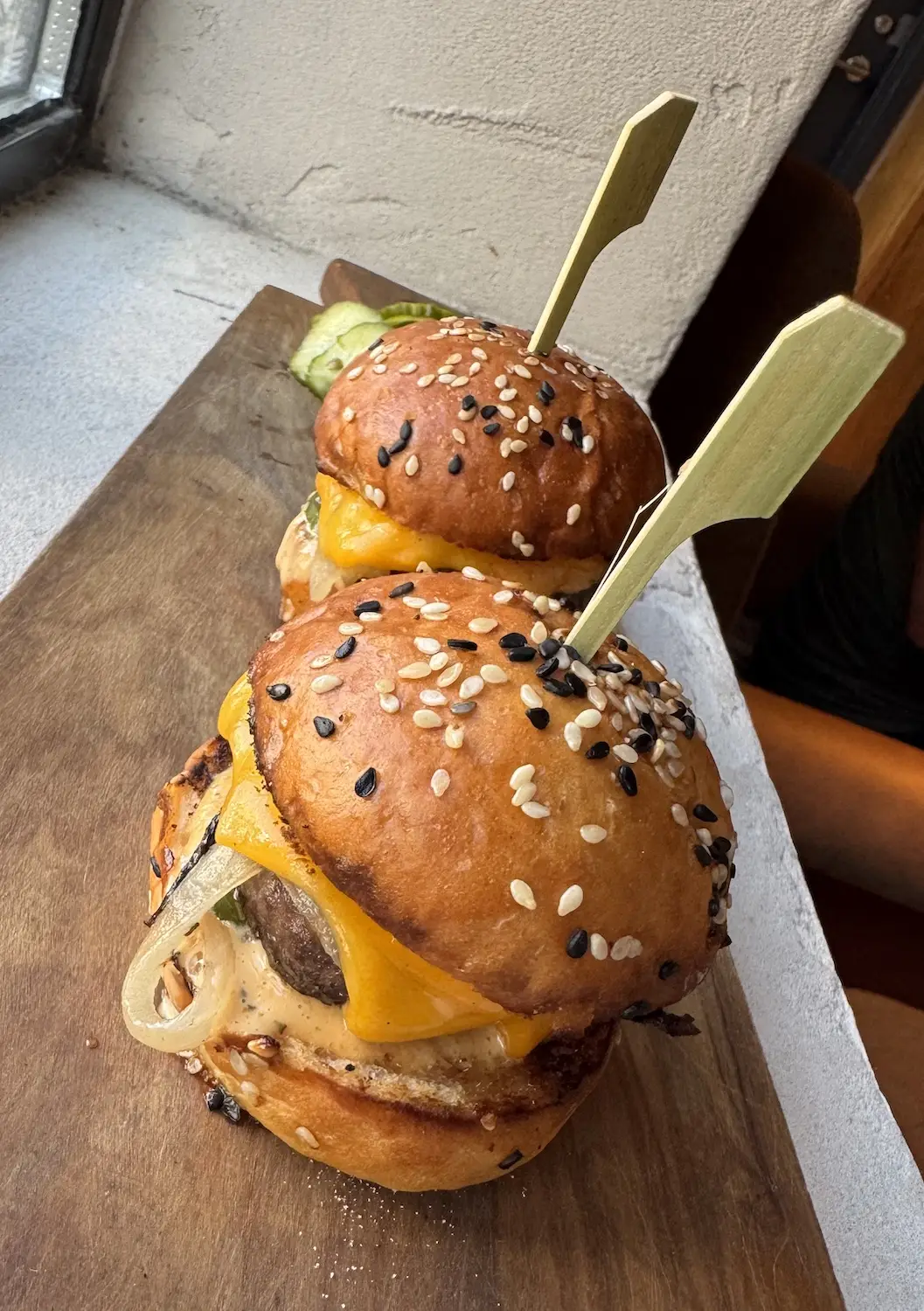
Taster versions of a J&I classic. Wagyu beef; house burger sauce (animal style on chef ’roids); and, most importantly, onions caramelized in beef tallow. (Tallow is the MSG of the fat world.) Then there’s American cheese, pickles, and a sesame bun. They come two per order, which is about the amount of a regular burger.

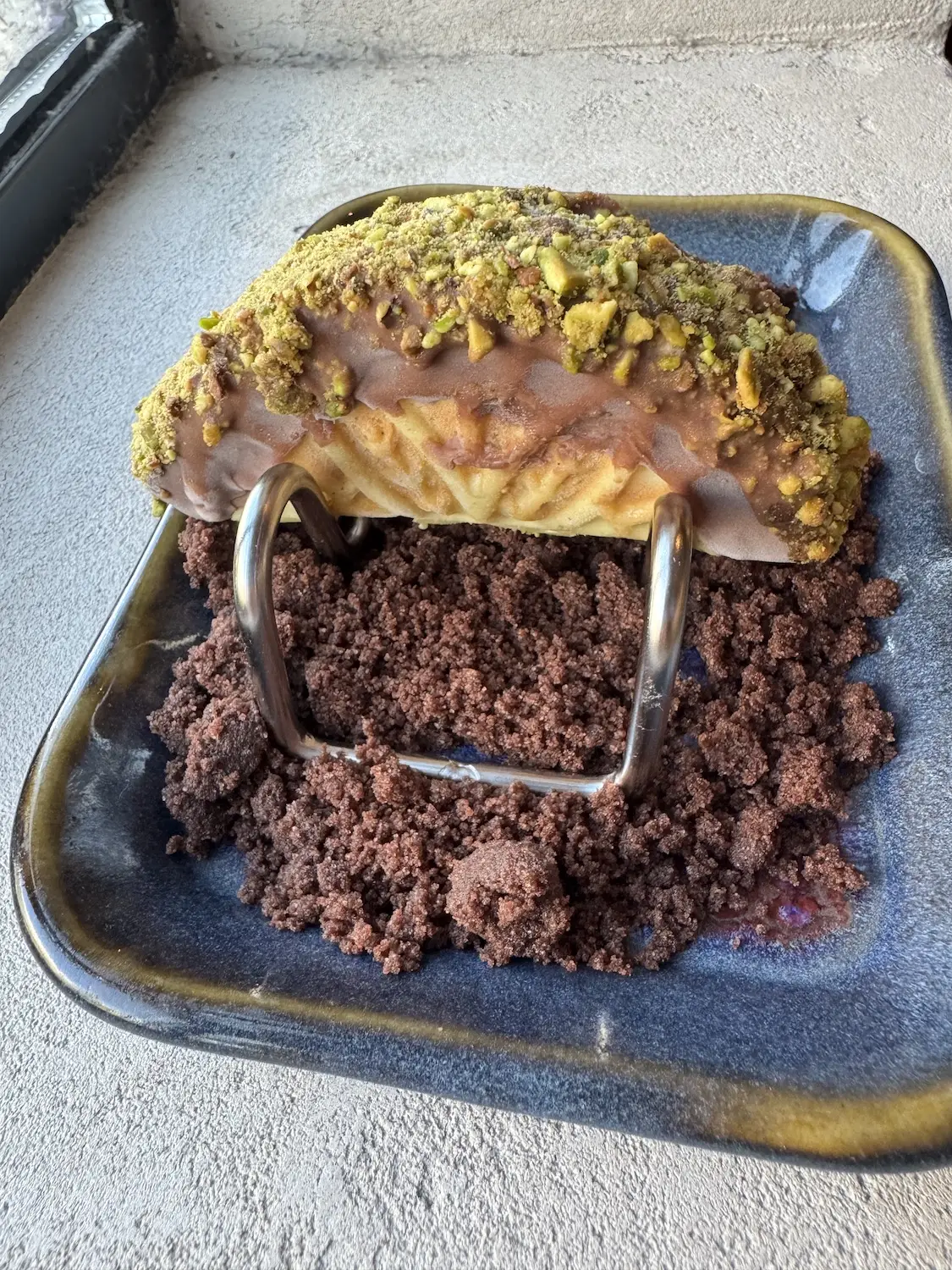
This is pastry chef Amanda Santiago’s take on the premium ice cream truck item that your fancy kid friends would order on allowance day. Housemade waffles are folded and filled with pistachio ice cream, coated with milk chocolate and chopped pistachios, and served over chocolate crumble. Let it sit for a few, then eat it when it’s a little melty.
Juni is open now.
Troy Johnson is the magazine’s award-winning food writer and humorist, and a long-standing expert on Food Network. His work has been featured on NatGeo, Travel Channel, NPR, and in Food Matters, a textbook of the best American food writing.
SeaWorld dazzles with a drone show, big-name entertainers, new animal adventures and more
Nights are heating up at SeaWorld San Diego. The quintessential summertime staple on Mission Bay is transforming into a destination for unforgettable day-to-night adventures, bringing back some of its most popular Summer Nights programming and introducing exciting new experiences sure to delight both kids and adults alike.

The 2026 Summer Day to Night at SeaWorld San Diego is the park’s most ambitious season yet. SeaWorld has planned a highly anticipated entertainment lineup that features nine weeks of throwback concerts featuring R&B and hip‑hop favorites from the ‘90s and early 2000s, including Jordin Sparks, Too $hort and Warren G, Ashanti, and an array of boy band heartthrobs performing together as part of the Pop 2000 Tour.
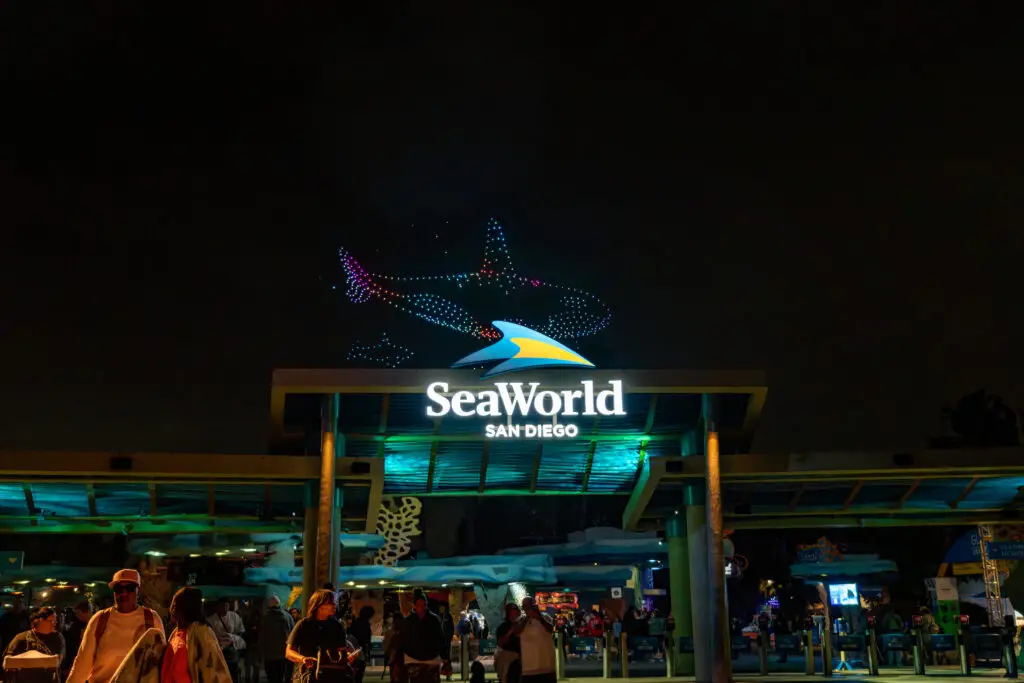
New this season is perhaps the park’s most visible update: a nightly drone show, Ocean of Dreams, which illuminates the sky with hundreds of synchronized sparklers. Drones form sea otters, sharks, dolphins, and a majestic orca that tell a breathtaking 12-minute story of marine life and underwater ecosystems. The show culminates with a spectacular electric neon finale celebrating hope, wonder, and ocean stewardship.
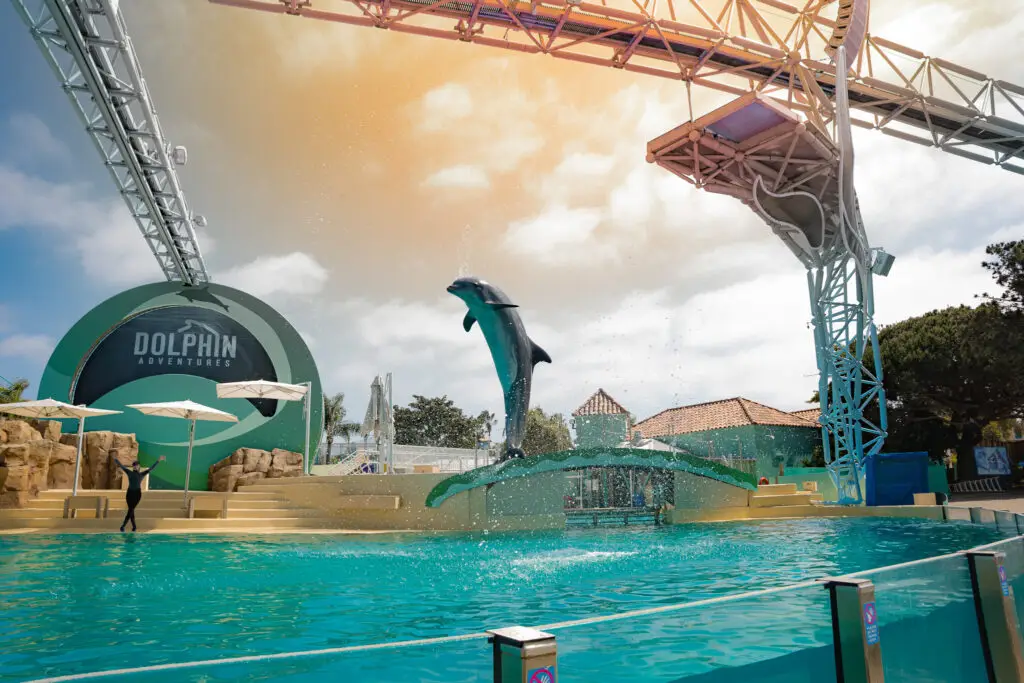
Nighttime visitors are also in store for animal adventures that fuse education with high-energy fun and the dreamy ambiance of nighttime. The park has launched two all-new animal presentations: Shamu’s Celebration: Light Up the Night and Dolphins: Touch the Sky. Shamu’s Celebration: Light Up the Night features vibrant lighting, music, and dynamic choreography that celebrates the power and beauty of killer whales. Dolphins: Touch the Sky showcases playful bottlenose dolphins and the special connection between humans and the natural world. And back by popular demand is fan-favorite Sea Lions Tonite. See the charming pinnipeds splash, play, and parody pop culture in this refreshed crowd-pleaser.

More must-sees: a newly reimagined Shark Encounter, one of the country’s more immersive exhibits highlighting 11 different species up close, SeaWorld’s beloved BMX Blast! stunt show, and high-seas escapade, Pirates Ahoy! The Battle for Mermaid Cove. And don’t miss the park’s all-new Deep Sea Disco, which encourages guests to dance the night away under the glow of the SkyTower, and vibrant closing time laser light display Laser Reef Summer Spectacular.
Amp up the nighttime vibe with local craft beers, curated cocktails, and nostalgic theme park treats with $1 beer all summer long. SeaWorld is the place for day to night summer fun. When the sun goes down, SeaWorld lights up, and inspires guests of all ages to embrace their inner whimsy and see why generations of San Diegans head to SeaWorld to make memories they’ll never forget.