Featured articles
Food & Drink
Food & Drink

Food & Drink
Featured articles

Everything SD
Everything SD
Everything SD
Featured articles
Things to Do

Things to Do

Things to Do
Featured articles

podcast-ep

podcast-ep

video
Featured articles
Everything SD
Everything SD
Everything SD
Featured articles
Food & Drink
Partner content
Partner content
Ready to know more about San Diego?
SubscribeReady to know more about San Diego?
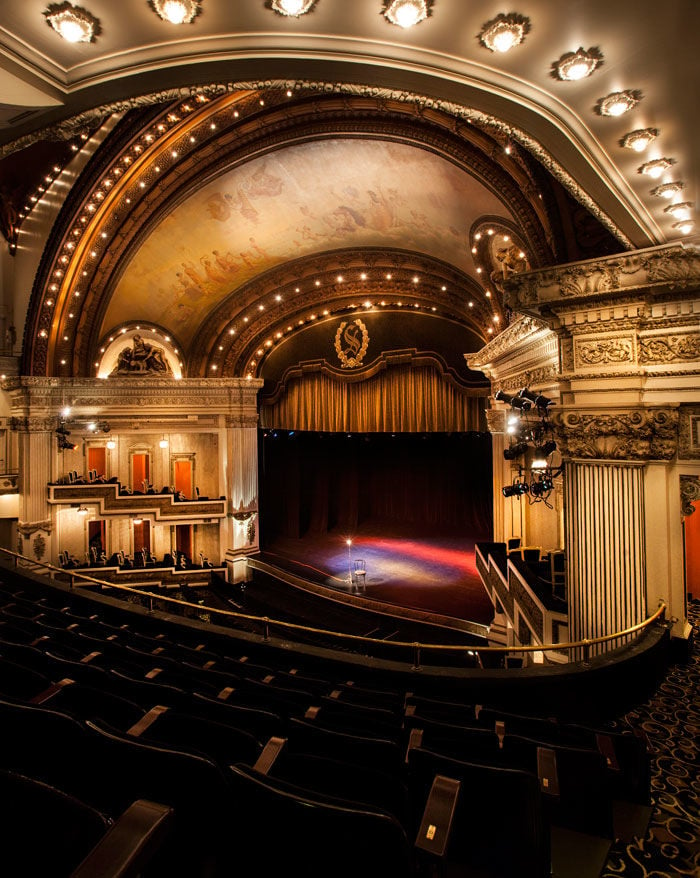
There's more to this local marvel than a famous marquee
Spreckels Theatre
PLEASE TAKE YOUR SEATS
Commissioned by sugar magnate John D. Spreckels to commemorate the 1915 Panama-Pacific International Exposition, the theatre was originally built with 1,915 seats. Over the years, worn seats were replaced and upgraded. Today, it has 1,463 seats.
A 360ËEXPERIENCE
The theatre’s unique design allowed for a staging of the famed horse-drawn chariot race in a 1923 performance of Ben Hur, with horses galloping through the theatre, onto the stage, and out onto First and Second avenues.
QUAKE-PROOF
Architect Harrison Albright began construction in 1910, two years after the great San Francisco earthquake. More than a century later, the theatre still retains a top-tier earthquake rating.
BOUGHT AND PAID FOR
The theatre opened on August 23, 1912, with a performance of the long-running New York show Bought and Paid For. It came via private train for one show only, at John Spreckels’ expense. The audience gave an extended ovation with five curtain calls.
STAGE TO SCREEN
From theatrical productions and Vaudeville, the venue made the leap to motion pictures in the days of silent film, investing in a projection booth and silver screen in 1923. In 1928, the theatre switched exclusively to movies.
Spreckels Theatre
MARQUEE MOMENT
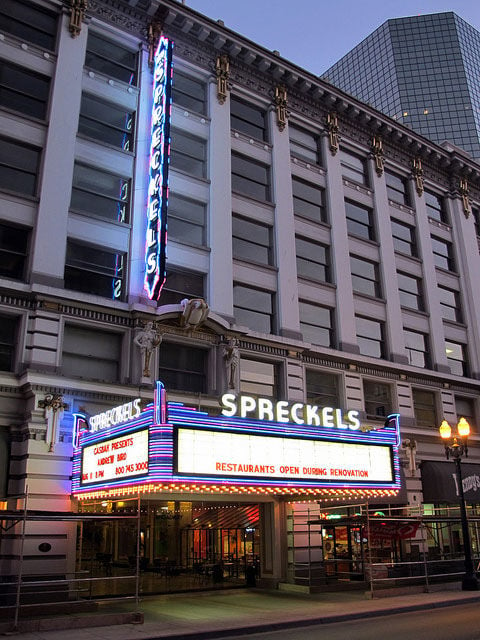
For its 2012 Centennial Celebration, the 75-year-old marquee was turned off for three months while it underwent a historically accurate restoration.
BUILT TO LAST
The structure, which cost an unprecedented $1 million to construct, remains mostly intact today, with its original onyx Grand Lobby, detailed woodwork, and tiled floors.
NEW MANAGEMENT
Owner Jacquelyn Littlefield, daughter of movie pioneer and one-time Spreckels manager Louis B. Metzger, took over operation of the theatre in 1944 at age 22.
GRAND GESTURE
In 1962, Littlefield bought the theatre from the Star and Crescent Investment Company and returned it to a stage-production venue. In 1978, when arson destroyed the Old Globe Theatre, she donated the use of the Spreckels for the Globe’s season.
FAMOUS ACTS
The Spreckels Theatre has hosted perhaps the widest variety of acts in the region, ranging from Charlie Chaplin to Abbott and Costello, Ronald Reagan to Ray Charles, and Ellen DeGeneres to Eddie Vedder.
Attend a gallery opening in La Jolla, sing along to Janet Jackson in Chula Vista, and stop by San Diego Mag’s scrumptious shindig in Carlsbad
Happy June! Welcome summer’s first month with a robust roundup of things to do in San Diego, from a suds-soaked brew fest and a long-distance bike race to a handful of musicals and a museum showcase of youth-made art—plus more fun happenings in our beloved city.
Food and Drink | Concerts and Theater | Festivals and Art | More Things to Do

Want to party with San Diego Mag and North County’s most influential tastemakers? Have your fill of unlimited food and drink offerings from the area’s standout restaurants, distilleries, brands, and more at the Carlsbad Flower Fields this Friday from 6 to 9 p.m. Guests can also take part in golden hour photo-ops, listen to live music, and check out over 40 local vendors. General admission to this 21-plus party is $85 per person.
5704 Paseo Del Norte, Carlsbad
The 13th annual San Diego Brew Festival is back with food trucks, live music, and many, many beers. This 21-plus event at Liberty Station NTC Park is a craft beer lover’s paradise, with more than 70 local breweries serving up a couple hundred different selections—from hazy IPAs to malty pale ales—plus several food trucks, lawn games, and cover-band concerts to enjoy. Ticket options include $50 general admission passes, which get you access to the brews from 1 to 4 p.m., and $65 VIP passes, which come with an extra hour of sipping from 12 p.m. to 1 p.m., as well as specialty pours.
2455 Cushing Road, Point Loma

In this musical adaptation of the beloved 1993 Robin Williams movie, a down-on-his-luck actor desperately attempts to reconnect with his family by posing as an eccentric Scottish nanny. As expected, hijinks and hilarity ensue. Following successful stints on Broadway and abroad, the musical heads to the San Diego Civic Theatre for eight shows. Tickets for Mrs. Doubtfire start at $48.
1100 Third Avenue, Downtown
Written by Mario Vega with music and lyrics from Eliza Vedar, Pásale Pásale—a poignant love letter to South Bay—continues its month-long run at Bayfront Charter School. TuYo Theatre’s new musical (which premiered at the La Jolla Playhouse’s Without Walls Festival earlier this year) tells the story of a community coming together when vendor fees are raised at the local swap meet. Ticket prices range from $25 to $39.
830 Bay Boulevard, Chula Vista
The La Jolla Playhouse hosts the world premiere of The Ballad of Johnny and June, a musical detailing the passionate and sometimes volatile love story of country music’s beloved “it couple.” There will be four performances of The Ballad of Johnny and June this weekend, and tickets start at $25.
2910 La Jolla Village Drive, La Jolla
Rock and Roll Hall of Fame member Janet Jackson stops by the North Island Credit Union Amphitheater this weekend, performing crowd favorites from her hit-heavy discography. The concert will also feature rap legend Nelly, known for addictive chart-toppers like “Hot In Herre” and “Ride Wit Me.” Tickets for Thursday night’s performance start at $40.75.
2050 Entertainment Circle, Chula Vista

Through July 14, new La Jolla gallery levels of service not required (LOS/NR) hosts its first-ever exhibition, room in a room in a room. The show’s group of eight local artists includes photographers, psychologists, and woodworkers. This Thursday from 6 to 8 p.m., room in a room in a room will open with a free reception featuring a ribbon-cutting ceremony and free soft-serve ice cream cones.
7910 Ivanhoe Avenue, La Jolla
Interconnections: The Relationships that Form Us will showcase the work of 20 high school juniors and seniors from San Diego County for one weekend only at the Museum of Contemporary Art San Diego. Museum visitors can hear from the young artists and enjoy refreshments and a local DJ set during the museum’s Teen Night event this Friday at 4:30 p.m. The free exhibition will be on display in the Axline Court gallery from 11 a.m. to 7 p.m. Friday and Saturday and from 11 a.m. to 5 p.m. on Sunday.
700 Prospect Street, La Jolla
At MiraCosta College from 10 a.m. to 4 p.m. this Saturday, the 74th annual Latino Book & Family Festival brings together more than 120 educational, health, and author-led booths; a food village; bilingual workshops; and more. Keynote speakers at this free event include La Bamba writer and director Luis Valdez; Dr. Beatriz Villareal, director of the Mano a Mano Foundation; and author and O’side lifer Victor Villaseñor. The night before the fest, catch a screening of La Bamba at the Little Theatre on campus at 7:30 p.m. Seating is first-come, first-served.
1 Barnard Drive, Oceanside
St. Spyridon Greek Orthodox Church hosts the San Diego Greek Festival this Saturday from 11 a.m. to 10 p.m. and Sunday from 11 a.m. to 8 p.m. Spend the weekend watching folk music and dance performances and sampling Greek bites, beers, wines, and spirits—but be sure to go easy on the ouzo. General admission is $4, and children under the age of 12 get in for free. A complimentary park-and-ride shuttle will take off from the San Diego Unified School District lot (4301 Campus Avenue) every ten minutes throughout the festival.
3655 Park Boulevard, North Park

Cyclists can test their endurance on this Tour de France–esque ride through inland San Diego. Riders will start bright and early at Ryan Park with the choice of 20-, 32-, 56-, and 95-mile ride options. Once you cross the finish line, celebrate with a beer garden, live music, and the greatest reward of all: an Italian feast. There’s still time to register for this long-distance ride.
390 Hidden Trails Road, Escondido
This week-long movement and arts festival kicks off Sunday with free dance workshops and performances at City Heights Performance Annex from 1 p.m. to 7 p.m. (Bring blankets and chairs to stay comfy during the outdoor happenings!) Highlighting local queer artists, the week-long event series includes workshops, panels, and live performances throughout San Diego and Tijuana. All offerings are free, but attendees are encouraged to RSVP ahead of time.
795 Fairmount Avenue, City Heights
Ryan Hardison is a freelance arts and entertainment writer and recent graduate of San Diego State. When he's not staring at his laptop, he's likely eating an adobada burrito or getting sunburnt at the beach.
There's more to this local marvel than a famous marquee
Spreckels Theatre
PLEASE TAKE YOUR SEATS
Commissioned by sugar magnate John D. Spreckels to commemorate the 1915 Panama-Pacific International Exposition, the theatre was originally built with 1,915 seats. Over the years, worn seats were replaced and upgraded. Today, it has 1,463 seats.
A 360ËEXPERIENCE
The theatre’s unique design allowed for a staging of the famed horse-drawn chariot race in a 1923 performance of Ben Hur, with horses galloping through the theatre, onto the stage, and out onto First and Second avenues.
QUAKE-PROOF
Architect Harrison Albright began construction in 1910, two years after the great San Francisco earthquake. More than a century later, the theatre still retains a top-tier earthquake rating.
BOUGHT AND PAID FOR
The theatre opened on August 23, 1912, with a performance of the long-running New York show Bought and Paid For. It came via private train for one show only, at John Spreckels’ expense. The audience gave an extended ovation with five curtain calls.
STAGE TO SCREEN
From theatrical productions and Vaudeville, the venue made the leap to motion pictures in the days of silent film, investing in a projection booth and silver screen in 1923. In 1928, the theatre switched exclusively to movies.
Spreckels Theatre
MARQUEE MOMENT
For its 2012 Centennial Celebration, the 75-year-old marquee was turned off for three months while it underwent a historically accurate restoration.
BUILT TO LAST
The structure, which cost an unprecedented $1 million to construct, remains mostly intact today, with its original onyx Grand Lobby, detailed woodwork, and tiled floors.
NEW MANAGEMENT
Owner Jacquelyn Littlefield, daughter of movie pioneer and one-time Spreckels manager Louis B. Metzger, took over operation of the theatre in 1944 at age 22.
GRAND GESTURE
In 1962, Littlefield bought the theatre from the Star and Crescent Investment Company and returned it to a stage-production venue. In 1978, when arson destroyed the Old Globe Theatre, she donated the use of the Spreckels for the Globe’s season.
FAMOUS ACTS
The Spreckels Theatre has hosted perhaps the widest variety of acts in the region, ranging from Charlie Chaplin to Abbott and Costello, Ronald Reagan to Ray Charles, and Ellen DeGeneres to Eddie Vedder.
From tacos to tailors and trainers to travel, these are the businesses, people, and places that earned San Diego readers' votes
San Diego Aesthetics and Med Spa
Elicia Soltesz, Elicia Marie Beauty
Ashley Fierro, Ashley Fierro Makeup
Michelle Langston, MSN, APRN, FNP-BC, HNB-BC, Starlite Aesthetics
Alysa Espiritu, Afterglo Beauty Lounge
Ronnie Page, Gold Comb Barbershop North Park

Ryleigh Hunter, Headbang Salon
Ann Teresa Degischer, Maen the Salon
Lindsay Axelrod, Pixiedot Salon
Lauren Skinker, Lucky Cat Tattoo

Father Joe’s Villages Turkey Trot
The Camp Transformation Center, West Chula Vista
Singing Hills Golf Club at Sycuan

Camila Casanueva, The Yard Gym

Austin Harrington, Captain’s Quarters
Bivouac Ciderworks, Savoy Dry Apple Cider

Missi Burns, Et Voila

Prospera Internal Medicine and Aesthetics
Behind every beautiful space is a thoughtful process, and ASID San Diego is helping homeowners understand the value of professional design.
A perfectly designed home rarely happens by accident. Those kitchens that feel effortless and rooms that seem to tell a story the second you walk in? They’re usually the work of someone who knows exactly what they’re doing.
It’s knowing which ideas will actually work, which materials will hold up over time, and how to turn a collection of choices into a space that feels intentional. That’s where a professional interior designer comes in.
For the American Society of Interior Designers (ASID) California San Diego Chapter, the goal is to help people see interior design as more than just the finished look. Behind every well-designed space is a process built on technical expertise. Designers are educated in everything from professional software and construction details to building codes, space planning, materials, and functionality.

“People don’t always realize how much goes on behind the scenes,” Kirsten Recce , current president of the ASID California San Diego Chapter, says. “Our designers are not just doing furniture placement and color selection and picking out new fluffy pillows. That’s not what they’re trained for.”
ASID members bring formal education, continued learning, and industry knowledge to their projects, helping create spaces that are not only beautiful, but designed to work. A paint color that changes completely depending on the lighting. A material that looks beautiful in a showroom but doesn’t make sense for everyday life. A layout that photographs well but doesn’t function for the people living there. These are the details where professional guidance can make all the difference.
Still, one of the biggest misconceptions about hiring an interior designer is that it’s reserved for massive renovations, luxury homes, or people who already know exactly what they want. The process can feel intimidating. Where do you begin? Is a designer worth the investment? What if you only need help with one room?
ASID’s answer: start with one hour.
ASID’s Spruce Up events break down one of the biggest barriers between homeowners and professional design: knowing where to begin. Held twice a year, the community program gives homeowners the chance to work directly with an ASID designer through a one-hour, $125 consultation in their own home. Whether you’re looking for advice on furniture placement, window treatments, kitchen and bath updates, remodeling ideas, vacation rentals, color selections or something else entirely, the upcoming September 2026 event offers an approachable way to get expert guidance before committing to a full project. Signups are open through Sept. 7, with consultations taking place Sept. 21 through Oct. 31. Proceeds benefit ASID San Diego’s educational and community programs. Register here!

“It’s a great opportunity for people who are in that exploratory phase,” Recce says. “Maybe they’re not sure they want to hire an interior designer yet, or they think it sounds daunting or expensive. This gives them a chance to discover what working with a designer is actually like.”
Design is personal. A good designer isn’t just creating a beautiful room; they’re helping create a space that fits the way someone lives.
“We’re a resource to all of San Diego County,” Recce says. “It doesn’t cost anything to pick up the phone and call and ask. We’ll answer.”
Follow ASID San Diego on Instagram, LinkedIn, and Facebook for updates on upcoming events, or connect with the chapter directly at [email protected] or 619-548-8847.
We found a handful of inspiring people who live in, and truly know, these 'hoods and asked them how they’d spend their time out and about
Growing up in Carlsbad, I never quite understood why people vacationed there. What, so you want to check out the field where I have soccer practice? Pay my orthodontist a visit? Carlsbad just felt like a town by the beach, no better or worse than any other in the country. It took going to college out of state for me to actually understand just how rare a place like Carlsbad is.
Thanksgiving break my freshman year, my first time coming home after three months in the Midwest, my shoulders dropped. I rolled down the windows and drove to lifeguard tower 37—the hangout magnet for Carlsbad’s youths (and, in the summer, tourists)—and the smells of the ocean woke me right up like smelling salts do. I finally got it.
Carlsbad isn’t just a stopover town on your way to something better. It is the destination. Travel + Leisure named Carlsbad one of the top 50 places around the world to travel in 2026. From the whole globe, the travel magazine picked my home. Sure, we’ve got the Flower Fields and Legoland—but now it’s the smaller ships and indier dreams that are giving it street-level character.
It’s not just Carlsbad, either. People have talked about the “North County bubble” for decades—a force field that prevents its residents from traveling south of the 56. It’s often used derogatorily, and it’s a fairly accurate burn.
For decades, living up in North County meant giving up on culture, or at least culture within close proximity. But now, the main expansion of San Diego culture is happening up north. Central San Diego restaurants have started taking notice and are expanding into the area—spurred no doubt by Oceanside’s food boom and the Jeune et Jolie–Campfire–Wildland–Lilo constellation in Carlsbad. City Heights burger joint Key & Cleaver opened a new spot in Oceanside; the owners of Parc Bistro-Brasserie in Bankers Hill opened Parc Lounge in Rancho Santa Fe. Possibly the strongest market indicator is that Sam Fox—one of the most successful restaurateurs west of the Rockies—has started focusing on North County for his concepts. In 2025, he opened both The Henry in Carlsbad and Culinary Dropout in Del Mar.
For the ultimate insider guide, we found a handful of inspiring people who live and create and truly know six North County neighborhoods—San Marcos, Escondido, Oceanside, Leucadia, Rancho Santa Fe, and Vista—and asked them how they’d spend a dream day out and about in their town.

San Marcos is in full renaissance mode. The biggest story is that the grand North City vision is starting to peek through the scaffolding. It’s essentially the North County Downtown that’s been written in the tea leaves and discussed whenever someone gets stuck in traffic at the 5/805 merge: a 200-acre, pedestrian-friendly, mixed-use face-changer that’s slated for 2,600 homes, 350,000 square feet of retail and restaurants, 250 hotel rooms, and about a million square feet of offices and labs. Its most recent manifestation is 222 North City—a 12-story residential tower with over 450 residences, rooftop garden, pool cabanas, art installations, and almost 20,000 square feet of ground-floor retail (Necessity Coffee, Buona Forchetta, Draft Republic, Milonga Empanadas, and a grocery store anchor on its way).
Which means Restaurant Row is no longer burdened with being the primary caregiver for the hungry or the socially inclined. Patricia Prado-Olmos has watched the city morph during her nearly three-decade tenure at CSUSM, having spent the past six years as the school’s chief community engagement officer. She also just announced her forthcoming retirement at the end of the 2026–2027 school year, so she’ll have even more time to haunt local haunts.
Those in the know call the university “Cal State StairMaster” from the Sisyphean amount of stairs on the hillside campus. So, any day at or around CSUSM should start with a homestyle carbo-load (biscuits and gravy) from Mama Kat’s.

“There’s something about this breakfast spot that immediately puts me in a good mood,” she says. Mama Kat’s is also known for its pie (strawberry-rhubarb), which is breakfast if you change your perspective.
After a few hours on campus—with a break to pet the university’s official therapy goldendoodle, Frank, who helps ease finals tremors or apprehension of on-campus stairs—Prado-Olmos will wander into North City, just steps away. She says the almond croissant and coffee at Christophe Rull Patisserie rival Parisian cafés: “It feels like the kind of place you’d stumble across in a much bigger city.”
Rull, a Michelin-trained pastry chef who’s done stints on Netflix (Bake Squad) and Food Network (Super Mega Cakes, Halloween Wars), opened his patisserie last fall. The hype hasn’t cooled off yet: Get there early because the crowds do.
Emma Veidt is an editor at San Diego Magazine. She earned her bachelor's and master's degrees from the Missouri School of Journalism. She loves running, hiking, and rock climbing, but really, she mostly loves encounters with the street cats around North Park.
The creator of Mission Hills' iconic topiary garden hoped future owners would preserve the living artwork she spent decades cultivating
Edna Harper asked for one thing before she died: that the next owner of her iconic Mission Hills home keep the street-facing “garden.” Which is essentially asking the future residents to be curators of a whimsical and obsessive, delightful and strange, classic, cartoony and slightly unhinged sculpture museum. Harper, who died in January at the age of 87, poured her heart into this topiary bonanza, and it’s right there for everyone to see.
Like thousands (or millions, there’s no formal estimation) of others, I had scrolled through the photos of this topiary fantasia before I ever stood in front of it. As of this writing, Harper’s Topiary Garden is No. 227 of 2,686 Things to Do in San Diego on Tripadvisor, making it a popular tourist stop between fish tacos, a day at the beach, and a stroll in nearby Presidio Park. But crowdsourced photos quickly snapped in direct overhead sunlight tend to flatten the shapes that, while meticulously manicured, refuse to behave. In person, Harper’s figures seem to be in motion and, given that they’re sculpted out of bushes, they literally are. (I’d love to see a maintenance timelapse.)
Animals emerge out of shrubs as if they have impish ideas. A fanciful whale, a man in a sombrero, a random spiral twisting skyward, otherworldly creatures that defy categorization—all of these exist together in a neatly trimmed cascade pouring down the steep front slope of the property.
You don’t accidentally end up with a yard like this. You decide to create it and choose to cultivate it, and then you keep deciding and cultivating—for decades.
Although a consistent parade of looky-loos have visited over the years, most have never been inside the home, which is on the market for the first time since Harper and her husband, Alex (who died in 2020), bought it in 1969.

“It was and is a landmark,” says Christopher Delgado, Harper’s cousin and trustee of her estate. “She specialized in Chinese brush art and Japanese art called ‘sumi-e,’ a form of Zen art. She was a creator … she was very, very talented.”
I can’t stop thinking about Harper, sitting at the kitchen window, looking down at her masterpiece and the watchers watching it. The image of Harper enjoying the joy the public took from her handiwork makes me want to understand the woman behind the work. Because topiary, as an art form, has always been a little… loaded.
Topiary has always had a bit of an identity crisis—and that’s part of its charm.
When I think of topiary, I immediately think: Fancy. French bourgeoisie. Palace of Versailles. Mais non! Topiary has its origins in Rome. According to the Center for Architecture, the word “topiary” has its origins in late 16th century English, which combines the Greek word “topos” for place and the Latin word “topiarius” for ornamental gardner.

Topiary started as a flex, really. A Julius-Caesar-adjacent pastime for the most ancient one-percenters; an expression accessible only to those with land, labor (or, put more plainly, enslaved people), and spare time. In its earliest form, topiary was about control: bending nature into submission. It’s where symmetry and precision signaled order, taste, and money.
But with the collapse of the Roman Empire and the Dark Ages that followed, the topiary almost preceded the Dodo Bird in extinction. Monks quietly kept the art alive by growing herbs and manicuring the gardens and hedges within the courtyards of their monasteries.
It wasn’t until the Renaissance nine centuries later when topiary saw a resurgence—ah, Versailles!—and this form of pleasure gardening went into overdrive. Nature became architecture. The French pruned their foliage into iconic cones and obelisks, walls to keep out the riffraff, and ornamentation designed to impress. The Dutch got a little freaky, as they do, and sculpted complicated figures, animals, and even furniture.
Inevitably, the pendulum swung again, and topiary fell out of favor once it became viewed as excessive and even absurd. Even so, it never really disappeared. It just migrated to exist in a completely different paradigm. It was less Versailles and more, “What if this bush were a mouse?”
Fast forward to Disneyland in 1963. That year, the park opened a topiary garden in Fantasyland with verdant sculptures of giraffes, camels, elephants, and hippos all inspired by Denmark’s Tivoli Gardens.
Disney’s interpretation of topiary—which is still a fixture of park decor today—falls more into the realm of imagination and possibility than restrained aristocratic performance.
That’s one of the stranger throughlines of topiary: It moves from elite to everyday, from stiff and formal to playful and silly, from symbol of control to something steeped in personal expression.
Which is what makes a place like Harper’s Topiary Garden so compelling and the woman behind it utterly intriguing.

Born in 1938, Edna Harper was something of a Renaissance woman. She worked for two decades as a dental assistant, and she later became a notable painter, calligrapher, and stained glass artist (the house itself is adorned with her work). But she was also savvy in other ways.
“She graduated [with a degree in dental assisting] from San Diego City College and wanted to have her own money and her independence,” says Delgado. “Most people didn’t know that she was such a great businessperson, and for many years, she managed all of [the couple’s] properties on her own. She was great at building relationships … she touched a lot of people’s lives.”
Her friend and fellow artist Julie Roth attributes her artistry to her relationship with Harper. The pair met two decades ago at an art class at Oasis in Mission Valley.
“She was just the most encouraging person,” Roth says. “I didn’t know I could paint, but apparently I can. She was a tremendous person.”
I asked Roth what she’d want people to know about her friend.
“Her empathy and diplomacy,” she says. “[She had] a sharp eye for other talent. She spotted me, but I’m not the only one she encouraged.”
That sharp eye suggests attention, the same kind it takes to look at a bush and also see a whale. Or a spiral. Or something that doesn’t exist yet, but could.

Nothing about Harper’s life suggests someone chasing attention. And yet, she ended up creating something that demanded hers, and she took great pleasure in seeing people enjoy her creations.
The garden didn’t happen all at once. It grew out of years of travel, observation, and collaboration. Harper often traveled without her husband, always returning from trips to Japan, Thailand, and other parts of Asia with ideas and impressions captured through sketches in a notebook.
“She would get creative ideas from her travels … she’d come back with ideas and pictures, and they’d go about cutting that topiary bush into shape,” Delgado says.
For the past 25 years, she had the help of her gardener, Pedro Duran—who’s still employed by the trust and has maintained the garden since Harper’s passing.
In the early topiary years, Harper worked closely with Duran in what Delgado describes as a kind of shared “labor of love.” She would share her sketches and together the pair would shape the bushes into something deliberate.

“As she got older, she would increasingly draw her ideas and [Duran] would [carry them out],” Delgado says.
That collaboration reinforces that her garden was not an act of control, but one of creative collaboration and translation. From memory to sketch. From sketch to shrub. From something seen, somewhere else in the world, to something rooted in the soil of a steep hillside in Mission Hills.
Harper also made sure that the lawn’s boisterous energy made its way into the house on Union Street. Apparently, she threw legendary parties.
“Fairly regularly, in the late ’70s and ’80s, she would host Super Bowl parties with 200 people. She had TVs everywhere,” Delgado says.
It’s not hard to square that image with the stillness of the garden which, despite the careful pruning and intentional design, is voluminous and nearly vibrating.
And, damnit, I wish I’d watched some sportsball on her shocking number of TVs and wandered out front to the topiary—slightly wine-drunk with an orange smear of wing sauce on the corner of my mouth—to marvel at the leafy hippo and this woman’s elaborately creative life.

I can hear Delgado smiling as we talk on the phone. He’s going back to his childhood, when he talks about being one of the cousins Harper doted on when he visited.
“The adults were inside, and we’d be out in the camper,” he says, “and [Harper] would come check on us, make sure we were okay. She always had gifts for us. If it was Easter, there were chocolate eggs. If it was Christmas, stockings. We were the beneficiaries of them not having kids because they showered us with all their love.”
Knowing this and taking a look at her garden again, you can see it’s not the work of a shut-away curmudgeon. It’s wondrous, inviting, and the right kind of weird.
“Ultimately, she did it for herself and family, first and foremost,” Delgado says of Harper’s Topiary Garden.
Harper’s one request of whomever buys her home may seem like a focus on basic maintenance, about hedges and upkeep and preserving something visually striking. But it’s really about attention. And maybe, too, about legacy. Not hers, per se, but the legacy of community, relationships, art, creativity, possibility, adventure, culture, dedication, and love.
For now, it’s there for anyone to see, and its future is in the hands of whomever comes next.
Aaryn Belfer is a writer and editor specializing in nonfiction across art, architecture, and culture. Once upon a time, she wrote a provocative column for San Diego CityBeat (RIP). She was a runner up in the 2025 Matchbook Stories contest at the San Diego Central Library and is irrationally happy about it. Currently in her Soft Girl Era, Aaryn has expensive taste in (mostly flat) shoes and will choose a great art exhibit or live jazz concert over almost anything else. Except, possibly, Javier Bardem.
A new program guides new moms through high-risk pregnancy and into the “fourth trimester”
Mai Vue was just 34 weeks pregnant when she delivered her baby. Her pregnancy had been complicated, and she’d had a recent second trimester pregnancy loss, which led to her receiving specialized care from Sean Daneshmand, MD, a Scripps Clinic perinatologist who oversees high-risk pregnancies. Dr. Daneshmand and his team took care of Mai during her pregnancy, through the birth of her healthy baby girl and beyond. Mai was part of a program Scripps launched to provide support to new moms in the weeks and months after delivery. The postpartum program, known as Scripps Health’s Fourth Trimester Continuum of Care, provides care for women with high-risk pregnancies to optimize their health after childbirth and reduce the risk of complications in future pregnancies. Click here to learn more.
For more nutrition, wellness, and healthy living tips, sign up for the San Diego Health newsletter here.