

Guides JUNE 19, 2018

Where to Watch the 2018 World Cup in San Diego

The best venues around town for catching every “Gooaaallll!”
Where to Watch the 2018 World Cup in San Diego

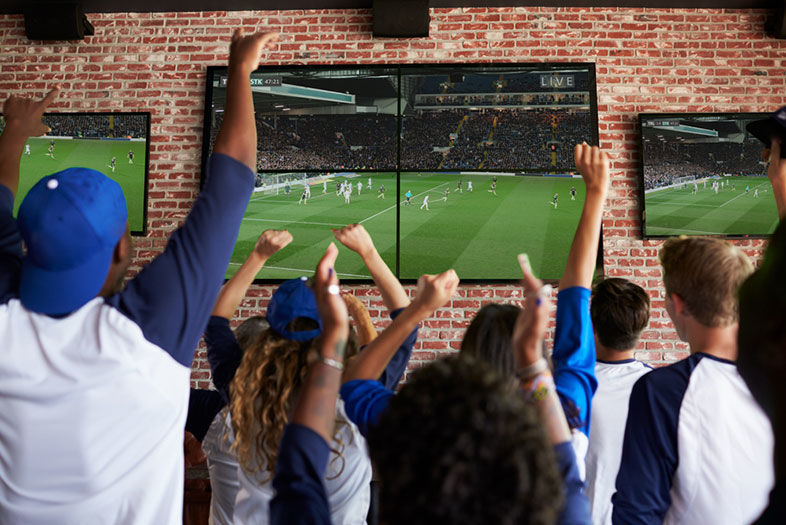
The World Cup is here. That means the wait to care about soccer again is over—and so is the wait for another excuse to grab a seat (and bites and drinks) at the bar. The world’s best will duke it out on the pitch for another month, giving you plenty of opportunities to make it to these joints for a match or two.

El Chingon

Cancel all your plans for the next month: This “Bad Ass Mexican” restaurant in the Gaslamp is showing World Cup games from the first kickoff through the final match. Watch on high-definition TVs while enjoying specials on food and drinks from 3 p.m. to 7 p.m., including $5 micheladas and regular menu items like elote and chicharrones.

Bluefoot Bar and Lounge

Bluefoot isn’t just a soccer bar during the World Cup. It’s a full-time soccer bar where footy-fans can always flock for no-frills viewing in the heart of North Park. Their calendar is stocked with World Cup games over the next month, plus their usual pints of micro and macro brews and specials like weekday happy hours of $1 off everything all day until 7:30 p.m. Expect a rabid crowd on June 24 for Colombia versus Poland.

Mavericks Beach Club

With more than three dozen flat-screen TVs (and five bars) spread around its 15,000 square-feet, this new indoor/outdoor Pacific Beach haunt will let you enjoy San Diego weather while watching the World Cup and probably a few other sporting events simultaneously.

O’Brien’s Pub

This Convoy Street establishment doesn’t try to be anything other than what it is: an Irish pub with a bias toward European (and European-style local) beers, sandwich melts, and soccer. What more could you want for a proper World Cup experience?

World Cup Final Game Watch Party in North Park

Sunday July 15, 8 a.m.

Whether or not your team is in the World Cup final, you’ll want to flock to North Park for the biggest outdoor game-watching party on the West Coast, complete with a beer garden and food trucks. A Jumbotron will show the game as thousands of fans pack a viewing area on 30th Street and University Avenue. The last party, in 2014, drew 10,000 fans, so get there early—game time is 8 a.m.—to set up shop.
Subscribe to our newsletters

Select Options

By subscribing you confirm that you agree with our Terms and Conditions and Privacy Policy.

Guides JUNE 11, 2026

A Guide to the FIFA World Cup 2026 in SoCal

From San Diego’s coastline to Los Angeles stadium and fan zones across the region, here’s how to experience soccer’s biggest event

A Guide to the FIFA World Cup 2026 in SoCal
Courtesy of FIFA

When three nations and 16 cities come together to host the FIFA World Cup 2026, the scale stops feeling like a tournament and starts feeling like geography. A continent becomes the stage as borders soften into corridors. And Southern California—shaped by migration, sport, entertainment, and constant movement—sits inside that landscape with all eyes on it.

San Diego and Los Angeles have always felt connected. Hop on the Pacific Surfliner, and the trip unfolds in one continuous stretch of coastline, passing beach towns, neighborhoods, and city centers.

Traveling from San Diego, everything still feels slightly suspended as the Pacific Surfliner follows the coast north with ocean on one side and a slow suburban blur on the other. San Diego stays in exhale. Los Angeles is already building toward something louder.

This summer, Los Angeles will host eight matches of the FIFA World Cup at Los Angeles Stadium, including the US Men’s National Team opener on June 11, while the region stretches into 39 days of programming across stadiums, parks, transit hubs, beaches, and neighborhoods. Instead of one massive fan hub, Los Angeles is embracing a citywide celebration, with fan zones spread across its entirety.

But this pattern has been rehearsed here for decades. In 1994, Southern California became one of the defining stages of the World Cup, when matches at the Rose Bowl placed global attention on the region and turned local stadiums into international landmarks, confirming its ability to hold the world at scale.

What distinguishes Southern California is not just infrastructure, but cultural permeability. Fashion, music, film, art, and sport constantly overlap here, creating an environment where identity is flexible and always in motion. From the Venice boardwalk, where skate culture shaped modern street style, to global soccer stars rubbing shoulders with Hollywood celebs, to authentic Spanish cuisine moving up and down the I-5 corridor, everything circulates.

The World Cup is not introducing anything new here, it’s showing up for the summer and showing out, revealing what this city has always known about itself. What follows is a look at the fan zones and how Los Angeles turns itself into a city-wide stage for the tournament, one neighborhood at a time.

Courtesy of Los Angeles Tourism & Convention Board

Los Angeles Union Station

As the heart of Los Angeles, Union Station is an official Fan Zone June 25-28 during the World Cup, but in practice it never really stops being one.

It is the city’s circulation point, its meeting ground, its pressure valve. Commuters, travelers, match-day crowds, and everyday Angelenos all move through the same space, and everything mixes, overlaps, and scales in real time. In a way, this is where the World Cup stops arriving in Los Angeles and starts moving through it.

The Pacific Surfliner from San Diego to Los Angeles makes that shift feel almost too easy. No stress or  gridlock anxiety, just a straight line up the coastline with ocean on one side and everything slowly becoming more built on the other. It’s one of the rare ways into LA that doesn’t feel like arrival as friction. You can sit with a laptop, watch the Pacific drift past, grab coffee from the café car, and let the city come to you in pieces.

That’s the beauty of arriving at Union Station. Instead of feeling like you’re on the edge of the city, you’re immediately surrounded by it. And, inside, the station already reads like a World Cup nerve center: banners, movement, multilingual energy, the sense that something global is about to funnel through this exact point. The Heart of the City Fan Zone only sharpens that feeling, with simultaneous match screens, DJ sets, meet and greets, and immersive activations built around marquee games like USA vs. Türkiye.

From there, the city splits outward.

ROW DTLA feels like the first exhale after arrival. A converted industrial campus turned creative district where restaurants, retail, and open-air courtyards form a self-contained ecosystem. If you’re looking for the perfect first meal in LA, make it lunch at Pizzeria Bianco. The thin-crust pizza is reason enough to go, but the space leaves just as much of an impression.

What I liked most about ROW DTLA is how quickly it resets you after the train. One minute you are stepping off at Union Station, and the next you are in a space that feels like its own version of LA, a city inside a city with some of the most curated shopping I’ve ever seen.

Bodega hides itself behind a convenience-store front, a sneaker and streetwear space disguised as something ordinary, like LA refusing to make anything feel too obvious. The whole campus moves like that, part retail, part gallery, part neighborhood you are only temporarily inside.

Isabella Dallas is a freelance writer for San Diego Magazine and the Arts and Culture Editor at The Daily Aztec in her final year at San Diego State University. She previously worked as an editorial intern for SDM, but when she’s not writing, you can find her trying the best coffee spots in SD, devouring the latest rom-coms, and indulging in anything and everything pop culture.

Food & Drink MARCH 12, 2025

Where to Watch NCAA March Madness in San Diego, 2025

The best sports bars and watch parties in San Diego to catch all the college basketball action

Where to Watch NCAA March Madness in San Diego, 2025
Courtesy of NCAA

For the first time in history, San Diego has four teams competing in March Madness!

Both the SDSU Aztecs and the UCSD Tritons men’s and women’s basketball teams are headed to the NCAA Tournament. In UCSD’s first year of eligibility as a Division 1 team, the Tritons have done the unthinkable. Let’s get mad, San Diego!

Here’s everything you need to know about the 2025 NCAA tournament, including where to catch all the action in San Diego.

When are the 2025 March Madness Brackets Announced?

March Madness kicks off on March 16 with Selection Sunday, when the NCAA Selection Committee officially announces the full tournament brackets for the men’s and women’s divisions, deciding on teams, seeds, and matchups. 

  • Women’s bracket: 5 p.m. PT
  • Men’s bracket: 3 p.m. PT
San Diego State University Aztecs playing in the 2025 NCAA March Madness mens basketball tournament
Courtesy of San Diego State Aztecs

When Does the NCAA March Madness Tournament Begin and End?

The first round of the men’s tournament begins March 20–21, while women’s games start March 21–22. The women’s NCAA basketball championship game takes place on Sunday, April 6, and the men’s finale is the following day on Monday, April 7. 

UC San Diego basketball player shooting a basket in the Big West's Division 1

What is the 2025 March Madness Schedule?

Men’s NCAA Basketball Tournament Schedule: 

  • First Four: March 18–19
  • First Round: March 20–21
  • Second Round: March 22–23
  • Sweet 16: March 27–28
  • Elite Eight: March 29–30
  • Final Four: Saturday, April 5 
  • NCAA Championship Game: Monday, April 7

Women’s NCAA Basketball Tournament Schedule:

  • First Four: March 19–20
  • First Round: March 21–22
  • Second Round: March 23–24
  • Sweet 16: March 28–29
  • Elite Eight: March 30–31
  • Final Four: Friday, April 4
  • NCAA Championship Game: Sunday, April 6
2025 NCAA March Madness basketballs with the official logo
Courtesy of the NCAA

How Can I Watch the 2025 NCAA Basketball Tournament from Home?

Fans can catch all the March Madness action live on CBS, TBS, TNT, and truTV. Streaming options include: HBO Max, Paramount+, or any other services with access to the above cable networks, including YouTube TV, Sling TV and Hulu + Live TV.

UC San Diego Tritons college basketball team playing in the 2025 NCAA March Madness mens basketball tournament
Courtesy of UC San Diego

Best San Diego Sports Bars and Watch Parties for March Madness

Park 101

This Carlsbad BBQ joint is a family-friendly destination for basketball fans featuring a multi-level complex, an outdoor patio, and a massive projector screen. Enjoy St. Louis ribs, pulled pork sandwiches, and Maine lobster while cheering on the teams in your bracket this year. 

3040 Carlsbad Boulevard, Carlsbad

Home & Away

A Kansas City Chiefs bar at heart, this Old Town spot is still a top venue for March Madness watch parties, featuring an oversized outdoor screen and a lively atmosphere. The kitchen closes at 11 p.m. daily so don’t fret if the game goes into overtime. 

2222 San Diego Avenue, Old Town

Bub's @ the Ballpark San Diego sports bar in the Gaslamp Quarter

Union Kitchen & Tap

Just steps away from Swami’s Beach, Union Kitchen & Tap is a local hotspot pairing cool vibes with game-day camaraderie. The gastropub prides itself on its extensive drink menu along with quality game-day fare that make it the ideal atmosphere for March Madness watch parties.

1108 South Coast Highway, Encinitas

Ballast Point Brewing

Catch the game at Ballast Point in Miramar, a massive, indoor-outdoor brewery and restaurant well-suited for big groups of fans. Track your bracket picks as you dine on bar bites and down Sculpins. During halftime, challenge your friends to a round of cornhole on the heated patio. 

9045 Carroll Way, Miramar

Nautilus Tavern 

La Jolla’s go-to sports bar offers an excellent weekday happy hour from 3–6 p.m., with half-off select draft beers, well drinks, and house wines, plus discounted appetizers—perfect for catching this year’s afternoon matchups.

6830 La Jolla Boulevard, La Jolla

Bay Hill Tavern

This Clairemont bar streams every game of the tournament and serves up brunch, dinner, and boozy slushies. Try the tequila-watermelon Lava Flow for a perfect game-day refreshment and accessory to an Aztec-red jersey.

3010 Clairemont Drive, Clairemont

Pacific Beach AleHouse

Visit this Pacific Beach staple for ales, hoops, and impressive ocean views this March. TV screens downstairs run 360 degrees along the perimeter and along the rooftop, so you never miss a moment.

721 Grand Avenue, Pacific Beach

Draft

Located on the Mission Beach boardwalk, Draft offers 70 beers on tap and more than 25 TVs. Pair a 394 AleSmith pale ale with their fan-favorite beer-battered fish and chips for the ultimate game-day experience.

3146 Mission Boulevard, Mission Beach

Dirty Birds

Home to some of the best wings in San Diego and featuring five San Diego locations throughout the city, Dirty Birds is a prime spot for catching NCAA basketball. Students can visit the UCSD location to cheer on the Tritons on their home turf.

Various Locations 

Pretzels & Pints

Cole Novak

About Cole Novak

Cole Novak is an award-winning writer with a passion for highlighting local figures, small businesses, and nonprofits. Born and raised in San Diego, Cole is passionate about photography, surfing, art, the local food scene, and the great outdoors.

Everything SD MARCH 5, 2025

Surfing America’s Most Polluted Waves

Imperial Beach has some of the finest surf in San Diego—and the nation’s most contaminated shores

Surfing America’s Most Polluted Waves
Photo Credit: Hunter Brackett

Every year, when winter swells bring San Diego’s best waves to their fullest potential, local surfers flood the lineups of popular spots like Black’s and Swami’s. But some of the heaviest and most dangerous surf lies further south, off the coast of Imperial Beach. The area’s crown jewel, Tijuana Sloughs, sometimes serves up 20-plus-foot waves that break up to a half-mile from shore.

Even as the surfing population has exploded, however, IB remains empty in comparison to the rest of San Diego, thanks to the pollution that plagues its waters. Surfers in IB don’t just check the surf cams and swell forecasts—they monitor the water data from the nearby International Boundary and Water Commission.

“It’s almost a science to go out for a surf and not get sick,” says resident Dwayne Fernandez. “My wife hates that I still surf here; she gets worried. I check the reports every day to see if it’s safe, which has been rare these days. If it’s not, I may have to drive over an hour just to get in the ocean—and I live minutes from the beach in IB.”

San Diego surfer and Imperial Beach resident Dwayne Fernandez who says pollution has forced him to surf elsewhere
Photo Credit: Ariana Drehsler
Dwayne Fernandez says his wife hates that he still surfs in IB. He lives near the beach but often must drive more than an hour to surf where water conditions are safer.

According to the Surfrider Foundation, IB has the unfortunate distinction of being the most polluted beach in America. Built in 1996 with the capacity to manage 25 million gallons of wastewater a day, the nearby South Bay International Wastewater Treatment Plant (SBIWTP) is frequently overwhelmed. Anything that exceeds the limits of the SBIWTP comes out as raw sewage, clearly visible in the water as a dark brown plume with an accompanying nasty smell.

The sewage flow can sometimes hit hundreds of millions of gallons in a single day. “You don’t want to be out there when that happens, and it can happen quickly,” says Adam Wraight, an Imperial Beach lifeguard sergeant, junior lifeguard coordinator, and longtime local surfer.

Aerial view of Imperial Beach and the Tijuana Sloughs known as America's most polluted beach according to the Surfrider Foundation
Courtesy of Surfrider Foundation

But that hasn’t stopped some residents, despite mandates prohibiting surfing and swimming during beach closures. If the waves are good, surfers are probably out there. Why take the chance, though, when there are so many other good waves—with cleaner water—in the county?

It’s partly a point of local pride. The surf history in IB runs deep. Stories of the Tijuana Sloughs on its good days are the stuff of legend, discussed in hushed tones in the core San Diego surf community.

Women over-50 surfers at Santa Brabara's Wahine Kai Surf Club suited up in the parking lot
Former lifeguard and Imperial beach lifeguard Jeff Knox surfing at Imperial Beach Pier despite pollution
Photo Credit: Kevin Stuart
Former lifeguard and IB resident Jeff Knox braves toxic conditions to surf his local waves.

“The Sloughs was never a spot meant for everyone,” says Jeff Knox, a former lifeguard and lifelong IB surfer. “The paddle-out alone was enough of a deterrent for most. The shorebreak took care of the rest. It’s mostly locals out there; we like it that way. It’s one of the best waves around and, for that very reason, we never used to talk about it. But those days are long gone. We need all the help we can get—the more attention, the better. Because this is a huge problem.”

It’s also been part of the deal for decades. “I started surfing IB in the ’60s, [and] we’ve always had to deal with pollution,” Knox adds. “Throughout my entire life, it’s never been as bad as the last 10 years. The last five have been absolutely terrible.”

Additionally, there’s the simple fact of convenience. While IB’s median rent cost of $3,000 is well under the staggering housing costs in other surf-adjacent ’hoods like Encinitas and Del Mar, locals still pay a pretty penny to live a few blocks from the beach. And they often pay a price for surfing there.

Raw sewage and pollution at San Diego's Imperial Beach after rainfall
Photo Credit: Jeff Knox
Imperial Beach is considered the most polluted beach in the United States, with dangerous levels of bacteria caused by millions of gallons of raw sewage regularly flowing directly into the sea.

Scientists have identified 175 toxic pollutants in IB’s waters. Surfers have contracted everything from diarrhea and bacterial infections like MRSA to neurological disorders and hepatitis A.

“As a lifeguard, I see all the data. I check the flows daily and monitor the testing just to see if I can go for a surf during my break or after work. There are plenty of people who don’t check anything—they just see waves and go out—but even they get spooked when they hit the water and everything feels and smells wrong,” Wraight says. “Our responsibilities are definitely different from other [lifeguard] stations and, unfortunately, so much of what we do revolves around the pollution. It can get pretty negative, and it takes a toll on morale and recruitment.”

Un Mar de Colores San Diego nonprofit which takes underprivileged kids surfing
Courtesy of Un Mar de Colores

The problem has driven some local diehards from the water completely. Ramon Chairez, an activist and educator with the nonprofit Un Mar de Colores, has lived in IB for decades, but in 2020, he “made a conscious decision to stop surfing IB,” he says. “I saw too many people around me getting sick. It wasn’t worth it. The last five to 10 years have really been pivotal in the consciousness of the population, especially the kids—they know it’s polluted and unsafe.”

As a junior lifeguard coordinator, Wraight once trained the next generation in IB. But, now, he and the local kids he works with must travel to other beaches in the county. YMCA’s Camp Surf, a program that attracts children and teens from all over the nation with the allure of learning to surf in San Diego, can no longer take participants into the area’s waters.

People walking on the beach in Imperial Beach, San Diego where the water is polluted
Photo Credit: Ariana Drehsler

They must head to other neighborhoods or stick to land-based activities. “The biggest tragedy is the youth,” Wraight says. “They’re growing up not being able to enjoy the ocean like we did—their whole life experience is affected by the pollution.”

Despite the toxic water, IB still feels like a classic beach town, a callback to a time before $8 lattes and luxury condos dominated the coast. It’s charming, quaint, and beautiful, with the open space of the Tijuana Estuary to the south, mountains in the distance, and the mighty Pacific to the west. It has one of the most unique coastal views of all of San Diego—and some of its best waves. If only you could safely surf them.

Chris Dodds

About Chris Dodds

Chris Dodds has been falling in love with San Diego for the past 10 years. He's passionate about the protection and preservation of our natural areas, especially our coastline and waterways.

Studio S JUNE 12, 2026

Nominations Open for the San Diego Business Impact Awards

The annual event honors middle market companies creating jobs, scaling up, and investing in the region

Nominations Open for the San Diego Business Impact Awards
Photo Credit: Kimberly Motos

San Diego is known for its startup culture and innovation economy, but what happens when the company moves beyond its early-stage years? The San Diego Business Impact Awards aim to answer that question, spotlighting the middle market businesses helping drive the region’s economy.

Hosted by San Diego Regional Economic Development Corporation (EDC) and JPMorganChase, the second annual awards celebration takes place on Thursday, July 23, from 4:30 to 7:00 p.m. at Scripps Research Auditorium. More than 200 executives, entrepreneurs, and business leaders are expected to attend the networking and cocktail event honoring some of San Diego County’s fastest-growing companies.

Businesses headquartered in San Diego County that have operated for at least two years are encouraged to submit their nomination by Thursday, June 18 at 4 p.m. Companies across industries—from technology and life sciences to tourism and consumer products, as well as pre-revenue startups—are eligible for recognition.

For EDC President and CEO Mark Cafferty, the event is as much about building connections as celebrating success. “We’ve had a longtime partnership with JPMorganChase; their work aligns with our efforts to support underserved communities and drive talent development,” says Cafferty. “And the networking was invaluable last year. I’m still in touch with people I met at last year’s awards.”

Photo Credit: Kimberly Motos

EDC is an independently-funded nonprofit that works directly with San Diego companies to help them grow the local economy, make the region as a whole more competitive, and attract and retain top-tier talent with quality jobs. Through EDC, companies can get help starting or expanding their business with support for things like site selection, permit navigation, and regulatory guidance, plus connections to local resources and potential business collaborators.

The San Diego Business Impact Awards began as an idea with one of EDC’s longtime strategic partners, JPMorganChase. The two organizations share a commitment to San Diego and are dedicated to bolstering middle market businesses.

“We’re blessed with a robust innovation economy and startup community,” says Aaron Ryan, San Diego Region Manager for JPMorgan’s Commercial and Investment Bank and vice chair of the firm’s’ San Diego Market Leadership Team. “But one of the segments of the business community we felt was overlooked was emerging middle market companies—the businesses that are no longer small but not yet large.”

Ryan says supporting those companies is critical as they scale and decide where to invest, hire, and grow.

San Diego’s high cost of living remains one of the region’s biggest business challenges, making talent recruitment and retention increasingly competitive. But local leaders point to the region’s quality of life, climate, and collaborative business community as advantages that continue to attract employers and workers.

Photo Credit: Kimberly Motos

“In order to support thriving households, there has to be enough high-quality jobs for people to be able to afford to live here,” Cafferty says. “Once a company grows and excels past that middle market point in their growth cycle, they become much more likely to pay higher wages and compete globally.”

Both Cafferty and Ryan proudly tout the unique collaboration that exists among San Diego County businesses. Bringing together top universities producing high-quality talent, cutting-edge research institutions, a robust military and defense presence, leading ocean science and environmental organizations, and a binational, cross-border identity creates a distinct business ecosystem that defines and strengthens the San Diego region. 

Last year’s San Diego Business Impact Awards celebrated nearly 60 honorees from 49 industries, representing a total of 8,232 jobs across eight sectors, including: software and technology, healthcare and life sciences, consumer goods, professional services, finance, construction and manufacturing, defense, and hospitality and tourism. On average, honoree companies doubled their revenues over the previous year, employed more than 145 San Diegans each, and offered an average annual compensation of $192,415.

Top honorees included defense contractor Innoflight, environmental consulting firm Bancroft Construction Services, life sciences startup Element Biosciences, defense technology contractor GALT Aerospace, organic grocery store chain Jimbo’s, and biopharmaceutical company LENZ Therapeutics. During the event, Innoflight Founder and CEO Jeff Janicik held a fireside chat offering his insights on investing in the community and embracing San Diego culture.

This year, organizers hope to continue highlighting the middle market players driving economic impact across the region. Nominations are now open through June 18 at 4 p.m. Get your tickets to the San Diego Business Impact Awards celebration to enjoy drinks by Snake Oil Cocktail Co., light bites, live music, and networking.

Everything SD MARCH 3, 2025

7 Places to Play Padel in San Diego

The racquet sport hailing from Mexico is quickly becoming one of America’s newest fitness activities—here’s where to try it out

7 Places to Play Padel in San Diego
Courtesy of Rancho Valencia Resort & Spa

In the 2010s, pickleball started to emerge as a new way for people to enjoy racquet sports without the physical demands of other such activities like tennis or racquetball. Compared to tennis, it offered a slower pace, smaller courts, and even had simpler rules. During the pandemic, pickleball picked up steam among millennials and Gen Z who, along with adopting a new sport, also took to the courts to find their next love interest.

By 2023, pickleball became a $1.5 billion sport globally, being played by individuals of all fitness levels and ages. But now, a new activity is gaining popularity in the US and across the pond: padel. Originating in Mexico, the sport blends elements of tennis and squash and is played on an enclosed court about a third the size of a tennis court. 

Padel typically is played in doubles on courts surrounded by glass and wire mesh walls. The ball must bounce on the ground before hitting the walls and can touch the glass but not the metal fence post bounce. It can also only touch the turf once before being returned. Points are scored when the ball bounces twice on the opponent’s side. 

With underhand serves and stringless padel racquets, it’s a fun game of strategy more than just skill. Today, there are more than 30 million padel players worldwide and an estimated 90,000 in the US—with California and New York being among the first to adopt the sport. 

Thankfully, our city already has seven padel courts to play on if you’re looking to learn more or are already a devoted enthusiast. Check out our list below of where to play padel in San Diego so you can earn some bragging rights about enjoying it when it was still “under-the-radar.”

Courtesy of Rancho Valencia Resort & Spa

Rancho Valencia Resort & Spa

Already considered one of the best resorts for tennis aficionados, Rancho Valencia Resort & Spa recently added three new padel courts to their racquet sports roster in partnership with sporting goods company, Wilson. Designed by Spain-based company Grupo Padel Galis World, guests can find a number of ways to enjoy the courts including drop-in sessions; beginner, intermediate, and advanced clinics; and monthly Americano tourney play. Or, reserve a private instruction with a USPTA certified professional starting at $125 for 60 minutes or $185 for 90 minutes. 

5921 Valencia Cir, Rancho Santa Fe

Courtesy of The Fairmont Grand Del Mar

The Fairmont Grand Del Mar

The Fairmont Grand Del Mar recently debuted its new padel court in partnership with Taktika padel, a group aiming to expand the sport throughout the US, starting with San Diego. Taktika will now manage all of the resort’s racquet programming with its certified Paquito Navarro Academy coaching staff. With one main padel court and two shared pickleball courts, players can book group clinics, private lessons, tournaments, join leagues, or participate in other events by calling 858.314.2000 or visiting the hotel’s website.

5300 Grand Del Mar Ct, Del Mar

Aerial view of the Barnes Tennis Center in Point Loma featuring Padel courts in San Diego
Courtesy of Barnes Tennis Center

Barnes Tennis Center

Home of the official San Diego Padel team, the Stingrays, Barnes Tennis Center in Point Loma is equipped with seven padel courts alongside 25 tennis courts. Club memberships start at $350, but non-members can reserve courts for $52 for an hour. The tennis center also hosts pro padel events throughout the year so keep an eye on their schedules. 

4490 West Point Loma Blvd, Ocean Beach

La Valle Coastal Club

Along with a 27-hole championship golf course, a driving range, eight tennis courts, and eight pickleball courts, the members-only La Valle Coastal Club now offers two padel courts for players of all skill levels. The Rancho Santa Fe club hosts a variety of programs including Padel 101 for beginners wanting to master the basics and Challenger Clinic which helps individuals advance their game on Tuesdays and Saturdays. Members can also book private lessons or participate in padel events and tournaments throughout the year.

5690 Cancha de Golf, Rancho Santa Fe

Interior of King of Padel in Bay Ho, San Diego offering several padel courts
Courtesy of King of Padel

King of Padel

Sprawled out across six indoor pickleball and padel courts, King of Padel in Bay Ho offers $15/hr open play Monday, Wednesday, and Friday from 6-9 p.m.; Saturday 11-2 p.m.; and Sundays from 2-5 p.m. Guests can also choose a monthly membership for $59 which includes priority booking six-days-a-week, unlimited open play, and a five percent discount at the pro shop. Players can also participate in seasonal leagues which guarantee a set number of matches on weekends, prizes, and women’s- and men’s-only leagues or mixed groups.

4370 Jutland Dr, Bay Ho

Courtesy of Padel California

Padel California

Padel California was founded to bring the sport to cities across the state, starting with San Diego and Los Angeles. The club features two padel courts, coaching, tournaments, social events, and membership packages starting at $180 per person for three months and up to $500 a person for a full year. Memberships include perks such as private coaching lessons, shop merch, 20 percent off retail products and services, guest passes and exclusive tournaments. Non-members can book a 90-minute session for $88 per court. 

222 S Coast Hwy, Oceanside

Rendering of the new padel courts center opening in Sorrento Valley called Padeln9ne
Rendering Courtesy of Padeln9ne

Padeln9ne

Opening soon, Padeln9ne will be a 100,000-square-foot wellness facility in Sorrento Valley featuring eight padel courts, two tournament courts with stadium seating, a fitness and wellness complex, on-site dining, and more. This massive facility is set to become a hub for serious players.

 9955 Barnes Canyon Rd, Sorrento Valley

Hannah Elizabeth Williams Is an editorial intern at San Diego Magazine in her last year as a literary journalism major at University of California Irvine. She is a passionate reader that has a ‘to be read’ pile that extends into the afterlife. Will constantly talk about her dog Daisy.

Nicolle Monico is an award-winning writer and the director of creative projects, digital editor for San Diego Magazine with more than 16 years of experience in media including Outside Run, JustLuxe and The San Francisco Chronicle.

Everything SD JANUARY 16, 2025

How Carlsbad Became the Golf Equipment Capital of the World

Home to major brands like Callaway and TaylorMade, the North County city has been the site of game-changing golf innovations for four decades

How Carlsbad Became the Golf Equipment Capital of the World
Courtesy of TaylorMade Golf

“I started playing golf when I was 16,” David Moon says. “I’m married to the game, and I love this brand.”

His affection for Honma Golf is understandable. Clubs from the BERES line, with smooth metals dyed silver, gold, and red, look more like pieces of jewelry than they do sporting goods. It’s Moon’s job, as the company’s ecommerce and customer service manager, to sell those clubs, although that title doesn’t fully capture his role running Honma Golf’s three-person Carlsbad operation. 

Gold golf clubs from San Diego golf brand Honma Golf located in Carlsbad
Courtesy of Honma Golf

Founded in Japan in 1959, the company developed a devout following, mostly in Asia, for its meticulously designed and unusually sophisticated golf clubs. They aren’t manufactured so much as they are crafted, but for decades that luxury went largely unnoticed in North America. In an effort to grow in Western markets, Honma Golf setup shop in Torrance in Los Angeles County, then Cyprus in Orange County. Finally, in 2019, the company landed in Carlsbad, known as the “golf equipment capital of the world.” 

That may sound like a roadside oddity or an obscure Guinness World Record, but in Carlsbad the moniker is serious business. A block from Honma Golf is Titleist’s Carlsbad office. TaylorMade and Callaway are headquartered on the other side of Palomar Airport. That makes three of golf’s “Big Four” brands within two miles of each other, and you can’t swing a club without hitting dozens of smaller companies like Cobra and Honma. “It’s good to be in the mix with the big companies,” Moon says. “We’re not moving any time soon.” 

Interior of TaylorMade Golf's San Diego production facility located in Carlsbad
Courtesy of San Diego Tourism Authority
TaylorMade Golf production facility

According to a report from the city’s economic development division, there are no less than 116 firms in the sports innovation and design industry cluster, which includes the city’s world-renowned golf equipment manufacturers. “We’re claiming over 2,300 employees in that sector, which is more than six times the national average,” says Bret Schanzenbach, president and CEO of the Carlsbad Chamber of Commerce. “It also generates good income—averaging $130,000 per employee per year in annual earnings.”

San Diego's best golf courses featuring Encinitas Ranch in north county

Callaway and TaylorMade together earn over $5 billion annually, or about $5 for every golf ball the world manufactures in a year. And the story of selling golf balls is inextricably linked with the story of Carlsbad.

Long a farming town, Carlsbad didn’t incorporate until 1952. Its population as of the 1960 census was just over 9,000, and not many people outside of San Diego County had heard of the town until the La Costa Resort, opened in 1965, began hosting the PGA’s Tournament of Champions in 1969. A 34-year-old Gary Player, at the height of his legendary career, fended off the likes of Jack Nicklaus, Arnold Palmer, and Lee Trevino for the trophy that year.

San Diego golf course The Club at Omni La Costa in Carlsbad
Courtesy of The Club at La Costa

“I believe it is the way courses should be set,” Player told The New York Times after his victory at La Costa, now known as the Omni La Costa Resort & Spa. “It’s as fine a course as I won on.” High praise from a man who had taken the crown at the British Open nine months prior. La Costa would go on to host the tournament for the next 30 years, and the city grew around it.

That’s due in large part to Ely Callaway and Gary Adams. A textiles executive from Georgia, Callaway brought his fledgling golf club company to Carlsbad in 1983. A year later, Adams came to town with TaylorMade, a company he started in Illinois that had some success hawking “metalwoods,” a departure from the traditional all-wood sets. 

In 1991, Callaway took the novel idea a step further and invented the Big Bertha driver, the first made entirely of stainless steel. The club head was massive yet light in the hand. It felt like the future, because it was. The story of golf—and Carlsbad—became centered around engineering, research and development, and technological advances. It mirrored the digital revolution rooted in Northern California. The Bay Area had Silicon Valley. Carlsbad had Titanium Valley. Honma Golf resides on Innovation Way. 

Golfer inspecting irons at TaylorMade's The Kingdom golf fitting facility in Carlsbad
Courtesy of TaylorMade Golf

“If you’re a golf company, do you want to be based in Illinois, or are you going to go to a place like California where you can golf year round?” Schanzenbach says. Carlsbad has “infrastructure, plus the weather, plus the quality of life, and the ability to bring in top [golf] professionals to your facility to test out your equipment,” he adds. “You want to bring them to a place where, afterwards, you can go out to a really nice course with beautiful weather and treat them.” 

But the local industry has hit the rough in recent years. According to the city, employment in the sector declined 16.3 percent between 2018 and 2020, a trend that started back in 2013, despite overall golf participation being up 30 percent since 2016, according to the National Golf Foundation. While the weather in Carlsbad is still perfect, some of the factors that fueled its explosive growth, especially cheap land and plentiful labor, are today tilting against it.

Exterior of San Diego golf brand TaylorMade's headquarters in Carlsbad
Courtesy of TaylorMade Golf

“Coming out of Covid, one of the biggest things we were hearing from our membership was the challenge with finding and then retaining talent for their companies,” Schanzenbach says. “I know TaylorMade has done a good job with it. But [for] the middle-tier companies, it’s hard.”

Honma Golf felt this firsthand.

PGA tour pro Justin Rose signed with the company in early 2019, and a few weeks later, he won the Farmers Insurance Open in San Diego. Honma was finally making inroads in the US, then Covid hit. “All the momentum stopped,” Moon says. 

Sales slumped, then the company struggled with staff turnover and recruiting executive and marketing teams to achieve its goals in North America. The realities of high costs, intense competition, and hiring challenges set in, but Honma Golf is undeterred. By reorganizing its marketing team and refocusing on its core market segment of golfers interested in premium clubs, the company feels there are better days ahead. “2025 is going to be a good year,” Moon predicts.

San Diego company Callaway golf clubs at Topgolf driving range
Courtesy of Topgolf

It’s a retrenchment not unlike Callaway Golf’s. In September, the company announced it was spinning off Topgolf, the chain of entertainment-focused driving ranges it acquired just four years earlier. The company wants to focus on its traditional golf equipment and apparel business, the one based in Carlsbad—the one that helped make Carlsbad. 

After Covid’s industry-wide disruptions, the future of the local golf manufacturing industry is coming into focus. So far, it looks a lot like the first 40 years: You can’t play golf without Carlsbad.

Brendan Dentino is a U.S. Navy veteran, writer, and public servant based in San Diego. He writes weekly about baseball and politics at Out in Left.

Partner Content MARCH 18, 2013

Spotlight on Women: Sarah Farnsworth

Senior Vice President, Public Affairs San Diego Padres

Spotlight on Women: Sarah Farnsworth

Sarah Farnsworth

Spotlight on Women: Sarah Farnsworth

Barney & Barney G.R.O.W. logo

geneenm

How did you make the leap from Washington, D.C., to the Padres in San Diego? Tom Garfinkel, CEO of the Padres, asked me if I would consider working for a baseball team. I thought it was a joke. I didn’t know anything about baseball. After 19 years in D.C. I wanted the opportunity to become a part of a community, and that is what I saw in San Diego. It’s an opportunity for me to give back.

You are engaged to marry a retired Marine, and you have a young daughter. What role did they play in your decision to join the Padres? It was a family decision. We decided together. I was working in a job that really wasn’t a career. With the Padres I have a career where I can be challenged, and I am part of a civic asset. Since my fiancé is retired, he plays a big role in my daughter’s care when I have work demands.

How did you get involved in politics? I was living in New York when the Democratic National Convention was held there; 22 years old and just out of college, I volunteered at the convention. From there I was assigned to do advance for Hillary Clinton during Bill’s first run for president. That was 1992. When Bill won the presidency, I was asked to work on the inauguration in 1993. From there I went to work on the First Lady’s staff in the East Wing. I was responsible for planning all events in the Rose Garden, the South Lawn, and basically anything in the White House. And the Clintons were very active, with many events going on!

Tell me about your time in the White House. I worked seven and a half years and left to marry, but returned for the last six months at the end of the Clinton term. I celebrated my 30th birthday at the second Clinton inauguration.

Where did you work when you left the White House? I was chief of staff at the USO and traveled frequently to Afghanistan and Iraq. I was working in the world headquarters for then-General Jim Jones, who later became President Obama’s national security advisor. President Obama asked me to become senior advisor to the national security advisor, so that put me working in the West Wing of the White House. When General Jones resigned in 2010, I was asked to work in the Pentagon.

You spent so much time working for presidents in both wings of the White House. How did you keep your feet on the ground? I never thought of it as politics, but as being part of an historical institution. There was a plaque on the wall in the White House that I passed by every day. The bottom line was “one day you will be on the other side of the iron gate.” That puts it in perspective.

What challenges have you faced? After being to Iraq and Afghanistan, challenges take on a different meaning. As long as my family is healthy, I don’t have any bad days.

What adjustments did you have to make when you joined the Padres? I have had to earn trust and credibility in a whole new profession, I had to learn baseball, and I have had to earn trust in the community.

What is in your future? I’m here with the San Diego Padres as long as they will keep me.

Thousands of savvy locals already get it.

San Diego's best restaurants, experiences, and events—handpicked and delivered to your inbox weekly. You in?

Close the CTA

Contact Us

1230 Columbia Street, Suite 800,

San Diego, CA
