You land in Oaxaca City with your husband and twins. Your friends are posting pics of the beach— the Bahamas, Cabo, Puerto one-thing-or-another. You panic. Why did you choose Oaxaca? You’re landlocked with two six-year-olds. This could go sour.
No, you chose this vacation for a reason. Mole! Mezcal! Art! Yes, you remember now—you are here to immerse your family in centuries-old crafts and culture. You do not need Spandex and seashells. You can do more than sand and waves.
You would have stayed at Hotel Escondido or Quinta Real or Hotel El Callejon, but you do Airbnb now to get extra bedrooms. Again, twins. You wonder for the 1,000th time since having kids why hotels were built to torture families.
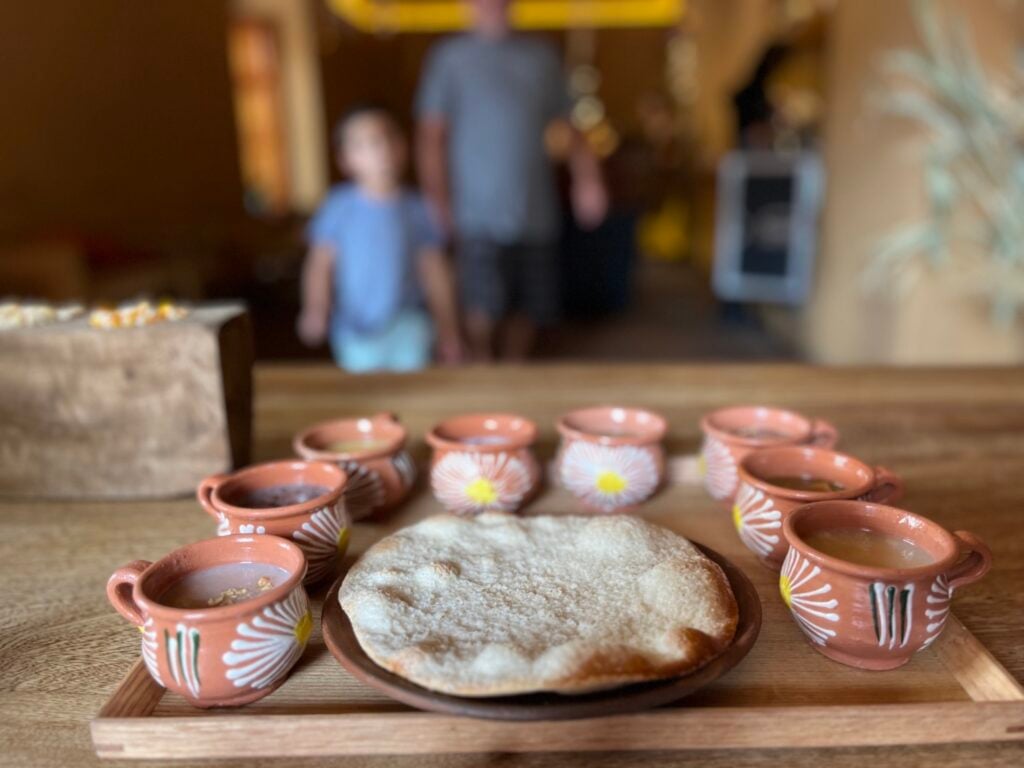
Photo Credit: Mara Altman A flight of eight different corn-based drinks at La Atolería
To fortify yourself before exploring the Ruta Magica de las Artesanias (or “Magic Route of Crafts”)—a route made up of small towns surrounding Oaxaca City that specialize in different crafts like weaving, embroidery, and ceramics— you eat all the things. Tlayudas from Chili Guajili, pan de elote from Boulenc, huevos divorciados from Pan:Am, paletas from Mezcalite POP!, a flight of eight different corn drinks from Atolería.
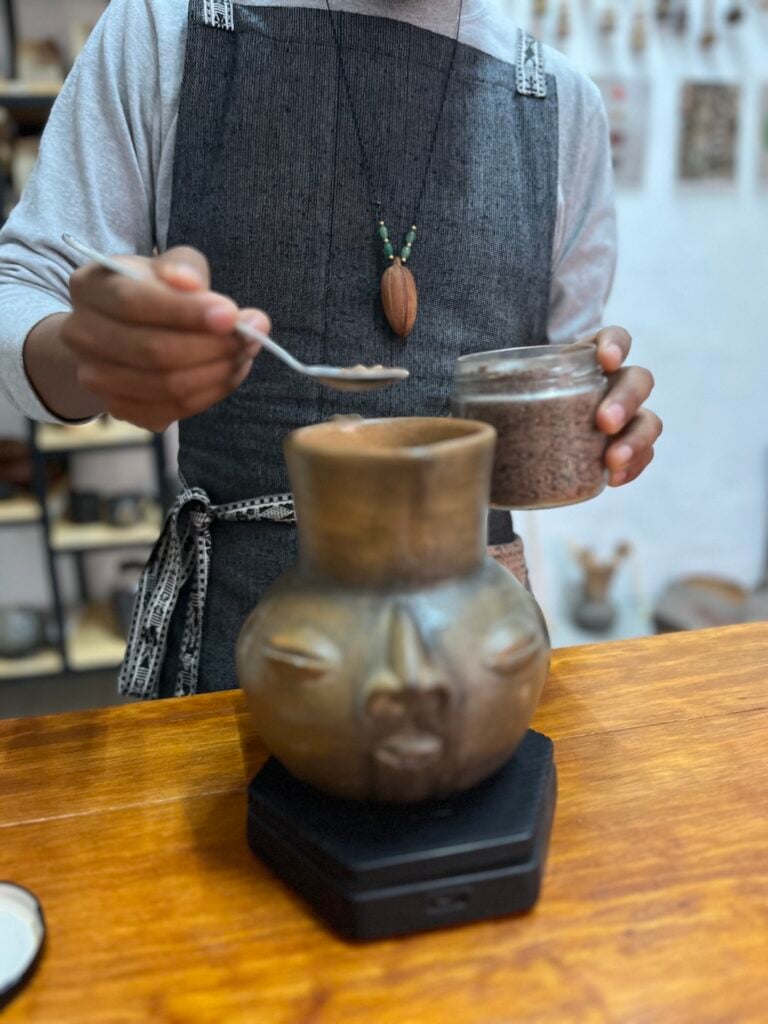
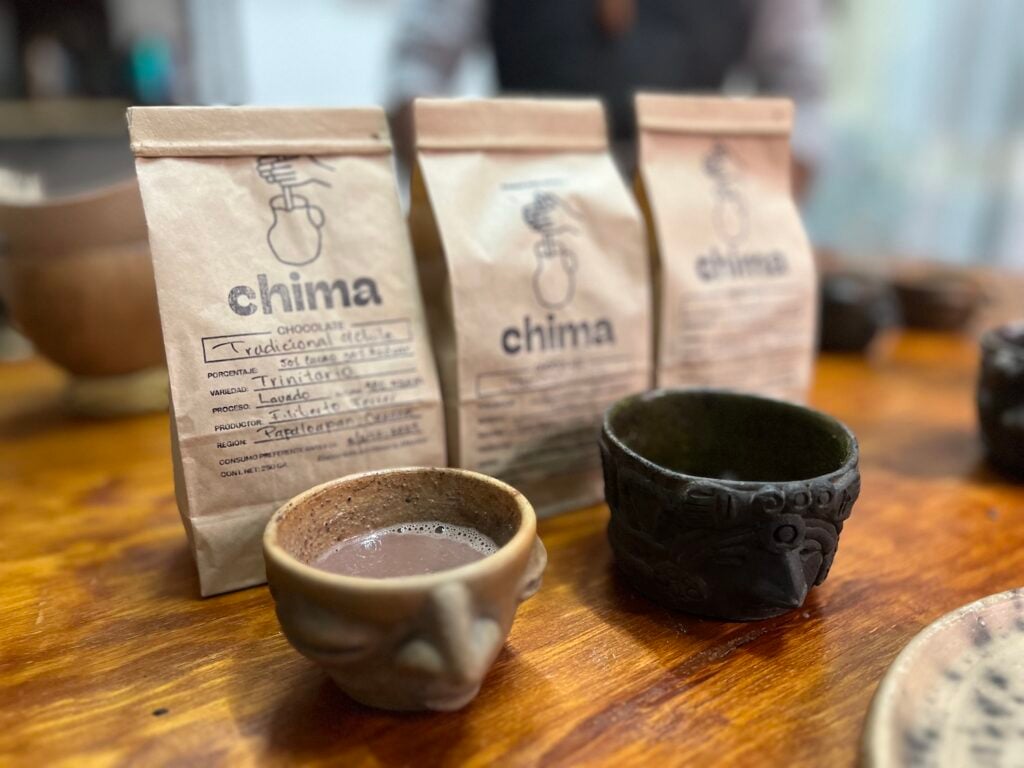
You could try one of many cooking classes, like the one from La Cocina De Humo, but you ease yourself into your workshop-laden visit by taking a chocolate class hosted by Chimalapa Cacao. You learn Oaxaca is home to more than 20 different cacao beverages, some made entirely of foam. You roast the cacao beans on a comal (a smooth, flat griddle), peel off the brittle skins, and grind them with spices. You mix the resulting powder with water using a specialized wooden wand called a molinillo. You have an epiphany: Any place that has a specific chocolate utensil is the Right Place.
Photo Credit: Mara Altman Diego Armando Contreras measures the perfect ratio of chocolate to water for the quintessential Oaxacan hot chocolate during a workshop at Chimalapa Cacao
“We want to teach people that chocolate is more than candy,” explains Diego Armando Contreras, biologist and one of the resident chocolate experts.
You feel bad for all the people snorkeling right now. They are not sipping chili chocolate.
Photo Credit: Mara Altman
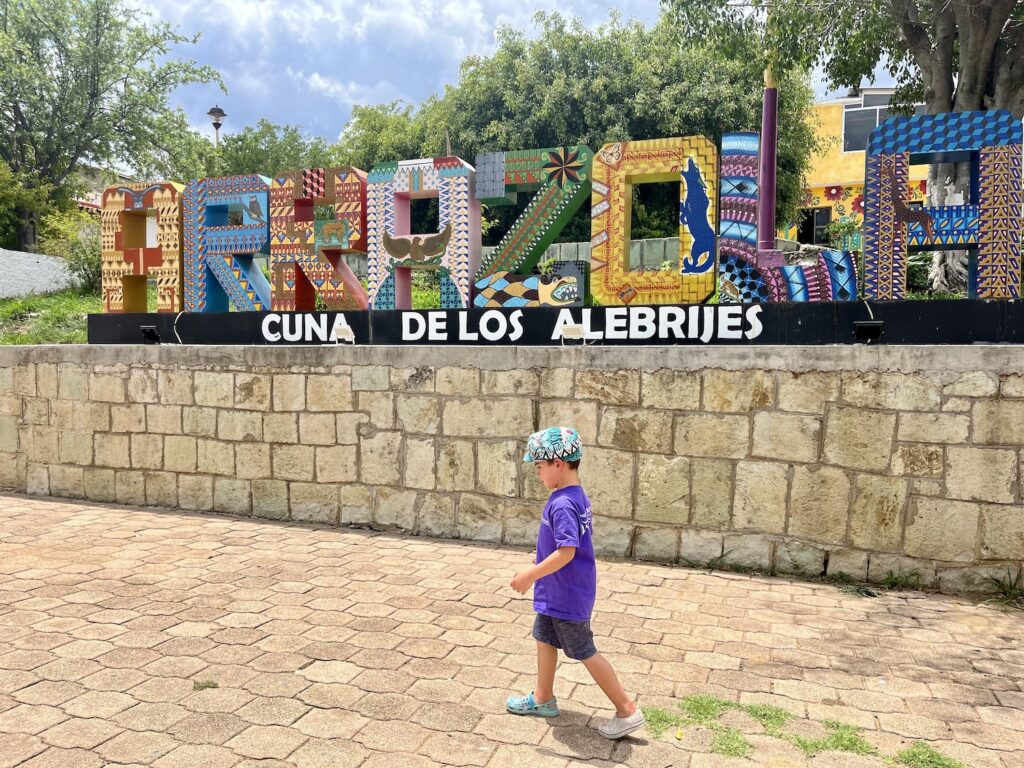
The next day, you take a 20-minute drive to Arrazola, a small town that specializes in alebrijes, whimsical creatures painted in bright, intricate designs. The godfather of alebrijes was Pedro Linares, who is said to have hallucinated the elaborate, animalistic beings during feverish visions he had in the 1930s.
Instead of Linares’ papier-mâché, Manuel Jimenez of Arrazola started making alebrijes out of hand-carved copal wood. You visit the workshop of his grandson, Armando Jimenez. Armando’s wife holds up a log, saying, “We bring out the animal that’s inside.”
You want active participation, so, of course, you sign up for an alebrije painting class. It looks easy to paint. There are lots of colors and dots and ovals and stripes. You sit around a table, feeling confident with 50 different pigments and a bare armadillo. As you swab your paintbrush in hot pink and flub an oval, you build a deeper appreciation for the art form and for the skill it takes to paint even one perfect circle.
Photo Credit: Mara Altman Snapshots from Oaxaca
You remind your kids that travel is heart-opening and humbling and they say, “Where’s the green? No, not that one,” and “Why does paint taste so bad?”
You need adult time, so you finagle a sitter recommendation from your Airbnb host and go to Crudo for dinner. The chef, Ricardo Arellano, who once lived and cooked in Escondido, CA, helms the Japanese-fusion establishment. His food makes you emit moany noises, but it’s not weird, because it’s doing that to everyone.
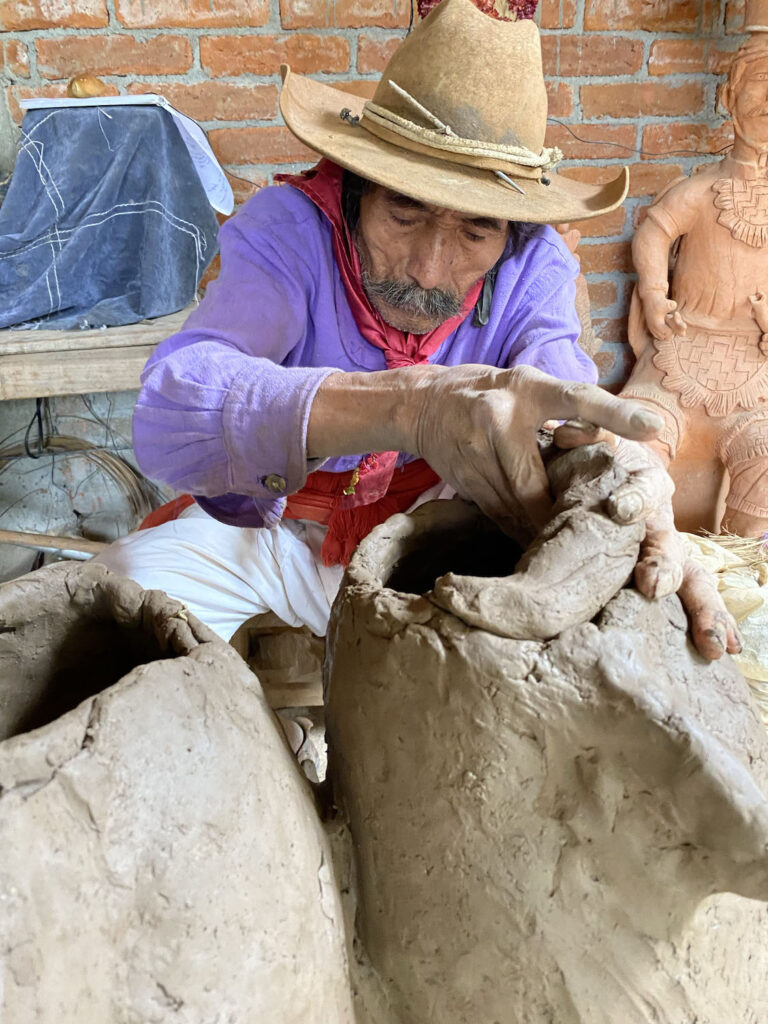
You overhear a guy four stools down talk about a ceramic studio a few towns away—a 76-year-old man who is blind creates sculptures using red clay that his family digs up in nearby fields.
Photo Credit: Andrea Sanchez Mendoza Sculptor Don José Garcia, who is blind, molds clay at his workshop, Manos Que Ven
Two days later, you are in a car with the guy four stools down, driving to San Antonino Castillo Velasco to visit the man’s workshop, Manos Que Ven (“Hands That See”).
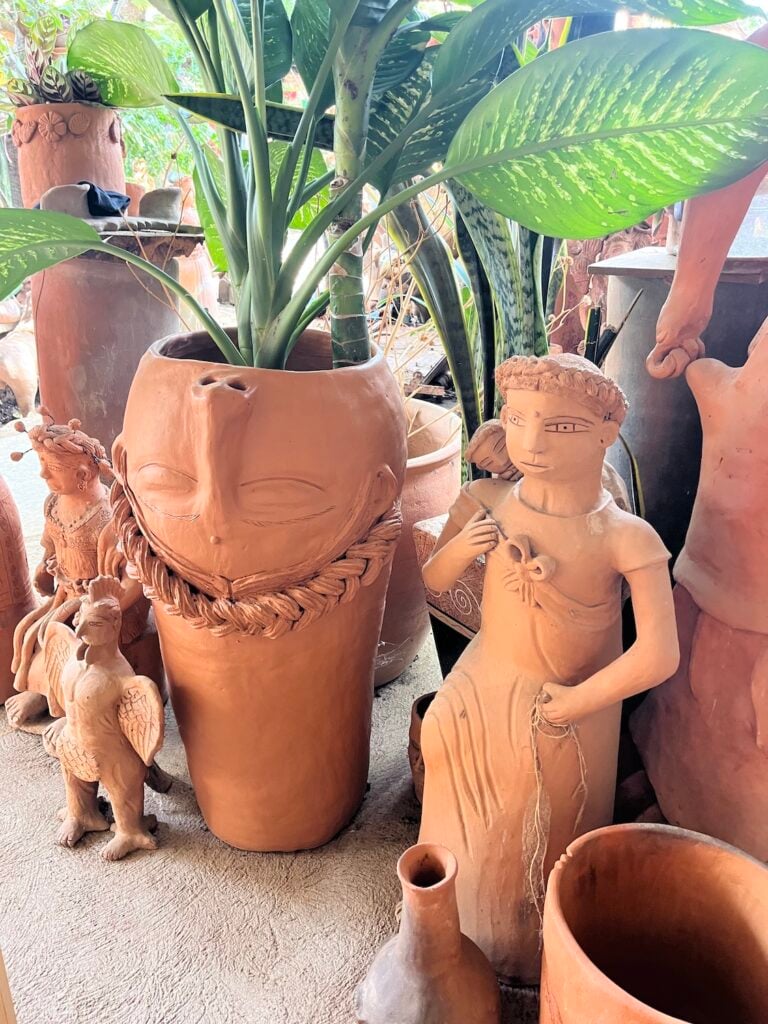
Don José Garcia’s signature pieces are faces on pots. Most look like his wife and sport her iconic forehead mole. He tells you that “love” is his inspiration and that he calls his wife “Princesa Magnolia Pechos de Oro” (or “Princess Magnolia Golden Breasts”). You wonder why your husband hasn’t come up with a cute nickname like that for you. If he were a sculptor, would he lovingly recreate your hairy upper-arm mole or your abnormally tiny and thick pinky toenail?
Photo Credit: Mara Altman
Assistants teach you Don José’s process by allowing you to attempt to form a visaged vessel, which they will fire for you to take home. They teach your kids, too, but instead of a vessel, one makes a blob with one whole that she tells you can both eat and poop. You pretend not to hear or see her demonstration.
You don’t have time to visit all the towns that specialize in clay, but there are multiple nearby with workshops to tour and places to get your hands dirty. One town is San Bartolo Coyotepec, which is famous for its black pottery. Yet another, Santa María Atzompa, is known for clay works fired in a ubiquitous algae-green glaze.
Photo Credit: Mara Altman
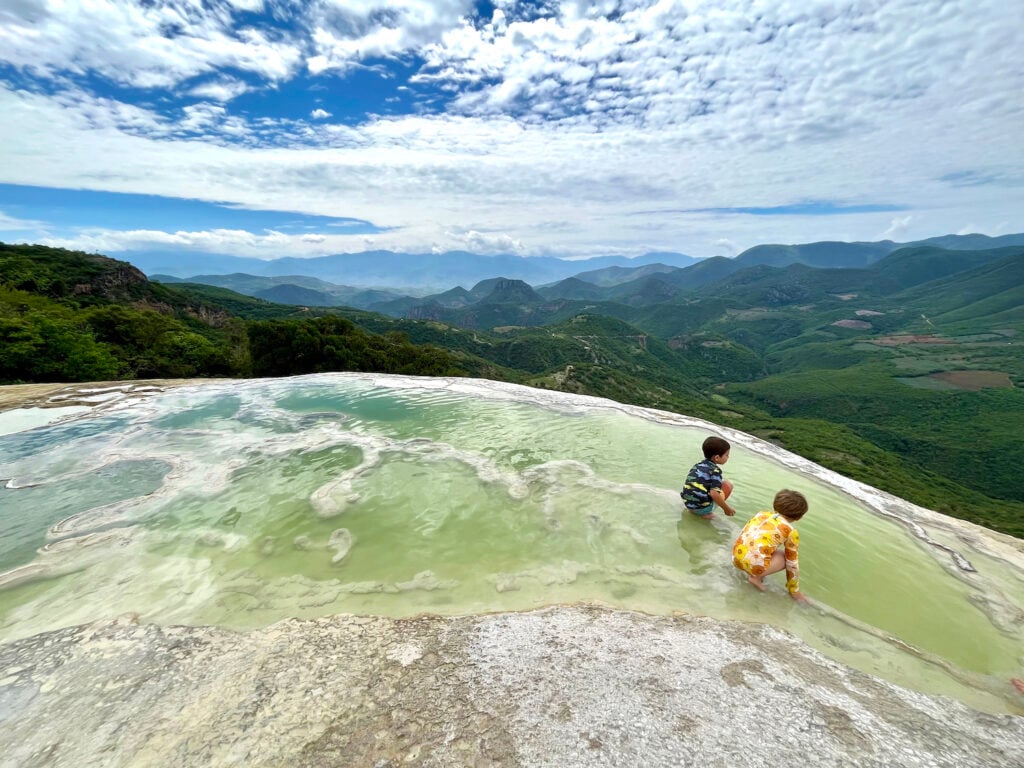
Before heading home, you manage to fit in a few more big experiences. You hit Hierve el Agua, a highly photogenic and swimmable mineral spring, before arriving at Teotitlán del Valle, a town known for tapestry.
Casa Textil Arte Zapoteco is a cooperative of 65 families. Alfredo, your host, tells you that his ancestors moved to this valley hundreds of years ago. They had fled the Aztecs, who had built quite a reputation for painting people indigo and sacrificing them to weather gods. The only thing the people of Teotitlán want in indigo is their beautiful Zapotec rug designs.
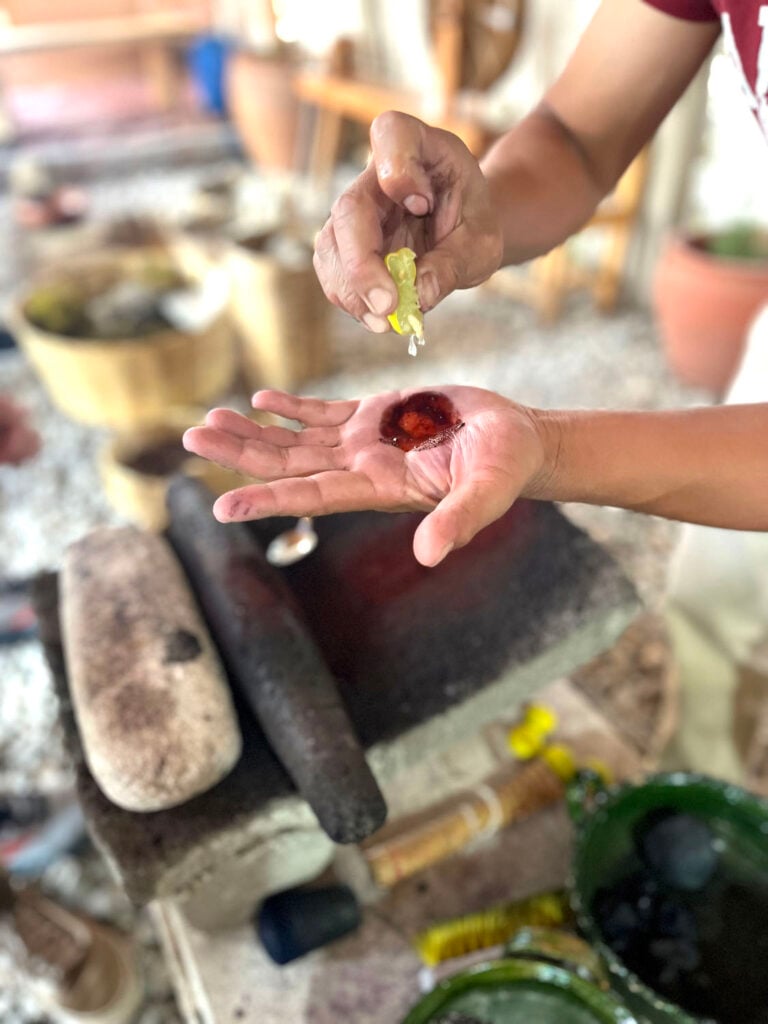
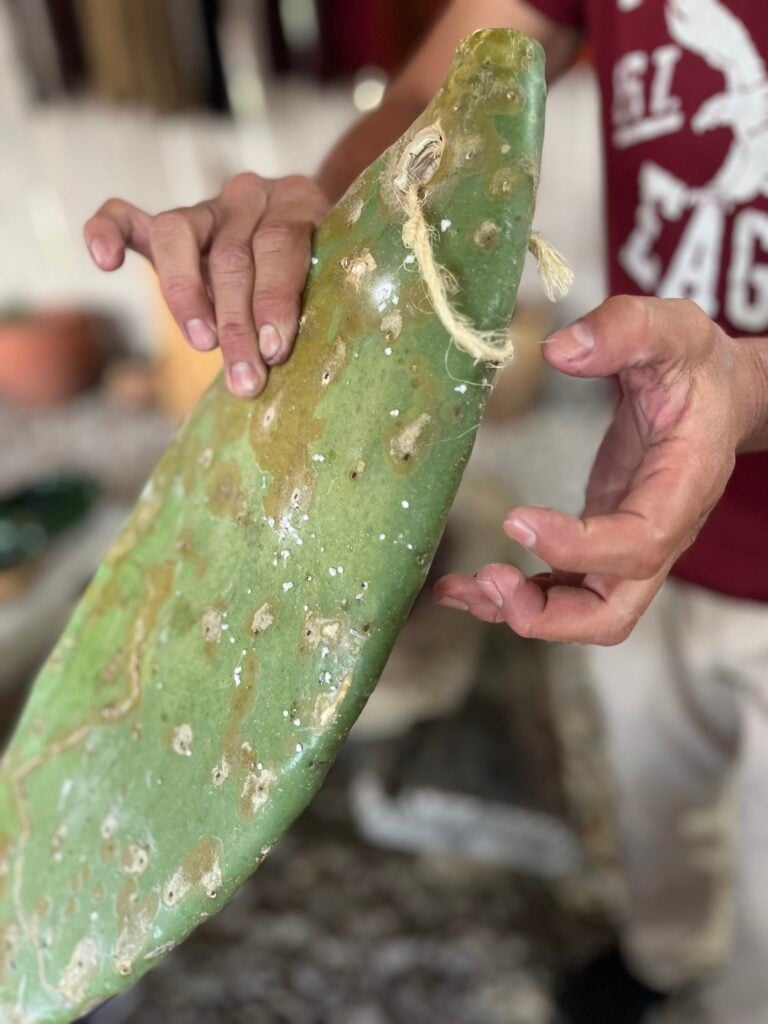
Photo Credit: Mara Altman Adding acid or citrus to powdered cochineal bugs produces a rich blood-red dye
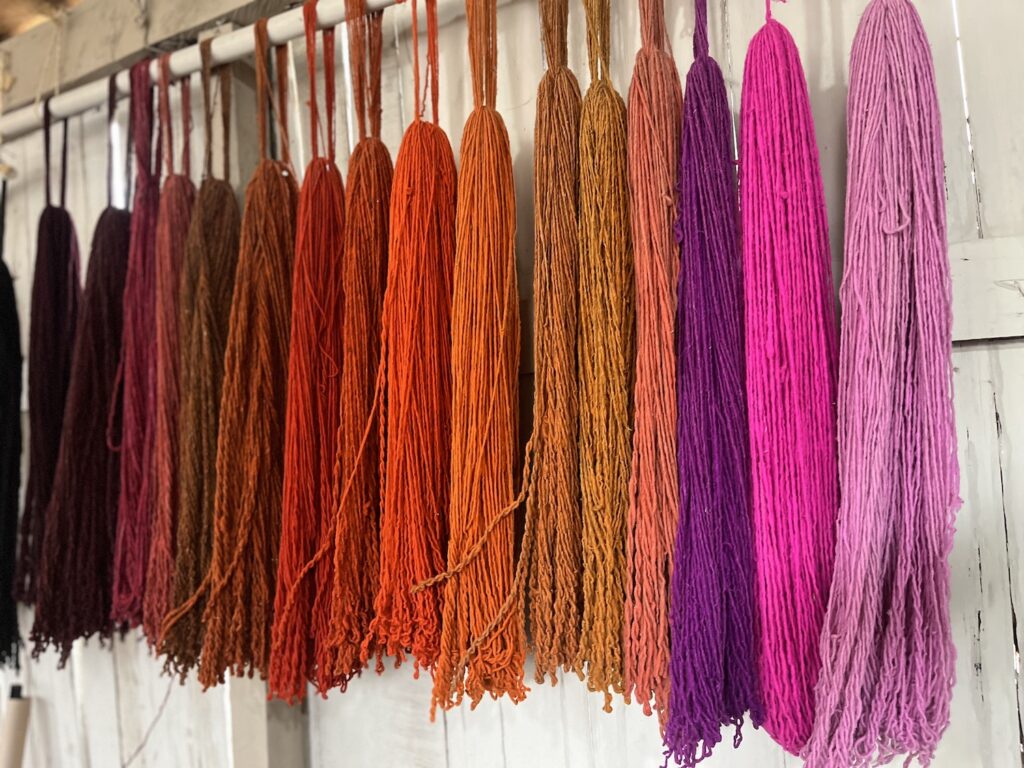
You see a demonstration about the dyeing process— how pecans make brown, moss makes green, cochineal insects make red—and have an option to sign up for more intensive natural dye courses.
You and your offspring are satisfied by the quick version. Alfredo dries the cochineal bugs, crushes them into a powder, and uses various methods— like lime juice or baking soda—to rehydrate them into different shades of red, anything from rosy pink to dark crimson.
As you leave, your son asks over and over again, “Why did the sun god want dead people?”
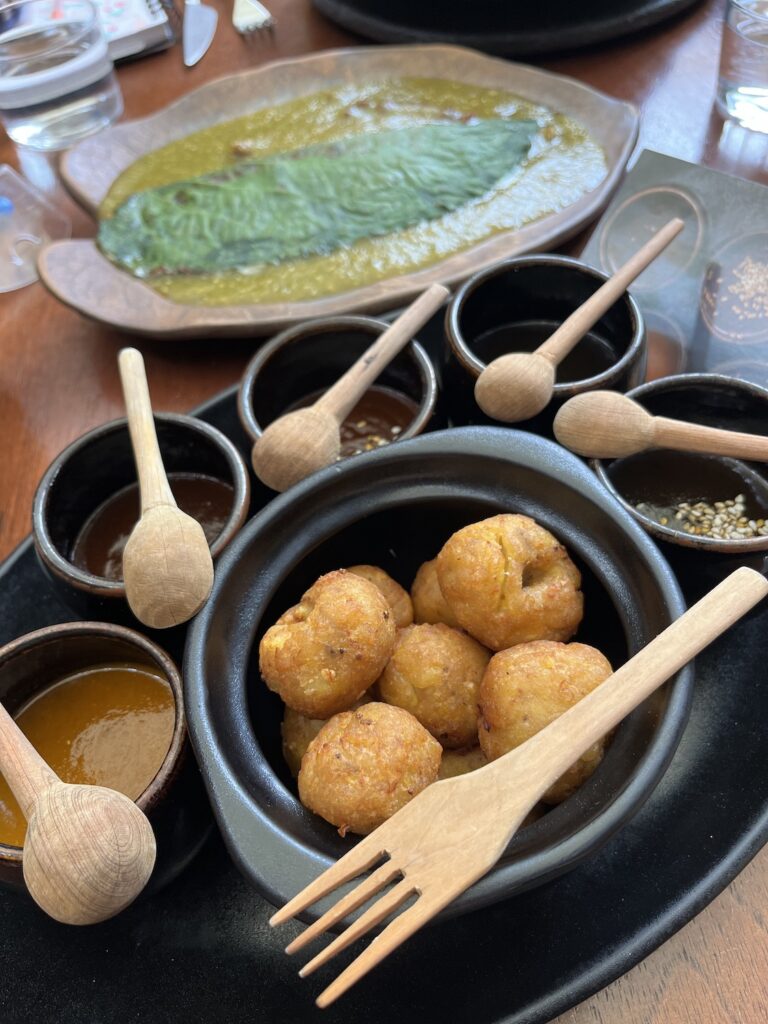
Photo Credit: Mara Altman The five-mole tasting at Los Danzantes
For you, the most magical part is driving with a guide to the town of Cuajimoloyas and going mushroom foraging in the northern Sierras. You find amanitas, russulas, and boletes hiding under pillows of pine needles and bring them to a tiny restaurant, El Mirador, for the chef to transform into traditional fare. Your favorite is the amanitas cooked in a packet with mayonnaise, Oaxacan cheese, and epazote. You are sure you will crave this taste (and moment) for the rest of your life.
In between your workshops, you’ve managed to eat at Casa Oaxaca, Adama, and Criollo and do the very worthwhile five-mole tasting at Los Danzantes. Oaxaca is the culinary capital of Mexico, after all, so you need to do your due diligence. You take a five-hour market tour in Central de Abastos. You put it all into your mouth: huaraches, memelas from Doña Vale, tesajo, tejate, habanero chapulines, pulque, squash-blossom empanadas. You realize you have not felt hunger for about eight days, and you are proud that you haven’t let that stop you.
Photo Credit: Mara Altman
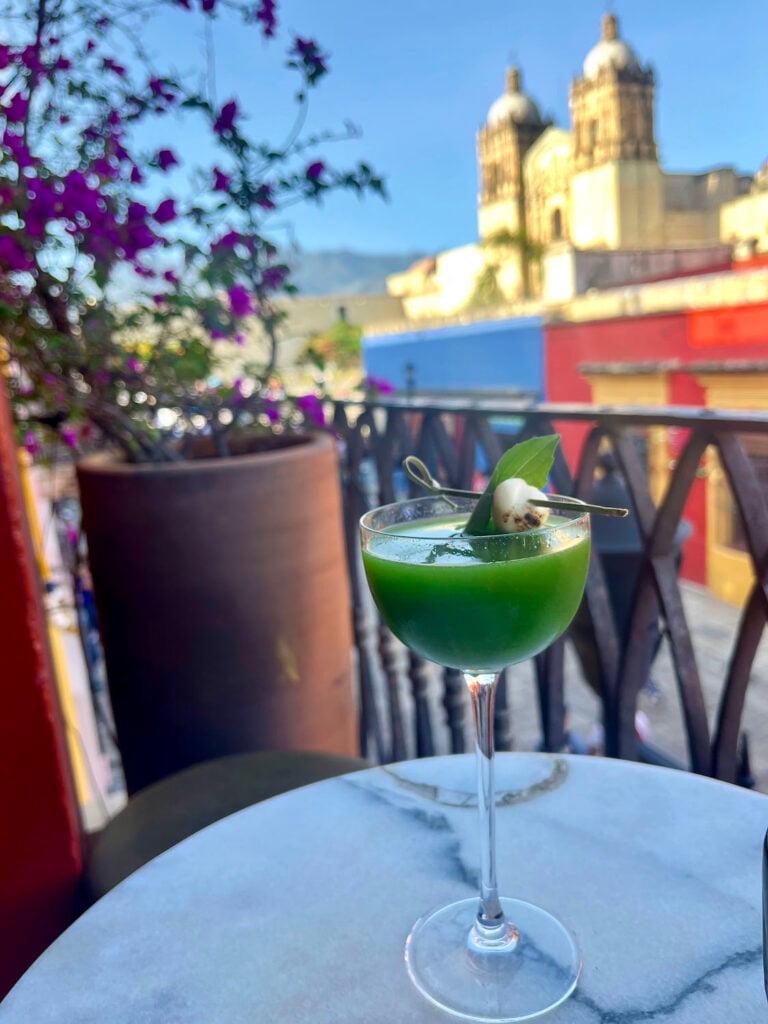
Someone tells you about a cocktail. They say, “You must have this cocktail before you leave.” You go to Selva to get the drink made with hoja santa, poblano liqueur, and mezcal and garnished with a roasted Oaxacan cheese ball. They don’t allow children in the bar, but they happily serve you the drink outside. People were right—this is divine. It’s bright, fresh, novel, creative, deep, and delicious. It’s Oaxaca in a coupe glass.
Photo Credit: Mara Altman The namesake drink at Selva, a sweet second-story cocktail bar, comes garnished with a roasted ball of Oaxacan cheese.
On your last day, you develop stomach issues. You are in the fetal position, but you’re an optimist; you brag about your new ability to turn any food into water.
You are not sure what the kids have processed from this trip—you briefly think about the beach, the waves—but then one taps you on the shoulder. “I love Oaxaca,” she says. “Can we come again next year?”
You picture those poor suckers with their sticky snorkels, sunburns, and sandy skin crevasses, and you know it for sure now—you nailed this vacation.
Oaxacan Cuisine Mentioned
Chapulines
Deep-fried or toasted grasshoppers seasoned with lime, chile, garlic, and salt.
Epazote
A leafy herb sometimes called “Mexican tea.” Powerful and medicinal in flavor, it has notes of citrus, oregano, and anise.
Hoja santa
A leafy, aromatic herb with flavors of eucalyptus, liquorice, mint, and tarragon. Its name means “sacred leaf.”
Huarache
Masa (cornmeal) dough filled with refried beans and formed into an oblong shape that resembles the leather sandal that shares its name. It’s then fried and crowned with salsa, meat, onions, potatoes, cilantro, and queso fresco.
Huevos divorciados
“Divorced eggs.” Similar to huevos rancheros, this is two fried eggs served over tortillas, but one egg is covered in green salsa and the other in red salsa.
Memelas
A small, oval-shaped, fried or toasted masa cake. Typical toppings include black beans, salsa, shredded cabbage, mole negro, guacamole, and cheese.
Mole
A name for several different sauces, typically containing chiles, fruits, nuts, and spices. The most famous, mole negro (“black mole”), is made with chocolate.
Paleta
An ice pop. Creamier milk-based paletas come in flavors such as horchata and vanilla, while water-based pops are made with fresh fruit.
Pan de elote
A corn cake. Made with sweetened condensed milk, it’s sweeter and moister than American corn bread, with a bread-pudding texture.
Pulque
A milk-colored alcoholic beverage made by fermenting agave sap. Said to be North America’s oldest fermented drink, it’s tangy, like buttermilk, though a version called pulque curado is sweetened with honey and fruit.
Tejate
A non-alcoholic beverage made with roasted corn flour, fermented cacao beans, cacao flower, and the toasted seeds of a sweet-and-savory fruit called mamey sapote.
Tesajo
Thinly sliced, salt-cured beef, usually made from organ meat or flank steak. In Oaxaca, it’s often served with tlayudas (see below) and radishes.
Tlayuda
A large, crunchy tortilla, traditionally topped with refried beans, pork lard, lettuce or cabbage, avocado, meat, Oaxacan cheese, and salsa. It looks like a cross between a pizza and a tostada.
Mara Altman is the author of two nonfiction books, Thanks for Coming and Gross Anatomy: Dispatches from the Front (and Back), which was a semi-finalist for the Thurber Prize for American Humor. Altman also wrote eight best-selling Kindle Singles and has written for publications such as The New York Times and New York Magazine. Earlier in her career, she was a staff writer for The Village Voice and daily newspapers in India and Thailand. She lives in North Park with her husband and twins.
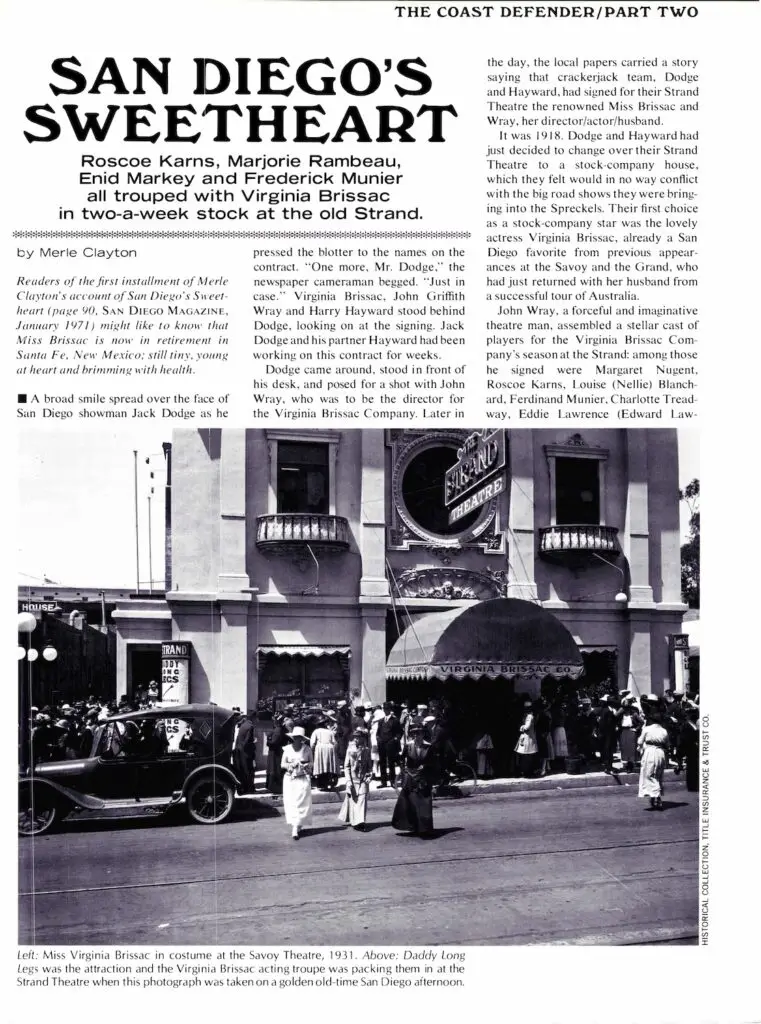
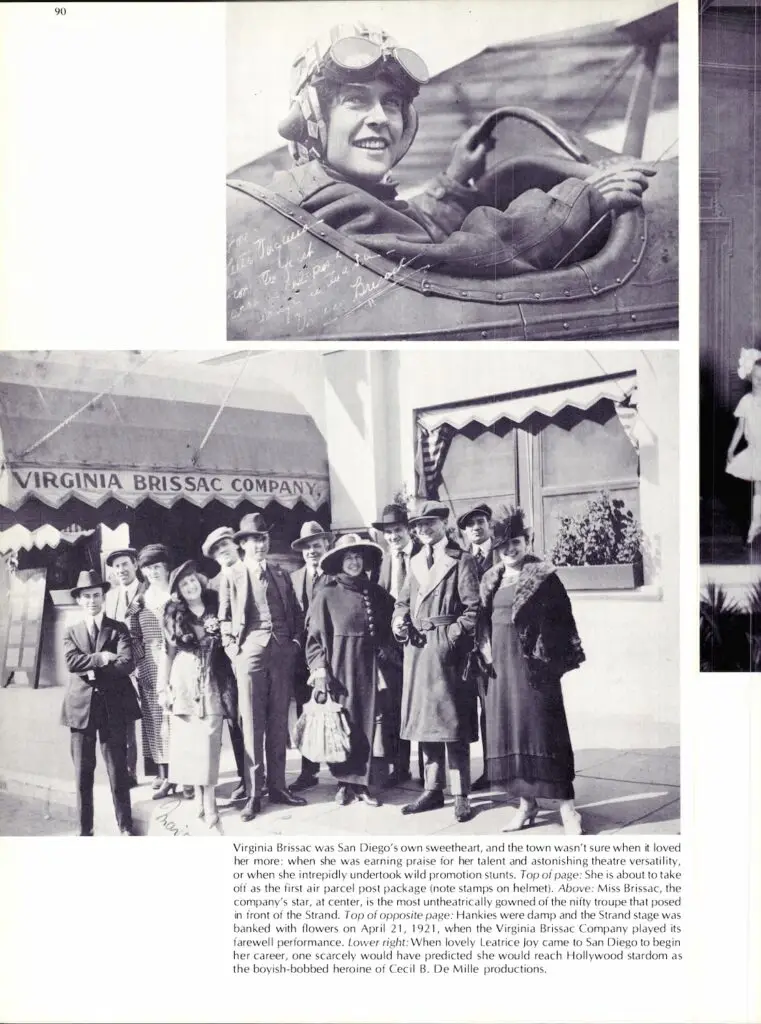
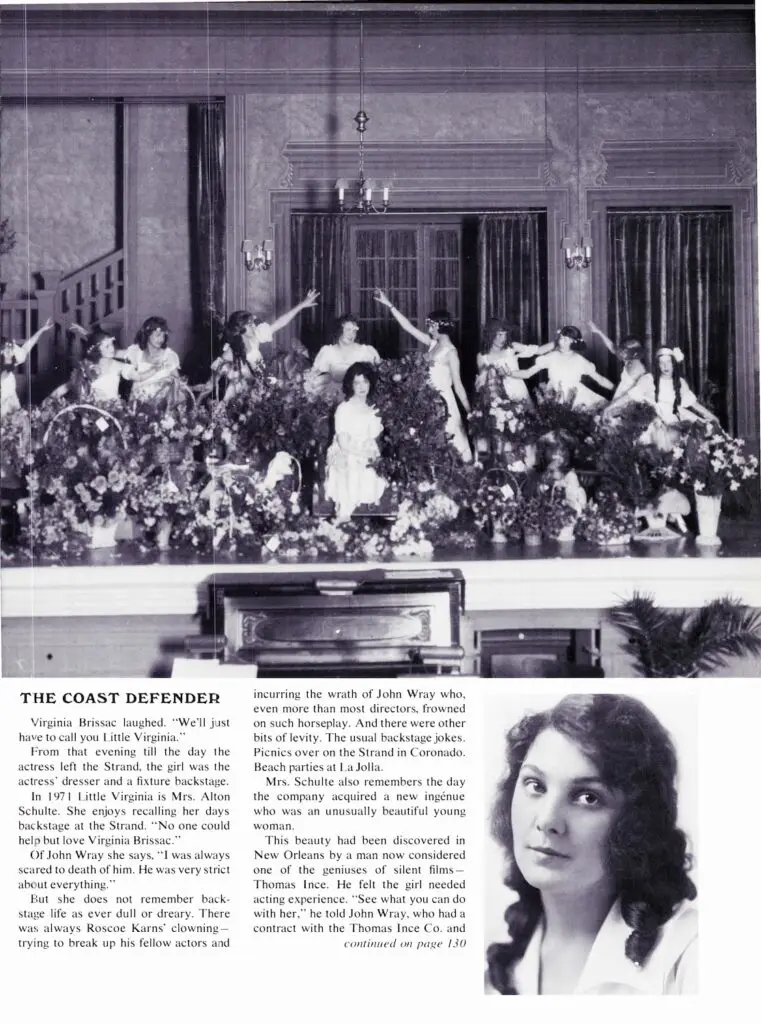
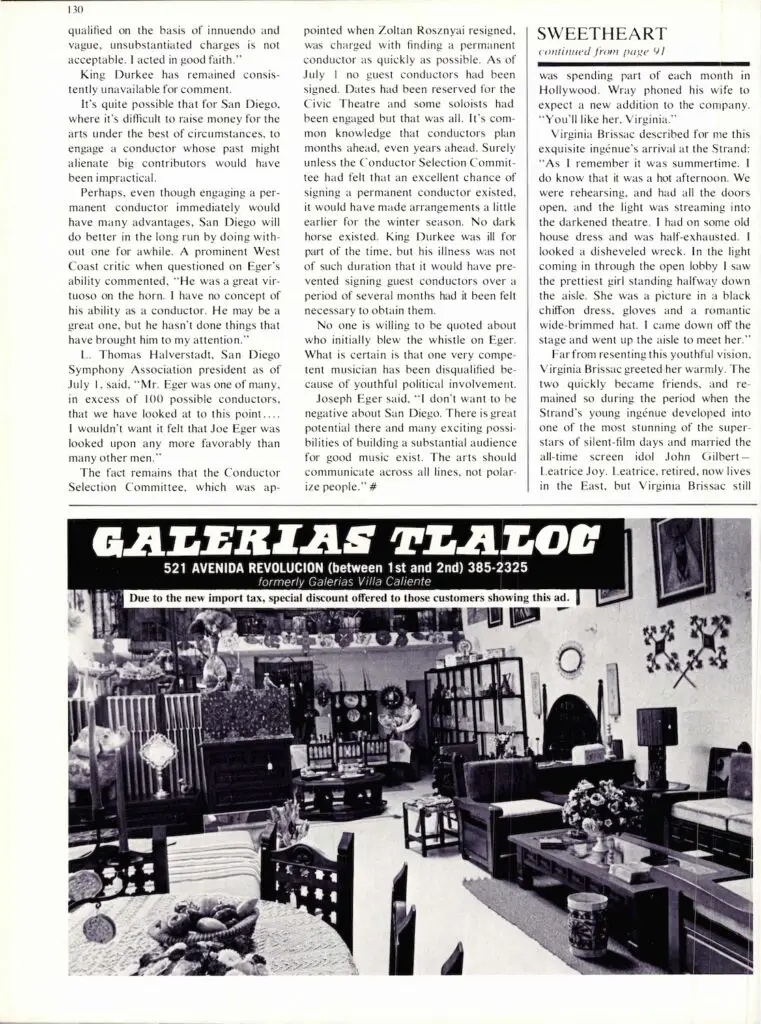
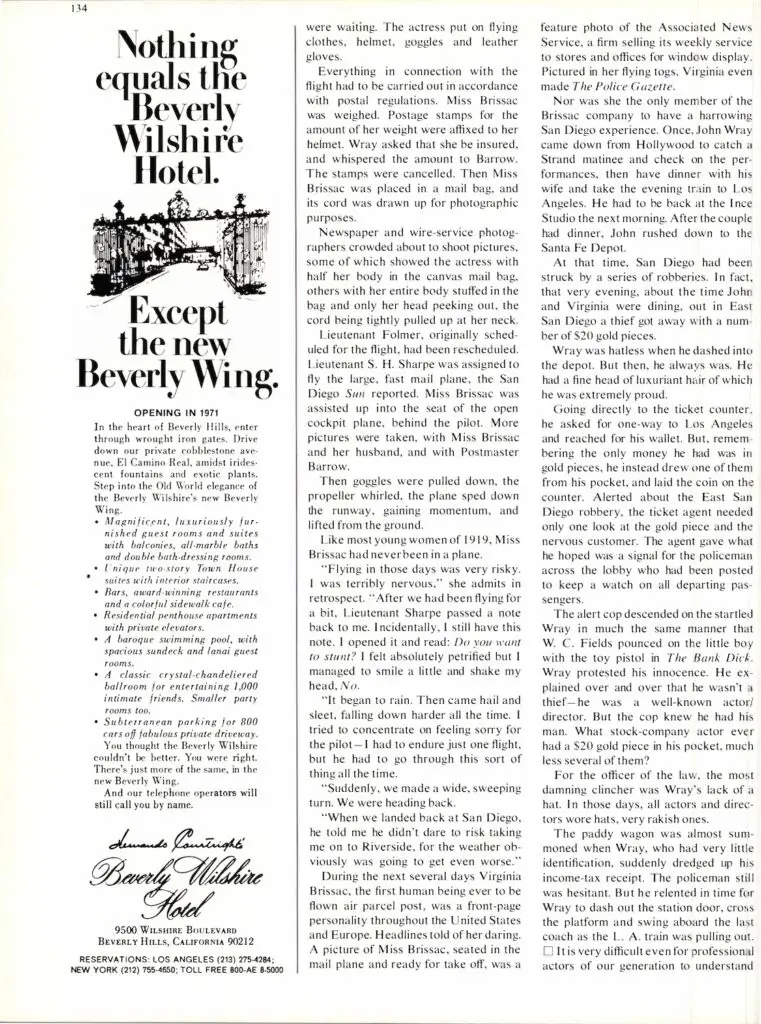
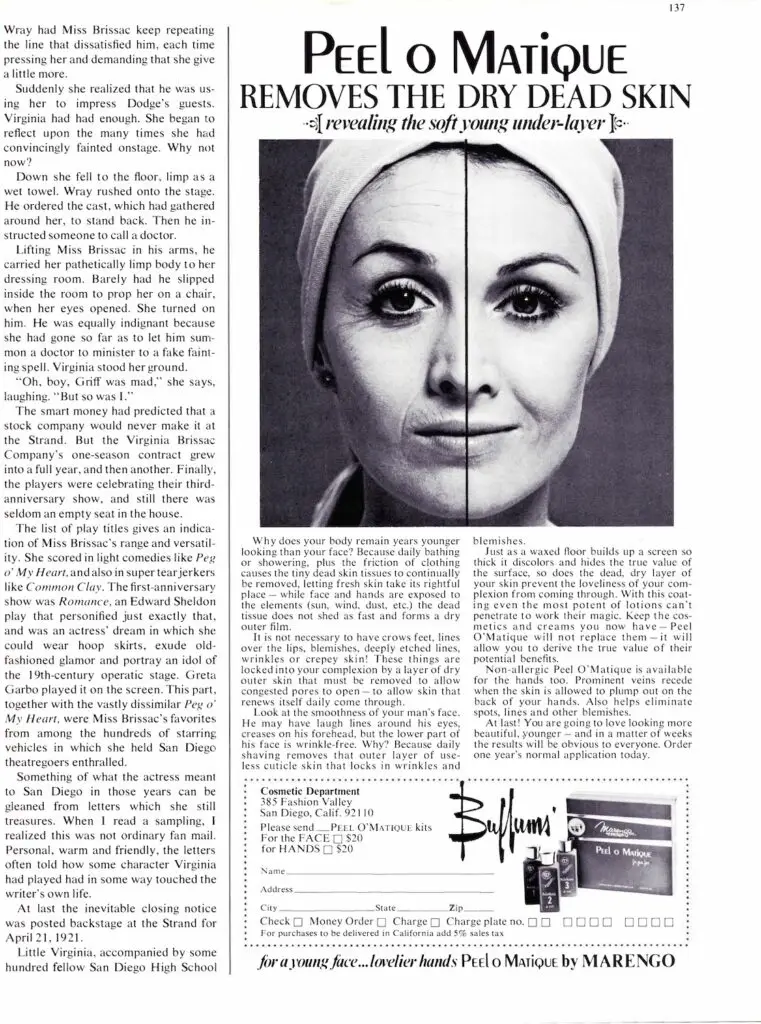
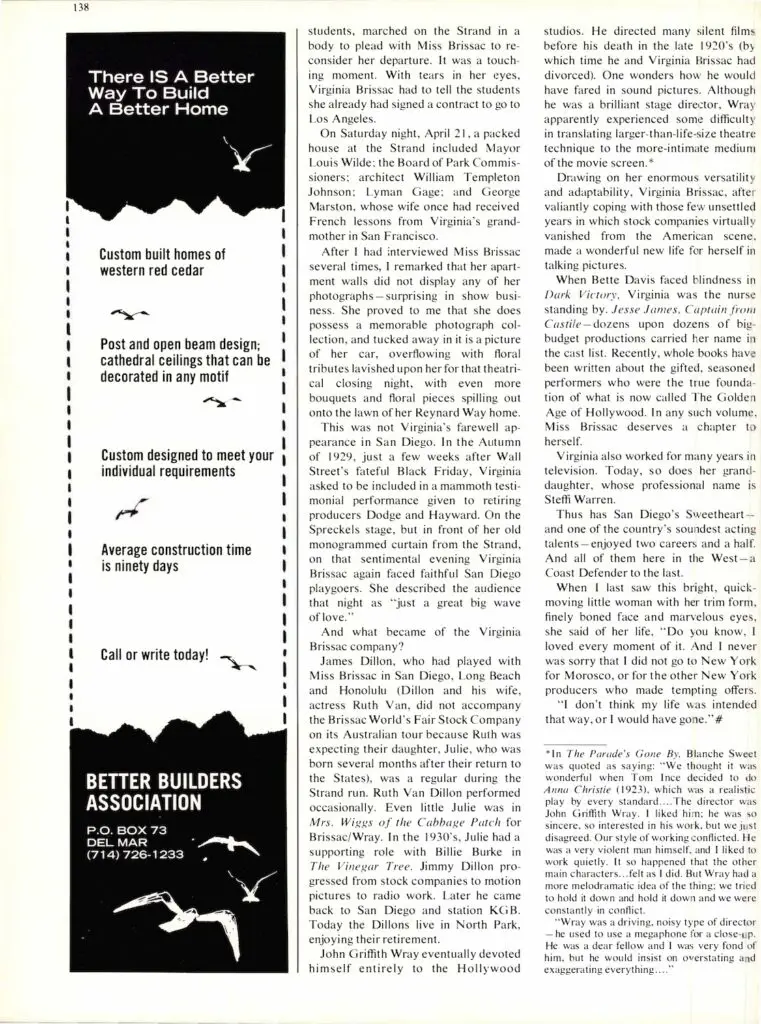
There was once an actress known as “San Diego’s Sweetheart” who mailed herself to Los Angeles—donning a helmet covered in postage stamps and boarding a two-seater, single-engine mail plane. The publicity stunt was billed as the first air parcel package in the US. It wasn’t. She wasn’t even the first human to be mailed: When the US parcel post started in 1913, at least seven people mailed their newborns to relatives (an innovative loophole eventually outlawed).
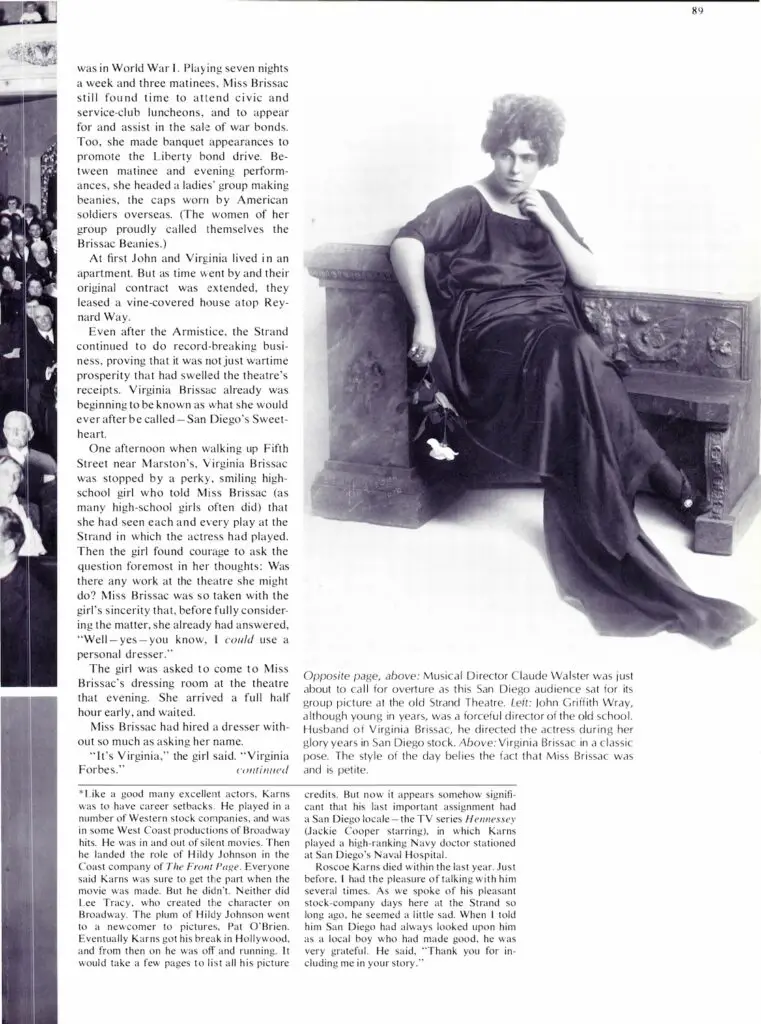
Technicalities be damned. That kind of nose for spectacle was why Virginia Brissac was such a star—landing bit parts in TV shows (I Love Lucy, Dragnet) and 155 films, notably playing James Dean’s grandmother in Rebel Without a Cause. “Nobody could help but love her,” her dresser told San Diego Magazine in a 1971 feature, published when Brissac was 88 years old.
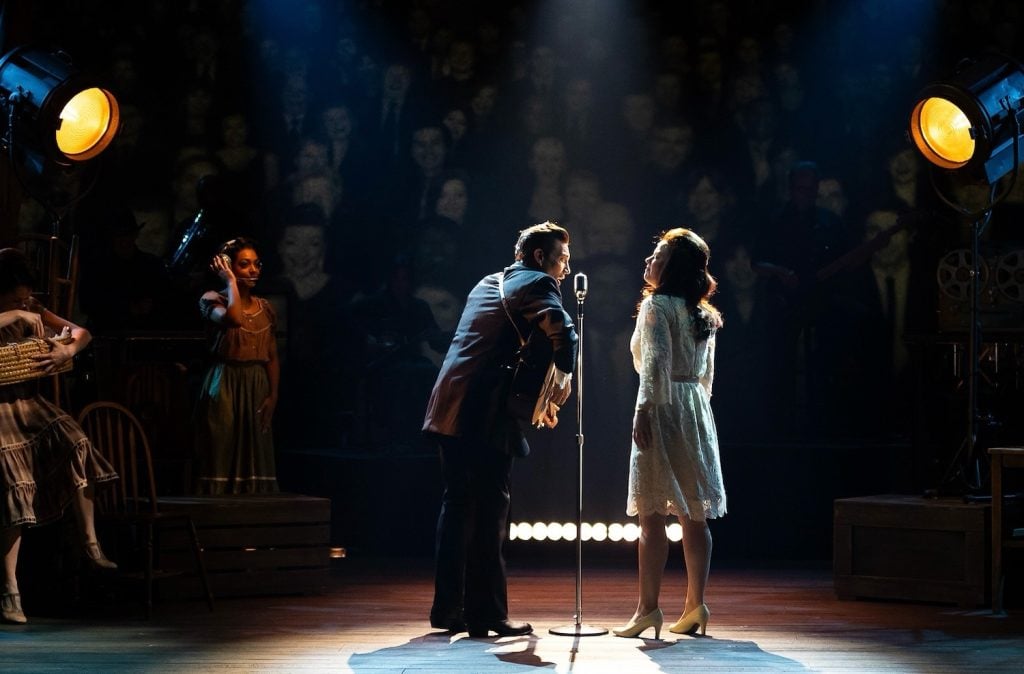
In 1911, she topped the Playbill at the opening of the Savoy Theatre at 3rd and C streets in Downtown—a grand live-performance hall built for $150,000 ($5.2 million in today’s money). It became one of the premiere vaudeville theaters in the country (under vaudeville king Alexander Patages). The theater helped make San Diego a destination for stars like silent-film comedian Roscoe “Fatty” Arbuckle, heavyweight champ Jack Dempsey, plus classical legends Rachmaninoff and Anna Pavlova. As theaters converted to movie houses through the ’20s and ’30s, the Savoy remained dedicated to live humans. It closed in 1940, and the Civic Theater now stands in its footprint.
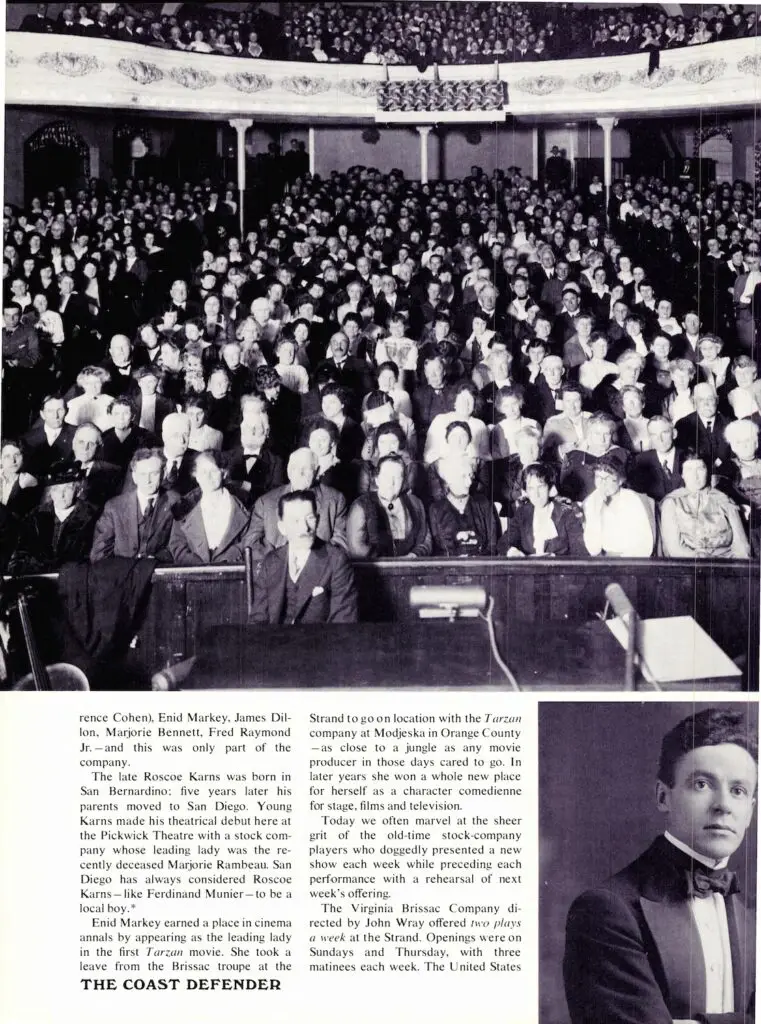
As for Brissac, during a time when women couldn’t even vote, she led a stock company under her own name at the Strand Theatre. The Brissac Company held a four-year residency, “an all-time successful record run for San Diego,” the article says. That classic Ocean Beach theater (featured in San Diego film legend Cameron Crowe’s Almost Famous) has been closed for decades, its bones now a chain beachwear and souvenir store. But Brissac’s legacy lives through the women leading San Diego’s theater scene.
Read the entire 1971 article by Merle Clayton below…
Emma Veidt is an editor at San Diego Magazine. She earned her bachelor's and master's degrees from the Missouri School of Journalism. She loves running, hiking, and rock climbing, but really, she mostly loves encounters with the street cats around North Park.
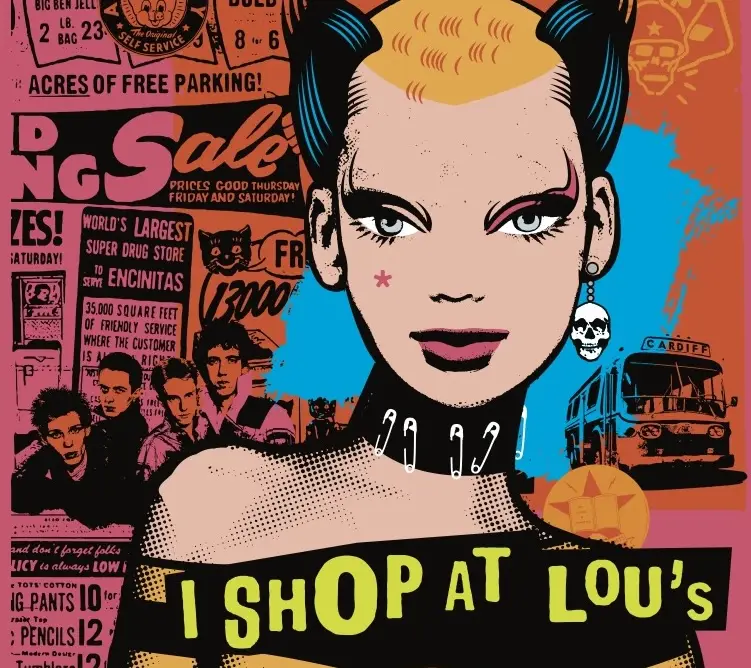
How Scrojo Became One of Rock’s Most Prolific Poster Artists
The San Diego designer has created more than 3,000 concert posters over nearly 40 years for artists including the Rolling Stones and the Red Hot Chili Peppers
When he was in high school, he and his friends were trying to come up with the perfect name for their punk band that would encapsulate all their personas. Nicaragua. The Freds.
One of his friends said he was going to go by Jimmy Stacks and called it “the perfect rock and roll name.” Their names changed so much that Haskett erupted: “Fine, I’m f—ing Scrotum Joe, the true defender of the Open West.”
Their response: Wow, that’s a great name.
As a teenager, he drew chalkboards for Del Mar’s Pannikin coffee shop and would design T-shirts for surf/skate brand Life’s a Beach. He signed the shirts with his moniker, but even in punk rebellion, who wants a shirt with the words Scrotum Joe on it? “They just cut out the ‘t-u-m,’ and the next thing you know, a client referred to me as that, and it stuck,” he says.
Courtesy of Scrojo
Scrojo could have been part of a band as iconic as The Misfits—had he been able to learn the famously cumbersome bassline to The Kingsmen’s “Louie Louie.” Becoming one of the most renowned concert poster designers—someone who quite literally designed the cover of Art of Modern Rock: The Poster Explosion—is a pretty good Plan B.
“To my knowledge, he’s done more rock posters than anybody else alive,” says Dennis King, whose D. King Gallery in Berkeley, California, serves as one of the largest private rock poster collections in the world. “He’s the hardest-working guy in the poster business.”
King not only co-authored the sequel to music historian Paul Grushkin’s The Art of Rock, but he also handles distribution and sales for all of Scrojo’s work. That’s more than 3,000 different posters over nearly 40 years. (That’s over one poster each week. For four decades straight.)
For anything from boxing matches to rodeos, posters have long been used as promotional items. Toulouse-Lautrec’s famous lithographs advertised Moulin Rouge in the late 1800s. Around the same time, Hatch Show Print in Nashville was making handbills for the Grand Ole Opry.
“I propose this: Cave paintings are the first poster art,” Scrojo says.
Courtesy of Scrojo
Rock and roll posters took off in the 1960s, when the hippie counterculture era replaced conformity and suburbia. Artists like Jimi Hendrix and the Grateful Dead used their vibrant, psychedelic prints as a form of rebellion from the mainstream. Posters were promotional, commemorative, collectible, and especially expressive.
If the name Scrojo is any indication, he doesn’t shy away from imagery that toes the line of being too provocative. He focused more on what inspired him instead of trying to be offensive for the sake of getting attention.
“Didn’t want to show it to my grandmother, but my parents were fine with it,” Scrojo says with a laugh.
“We’ve had to ask him to put a Band-Aid over a nipple every now and then,” says Chris Goldsmith, president of Belly Up Tavern in Solana Beach, where Scrojo started out and hundreds of his posters currently line the walls.
Scrojo spent six weeks at Otis College of Art and Design for a summer semester before drugs, alcohol, and a self-described lack of discipline prevented him from enrolling full time. Still, he taught himself concepts like text hierarchy and later found his niche at the Belly Up and in the surfing and skating world, working with brands like Quiksilver, Rip Curl, Scorpion Bay, and DGK.
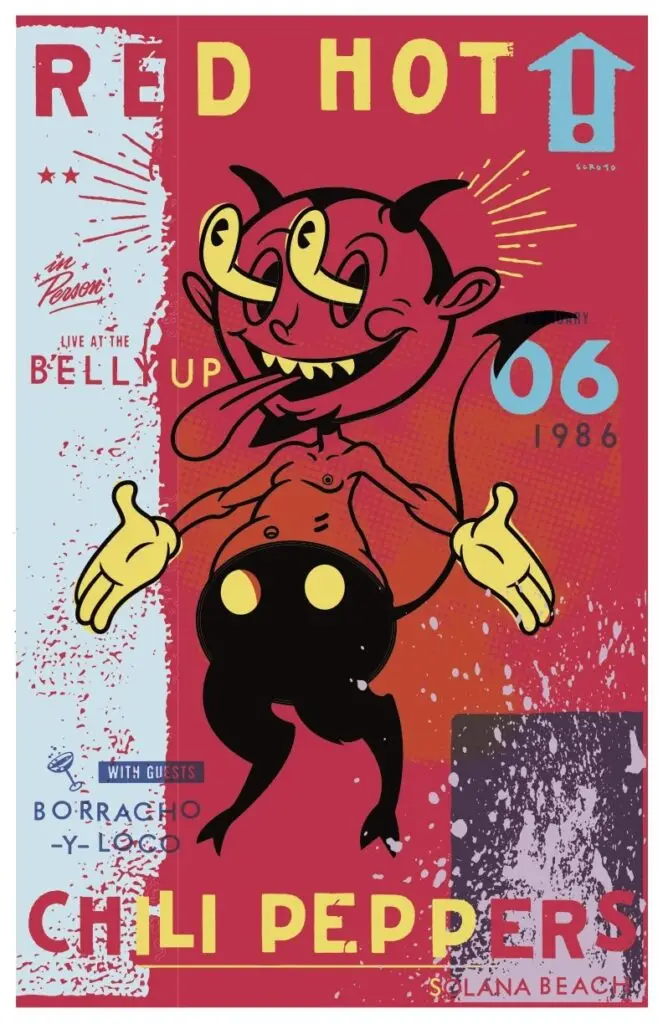
His first concert poster was for North County band Borracho y Loco, of which Goldsmith was bass guitarist. Scrojo drew an abstract version of the Belly Up’s iconic shark with colorful calypso and tiki themes.
Early on, he would craft using a pencil, pen, non-reproduction blue pencil, X-Acto knife, rubber knife, and proportion scale to create each poster, and the finished product could take a week or even longer.
Courtesy of Scrojo
“I recommend every artist coming up to do that for like six weeks,” Scrojo says. “It forces you to think about every design decision as you’re going along.”
He has since mastered vector imagery through Adobe Illustrator to the point where, depending on the level of detail needed, he could finish two projects in a day. Still, he fills sketchbook after sketchbook to blueprint.
“I liked his line in particular, and he knows how to draw, which a lot of people don’t really know how to do these days,” King says.
Scrojo would research what each musician’s merchandise looks like to get a feel for each artist’s tone and voice. Once he has his central image in mind, he focuses on what and where to place the text.
He doesn’t have one specific style, ranging his talents from art deco to psychedelic and everything in between (and outside the lines). Want a pop surrealist comic book cartoon devil with splattered paint textures, halftone dot patterns, and pure chaos? Red Hot Chili Peppers, February 1986. Want a minimalist graphic portrait with bold strokes and graffiti text? P!nk, October 2023. Want a carnival sideshow style piece with a tasteful caricature of Jeff Bridges? The Big Lebowski, August 2011.
Scrojo calls himself a jack of all trades because he can create posters for all music genres. King calls him a chameleon for his ability to adapt his voice to new eras.
Courtesy of Scrojo
“The variety of his skillset makes it possible for us to put 50 of his posters on a wall next to each other and have it look compelling, not just a bunch of the same thing over and over,” Goldsmith says.
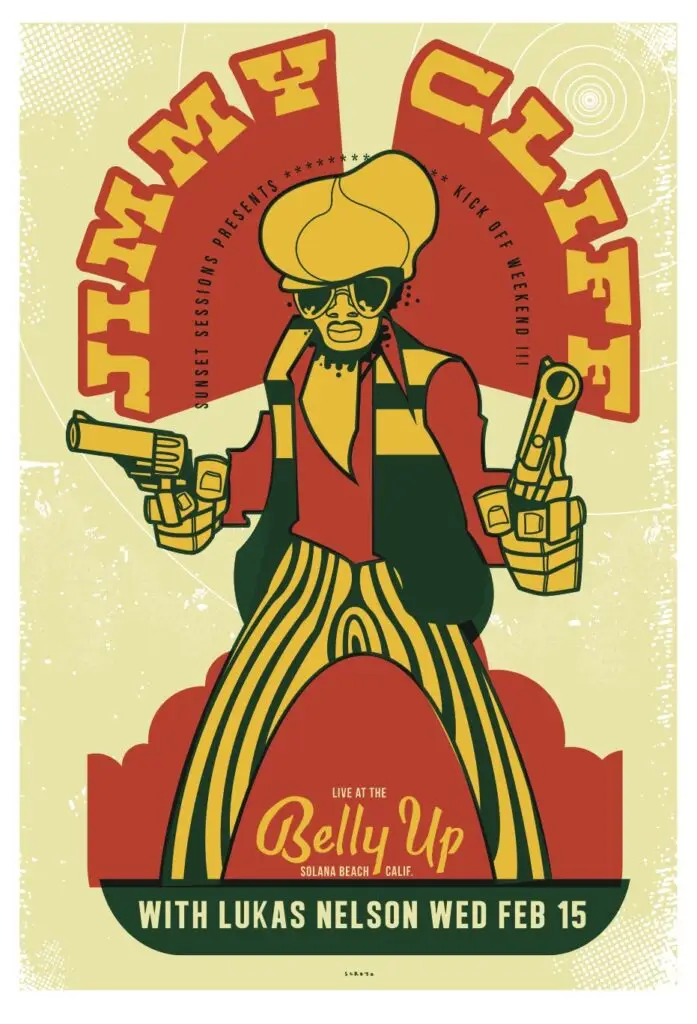
Some of Scrojo’s favorite posters are when he feels a personal connection to the artist or the album. He has a vivid memory as a child of being trapped in a closet filled with marijuana leaves while playing hide and seek and staring at Jimmy Cliff’s “The Harder They Come” LP. “For whatever reason, as a kid, that sparked a desire to do graphic design,” Scrojo says.
Fast forward to February 2012, Cliff is performing at Belly Up. Scrojo decided to modify Cliff’s original album cover from rainbow gradient fills to classic reggae psychedelia while preserving Cliff’s striped pants and bold hat. Cliff’s manager called him and said they wanted to use it for the rest of their tour.
“We always get artists requesting that he does their posters,” Goldsmith says. “A lot of artists don’t want venues to go all rogue because they want to control how they’re being presented. With him, they’re like, ‘Let him go nuts.’”
Matt Eisenberg is an award-winning writer and photographer based in San Diego. A former ESPN editor, his work has also been published by CNN, Bleacher Report and the New York Daily News.
“This is insane!” the guy filming it seems to proclaim. “It’s the best fireworks show ever!” a companion confirms, inspiring a debate lasting over a decade.
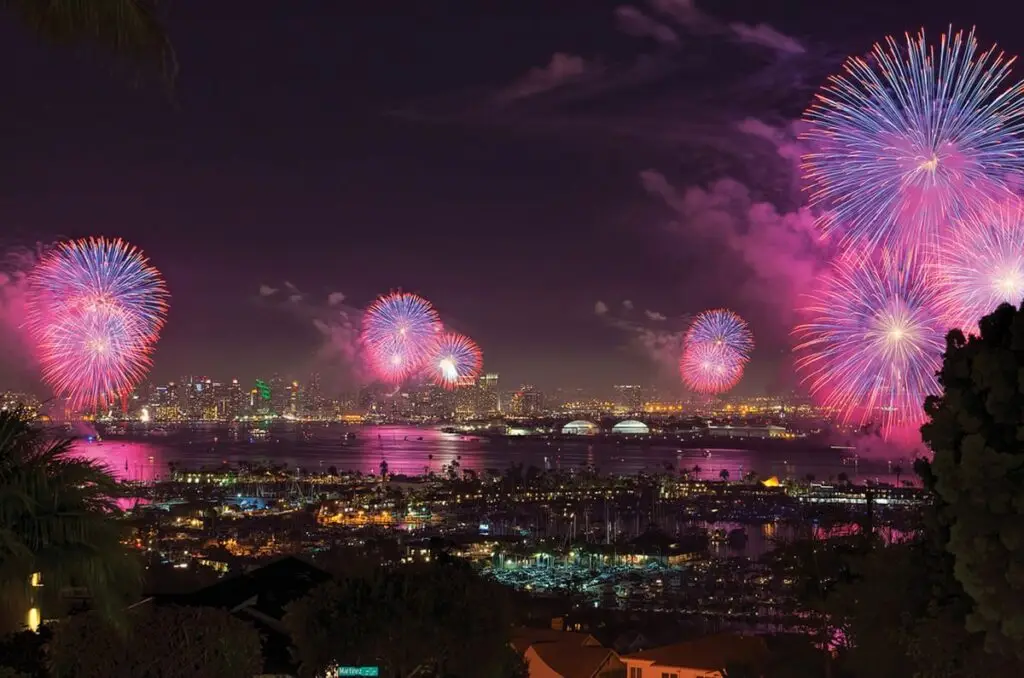
All told, 7,000 fireworks exploded in the span of 25 seconds over San Diego Bay on July 4, 2012. A Michael Bay amount of unison. $125,000 worth of shells, cakes, Roman candles, and skyrockets had been placed on a barge—enough for 17 minutes of decorative sky flares—and…
Boom.
The sky looked like someone had set a giant Rorschach test on fire. Or as if whatever we all see in our Rorschachs—butterflies, clowns, tongue kissing, dads—was being electrocuted and lifted heavenward, amen. It was shocking how bright it was, how much it sizzled the local cosmos. Could’ve been one of those sci-fi films where a hole is ripped open between warring universes. But angstier, more metal—the work of some methy creator in a sleeveless concert tee.
The sound?
Lou Reed once released an entire album that contained 64 minutes of mindflaying guitar screeches and machine noises. No regular songs, just a fascinating amount of ear distress. His record label reps no doubt heard the melodic outro of their careers, but everyone else was in pain and stumped. That album still sounded better than the bay did that night. The bay sounded like a god who struggled with emotional regulation had blown his speakers and was working through the anger stage of AV grief.
In the left frame of the video, a middle-aged woman is attempting to drag her husband off by the hand. In no way does he want to go, possibly because he had missed the time Roseanne Barr sung the national anthem at a Padres game, simultaneously disemboweling and amusing America through the power of song. He would not willingly abandon an equally worthy San Diego trainwreck.
Another woman in the video appears to have just filled her beer, rushing to sit down for the show. She pauses mid-sit and returns to the full and upright position to properly bear witness. What was supposed to be prolonged entertainment has been so radically shortened that she will have to find another reason to drink. Lucky for her, drinking will be the only way to adequately process.
Locals remember the conspiracy theories. People wondered if the fuses had been tripped by a saboteur who was sympathetic to dogs, fish, or the growing suspicion that late-stage capitalism is a gorgeously branded but impossible dream sustained by remarkably efficient top-tier wealth retention and the soft compliance of fireworks-watchers who can no longer afford a house, a beer, or the personal impacts of human reproduction.
Speaking of being terrified of babies, babies were terrified. The children who witnessed it probably still can’t go near a candle store. But those kids will be tougher, perfectly scarred kids. They’ll write better songs.
That night helped us absolutely dominate the national news cycle. For a hot minute, we became America’s water-skiing squirrel. Now, years later, when you Google “fireworks gone wrong,” San Diego is always a top contender, along with that poor Nebraska family who nearly wiped out a couple generations in their front yard, their minivan somehow turning into a howitzer of recreational TNT.
There is still debate as to whether Big Bay Boom 2012 is the worst or greatest fireworks show of all time. But the advanced parts of civilization arrived at the truth as quickly as the women in the video did. It was undeniably amazing.
First of all, the point of Fourth of July fireworks isn’t “the intricate choreography of sky fire over a guaranteed amount of show time.” It’s about creating a vivid memory shared with some people you like, love, or would like to love.
BBB2012 used large-scale chemical fire to create the ultimate memory.
Sure, some people who iron their jeans subjected their family to a sermon about how San Diego managed to botch America’s birthday like a Disney princess-for-hire who smelled of quite a few Sauvignons.
The rest of us saw how perfectly it nailed the actual feeling of being an American. Because only a miniscule percentage of us bake postcard apple pies where every inch of crust is perfectly laminated like the wood in an Irish bar. Very few of us can paint on par with Picasso. The rest of us—despite truly believing in our America-activated abilities to achieve greatness in almost any field of our choosing—burn pies. We try to paint only to realize it looks like our fine motor skills have entered active death.
That’s why BBB2012 was the most perfectly American fireworks show ever: A wildly ambitious idea galvanized thousands upon thousands of people to both work on it and come to hold a beer and gawk at it, only to have it fail in the most glorious TMZ-level spectacle.
America isn’t about immaculate, storyless wins. It’s about how the framework of a country is solid enough that we can accidentally detonate our entire lives—a few times—and still probably be OK.
No one has America’d quite like San Diego did on that day. It was performance art. Lou Reed’s heart slow-clapped. Any brief municipal embarrassment quickly became a pride of our people. I can only hope the same for the Nebraskan yard family whose Dodge Aerostar became a hyperactive Death Star.
P.S. Local writer Maya Kroth compiled a quite great oral history of that night for Thrillist. The bottom lines for me were—it took nine months to prepare, no one was hurt, and even though the pyrotechnics company tried to zero out the bill, Big Bay Boom founder H. P. “Sandy” Purdon refused and paid them in full. This year will mark the 25th Anniversary of the yearly Big Bay Boom.
Troy Johnson is the magazine’s award-winning food writer and humorist, and a long-standing expert on Food Network. His work has been featured on NatGeo, Travel Channel, NPR, and in Food Matters, a textbook of the best American food writing.
Today’s seniors are more connected than ever, with a renewed focus on retirement as a time of discovery and enriching experiences. The ultimate reward for a retirement well-earned is the wisdom to appreciate it all, and what better place to enjoy that unique perspective than Vi at La Jolla Village, in the heart of San Diego.
All-access pass to good living.
As a Continuing Care Retirement Community (CCRC), Vi provides access to a connected and fulfilling community while making it easy to plan for future care, should the need ever arise. With a care plan in place, residents enjoy greater financial predictability and long-term value, freeing them to focus on making the most out of retirement.
Resort-style amenities at the epicenter of a cultural hub like San Diego offer a retirement experience unlike any other. Paired with exceptional dining, spacious accommodations and dedicated staff, the best of maintenance-free living is all around. And with the introduction of Vista 360 Well-Being, Vi’s panoramic approach to wellness, there are more ways than ever for residents to access it all.
The harmony of mind, body and community.
Courtesy of Vi at La Jolla Village
The key to longevity is striking the right balance in maintaining an active lifestyle with an active mind in a fulfilling community. With newly renovated community spaces and restaurants, Vista brings a variety of opportunities for residents to elevate their well-being through Vi-exclusive “Signature Experiences.”
Vista Enrich takes an evidence-based approach to brain vitality, keeping residents at the forefront of cognitive health through exergaming (exercising + gaming), nutritional plans and informative workshops. It is also home to The Brain Vitality Studio, an innovative facility dedicated to cognitive fitness that has garnered national recognition.
Vista Discover invites residents into stimulating educational experiences, from chef-led cooking demos and guided wine tastings to lectures at local universities and intimate lectures following cultural outings.
While Vista Enrich focuses on brain health and Vista Discover engages residents intellectually, Vista Explore cultivates a sense of adventure through curated travel and local excursions. But broadening one’s horizons doesn’t always require a plane ticket. One recent event brought a taste of the world right to the community: an onsite “jazz cruise” featuring live music and global cuisine served at a series of themed “ports” all within the community’s own ballroom.
“Location, location, location”
Courtesy of Vi at La Jolla Village
One of the biggest perks of life at Vi at La Jolla Village is its proximity to just about everything. With easy access to transportation and local attractions just steps away, residents can explore and engage with their community at their own pace.
“There are trolley and bus stops within a 5-minute walk that will get you to the beach, UCSD Campus, medical appointments, downtown La Jolla or San Diego, et cetera. We rarely use our car,” said resident Tom Yager.
With the best of San Diego just steps away, residents don’t just live in the city, they live within reach of everything that makes it special.
The best of all worlds.
Courtesy of Vi at La Jolla Village
At Vi at La Jolla Village, retirement isn’t a chapter to slow down; it’s an invitation to discover more. Tailored community experiences created by Vista, paired with the vibrant pulse of San Diego just outside the door, mean that residents don’t have to choose between security and adventure, connection and independence. They get all of it.
This is what an all-access pass to good living looks like: the comforts of an elevated lifestyle, a community built for growth and a city made for discovery – all in one place.
To learn more about Vi at La Jolla Village or for details on available floor plans, visit ViatLaJollaVillage.com/SDM.
If absence makes hearts (and stomachs) grow fonder, then shuttered restaurants quickly become the hottest tickets in town—something a number of iconic institutions found out after taking very public hiatuses after historically long runs. For instance, following a lengthy (and extremely flip-floppy) closing process after 92 years in business, Las Cuatro Milpas reopened two blocks away in Mercado del Barrio. Similarly, Carlsbad butcher shop Tip Top Meats reopened in the same location (albeit a smaller space) after the death of founder Joachim “Big John” Haedrich in 2023. Finally, after a whopping decade out of business, Sami Ladeki and chef Alfie Szeprethy brought back Roppongi to its original Prospect Street space, where it was the talk of the town in the late ’90s. All came back under the same proprietors, so they weren’t third-party nostalgia-licensing deals. The algorithm may have ravaged our attention spans away from all but the newest and shiniest, but this proves there’s still hope for our collective prefrontal cortex.
Other local eateries honored their pasts by bringing in new perspectives. The Lion’s Share in Embarcadero, Milton’s Deli in Del Mar, Dudley’s Bakery in Santa Ysabel, and J-K’s Greek Cafe in La Mesa handed over the keys to new owners willing to take on a big task: maintain the soul of icons through particularly rough economic circumstances for restaurants, navigate big feelings from longtime regulars (who often don’t take kindly to change), and make some necessary changes to keep going for another few decades. Taking over a project in process can be a lot harder than starting from scratch. But building that feel-good nostalgia doesn’t happen overnight, so it sure helps to have a well-established playbook of success passed down from those who came before.
Courtesy of Sugarfish
The Expansion Class Arrives
It wasn’t just restaurant groups from Los Angeles that decided to put down roots en masse, although San Diego saw plenty of LA transplants recently (Sugarfish, Mr. Charlie’s, For the Win, Katsuya Ko, Bacari). Global brands like Chef Fei, Zuma, and Pepper Lunch have locations of their own on the way, and upscale Canadian eatery Joey joined to the inescapable gravitational pull of Westfield UTC’s culinary cosmos for its first spot in America’s Finest City. Good to see the rest of the world is catching up with what we’ve been seeing the last few years—San Diego is a dining destination already on the rise.
Choosing To Not Choose
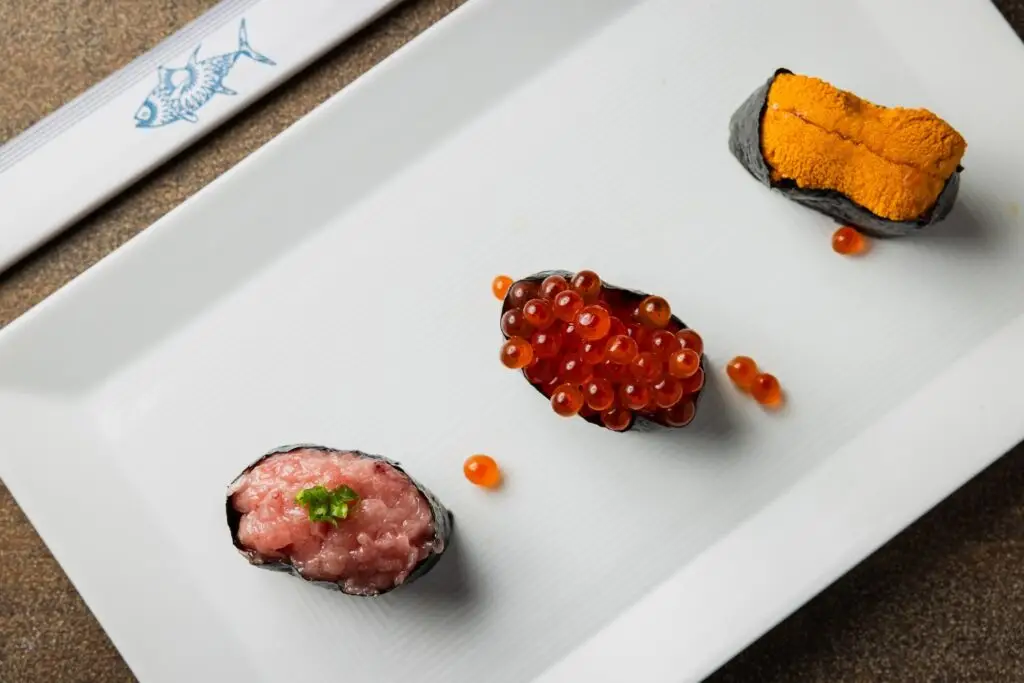
Between the never-ending news cycle of doom and perimenopause brain fog, I’m at the stage in life where I’m more than happy to let someone else make a decision for me, especially when it comes to what’s for dinner. And based on the way a lot of menus look right now, I’m not alone. It seems like half the places I visit offer some version of a prix fixe, omakase, or tasting menu. Restaurants are embracing the curated experience to solve the problem of affordability (a fixed menu reduces food and labor costs, guarantees an acceptable check average, etc.) and critical thinking in one fell swoop. Omakase (meaning “I leave it up to you”) is far from a new concept in high-end Japanese sushi culture, but now that it’s popping up everywhere from coffee experiences to grab-and-go sushi and sandwiches, it’s gone from somewhat niche to nearly omnipresent.
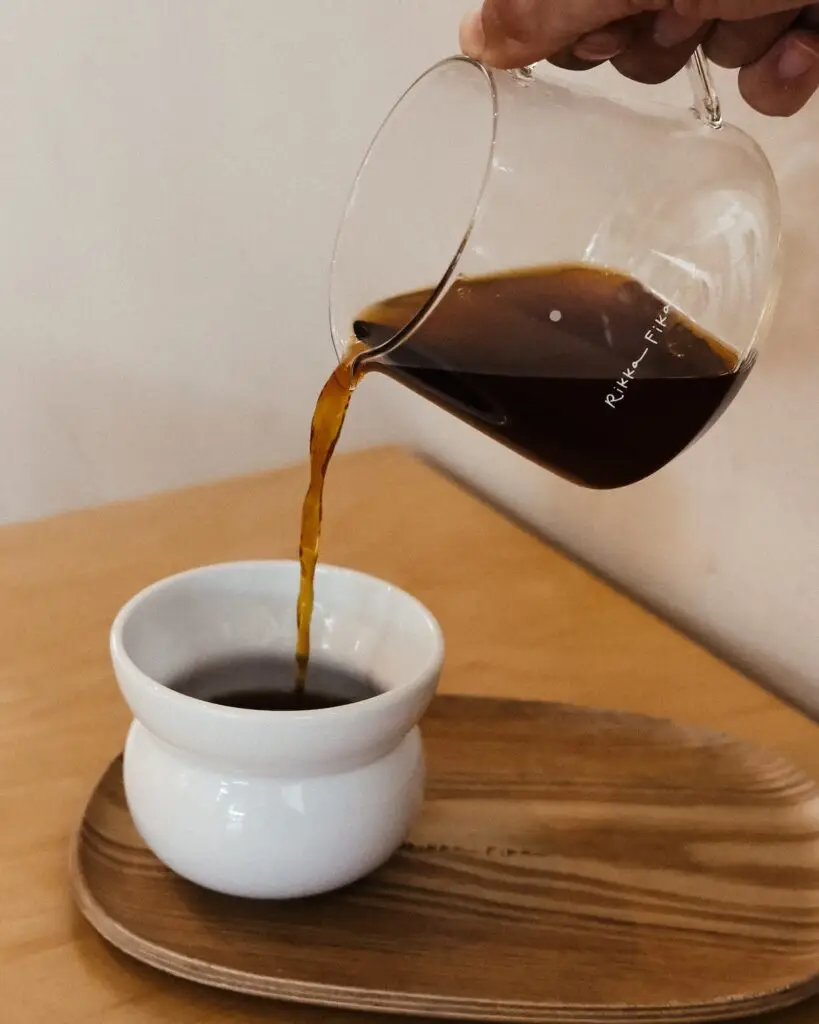
Courtesy of Rikka Fika
Local Coffee Hit the World Stage
The world got an up-close look at San Diego’s coffee industry when we hosted the premier specialty coffee expo World of Coffee for the first time this April. San Diego’s long and rich coffee history stretches back to the late 19th century. Things percolated fairly quietly for around a century before really picking up steam. Today, there are nearly 200 specialty roasters and cafes across the county, with many earning national accolades like the Good Food Award (Steady State Roasting, 2020; Bird Rock Coffee Roasters, 2023, 2021, 2019, 2017, 2016), Roaster of the Year by Roast Magazine (Mostra Coffee, 2020; Bird Rock Coffee Roasters, 2012), and the Specialty Coffee Association Coffee Design Award for packaging (Rikka Fika, 2026). Now that we’ve moved past the comically insufferable coffee snob era of the early 2000s, even java newbies can feel comfortable walking into pretty much any coffee shop in San Diego, asking questions, trying a few things, and feeling confident they’re going to get great service and a great beverage.
Beth Demmon is an award-winning writer and podcaster whose work regularly appears in national outlets and San Diego Magazine. Her first book, The Beer Lover's Guide to Cider, is now available. Find out more on bethdemmon.com.
Food is a notorious diva to photograph. The wrong lighting can make José Andrés’ paella look like a jaundiced grain bowl. You could be staring at the best sandwich of your life, but shoot it from above and—hey, congrats on that abandoned piece of lettuce bread. A cottage meme industry has been built around the hilariously bad photos on review sites that make Michelin-star food look like Michelin tires.
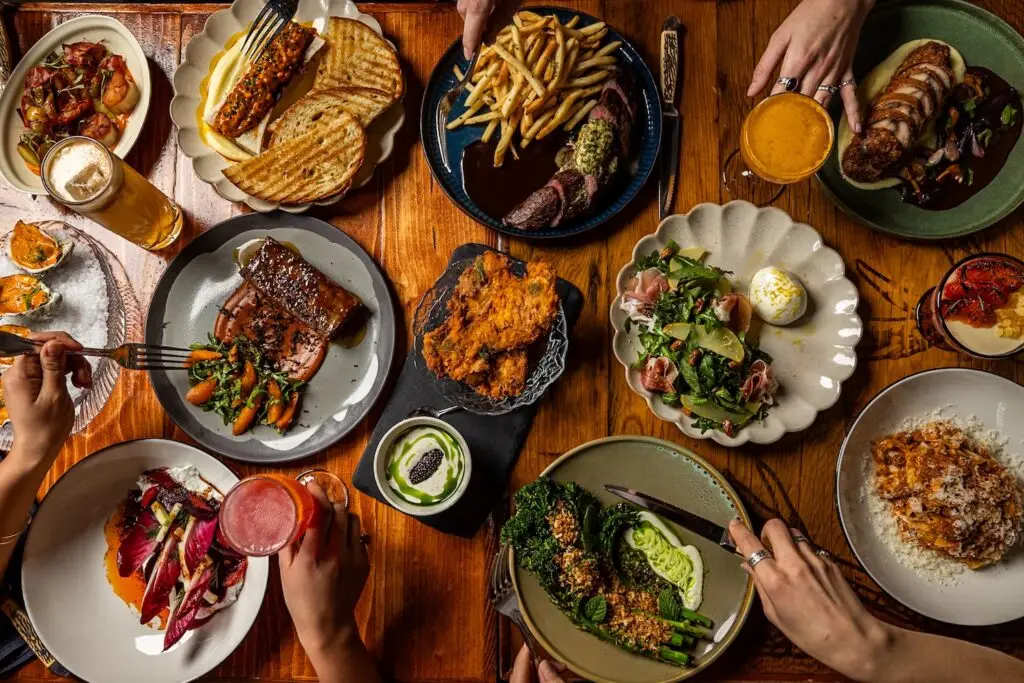
Especially in a visual modern media world, food culture depends on great photographers capturing the painstaking work in equally deserving ways. We asked four of San Diego’s top food photographers for their favorite shot from another year of documenting what we eat.
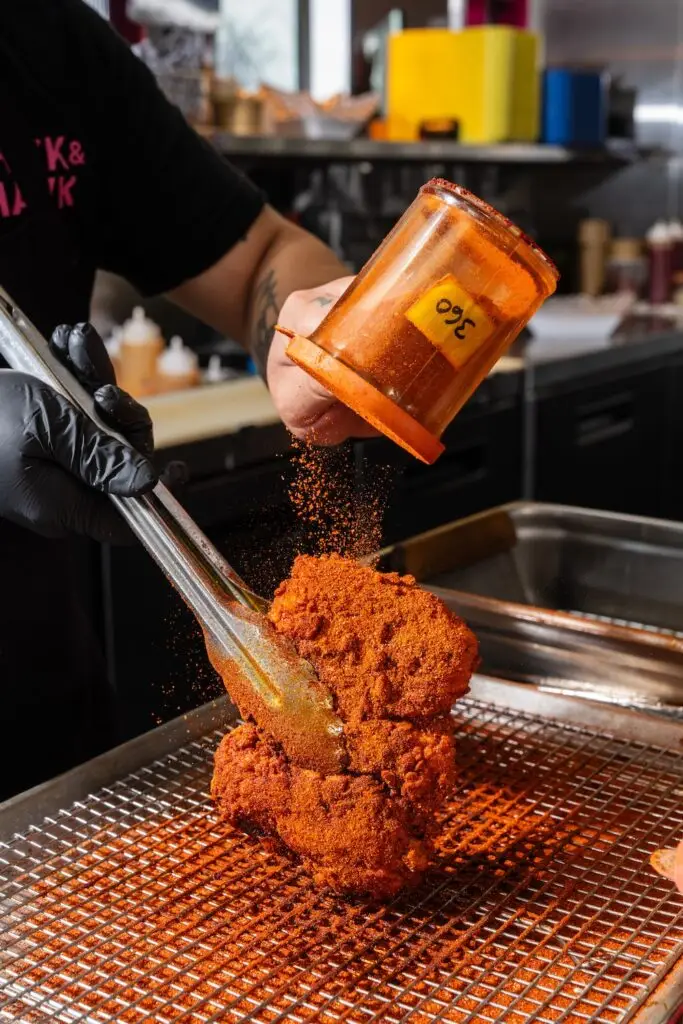
Photo Credit: Kimberly Motos
Kimberly Motos
Birdman Sandwich at Chick & Hawk
Getting this kind of shot takes a bit of yoga. Asana yourself into the corner, hold your breath, pray that a chef on the move doesn’t back into your light stand.
“You’re stepping into someone’s workspace during their busiest moments, so it’s a balance of being present to get the shot and being invisible to not slow anything down,” Kimberly Motos says.
The subject here is the Birdman sandwich from Chick & Hawk—hot fried chicken thigh, tangy slaw, kimchi comeback sauce, sweet and spicy pickles, potato brioche bun—getting a hearty dousing of its difference-maker seasoning. Motos captures the parts of the process that diners don’t usually see: the chaos behind something that looks so simple.
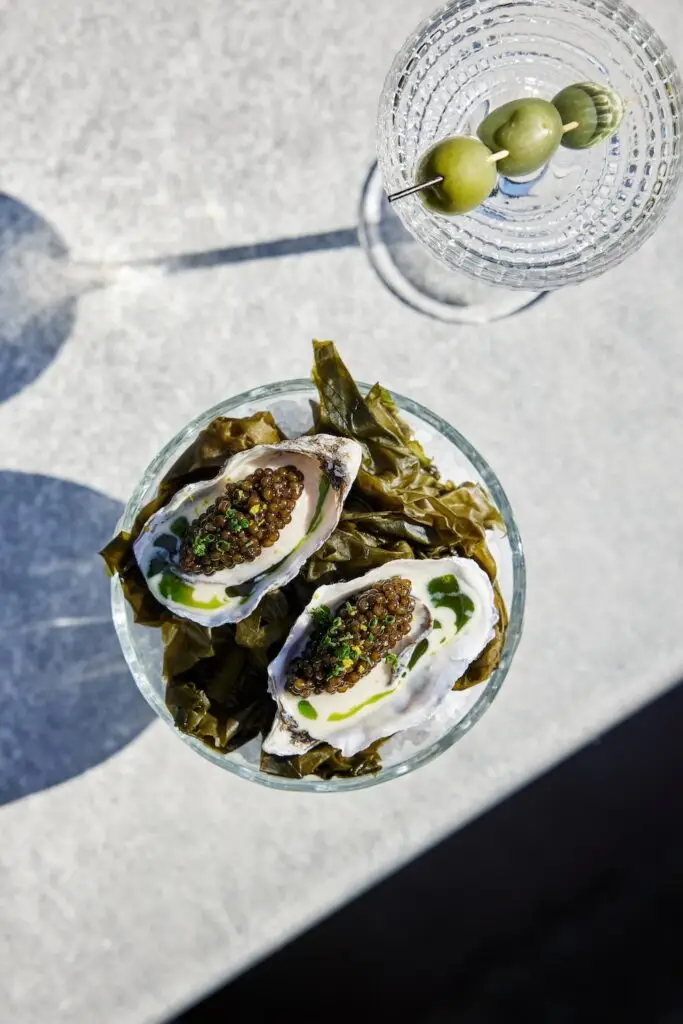
Photo Credit: Lucianna McIntosh
Lucianna McIntosh
Oysters + Jewel of the Sea Martini at The Fishery
“I love this image because it feels like a moment you want to step into,” says Lucianna McIntosh. A warm, sunny day at The Fishery in PB with oysters, caviar, and martinis. Yes, please.
The little details—the glass sweating a little, the direct afternoon light creating stark shadows, the oyster glistening on the tray—are the main characters. Instead of trying to overly control the setup, McIntosh “followed the light and lines that draw you in more,” she says. “This was one of those moments where everything lined up on its own for a second. I love it when the shadows end up being just as important as the food itself.”
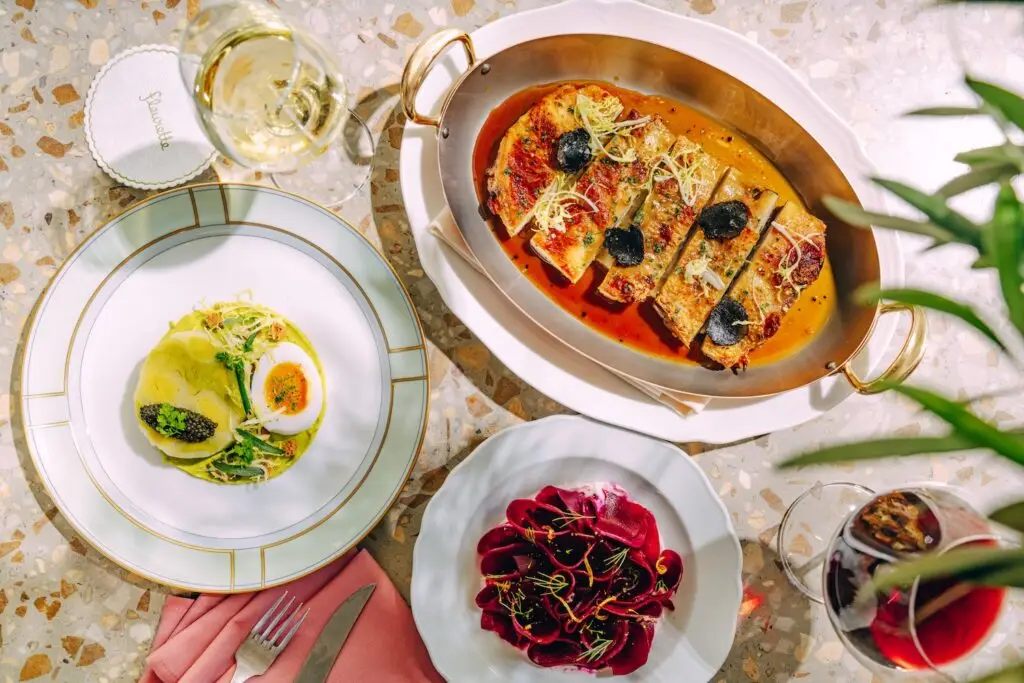
Photo Credit: Eric Wolfinger
Eric Wolfinger
Herb-Roasted Golden Chicken at Fleurette
La Jolla native Eric Wolfinger—who won a James Beard Award for Tartine Bread, one of the most stunning bread books of all time—says he doesn’t have a signature style. His style is a conduit.
“I see my job is to translate the chef’s point of view into something you can feel,” he says.
For this shot, Fleurette chef Travis Swikard had one directive: cuisine du soleil (“cuisine of the sun”). With a spread of leeks vinaigrette, herb-roasted golden chicken, and beets, Wolfinger wanted to create a scene that felt straight out of the French Riviera, relaying the light, bright style of Swikard’s new spot.
Some bonus additions here: Extra lights—to add lots of warmth—and a clipping from an olive tree.
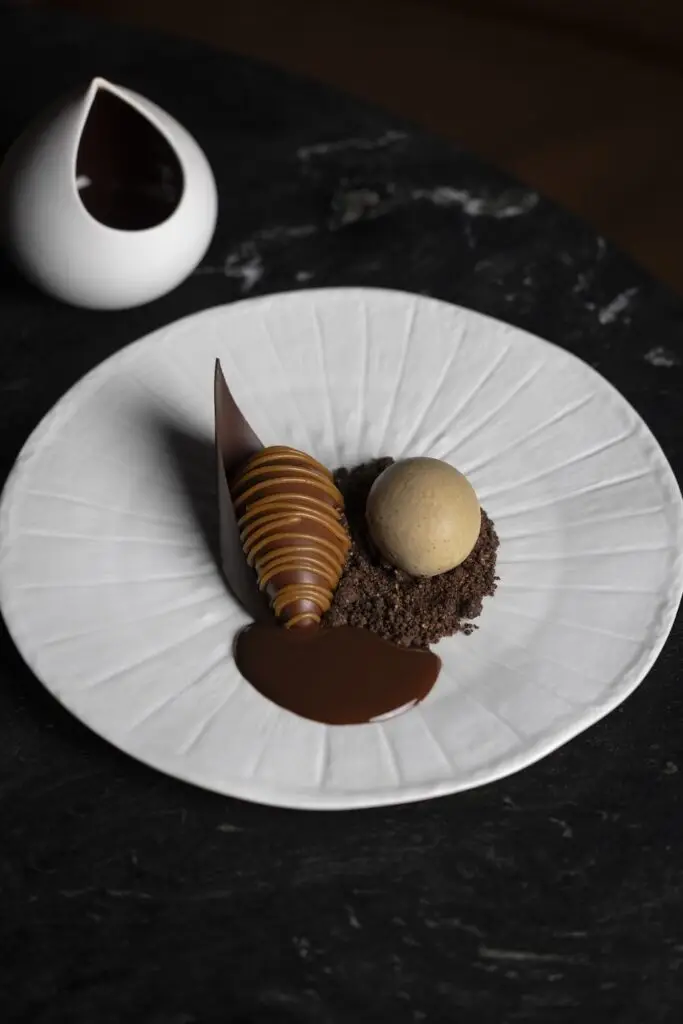
Photo Credit: Dee Sandoval
Dee Sandoval
Espresso Ice Cream at Lucien
Timing and light are everything in food photography. In Lucien—La Jolla’s tasting-menu-only restaurant with moody ambiance—a single strobe flash creates the ideal spotlight.
Dee Sandoval says she uses the “natural, just-plated energy” of the dish to “create a portrait of moment and craft.” That’s why this Mostra Ghost Bear espresso ice cream—with San José dark chocolate mousse, soy-miso caramel, and koji shoyu chocolate sauce—looks like it might dissolve halfway to your mouth.
Emma Veidt is an editor at San Diego Magazine. She earned her bachelor's and master's degrees from the Missouri School of Journalism. She loves running, hiking, and rock climbing, but really, she mostly loves encounters with the street cats around North Park.
Visit Tuolumne County to Find the Unmistakable Spirit of Fall and Winter
Take a refreshing trip to Tuolumne County, where your senses will get their fill and your wallet will stay full with off-peak accommodation prices
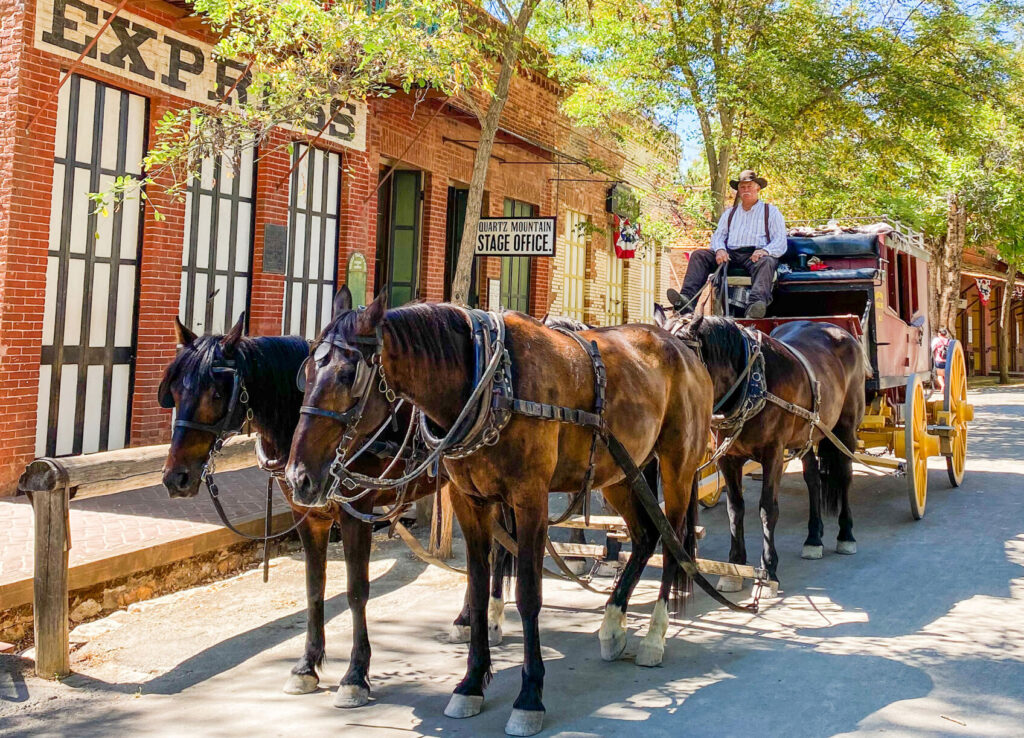
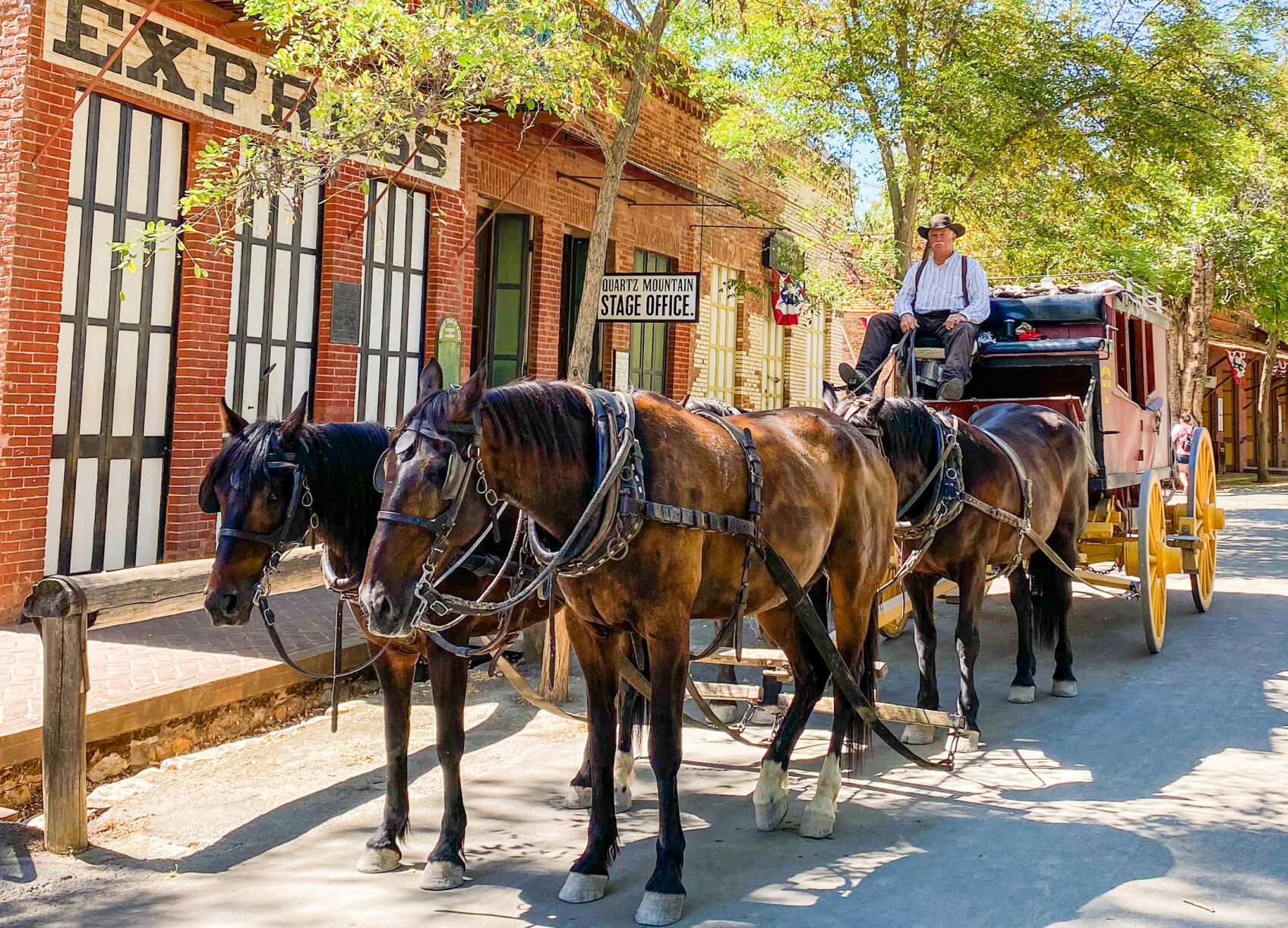
Gold Country Columbia Stage Coach.jpg
It’s that time when all of your senses are awakened by the unmistakable feel, sights, tastes, smells, and sounds of fall and winter. Experience them all in Tuolumne County in Northern California! Discover a different side of Yosemite National Park in the quieter and less crowded destinations. Watch as history comes to life with local tales and vibrant colors in Gold Country. Temperatures are dropping, but cooler adventures are found on the trails and slopes of the High Sierra and at unique events throughout the County.
Take a refreshing trip to Tuolumne County, where your senses will get their fill and your wallet will stay full with off-peak accommodation prices.
Find Serenity in Less-Crowded Yosemite National Park and Surrounding Area
Yosemite
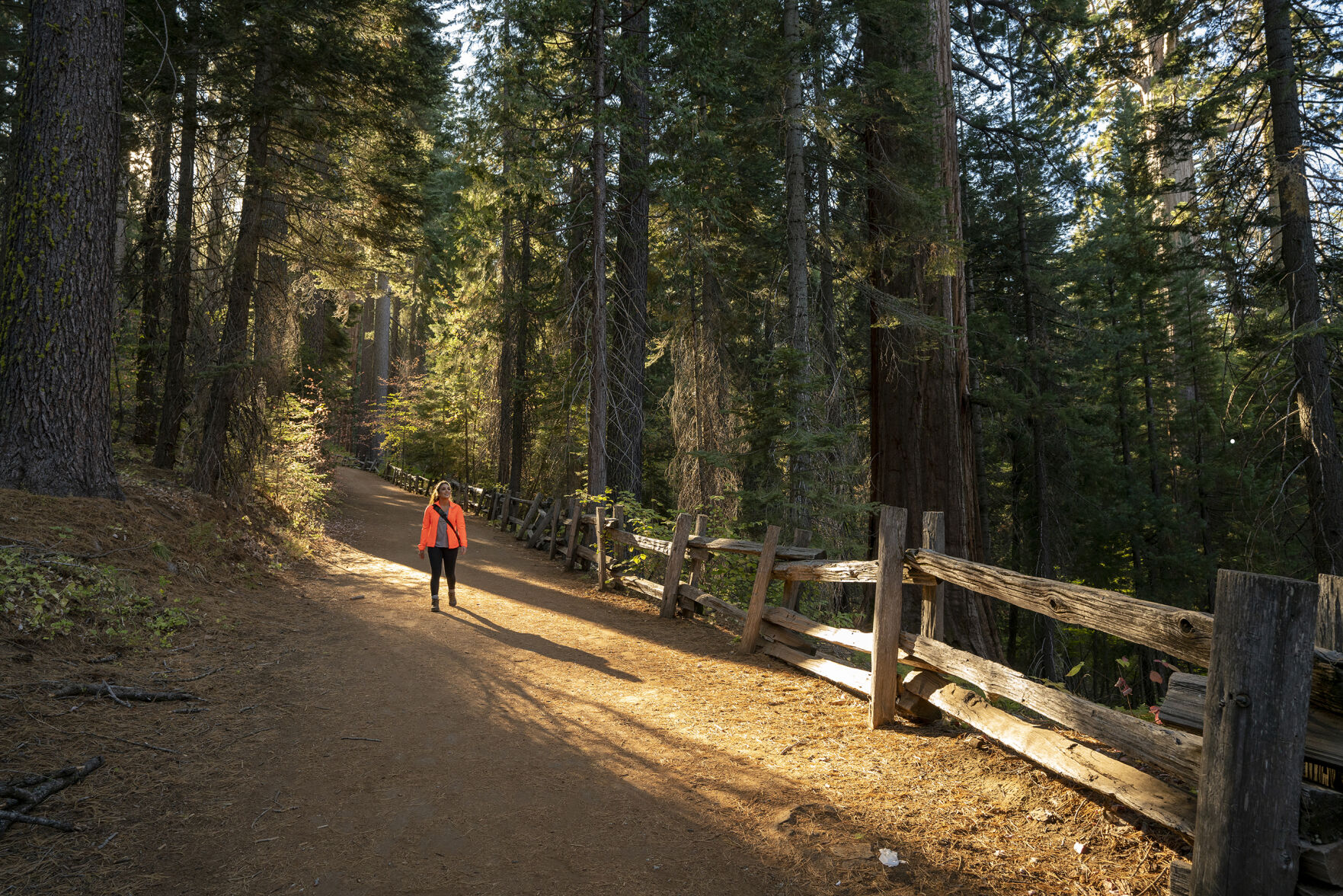
Yosemite has quieted down, and now’s the time for national park adventures and new explorations. Find yourself in awe as you take in the sights among the giant sequoias backdropped by colors of maples and dogwoods and maybe some glistening snow in the Tuolumne Grove of Giant Sequoias. Or, hike around stunning Hetch Hetchy Reservoir.
Wander in Groveland, outside of Yosemite, and enjoy a warming pumpkin spice latte or a one-of-a-kind seasonal brew. Feel like shopping? Pop into some of the unique shops in town to find gifts and seasonal decor to bring home.
Discover an Era Past in Gold Country
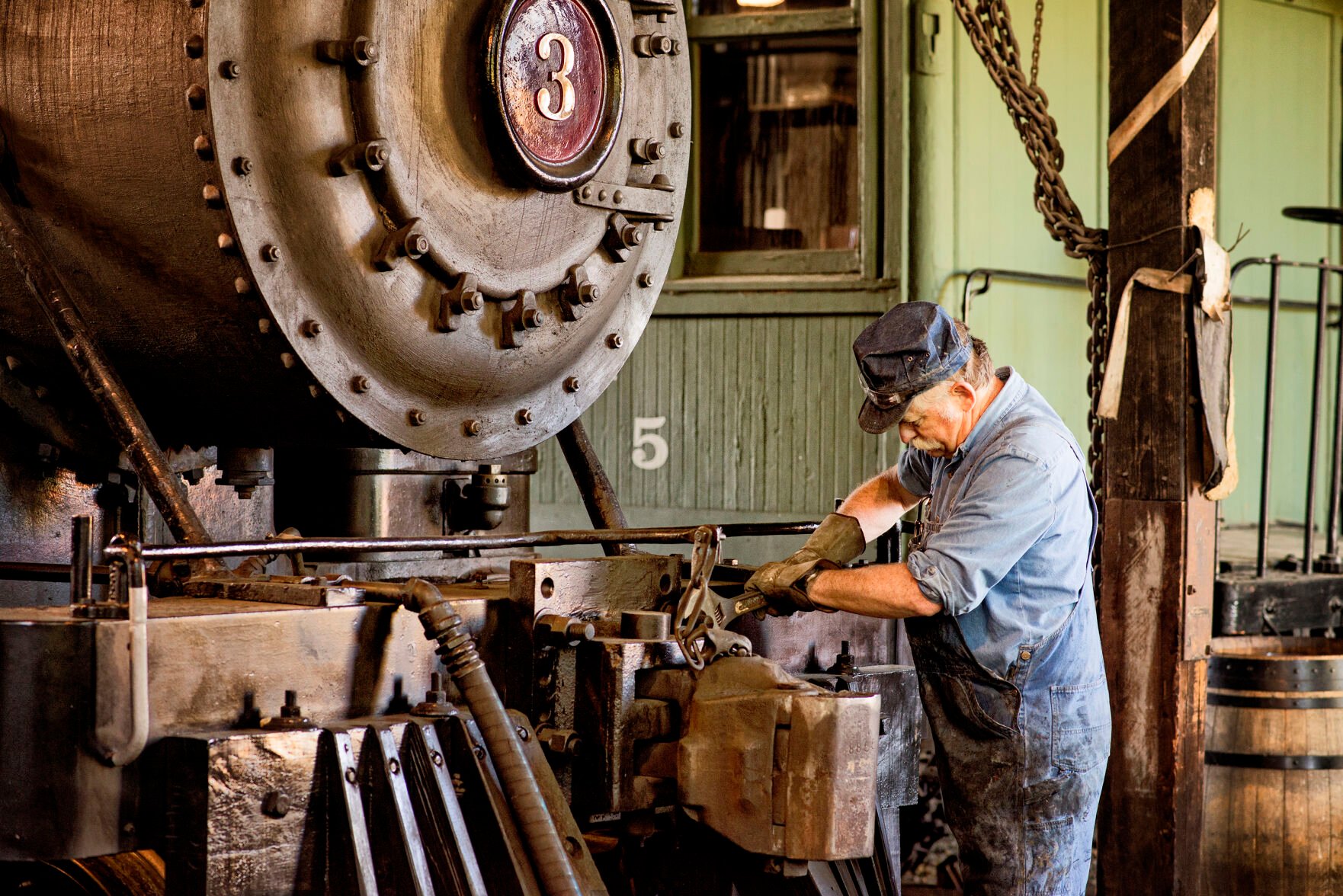
Gold Country Jamestown – Railtown SHP Roundhouse-3.jpg
Explore Gold Country starting with the nooks of Columbia State Historic Park, and let your eyes and nose lead you into candle, candy, and provisional shops where their seasonal creations will warm your heart. Listen for clanging from the blacksmith shop or clinking of the authentic stagecoach as it enters town.
In nearby Jamestown, become immersed by the smells, sounds, and sights of Wild West railroad culture at Railtown 1897 State Historic Park, and stroll down Main Street where you’ll find shops, restaurants, and inns housed in picturesque historic buildings.
In Downtown Sonora, you’ll find many shops and restaurants located in historic buildings; as you step inside, you’ll see some interiors are left to show the architecture of 150 years ago. Also, take in a show at the Gold Country’s premier theater company, Sierra Repertory Theatre.
Reach the Mountain Tops in the High Sierra
High Sierra Ski_Photo Credit-Dodge Ridge Mountain Resort.jpg
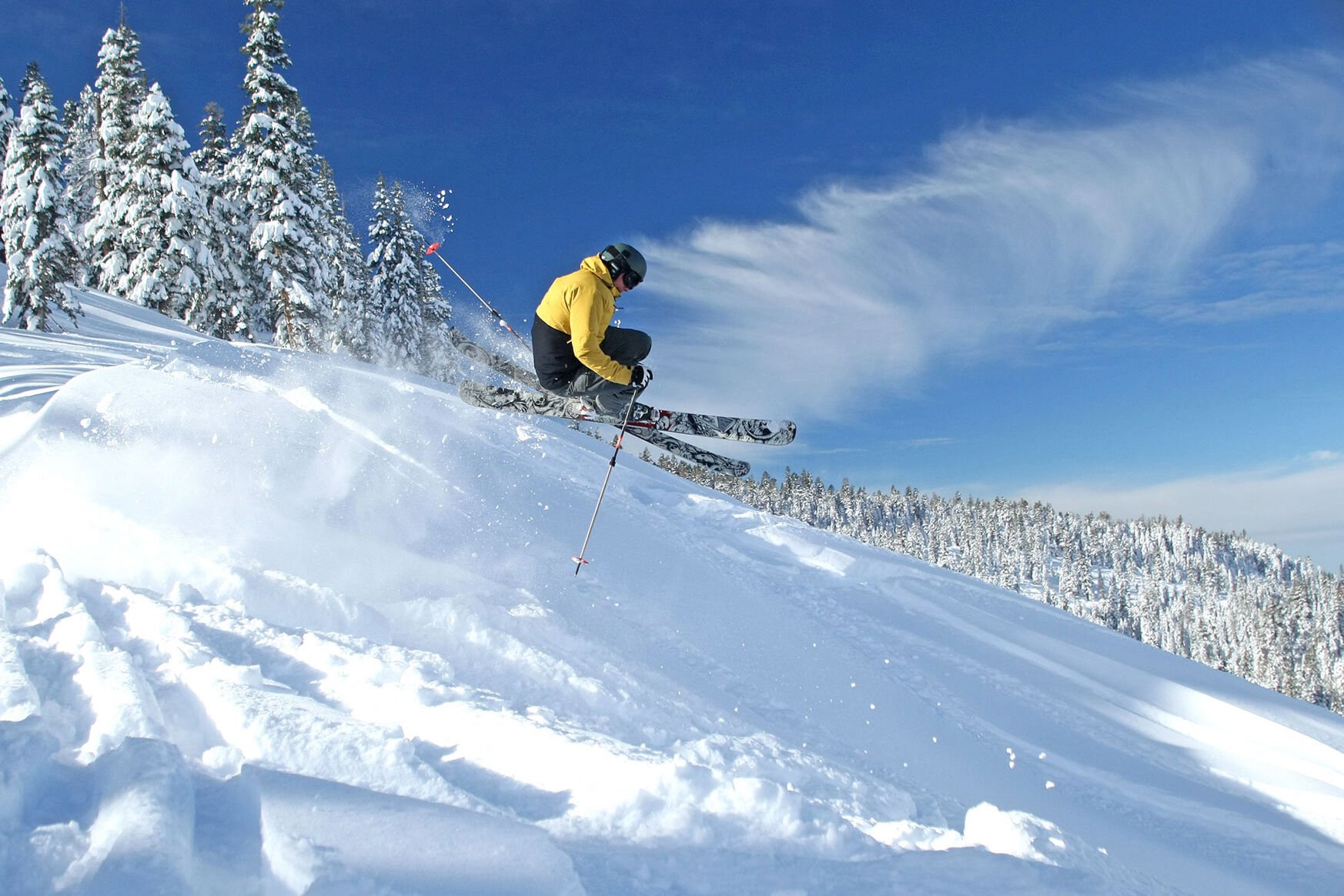
High Sierra adventures await where brisk mountain breezes are the perfect excuse for a cozy sweater. Take a hike along the Pinecrest Lake Loop Trail, and catch unreal views of changing leaves set against rugged granite mountains. Feel the invigorating wind in your face as you ski, snowboard, or snow tube down glorious mountain sides.
Visit the nostalgic mountain town of Twain Harte and enjoy a relaxing stroll to find some fun fall fashions or handy cooking gadgets to help with upcoming holiday cooking or gift giving.
Stir Up Your Seasonal Cheer
Events Sonora Christmas Parade.jpg
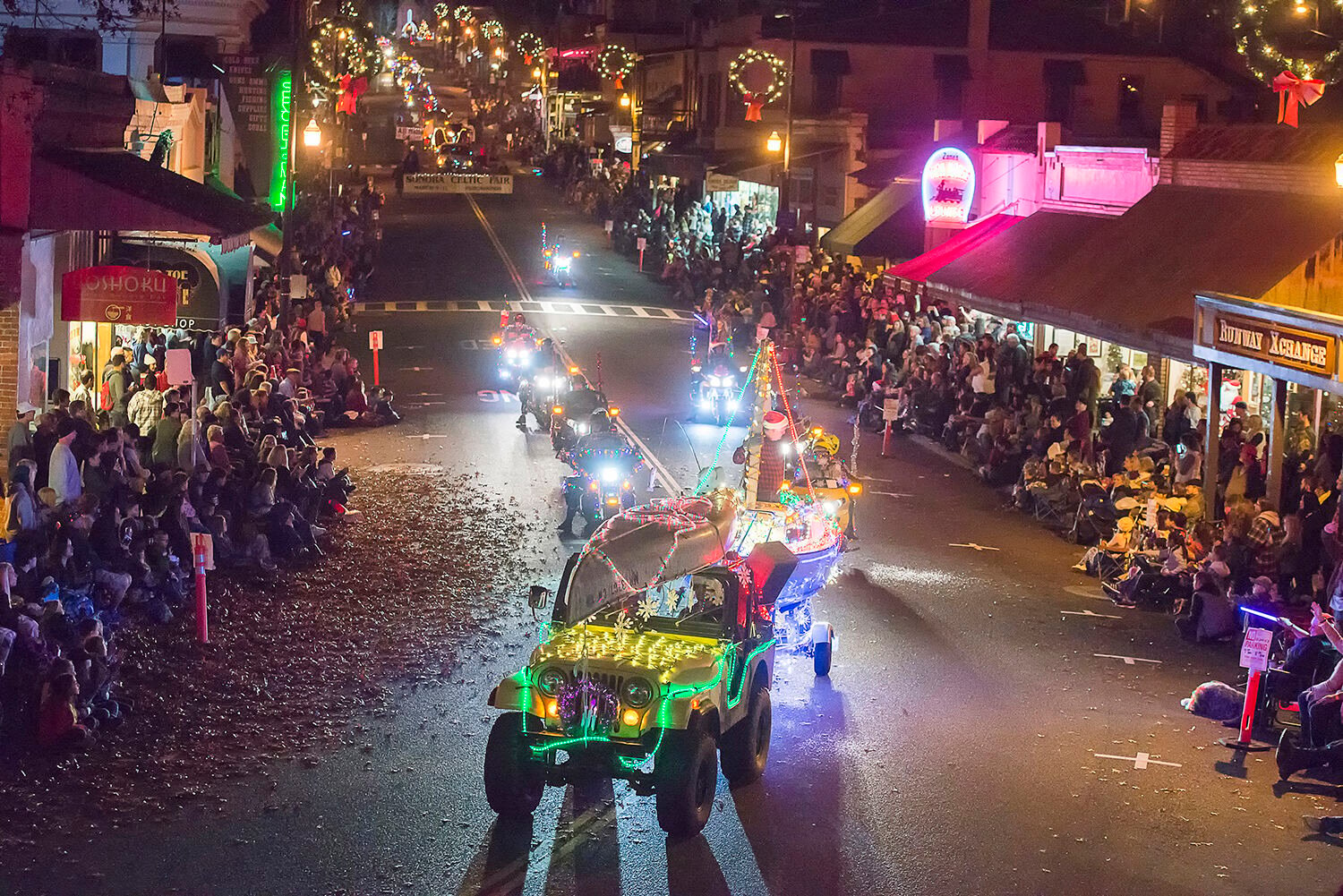
Seasonal cheer is found in every town throughout Tuolumne County. Events include Fall Fest at Indigeny Reserve in Sonora and Harvest Festifall in Columbia State Historic Park in October. The night-time Sonora Christmas Parade, the night after Thanksgiving, and the sights and activities of Christmas Town Sonora delight all ages. The Polar Express departs Railtown 1897 State Historic Park for the North Pole on weekends following Thanksgiving.
Plan Your Trip to Tuolumne County
Rush Creek Lodge
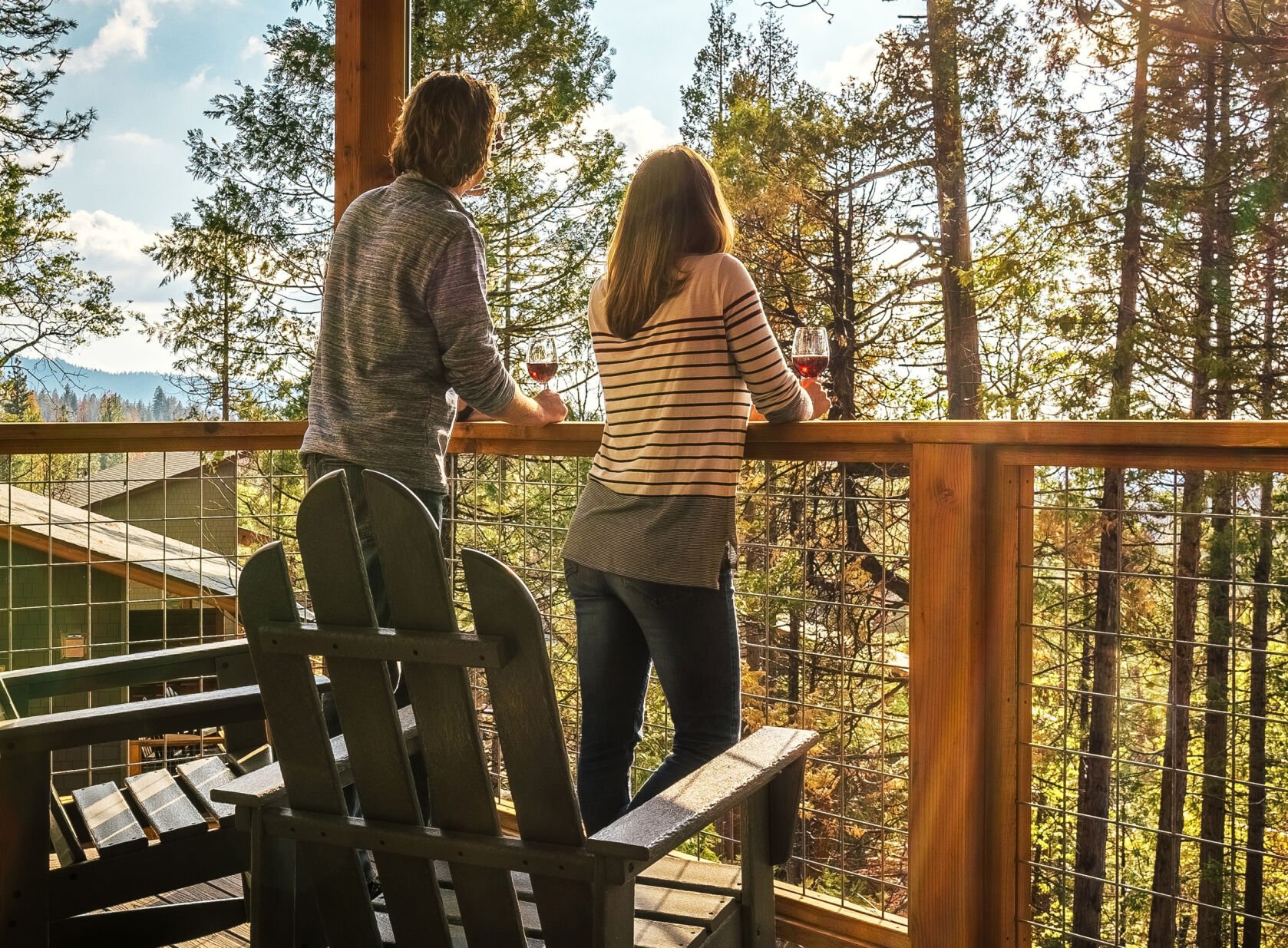
You’ll need a place to stay during your visit. Pick from mountain resorts, historic inns, cozy vacation cabins (perfect for gathering the family), distinctive B&Bs, and full-service RV parks.
Start planning your vacation with the help of travel inspiration and information delivered directly to your mailbox. Request your FREE Tuolumne County Travel Guide at VisitTuolumne.com today. Or, call the Visit Tuolumne County team at 209-533-4420.