Featured articles
Food News
Food News
Food & Drink
Featured articles
Things to Do
Things to Do
Everything SD
Featured articles
Things to Do
Things to Do
Everything SD
Featured articles
podcast-ep
podcast-ep
podcast-ep
Featured articles
Food & Drink
Everything SD
Everything SD
Featured articles

Food News
Things to Do
Things to Do
Ready to know more about San Diego?
SubscribeReady to know more about San Diego?
When the Del Mar resident was laid off in 2016, he took it as an opportunity to pursue his drive to create
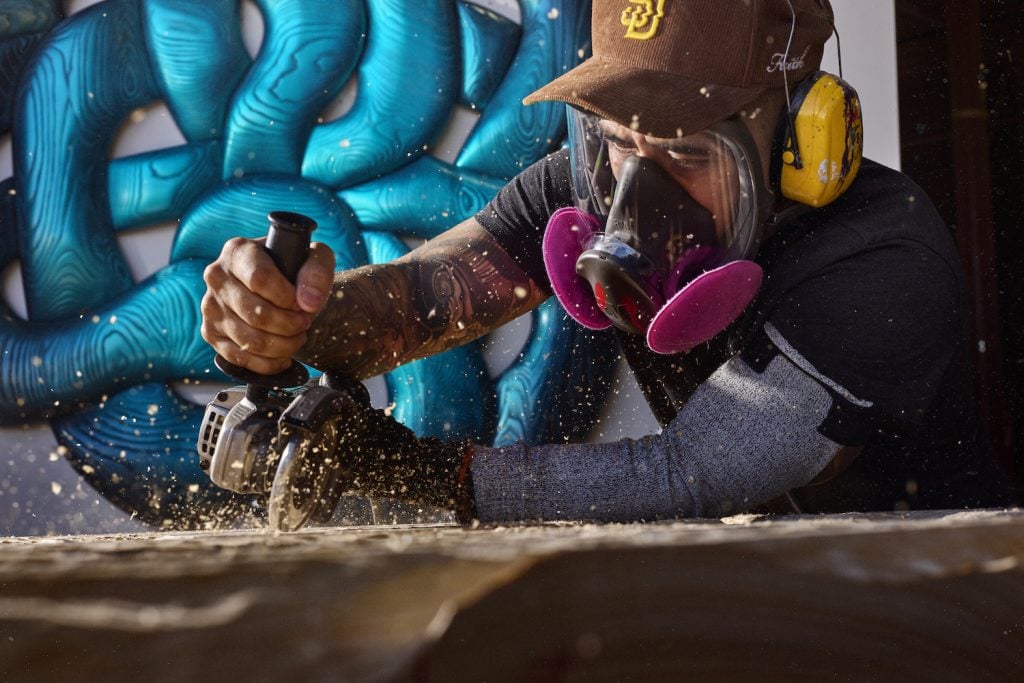
Dan Nguyen is having trouble with the Viper Pit. Its iridescent curves threaten to slip from his hands, even with his assistant, Christian Ramirez, shouldering half its weight as they attempt to mount it on a few freestanding photo boards. The metallic teal of a blue morpho butterfly, the undulating, carved ash wood sculpture is the brightest thing in this vast warehouse permeated with the whir of machinery and the earthy scent of sawdust. At 100 pounds, with a 54-inch diameter, it demands your gaze.
“Bigger works have a different type of presence,” says Nguyen, who goes by Nuge, an affectionate nickname lifted from a mispronunciation of his last name. “It can change the energy in a room.”
Nuge would know. The Boston-born artist began his career as an architect, studying the craft at Roger Williams University in Rhode Island. “It was a fulfilling experience for me because I love design. I love to draw and work with my hands—I got to build physical models for my designs,” he says. After he obtained his master’s, “I moved out to San Francisco, and then, right away, I realized that the world of architecture versus what life in school was like was completely different. For the entire process of designing a home and all the work that goes into it, the designing is maybe two percent of the process.”
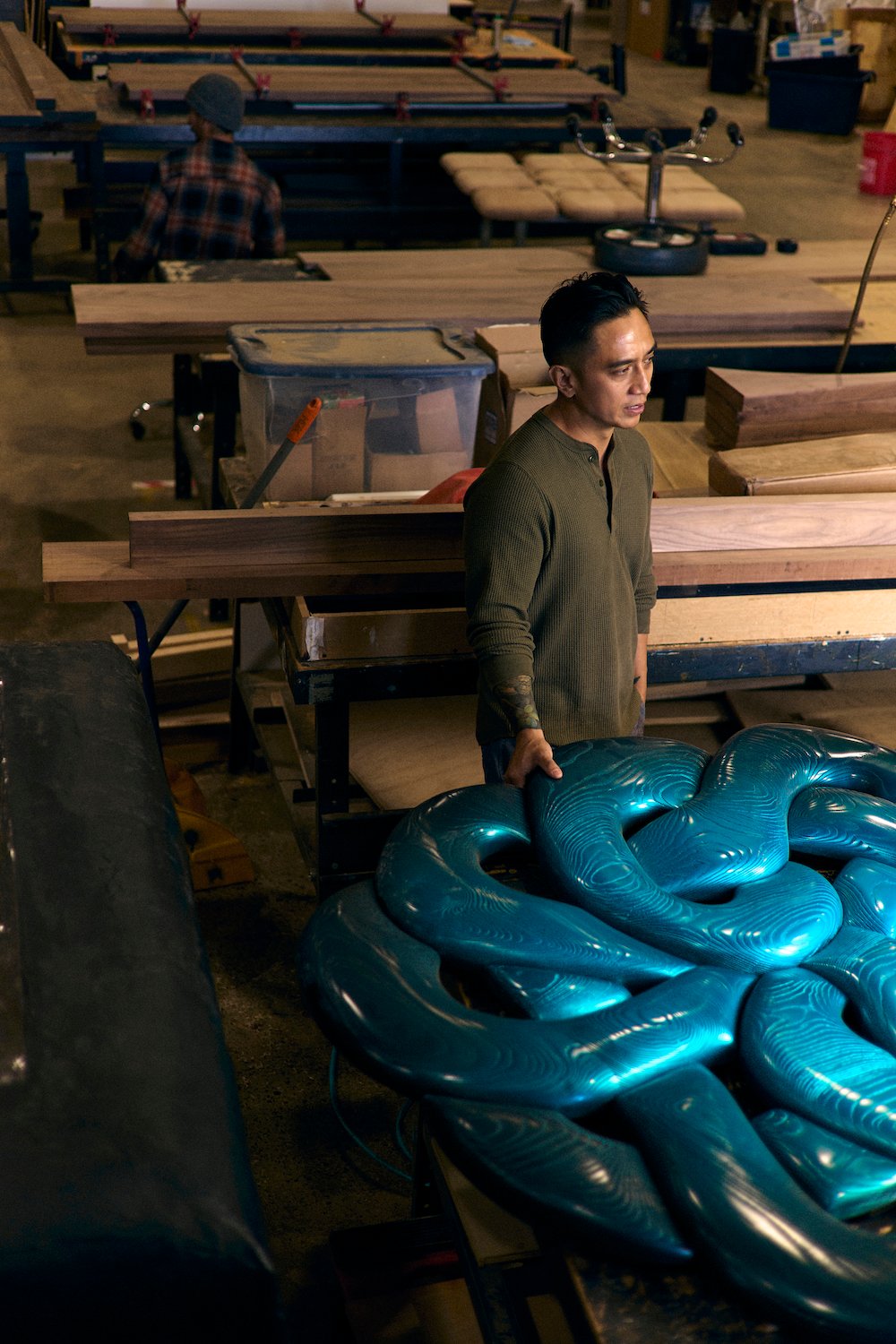
After 18 months in SF, Nuge moved to an architecture firm in San Diego but found the work increasingly draining and creatively stifling. Desperate for an outlet, he took a weekend-long wood cutting board–making class, with ambitions of eventually crafting furniture. “That alone was one of the most gratifying feelings because, up until that point, I never got to own any part of the process,” he recalls. “But this simple cutting board—from the concept to the final product, all of it was mine. I was hooked.”
He began woodworking daily after his 9-to-5. Then, in 2016, he got laid off from the firm. He took it as an opportunity to pursue art more seriously. “I told myself—and also my mom—that if this didn’t work out in six months, I’d apply for more jobs in architecture and get back to the grind,” Nuge says.
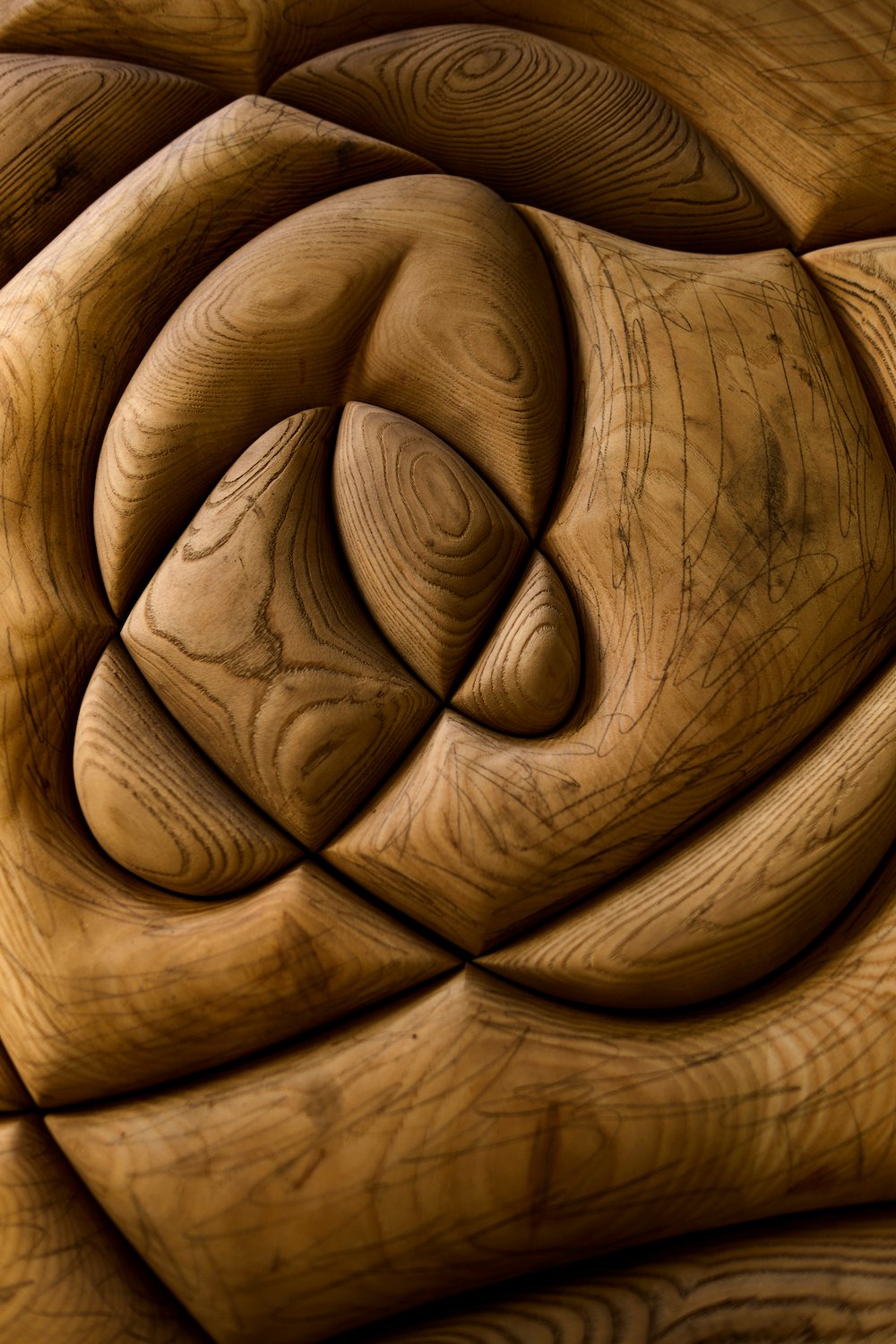
One of his first clients was sales director Jeffrey Bitner, who gave him full creative license. As Nuge worked on the piece, the two became friends and eventually roommates in Del Mar. Nuge credits Bitner as a vital sounding board for his creative process—and the piece, with its rippling texture (inspired, Nuge explains, by rumpled bed sheets) and shiny, single-color paint that shows off the wood’s grain—would become emblematic of Nuge’s style.
“It’s almost like he’s had all of these ideas and thoughts running through his head his whole life, and, finally, everything was exploding out of him and he was able to start creating and getting all this stuff out and letting it flow,” Bitner recalls of the early days of Nuge’s practice. “You could just see the light inside of him.”
Others saw it, too. Steady sales at $10,000 to $25,000 per piece allowed Nuge to keep making art full-time. He placed his work at a number of galleries. Tiffany & Co. commissioned 10 pieces, displaying them at stores as near as Palo Alto and far-flung as Tokyo. In 2023, he landed his first museum show, a three-month exhibition at the Lancaster Museum of Art and History in LA County.
While he’s currently in the process of moving into his own dedicated space, since 2020, he’s crafted every piece in Miramar at the shared makers’ space Maketory—where Viper Pit finally slides into place, ready to be photographed.
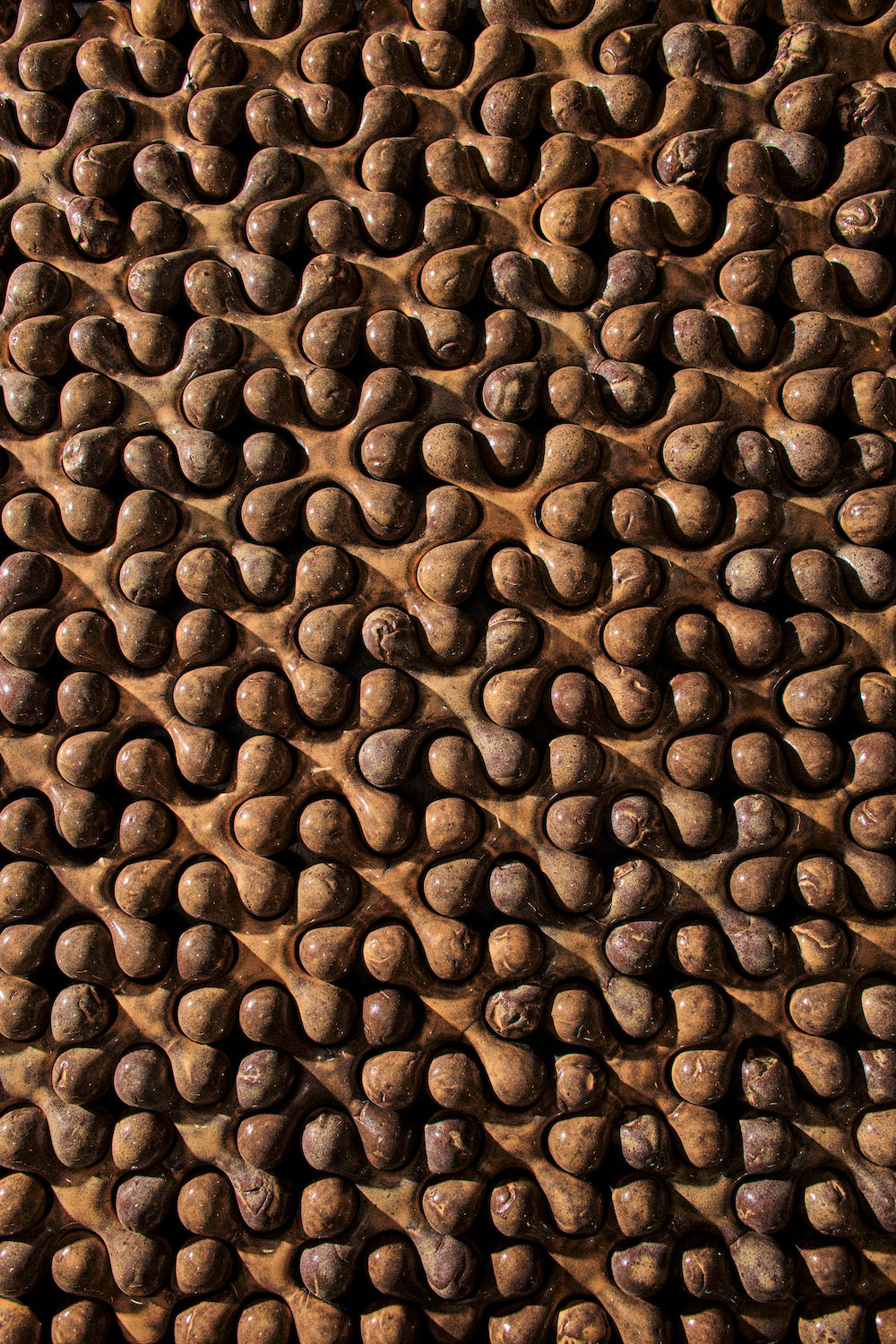
Stepping back, Nuge’s assistant Ramirez floats a fingertip over the contours of the piece’s deep wood grain. “Sandblasting gave it that definition,” he explains.
Ramirez has been working with Nuge for three years. He helps Nuge carve, sand, sandblast, and paint his massive-scale pieces, which can take up to five months to complete. Albert Dawson, another employee who recently resigned to pursue an MFA, spent three years supporting Nuge’s efforts, too. But, while there is a long legacy of artists who have managed to ramp up production by delegating most of the labor to assistants—Rembrandt, Andy Warhol, Jeff Koons—that list won’t ever include Nuge.
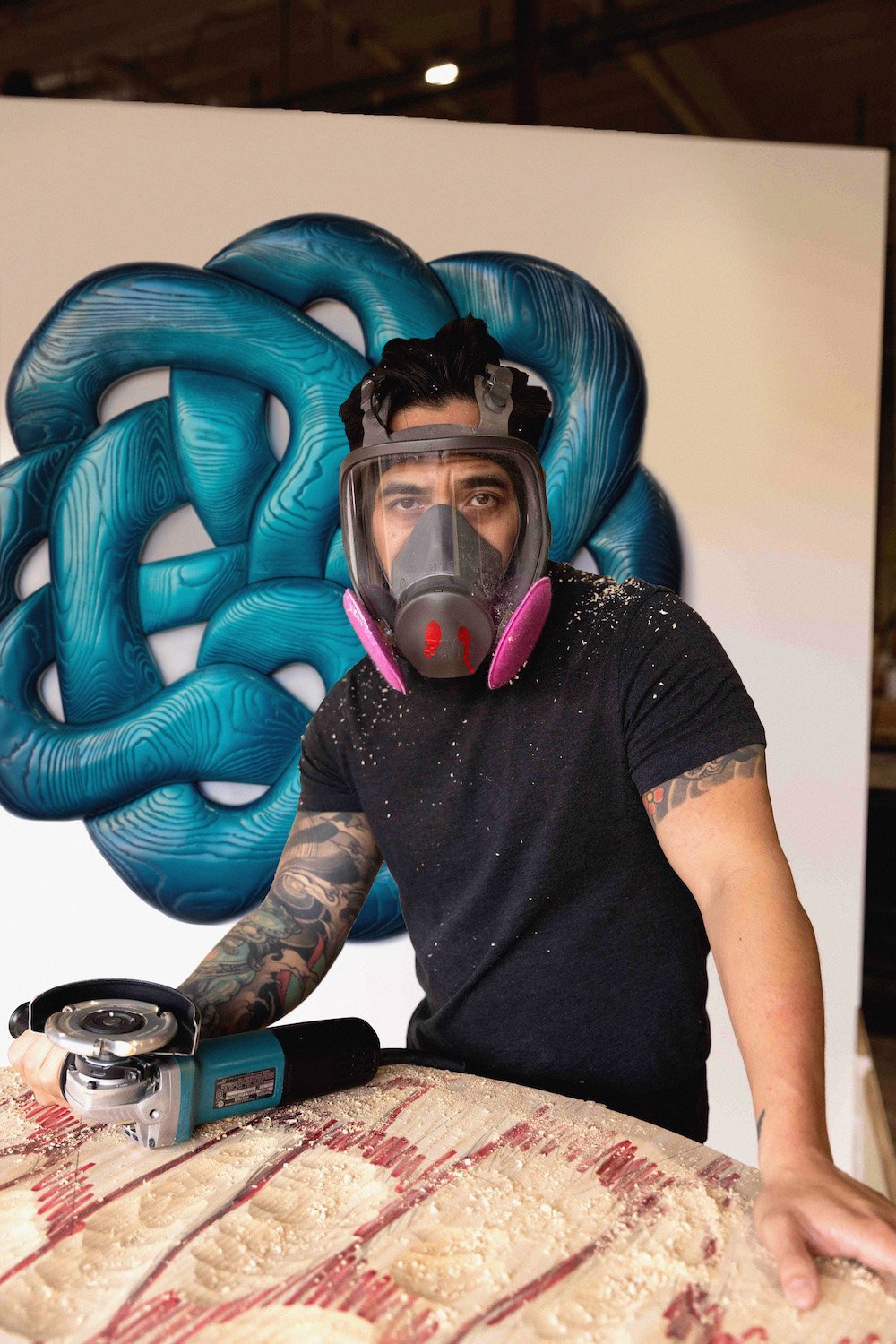
“I love working,” he says. “If I’m not in the studio, I’m more like an art director, rather than an artist with my hands in it. I want to steer the creative ship.”
That’s also why, in addition to completing commissions for private collectors and the occasional corporate or business client, Nuge consistently dedicates time toward personal projects. “This past year, I made it a point to play with new materials,” he says.
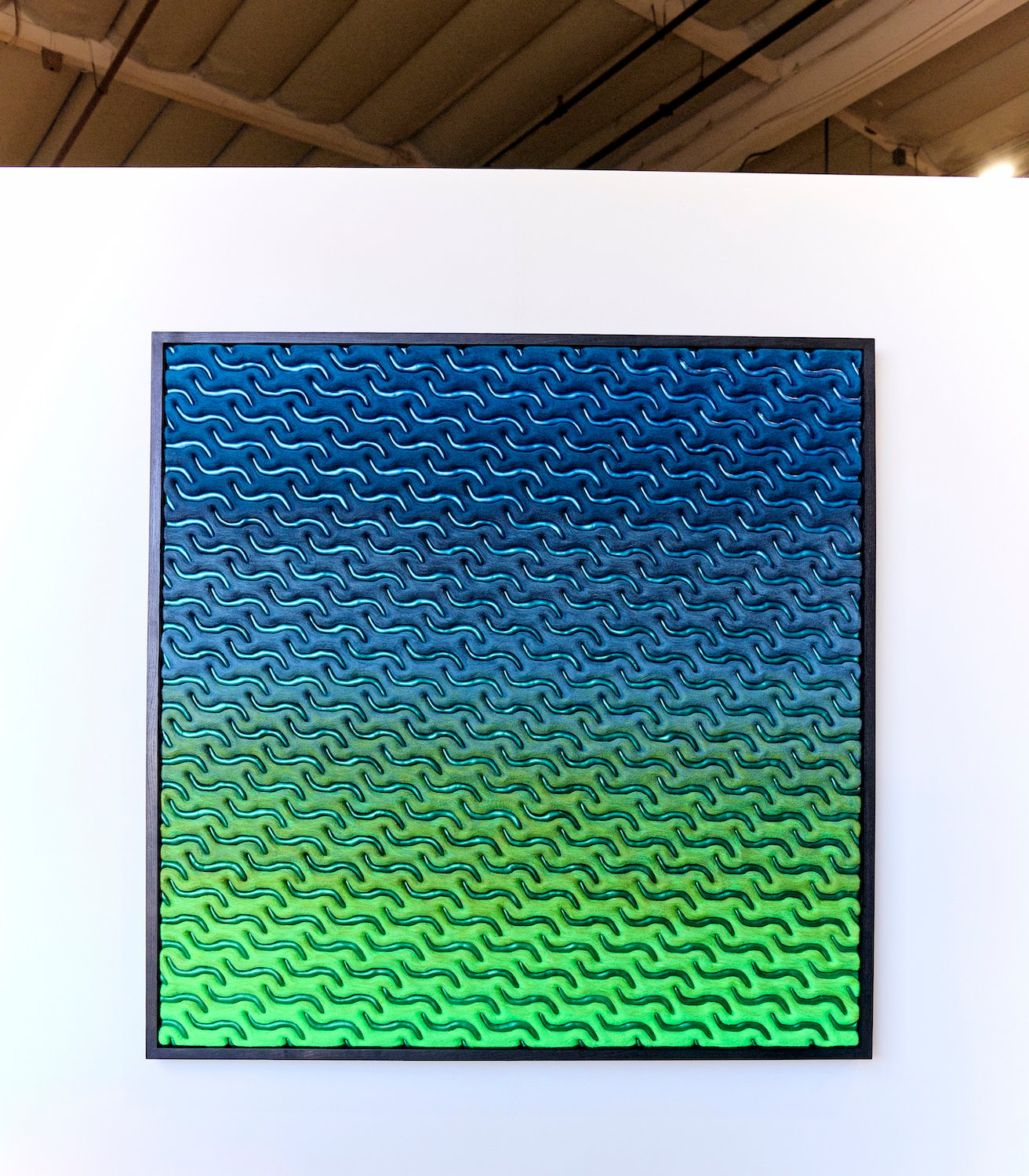
In the aptly named Wiggle Room, for example, waves of epoxy clay squirm across a heathered terrain of blue-green felt. Nuge has expanded into ceramics, too, using wood to create textured silicon models that give his clay pieces the same grain and gravitas as his hallmark works. Piled on a table in one corner of the warehouse are ceramic structures a few feet tall, with interlocking sections reminiscent of vertebrae. Nuge plans to stack them into one massive pillar, he says, studying a minute fissure in one slab. “The cracks aren’t too bad,” he decides. He gestures toward another ceramic piece. “That has ’em, and that makes it look like an ancient ruin.”
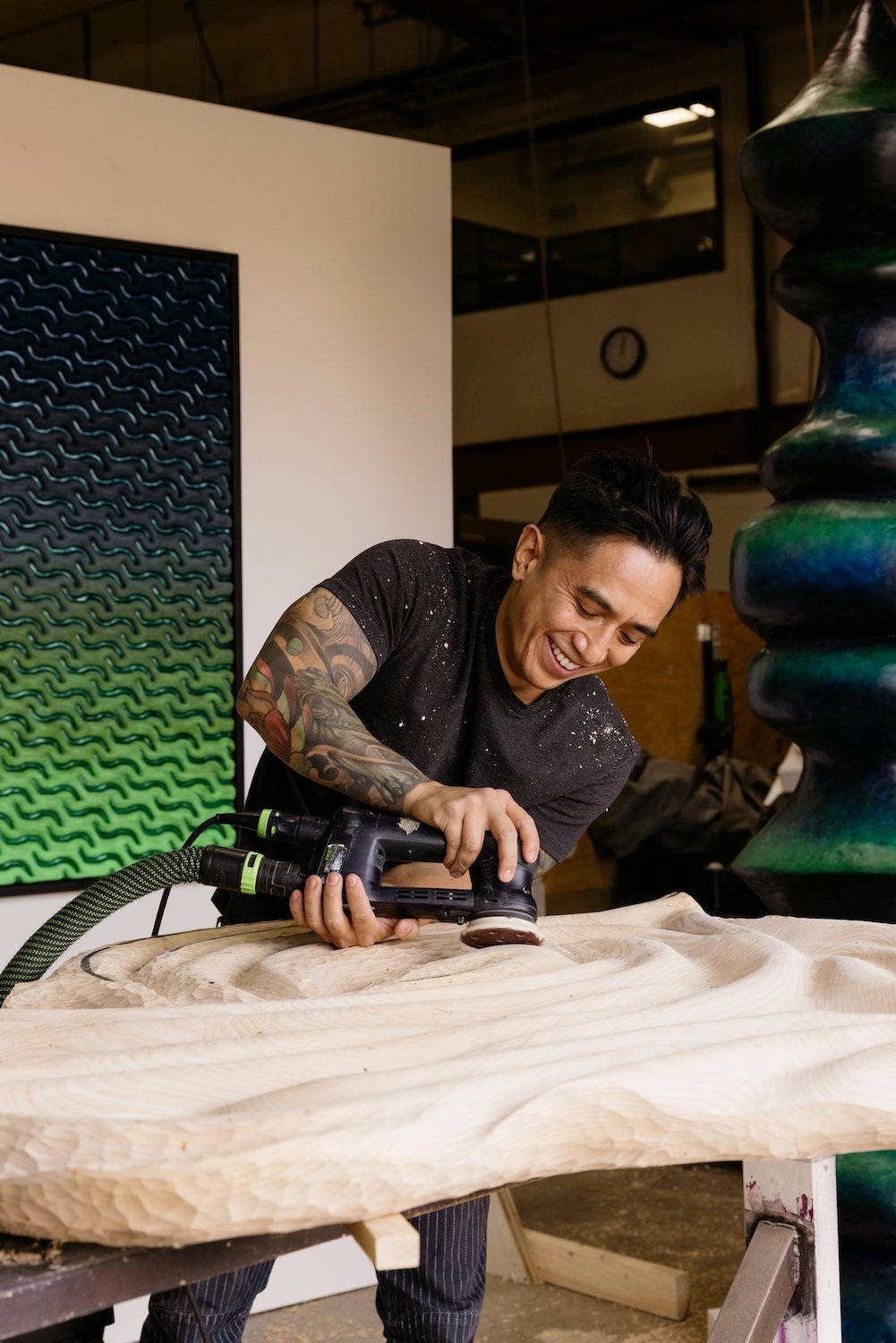
His goal is to give commissioning clients an expanded reference point for the Nuge aesthetic. “Typically, they point to pieces I’ve made and say they want something like that,” he explains. “If I want people to ask me to make it, I have to make it first.”
However, not everyone is so prescriptive. Shane Foye, managing partner at jobsite management firm Discount Waste Inc. dba DW1, gave Nuge carte blanche on the two pieces he requested for his art-filled Georgia office, where Foye curates a sealed private collection.
“Normally, I wouldn’t do that, but you could tell that he cared about it probably more than anyone that’s ever going to get a piece from him. He wants that outcome to be perfect,” Foye explains. “For the first piece, I just sort of put it in his hand and said, ‘Is there something you’ve always wanted to create?’”
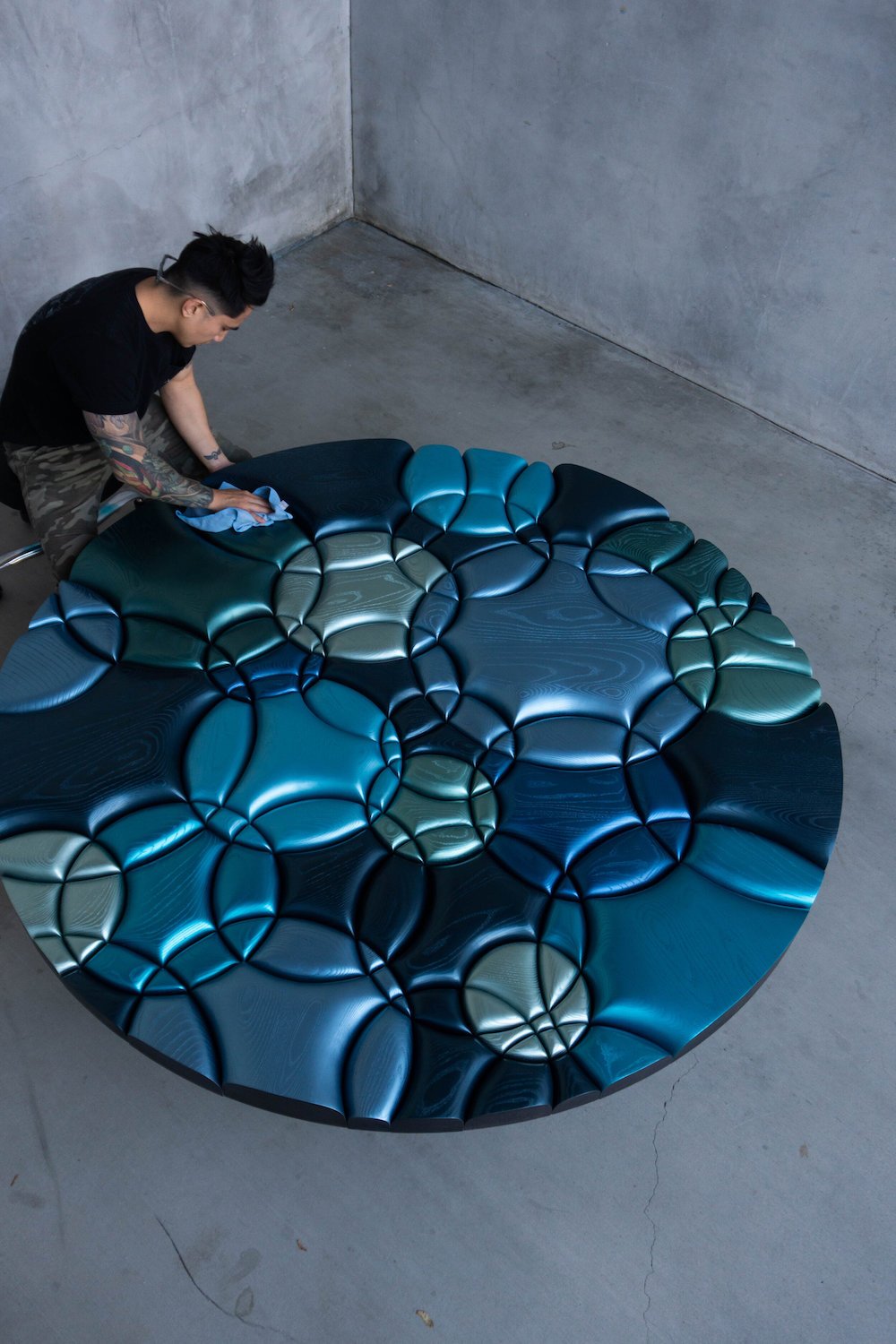
The result was Dreamland, a 72-inch-diameter, ash wood circle in varying shades of blue. Its 136 pieces form smaller, overlapping circles across the work, like a puddle disturbed by a soft rain.
“I consider him to be a very visionary thinker,” Foye adds. “He has [each piece] so crystal-clear in his head that the complexity to get it done is way more involved than he would ever portray. It seems so simple when he’s explaining it, but I can’t imagine the challenges he faces when producing [the work].”
Nuge doesn’t shy away from discussing the hard parts. “I don’t know why, but I thought that ceramics would be less labor-intensive and more Zen. And it has been the exact opposite of that,” he admits. “It’s so stressful. It’s even more finicky than wood.” Yet a key word comes up more than once: play.
In the studio, dressed in a respirator and a wood shaving–coated hoodie, his eyes a bit red from flying sawdust, Nuge wears the evidence of his efforts all over him. But there’s a joy to him, a palpable “I can’t believe I get to do this for a living” energy, that makes it look fun.
“I’ve been playing with [clay] for a year now and I’m absolutely in love with it, and because it’s a challenge, it makes me wanna learn it more,” he says. “Architecture was very restraining and hard-lined and rigid. So I feel like my path as an artist is almost a rebellion to that entire aspect.”

Amelia Rodriguez is a writer and journalist and winner of the San Diego Press Club's 2023 Rising Star Award and 2024 Best of Show Award, she’s also covered music, food, arts and culture, fashion, and design for Rolling Stone, Palm Springs Life, and other national and regional publications. After work, you can find her hunting down San Diego’s best pastries and maintaining her five-year Duolingo streak.
The creator of Mission Hills' iconic topiary garden hoped future owners would preserve the living artwork she spent decades cultivating
Edna Harper asked for one thing before she died: that the next owner of her iconic Mission Hills home keep the street-facing “garden.” Which is essentially asking the future residents to be curators of a whimsical and obsessive, delightful and strange, classic, cartoony and slightly unhinged sculpture museum. Harper, who died in January at the age of 87, poured her heart into this topiary bonanza, and it’s right there for everyone to see.
Like thousands (or millions, there’s no formal estimation) of others, I had scrolled through the photos of this topiary fantasia before I ever stood in front of it. As of this writing, Harper’s Topiary Garden is No. 227 of 2,686 Things to Do in San Diego on Tripadvisor, making it a popular tourist stop between fish tacos, a day at the beach, and a stroll in nearby Presidio Park. But crowdsourced photos quickly snapped in direct overhead sunlight tend to flatten the shapes that, while meticulously manicured, refuse to behave. In person, Harper’s figures seem to be in motion and, given that they’re sculpted out of bushes, they literally are. (I’d love to see a maintenance timelapse.)
Animals emerge out of shrubs as if they have impish ideas. A fanciful whale, a man in a sombrero, a random spiral twisting skyward, otherworldly creatures that defy categorization—all of these exist together in a neatly trimmed cascade pouring down the steep front slope of the property.
You don’t accidentally end up with a yard like this. You decide to create it and choose to cultivate it, and then you keep deciding and cultivating—for decades.
Although a consistent parade of looky-loos have visited over the years, most have never been inside the home, which is on the market for the first time since Harper and her husband, Alex (who died in 2020), bought it in 1969.

“It was and is a landmark,” says Christopher Delgado, Harper’s cousin and trustee of her estate. “She specialized in Chinese brush art and Japanese art called ‘sumi-e,’ a form of Zen art. She was a creator … she was very, very talented.”
I can’t stop thinking about Harper, sitting at the kitchen window, looking down at her masterpiece and the watchers watching it. The image of Harper enjoying the joy the public took from her handiwork makes me want to understand the woman behind the work. Because topiary, as an art form, has always been a little… loaded.
Topiary has always had a bit of an identity crisis—and that’s part of its charm.
When I think of topiary, I immediately think: Fancy. French bourgeoisie. Palace of Versailles. Mais non! Topiary has its origins in Rome. According to the Center for Architecture, the word “topiary” has its origins in late 16th century English, which combines the Greek word “topos” for place and the Latin word “topiarius” for ornamental gardner.

Topiary started as a flex, really. A Julius-Caesar-adjacent pastime for the most ancient one-percenters; an expression accessible only to those with land, labor (or, put more plainly, enslaved people), and spare time. In its earliest form, topiary was about control: bending nature into submission. It’s where symmetry and precision signaled order, taste, and money.
But with the collapse of the Roman Empire and the Dark Ages that followed, the topiary almost preceded the Dodo Bird in extinction. Monks quietly kept the art alive by growing herbs and manicuring the gardens and hedges within the courtyards of their monasteries.
It wasn’t until the Renaissance nine centuries later when topiary saw a resurgence—ah, Versailles!—and this form of pleasure gardening went into overdrive. Nature became architecture. The French pruned their foliage into iconic cones and obelisks, walls to keep out the riffraff, and ornamentation designed to impress. The Dutch got a little freaky, as they do, and sculpted complicated figures, animals, and even furniture.
Inevitably, the pendulum swung again, and topiary fell out of favor once it became viewed as excessive and even absurd. Even so, it never really disappeared. It just migrated to exist in a completely different paradigm. It was less Versailles and more, “What if this bush were a mouse?”
Fast forward to Disneyland in 1963. That year, the park opened a topiary garden in Fantasyland with verdant sculptures of giraffes, camels, elephants, and hippos all inspired by Denmark’s Tivoli Gardens.
Disney’s interpretation of topiary—which is still a fixture of park decor today—falls more into the realm of imagination and possibility than restrained aristocratic performance.
That’s one of the stranger throughlines of topiary: It moves from elite to everyday, from stiff and formal to playful and silly, from symbol of control to something steeped in personal expression.
Which is what makes a place like Harper’s Topiary Garden so compelling and the woman behind it utterly intriguing.

Born in 1938, Edna Harper was something of a Renaissance woman. She worked for two decades as a dental assistant, and she later became a notable painter, calligrapher, and stained glass artist (the house itself is adorned with her work). But she was also savvy in other ways.
“She graduated [with a degree in dental assisting] from San Diego City College and wanted to have her own money and her independence,” says Delgado. “Most people didn’t know that she was such a great businessperson, and for many years, she managed all of [the couple’s] properties on her own. She was great at building relationships … she touched a lot of people’s lives.”
Her friend and fellow artist Julie Roth attributes her artistry to her relationship with Harper. The pair met two decades ago at an art class at Oasis in Mission Valley.
“She was just the most encouraging person,” Roth says. “I didn’t know I could paint, but apparently I can. She was a tremendous person.”
I asked Roth what she’d want people to know about her friend.
“Her empathy and diplomacy,” she says. “[She had] a sharp eye for other talent. She spotted me, but I’m not the only one she encouraged.”
That sharp eye suggests attention, the same kind it takes to look at a bush and also see a whale. Or a spiral. Or something that doesn’t exist yet, but could.

Nothing about Harper’s life suggests someone chasing attention. And yet, she ended up creating something that demanded hers, and she took great pleasure in seeing people enjoy her creations.
The garden didn’t happen all at once. It grew out of years of travel, observation, and collaboration. Harper often traveled without her husband, always returning from trips to Japan, Thailand, and other parts of Asia with ideas and impressions captured through sketches in a notebook.
“She would get creative ideas from her travels … she’d come back with ideas and pictures, and they’d go about cutting that topiary bush into shape,” Delgado says.
For the past 25 years, she had the help of her gardener, Pedro Duran—who’s still employed by the trust and has maintained the garden since Harper’s passing.
In the early topiary years, Harper worked closely with Duran in what Delgado describes as a kind of shared “labor of love.” She would share her sketches and together the pair would shape the bushes into something deliberate.

“As she got older, she would increasingly draw her ideas and [Duran] would [carry them out],” Delgado says.
That collaboration reinforces that her garden was not an act of control, but one of creative collaboration and translation. From memory to sketch. From sketch to shrub. From something seen, somewhere else in the world, to something rooted in the soil of a steep hillside in Mission Hills.
Harper also made sure that the lawn’s boisterous energy made its way into the house on Union Street. Apparently, she threw legendary parties.
“Fairly regularly, in the late ’70s and ’80s, she would host Super Bowl parties with 200 people. She had TVs everywhere,” Delgado says.
It’s not hard to square that image with the stillness of the garden which, despite the careful pruning and intentional design, is voluminous and nearly vibrating.
And, damnit, I wish I’d watched some sportsball on her shocking number of TVs and wandered out front to the topiary—slightly wine-drunk with an orange smear of wing sauce on the corner of my mouth—to marvel at the leafy hippo and this woman’s elaborately creative life.

I can hear Delgado smiling as we talk on the phone. He’s going back to his childhood, when he talks about being one of the cousins Harper doted on when he visited.
“The adults were inside, and we’d be out in the camper,” he says, “and [Harper] would come check on us, make sure we were okay. She always had gifts for us. If it was Easter, there were chocolate eggs. If it was Christmas, stockings. We were the beneficiaries of them not having kids because they showered us with all their love.”
Knowing this and taking a look at her garden again, you can see it’s not the work of a shut-away curmudgeon. It’s wondrous, inviting, and the right kind of weird.
“Ultimately, she did it for herself and family, first and foremost,” Delgado says of Harper’s Topiary Garden.
Harper’s one request of whomever buys her home may seem like a focus on basic maintenance, about hedges and upkeep and preserving something visually striking. But it’s really about attention. And maybe, too, about legacy. Not hers, per se, but the legacy of community, relationships, art, creativity, possibility, adventure, culture, dedication, and love.
For now, it’s there for anyone to see, and its future is in the hands of whomever comes next.
We ask the city's best food photographers to choose their favorite pics and share their secrets to capturing a drool-worthy pic
Food is a notorious diva to photograph. The wrong lighting can make José Andrés’ paella look like a jaundiced grain bowl. You could be staring at the best sandwich of your life, but shoot it from above and—hey, congrats on that abandoned piece of lettuce bread. A cottage meme industry has been built around the hilariously bad photos on review sites that make Michelin-star food look like Michelin tires.
Especially in a visual modern media world, food culture depends on great photographers capturing the painstaking work in equally deserving ways. We asked four of San Diego’s top food photographers for their favorite shot from another year of documenting what we eat.

Getting this kind of shot takes a bit of yoga. Asana yourself into the corner, hold your breath, pray that a chef on the move doesn’t back into your light stand.
“You’re stepping into someone’s workspace during their busiest moments, so it’s a balance of being present to get the shot and being invisible to not slow anything down,” Kimberly Motos says.
The subject here is the Birdman sandwich from Chick & Hawk—hot fried chicken thigh, tangy slaw, kimchi comeback sauce, sweet and spicy pickles, potato brioche bun—getting a hearty dousing of its difference-maker seasoning. Motos captures the parts of the process that diners don’t usually see: the chaos behind something that looks so simple.

“I love this image because it feels like a moment you want to step into,” says Lucianna McIntosh. A warm, sunny day at The Fishery in PB with oysters, caviar, and martinis. Yes, please.
The little details—the glass sweating a little, the direct afternoon light creating stark shadows, the oyster glistening on the tray—are the main characters. Instead of trying to overly control the setup, McIntosh “followed the light and lines that draw you in more,” she says. “This was one of those moments where everything lined up on its own for a second. I love it when the shadows end up being just as important as the food itself.”

La Jolla native Eric Wolfinger—who won a James Beard Award for Tartine Bread, one of the most stunning bread books of all time—says he doesn’t have a signature style. His style is a conduit.
“I see my job is to translate the chef’s point of view into something you can feel,” he says.
For this shot, Fleurette chef Travis Swikard had one directive: cuisine du soleil (“cuisine of the sun”). With a spread of leeks vinaigrette, herb-roasted golden chicken, and beets, Wolfinger wanted to create a scene that felt straight out of the French Riviera, relaying the light, bright style of Swikard’s new spot.
Some bonus additions here: Extra lights—to add lots of warmth—and a clipping from an olive tree.

Timing and light are everything in food photography. In Lucien—La Jolla’s tasting-menu-only restaurant with moody ambiance—a single strobe flash creates the ideal spotlight.
Dee Sandoval says she uses the “natural, just-plated energy” of the dish to “create a portrait of moment and craft.” That’s why this Mostra Ghost Bear espresso ice cream—with San José dark chocolate mousse, soy-miso caramel, and koji shoyu chocolate sauce—looks like it might dissolve halfway to your mouth.
Emma Veidt is an editor at San Diego Magazine. She earned her bachelor's and master's degrees from the Missouri School of Journalism. She loves running, hiking, and rock climbing, but really, she mostly loves encounters with the street cats around North Park.
San Marcos-based Vintage Cellars designs and builds customized, high-end wine storage with calibrated humidity, racking systems, and LED lighting
The floor is made of glass. Under your feet, you can see the cellar—15-foot ceilings, soft light, and stained white oak walls the color of desert silt.
Tucked behind the wood, inside the doors, and in the ceiling is a highly advanced and very specific network of tech assembled in San Marcos—perfectly calibrating the room for humidity and temperature with vapor barriers, specialized insulation, and LED lights. Along the walls on matte blag pegs lay 1,000-plus bottles of wine—some iconic collector vintages, some with stories, some earmarked for major life moments.
This is a very serious wine home, built by someone whose obsession eventually leads to a call with Chris Noel.
“We have some clients who have been collecting wine since the ’60s and the ’70s, and they have collections of 15,000 or 20,000 or more bottles,” says Noel, owner of Vintage Cellars, the San Marcos–based designer of custom wine vaults for some of the region’s top restaurants and super-collectors. “[For them], collecting wine is similar to Jay Leno collecting cars.”

Before the wheel, there was wine. Fermenting fruit sugars into alcohol was a thing as early as 4100 B.C. (wheel, circa 3500 B.C.), most likely a happy accident. Unsurprisingly, the tipsy breakthrough in juice arts was a huge hit. The challenge was that it was also hugely perishable.
The first efforts to save it from spoil were clay vessels called amphora, often fully or partially buried to create a sun-proof, temperature-stable environment. The terra-cotta pots were pointy-bottomed, which stacked and traveled better, encouraged gas circulation (thus preventing oxidation, the famed wine ruiner), and helped separate sediments.
Once basic preservation was figured out, makers noticed the aging process ushered in a moodier magic. So they engineered structures to tinker with the possibilities of the long haul. Those first wine holes in the dirt evolved into entire catacombs, tombs, quarries, and caves.

Ancient Romans engineered wine storage rooms called fumariums, built facing north to avoid the sun and filled with smoke to speed the aging process (no doubt rapidly aging the cellar workers in the process).
For centuries, specialized wine storage was mostly a commercial venture. Serious wine people would (and still do) outsource their collections to a bonded storage facility or turn to professional cellarers who run giant chilled warehouses of cabernets.
A few major social moments sparked a more serious at-home cellar trend. First, the “Judgment of Paris” in 1976 (California wines famously besting the French in a blind tasting) established US wineries as worthy of collections.
A few years later came the 1982 Bordeaux, one of the most-coveted vintages in history. It was championed by a US lawyer named Robert Parker, whose 100-point scale rating system would quickly become the gold-standard for grading wines, creating a huge boom of wine collectors for the next few decades (wine as an economic investment became a thing).
The US economy also boomed in the ’80s, while France hit a skid. With the dollar trading 6-1 against the franc, US collectors had a rare chance to pick up Grand Crus at serious bargains, which demanded equally serious storage.

Given that framing, 1990 was a fairly great time for Vintage Cellars to get into the game. Noel—who worked his way up at the company and then eventually took over as owner in 2020—and his team work with architects, designers, and builders to create cellars that both fit the space and act as an attraction in multimillion-dollar homes across the region, and at top restaurants like Pamplemousse Grille in Del Mar and Avant Restaurant in Rancho Bernardo Inn. They hide cooling systems in brick-walled enclosures, bend bottle racks around curved walls, create standalone pavilions—engineer structures for cabs.
Their cellars hover between 50 to 70 percent humidity to keep the cork appropriately moist. Air too dry, and a cracked cork will give up the ghost—O2, in excess, turns wine into vinegar. If the air’s too dry, it can shrink the cork, eventually evaporating the wine and creating a low pressure that will pull in destruction. Too humid, and mold contaminates the works.
Light’s a big no-no for wine, too. Incandescent or halogen lights were the norm for cellars 20 years ago, but they emitted heat. Like Schrödinger’s Cat, these bulbs would risk the subject in order to view it. Vintage Cellars adopts LED lighting and, for glass cellars in the sightline of bright windows, mechanized shades that lower during UV exposure times.
Custom circumference-cut cove trays, leather saddles, and pegs stabilize bottles in Vintage Cellars storage areas; movement disturbs the tannins and upsets the aging process. And these cellars are smart, with app-based monitoring, remote temperature monitoring, and eSommelier cellar management. Don’t fret, Siri’s got your Syrah.
The most important decision, however, is deciding when to uncork that special bottle.
“[A lot of times, people] are saving those wines for specific moments in life—maybe a 50th anniversary or when their firstborn turns 21,” says Noel. “That’s how they look at it: as social and also to create memories.”
Pete Peterson has served as high as Editor-in-Chief of an enthusiast media magazine and as low as writer of his own bio… In addition to contributing to San Diego Magazine, Pete authored the YA novel One Tiger One Teen and is working on his second novel. Slightly more info is available at petepetersonauthor.com.
Troy Johnson is the magazine’s award-winning food writer and humorist, and a long-standing expert on Food Network. His work has been featured on NatGeo, Travel Channel, NPR, and in Food Matters, a textbook of the best American food writing.
KQ Aesthetic Society goes beyond cosmetic to provide comprehensive care and transformative results
Kelly H. Harfouche, founder of KQ Aesthetic Society, knows firsthand that cosmetic treatments like fillers, neurotoxins, and microneedling, can not only enhance a person’s appearance and restore confidence, they have the power to truly change a person’s life. An expert injector has the ability to tailor treatments to each individual patient’s anatomy and goals for personalized results. Harfouche, a board-certified nurse practitioner, has spent nearly a decade perfecting her craft as an aesthetic injector and integrating her multifaceted artistic skills with precision patient care. Her commitment to continual education and training, plus a passion for helping people look—and feel—their best, set KQ Aesthetic Society apart in a sea of local medspas.
For many people considering nonsurgical treatments, the intent is to look refreshed and refined. KQ Aesthetic Society’s philosophy eschews a cookie cutter approach that bases treatments around units, instead working to understand each person’s unique goals, then curating a treatment plan to fit that vision. Harfouche focuses on “inclusive luxury,” the belief that everyone deserves access to aesthetic treatments, respective of budget restrictions. She develops long-standing trusted relationships with her patients, and works with each one to achieve their aesthetic objectives and address the underlying causes of their concerns.
“For me, forming an honest and open relationship with every patient who walks through the door is essential. This means understanding them on a deeper level and meeting them where they are to define and achieve their individual goals,” she says.

Drawing on her artistic background, which inspired her transition into medical aesthetics, Harfouche sees each client as a “unique canvas.” Rather than relying on standardized procedures, the practitioner’s distinctive approach combines her profound understanding of the physiological and anatomical changes associated with aging with an unwavering commitment to ongoing education about the newest products and their mechanisms of action. Her goal is to make each patient feel beautiful in their own skin and to embrace their individuality.
She has also pioneered a way to combine her talent for aesthetic artistry with her philanthropic nature. Harfouche is one of only a handful of providers using dermal fillers to treat patients with lip asymmetry and scarring resulting from cleft lip surgery. Patients travel from around the country for this transformative treatment, noting increased confidence and a restored identity. She hopes to eventually launch a training program to help fill the void in this space.

“My passion has always been connecting with people and giving back in any capacity that I can,” she says. In the rapidly advancing landscape of aesthetic medicine, you can place your confidence in Harfouche and KQ Aesthetic Society to deliver exceptional care. To learn more or book a consultation, please visit kqaestheticsociety.com.
Meeting new friends is a scary and sweaty venture—that’s where the city's social event planners come in
Walking into a room full of strangers isn’t high on the fun index for most. It’s inherently awkward: Everyone’s standing in closed-loop clusters, deep in conversation, and, depending on your social aptitude, the feeling is somewhere between light apprehension and burning alive from the inside out. The pull to retreat or reflexively look busy on your phone is stronger than the drink you now deeply crave. Having friends is nice, but making friends can be brutal.
There’s plenty of commentary on the loneliness epidemic. Last year, the American Psychiatric Association reported that one in three adults feel lonely at least once a week; those aged 18 to 34 are more likely to feel isolated and even more likely to turn to social media as a result. Dr. Vivek Murthy’s “My Parting Prescription for America” cautioned that “being socially disconnected increases our risk of heart disease, dementia, depression, anxiety, and premature death.” So it’s not just an emotional need; it’s nearly nutritional—chit-chat and the occasional wine-fueled, emotional deep-dive are just as important as Pilates and a reasonable amount of kale.
Finding social connections in any city is hard, but San Diego has very specific challenges. This is largely a transient population that acts as a temporary hotspot for many and a permanent home for few. Pick your reason: high rent, surreal gas prices, housing shortage, meh job opportunities (ranked 71st in the country in 2025), or the fact that active military is a sizable chunk of us (110,000-ish)—stationed here for a stretch, then gone. This constant flow of departees sucks out the potential for deeply established families and friend groups, leaving a good share of nomads, searchers, and plenty of people feeling socially awkward.
“There’s an underlying loneliness in all of us,” says Ramel Wallace, the host of monthly meetup CreativeMornings. “There are not a lot of San Diegans who are born and raised here, so [even those] San Diegans end up being just as lonely as the person who just got here.”

Every month, in local libraries, breweries, and small businesses, there are ambitious social architects who have made a career out of undoing social sads. Extroverted champions of the awkward and searching, they’ve struck gold on in-person connection.
The first moments in a social situation are crucial. Sets the tone and cools the nerves.
At Pitch-A-Friend, singles recruit their close friends to present a slideshow of their dating green flags. The entry points for connection at Pitch-A-Friend are simple, old tech: stickers. Each colored sticker indicates if the wearer is single or taken, queer or straight, or practicing ethical non-monogamy (in a partnership but open to others under a mutual understanding).
At the helm of each showcase is Arielle Fuller, aka Chief Wingwoman, who is making dating hopeful again. As Fuller explains, this takes some of the fear of rejection out of a first interaction. “Putting a sticker on immediately means, ‘I wanted to leave my house and talk to someone, and I am a safe space to come and speak to me,’” she says.
Of course, not all of San Diego’s events designed to make connections are romantic. On the last Friday of every month, hundreds gather at San Diego Central Library for the local chapter of CreativeMornings—an org formed to unite creatives in various cities across the world (designers, artists, writers, producers, performers, architects, etc.).

These aren’t your standard business card swaps, though. Coming from a hip-hop background, host Wallace uses call-and-response to break the fourth wall. “This is not my stage at all, this is our stage,” he says.
In your standard lecture-based meetup, the crowd silently faces the host and acknowledges nobody except those they came with. At CreativeMornings, everyone is encouraged to look around, pay attention to the strangers in the audience—not just the host. Wallace will pull volunteers to read the CM manifesto aloud, and he passes the mic to creatives, who make 30-second pitches to the community about projects they’re working on—and there’s always an invitation to connect and collaborate with the presenters whose ideas struck a chord.
The U.S. Chamber of Connection (yes it exists) says people experience life transitions nearly every year, and in these stretches are more open to forming new habits, relationships, and communities. In a revolving-door city like ours, the transition often comes when someone moves away. In 2023, the Census Bureau reported San Diego had the ninth-highest rates of domestic out-migration in the US.
This poses an issue for friendships that IRL SD addresses in monthly friend-making events called 619 Night.
“San Diego isn’t a place a lot of people stay forever,” says Alex Hunter, the creator of IRL SD. “They leave, and people [who stay] lose that community, so they’re hungry for community again.”
Their website describes the vibe as “backyard party meets college fair meets networking event meets happy hour.” Each follows a theme—wellness, sports, refresh and reset, etc.—with related community groups joining as well.
“The people I encounter are trying to get a fresh start in some capacity, so they’re more open, receptive, and ready to meet new friends,” Hunter says. “They need the circle.”

Another way adults can break out of this disconnection is to revert in unison, says artist Elisa Summiel-Bey. The 2015-ish adult coloring book moment in the US was based on some real science, with multiple studies finding coloring has a noticeable meditative and stress-release effect by taking the brain away from anxieties and mental inventories, and focusing it on a simple, easy art. Summiel-Bey’s company Illustrated Melanin throws “Color & Chill” events, turning that trend into a group exercise, along with live DJ sets, wellness experts doing sound baths, and food and drink from BIPOC-owned local businesses. “I tend to think of coloring as your way to tap back into your childlike play,” she says. “As adults, I think we’re almost scared to let loose and have that unabashed joy.”
All of these social meetups attract crowds of likeminded connection-seekers, but high attendance is not the only thing that matters. Metrics nuts can track RSVPs, but spreadsheets can’t capture intangible wins: friendships made, innovative ideas sparked, collaborations kicked off. At CreativeMornings, Wallace redefines ROI as Return On Imagination. Resounding success means thoughtful inquiries over coffee, curiosity about the monthly meeting themes, and requests to take the microphone.
A simple, observable ROI is an increased number of window shoppers to the experience—on the periphery, watching from afar, looking for the right way in. Hunter from IRL SD sees the anxiety in her DMs. “The scariest part for you right now is not meeting new friends: It’s the unknown,” she says. “It’s the gap between ‘I’m here’ and ‘That’s where I need to be.’ If I can help you understand, or get a little bit of a shape around that unknown, it’s much more approachable.”

Being able to bridge that gap, however, depends on your ability to step out of your own mind. “It’s not a connection crisis; it’s a courage and confidence crisis,” says Fuller. The first hello could be as easy as, “Hey, cool shirt.” These are the types of things she includes in her confidence lab reels on Instagram and weekly newsletters.
Ever left a social event and shot straight into a spiral? Was I being weird? Why did I tell that story? I hope that person moves to another state very soon.
The experts say that post-event self-interrogation is a standard-issue part of being alive.
“I love awkward people, and I love being awkward myself,” says Wallace. “It’s humbling to experience: ‘I’m not alone. Finally someone is not put together.’ So give yourself that grace.”
Jeannine Boisse (she/her) is a freelance writer and professional creative with a background in Radio & Television. Based in sunny San Diego, Jeannine spends her time exploring the city's vibrant brewery scene, cooking up new recipes in the kitchen, and connecting with new people.
Spruce up your home bar setup with product recommendations from local cocktail aficionado and Collins & Coupe owner Gary McIntire
I peel myself off my couch, crack my back, and force myself to the bar (23 years old, by the way). It’s a Friday night, and my smart watch is already informing me my body battery is critically low.
Nevertheless, party we must.
Because, to be fair, one of the best things about going out—dive bar, velvet-clad cocktail lounge, or anywhere in between—is the performance of it all. Watching a bartender shake and stir like it’s choreography, finishing the drink with a sprig or petal placed just so, feeling like your collection of mixers and spirits is worth pouring into the Holy Grail.
One of the worst things about going out, though? Being out.
So I thank God for the home bar.
No lines, no cover, no shouting your order over someone named Kyle who just discovered the AMF. No $19 cocktails that taste suspiciously like juice. Just me, my apartment (where I can play whatever music I want), and the quiet confidence of knowing I can make something decent without putting on real pants.
A home bar, I’ve learned, doesn’t have to be impressive. It just has to be intentional—a few bottles you actually like, some tried-and-true tools, and at least one drink you can make without Googling. That’s it. That’s the barrier to entry.
To create the ultimate home bar collection, we tapped the folks at San Diego cocktail supply shop Collins & Coupe to give us some of their recommendations. Pick and choose what you need, and start cocktailing.

You won’t get very far in your cocktail-making-journey without shaker tins. Boston shakers (two pieces, tin-on-tin) and cobbler shakers (three pieces with a strainer and cap) are the most classic styles, but if you want to avoid the tins getting stuck (or creating a mess on the floor), Boston shakers are the way to go.
“Koriko Tins by Cocktail Kingdom are the gold standard for every bar worth their salt. Every new bar we help outfit with tools insists on this brand and model,” says Collins & Coupe co-owner Gary McIntire.
“These are handmade, 100 percent solid copper and will last a lifetime,” McIntire says. “Because they are solid, there is no plated finish to wear off, and they will only look more beautiful with age.”
According to the pros, don’t even bother getting bar spoons shorter than 12 inches. One foot long is the magic length to get the best stirring results: “Rule of thumb is at least 50 percent of the spoon should be out of the glass,” says McIntire.
Sugar Skull Bar Spoon
Cocktail Kingdom Enamel Lucky Cat Bar Spoon
Pulp in your orange juice? We’ll allow it. But in your cocktail? Smooth and strained is optimal. You have two choices here: Hawthorne strainers have a spring that attaches snugly to shaking tins; julep strainers have no tabs or springs (originally created to drink mint juleps before straws became commercially available).
Bull in China Julep Strainer, Brushed Stainless Steel
Barfly Two-prong Heavy Duty Hawthorne Strainer
We’ve all seen those seasoned bartenders with the arm tats and haughty demeanors who can assemble perfect drinks with their eyes shut. The rest of us, however, need training wheels. Jiggers—those hourglass-shaped measuring tools—make consistent cocktail-making easy, although cheap versions tend to be inaccurate. Don’t skimp out on these.

“Heavy-duty and made of one piece,” McIntire says. “We use [this jigger] in our classes and at home. It comes in a bell-shaped version and a Japanese version, which is tall and narrow.”
“Glassware is always essential to the cocktail experience,” says McIntire. The martini glass is an avatar for American hair-loosening for a reason: sleek, viciously “V,” and highly spillable (danger always looks good). To start, look for a coupe glass (the fancy cat bowl-looking thing), a highball (glassware with posture), and a rocks glass (the blue collar hero).
Milo Crystal Rocks Glass by Viski
Savage Coupe by Nude Glassware
Meridian Highball with Gold Rim by Viski
You know how Caesar dressing tastes way better when you don’t think about the fact that there are anchovies in it? The same goes for cocktails and raw egg whites. Some of your favorites rely on the frothy ingredient to shine (whiskey sours, gin fizzes, etc.). Mesh strainers help make that magic happen. According to McIntire, always get the conical version; the round, bowl style could cause spills.
Lili Kim is a content coordinator and writer for San Diego Magazine, with experience highlighting local businesses and communities. When not writing or shooting film, she is likely brewing her seventh cup of tea of the day or strolling along Sunset Cliffs.
A look at San Diego's top designers creating unique environments that combine creativity and function


AVRP Studios’ tradition for Design Excellence and Innovation began in 1976 with Doug Austin, FAIA, in Solana Beach, California. The firm has since grown to complete major projects throughout the United States and Canada. We think of ourselves as a family and we care deeply about people. We want to inspire, help make their lives richer and more complete through our efforts. We believe that architecture is one of the most important art forms because of the impact it can have on the lives of those it touches. We’re delighted to have been recognized with over 150 awards for design excellence.
703 16th Street, Suite 200, San Diego, California 92101 | 619-704-2700 | avrpstudios.com