Ready to know more about San Diego?

Subscribe
Arts & Culture JULY 2, 2024

A Brief History of San Diego’s Pride Parade

First founded in the 1970s, San Diego’s Pride Parade has grown into one of the city’s biggest annual civic celebrations
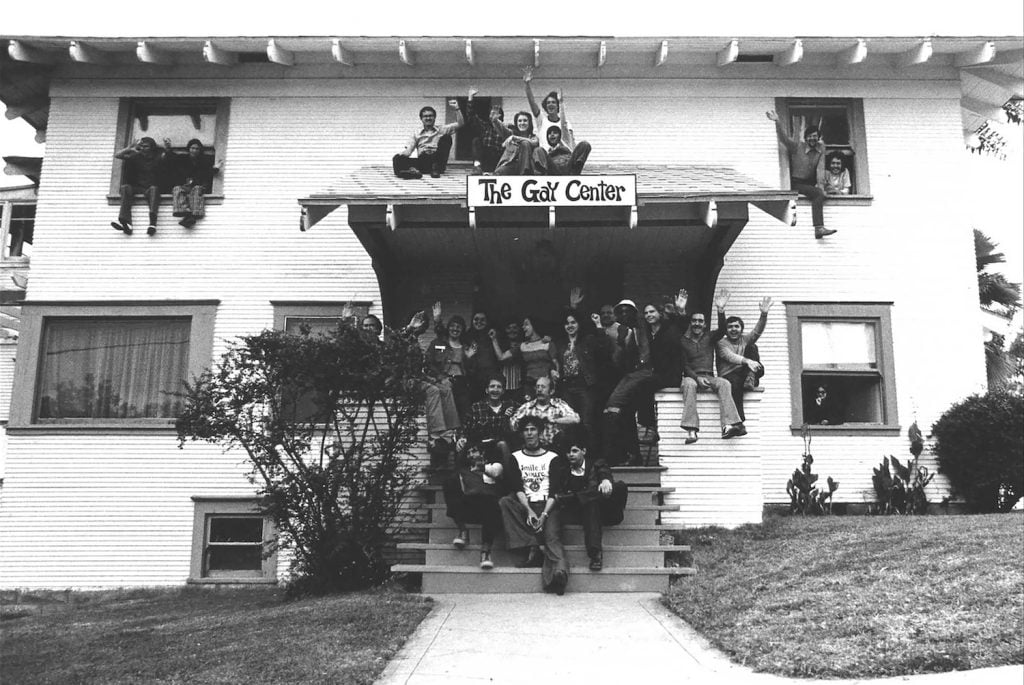
A Brief History of San Diego’s Pride Parade
Courtesy of San Diego Pride

We gays can’t agree on a time for brunch, let alone a landmark year in local queer history. So it’s no surprise that there’s a dispute over San Diego Pride’s origin story.

Some—let’s call them “originalists”—contend that our first Pride parade took place in the summer of 1974, exactly 50 years ago. That’s when a yard sale and potluck fundraiser at the local gay center reportedly ended with an unplanned march to Balboa Park.

The 50th anniversary of San Diego's first gay pride parade occurring in 1975
Courtesy of San Diego Pride

But others prefer to focus on 1975, when organizers went legit and got an official parade permit. About 400 people celebrated “Gay Pride Day” by sashaying through downtown and holding a rally. (Pride doesn’t need a permit, of course, but official recognition can make the public procession safer for participants.)

Either way, this year’s celebrations—taking place July 13–21 and expected to draw 1,000 times as many people as the 1975 event—are a great excuse to appreciate the rise of San Diego Pride over the last half-century.

Back in the mid-1970s, the Indigo Girls didn’t exist, countless women swooned over Rock Hudson and Liberace, and TV drag races hadn’t yet taught large swaths of America the definition of a “meaty tuck.” In fact, no one had ever heard of a flamboyant teenager named RuPaul Charles, who was growing up near Highway 94 and Euclid Avenue, although he’d soon win “Best Afro” and “Best Dancer” at Gompers Junior High.

A pride flag flying at San Diego's annual Pride Parade and Festival
Courtesy of San Diego Pride

Still, this conservative Navy town boasted a rich—if hidden—queer past.

In the 19th and early 20th centuries, a gay male couple built the landmark Villa Montezuma mansion, and a pair of wealthy, most-likely-lesbian ladies hosted their close pals Mr. and Mrs. Teddy Roosevelt. Local queer culture really took off in the 1940s, when World War II brought gay servicemen and servicewomen to town. So many gay bars opened up that a book called USA Confidential warned darkly of “fairy dives” full of “prancing misfits in peekaboo blouses.” (Sign me up!)

By the mid-1970s, Hillcrest had begun its evolution into a gentrified gayborhood, and a police crackdown on gay men at a Mission Valley department store restroom united the queer community in activism for the first time.

Pride and politics have always gone hand in hand. An estimated 3,000 people marched in 1978, the year that California voters rejected a ballot initiative to ban gay teachers. The 1980s brought a focus on AIDS activism as crowds grew bigger and bigger. By the 1990s, when Pride festivities switched to July to avoid Pride Month’s June gloom, politicians from both parties began to show up in search of votes.
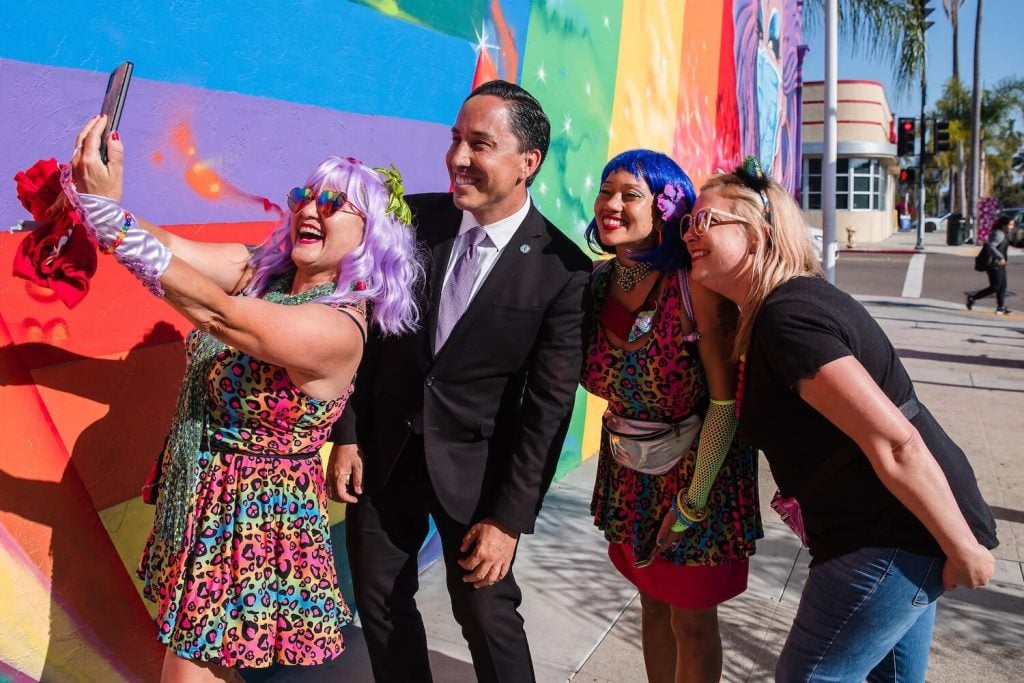
San Diego mayor Todd Gloria posing for pictures with LGBTQ+ people at the San Diego Pride Parade

Then, just over 30 years ago, queer people started to take power themselves, led by women. Councilmembers were elected first. Then came LGBT state legislators and the county district attorney. Now, San Diego is the largest city in the country to have elected a gay man as mayor.

Of course, San Diego Pride hasn’t always been a land of unicorns, rainbows, and drag queens in nun outfits. Fundamentalists get a free-speech space every year where they can wave signs at paradegoers, getting one-fingered salutes in return. Pride organizers have faced financial problems, and a tear gas attack marred the 1999 parade. Recently, progressive LGBT activists assailed parade organizers for allowing the police to take part, in turn disturbing veteran activists who’d worked to forge a friendly relationship with local law enforcement.
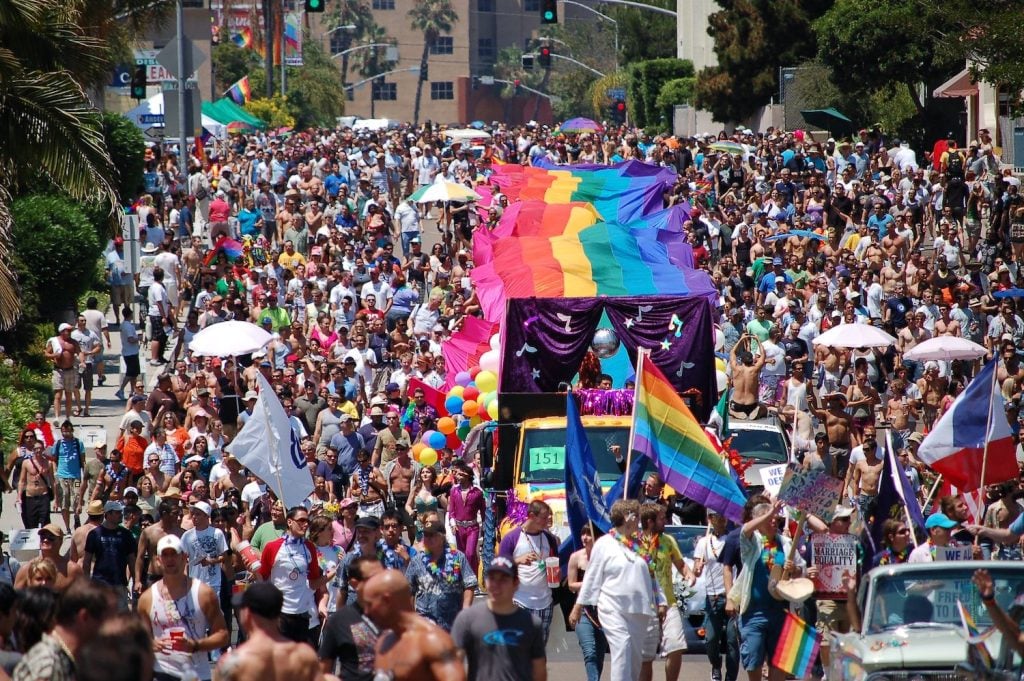
San Diego's annual Pride Parade happening in Hillcrest
Courtesy of LGBTQ+ Institute

This year, the Pride parade will feature the usual fabulousness: Dykes on Bikes (it’s okay to say that; it’s their name), glittery marching bands, and more skimpy outfits than you can shake a pair of short-shorts at.

As always, though, San Diego Pride will be more than an excuse to party under the summer sun and flirt with him, her, or them (in every sense of the word). It’s all about loudly and proudly proclaiming,

“We’re here, we’re queer, get used to it!”

“We’re no less citizens because we are gay,” an attendee told a local TV reporter at the 1978 parade. Now, as then, it’s a message that unites people who disagree about plenty of stuff. And it’s a message that still resonates because progress, unlike fabulousness, is a mighty fragile thing.

Subscribe to our newsletters

Select Options

By subscribing you confirm that you agree with our Terms and Conditions and Privacy Policy.

Arts & Culture JUNE 26, 2026

Who Makes San Diego, San Diego?

That's the question at the center of a new collaborative arts initiative launching this September, celebrating the artists, performers, designers, and makers shaping the region

Who Makes San Diego, San Diego?
Courtesy of Downtown San Diego Partnership

You may not know his name, but if you were one of the millions of people who traveled in and out of Terminal 2 at San Diego International Airport in 2024, you’ve seen his work. David Mont Virgen was born and raised in Tijuana. He earned a degree in international business and studied interior design in Madrid. In early 2020 during the global pandemic, he made one of life’s impactful pivots and decided to pursue art full time. 

David works between San Diego and Tijuana, in the cross-border corridor that is, depending on who you ask, either one of the most complicated places to build a life or one of the most generative creative regions in the country. He makes minimalist work—paintings, sculpture, objects. To do minimalism well, you have to be very good, because there is nowhere to hide. That airport piece? It’s officially entered the permanent collection of the San Diego Museum of Art. David is very good.

While his work was gaining real traction in San Diego, his marriage ended. When that relationship dissolved, the legal and physical ground beneath his feet shook: The future of his citizenship was now in limbo. David looked at his options and chose yet another life pivot.  

An accomplished working artist with a piece in a museum’s permanent collection enlisted in the U.S. Army, at a time when this country is at war. David describes this period of his life with grace, as “…an opportunity to choose myself and move forward with greater clarity and intention. For the love of self.” 

That phrase, “For the Love of Self,” became the title of his show, which opened at the Guild Hotel in January 2026 with support from Oram Hotels and the Consulate General of Mexico in San Diego. Jennifer Findley of JFin Collective led the curation. Within weeks of the show’s debut, David shipped off to train with the army. It would be easy to read his enlistment as purely practical, and citizenship was part of his calculus, but he is precise about his reasons: He wants to continue building a future in this country and building a future for this country. Because service, he says, feels connected to art. “Both are rooted in the belief that we are responsible for contributing something larger than ourselves.”

David is one creator out of many whose story hasn’t yet been told, but whose path reflects the world we live in. The truth he represents is that the artists in this city are creating under increasingly challenging constraints even as their work actively shapes the world we move through—the places we gather, the neighborhoods we love and live in—whether we know their names or not. 

It’s time their stories are told.

This fall, we’ll be publishing an ambitious arts and culture issue made possible by the support of two organizations who are underwriting an expanded freelance budget with one question at its center: Who makes San Diego, San Diego? 

The Art & Design District—a Prebys-supported initiative to develop and shape a dedicated area of the city for creative work, led by Jonathan Glus—has joined as co-publisher of our September issue. SDFC Playmakers led by Sebastian Moura, the MLS team’s program dedicated to showcasing San Diego’s creative community, has also joined as digital co-publisher for the next six months. 

With their support, our freelance budget has tripled. In the spirit of radical transparency, and because our readers deserve to know how our work is funded, our typical monthly print freelance budget is about $6,000. That supports writing, photography, and design across more than 100 pages. Our monthly digital budget is $2,500. 

With the support of our co-publishers, we’ve brought on Aaryn Belfer, one of San Diego’s most respected editorial voices, as the issue’s special editor. Alongside Troy Johnson, content chief; and Emma Veidt, editor; she is helping shape the editorial vision of the issue.

With an expanded team, we’ll soon bring on a digital producer and an additional art designer. We’ll produce an expansive portrait of the artists, makers, performers, and institutions defining this region’s creative life, commission original photography, and create a comprehensive fall arts and culture calendar. The issue will anchor a six-month editorial program that will extend across digital, social media, video, podcast, and newsletters through early next year.

We have been doing this for 78 years, and we have learned how to do it well with limited resources. But the conversation happening in San Diego right now—about the role arts and culture play in shaping a city and the role a city plays in shaping arts and culture—is one that demands more than what our standard monthly budget can produce. Until now. 

This partnership model is new to us but the challenges that precede it are not new to media, particularly on the local level. And yet, this collaboration serves as real proof that civic organizations and local media can work together to document and preserve the story of a place and the people who make it, for the record.

David told me that San Diego gave him a sense of belonging. That he felt supported and encouraged to keep growing. Not because life got easier, but because he learned to trust himself through uncertainty.

Today, he’s somewhere in basic training. But he is still an artist and he will keep making work. The artists in this city are almost never just one thing. They are painters and soldiers, sculptors and teachers, dancers and mathematicians. David is a minimalist artist and a U.S. Army recruit. He is Tijuana and San Diego. He is, in the most literal sense, still becoming.

A great city knows its makers. I want San Diego to be that city. 

September is on newsstands soon.

Everything SD JUNE 26, 2026

A New Otay Mesa Border Crossing May Improve Wait Times

A massive $1.3 billion construction project is slated to improve the border-crossing process—will it live up to its expectations?

A New Otay Mesa Border Crossing May Improve Wait Times
Courtesy of SANDAG and Caltrans

You’re coasting home after a weekend in Rosarito Beach—still riding the high of vitamin D and Baja Med—and then comes a slap back into reality: brakelights and gridlock exhaust.

Small wonder, given that San Ysidro is the busiest land border crossing in the western hemisphere (fourth-busiest in the world). Otay Mesa’s no breeze either; it’s the busiest commercial port in California and second-busiest across the entire southern border. Smart Border Coalition says that each day last year, 41,800 vehicles crossed into the US at San Ysidro; 17,800 crossed at Otay Mesa, along with 1,023,000 commercial trucks.

Guide to visiting Tijuana, Baja California, Mexico featuring the skyline

Diana Pazos, a San Diego resident and adolescent psychiatrist working in Tijuana, says the northbound border wait at the San Ysidro crossing is often three to five hours Saturday through Monday—delays that modern humans and multinational maquiladoras alike aren’t built to endure. At the current Otay crossing, “commercial trucks may be in line for six hours or longer,” she says.

Needing to bake a couple hours of commute into the States doesn’t just affect vacations; tens of thousands of people cross the border each day for doctor’s appointments, work, school, you name it. The clog has personal and commercial ramifications.

But change is coming. Construction has begun on a new border crossing in Otay Mesa, which is expected to significantly reduce wait times across all San Diego border crossings, bolster binational trade, and improve the air pollution levels in the area.

Nikki Tiongco, an 18-year Caltrans veteran who oversees the Otay Mesa East project (aka Otay 2) for the agency, says the new border crossing will also be among the most high-tech, efficient, and secure border crossings in the nation.

“We have already completed the roadway network within the Otay Mesa East region,” says Tiongco. Part of this project included building State Route 11, an extension of SR 905, which has been open to the public since August and will feed traffic to the new entry port. Otay 2 comes with a 21st century upgrade, too. Miles of fiber-optic cables have been installed underground, which gives the port the brainpower to efficiently sort and streamline traffic as cars approach the border. (Unlike the San Ysidro border, where lanes get organized by vehicle type, Otay 2’s lanes will be interchangeable. For example, if the system indicates that a high number of commercial trucks is heading to the border, passenger lanes could be converted to cargo lanes in real time.)

Otay 2, driven by a binational collaboration among government agencies (Caltrans, SANDAG, General Services Administration, and U.S. Customs and Border Protection), receives both federal and state funding, plus hefty contributions from Mexico. So far, funds from the $1.3 billion project have helped build new bridges and roadway interchanges that will guide traffic to the crossing. At this stage in the process, Caltrans is “laser-focused on building the facility itself,” Tiongco says.

Now, to the juicy part: the prospect of a “20-to-30-minute border wait time” at Otay 2, according to Tiongco. Currently, there are three standard ways to cross the border at San Ysidro: Ready Lanes, General Lanes, or SENTRI Lanes. Most travelers use either the Ready or General lanes. SENTRI Lanes require a form of pre-approval from the US federal government plus an additional fee. According to CBP, the average wait time in 2025 at the San Ysidro crossing, was as little as 15 minutes in the SENTRI Lanes, 45 minutes in the Ready Lanes, and 1.5 to 2 hours in the General Lanes. Those are best-case scenarios that vary based on lane type and time of day.

Otay 2 is about 12 miles east of the San Ysidro crossing and 2.5 miles east of Otay 1. Those not wanting to spend that much extra time on the road to drive to the new border crossing, despite the allure of an under-30-minute wait, are still expected to see some benefits. Tiongco says Otay 2 will “provide a relief valve” overall by spreading the burden across the three border crossings. As a result, SANDAG says, wait times at San Ysidro and Otay 1 could be cut in half.

It’s not just your time waiting at the border that matters. Multinational corporations that relocated their manufacturing plants (maquiladoras) to Northern Baja have claimed for years that the long delays at Otay 1 eat away at their profits. More than 600 maquiladoras, used by companies such as Samsung and Panasonic, currently use Otay 1 to transport products to US and international markets. Ambassador Alicia G. Kerber-Palma, the consul general of Mexico in San Diego, says the project will facilitate more than $60 billion in cross-border trade annually.

Previous reports say that Otay 2 also has the capacity for around 12,000 passenger cars and 1,500 commercial trucks daily. A shiny, new element to this port: Commercial and personal vehicles that choose to cross will pay a dynamic toll on both sides of the border. The fee will increase during busy hours and decrease during slower periods, Tiongco says. Caltrans estimates that the toll could range from $4 to $30 for passenger vehicles and higher for commercial trucks. Drivers will be able to see current rates before they reach the actual border crossing.

And, with these changes, there are environmental benefits, too. “With shorter wait times at all three ports, there’s less idling and congestion, which should significantly reduce air pollution on both sides of the border,” says Kerber-Palma. The main factor driving improved air quality would be decreasing dirty emissions from idling diesel trucks. This county’s air could use some sprucing up, anyway. A 2026 report from the American Lung Association named San Diego as the fifth-most particle-polluted county in the US. The bulk of that dirty air comes from the heavy-duty trucks and ships that pass through the area.

Otay 2 is not only expected to curb the acceleration of air pollution in San Diego; if the state’s legislature passes California Senate Bill 10, the border crossing could also restore local water quality. This bill would use a portion of Otay 2 toll revenues to fund ongoing maintenance of the South Bay International Wastewater Treatment Plant. Current media reports say, however, that it’s increasingly unlikely that SB 10 will become law.

Otay 2 has been in the works for over two decades and is finally nearing the finish line. Construction estimates show that it should be up and running in 2029. Tiongco says this border crossing is “a good example of how the state, federal and local governments are working together and with Mexico to advance our mutual goals in the region.”

Adam Behar

About Adam Behar

Adam is a longtime San Diego journalist and communications pro. He covers everything from politics and culture to surfing and business.

Everything SD JUNE 24, 2026

Before She Died, Edna Harper Asked for One Thing

The creator of Mission Hills' iconic topiary garden hoped future owners would preserve the living artwork she spent decades cultivating

Before She Died, Edna Harper Asked for One Thing
Photo Credit: Casiel Sanchez

Edna Harper asked for one thing before she died: that the next owner of her iconic Mission Hills home keep the street-facing “garden.” Which is essentially asking the future residents to be curators of a whimsical and obsessive, delightful and strange, classic, cartoony and slightly unhinged sculpture museum. Harper, who died in January at the age of 87, poured her heart into this topiary bonanza, and it’s right there for everyone to see.

Like thousands (or millions, there’s no formal estimation) of others, I had scrolled through the photos of this topiary fantasia before I ever stood in front of it. As of this writing, Harper’s Topiary Garden is No. 227 of 2,686 Things to Do in San Diego on Tripadvisor, making it a popular tourist stop between fish tacos, a day at the beach, and a stroll in nearby Presidio Park. But crowdsourced photos quickly snapped in direct overhead sunlight tend to flatten the shapes that, while meticulously manicured, refuse to behave. In person, Harper’s figures seem to be in motion and, given that they’re sculpted out of bushes, they literally are. (I’d love to see a maintenance timelapse.)

Animals emerge out of shrubs as if they have impish ideas. A fanciful whale, a man in a sombrero, a random spiral twisting skyward, otherworldly creatures that defy categorization—all of these exist together in a neatly trimmed cascade pouring down the steep front slope of the property.

You don’t accidentally end up with a yard like this. You decide to create it and choose to cultivate it, and then you keep deciding and cultivating—for decades.

Although a consistent parade of looky-loos have visited over the years, most have never been inside the home, which is on the market for the first time since Harper and her husband, Alex (who died in 2020), bought it in 1969.

Courtesy of Christopher Delgado

“It was and is a landmark,” says Christopher Delgado, Harper’s cousin and trustee of her estate. “She specialized in Chinese brush art and Japanese art called ‘sumi-e,’ a form of Zen art. She was a creator … she was very, very talented.”

I can’t stop thinking about Harper, sitting at the kitchen window, looking down at her masterpiece and the watchers watching it. The image of Harper enjoying the joy the public took from her handiwork makes me want to understand the woman behind the work. Because topiary, as an art form, has always been a little… loaded.

Topiary has always had a bit of an identity crisis—and that’s part of its charm.

When I think of topiary, I immediately think: Fancy. French bourgeoisie. Palace of Versailles. Mais non! Topiary has its origins in Rome. According to the Center for Architecture, the word “topiary” has its origins in late 16th century English, which combines the Greek word “topos” for place and the Latin word “topiarius” for ornamental gardner.

Photo Credit: Casiel Sanchez

Topiary started as a flex, really. A Julius-Caesar-adjacent pastime for the most ancient one-percenters; an expression accessible only to those with land, labor (or, put more plainly, enslaved people), and spare time. In its earliest form, topiary was about control: bending nature into submission. It’s where symmetry and precision signaled order, taste, and money.

But with the collapse of the Roman Empire and the Dark Ages that followed, the topiary almost preceded the Dodo Bird in extinction. Monks quietly kept the art alive by growing herbs and manicuring the gardens and hedges within the courtyards of their monasteries.

It wasn’t until the Renaissance nine centuries later when topiary saw a resurgence—ah, Versailles!—and this form of pleasure gardening went into overdrive. Nature became architecture. The French pruned their foliage into iconic cones and obelisks, walls to keep out the riffraff, and ornamentation designed to impress. The Dutch got a little freaky, as they do, and sculpted complicated figures, animals, and even furniture.

Inevitably, the pendulum swung again, and topiary fell out of favor once it became viewed as excessive and even absurd. Even so, it never really disappeared. It just migrated to exist in a completely different paradigm. It was less Versailles and more, “What if this bush were a mouse?”

Children at the New Children's museum clay workshop

Fast forward to Disneyland in 1963. That year, the park opened a topiary garden in Fantasyland with verdant sculptures of giraffes, camels, elephants, and hippos all inspired by Denmark’s Tivoli Gardens.

Disney’s interpretation of topiary—which is still a fixture of park decor today—falls more into the realm of imagination and possibility than restrained aristocratic performance.

That’s one of the stranger throughlines of topiary: It moves from elite to everyday, from stiff and formal to playful and silly, from symbol of control to something steeped in personal expression.

Which is what makes a place like Harper’s Topiary Garden so compelling and the woman behind it utterly intriguing.

Courtesy of Christopher Delgado

Born in 1938, Edna Harper was something of a Renaissance woman. She worked for two decades as a dental assistant, and she later became a notable painter, calligrapher, and stained glass artist (the house itself is adorned with her work). But she was also savvy in other ways.

“She graduated [with a degree in dental assisting] from San Diego City College and wanted to have her own money and her independence,” says Delgado. “Most people didn’t know that she was such a great businessperson, and for many years, she managed all of [the couple’s] properties on her own. She was great at building relationships … she touched a lot of people’s lives.”

Her friend and fellow artist Julie Roth attributes her artistry to her relationship with Harper. The pair met two decades ago at an art class at Oasis in Mission Valley.

“She was just the most encouraging person,” Roth says. “I didn’t know I could paint, but apparently I can. She was a tremendous person.”

I asked Roth what she’d want people to know about her friend.

“Her empathy and diplomacy,” she says. “[She had] a sharp eye for other talent. She spotted me, but I’m not the only one she encouraged.”

That sharp eye suggests attention, the same kind it takes to look at a bush and also see a whale. Or a spiral. Or something that doesn’t exist yet, but could.

Photo Credit: Casiel Sanchez

Nothing about Harper’s life suggests someone chasing attention. And yet, she ended up creating something that demanded hers, and she took great pleasure in seeing people enjoy her creations.

The garden didn’t happen all at once. It grew out of years of travel, observation, and collaboration. Harper often traveled without her husband, always returning from trips to Japan, Thailand, and other parts of Asia with ideas and impressions captured through sketches in a notebook.

“She would get creative ideas from her travels … she’d come back with ideas and pictures, and they’d go about cutting that topiary bush into shape,” Delgado says.

For the past 25 years, she had the help of her gardener, Pedro Duran—who’s still employed by the trust and has maintained the garden since Harper’s passing.

In the early topiary years, Harper worked closely with Duran in what Delgado describes as a kind of shared “labor of love.” She would share her sketches and together the pair would shape the bushes into something deliberate.

Photo Credit: Casiel Sanchez

“As she got older, she would increasingly draw her ideas and [Duran] would [carry them out],” Delgado says.

That collaboration reinforces that her garden was not an act of control, but one of creative collaboration and translation. From memory to sketch. From sketch to shrub. From something seen, somewhere else in the world, to something rooted in the soil of a steep hillside in Mission Hills.

Harper also made sure that the lawn’s boisterous energy made its way into the house on Union Street. Apparently, she threw legendary parties.

“Fairly regularly, in the late ’70s and ’80s, she would host Super Bowl parties with 200 people. She had TVs everywhere,” Delgado says.

It’s not hard to square that image with the stillness of the garden which, despite the careful pruning and intentional design, is voluminous and nearly vibrating.

And, damnit, I wish I’d watched some sportsball on her shocking number of TVs and wandered out front to the topiary—slightly wine-drunk with an orange smear of wing sauce on the corner of my mouth—to marvel at the leafy hippo and this woman’s elaborately creative life.

Photo Credit: Casiel Sanchez

I can hear Delgado smiling as we talk on the phone. He’s going back to his childhood, when he talks about being one of the cousins Harper doted on when he visited.

“The adults were inside, and we’d be out in the camper,” he says, “and [Harper] would come check on us, make sure we were okay. She always had gifts for us. If it was Easter, there were chocolate eggs. If it was Christmas, stockings. We were the beneficiaries of them not having kids because they showered us with all their love.”

Knowing this and taking a look at her garden again, you can see it’s not the work of a shut-away curmudgeon. It’s wondrous, inviting, and the right kind of weird.

“Ultimately, she did it for herself and family, first and foremost,” Delgado says of Harper’s Topiary Garden.

Harper’s one request of whomever buys her home may seem like a focus on basic maintenance, about hedges and upkeep and preserving something visually striking. But it’s really about attention. And maybe, too, about legacy. Not hers, per se, but the legacy of community, relationships, art, creativity, possibility, adventure, culture, dedication, and love.

For now, it’s there for anyone to see, and its future is in the hands of whomever comes next.

Studio S MAY 5, 2026

Artistry, Aesthetics, and Inclusive Luxury

KQ Aesthetic Society goes beyond cosmetic to provide comprehensive care and transformative results

Artistry, Aesthetics, and Inclusive Luxury

Kelly H. Harfouche, founder of KQ Aesthetic Society, knows firsthand that cosmetic treatments like fillers, neurotoxins, and microneedling, can not only enhance a person’s appearance and restore confidence, they have the power to truly change a person’s life. An expert injector has the ability to tailor treatments to each individual patient’s anatomy and goals for personalized results. Harfouche, a board-certified nurse practitioner, has spent nearly a decade perfecting her craft as an aesthetic injector and integrating her multifaceted artistic skills with precision patient care. Her commitment to continual education and training, plus a passion for helping people look—and feel—their best, set KQ Aesthetic Society apart in a sea of local medspas. 

For many people considering nonsurgical treatments, the intent is to look refreshed and refined. KQ Aesthetic Society’s philosophy eschews a cookie cutter approach that bases treatments around units, instead working to understand each person’s unique goals, then curating a treatment plan to fit that vision. Harfouche focuses on “inclusive luxury,” the belief that everyone deserves access to aesthetic treatments, respective of budget restrictions. She develops long-standing trusted relationships with her patients, and works with each one to achieve their aesthetic objectives and address the underlying causes of their concerns. 

“For me, forming an honest and open relationship with every patient who walks through the door is essential. This means understanding them on a deeper level and meeting them where they are to define and achieve their individual goals,” she says. 

Drawing on her artistic background, which inspired her transition into medical aesthetics, Harfouche sees each client as a “unique canvas.” Rather than relying on standardized procedures, the practitioner’s distinctive approach combines her profound understanding of the physiological and anatomical changes associated with aging with an unwavering commitment to ongoing education about the newest products and their mechanisms of action. Her goal is to make each patient feel beautiful in their own skin and to embrace their individuality. 

She has also pioneered a way to combine her talent for aesthetic artistry with her philanthropic nature. Harfouche is one of only a handful of providers using dermal fillers to treat patients with lip asymmetry and scarring resulting from cleft lip surgery. Patients travel from around the country for this transformative treatment, noting increased confidence and a restored identity. She hopes to eventually launch a training program to help fill the void in this space.  

“My passion has always been connecting with people and giving back in any capacity that I can,” she says. In the rapidly advancing landscape of aesthetic medicine, you can place your confidence in Harfouche and KQ Aesthetic Society to deliver exceptional care. To learn more or book a consultation, please visit kqaestheticsociety.com.

Features JUNE 18, 2026

The Perfect Shot with SD’s Top Food Photographers

We ask the city's best food photographers to choose their favorite pics and share their secrets to capturing a drool-worthy pic

The Perfect Shot with SD’s Top Food Photographers
Photo Credit: Luciana McIntosh

Food is a notorious diva to photograph. The wrong lighting can make José Andrés’ paella look like a jaundiced grain bowl. You could be staring at the best sandwich of your life, but shoot it from above and—hey, congrats on that abandoned piece of lettuce bread. A cottage meme industry has been built around the hilariously bad photos on review sites that make Michelin-star food look like Michelin tires.

Especially in a visual modern media world, food culture depends on great photographers capturing the painstaking work in equally deserving ways. We asked four of San Diego’s top food photographers for their favorite shot from another year of documenting what we eat.

Photo Credit: Kimberly Motos

Kimberly Motos

Birdman Sandwich at Chick & Hawk

Getting this kind of shot takes a bit of yoga. Asana yourself into the corner, hold your breath, pray that a chef on the move doesn’t back into your light stand.

“You’re stepping into someone’s workspace during their busiest moments, so it’s a balance of being present to get the shot and being invisible to not slow anything down,” Kimberly Motos says.

The subject here is the Birdman sandwich from Chick & Hawk—hot fried chicken thigh, tangy slaw, kimchi comeback sauce, sweet and spicy pickles, potato brioche bun—getting a hearty dousing of its difference-maker seasoning. Motos captures the parts of the process that diners don’t usually see: the chaos behind something that looks so simple.

Photo Credit: Lucianna McIntosh

Lucianna McIntosh

Oysters + Jewel of the Sea Martini at The Fishery

“I love this image because it feels like a moment you want to step into,” says Lucianna McIntosh. A warm, sunny day at The Fishery in PB with oysters, caviar, and martinis. Yes, please.

The little details—the glass sweating a little, the direct afternoon light creating stark shadows, the oyster glistening on the tray—are the main characters. Instead of trying to overly control the setup, McIntosh “followed the light and lines that draw you in more,” she says. “This was one of those moments where everything lined up on its own for a second. I love it when the shadows end up being just as important as the food itself.”

Photo Credit: Eric Wolfinger

Eric Wolfinger

Herb-Roasted Golden Chicken at Fleurette

La Jolla native Eric Wolfinger—who won a James Beard Award for Tartine Bread, one of the most stunning bread books of all time—says he doesn’t have a signature style. His style is a conduit.

“I see my job is to translate the chef’s point of view into something you can feel,” he says.

For this shot, Fleurette chef Travis Swikard had one directive: cuisine du soleil (“cuisine of the sun”). With a spread of leeks vinaigrette, herb-roasted golden chicken, and beets, Wolfinger wanted to create a scene that felt straight out of the French Riviera, relaying the light, bright style of Swikard’s new spot.

Some bonus additions here: Extra lights—to add lots of warmth—and a clipping from an olive tree.

Photo Credit: Dee Sandoval

Dee Sandoval

Espresso Ice Cream at Lucien

Timing and light are everything in food photography. In Lucien—La Jolla’s tasting-menu-only restaurant with moody ambiance—a single strobe flash creates the ideal spotlight.

Dee Sandoval says she uses the “natural, just-plated energy” of the dish to “create a portrait of moment and craft.” That’s why this Mostra Ghost Bear espresso ice cream—with San José dark chocolate mousse, soy-miso caramel, and koji shoyu chocolate sauce—looks like it might dissolve halfway to your mouth.

Emma Veidt

About Emma Veidt

Emma Veidt is an editor at San Diego Magazine. She earned her bachelor's and master's degrees from the Missouri School of Journalism. She loves running, hiking, and rock climbing, but really, she mostly loves encounters with the street cats around North Park.

Everything SD JUNE 18, 2026

How San Diego’s Most Serious Wine Collectors Store 20,000 Bottles

San Marcos-based Vintage Cellars designs and builds customized, high-end wine storage with calibrated humidity, racking systems, and LED lighting

How San Diego’s Most Serious Wine Collectors Store 20,000 Bottles
Courtesy of Vintage Cellars

The floor is made of glass. Under your feet, you can see the cellar—15-foot ceilings, soft light, and stained white oak walls the color of desert silt.

Tucked behind the wood, inside the doors, and in the ceiling is a highly advanced and very specific network of tech assembled in San Marcos—perfectly calibrating the room for humidity and temperature with vapor barriers, specialized insulation, and LED lights. Along the walls on matte blag pegs lay 1,000-plus bottles of wine—some iconic collector vintages, some with stories, some earmarked for major life moments.

This is a very serious wine home, built by someone whose obsession eventually leads to a call with Chris Noel.

“We have some clients who have been collecting wine since the ’60s and the ’70s, and they have collections of 15,000 or 20,000 or more bottles,” says Noel, owner of Vintage Cellars, the San Marcos–based designer of custom wine vaults for some of the region’s top restaurants and super-collectors. “[For them], collecting wine is similar to Jay Leno collecting cars.”

Courtesy of Vintage Cellars

Before the wheel, there was wine. Fermenting fruit sugars into alcohol was a thing as early as 4100 B.C. (wheel, circa 3500 B.C.), most likely a happy accident. Unsurprisingly, the tipsy breakthrough in juice arts was a huge hit. The challenge was that it was also hugely perishable.

The first efforts to save it from spoil were clay vessels called amphora, often fully or partially buried to create a sun-proof, temperature-stable environment. The terra-cotta pots were pointy-bottomed, which stacked and traveled better, encouraged gas circulation (thus preventing oxidation, the famed wine ruiner), and helped separate sediments.

Once basic preservation was figured out, makers noticed the aging process ushered in a moodier magic. So they engineered structures to tinker with the possibilities of the long haul. Those first wine holes in the dirt evolved into entire catacombs, tombs, quarries, and caves.

Courtesy of Vintage Cellars

Ancient Romans engineered wine storage rooms called fumariums, built facing north to avoid the sun and filled with smoke to speed the aging process (no doubt rapidly aging the cellar workers in the process).

For centuries, specialized wine storage was mostly a commercial venture. Serious wine people would (and still do) outsource their collections to a bonded storage facility or turn to professional cellarers who run giant chilled warehouses of cabernets.

A few major social moments sparked a more serious at-home cellar trend. First, the “Judgment of Paris” in 1976 (California wines famously besting the French in a blind tasting) established US wineries as worthy of collections.

A few years later came the 1982 Bordeaux, one of the most-coveted vintages in history. It was championed by a US lawyer named Robert Parker, whose 100-point scale rating system would quickly become the gold-standard for grading wines, creating a huge boom of wine collectors for the next few decades (wine as an economic investment became a thing).

The US economy also boomed in the ’80s, while France hit a skid. With the dollar trading 6-1 against the franc, US collectors had a rare chance to pick up Grand Crus at serious bargains, which demanded equally serious storage.

Courtesy of Vintage Cellars

Given that framing, 1990 was a fairly great time for Vintage Cellars to get into the game. Noel—who worked his way up at the company and then eventually took over as owner in 2020—and his team work with architects, designers, and builders to create cellars that both fit the space and act as an attraction in multimillion-dollar homes across the region, and at top restaurants like Pamplemousse Grille in Del Mar and Avant Restaurant in Rancho Bernardo Inn. They hide cooling systems in brick-walled enclosures, bend bottle racks around curved walls, create standalone pavilions—engineer structures for cabs.

Their cellars hover between 50 to 70 percent humidity to keep the cork appropriately moist. Air too dry, and a cracked cork will give up the ghost—O2, in excess, turns wine into vinegar. If the air’s too dry, it can shrink the cork, eventually evaporating the wine and creating a low pressure that will pull in destruction. Too humid, and mold contaminates the works.

California winery Domaine Carneros in the Nap Valley featuring vineyards

Light’s a big no-no for wine, too. Incandescent or halogen lights were the norm for cellars 20 years ago, but they emitted heat. Like Schrödinger’s Cat, these bulbs would risk the subject in order to view it. Vintage Cellars adopts LED lighting and, for glass cellars in the sightline of bright windows, mechanized shades that lower during UV exposure times.

Custom circumference-cut cove trays, leather saddles, and pegs stabilize bottles in Vintage Cellars storage areas; movement disturbs the tannins and upsets the aging process. And these cellars are smart, with app-based monitoring, remote temperature monitoring, and eSommelier cellar management. Don’t fret, Siri’s got your Syrah.

The most important decision, however, is deciding when to uncork that special bottle.

“[A lot of times, people] are saving those wines for specific moments in life—maybe a 50th anniversary or when their firstborn turns 21,” says Noel. “That’s how they look at it: as social and also to create memories.”

Pete Peterson has served as high as Editor-in-Chief of an enthusiast media magazine and as low as writer of his own bio… In addition to contributing to San Diego Magazine, Pete authored the YA novel One Tiger One Teen and is working on his second novel. Slightly more info is available at petepetersonauthor.com.

Troy Johnson

About Troy Johnson

Troy Johnson is the magazine’s award-winning food writer and humorist, and a long-standing expert on Food Network. His work has been featured on NatGeo, Travel Channel, NPR, and in Food Matters, a textbook of the best American food writing.

Partner Content MARCH 26, 2026

Design Leaders & Innovative Interiors: AVRP Studios

A look at San Diego's top designers creating unique environments that combine creativity and function

Design Leaders & Innovative Interiors: AVRP Studios


AVRP Studios’ tradition for Design Excellence and Innovation began in 1976 with Doug Austin, FAIA, in Solana Beach, California. The firm has since grown to complete major projects throughout the United States and Canada. We think of ourselves as a family and we care deeply about people. We want to inspire, help make their lives richer and more complete through our efforts. We believe that architecture is one of the most important art forms because of the impact it can have on the lives of those it touches. We’re delighted to have been recognized with over 150 awards for design excellence.

703 16th Street, Suite 200, San Diego, California 92101  |  619-704-2700  |  avrpstudios.com

Thousands of savvy locals already get it.

San Diego's best restaurants, experiences, and events—handpicked and delivered to your inbox weekly. You in?

Close the CTA

Contact Us

1230 Columbia Street, Suite 800,

San Diego, CA