Featured articles
Food & Drink
Food & Drink
Food & Drink
Featured articles
Everything SD
Everything SD
Everything SD
Featured articles
Things to Do
Things to Do
Things to Do
Featured articles
podcast-ep
podcast-ep
video
Featured articles
Everything SD
Everything SD
Everything SD
Featured articles
Food & Drink
Partner content
Partner content
Ready to know more about San Diego?
SubscribeReady to know more about San Diego?
Celebrate the season with these 25 restaurants offering holiday specials, prix-fixe menus, and more
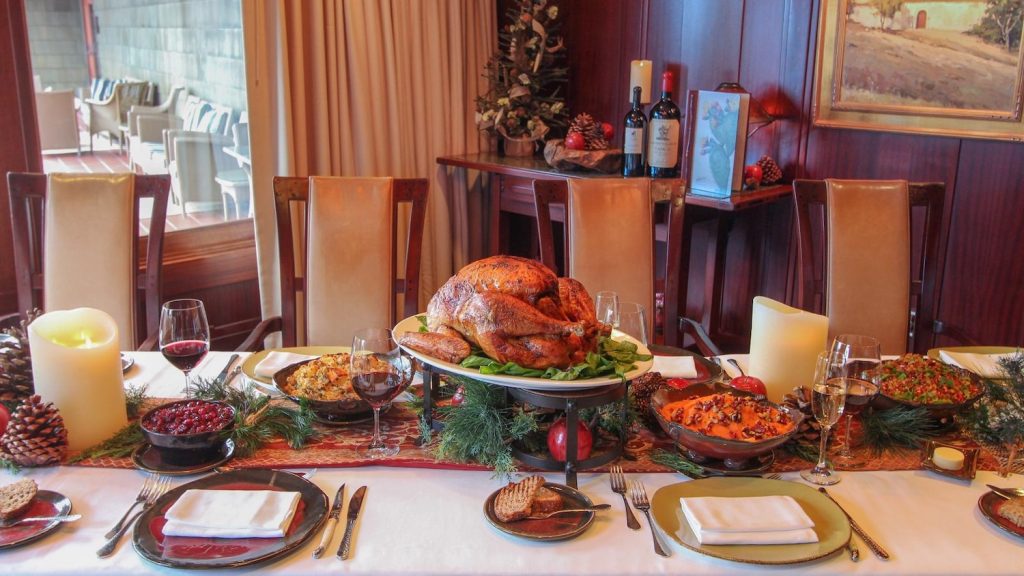
Sometimes the best Christmas dinner is one you don’t have to cook. Whoever you’re celebrating with this year, a prix-fixe meal or a fleet of takeout containers can save you from hours in front of the stove, leaving more time to fête the season with the people you love most.
From classic festive fare (prime rib! candied yams!) to your new favorite tradition (hi, crab corn doughnuts), local eateries offer plenty of delicious bites for revelers on Christmas Eve and Christmas Day. Let’s sleigh the holiday season and savor Christmas specials, prix-fixe menus, holiday cocktails, and takeout feasts from some of San Diego’s finest restaurants.
Head to the luxurious L’Auberge Del Mar for a Christmas Day buffet at Adelaide. The feast is fit for Santa himself, featuring a raw bar, prime rib, lamb, roasted chicken breast with porcini mushroom gravy, and crème fraîche mashed potatoes. After indulging, settle into a post-feast nap under a poolside cabana, treat yourself to a lemongrass spa session at Spa L’Auberge, or swing by the hotel’s family movie night, complete with a side of hot cocoa and sugar cookies.
Price: $170 per adult | $40 per child
When: Dec. 25, 1–3 p.m.
Where: 1540 Camino Del Mar, Del Mar

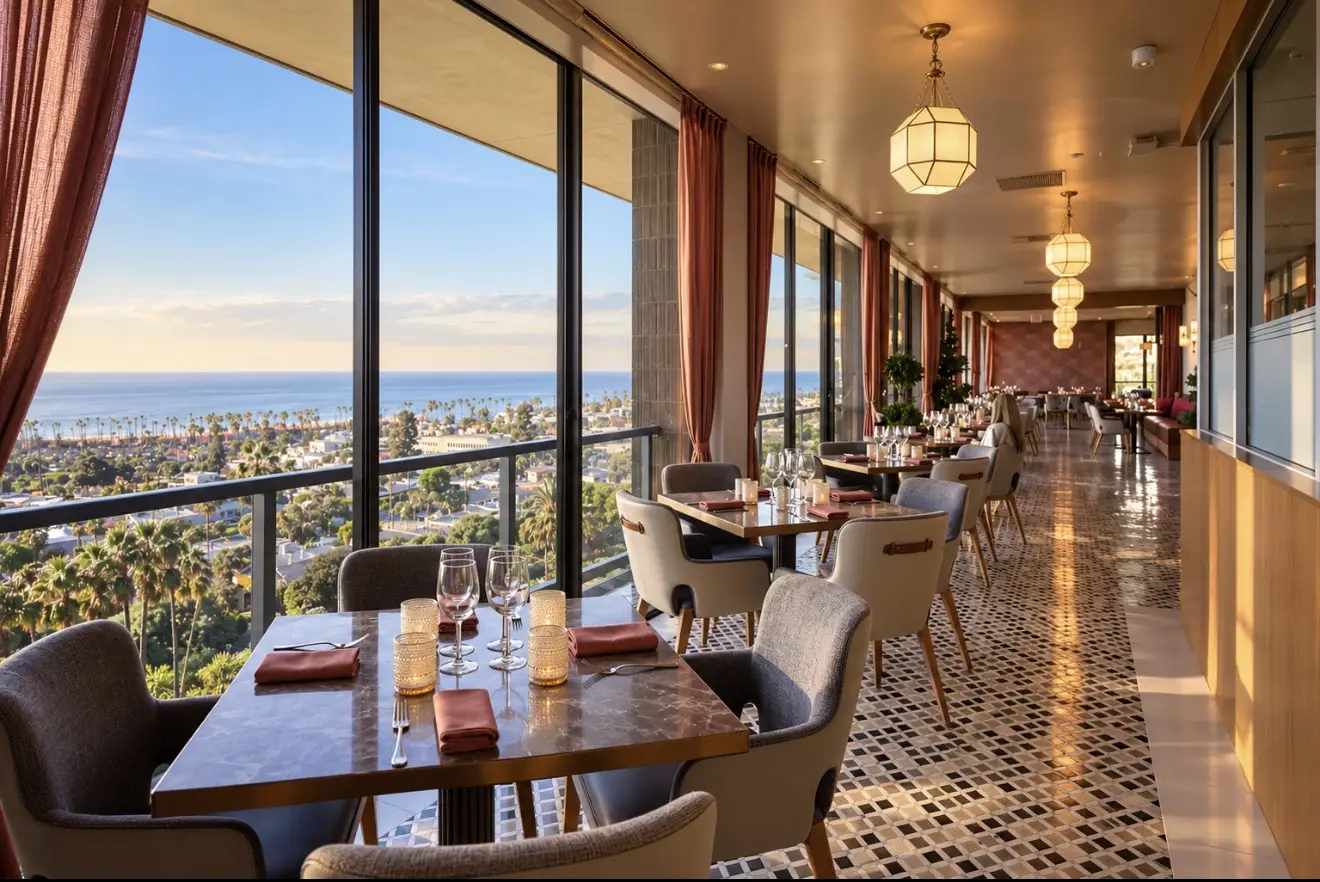
Elevate your holiday dinner with arguably the best view in San Diego. On Christmas Eve and Christmas day, Mister A’s in Bankers Hill offers an elegant, three-course, prix-fixe menu from its rooftop vantage point. The menu includes butternut squash soup, roasted rack of lamb, crispy Brussel sprouts, and gingerbread sticky toffee pudding. While you eat, sway to the soothing melodies of Spanish guitarist David Maldonado.
Price: Christmas Eve – $105 per adult | $35 per child; Christmas Day – $97.50 per adult | $35 per child
When: Dec. 24, 4:30–9 p.m. | Dec. 25, 12–7 p.m
Where: 2550 Fifth Avenue, 12th Floor, Banker’s Hill
Ring in Christmas Eve with Matsu’s Karaage Night—an extravaganza of traditional Japanese fried chicken and strawberry shortcake. The six-course meal features a variety of fried chicken cuts infused with flavors like tenkasu, miso, caviar, and jalapeño. Sip selections from Matsu’s extensive sake list before a sweet holiday nightcap. Reserve your table here.
Price: $125 per person
When: Dec. 24, 4–9 p.m.
Where: 626 South Tremont Street, Oceanside
Embrace the spirit of the season with a family dinner at the iconic Hotel Del Coronado, which transforms each year into a winter wonderland. Gather in the hotel’s Southpointe Ballroom for a festive Christmas Eve dinner or Christmas day brunch packed with holiday favorites, sweet treats, and a photo op with Santa. The Del also offers holiday packages like their Fire & Ice experience, which includes overnight accommodation, ice skating by the sea, a private fire pit with s’mores, and even your own personal holiday concierge.
Price: Dinner – $175 per adult | $100 per child ages 4–10 | free for children 3 and under; Brunch – $165 per adult | $100 per child ages 4–10 | free for children 3 and under
When: Dinner – Dec. 24, 2–8 p.m. | Brunch – Dec. 25, 10 a.m.–4 p.m.
Where: 1500 Orange Avenue, Coronado
Savor a Christmas feast at Mission Bay Resort’s Covewood. Nibble your way through executive chef Roy Hendrickson’s Christmas day prix-fixe menu from the comfort of the restaurant’s heated patio overlooking the bay. Feast on dishes like lobster bisque, pear salad, rack of lamb, wild sea bass, caramelized brussel sprouts, Dutch apple pie tartlets, and a chocolate yule log made with spiked eggnog ice cream and toffee brittle.
Price: $113.67 per person
When: Dec. 25, 7 a.m.–9 p.m.
Where: 1775 East Mission Bay Drive, Mission Beach
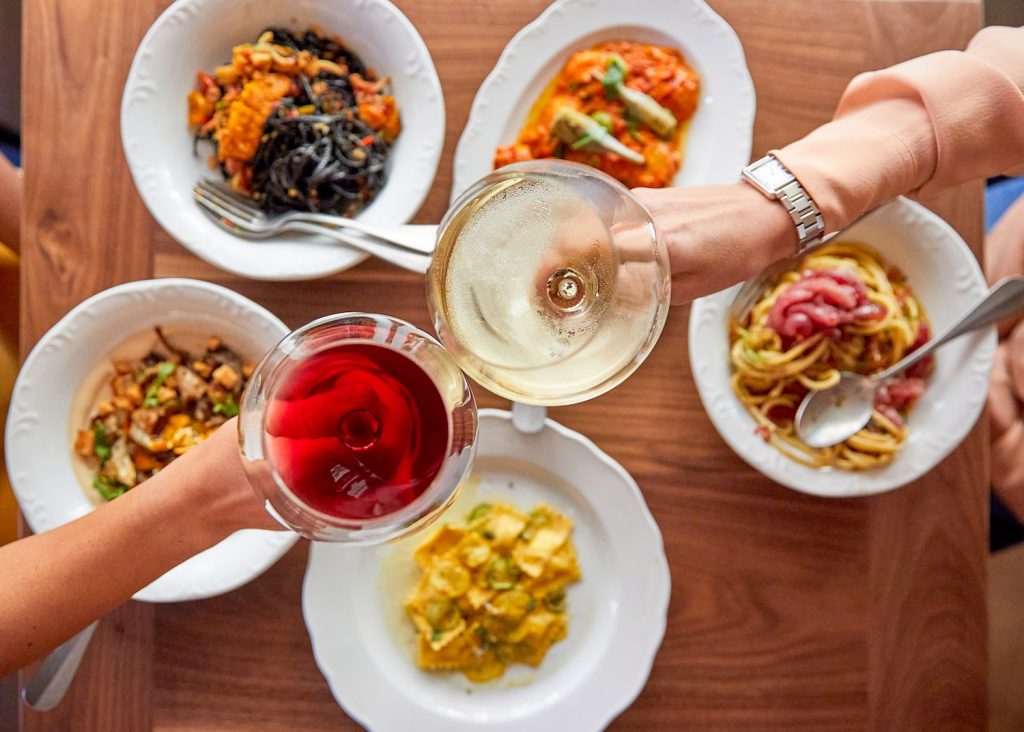
RustiCucina, one of Hillcrest’s chicest dining spots, is decking the halls with lavish Italian dishes and holiday cheer this Christmas. Dine on Dec. 24 or 25 with a Sicilian pre-fixe menu. Entrées include parmesan-stuffed roasted chicken, lobster ravioli, red wine–braised beef, and grilled salmon. You can also go big and order a wheel of cheese to share with family and add extra flavor to filet mignon pasta.
Price: $55 per person
When: Dec. 24 & 25, 4–10 p.m.
Where: 3797 Park Boulevard, Hillcrest
Celebrate Christmas in style at Provisional Kitchen in the Gaslamp. The pre-fixe brunch will feature carving and dessert stations (complete with a chocolate fountain) and be set to the tune of live music to help make spirits bright. If you prefer an evening affair, stop by for a three-course dinner featuring hearty entrées including prime filet mignon and ravioli doppio.
Price: Brunch – $85 per adult | $30 per child; Dinner – $105 per adult | $40 per child
When: Brunch – Dec. 25, 9 a.m.–1 p.m. | Dinner – Dec. 25, 4–9 p.m.
Where: 425 Fifth Avenue, Gaslamp Quarter

Experience a picturesque sunset Christmas dinner on the sandy beaches of La Jolla at The Marine Room. Order their seasonal dinner specials like the Spindrift Trilogy, which includes lobster tail, diver scallops, and wild prawn. Or get the Norwegian halibut or lamb osso buco. On Christmas Day, the oceanfront restaurant is offering festive blackberry cider, brined turkey, elk medallions, and roasted branzino sure to bring you waves of joy.
Price: $150 per person
When: Dec. 24, 5–9 p.m. | Dec. 25, 12–7 p.m.
Where: 2000 Spindrift Drive, La Jolla
Join Arlo this Christmas Eve for a tantalizing three-course prix-fixe dinner, or enjoy a bountiful Christmas Day buffet with loads of locally sourced dishes. The Mission Valley eatery’s offerings include salt-crusted prime rib, pan-roasted duck breast, and brown butter sage gnocchi that you can enjoy on the restaurant’s heated, outdoor patio. The Christmas Day buffet includes performances from local musicians. Jason Mann takes the stage from 1 to 4 p.m., followed by Natalie Aley from 4:30 to 8 p.m.
Price: Christmas Eve Dinner – $80 per person; Christmas Day Buffet – $85 per adult | $35 per child ages 6–12 | free for children 5 and under
When: Dinner – Dec. 24, 5–10 p.m. | Buffet – Dec. 25, 1–8 p.m.
Where: 500 Hotel Circle North, Mission Valley
The LaFayette Hotel’s Oaxacan enclave, Quixote, is moonlighting as the ultimate spot to celebrate Christmas with friends and family this year. Chow down on fusion Mexican cuisine like crab corn doughnuts, fried chicken tacos, and golden snapper ceviche in North Park—plus plenty of mezcal-based cocktails to rock your stockings. Can you say “Feliz Navidad” again?
When: Dec. 25, 12 p.m–12 a.m.
Where: 2223 El Cajon Boulevard, North Park
Journey to Coasterra on Shelter Island for their annual Christmas Day buffet. The bayfront Mexican restaurant presents an array of charcuterie cheeses and meats and a carving station packed with roasted turkey, ham, and New York strip loin. Pair your cuts with classic Christmas sides like cornbread stuffing, candied yams, and roasted rosemary carrots. Cap off the feast with an assortment of pies, cakes, cookies, and tarts.
Price: $89.95 per adult | $19.95 per child
When: Dec. 25, 12–7 p.m.
Where: 880 Harbor Island Drive, Shelter Island
Savor the holiday spirit at the elegant Nine-Ten restaurant in La Jolla, offering a three-course, prix-fixe Christmas Eve dinner, complemented by an amuse-bouche appetizer and a decadent dessert selection. On Christmas Day, stop by for brunch delights, including pitaya bowls, pastries, avocado toast, and huevos rancheros. Secure your spot through Open Table.
Price: Christmas Eve Dinner – $105 per person
When: Dinner – Dec. 24, 5–9 p.m. | Brunch – Dec. 25, 7 a.m.–2 p.m.
Where: 910 Prospect Street, La Jolla
Say “joyeux noël” at French bistro Et Voilà! in North Park. This adorable spot offers special three-course menus on Dec. 24 and 25. Feast on smoked salmon, braised beef short ribs, and strawberry shortbread. Voilà, a holiday celebration to remember!
Price: $75 per adult | $28 per child
When: Dec. 24, 4:30–9:30 p.m. | Dec. 25, 12–7 p.m.
Where: 3015 Adams Avenue, North Park

Prepare for a sleigh ride of flavors as chef Travis Swikard creates a five-course holiday feast at Callie. This Michelin-recognized restaurant offers a prix-fixe menu with Mediterranean-inspired dishes on Christmas Eve. Secure your spot online at Tock.
Price: $95 per person
When: Dec. 24, 5–9 p.m.
Where: 1195 Island Avenue, East Village
Fort Oak chef Brad Wise concocted a December menu based on his personal festive favorites. While the Mission Hills restaurant is closed on Christmas Day, Fort Oak is expanding its hours to serve holiday lunches ahead of the big day. Try Fort Oak’s on-theme cocktails, including their Wish List Spritz, made with kumquat aperitif, prosecco, soda, and star anise. The Home for the Holidays is a mixture of hot apple cider, bourbon, and warming spice.
When: Dec. 14–16 & 21–23, 11 a.m.–1:30 p.m.
Where: 1011 Fort Stockton Drive, Mission Hills
Got a fresh set of clubs for Christmas? Head to the Lodge at Torrey Pines for a round of golf before sitting down for a holiday dinner at A.R. Valentien afterwards. The luxurious restaurant, which overlooks the links, offers an extravagant prix-fixe menu curated by executive chef Kelli Crosson. Though Santa can’t gift you a better short game, at least you can dine like a pro.
Price: $165 per adult | $90 per child
When: Dec. 25, 4–8:30 p.m.
Where: 11480 North Torrey Pines Road, La Jolla
If tapas are on your Christmas wishlist this year, head to Costa Brava, a family-owned Spanish restaurant in Pacific Beach. Enjoy Christmas Eve dinner on their charming garden patio and relish in bacon-wrapped dates, lamb skewers, and patatas a la brava.
When: Dec. 24, 11 a.m.–10 p.m.
Where: 1653 Garnet Avenue, Pacific Beach

For a cozy, pasta-packed Christmas dinner, venture to Michelin-recognized restaurant Ciccia Osteria in Barrio Logan. Alongside their classic Italian menu, chefs Francesca Penoncelli and Mario Casineri are cooking up Christmas specials like beef Wellington and osso buco with saffron risotto, paired perfectly with a smoked old fashioned.
When: Dec. 24, 12–2pm & 4:30–9:15 p.m. | December 25 4:30–9:15 p.m.
Where: 2233 Logan Avenue, Barrio Logan
Celebrate Christmas with a sunset feast at JRDN, the oceanfront rooftop restaurant offering stunning views of Pacific Beach and Crystal Pier. Indulge in a three-course Christmas meal featuring appetizers like seafood chowder; entrées such as prime rib, scallops, and roasted mushroom risotto; and desserts that will make your taste buds jingle with joy.
Price: $69–89 per adult
When: Dec. 25, 2–7 p.m.
Where: 723 Felspar Street, Pacific Beach
Treat yourself to a Sicilian dinner at this La Mesa hotspot known for its delectable pastas and seafood. Order a round of appetizers for the table (the bruschetta is great) and try entrées like gnocchi and lasagna. Pair it all with a bottle from the restaurant’s vast wine collection.
When: Dec. 24, 4:30–10 p.m. | Dec. 25, 4:30–9:30 p.m.
Where: 5654 Lake Murray Boulevard, La Mesa
Head to The Pony Room at Rancho Valencia and revel in a Christmas Day buffet accompanied by live music and delightful activities for the whole family. Horse-drawn carriage rides, arts and crafts, and cookie decorating will add an extra sprinkle of joy to your festivities.
Price: $195 per adult | $55 per child aged 4–11 | free for children under 3
When: Dec. 25th, 10 a.m.–3:30 p.m.
Where: 5921 Valencia Circle, Rancho Santa Fe
Oversized roasted meats are synonymous with Christmas Eve dinner. Visit this Texas BBQ spot for smoked brisket, beef short ribs, pork chili, mac n’ cheese, and other savory bites. Come with a red jumpsuit, a large belt, and an appetite. Leave with the ultimate Santa cosplay.
When: Dec. 24, 12–9 p.m.
Where: 15505 Olde Highway 80, El Cajon & 3302 32nd Street, North Park
Dine on a plant-based, zero-waste Christmas dinner from The Plot this year from the comfort of your home. Savor smoky maple-butter roasted parsnips; a squash, wild rice, and lentil roast; gluten-free cornbread stuffing; and more. All the holiday goodness, none of the climate guilt.
Price: $40 per person
When: Pre-order by December 22 & pick up on December 24
Where: 1733 South Coast Highway, Oceanside

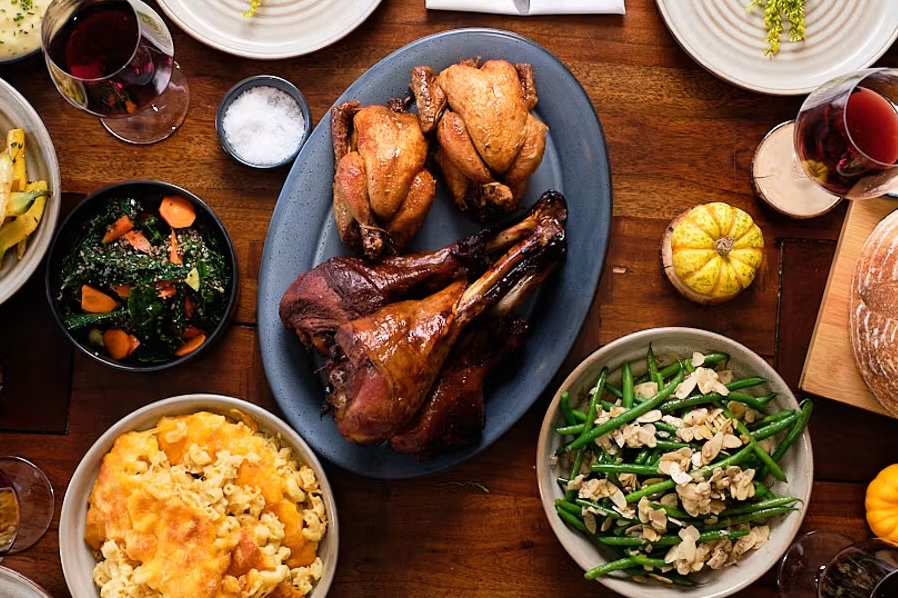
Ranch 45 in Solana Beach has your Christmas feast covered! Order some of San Diego’s finest meats and treats—including herb-crusted prime rib, smoked turkey legs, aged ribeye, pecan pie, and apple crisp—à la carte by Sunday, December 17.
When: Order by December 17 at 4 p.m. | Pickup on December 24 between 10 a.m and 4 p.m.
Where: 512 Via De La Valle, Suite 102, Solana Beach
Invite the whole squad over for a family-sized Chinese takeout dinner from Chula Vista’s Golden Mandarin this Christmas. Dive into sweet-and-sour pork, shrimp fried rice, and the restaurant’s coveted salt-and-pepper chicken wings.
When: December 24 & 25, 11 a.m.–10 p.m.
Where: 45 Broadway, Chula Vista
Cole Novak is an award-winning writer with a passion for highlighting local figures, small businesses, and nonprofits. Born and raised in San Diego, Cole is passionate about photography, surfing, art, the local food scene, and the great outdoors.

The city's fish taco hero is opening Concrete Cowboy across the street, plus a home-cooked Mexican sandwich spot
You have to be crazy or a genius to name a restaurant Fish Guts. You have to be even crazier to open a restaurant that holds maybe two dozen people at a time—if you don’t mind elbowing one other while scarfing down some of the best fish tacos in San Diego.
And yes, “best” is a relative term. But in Fish Guts’ case, it’s for real—and that’s saying something in a town literally world-famous for fish tacos.
Ever since Pablo Becker opened up his diminutive eatery in 2023 at the corner of Logan Avenue and Sampson Street in Barrio Logan, Fish Guts has been named one of the city’s best new restaurants in 2023, Critic’s Pick for the best fish tacos in San Diego in 2024, 2025 and 2026, as well as readers’ top pick in 2024. It’s like if Rubio’s married into the royal family.
Most of his ingredients come straight from the cold waters of the Pacific Ocean, which happens to be down the street. His de espada (blackened swordfish) taco is the stuff of legend. He’s kept Fish Guts operating at an elite level, which tends to happen when you work for five years in Chicago under chef Richard Sandoval (who, by chance, is also his cousin) and open an ahead-of-its-time high-end modern Mexican restaurant in East Village (El Vitral Restaurant & Tequileria, 2009-2013).
Now Becker is branching out again, opening two new concepts in Barrio Logan this fall.
The first will be upstairs from Fish Guts, which at one point was destined to become an intimate omakase counter. Santo Poco will be a lunch-only sandwich shop, offering takeout and delivery (no dine-in), and the sandwiches will be a little Mexican, a little French, a little Italian, a little from Chicago, a little from New York. Basically, a bunch of different styles all on really, really good bread.
“There’s probably going to be a Cuban-style sandwich in there with a touch of Mexican, some cold cut Italians, too, putting my touch on them,” he says. “That’s what I feel like is my style of cooking.”
Things will be traditional, but inventive. Like his fish & chips taco at Fish Guts: two classic dishes, one killer mash-up. There will also be a hat tip to the late, great Anthony Bourdain, a sandwich called the Antonio Bourdain.
The second will be across the street from Fish Guts in the former Lia’s Lumpia space. Concrete Cowboy will be a taco-driven joint on the same wavelength as Fish Guts (keep it simple, keep it special), but featuring land animals rather than sea brethren. Think tacos made with duck confit, ribeye, pork belly, skirt steak.
The inspiration behind Concrete Cowboy comes from Becker’s father, a lifelong Western obsessive, despite growing up in Mexico City’s urban metropolis. “He always liked that cowboy life, that vibe,” he says. “I always say ‘Dad, you just grew up in the wrong city.”
He’s aiming to open Santo Poco in October and Concrete Cowboy in November. Neither require massive renovations, and while the former Lia’s Lumpia space will keep the cabin-esque aesthetic, he’s creating more of an adobe-style exterior and an interior lined with Western-themed wallpaper and taxidermied animals. He’ll also tweak the bar layout to move from a fast-casual feel to full service.
Local designer Dane Danner is designing both spaces and visual direction for menu layouts, logos, and packaging, going for low-key, but high on vibes. Once Concrete Cowboy opens, Fish Guts will temporarily close to remodel the space to switch its white palette for a warmer feel, plus introducing a refreshed menu featuring some new tacos and other items.
Could another Fish Guts be on the way somewhere else in San Diego? Not likely, says Becker. “Fish Guts is cool, “ he says. “I feel once you start branching out, it’s more forced, not as organic.” So for now, count on Becker staying in the neighborhood.
Santo Palo opens for lunch daily October 2026, 2222 Logan Avenue (above Fish Guts). Concrete Cowboy opens Tuesday through Sunday for lunch and dinner November 2026, 2219 Logan Avenue.
Beth Demmon is an award-winning writer and podcaster whose work regularly appears in national outlets and San Diego Magazine. Her first book, The Beer Lover's Guide to Cider, is now available. Find out more on bethdemmon.com.
The University Heights eatery will close September 7 for a multi-month renovation and rebrand
Ten years ago, restaurant design centered around sleek minimalism. Fonts lacked serifs, clean lines dominated, and any manufacturer that made globe-shaped chandeliers must have made an absolute killing.
Things have changed since then, and Jeff Fink says it’s time for Madison on Park to glow up. On September 7, Madison will temporarily close its doors for a top-to-bottom renovation of the space and concept. Fink hopes to reopen this fall ahead of the busy holiday season, with a new look he calls moody mid-century maximalism.
“We have to take into consideration what’s going on culturally,” he says. When Madison first opened, TikTok wasn’t a thing in the U.S. and craft cocktails felt relatively cutting-edge. Today, he sees a resurgence in the vintage look, handmade goods, and low-to-no ABV drinks dominating menus everywhere.

Fink and his partner Matt Sieve have already dabbled with that sort of motif at Sonny’s Pizza, their Brooklyn-inspired joint around the corner. Fully half of the cocktail menu is made up of spritzes, mocktails, and Negronis. Madison 2.0 will take it further.
The new concept doesn’t have a name yet—Fink says they have to feel out the vibes as they make progress with the design. “The name comes when you see it appear,” he says. But he has a few design elements in mind: things like more artwork and more uplighting. “Not cluttered and overstuffed… I want to keep it intimate, sexy, and immersive.”
Madison rightly earned its rep as one of the best-dressed eateries in San Diego, nabbing an Orchid Award for interior design its first year. The returning designers Anna and David Sindelar originally transformed the space from weird padded walls and fake greenery at Lei Lounge into a mid-century modern wonderland, complete with a signature arched ceiling and geometric patterns aplenty. Michelin-recognized chef Mario Cassineri (Ciccia Osteria, Bice Ristorante) built a menu heavy on Mediterranean flavors mixed with California classics.
The new menu shouldn’t feel completely jarring, but will take cues from Fink’s recent travels in Spain with his family. Expect shareable plates with lighter ingredients. “Americans eat way too much, and our portions are way too big,” he says. “I like the idea of smaller plates, healthier plates, and being creative… I’d rather see 15 items on the menu that are all less than $20 so that I can try different ones.” Bar manager Danny Kuehner will continue developing craft cocktails and mocktails for the new venture, as well as curating a selection of wine from Europe and locally.

This isn’t the only project on their plate. Besides running Sonny’s in University Heights and Madi in Normal Heights, later this fall, Fink and Sieve will also open Josie’s, a modern all-day, Midwestern-style diner inspired by Sieve’s Minnesota roots. Like all their restaurants, it’ll hold a special part of their families’ legacies—something Fink hopes people feel as soon as they enter.
“You walk into Sonny’s, you’re like ‘Oh, Jeff’s at home,’” Fink laughs. “[Josies’] will be ‘Matt’s at home.’” The next version of Madison? We’ll have to wait and see.
Madison on Park will temporarily close on September 7 until October (barring any unexpected delays). Keep up with the newest updates on Madison’s Instagram.
Listen Now: The Latest in San Diego’s Food and Drink Scene
Have breaking news, exciting scoops, or great stories about new San Diego restaurants or the city’s food scene? Send your pitches to [email protected].
Beth Demmon is an award-winning writer and podcaster whose work regularly appears in national outlets and San Diego Magazine. Her first book, The Beer Lover's Guide to Cider, is now available. Find out more on bethdemmon.com.
Sinner Buns is building a following for its slow-made, seriously gooey weekend treats
When I was pregnant, my food craving was singular and intense. If I didn’t eat at least one thing doused in cinnamon every day (ideally, more than one), I was—to put it gently—a complete monster.
Since then, my obsession has tempered somewhat. But cinnamon buns still perch high on my top treats list, so I’m always on the lookout for the next great place to indulge. IMO, The Huddle in Mission Hills’ mondo cinnamon roll remains top-tier, but after eyeing the ooey, gooey goodies from Sinner Buns, we might have a contender.
Originally from Ukraine, Daria Nadar had already done everything one can do at a bakery—business operations, wholesale contracts, actually baking, you name it—so during the pandemic, she started dabbling with perfecting her cinnamon rolls. After she got a couple fans over social media, she threw her first pop-up to see how they’d be received. She sold out.
After a few false starts with a couple storefronts and business deals, Nadar officially launched Sinner Buns in October 2025 with her partner Filipe Pazi. After making it through an unexpectedly hectic season stuffed with holiday orders, the team closed temporarily to get everything in line and reopened this April. Business has remained in full swing ever since.
There are only so many ingredients in a cinnamon roll, but “the process is what makes it special,” she says, adding they use fresh yeast rather than powder and a 48-hour process for each batch of brioche dough made to order. (Thus the need for pre-orders.) Customers can preorder until Thursday each week for pickup Friday, Saturday, or Sunday from Sinner Buns’ ghost kitchen at 780 Hollister Street, just east of Imperial Beach.
You can also catch her at various pop-ups around San Diego, the next one taking place on Saturday, August 22 at Infusion Lab Coffee in Pacific Beach. Eventually, Nadar opens to offer nationwide shipping (once she figures out the logistics and quality control) and one day, her own storefront.
But it’ll be on her terms, not the whims of social media. “We already learned how to not only rely on virality of the product, because you go viral and then it fades,” she says. “It’s a slow burner, and I know eventually, it’s going to grow much more.”

Listen Now: The Latest in San Diego’s Food and Drink Scene
Have breaking news, exciting scoops, or great stories about new San Diego restaurants or the city’s food scene? Send your pitches to [email protected].
Beth Demmon is an award-winning writer and podcaster whose work regularly appears in national outlets and San Diego Magazine. Her first book, The Beer Lover's Guide to Cider, is now available. Find out more on bethdemmon.com.
The 29-year-old culinary director at Herb & Sea is making seafood sexy (and approachable) again
Implementing a farm-to-table model hardly deserves acknowledgement these days. It’s not a stretch. It’s not innovative. “It’s the bare f**king minimum,” says Herb & Sea‘s executive chef Aidan Owens.
When I arrive at the Encinitas restaurant, I’m ready to talk sustainability, farm-to-table stuff, with Owens. “Did you see the chin on that?” he says of the extra big jiggly chin on the sheephead that just arrived with the day’s fresh catch. I did. It was Jay Leno adjacent.
I learn quickly that he somehow oozes both charm and stone-cold honesty. Maybe he could construct a new dish with chin goo, like he did when he had a bunch of tuna scraps and voila’d it into a smooth and crowd-pleasing ‘nduja. “I want to know what’s in there,” he says.

The instinct to look closer, to dig into what others might discard, says a lot about the chef’s approach. I guide him back to our topic, but he has something else on his mind. “We’re overcomplicating food—what happened to just cooking good food and having fun with it?”
Owens grew up on a farm in Byron Bay, Australia, where sustainability wasn’t a concept you chat about so much as a way of life. Think dirt roads, backyard chickens, pulling vegetables straight from the ground, and a mother who believed that if you couldn’t pronounce the ingredients on a package, you shouldn’t eat what was inside.
Food wasn’t precious or performative. Making it was what you did because you were hungry and that’s still what inspires Owens today. “I like to cook good food because I like to eat good food,” he says.
His approach to sustainability at Herb & Sea began so naturally that it felt just like instinct. “I was just like, ‘Let’s order food from the people who live and work here,’” he says.

And why wouldn’t he when lives in San Diego? Cities all over the world vie for our goods. Our tuna is sent overseas. Our spiny lobsters hit dinner plates in China and Japan. Not to mention California’s producing a third of the country’s vegetables and three-quarters of its fruits and nuts.
“Why would we outsource when it’s all here?” Owens asks.
Sustainability, in this context, is about cooking what exists in abundance, nearby, right now. “I love the local fish here. It’s f**king delicious and San Diego citrus, I mean, it is so f**ing good,” he says.
Instead of importing ingredients, Owens also looks for nearby alternatives. “You can find really cool things in the local waters,” he says, pointing out that stingray cheeks taste similar to scallops.

Whatever he finds in that sheephead chin might just be the next substitute for marrow. But to make this work, it means getting diners amped up about the slightly unfamiliar.
Tasting menus, where diners are completely in his hands, become an opportunity to gently push boundaries. “I’ll serve mackerel, because people think they hate it,” Owens says, noting that the abundant local fish can have some fishiness. “But when it’s fresh, it’s arguably one of the best fish in the ocean.”
He also tweaks the language on the menu so people might feel more compelled to give dishes a try without preconceived notions. He might use “lengua” instead of “tongue.” “Whelk” instead of “snail.” When he puts “stingray throat” on the menu, he disarmingly calls it “skate.”
To reduce waste, scraps aren’t always discarded but rather turned into something new. Sometimes they’re smoked, cured or fermented. Apples going bad turn into apple ponzu. Lemons turn to marmalade, which stretches their usefulness far beyond peak season. “And it’s super tasty on our pizza,” he says.
What makes the food even richer, is the relationships he’s built with farmers. Though it didn’t always feel natural, Owens sought personal connection first. He recalls approaching a fisherman at the Tuna Harbor Dockside Market. “I was awkward,” he says. “I went up to him and said, ‘I like your fish.’”
Owen’s is now so close to his suppliers—like fishermen Ryan Sebo and Joe Daly—that he gets texted pictures of fresh catches right as they flop on the boat. The messages always ask if he wants first dibs. “I say yes to a lot of fish,” Owens says, noting that Herb & Sea can go through 2,000 pounds of seafood a week.

The next evolution of sustainability, in his view, will be chefs working directly with producers such as his alliance with Sebo, cutting out middlemen and purveyors where possible. “It will put more money in the pockets of the people doing the work,” he says.
It will mean that chefs can’t just know their local farmers and producers, but they’ll choose to work with the ones who have the best practices. Dining and sustainability will become much less about the final plate. “It will be more about the impact that plate has on the Earth,” he says.
Ultimately, he believes sustainability doesn’t need to be loud. It doesn’t need hashtags. It just needs to be honest.
“We aren’t saving lives. We’re feeding people good food,” he says.
And yet, in feeding people well—simply, thoughtfully, responsibly—something meaningful happens. Guests leave satisfied. Ingredients are respected. Local ecosystems are supported and food returns to what it has always been at its core: nourishment, pleasure, and a quiet reflection of the place it comes from.
No buzzwords required.
From her Rancho Peñasquitos kitchen, Yanira Majano is sharing family recipes through San Diego’s growing home-restaurant movement
When San Diego launched Micro Enterprise Home Kitchen Operations (MEHKO), it changed everything. Riverside County first established the experimental program in 2019, with San Diego introducing its own countywide pilot program in 2022 and granting it permanent status in 2024. The new category allowed people to launch at-home retail food operations—basically, home restaurants—with special requirements and restrictions to ensure food safety and smooth operations. Over two dozen counties across California have since adopted their own versions with over 1,200 permits issued, around 100 of them in San Diego alone.
Some have a dizzyingly long waitlist (Warung RieRie), others are still getting their name out there (The Hidden Gazebo Eatery), and still others use MEHKO for pickups rather than fully opening their home as an onsite dining facility. Love Pupusas falls into that category.
Yanira Majano came with her family from El Salvador to the United States when she was 11 years old, bringing a love of cooking and desire to share the country’s cuisine along with her. “There’s a lot of similarity [between Salvadoran food and] Central, South America, even Baja Mexico,” she says. Salvadoran cooking tends to be less spicy than some Mexican cuisines, with an emphasis on ingredients like corn, staples like yucca root (cassava), meats like crispy pork (chicharrón), and sides like curtido, a tangy cabbage slaw that’s typically either naturally fermented or vinegar-based.
And of course, the signature dish of El Salvador—pupusas.
In San Diego, Salvadoran food lacks the widespread availability of other Latin American cuisines like Mexican or Peruvian food, but Majano says she’s seen pupusas gain popularity over the past few years. But she likes to think her recipes, which have been passed down by her mother and kitchen partner Martha, contain a certain special something.
Some pupuserías use rice flour to create the handheld stuffed tortillas, but she prefers the more traditional gluten-free corn flour. Still, it’s what’s inside that really counts. “That’s where we put our own touch,” she explains. Most of Majano’s pupusas come with cheese and different fillings like carnitas, black beans, mushrooms, or zucchini, but she also offers vegan options. Every one comes with a side of curtido and salsa, each made fresh daily.
Showing people the magic of home-cooked food might not have been possible without the MEHKO program or The Cook Alliance, a MEHKO support and advocacy coalition. Opening a brick-and-mortar restaurant requires a huge amount of start-up capital—at least six figures, generally. Not exactly pocket change. “But when the MEHKO program started in 2022, I said, ‘Oh my God, this is for me,’” says Majano.
Now with four years under her belt, she says she’d love to bring Love Pupusas to more food festivals, host more pop-ups, and eventually open a food truck to keep serving the humble dish of her homeland, taking pride in every bite. “[I put] a lot of love in everything I do. You see it when you taste the food,” she promises.
Pre-order Love Pupusas for next day pickup in Rancho Peñasquitos between noon and 5 p.m.
Listen Now: The Latest in San Diego’s Food and Drink Scene
Have breaking news, exciting scoops, or great stories about new San Diego restaurants or the city’s food scene? Send your pitches to [email protected].
Beth Demmon is an award-winning writer and podcaster whose work regularly appears in national outlets and San Diego Magazine. Her first book, The Beer Lover's Guide to Cider, is now available. Find out more on bethdemmon.com.
The county that helped push skating into the mainstream is now nurturing the competitors, communities, and culture shaping its future
It was the summer of 1999. MTV, The Matrix, and first-generation PlayStation glowed on tube TV sets all over America. What a time to be alive. Smartphones weren’t yet stealing people from the moment. Cultural was a shared reality. During the last few minutes of the monoculture, Tony Hawk executed the first-ever 900 at X Games V in San Francisco. That’s two and a half aerial rotations with a side of the dizzies.
The time had run out on the Vert Best Trick competition long before the 11th attempt when he pulled off the fateful feat. Nobody cared. Not the judges, not the competition, and certainly not the crowd. “Let that bird fly,” they said. Once the trick was landed, they partied like it was 1999 … because it was.
That was the tipping point when the skateboarding world exploded, going from counterculture to a national phenomenon. Shortly after that, “Tony Hawk’s Pro Skater” video game came out, introducing millions of kids to what skate culture looked like. Oh, the game had a killer punk soundtrack, too.
We can all thank Hawk for the globalization of skateboarding. But we can also recognize his local influence and how San Diego County continues to be a hub for skateboarders young and old, for competitors and street skaters. To see it all, go to Park De La Cruz in City Heights—or, heck, any other skatepark in the county—which, at 19,000 square feet, is about twice the size of the average skatepark and has signature features like an M-shaped transition ramp. The amount of talent that continues to evolve in this county is a testament to deep-rooted skate culture and world-class athletes supporting the next generation.

I’m a little early for a skate lesson with pro skater Mike Owen when I get to Linda Vista Skatepark. In the 2010s, Owen ranked as one of the world’s top bowl riders. He’s the founder of San Diego Skateboarding and has “helped thousands of kids, teens, and adults learn to skate safely, confidently, and with style,” the company’s site says. And now it’s my turn. We start the lesson on the nearby tennis courts, getting my basic foot mechanics down. Safety before style.
In terms of street plaza features, the massive Linda Vista Skatepark is loaded with rails, stairs, manuals, and ledges. There are more bowls than you can get from Cava: a flow bowl, backyard-style pool, and vert bowl. The main feature is a full pipe for advanced line riders. It’s a hell of a park, even if somebody just wants to watch the action from the 100-foot-long pedestrian skybridge overhead.
Right now, San Diego has over 50 public skateparks scattered throughout the county. “There are now more [skateparks], more resources for them, and more terrain,” Owen tells me. “Now, they’re offering different competitive style skateparks that help for competitions. The best parks have a variety of different terrain where you have things for beginners and bigger transitions. Not every town has that.”
San Diego, luckily, does. But despite the bounty, Owen believes there should still be more—public skateparks are safe spaces for all to learn and develop on-board skills. Without them, a huge portion of San Diego’s culture withers. Encinitas could be the next city to add a skatepark to the county’s roster: In early July, the Encinitas City Council appointed 12 local skaters and community members for the newly established Skate Feature Committee. In partnership with two councilmembers, the committee’s purpose is to design a working skatepark or feature for the city.
But like any big project, Owen says, it’s a long process to add another skatepark to the community.
“I wish it were easier,” he says. “When there are different contractors for different things, [there’s only] a certain amount of time to build. It gets tricky.”
Then there’s the matter of funding the actual construction and development of the skatepark. That usually comes from grants, fundraisers, and donations. For reference, Linda Vista Skatepark was built on a $4.46 million grant from the California Department of Housing and Community Development in 2014. With an additional $40,000 donated by the Tony Hawk Foundation, the park opened in 2018 and is the largest in San Diego’s Parks and Recreation system. The best way to get a skatepark in your neighborhood, Owen says, is to start a petition and reach out to your city.

Jordan Thrower’s first street skate sesh at San Diego City College in 2003 ended with a police chase. The campus was swarming with skaters riding rails, jumping stairs, and grinding tricks on benches, curbs, and ledges. When the cops got on their loudspeaker telling them not to run, everyone obviously ran. Back then, cops would give tickets and confiscate boards. The vibe has loosened since. “Now, the police don’t really care,” Thrower says. “They just make you leave. It’s not anything crazy.”
Street skating is when riders use real-world urban obstacles, rather than pristinely designed bowls or ramps—such as in college campuses, downtown areas, corporate buildings, and malls. Abandoned mini-golf courses and construction sites do the trick, too.
Thrower says the street skating hub here isn’t as huge as it once was. Thanks to modern technology and social media, skaters aren’t tied to any certain place to create skate videos. You know, those videos that could have been taken this year but have the low-fi vibe of 2004, where skaters carve down stairwells into parking lots, over mailboxes, or across park benches. The silver lining: Even though there are fewer street skaters than there once was, those who stayed in San Diego are still tight.
“Everyone skates with each other and knows each other here,” Thrower says. “In LA, it’s not really like that. It’s small there, but not everybody knows each other, and they don’t really skate with each other too much. They just have a lot of little crews.”
Back in 2015, Thrower started his own street team and brand that sells boards and shirts called Tantrum. The Tantrum team is split between San Diego and San Francisco. It doesn’t take much to be a part of a skate team. You just have to be a good hang.
“The way I pick people [for the team] is if I can get along with them,” he says. “It doesn’t even really matter if they’re that good. If you’re likable and funny, you can pretty much be on the team.”

Running it up to North County, a Vista-based nonprofit organization called Exposure Skate has been shaping up the youth since 2012. Its mission is to give more opportunities to otherwise underrepresented women, girls, and non-binary individuals by offering classes and camps. This, to build up confidence and community. We could all use a little bit of that, eh?
Thanks to Exposure Skate, 13-year-old Joey Yarbrough has found herself competing in the LA Olympic trials. (Her first time on a skateboard came at just 18 months old at an Exposure Skate Rising event.)
While competing for Team USA in Rome in June of this year, she finished 13th at the first Olympic qualifier for LA28. Currently ranked 21st in the world and 5th among American women, the young prodigy is blooming. And she’s in good company and mentorship from her biggest influence, Bryce Wettstein.
“She taught me at the first Exposure Skate Rising when I was little,” Yarbrough recalls. “I compete and skate with her all the time now, and it’s super fun. [At Exposure,] it feels so good to have someone there to help me whenever I need it. They’re like my family, always encouraging me and always there for me.”
Yarbrough will be just 15 years old when the Olympics go down in LA. She’s following the Olympic torch carried by other locals such as Wettstein, Ruby Lilley, Jordyn Barratt, and Exposure Skate’s Amelia Brodka.
“I’m working my hardest to get there,” she says. “I’ll also work my hardest to go higher in the Olympics, maybe on podium. That’s just my dream. So, hopefully it’ll come true.”
Jake Peterson is a San Diego-based journalist and culture writer. His work explores the city’s music scene, sports, local characters, and the offbeat corners of San Diego’s subcultures.
SeaWorld dazzles with a drone show, big-name entertainers, new animal adventures and more
Nights are heating up at SeaWorld San Diego. The quintessential summertime staple on Mission Bay is transforming into a destination for unforgettable day-to-night adventures, bringing back some of its most popular Summer Nights programming and introducing exciting new experiences sure to delight both kids and adults alike.

The 2026 Summer Day to Night at SeaWorld San Diego is the park’s most ambitious season yet. SeaWorld has planned a highly anticipated entertainment lineup that features nine weeks of throwback concerts featuring R&B and hip‑hop favorites from the ‘90s and early 2000s, including Jordin Sparks, Too $hort and Warren G, Ashanti, and an array of boy band heartthrobs performing together as part of the Pop 2000 Tour.
New this season is perhaps the park’s most visible update: a nightly drone show, Ocean of Dreams, which illuminates the sky with hundreds of synchronized sparklers. Drones form sea otters, sharks, dolphins, and a majestic orca that tell a breathtaking 12-minute story of marine life and underwater ecosystems. The show culminates with a spectacular electric neon finale celebrating hope, wonder, and ocean stewardship.
Nighttime visitors are also in store for animal adventures that fuse education with high-energy fun and the dreamy ambiance of nighttime. The park has launched two all-new animal presentations: Shamu’s Celebration: Light Up the Night and Dolphins: Touch the Sky. Shamu’s Celebration: Light Up the Night features vibrant lighting, music, and dynamic choreography that celebrates the power and beauty of killer whales. Dolphins: Touch the Sky showcases playful bottlenose dolphins and the special connection between humans and the natural world. And back by popular demand is fan-favorite Sea Lions Tonite. See the charming pinnipeds splash, play, and parody pop culture in this refreshed crowd-pleaser.

More must-sees: a newly reimagined Shark Encounter, one of the country’s more immersive exhibits highlighting 11 different species up close, SeaWorld’s beloved BMX Blast! stunt show, and high-seas escapade, Pirates Ahoy! The Battle for Mermaid Cove. And don’t miss the park’s all-new Deep Sea Disco, which encourages guests to dance the night away under the glow of the SkyTower, and vibrant closing time laser light display Laser Reef Summer Spectacular.
Amp up the nighttime vibe with local craft beers, curated cocktails, and nostalgic theme park treats with $1 beer all summer long. SeaWorld is the place for day to night summer fun. When the sun goes down, SeaWorld lights up, and inspires guests of all ages to embrace their inner whimsy and see why generations of San Diegans head to SeaWorld to make memories they’ll never forget.